Andy Burnham will keep his cool with Donald Trump and quickly win over other European leaders after he becomes prime minister, Neil Kinnock has insisted.
The former Labour leader admitted pressure would be piled on to the incoming PM, but backed Mr Burnham to deliver in office and succeed on the world stage – including handling the prickly US President.
However, he signalled a potential foreign policy headache ahead for Mr Burnham as he hit out at Labour’s “counterproductive” international aid cuts.
He said his late wife Glenys, a minister under Gordon Brown, would never have stopped fighting the party over the policy.
Advertisement
“Andy’s got to deal with Trump like hedgehogs make love – carefully,” Lord Kinnock, who met Ronald Reagan in the White House in 1984, said in an interview with The Independent.
“That’s just basic, but nobody’s got to tell him that. That’s what he’ll do.”
He added: “The good thing about Andy, he is a very cool guy. He doesn’t burst into flames.
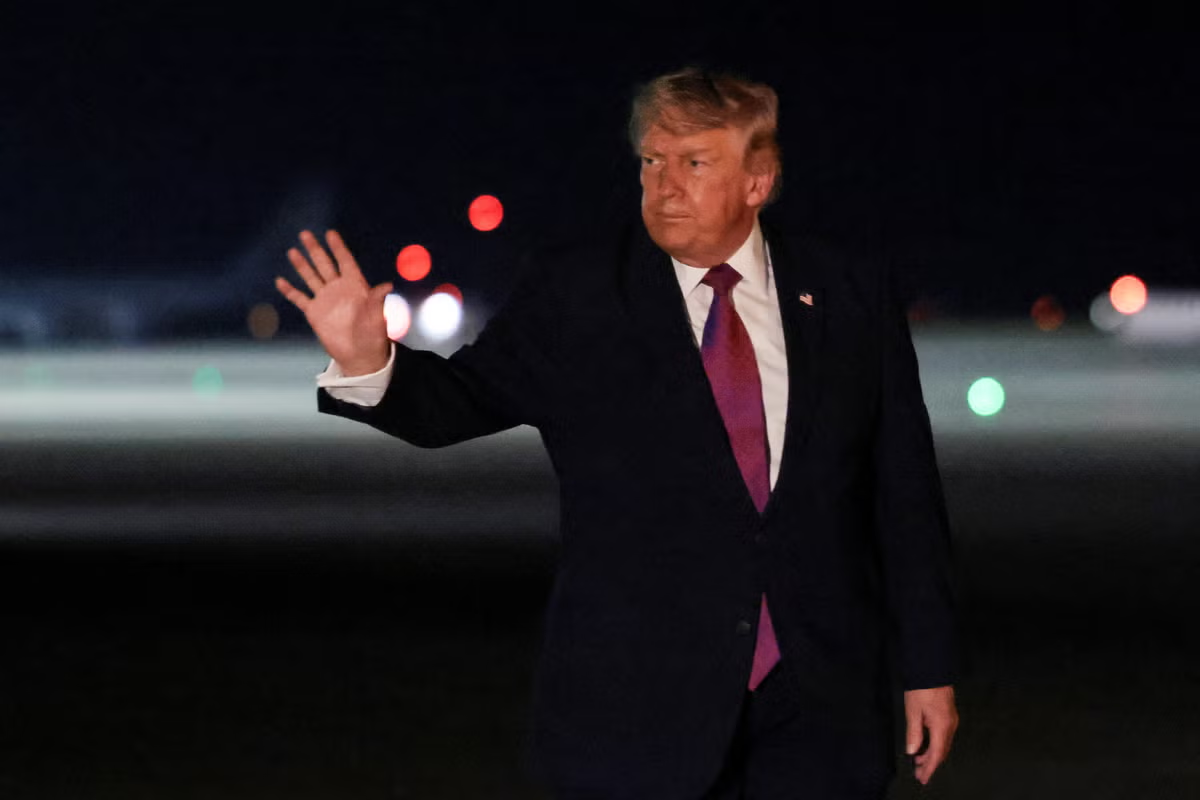
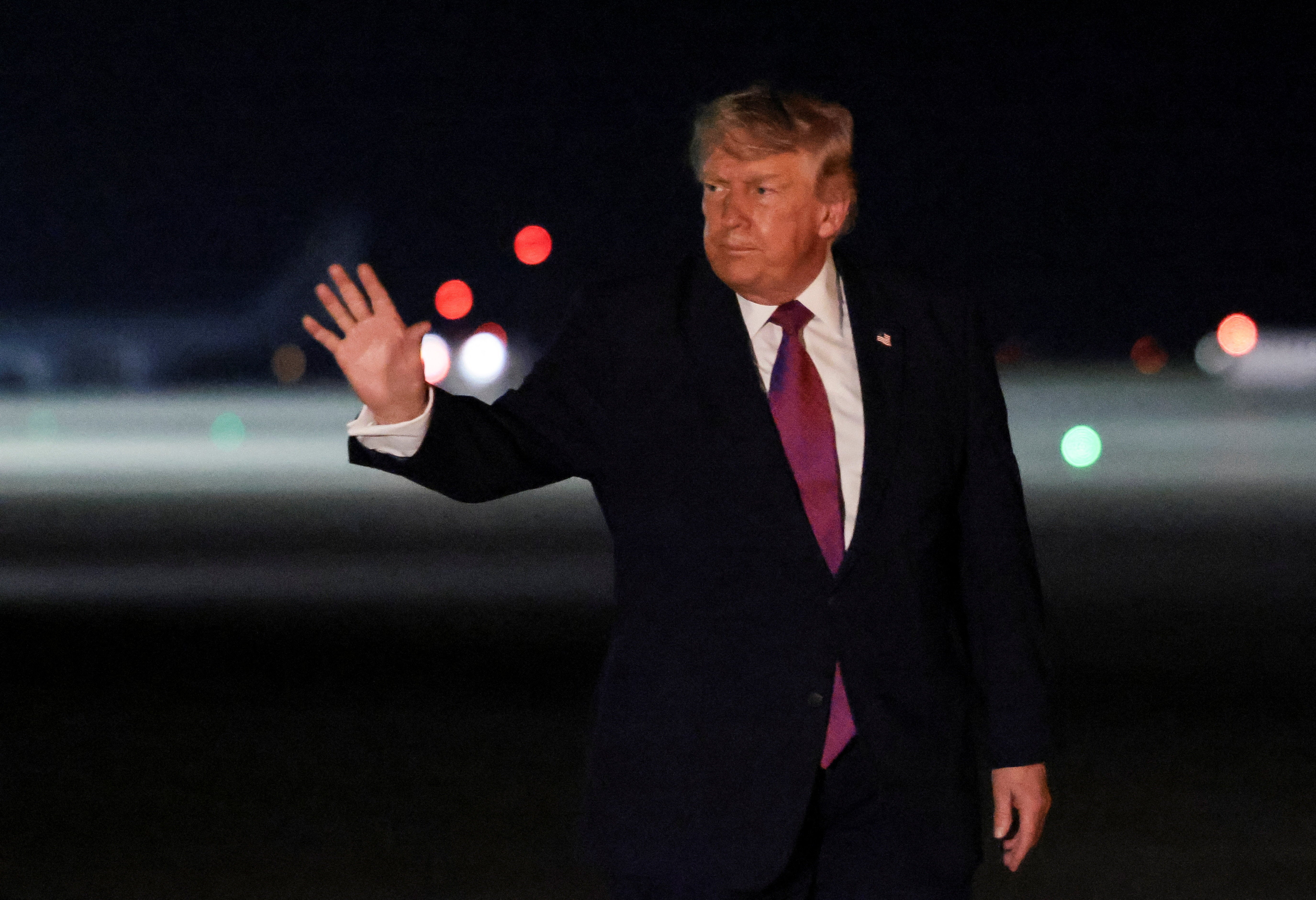
U.S. President Donald Trump waves ahead of boarding Air Force One, en route to Joint Base Andrews, at Ellsworth Air Force Base in Belle Fourche-Cheyenne Valleys, South Dakota, U.S., July 3, 2026. REUTERS/Kylie Cooper (Reuters)
“I’d have had difficulty with Trump because my irritation level is very, very low.
“And Andy’s isn’t, which is a real plus. So he’ll keep his temper, and if he doesn’t actually bite his tongue, he’ll discipline it, so it’ll be okay.”
Advertisement
For exclusive analysis on how Britain can rebuild its relationship with Europe, sign up for our weekly Europe: The Way Back newsletter here
When it comes to European leaders, however, they would be “quickly reassured by Andy” after Sir Keir Starmer built “real trust and admiration” across the bloc, he said.
Lord Kinnock, who was speaking to The Independent as part of its Europe: The Way Back campaign, which is calling for the UK to rebuild its relationship with Europe, said Mr Burnham’s passion for devolution, which he talked of in his first major policy speech on Monday, means that “quite a lot of what he’s proposing is conventional politics in much of the rest of Europe… they know what Andy is talking about when he’s talking about devolved empowerment”.
“I think it’ll be a relatively short bridge from trusting Keir to having trust in Andy,” he said.
Advertisement
Lord Kinnock also dismissed criticism from Sir John Major, in this publication last week, who suggested it was a leap to go from being in charge of buses in Manchester to mastering international relations.
Lord Kinnock said it was a “candid appraisal” and “the man on the whole planet who knows that best is called Andy Burnham”.
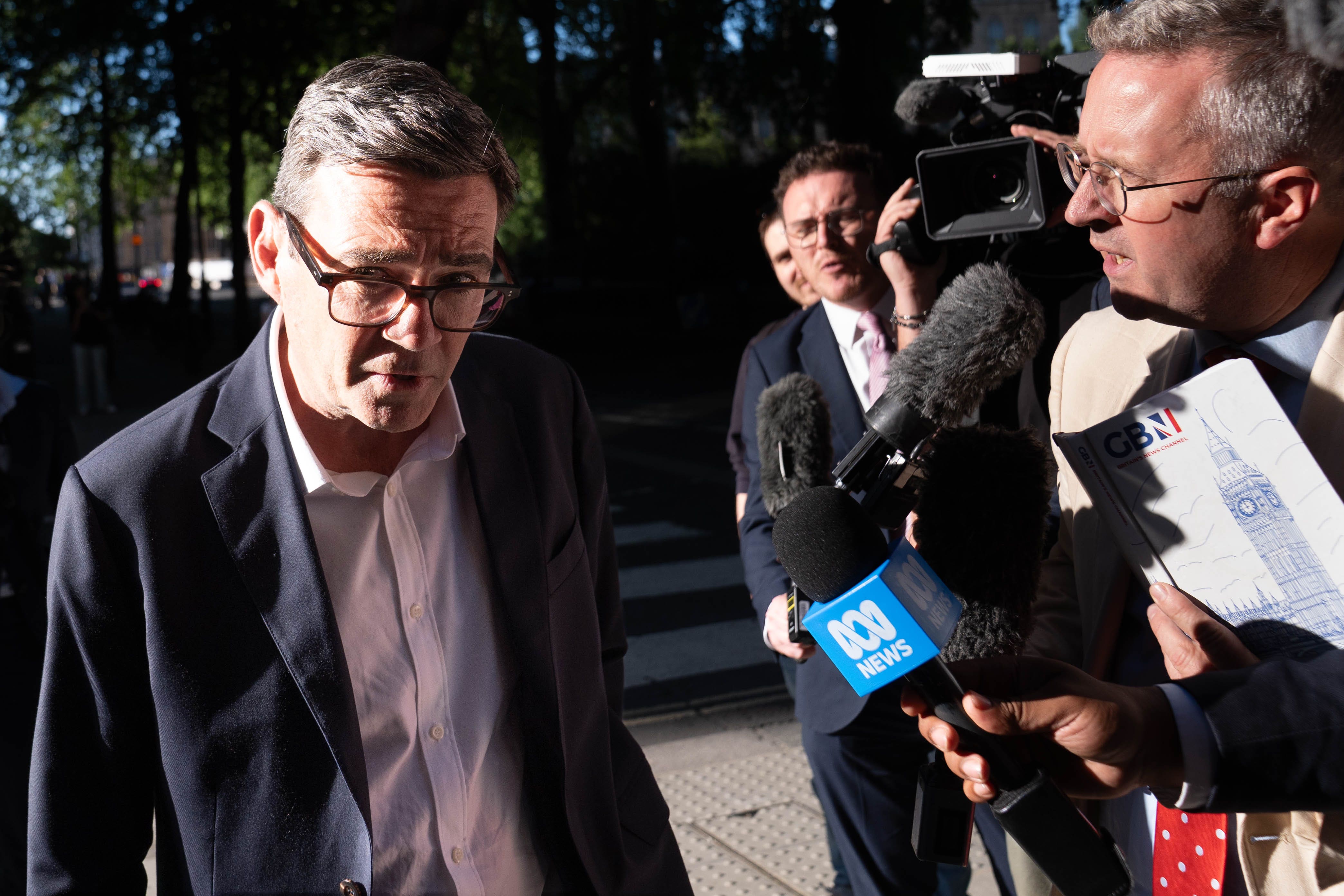
Andy Burnham arriving ahead of an appearance on the Tonight with Andrew Marr show on LBC radio, from the Global studios at Millbank, central London (Stefan Rousseau/PA) (PA Wire)
“He mustn’t be daunted by it, because of course John Major would be the first to recognise that there are some common requirements.”
These included a strong sense of purpose, confidence, the ability to persuade people to work together, to stop them being ideological or dogmatic and to negotiate, he said.
“Both in terms of the clarity of his direction and purpose, which is invaluable – and the fact that he’s a normal guy who can get on with just about anybody –Andy will be fine,” he said.
Advertisement
Lord Kinnock also criticised the government’s decision to fund higher defence spending through cuts to development aid, one of the key passions of Glenys, arguing the policy risked being self-defeating.
He warned that, in conflict situations such as the Democratic Republic of Congo, aid could mean the difference between a young person going to university or getting embroiled in a life of violence.
He said a “reordering of priorities is very much needed, and Glenys would have been arguing for that, ferociously.”
“I don’t think there’s anybody in the (Labour) movement who thinks that she wouldn’t have been disappointed, but she was never silently disappointed. Glenys could be lethally disappointed,” he said.
Advertisement
“She never stopped campaigning.”
He recalled one of her key slogans, which guided her politics: “It’s the duty of those with freedom to expand the liberty of others”.
A dedicated community: We are fully committed to the long haul, consistently campaigning to secure the absolute best deal for Britain within Europe.
Free weekly newsletter: Every Wednesday, political editor David Maddox and political correspondent Millie Cooke will be in your inbox with exclusive reporting, analysis and insight on the biggest developments shaping relations between Britain and Europe. Each week, they will explain what’s happened, what it means, and what the key political figures, experts and decision-makers are saying about it.
Essential continental updates: Stay informed with regular briefings on the biggest developments in European politics and the specific policies that could pave the way for closer EU relations.
Exclusive content: Get the highest quality analysis, opinion and debate from political experts across the UK and Europe by subscribing to our premium service.
The Brexit Effect: You’ll get exclusive access to extracts from Anthony Seldon’s major new book, The Brexit Effect, offering an unparalleled analysis of the 10 years since the referendum.
Inform the debate: Receive exclusive invitations to live events, webinars, expert Q&As and podcast recordings.
Saudi Crown Prince Mohammed bin Salman has reportedly expressed concern to President Donald Trump over his plans to hit Iran with further airstrikes.
The leader of Saudi Arabia called the president on Saturday to voice his concerns and urge Trump not to carry out the strikes, two US officials and a third source told Axios.
One source told the outlet that Prince Salman urged Trump to deescalate the situation and to not launch further strikes.
A US official added: ‘The Saudis expressed concern and asked for clarity about the plan of action.’
Advertisement
The White House on Friday signaled that Trump is weighing carrying out new strikes on Iran as the US presses for Tehran to reopen the Strait of Hormuz.
They are also calling on the nation to abide by terms set out in a truce agreement the two sides forged last month which quickly collapsed.
The President was bombastic at a televised meeting with his Cabinet at Camp David in which he vowed to hit the nation.
‘We will be hitting them very hard and you know at some point, they’re going to say, ‘We just can’t take it anymore.’
Advertisement
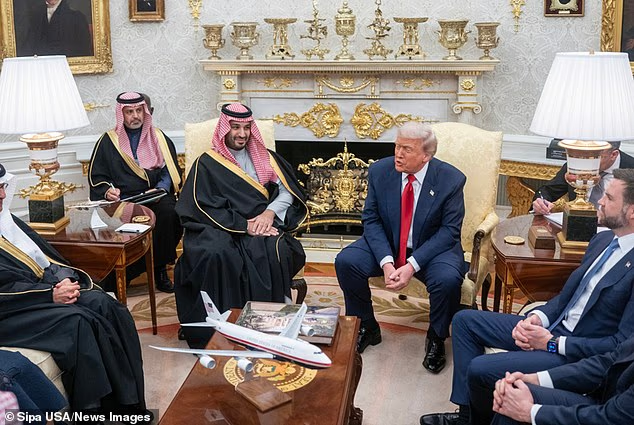
Trump is seen here with Crown Prince and Prime Minister of the Kingdom of Saudi Arabia Mohammed bin Salmanin the Oval Office on November 18, 2025
Smoke is seen here rising following multiple US strikes hit the city of Ahvaz in the Khuzestan Province in Iran on Thursday
White House press secretary Karoline Leavitt expressed the US administration’s frustration anew, charging that Tehran last month signed a memorandum of understanding with the U.S. on a truce but then quickly ‘broke it, shot at commercial ships, and killed American soldiers.’
Advertisement
‘President Trump is not going to stand by and allow this terrorist behavior to occur,’ Leavitt said in a statement on Friday evening.
‘Iran will continue to pay until they come to the table in, what President Trump deems, a meaningful way.’
Leavitt issued the fresh warning after Trump earlier on Friday told reporters that “we just want to win” in Iran and signaled that he expected US military action to continue for some time.
The Wall Street Journal claimed Trump has already given his approval for strikes that could begin this weekend and last a few days, citing several officials.
Advertisement
Axios, on the other hand, reported that Trump ‘hasn’t given final orders to do it.’
A report from CBS News emerged on Friday which cited sources as saying that the US and Israel are preparing ‘one of the harshest bombing campaigns to date’ against Iran’s energy infrastructure.
While the president has not yet given the final green light, several insiders told the outlet that strikes could begin as soon as this weekend, with Israel already notified and coordinating with Washington.
‘The Department of War is locked and loaded, ready to execute the President’s directives at a moment’s notice,’ Chief Pentagon spokesperson Sean Parnell said in a statement, though refused to comment on intended targets.
Advertisement
One source told Axios that Prince Salman urged Trump to deescalate the situation and to not launch further strikes, the pair are seen here last November
Smoke rises following explosion at an unknown location, during what U.S. Central Command (CENTCOM) says are strikes on Iran
Both Iran and the United States plotted out new strikes after several days of back and fourth between the two nations
Meanwhile, an Israeli official told the outlet: ‘Israel is unaware of any decision to restart full military operations, nor has Israel been asked to join any military action against Iran.’
Advertisement
A former US military official told CBS News that striking Iran’s energy infrastructure would aim to cripple the regime’s ability to support its military, provide services and maintain control.
A joint operation would see Israel return to the battlefield after pausing its attacks under the US-brokered truce. Iran has not struck Israel since the agreement fell apart and Washington restarted combat operations in early July.
A senior Iranian security official vowed Tehran has ‘the capacity and the will’ to retaliate against any US and Israeli strikes, claiming ‘extensive response plans’ are already prepared.
The unnamed official told Iran’s semi-official Tasnim News Agency that potential US-Israeli attacks would amount to a ‘form of recklessness’ on their part.
Advertisement
The Iranian official claimed the ‘comprehensive’ plan includes strikes on ‘the vital infrastructure of the Zionist regime and US energy infrastructure in the region.’
A joint operation would see Israel return to the battlefield after pausing its attacks under the US-brokered truce. Israeli soldiers are seen here in the Israeli-occupied West Bank
Trump’s comments come as the US demands Tehran reopen the Strait of Hormuz and honor a truce agreement that was forged last month but quickly fell apart
‘We are fully prepared to carry it out,’ the official added.
Advertisement
Many believe that regardless of what Trump does, they want the operation complete by the time Wall Street opens for business on Monday to avoid any economic damage.
Iran fired drones at Kuwait, a Gulf country hosting US forces, and said it had also fired at oil tankers in the Strait of Hormuz, a key waterway for global oil and gas shipments, which has been largely closed by the fighting.
Kuwait’s Defense Ministry said Friday its armed forces had shot down drones inside Kuwaiti airspace.
It said the Iranian attacks had targeted several vital military facilities, causing material damage from falling shrapnel but no casualties. It did not specify how many drones were intercepted.
The warning covers 10 countries: the United Arab Emirates (UAE), Qatar, Oman, Iraq, Jordan, Israel, Kuwait, Saudi Arabia, Bahrain and, most recently, Egypt.
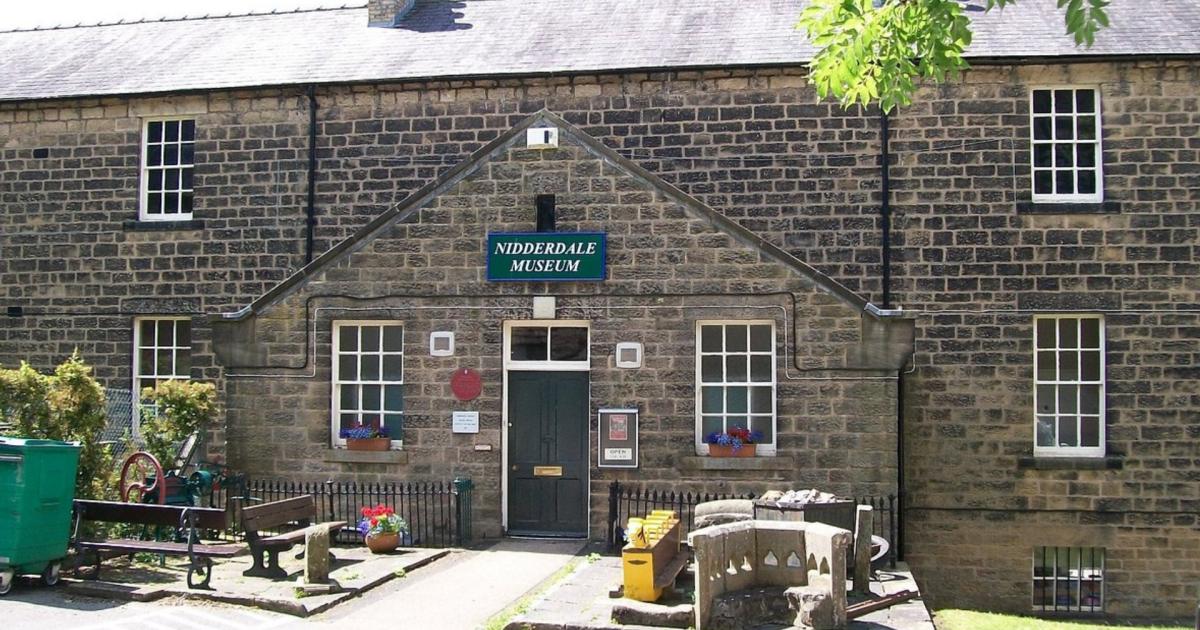
Nidderdale Museum, in Pateley Bridge, tells the story of life across the dale through thousands of objects, recreated rooms, and displays covering farming, industry, schools, shops, and family life.
The museum was founded in 1975 by a group of enthusiasts who feared that traditional ways of life were disappearing in the years after the Second World War.
The founders began collecting objects and memories before they were lost, creating a museum dedicated to preserving the history of Nidderdale and the people who lived there.
It is housed in The Old Workhouse on King Street, a building originally constructed in 1863 as the Pateley Bridge Union Workhouse.
Today, the rooms once used by the workhouse contain displays recreating everyday life in the dale.
Advertisement
The museum has more than 30,000 items in its collection, with exhibits arranged across 13 spaces and 15 life-sized displays.
Visitors can explore a traditional schoolroom, parlour, kitchen, cobbler’s shop, and war room, along with sections on farming, mining, geology, religion, costume, local industries, and archaeology.
The size of the museum regularly surprises people who step inside.
One recent visitor on TripAdvisor described it as an “unexpected delight”, saying it was “much bigger than it looks from the outside” and packed with objects and information.
Advertisement
Another visitor, who had passed through Pateley Bridge several times without knowing the museum existed, called it a “hidden gem”.
Others have described the museum as an “Aladdin’s Cave” and an “extraordinary museum”, while one reviewer said it was among the most comprehensive local museums they had visited.
Nidderdale Museum, in Pateley Bridge (Image: TRIPADVISOR)
The museum is also unusual because it is entirely run and staffed by volunteers.
Visitors frequently praise the volunteers for being welcoming, knowledgeable, and willing to explain the history behind the displays.
Advertisement
One reviewer said the staff were “ever so friendly and obliging”, while another praised them for being “helpful and kind”.
That volunteer effort was formally recognised in 2017, when the museum received the Queen’s Award for Voluntary Service.
The Nidderdale Museum Society has around 150 members and is overseen by an elected board of trustees.
In April 2022, it became a Charitable Incorporated Organisation.
Advertisement
Despite its large collection and historic setting, visitors regularly highlight its affordability.
Recent reviews describe the £5 adult admission charge as “worth every penny”, “amazing value”, and good value for the amount there is to see.
Children can enter free of charge.
The museum is currently rated 4.8 out of five on TripAdvisor and is listed among the leading attractions in Pateley Bridge.
Advertisement
The recreated rooms give people the chance to picture how residents of Nidderdale lived, worked, and learned in previous generations.
One visitor summed it up by saying: “This is how museums should be.”
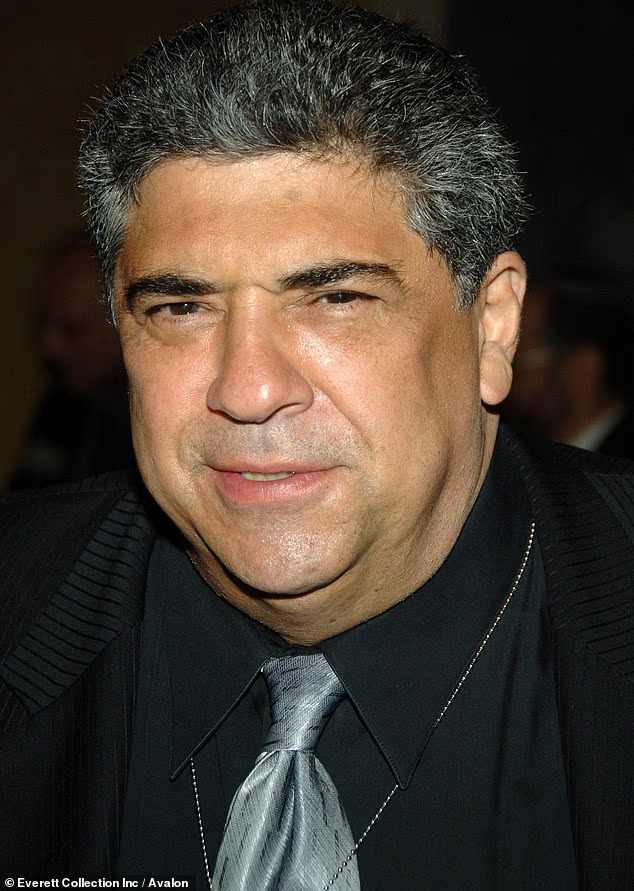
Vincent Pastore, best known for his iconic portrayal of mobster Salvatore ‘Big Pu**y’ Bonpensiero on HBO‘s The Sopranos, has died at age 80.
He had not been heard from for three days before a neighbor discovered his body at his home in the Bronx. An investigation is underway, according to Deadline.
Pastore was beloved by fans of The Sopranos for his nuanced performance as Pu**y, who is ultimately exposed as an FBI informant and shot.
Born in 1946 to an Italian family in the Bronx, he was often cast in mafia roles, including a bit part in GoodFellas and a larger role in the 1996 HBO film Gotti.
Advertisement
His television career included frequent guest shots on Law & Order, as well as reality shows ranging from Celebrity Apprentice to Dancing with the Stars.
In his later years, he ran a theater company that produced multiple plays a year and reunited him with a number of The Sopranos alumni, including Anthony Ribustello, who featured as the chauffer of James Gandolfini’s lead character Tony Soprano.
The Daily Mail has contacted the New York City Police Department and the New York City Office of the Chief Medical Examiner for comment.
Advertisement
Actor Vincent Pastore, best known for his iconic portrayal of mobster Salvatore ‘Big Pu**y’ Bonpensiero on HBO’s The Sopranos, has died at age 80; pictured 2006
Pastore is pictured (right) with (from left) Tony Sirico, Steven Van Zandt, James Gandolfini and Michael Imperioli in a publicity still for The Sopranos
Pastore was born in the Bronx in 1946 but raised upstate in an Italian neighborhood of New Rochelle, living with his family above the local Foresters club.
‘I can still smell the pizza!’ he fondly remarked a few years ago to Edge magazine. ‘Roller skating every Friday night at the Boys Club. Great memories.’
Advertisement
Although he came across ‘bookies and loan sharks’ as a child and acknowledged that many fans ‘think I grew up with’ the ‘kinds’ of insalubrious characters he later played, he insisted he ‘grew up in a pure Italian-American home. Tradition.’
After serving in the US Navy in the Vietnam War, he began opening bars and clubs, including the 1980s New Rochelle nightspot the Crazy Horse.
However he had long nurtured dreams of acting, having obtained a drama degree at Pace University, and in the late 1980s he began pursuing them.
A stroke of luck arrived when he was working as a New York City limousine driver and thus became acquainted with Kevin Dillon and his brother Matt Dillon.
Advertisement
‘I told them about my dreams of becoming an actor. They ended up seeing me at this community theater I was doing, and Kevin helped me out. He gave me the direction I needed to finally act,’ Pastore remembered.
After jobbing around with small roles in mob movies like GoodFellas and Carlito’s Way, Pastore landed a major supporting role in the 1995 crime comedy The Jerky Boys: The Movie as the sidekick of a mob boss played by Alan Arkin.
Pastore was beloved by fans of The Sopranos for his nuanced performance as ‘Big Pu**y,’ who is ultimately revealed to be an FBI informant and shot
By the next year, he had earned his breakthrough part on HBO as the real-life Gambino family capo Angelo ‘Quack Quack’ Ruggiero in Gotti, with Armand Assante in the title role in a cast that also featured Anthony Quinn.
Advertisement
Pastore’s co-stars in that TV film included Tony Sirico, Dominic Chianese and Frank Vincent, all of whom went on to become colleagues of his on The Sopranos.
He later described Gotti as a ‘turning point’ in his career that led to his being recognized in the street and later cast on The Sopranos, via Cryptic Rock.
Big Pu**y was one of Tony Soprano’s best friends, a prized member of the mob boss’s inner circle including Paulie Walnuts (Tony Sirico), Christopher Moltisanti (Michael Imperioli) and Silvio Dante (Steve Van Zandt).
One of the key plot threads of the first two seasons is Pu**y’s unsuccessful attempt to conceal the fact he has become a mole for the FBI informant.
Advertisement
Pastore drew praise for his portrayal of a ‘rat’ who is wracked with guilt until his betrayal is discovered and he is shot dead by Tony, Silvio and Paulie.
Several years later, Pastore revealed one of his iconic scenes – when Tony furiously searches Pu**y for a wire – was born of an improvisation by Gandolfini.
‘We were scripted on Sopranos, but you don’t know the moment he’s going to come in whether he’s going to be mad at you,’ said Pastore.
Pastore has said portraying his character’s ‘mental turmoil’ over his activities as an FBI informant ‘stayed with me as an actor, over five days a week of taping’
Advertisement
‘In the scene when he was frisking me down in the basement of the house in Episode One, Season Two, he’s really frisking me. I didn’t know he was going to do that.’
Pastore took a dim view of the unflattering remarks that Gandolfini’s colleagues made about him after his death of a heart attack aged 51 in 2013.
In the 2024 documentary Wise Guy: David Chase and the Sopranos, Gandolfini was accused of having had a fiery temperament and drinking so heavily that the head of HBO tried to persuade him to go to rehab, only for him to retort: ‘Fire me!’
His commitment to method acting was said to have been so intense he would stay awake for days on end and get himself ‘angry’ by keeping rocks in his shoes.
Advertisement
The Sopranos creator David Chase alleged that Gandolfini ‘had to go places that were destructive to him, and painful for him’ for the role.
Pastore, on the other hand, said: ‘People talk bad about Jimmy. I saw it in that documentary. I didn’t dig it, man. Jimmy was tired. He was carrying the weight for seven years. Without Jimmy, there would have been no Sopranos. I’m sorry.’
In another interview, Pastore remarked that portraying his own character’s ‘mental turmoil’ over his activities as an FBI informant ‘stayed with me as an actor, over five days a week of taping. It was rather tough.’
He explained: ‘I saw Big Pussy as a man with a big heart, and that was my choice of how I played that role. In that scene where he is crying in the bathroom at Anthony Jr.’s confirmation, you knew it was not just because he was a rat – he was betraying his friends, which was even harder to deal with.’
Advertisement
Pastore is pictured with his The Sopranos co-stars Jamie-Lynn Sigler (left) and Drea de Matteo (right) at the MTV Video Music Awards in 2019
After The Sopranos, Pastore featured on a string of reality shows including Dancing with the Stars, Celebrity Family Feud, Celebrity Apprentice and Shark Tank, and his attempts at weight loss were documented on Celebrity Fit Club.
On scripted TV, he guested on such programs as General Hospital, Mad TV, Blue Bloods, Hawaii Five-0 and, as recently as last year, Yellowjackets.
Pastore held a voice role in the hit animated movie Shark Tale, starring Will Smith and Renee Zellweger, and also acted in the 1999 Hugh Grant comedy Mickey Blue Eyes.
Advertisement
He also enjoyed a long stage career, which has Broadway has included being one of the actors to play the dopey Amos Hart in the still-running 1990s revival of Chicago.
Pastore was also cast alongside Zach Braff in the original Broadway cast of the 2014 musical adaptation of Woody Allen’s 1994 comedy Bullets over Broadway.
While working on Bullets over Broadway, he was diagnosed with prostate cancer and earned plaudits for his show-must-go-on work ethic by refusing to miss any rehearsals or performances while undergoing his ultimately successful treatment.
He later began his own small theater company, through which he was able to work with a fleet of The Sopranos alumni including Maureen Van Zandt, Nicholas Giangiulio, Joe Lisi, Garry Pastore, Tony Rossi, Anthony Ribustello and Janet Sarno.
Advertisement
‘I try to produce three plays a year. It really enables people to see the actors work,’ Pastore remarked four years into the venture. ‘I don’t make a lot of money because I own the theater company, but we’ve had a pretty good run.’
Former castmates mourned the loss of Pastore, with Edie Falco telling Page Six in a statement that his death was both an ‘awful loss’ and ‘unexpected’; Falco seen in 2024 in NYC
Michael Imperioli shared a throwback photo to Instagram as both he and Pastore paused for a photo together; seen in 2004 in NYC
Pastore is survived by his 55-year-old daughter daughter Renee, whom he shared with his amicable ex-wife Nancy Berke.
Advertisement
Former castmates mourned the loss of Pastore, with Edie Falco telling Page Six in a statement that his death was both an ‘awful loss’ and ‘unexpected.’
The star, who had portrayed the character of Carmela Soprano on the hit series, continued, ‘Vinnie was always so full of life.’
Michael Imperioli shared a throwback photo to Instagram as both he and Pastore paused for a photo together.
The actor, who played Christopher Moltisanti on the series, wrote: ‘Our beloved friend and collaborator VINCENT PASTORE has passed away.
Advertisement
‘This is a hard one for us, it seems like I’ve known Vinny forever. We did lots of work together and traveled all of the USA as well as Italy and Australia. Lots of good times.’
He concluded, ‘Lots of laughs. Vinny was a kind hearted brother who cared deeply about his family and friends. I will miss him always.’
‘This is a hard one for us, it seems like I’ve known Vinny forever. We did lots of work together and traveled all of the USA as well as Italy and Australia. Lots of good times,’ he wrote
Lorraine Bracco, who had portrayed Jennifer Melfi, uploaded a black and white photo of the late actor to her Instagram stories on Saturday
Advertisement
Dominic Chianese had played Corrado ‘Junior’ Soprano on the series and also took to his Instagram account to pay tribute; seen in 1999 in NYC
‘We lost a friend today. Paying respect and sending Love in tribute. You were a gem Vinnie,’ the actor wrote
Lorraine Bracco, who had portrayed Jennifer Melfi, uploaded a black and white photo of the late actor to her Instagram stories on Saturday.
‘Such a funny & charming man…just a beautiful soul. Absolutely heartbreaking,’ the actress penned.
Advertisement
Dominic Chianese had played Corrado ‘Junior’ Soprano on the series and also took to his Instagram account to pay tribute.
‘We lost a friend today. Paying respect and sending Love in tribute. You were a gem Vinnie,’ the actor wrote.
Robert Attermann, who had been Pastore’s manager for over 30 years, also shared an emotional statement to Page Six.
He said that Pastore had been ‘so much more’ than his character on The Sopranos.
Advertisement
Robert Attermann, who had been Pastore’s manager for over 30 years, also shared an emotional statement to Page Six; Pastore seen in 2005 in NYC
The late star had been ‘one of the kindest, most generous people [he’d] ever known’ who also ‘treated everyone with warmth and respect, never turning down a fan who wanted a photograph or an autograph.’
Pastore was passionate about his acting career and would ‘offer guidance and support’ to other young actors.
Attermann added that the star will be remembered for his ‘remarkable career but also the incredible person he was.’
Advertisement
Pastore ‘leaves behind a legacy that extends far beyond his memorable performances,’ his longtime manager continued, before noting that the actor will be ‘never forgotten.’
WWE Summerslam 2026 continues tonight, hot on the heels of a spectacular night of wrestling.
The first of a two-night extravaganza kicked off with Liv Morgan successfully defending her WWE women’s world championship against Iyo Sky and ended with Oba Femi slaying ‘the beast’ Brock Lesnar in a ‘Hell in a Cell’ match for the ages.
In between, Randy Orton made a shocking return to cost Cody Rhodes in his undisputed WWE championship match with CM Punk, while The Bella Twins (Brie and Nikki Bella) attacked Paige after their loss to Fatal Influence.
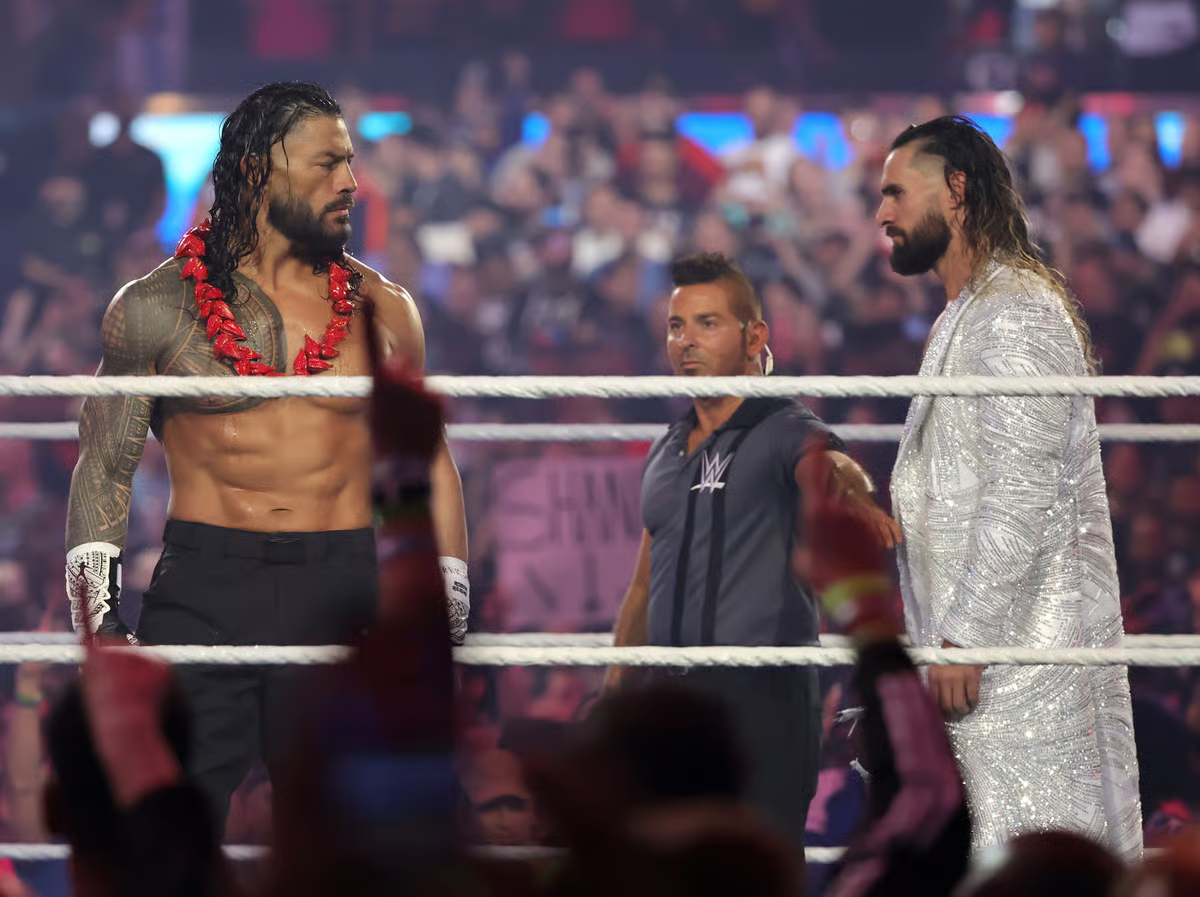
Now attentions turn to the second night as Roman Reigns puts the world heavyweight championship on the line against former ‘Shield’ stablemate Seth Rollins in a match that is 12 years in the making.
Advertisement
Over on SmackDown, with Rhea Ripley sidelined due to injury, an interim WWE women’s champion will be crowned in a five-way ladder match involving Charlotte Flair, Lash Legend, Tiffany Stratton, Chelsea Green and Jade Cargill.
Baron Corbin, making his first WWE PLE appearance since returning to the company, takes on Trick Williams for the United States title, and Intercontinental champion Penta defends against Chad Gable.
Elsewhere on the undercard, Danhausen battles Dominik Mysterio and Sami Zayn faces Finn Balor to determine the number one contender for CM Punk’s undisputed WWE championship.
Date, start time and venue
Advertisement
In the UK, WWE Summerslam 2026 is scheduled to start at 11pm BST tonight, Sunday, August 2. The Premium Live Event will take place at the U.S. Bank Stadium in Minneapolis, Minnesota.
Where to watch WWE Summerslam 2026
Live stream: In the UK, WWE Summerslam 2026 can be watched and streamed live on Netflix. A standard subscription costs £5.99 per month and it can be cancelled at any time.
WWE Summerslam 2026 night two match card
Advertisement
Danhausen vs. Dominik Mysterio
No1 contender match for undisputed WWE championship: Sami Zayn vs. Finn Balor
WWE United States championship: Trick Williams (c) vs. Baron Corbin
WWE Intercontinental championship: Penta (c) vs. Chad Gable
Advertisement
WWE interim women’s championship (five-way ladder match): Jade Cargill vs. Tiffany Stratton vs. Chelsea Green vs. Charlotte Flair vs. Lash Legend
World heavyweight championship: Roman Reigns (c) vs. Seth Rollins
*Card is subject to change.
WWE Summerslam 2026 night one results
Advertisement
WWE women’s world championship: Liv Morgan (c) def. Iyo Sky
LA Knight, Solo Sikoa and Royce Keys def. The Bloodline
Fatal Influence def. The Bella Twins and Paige
Undisputed WWE championship: CM Punk (c) def. Cody Rhodes
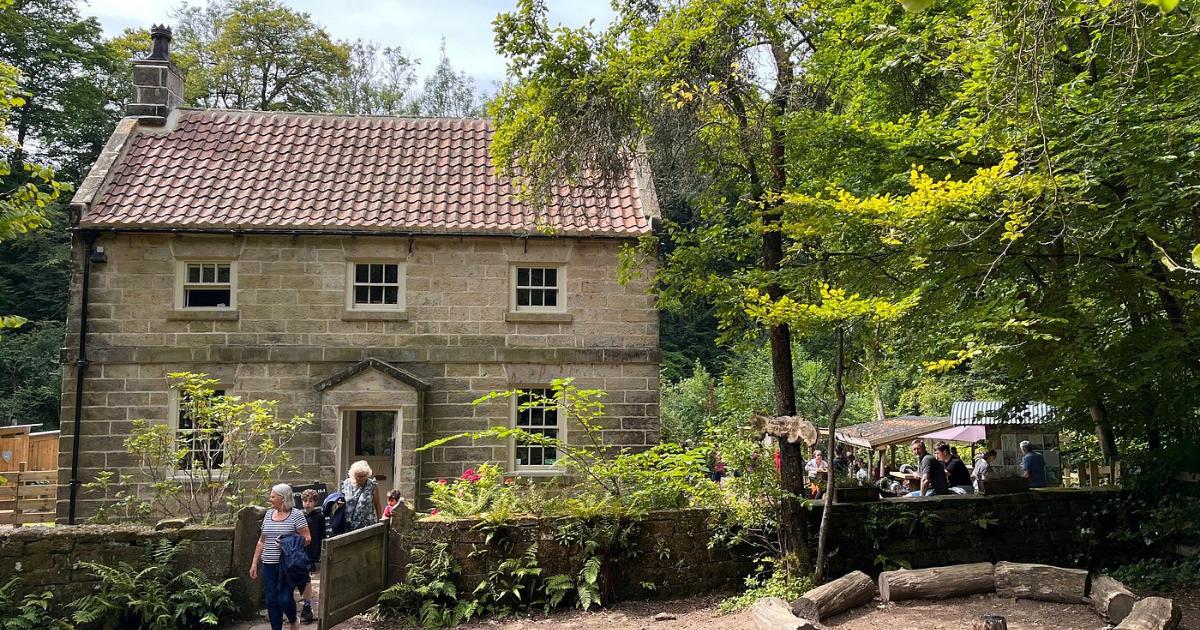
“Think picnic tables and wellington boots rather than fine china and linen table cloths.
“Our offering is simple, scones baked freshly on site daily served with lashings of jam & cream, delicious cakes, barista coffees, speciality teas and locally made dairy ice cream.”
There is plenty of outdoor seating to soak up the sun while enjoying an iced coffee, warming tea, or indulgent hot chocolate.
The tea garden serves a range of sandwiches that you can have with crisps while listening to the sounds of nature around you.
Advertisement
If you need a bit of a sugar boost for the rest of your walk, you can pick up one of the many home-baked goods the café offers, from cakes to rocky road slices.
The homemade scones are described as being “to die for” and are served with jam and fresh cream.
What do visitors of the Falling Foss Tea Garden say?
Many visitors have stopped off at the tea garden during their visit to the Falling Foss waterfall and call it a “beautiful” spot with reasonably priced food.
One reviewer on Tripadvisor said: “Had a lovely couple of hours at Falling Foss.
Advertisement
“It is peaceful and the waterfall is beautiful.
“The tea garden does amazing food, and the scone was to die for.
“The staff are all lovely and helpful and would recommend a visit if you’re thinking of visiting.
“You have 48 hours to pay for the car park too if you can’t get signal when you leave like we couldn’t so don’t panic.”
Advertisement
Would you visit the Falling Foss Tea Garden? Let us know in the comments.
Ravi Ghelani, a finance expert at consumer group Which?, has outlined six key checks to make sure policies still offer adequate cover, especially for those taking out annual policies.
Annual cover can save money for those who travel frequently throughout the year, but changes in health, destination, or planned activities could affect whether the policy still meets a traveller’s needs.
Depending on where you are going on holiday and how often, it might be cheaper to buy other travel insurance. (Image: Getty)
How to check if annual travel insurance is worth it
Mr Ghelani said: “A single-trip policy may work out cheaper if you do not expect to travel again.
“But do not rule out annual cover too quickly – if you are taking one big trip, check how much more an annual policy would cost.
Advertisement
“The difference may be smaller than you expect, and if you travel again later in the year, annual cover could work out better value.”
Which? reviewed 138 travel insurance policies, considering factors such as cancellation limits, baggage cover, and requirements for medical disclosure, to assess whether annual policies deliver value across multiple trips.
Changes to your health
According to Mr Ghelani, 90 per cent of annual policies reviewed required policyholders to declare any new medical information before travelling.
Advertisement
The Government website Money Helper explains that insurers may define pre-existing medical conditions differently, but they typically include conditions awaiting surgery or test results, any health issue discussed with a doctor in the past year, or serious conditions such as cancer or heart problems.
Cancellation limit
A Government website lists cancellation cover as essential, recommending at least £2,000 in protection.
However, policyholders should review the terms carefully as not all policies cover every scenario leading to cancellation.
Advertisement
Coverage for baggage and belongings
Baggage cover also varies by policy, and Mr Ghelani advises travellers to pay close attention to individual limits.
He said: “Also look out for any separate single-item, valuables or gadget limits, as these may be lower than the overall baggage limit.”
The government recommends that a good policy should offer at least £1,500 in baggage cover.
Advertisement
Activities
Adventure travellers should also check what activities are included.
All 138 annual policies reviewed by Which? covered hiking as standard, but not at the same altitude.
Mr Ghelani explained: “Altitude limits varied from 1,000 metres to 5,000 metres, with a median limit of 3,000 metres.
Advertisement
“Some providers may offer higher altitude limits as an optional extra.
“So, before you strap on your walking boots, check whether your route falls within the limit of your policy.
“For example, Mount Toubkal in Morocco reaches 4,167 metres, which would exceed the standard hiking limit in many of the policies we analysed.”
Winter sports are another area to consider.
Advertisement
The Government website recommends winter sports cover as a valuable add-on for activities such as skiing and snowboarding.
Money Helper advises that a good policy should cover personal or hired winter sports equipment and include benefits such as cover for lost ski packs or slope closures.
Where you are travelling
Travellers should confirm which countries are included in their annual policy, especially when travelling outside of Europe.
Advertisement
Some insurance companies categorise global regions differently, and not all destinations may be covered under standard “worldwide” policies.
Additionally, there may be no cover for travel to countries where the Foreign, Commonwealth and Development Office advises against all or all but essential travel.
How many holidays you are going on
For those who only plan one trip, single-trip cover may be more cost-effective.
Advertisement
Citizens Advice said that for travellers planning multiple holidays in a year, an annual policy could still offer better value than several single-trip policies.
Do you buy annual travel insurance? Let us know in the comments.
Defence chiefs have been accused of showing ‘shocking disregard’ for Britain’s war dead after destroying almost 800 First and Second World War gravestones of Commonwealth soldiers killed in the Iraqi desert.
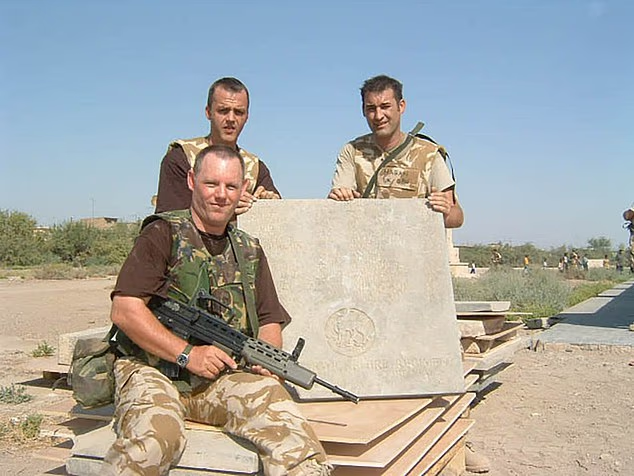
The British Army removed dozens of gravestones and panels engraved with the names of the fallen from the Basra War Cemetery in southern Iraq in 2003 amid fears that they could be destroyed or vandalised by locals.
As well as hundreds of gravestones, 80 large, 2 in-thick slate panels bearing the regimental crests of Army units and the names of the war dead were also removed.
Advertisement
The remains of the soldiers –who died in the First and Second World Wars – stayed buried but unmarked.
Within 18 months, almost all of the gravestones and panels had been deliberately pulverised into gravel and used to fill a drainage ditch at another military base in southern Iraq.
The work was overseen by 64 Works Group, Royal Engineers and appears to have gone ahead after the assent of a padre.
Ben Soppitt, whose grandfather, Gunner Joseph Soppitt, was buried in Basra War Cemetery, claims the Commonwealth War Graves Commission (CWGC) and the Ministry of Defence tried to hide the truth about the demolition from the public.
Advertisement
British Army Personnel with removed panels and gravestones, Basra 2003
Ben Soppitt’s grandfather, Gunner Joseph Soppitt, is among those buried at Basra War Cemetery
Details of the destruction of the gravestones only emerged recently after the publication of Freedom of Information (FoI)responses by Mr Soppitt, 55, who lives near San Francisco.
Advertisement
The MoD had to respond to his requests because the Information Commissioner stepped in to order their release.
The FoI disclosures reveal that the gravestones were crushed into gravel and used to build a drain inside the British Army’s Shaibah Logistics Base, nine miles south-west of Basra, in April 2005.
The Mail’s chief reporter David Williams visited the cemetery just the week before the US-led invasion of Iraq in 2003, and found that the local militia had been using the gravestones for target practice – explaining why the army removed them, though no such action was taken at any other graveyard in Iraq.
In footage from the time showing the operation to remove the gravestones, an unnamed officer said: ‘We have collected all the gravestones together along with the tablets which have the names of all those people who died bravely during the First World War and Second World War.
Advertisement
‘We have put them all into the back of the truck. We will take them back to our camp where we will hold them for the Commonwealth War Graves Commission, which will come back in the future and restore this cemetery to its former glory.’
The FoI disclosures show a SITREP (situation report) from 64 Works Group, Royal Engineers in April 2005 records: ‘The gravestones have now been crushed and are ready to be placed in the soakaway.’
Field Marshal The Lord Richards of Herstmonceux, the former chief of the defence staff, said he had no doubt the soldiers who removed the stones thought they were doing the right thing.
The vast memorial in the deserts outside the Southern Iraq city of Basra which contains the names of thousands of British Empire soldiers who died in the First World War, which now lies in semi-ruin
Advertisement
Lord Richards, who served as Assistant Chief of the General Staff at the time the gravestones were destroyed, told The Mail on Sunday: ‘I am deeply saddened by what happened to this cemetery. With the benefit of hindsight there is of course no excuse. However, I have no doubt that in the dangerous and febrile environment of Basra at the time, the officers who took this decision thought they were doing the right thing.’
But Lord Dannatt, the former chief of the general staff, said: ‘The Chairman of the Commonwealth War Graves Commission is the Secretary of State for Defence. A decision should be taken to either re-instate all the graves, probably now impossible, or otherwise put in place a memorial with all the names of those buried in the cemetery with a suitable explanation of recent events.’
Mr Soppitt travelled to Basra last year with a new granite gravestone to mark the grave of his grandfather, who died from dysentery in 1941. A service was held, attended by the Archbishop of Basra and local residents.
Gunner Joseph Soppitt was one of more than 360 Britons who lie in the cemetery alongside comrades from India, Poland and other Commonwealth nations.
Advertisement
Mr Soppitt has made a High Court application for Judicial Review into the destruction, with the aim of holding the MoD accountable.
He said: ‘The MoD is fighting this claim, unwilling to bear the cost of ensuring the over 3,000 men and women buried there are properly commemorated with the honour they deserve and that the public expects.
‘It is a bitter irony that a member of the public, a relative of one of the casualties buried at Basra, is having to pursue the MoD through the courts simply to secure the basic dignity of commemoration that those who died in service are owed.’
In contrast, Basra Memorial, only 30km away from the cemetery, was left untouched.
Advertisement
The MoD said it is unable to comment for legal reasons.
Callous disdain for the memory of the fallen
By COLONEL RICHARD KEMP
Among the 800 men whose gravestones and memorial panels at the First and Second War World cemetery in Iraq were summarily pulverised on the orders of the Ministry of Defence, 130 were from a forerunner of my own regiment, the Royal Anglian.
So you can appreciate why I am appalled at such a callous disdain for the memory of the fallen.
Advertisement
It does not matter that some of these men died over a century ago, what matters is that they did so fighting for their country. Such patriotism and heroism should never be treated so shabbily.
The Army removed the headstones for their own safety in 2003, after British forces invaded Saddam Hussein’s Iraq.
No doubt the removal was carried out by soldiers in good faith that the stones would be replaced when the time was right.
But that faith was betrayed after 18 months, when it appears that the MoD decided the stones should be destroyed. Having fought in Iraq and Afghanistan, I can sympathise with soldiers given wrong-headed orders from London, clueless as to the reality on the ground.
Advertisement
In Kabul, we had intelligence of a planned coup d’etat on the parliament building. We understood that the thrust of the assault would be carried out by tanks. Only, when I proposed to lay anti-tank mines around the insurgents’ tank enclosure, the MoD’s response was one of horror – along the lines of ‘You do realise Afghanistan is the most land-mined country in the world?’ A few more to prevent huge political upheaval seemed a price worth paying to me, but we thwarted the coup nonetheless.
Pictured: British Army soldiers are seen out on patrol in Basra, Iraq, in April 2003
Soldiers follow orders, and those in Iraq who helped in the destruction of the headstones would have done so with a heavy heart. It must have been galling to know that a drainage ditch had been filled in a way that was so obscene to the memory of past British soldiers.
But what twists the knife is the evasiveness of the top brass. They have stonewalled the attempts of relatives of those buried there to get to the truth. Only begrudgingly revealing the sorry episode after being taken to the Information Commissioner.
Advertisement
But even public shame about their behaviour has not prompted the MoD to make right the scandal. The cemetery in Basra is still bare, the fallen still unmarked. It beggars belief that new headstones have not been erected in their place.
These are soldiers who died in the most horrific of circumstances, often under constant gunfire, in punishing heat and with little in the way of sanitary facilities, meaning that death by dysentery was grimly common.
They deserve a cemetery that befits their sacrifice.
If the MoD believes new headstones would be vandalised I urge them to visit Kabul, where locals respectfully tend to a British cemetery I visited there. To ensure the upkeep of the Basra site, surely we could expect the co-operation of the Iraqi government, which is the recipient of many billions of pounds in British economic aid?
Advertisement
Even if the cemetery is vandalised, so be it: that can be repaired. What cannot is the permanent deletion of their memory from the ground where they are buried – effectively killing them twice.
The MoD must correct its terrible mistake: failure to do so shames our country.
In this second part in our series on how the UK has changed in the past 25 years, we look at the finances of both the nation and individuals, before turning to housing and business.
The economy
Steve Schifferes, honorary research fellow, City St George’s University
For most of the 2000s the economy grew strongly, raising living standards and allowing the government to invest more in public services such as the NHS. This was the “NICE” decade, an acronym coined by former Bank of England governor Mervyn King to describe a long period of “non-inflationary, continually expanding” growth – in contrast to previous decades of “boom and bust”.
How has the UK changed since the start of the century? From Blair to Burnham, from the dotcom era to AI agents, time has certainly not stood still. In this six-part series, a team of some 35 experts look at everything from defence spending to species populations to the rise of populism to try and make sense of the intervening years.
In contrast, the period since the 2008 global financial crisis has been characterised by low growth, static real incomes and a growing government debt burden – all exacerbated by the COVID pandemic and the energy supply crisis caused by the Ukraine war.
Underlying the deterioration in Britain’s economic performance since 2008 has been a sharp fall in the rate of productivity, meaning the amount of output produced per worker. Falling productivity reduces output for the same number of workers, which brings down both GDP and real incomes.
In the first decade of the 21st century, UK productivity grew at 2% per year, with the economy expanding by 2.5%-3% annually – this was the culmination in a long period of strong productivity growth driven by everything from North Sea oil to corporate investment in IT and the internet. Since 2008 productivity on average has increased by 0.4% per year, and economic growth has fallen to an average of just 1.5% per year. If productivity had continued to grow at its pre-2008 rate, the average British household would be £18,000 better off today.
Underlying this weakening productivity has been low levels of investment in infrastructure by both the private and the public sectors. This includes both physical investment in plant and equipment, as well as transport and energy, but also investment in training.
Despite prioritising improving productivity, there is little evidence that Keir Starmer’s Labour government managed to tackle this shortfall, at least in the short term.
Debt and spending
The stronger performance of the economy before 2008 allowed the government to boost spending while limiting tax rises and keeping the public debt below 40% of GDP. This changed after the financial crisis: government debt rose to 60% as it pledged over £1 trillion to bail out the collapsing financial sector.
Debt increased further to 80% during the COVID pandemic when the government spent £400 billion to subsidise wages, and has since kept on rising to 95% of the size of the economy – £2.9 trillion. This means the government is now paying out more in debt interest than it spends on any other service except the NHS.
Both government spending and tax revenues are now at 80-year highs as a percentage of GDP, with spending making up 45% of the total economy, and taxes 40%. This has severely limited the government’s scope to improve public services and invest in future growth, or to tackle the cost of living crisis.
Economic growth has also become even more uneven. The gap in GDP per capita
between the south-east and the rest of the country has continued to grow, with London’s average income now two and half times that of the poorest region – the north-east of England. The relentless rise in house prices has driven both regional and generational inequality.
The outlook
Advertisement
Though many countries were hit by the global financial crisis, Britain’s oversized financial sector meant it was both hit harder and recovered more slowly. It has fallen further behind its main G7 rivals both in long-term productivity growth and the level of real incomes.
With its economy more dependent on foreign trade, it is also more vulnerable to disruptions to the international economy, such as the Trump-era tariff wars and the effects of the Iran war on oil and gas output. The IMF has projected that despite a small upgrade the UK will only grow by 1.0% in 2026, dragged down by weaker international trade and higher oil prices.
In the 1970s, Britain was regarded as the “sick man of Europe”, falling behind while its continental rivals surged ahead. With the world more divided than ever, and with the emergence of new economic superpowers like China, the UK’s task in recovering its position will be even more difficult than the challenges it faced then.
Advertisement
Haves and have nots
Young people are finding it increasingly difficult to afford to own a home or find secure jobs. More working age adults, including those with low-paid jobs, are receiving benefits, while over a million people aged 16-24 are not in education, employment or training.
Overall unemployment is little changed, having fallen during the Tony Blair years, but now it is young people who are particularly hard hit as firms are not hiring new recruits. Meanwhile pensioners have benefited from the “triple lock”, which guarantees that state pensions grow generously each year.
Pensioners have done well in recent years. Rawpixel.com
Whereas poverty has decreased for pensioners, there has been a sharp increase in working age poverty and child poverty, including many who are working but still below the poverty line. The huge rise in house prices and the larger number of substantial private pensions being received by the baby boomer generation has meant that wealth is much more unequally distributed than 25 years ago.
Wealth
Mike Savage, professorial research fellow, International Inequalities Institute, London School of Economics
Britain has a far more equal distribution of wealth assets than in the early 20th century. Home-ownership, pension funds and various other financial investments have seen wealth shared much more widely among the middle and upper classes.
On the other hand, many have been left behind. The Resolution Foundation reckons that household wealth is now nearly 7.5 times GDP, up from around three times GDP in the mid-1980s, and the wealthiest have benefitted disproportionately.
There has been a stark rise in the “wealth gap” between the top 10% of wealth holders and sizeable numbers of the British population with little or no wealth. This is despite the fact that the share of total wealth taken by the top 10% has changed relatively little over the same period.
You don’t have to look all the way down the social strata to see what has happened. The Resolution Foundation calculates that the gap between the average family wealth per adult for the wealthiest 10% and those in the middle (the fifth decile) reached £1.3 million in 2020-22. This is up from £1 million in 2006-08 (once inflation is stripped out).
How wealth breaks down
Total household wealth in Great Britain reached £17 trillion in 2020-22, according to the wealth and assets survey of the Office for National Statistics. Some £5.5 trillion (32%) was held in property (mostly through owner-occupied housing) and £8.2 trillion (48%) in pension funds.
Middle-class homeowners have benefited from rising house prices – they’ve increased 8% in real terms since 2008, when the first edition of the survey was published. Since income levels grew at less than 1% in real terms over the same period, this has made the possibility of buying a house more remote for younger generations. Those who have retired in recent years have also benefitted from the inflation of pension stocks, whose contribution to total wealth rose from 35% to 48% over the period.
Advertisement
All this refers to what we could call “ordinary wealth”. Beyond that is another category called “strategic wealth” that’s tied up in financial investments, such as stocks and shares. This will include much of the 20% of total household wealth not tied up in pensions or property – though property wealth can also be strategic if it’s for rental.
Strategic wealth is predominantly held by a small number of very wealthy people. Those benefitting from these resources, often actively managed by a highly professionalised wealth management infrastructure, have done very well in recent decades.
Some commentators argue that we now live in an “asset society”. The capacity to earn economic rewards from assets plays an increasing role in shaping life prospects, as well as leading to greater socioeconomic inequality.
Wealth divides are strongly entrenched across many walks of life and may be becoming more evident. A striking example is the disparity between ethnic groups, where White Britons and the Indian diaspora have up to ten times more wealth than Black Africans and Bangladeshi communities.
Advertisement
Overall, this widening wealth gap poses significant challenges in British society. There are numerous concerns it is undermining social cohesion, by removing the ladder of opportunity and increasing younger people’s resentment of older generations. This is driving urgent policy discussions within the Labour party and beyond about how best to tax wealth.
Employment
Abigail Taylor, research fellow, Business School, University of Birmingham
In 2001 manufacturing accounted for the second-largest share of total workforce jobs (17%), reflecting a relatively strong industrial footprint remaining in regions such as the West Midlands. By 2025 manufacturing was down to just 7% of the total. Over the same period, employment in professional, scientific and technical activities – a key component of the knowledge economy – increased from 7% to 10%.
In 2001 as many as 23% of people aged 16-64 were economically inactive in England – in other words, not in work and not actively seeking work. This includes students, early retirees, long-term sick or disabled people, and those caring for family or homes. By 2025, the proportion had fallen slightly to 21%.
Advertisement
Yet there have been several striking shifts within the data. Among women the inactivity rate fell from 31% in 2001 to 24% in 2025, while among men it rose from 16% to 18%. The fact that women are participating more in the labour market reflects rising numbers of women working full-time, greater access to education and greater flexible work opportunities.
Women have become a bigger part of the workforce. William Perugini
Underlying this are changing social norms about women working, as well as increases in their state pension age (from 60 to 66, while men’s has risen from 65 to 66). The shift is despite the fact that women continue to do more unpaid care work than men, and mothers, especially of young children, continue to experience disadvantages in job quality.
Meanwhile, long-term sickness has become an increasingly common reason for individuals being inactive. In 2004, 23% of inactive people were not working because of long-term sickness, compared with 28% today.
The rise of remote working
Advertisement
In the 2001 census only 9% of working people aged 16-74 reported working mainly at or from home. By the 2021 census, the equivalent figure was 32%. While the latter figure reflected the COVID-19 pandemic when a national lockdown was in place, more recent evidence points to a sustained increase in remote and hybrid working (meaning partly in the workplace, partly at home). Between January and March 2025, 28% of working adults in Great Britain worked in a hybrid manner.
Working at home remains far more common than before the pandemic. Drazen Zigic
As we move into the second quarter of the 21st century, AI is beginning to transform work. It promises large-scale potential for making us more productive, but there are concerns about what will happen to jobs. There is also the prospect of widening inequalities between workers who can use AI and others that get left behind.
Another key concern is the number of young people not in education, employment or training: it now stands at one in eight and rising. The Milburn report published in June 2026 is calling for a whole-system reset of the UK’s youth support and benefits systems.
Housing
Ken Gibb, professor in housing economics, University of Glasgow
Advertisement
To take the abrupt changes first, the most notable was the financial crisis of 2007-08. It dampened mortgage lending, while the ensuing shift to austerity hurt spending on social housing.
Other important turning points include the Grenfell tower fire of 2017, which led to an overhaul of building regulations, while the tragic death of Awaab Ishak in Rochdale in 2020 from mould exposure in his family’s social housing led to new laws making landlords more accountable for hazardous living conditions.
We should not be dewy-eyed about the past – homelessness was worse in 2001, as were property conditions. Housing quality has particularly improved in the social sector – at least until the repairs backlog caused by COVID. New-build standards are much better in relation to everything from insulation to ventilation, even if pockets of poor-quality housing do remain across the system, including in parts of the rental market.
Advertisement
Yet in 2001 it was easier to buy a home, afford private renting and access social housing. Many would agree that housing outcomes and opportunities are materially worse now than then. So what happened?
We do not build enough homes to meet demand for housing. Debates rage about the extent to which this reflects how the planning system operates, and how much can be blamed on nimbyism and developers essentially building out more slowly to maintain selling prices (and share prices).
The social housing sector has shrunk. Social renting is now a scarce and prized commodity, with low vacancy rates, building levels way too low, and long queues to access what is available. The underlying composition of public spending is about 80% dominated by housing benefit, not building new housing.
The beneficiary from declining social housing and home ownership has been the remarkable growth in private renting, even if the above graph shows it peaked as a percentage of total tenure a decade ago. Initially rental growth was mainly in the form of small-scale buy-to-lets, but more recently it’s primarily from institutional investors such as pension funds building urban apartments to rent.
As for homelessness, despite overall figures well below that of 2001, everything from rough sleeping to precarity to temporary accommodation has been rising in recent years. This is beyond the capacity of many councils to cope.
These forces combine to reduce mobility, lengthen commutes, keep adult children in the family home, stretch public services and lower home-ownership rates. This has helped make housing more of a battleground in the debate about immigration, asylum seekers and refugees, amid misunderstandings (or worse) regarding how social housing is allocated.
Advertisement
Council tax and devolution
In England and Scotland, incredibly, the valuation basis of council tax remains at 1991 prices. Cumulative growth in property prices as a proportion of income over 35 years is not taken into account (between 1992 and 2023 house prices in England grew by 377% compared to median disposable household incomes growing by just 51%).
Meanwhile, the divergent housing policies across the UK’s four nations have been very noticeable. Scotland and then Wales abolished the right to buy; Scotland legislated for a strong rights framework to address homelessness; Wales then England (and now Scotland) have brought in stronger homelessness prevention laws.
The four nations have differing though converging approaches to the regulation of private renting, though only Scotland has tried rent control thus far. Devolution deals across England will also bring further housing divergence within England.
Finally, an influential short paper published in 2021 concluded that contemporary housing generates myriad economic, social and health-related problems, difficulties that require a systemic programme of long-term reform. It may take a further 25 years to reverse the problems we see across Britain’s housing today.
Business
John Colley, professor of practice, University of Warwick
Just over 25 years ago the dotcom boom collapsed. As finance was pulled from thousands of these businesses, most went bust. The boom had sucked investment away from traditional industries and into the brave new world of the internet.
The problem was that people weren’t ready for the immense change and the new business models would take time to become effective. So the early 2000s were littered with recent British failures like retailer Boo.com and health portal ClickMango. Among the few that survived – besides Amazon – the British names include travel broker Lastminute.com and retailer Asos.
Once again, investment is being diverted from many non-AI sectors in the gold rush. Professions ranging from lawyers and accountants to medical doctors and clerical work all know that AI is coming for their jobs, but the boom may well collapse before that happens. McKinsey for one believes that AI industry returns will fail to justify the investment.
Between these two events we have seen immense change in UK business, not least the rise of the gig economy and so much business now being conducted online. Taxis have vastly increased in number – from 63,000 in England in 2001 to 313,000 in 2024 – and the same is almost certainly true for takeaway food delivery people, as significant numbers of people are willing to work for low rates of pay.
High street shopping has collapsed over the same period, as the online share of UK retail has increased from very low digits to almost 30% today. Physical retail has shrunk back to a few major shopping centres, with high-street stores replaced by coffee and fast food outlets, and personal services such as barbers and nail bars.
Amazon may no longer necessarily be the cheapest, but it has become an extraordinary force in retail over the past 25 years. Its network of enormous distribution centres are dotted across the country. For many, this is the first point of call for almost everything except groceries.
The 2008 crisis
If the shift online has been the big theme, the key single event of the last 25 years was surely the banking crisis of 2008. Banks had to be rescued and have only recently been returned to the private sector.
The weakness in economic growth since then has meant that UK listed stocks have performed worse than inflation since 2001, rising 67% compared to a 93% rise in inflation. Many public companies have switched to a US listing – chip designer Arm, Paddy Power owner Flutter Entertainment, and heating/plumbing giant Ferguson are all examples. The perception is that stocks perform better there than in the UK. This has never really been proved, though we do know that board salaries are much higher in the US.
A bigger trend is that stock market-listed businesses have halved in number across the western world as vast sums of money have moved into private capital. This has taken the form of lots more private lending to businesses, and the rise of private equity, both of which have been encouraged by the fact that the low interest rates ushered in by 2008 made borrowing much cheaper.
Morrisons is one of numerous big UK businesses now owned by private equity. Gary Perkin
The private equity model sees investors ploughing money into vehicles that borrow to buy companies and try and run them more efficiently. This has delivered much higher returns than investing in stock markets, such that private equity now contributes between a third and 40% of all global corporate transactions, and has quadrupled in size to almost US$5 trillion (£3.8 trillion) of assets under management.
The chances of someone working in a private equity-owned company in the UK are now high, whether they like it or not. Examples include Morrisons, Boots and Thames Water.
The Insights section is committed to high-quality longform journalism. Our editors work with academics from many different backgrounds who are tackling a wide range of societal and scientific challenges.
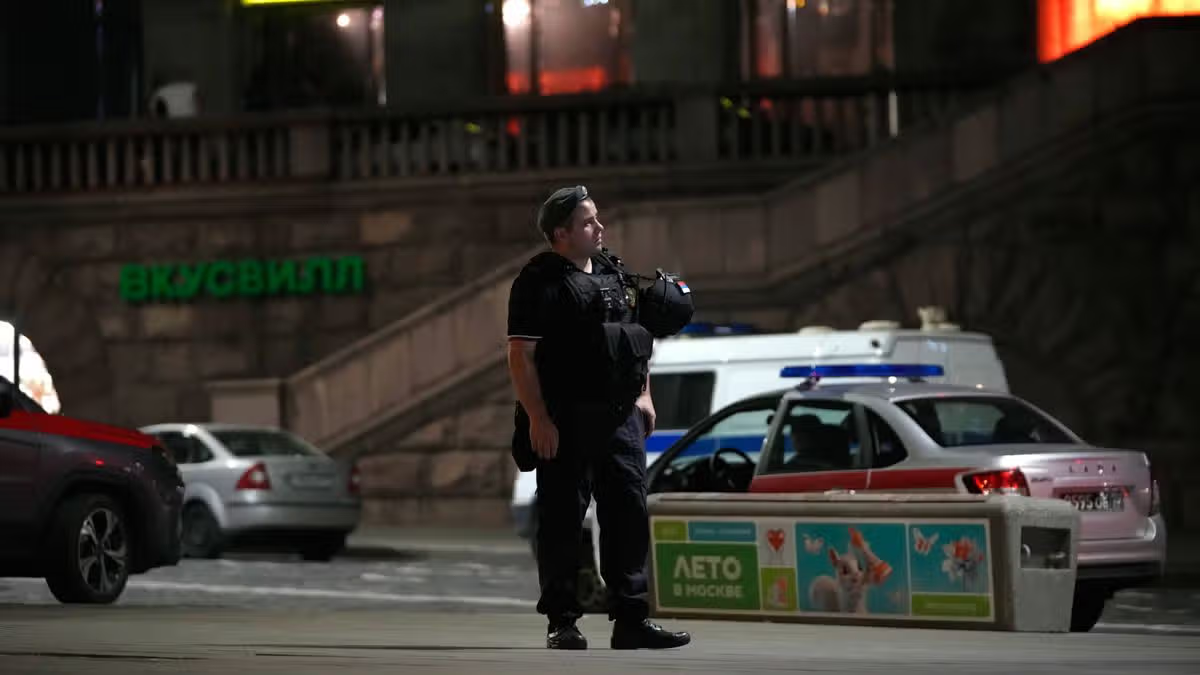
The explosion occurred close to a restaurant terrace on Kudrinskaya Square in Moscow on Saturday evening
Peter Hennessy UK & World News Editor and Laura Zilincanova
23:58, 01 Aug 2026
Three people have lost their lives and 21 others have been injured after an explosion near a restaurant in Moscow, police have confirmed.
The blast took place close to a restaurant terrace on Kudrinskaya Square in Moscow on Saturday evening at around 8:10pm (6:10pm BST), the Interior Ministry said in a statement on the Russian social media platform Max.
Advertisement
Officials told state news agency Ria Novosti that the explosion led to “three deaths and 15 injured, of varying degrees of seriousness”. The committee later revised the injury toll from 15 people to 21, taking the total number of casualties to at least 24.
Those hurt were being treated medically.
The deaths included “a security guard who prevented an unknown woman suspected of trying to carry the explosive device into the restaurant, the unknown woman and one of the visitors,” a committee statement reported by the Tass news agency said.
Video released by the agency showed heavily armed police officers at the scene, which had been sealed off from members of the public, the BBC reports.
The exact cause remains uncertain, though the Baza Telegram channel suggested it happened in the establishment’s kitchen.
A witness told the channel the venue was holding a wedding reception with approximately 50 guests present, adding that they saw people being carried out covered in blood after the explosion. Scores of cyclists had gathered in the vicinity for a planned evening ride through the city, though the event was subsequently cancelled.
Police and emergency services were deployed to the scene, with authorities confirming that an investigation into the cause of the explosion was under way.
Advertisement
Russian media reported that traffic in the area surrounding the square has been temporarily suspended, and the entrances to Barrikadnaya metro station have been closed.
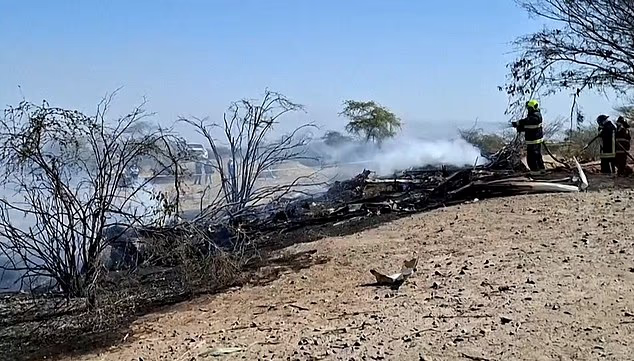
Thirteen passengers have been killed after a tourist plane on a sightseeing flight of the Nazca Lines in Peru crashed into a field, police said.
The plane was taking passengers over the archaeological site in the South American country, Nazca’s municipal government said in a statement.
The aircraft, which belonged to local airline Aerodiana, departed from Pisco airport located in the region of Ica, it added.
The plane lost contact with the control tower minutes after it departed from the airport, local news outlet RPP reported.
Advertisement
Local authorities said that the plane crashed in the area of Pueblo Viejo, approximately six kilometres from the city of Nazca shortly after 1pm local time.
Two pilots and 11 passengers, who are believed to be ‘foreign tourists’ are among those who have been killed in the crash, local media reports.
Seven Italians, two Germans and two Spaniards are among those who have died, RPP radio said.
In a statement, municipal officials of Vista Alegre, where the plane crashed, said preliminary findings indicated there was an ‘in-flight emergency’.
Advertisement
Thirteen passengers have been killed after a tourist plane on a sightseeing flight of the Nazca Lines (pictured) crashed into a field, officials have said
The plane was taking passengers over the archaeological site in the South American country (pictured), Nazca’s municipal government said in a statement
A nearby resident said the aircraft exploded on impact. A probe has since been launched by local authorities, while the cause of the crash remains unknown.
Advertisement
‘We have information that 11 passengers and two crew members have died,’ Police Major Jorge Andrade told reporters at the crash site.
‘Given the severity of the accident, there are no survivors. We have recovered four bodies so far.’
Aerodiana, which says it has offered scenic flights over the Nazca Lines for the past 14 years, was not immediately available for comment.
The Nazca Lines, enormous drawings and geometric figures etched into desert plains, are one of Peru’s main tourist destinations.
Advertisement
And dozens of small planes operate from the airport in Pisco, handling a large volume of primarily foreign tourists hoping to visit.
They attract approximately 100,000 annual visitors, with tourists typically viewing them from small aircraft flying over the site.
On Friday, flights travelling over the site from nearby Maria Reiche were suspended due to winds exceeding 40km per hour kicking up dust and reducing visibility.
The gales forced a small plane carrying two Peruvian tourists and another aircraft carrying six tourists to be diverted to the Marcona Airport, local media said.
Advertisement
In 2022, seven people were killed in a plane crash over the site, including two Chileans and three Dutch nationals.
In October 2010, four British tourists and two Peruvian crew members died when an AirNasca plane crashed after taking the tourists to view the site.
Share or comment on this article:
Tourist plane on sightseeing flight in Peru crashes into a field, killing all 13 people on board























































You must be logged in to post a comment Login