








Eight hours is said to be the magic recipe for restful, restorative sleep. But how many of us actually get it? Just one in five of us, according to the latest figures.
Many – those working early shifts, insomniacs and new parents – regularly function on around half of the recommended amount of sleep and live to tell the tale.
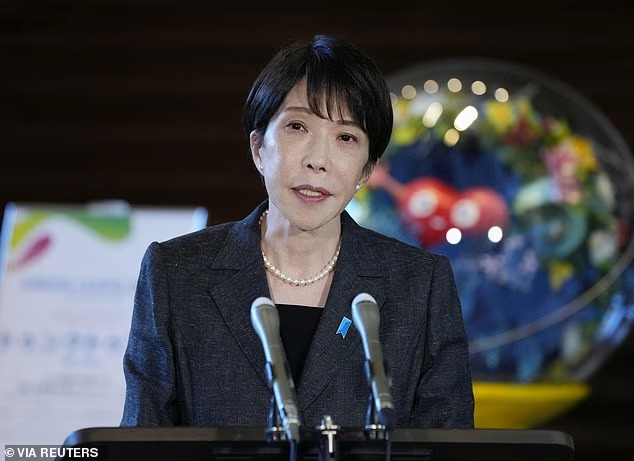
The Prime Minister of Japan is one of them. Sanae Takaichi – the nation’s first female PM – revealed earlier this month that she’s slept a maximum of three hours a night during her nine month spell in power.
She’s far from the only high-powered figure to adopt a restless routine.
Former UK Prime Minister Margaret Thatcher was said to have slept four hours, while Winston Churchill managed a maximum of five.
Studies show that chronic sleep deprivation can fuel a range of potentially deadly conditions including heart disease and dementia.
But how much sleep do we actually need to function and at what point do the late nights and early mornings become dangerous?
Here, experts reveal the alarming impact of too little rest – and exactly when you need to worry.
Japan’s Prime Minister Sanae Takaichi said she usually sleeps ‘zero to three hours’ per night
How many hours of sleep can we get by on?
Sleep serves many vital roles for keeping the brain in optimum health, experts say.
Deep sleep is vital for strengthening memories and storing new information; hence why exam performance is better after a good night’s rest.
It is also essential for the functioning of the so-called glymphatic system, which clears waste products that are linked to dementia.
Brain cells also benefit from a boost in energy during sleep, including the receptors responsible for hormones involved in mood like dopamine and serotonin.
It takes several hours for these processes to be completed, says Dr Tom Chambers, a sleep medicine doctor and chief medical officer at Theta Sleep.
But, he adds, the widely touted ‘sweet spot’ of eight hours per night is ‘not based on science’.
‘Some people do not need it and can function just fine without eight hours of sleep.’
However anything below six hours is unhealthy.

Former UK Prime Minister Margaret Thatcher got by on roughly four hours per night
‘Sleep duration and need are a bit like shoe size; everyone is different,’ says Dr Chambers. ‘It’s normal and healthy to be at extreme ends of a sleep spectrum. The extreme lower end being six hours and the extreme higher end being nine hours.’
Sleeping three or four hours, in the short term, is unlikely to cause long-term problems, he says – apart from impairing your ability to function on day-to-day tasks during these periods.
‘We can cope pretty well with short periods of much less sleep when life demands it,’ he says, adding that new parents are a ‘good example’.
Dr Eidn Mahmoudzadeh, a sleep doctor and co-founder of The Sleep Project, adds: ‘Many people go through periods, up to a couple of years even, like this without any long-term ill-effects.’
Experts also recommend a hack to protect against some of the effects of short-term sleep deprivation.
‘A regular, consistent sleep pattern is more protective against cardiovascular diseases and death than having an optimum sleep duration,’ says Dr Chambers.
In other words, going to bed at the same time every night and getting out of bed at the same time is more important than the number of hours you sleep, according to a 2023 UK study involving 61,000 people.
Years of bad sleep may send you to an early grave
Ms Takaichi could be spared the dangerous effects of her exhausting routine if it lasts for less than a couple of years, experts say.
But anymore than that and she’s putting herself at risk of diabetes, obesity, dementia, heart disease and stroke, as well as psychiatric illness like depression and anxiety.
Dr Chambers points to something called a ‘U-shaped curve’ to explain the phenomenon of health risks linked to sleep deprivation.
‘The curve shows that if you’re sleeping much less than six or seven hours, or much more than nine to ten hours, then there is an increased risk of illness and mortality. Both extremes are risky.’
Some studies suggest that a lifetime of regularly sleeping for less than six hours can increase the risk of dementia by 400 per cent.
According to one research review, getting less than five to six hours of shut-eye a night could lead to a higher risk of metabolic syndrome – a group of conditions including high blood pressure, raised blood sugar, excess belly fat and unhealthy cholesterol.
Together, these increase your risk of heart disease, type 2 diabetes and stroke.
‘The effects tend to build gradually and over a very long period, so a few bad nights or even a few bad months are neither here nor there really,’ says Dr Mahmoudzadeh.
‘But over years and decades there’s no question that there is a strong association with so many long term health problems and an increased mortality risk, aka, dying younger.
‘And don’t rely on naps to “cancel out’” the effects of ongoing sleep deprivation.’
‘Although broken sleep still counts, solid, consolidated sleep is usually more restorative because the brain has time to move through repeated cycles of light sleep, deep sleep and REM sleep.’
He advises keeping naps under 30 minutes and in the early afternoon to avoid depleting sleep pressure – your natural urge to sleep – at night.
Are some people super sleepers?
Some people carry DNA that makes them both survive and thrive off much less sleep than the majority of the population.
‘Less than one per cent of people are genuine “short sleepers”, as we call them,’ says Dr Mahmoudzadeh.
‘They might sleep only around four to five hours and still wake refreshed, function normally and have no long term issues as a result.’
Sadly it’s not a trait you can develop, but due to rare genetic variations.
Dr Mahmoudzadeh adds: ‘The vast majority of people who are sleeping that little amount are in fact sleep deprived and doing themselves harm, whether they feel it or not.’
Dr Chambers is clear that sleeping three or four hours a night is not doctor-recommended.
‘Sleeping zero to three hours a night is a dangerous thing to do. I would never recommend it at scale for the vast majority of people on the planet.’

















































You must be logged in to post a comment Login