

Crypto World
Strategy’s Bitcoin Sale Sparks Polymarket Dispute

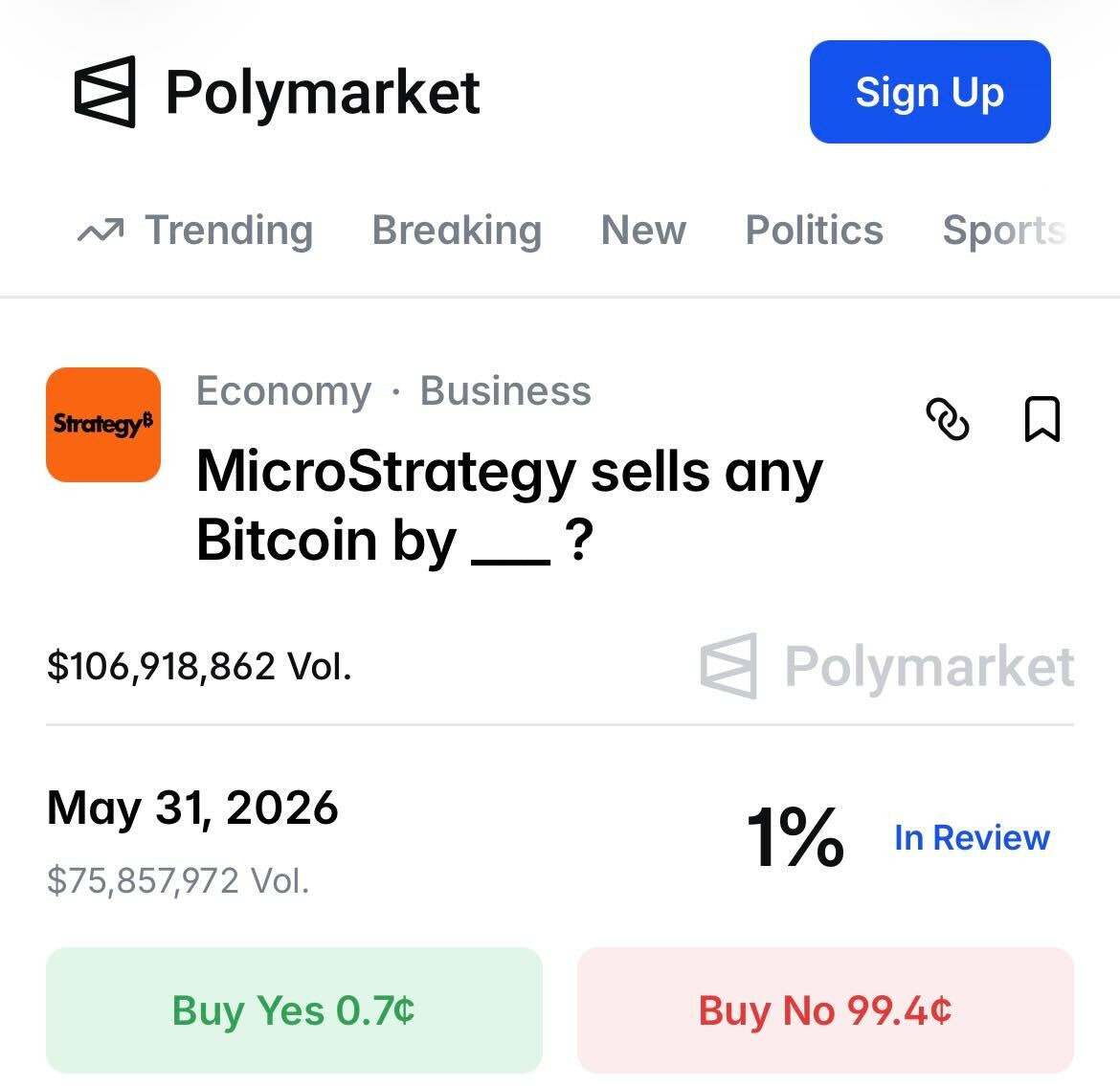
Polymarket users who bet on when Michael Saylor’s Strategy would sell Bitcoin are in dispute with the prediction market platform over the timing and disclosure of the company’s recent sale.
More than $80 million has been wagered on whether Strategy would sell Bitcoin (BTC) by May 31, with users able to buy odds on “Yes” or “No.”
Strategy said in a regulatory filing that it sold 32 Bitcoin (BTC) between May 26 and May 31, but the disclosure of the sale was made on Monday, June 1, leading the market to resolve to “No,” causing confusion among users.
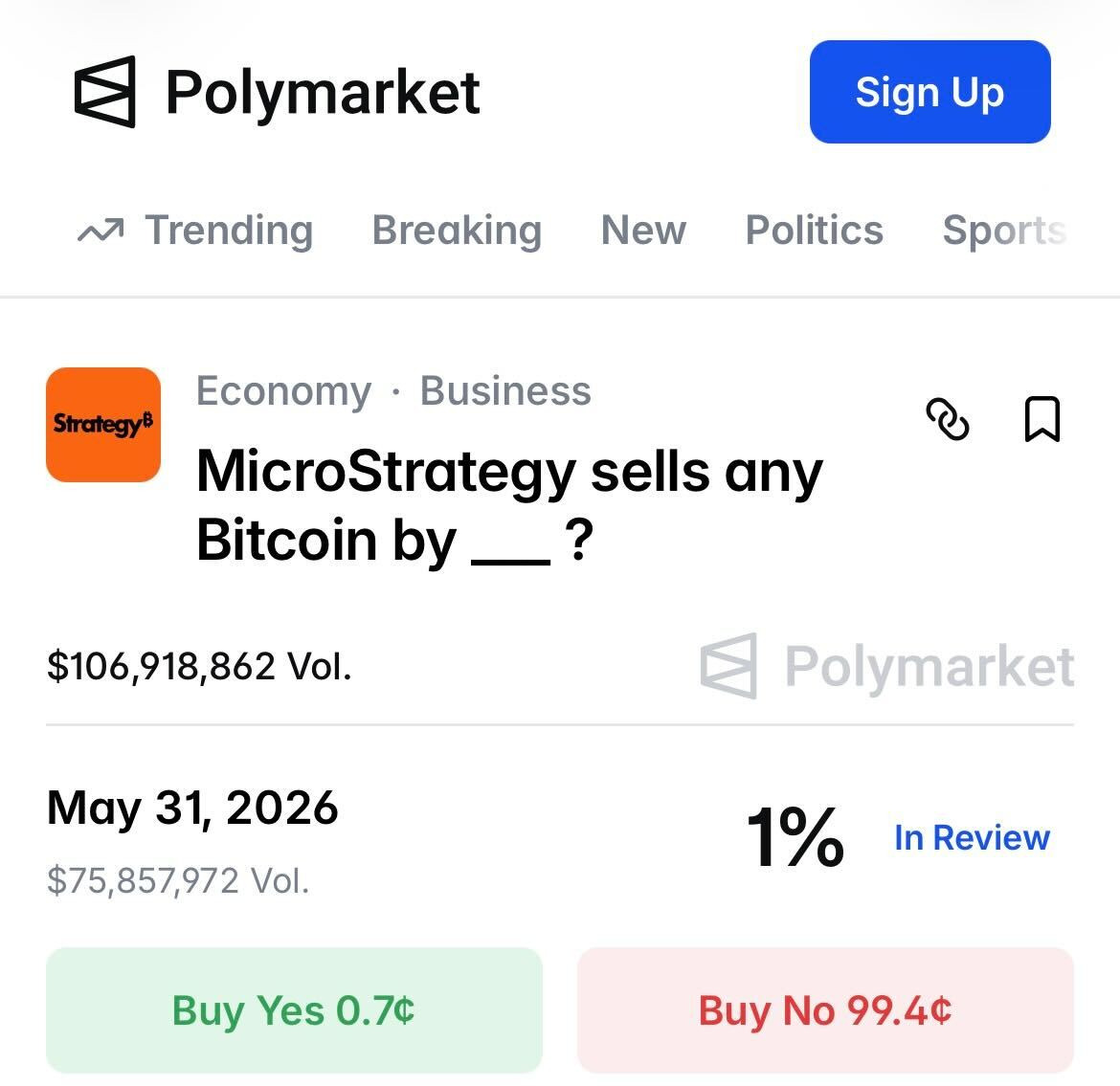
Odds for Polymarket’s “MicroStrategy sells any Bitcoin by May 31” market have since fallen to 0.7 cents. Source: Polymarket
Polymarket said in an “additional context” section of the affected market updated on Tuesday that any confirmation of a sale disclosed outside of the market’s timeframe “does not qualify.”
“No information from MSTR, on-chain data, or consensus of credible reporting confirmed that MicroStrategy sold Bitcoin within the market’s timeframe,” the notice said.
Several Polymarket users expressed frustration with the market.
“Polymarket should trade truth, not technicalities,” one affected user said. Another added it had made them “lose a lot of faith in Polymarket.”
“I am so disappointed in this company today. Unbelievable,” another user said.
Final decision to come Wednesday
The market is currently awaiting the outcome of a second dispute, which is set to be decided by 12:00 am UTC on Wednesday.
If no statement is issued at that time, the order book will be cleared, Polymarket said.
Related: Strategy’s STRC hits record $1.5B trading volume
Saylor first pitched the idea of selling Bitcoin in the company’s first-quarter earnings call on May 5, stating that the sale would be to “inoculate” the market against sudden panic.
He said at the time that market participants will realize that “the company’s fine, the Bitcoin’s fine, the industry’s fine, the world didn’t come to an end.”
The sale contrasts with Strategy’s previously long-stated promise that it would never sell its Bitcoin.
Bitcoin fell 2.5% to $70,815 within five hours of Strategy reporting the Bitcoin sale on Monday.
Bitcoin has since partially recovered to $71,200.
Magazine: eToro founder timed Bitcoin top perfectly due to belief in 4 year cycles

Gnosis Pay users were urged to withdraw funds after an active exploit linked to the platform’s Zodiac delay module, according to posts from Gnosis co-founder Martin Köppelmann and blockchain security firm PeckShield.
Summary
- Gnosis Pay users were told to withdraw EURe and GNO after a delay module exploit.
- Köppelmann said the bug lets an attacker initiate transactions from Safes using the module.
- Gnosis said it would cover user losses while asking bridge validators to pause activity.
“If you are a Gnosis Pay user – unfortunately I have to recommend: withdraw all funds (EURe and GNO),” Martin Köppelmann said on X.
He said the delay module has a bug and warned that users “might be affected.” The post told users to move both EURe and GNO from Gnosis Pay while the team worked on the issue.
“Users are strongly urged to withdraw all funds (EURe and GNO),” PeckShield said in a separate alert.
The blockchain security firm said Köppelmann had warned about an active exploit related to Gnosis Pay. It also told users to check their exposure because they may be affected.
Zodiac delay module bug tied to attack
“The bug is related to the Zodiac delay module,” Köppelmann said in a later update.
He said the attacker can initiate transactions from Safes that use the delay module. The update gave more detail on the technical source of the exploit after the first warning referred only to a delay module bug.
Gnosis Pay uses Safe-based accounts with smart contract modules. Its own documentation says Gnosis Pay accounts use a Delay Module and a Roles Module to support card payments while keeping users in control of their accounts.
The Delay Module is designed to place a short wait before outgoing transactions can execute. In normal use, that gives users time to react before certain transfers are completed.
Gnosis moves to contain damage
“We are doing various measures to contain the damage like asking bridge validators to pause,” Köppelmann said.
The statement shows that Gnosis is working with outside infrastructure providers while it responds to the exploit. Bridge validators can play a role in cross-chain movement, so a pause may help slow further movement of affected funds.
“Rest assured, Gnosis will cover all user losses,” Köppelmann said.
No final loss figure had been published at the time of writing. The team has also not released a full post-mortem explaining how many accounts were affected or whether all attacker activity has stopped.
Wider payment security context
As previously reported by crypto.news, Gnosis Pay launched a self-custody card for crypto spending at Visa merchants. The product was built to connect blockchain wallets with real-world payments.
That design places Gnosis Pay in a growing group of crypto payment tools that use smart contracts to support everyday spending. It also puts more attention on the code that controls wallet permissions and transaction timing.
The latest warning does not describe Gnosis Pay as shut down. It says users should withdraw EURe and GNO while the team works to contain the exploit.


Radiant Capital has announced plans to wind down operations after failing to recover from a $50 million exploit that devastated the lending protocol and left it without sufficient funding to continue.
Summary
- Radiant Capital said it will wind down operations after failing to recover from a $50 million exploit and secure new funding.
- The protocol will remain online in a maintenance state, allowing users to withdraw funds and manage positions while development work ends.
- Investigations linked the 2024 attack to North Korea-aligned threat actors, while recovery efforts were hindered after portions of the stolen funds moved through Tornado Cash.
According to a statement published Monday by Radiant’s decentralized autonomous organization, the protocol could no longer identify a viable route forward after unsuccessful attempts to recover stolen assets, raise fresh capital, and maintain the resources needed to operate responsibly.
In a separate update shared on X, the DAO said contributors and community members had continued supporting the platform under increasingly challenging circumstances. The organization stated that without recovered funds, new investment, or renewed growth, the protocol could not remain sustainable.
The decision closes a difficult chapter for a project that once ranked among the largest cross-chain lending platforms.
Launched in 2022, Radiant sought to unify liquidity across multiple blockchains and grew rapidly during 2023. Data from the protocol shows its total value locked reached $386.8 million in December 2023.
Fortunes changed sharply after an October 2024 exploit that security researchers and later investigations linked to North Korean threat actors. Following the breach, Radiant’s total value locked fell to roughly $75 million and dropped to about $5 million within weeks, according to protocol data.
Recovery efforts failed to restore the protocol
While operations are being scaled back, Radiant said the protocol will not disappear entirely. Instead, it will move into what it described as a maintenance state.
Under that arrangement, the frontend will remain online, smart contracts will stay accessible, and users will still be able to withdraw assets, repay loans, and manage existing positions. Development work, protocol upgrades, and expansion efforts, however, will cease as DAO contributors step away from active operations.
Radiant also urged users to manage their exposure carefully while the protocol enters its final phase.
Remaining recovery initiatives connected to the hack will continue. The DAO said its remediation portal will stay open and any assets recovered in the future will be returned to affected users.
Previous recovery efforts have produced limited results. In October 2025, blockchain security firm CertiK reported that wallets linked to the attacker deposited 2,834 ETH into Tornado Cash after moving funds through multiple addresses and swaps involving DAI.
CertiK estimated that approximately $10.8 million worth of Ethereum had already been laundered through the mixer, complicating efforts to trace and recover the stolen assets.
North Korea-linked attack became a turning point
Radiant said in December 2024 that an attacker posing as a former contractor distributed malware through Telegram. According to the protocol, a malicious ZIP file circulated among developers for feedback, creating an entry point that ultimately led to the compromise.
A post-mortem investigation from cybersecurity firm Mandiant later linked the incident to the AppleJeus hacking group, which it identified as part of North Korea’s cyber ecosystem.
According to Mandiant, the attackers gained control of three of Radiant’s eleven multisig signer permissions and replaced the lending pool’s implementation contract, allowing them to steal approximately $53 million from the Arbitrum and BNB Chain deployments.
The tactics used in the attack later surfaced in other major crypto incidents. In April 2026, Drift Protocol said it had medium-high confidence that the same actors behind the Radiant breach were responsible for a separate exploit against its platform. Drift’s investigation concluded that the group spent months building trust with contributors through conference meetings and professional contacts before deploying malicious tools and links.
Market reaction to Radiant’s closure announcement remained negative. The protocol’s RDNT token fell 4.2% after the news.
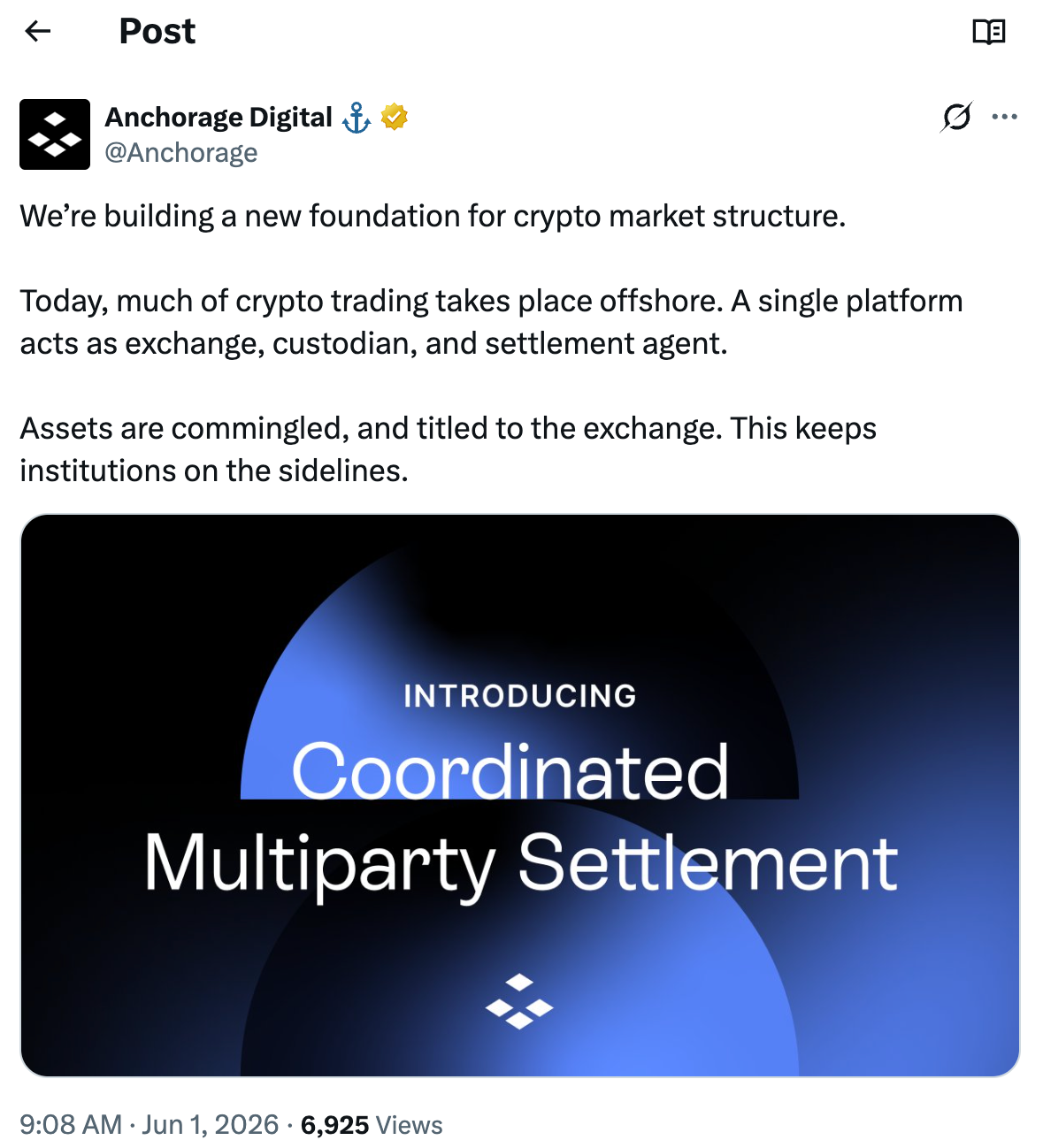
Anchorage Digital launched a settlement platform that allows institutions to trade on crypto venues while keeping assets in custody at its federally regulated bank, which it said will help manage counterparty and operational risks.
According to Monday’s announcement from the company, Coordinated Multiparty Settlement (CMS) connects trading venues, prime brokers and institutional clients through a shared settlement layer while keeping assets at Anchorage Digital Bank throughout the trade lifecycle.
Anchorage said CMS verifies funding obligations and coordinates settlement across participants, reducing the number of asset transfers needed to complete trades. The company said the system is designed to reduce the need for pre-funded exchange accounts, a common practice in crypto markets.
In a Monday X post, Anchorage said much of crypto trading still takes place on offshore platforms where “a single platform acts as exchange, custodian, and settlement agent” and client assets are often commingled and titled to the exchange.
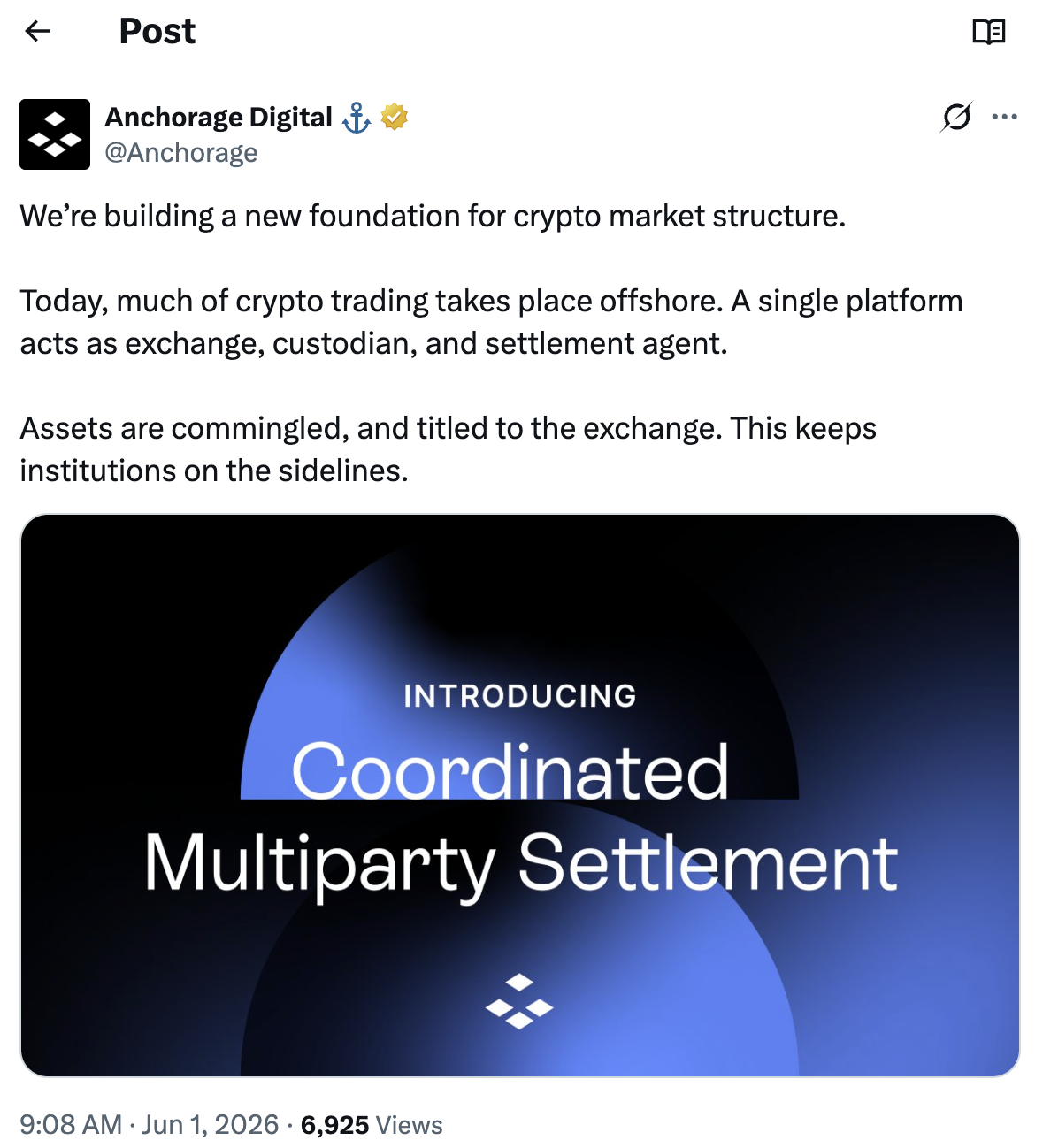
Source: Anchorage Digital on X.com
Under the CMS model, prime brokers manage client balances and credit relationships, trading venues act as matching engines and Anchorage provides custody and settlement services.
The rollout will begin with foreign exchange trading platform Spotex, which Anchorage said processes billions of dollars in daily volume, with additional venue integrations under development.
Related: Anchorage Digital, Mexico’s Grupo Salinas partner on stablecoin cross-border settlement
Institutional trading infrastructure continues to evolve
Financial institutions and digital asset companies are fast expanding infrastructure for tokenized assets and institutional trading, with the Canton Network emerging as one focal point for those efforts as firms explore blockchain-based settlement.
In December, DTCC partnered with Digital Asset and the Canton Network to support the tokenization of DTC-custodied US Treasury securities, with plans to expand the initiative to additional asset classes. Two months later, Fireblocks integrated the network, enabling banks, custodians and asset managers to custody and settle assets on a blockchain built for regulated financial markets.
Banks are also investing in digital asset custody and market infrastructure. In May, Standard Chartered agreed to acquire Zodia Custody while spinning out Zodia Solutions, a standalone platform serving institutional digital asset clients. The transaction consolidates the bank’s custody operations while creating a separate company focused on services for financial institutions.
Magazine: ETH bears growling, Tom Lee’s buying, XRP to ‘explode’: Market Moves
The Open Network says it is planning to rebrand its Toncoin (TON) token to Gram (GRAM), the original name of the network’s cryptocurrency in its first white paper.
“Gram was the original name of TON’s currency in the first white paper,” Telegram and TON founder Pavel Durov posted to Telegram on Monday. “We’re returning to our roots — and starting a new chapter.”
The rebranding will “pave the way for what comes next,” and the transition will take around three weeks, he added.
The change revives the original token name from TON’s 2018 whitepaper, which Telegram abandoned after the US Securities and Exchange Commission blocked its $1.7 billion initial coin offering (ICO) in 2020.
The move follows Telegram’s takeover from the TON Foundation as the network’s primary driver and largest validator in May.
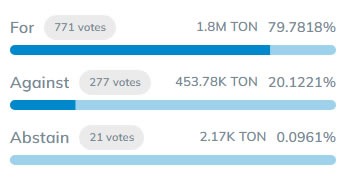
The Open Network launched a vote on the proposal on Monday, explaining that there is no swap, migration, bridge, claim or conversion, and every balance, address, contract and position stays exactly as it is currently.
At the time of writing, there were 1.8 million TON, or almost 80%, pledged in favor of the rebrand.
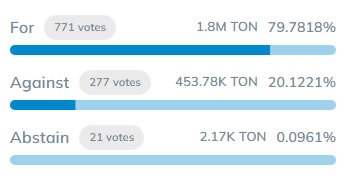
Voting for TON rebranding is underway. Source: The Open Network
Durov has positioned the token rebrand as part of the “Make TON Great Again” roadmap. The rebrand is the fourth stage of the roadmap, with the first three coming earlier this year that included an upgrade to Catchain in April to boost blockchain speed, a decrease in transaction fees, and the Telegram takeover.
“These changes mark a milestone for the network — and a natural moment to refresh how the token is known publicly,” TON stated.
The endgame is to power a seamless Web3 “super app” experience inside Telegram for its one billion users, turning the messenger into a global platform for payments, mini-apps, digital ownership, AI agents, and more.
Related: TON Pay aims to turn Telegram into a crypto checkout layer for TON
TON prices reacted strongly to the announcement, surging more than 15% from around $1.95 to top $2.25 in late trading on Monday.
The token had retreated by Tuesday morning, falling back to $2.07, and it remains down 75% from its June 2024 all-time high of $8.25, according to CoinGecko.
Magazine: HYPE chases $100 target, ETH could dump below $1800: Market Moves


Bitcoin extended its slide below $71,000 in early Asian hours Tuesday, down 3.4% in the past 24 hours and 7.5% on the week, as the aftermath of Strategy’s first disclosed bitcoin sale weighed on the market while stocks paused at record highs and oil pushed further on the stalled U.S.-Iran ceasefire negotiations.
BTC traded near $70,830 by Tuesday morning, with the 24-hour range stretching from a low of $70,120 to a high of $73,458, per CoinDesk data. Ether (ETH) hovered just below $2,000 at $1,996, sat flat at $0.10, XRP fell 3% to $1.28 and Solana’s SOL slipped 1.7% to $80.47.
Monday’s 8-K filing from Strategy (MSTR), the largest corporate holder of bitcoin, disclosed the company’s first publicized sale of bitcoin in the five years since it began accumulating, with 32 coins sold for $2.5 million at an average price of $77,135 and proceeds earmarked to fund preferred stock distributions.
CoinDesk covered the sale extensively on Monday, including the broader funding-stack context behind it and the resulting Polymarket resolution around a $14 million market that debates whether the sale occured in May or June.
Stocks eased from all-time highs as investors locked in gains on the AI rally that has dominated markets this year, Bloomberg reported.
MSCI’s Asia-Pacific equity index fell 0.5%, with South Korea’s Kospi sliding 1.8% after its 105% year-to-date run. Nasdaq 100 futures slipped 0.7%, while Chinese tech bucked the trend with Tencent (0700) jumping 7.5%.
Brent crude pared some of Monday’s advance but held around $94.40 a barrel as the U.S.-Iran impasse persisted, with Treasuries holding their losses from the prior session on concerns that higher energy costs would force the Federal Reserve to keep interest rates higher for longer. Iran said it would halt message exchanges with Washington, Tasnim news agency reported.
Hyperliquid’s HYPE remained the outlier in the top 10 by market value, gaining 24.3% over the past seven days to $73.76 even as bitcoin and ether bled.
BTC is now at its lowest level in weeks. With ETF demand still flowing the wrong way and Strategy disclosed as a seller, there is no obvious near-term catalyst for a reversal.


On May 4, 2026, Pavel Durov announced Telegram would replace the TON Foundation as the primary driver of The Open Network and become its largest validator.
Summary
- Telegram’s May 2026 TON takeover reversed the SEC-forced retreat that ended the original project in 2020.
- The MTONGA roadmap combines faster finality, lower fees, validator control, developer tools, and Telegram payments.
- TON’s bullish case now rests on Telegram’s execution, but centralization and Durov’s legal exposure add risk.
- The takeover turns TON into a live test of whether consumer-scale crypto can grow through a messaging app.
The announcement is the third step in a seven-step “Make TON Great Again” (MTONGA) roadmap. Network fees dropped sixfold to roughly $0.0005 per transaction, standardized regardless of congestion. Toncoin surged from $1.30 to $1.80 within 24 hours, then climbed to $2.151 over the week, with $191.83 million in single-day staking inflows. The structural reversal is genuinely significant.
Six years ago, in May 2020, the SEC forced Telegram to return $1.22 billion to Gram token investors and pay $18.5 million in penalties, killing the original Telegram Open Network. The 2026 takeover walks Telegram back into the same blockchain through the front door, this time under a different regulatory environment and with 950 million users sitting in the distribution channel.
This is what actually happened, why it happened now, what the centralization debate misses, and what the takeover means structurally for both TON and the broader question of how consumer-scale crypto adoption might work.
What Durov actually announced
The mechanics of the May 4 announcement matter because they determine what specifically changed and what stayed the same.
Pavel Durov posted on X on May 4, 2026 confirming Telegram would replace the Switzerland-based TON Foundation as the primary steward of The Open Network. Telegram would also operate as the largest validator on the chain, contributing infrastructure and stake at a scale beyond any other single entity. The post framed the move as the third visible step in a seven-step roadmap Durov had been calling MTONGA, short for “Make TON Great Again.”
The announcement followed two earlier MTONGA steps. The first was the Catchain 2.0 protocol upgrade, announced on April 9, 2026, which reduced block times from approximately 2.5 seconds to roughly 400 milliseconds and cut transaction finalization from around 10 seconds to nearly one second. The second was the fee reduction, which standardized transaction costs at 0.00039 TON (roughly $0.0005 per transfer) regardless of network congestion. The validator takeover is the third step. The remaining four steps include new developer tools, a revamped ton.org website, TON Pay 2.0 for in-app payments, and the TON Teleport bridge bringing Bitcoin liquidity into the ecosystem.
The market reaction was immediate. Toncoin opened May 4 at roughly $1.30, hit $1.73 within 24 hours, climbed to $1.80 by May 5, and reached $2.151 over the following week. Over a one-week window, TON gained 61.4 percent. Over a one-month window, it gained 69.4 percent. The rally coincided with $191.83 million in single-day staking inflows, the highest level in nearly four months, and $7.17 million in short liquidations as bearish positions were caught off guard.
The ton.org domain, which had been operated by the TON Foundation, now displays a simple holding page reading “ton.org is now controlled by MTONGA. Expect changes soon.” This is more than a symbolic transition. The TON Foundation, which had served as the primary coordinator since 2021 after Telegram abandoned the original project, is being structurally replaced. Telegram is stepping in as both the operational steward and the largest infrastructure participant.
What the announcement did not do is dissolve the TON Foundation entirely. The Foundation has a pending $400 million Kingsway-led PIPE (private investment in public equity) deal and still holds significant TON tokens and ecosystem resources. The Foundation’s role going forward is unclear, but the practical effect of the Telegram takeover is to make the Foundation a secondary rather than primary entity in TON’s governance and development.
The June 2026 inflation vote, which will determine the long-term token issuance schedule, is the next major governance event. The outcome will signal how the new Telegram-led structure handles community governance decisions versus how the prior Foundation-led structure handled them.
The 2020 SEC defeat and why this is a reversal
To understand why the 2026 takeover matters, you have to understand the specific way the original Telegram Open Network ended in 2020.
Pavel and Nikolai Durov began building TON in 2018. The project raised approximately $1.7 billion in two private token sales for “Gram” tokens, which would have been the native asset of the network. Investors included major US and international funds, with the expectation that Gram tokens would be distributed when the network launched.
The SEC filed suit in October 2019, alleging that Telegram’s Gram token sales constituted unregistered securities offerings. A federal judge in New York issued a preliminary injunction in March 2020 blocking the distribution of Gram tokens worldwide. The injunction was the practical end of the project. With distribution blocked globally, Telegram could not deliver the tokens it had sold to investors. The legal pathway forward was prohibitively expensive and uncertain.
In May 2020, Telegram agreed to a settlement that required returning $1.22 billion to Gram token investors and paying $18.5 million in penalties to the SEC. Durov wrote a blog post announcing the death of TON. The project Telegram had spent two years and $1.7 billion building was officially over.
The aftermath was complicated. The TON blockchain itself had been developed and was technically operational, but Telegram could no longer be associated with it. A community of independent developers took over the codebase, eventually formalizing the project under the Switzerland-based TON Foundation in 2021. The community-led TON ran independently of Telegram for approximately four years, gradually building out infrastructure, tools, and an ecosystem.
Telegram’s relationship with the community-led TON deepened in stages. The TON Foundation positioned the network as Telegram-adjacent rather than Telegram-controlled. Telegram integrated TON Connect for wallet authentication. TON-based Mini Apps became a feature of the Telegram platform. In 2024 and 2025, Telegram established TON as its exclusive blockchain partner, deepening integration further without taking direct control.
The May 2026 takeover ends that arms-length arrangement. Telegram is no longer just supporting TON or partnering with TON. Telegram is running TON. The same regulatory entity the SEC forced out in 2020 is the one now driving the project six years later. The reversal arc is genuinely interesting because it shows how regulatory environment shifts can change the structural composition of crypto in ways the original enforcement actions did not anticipate.
The current SEC under Chair Paul Atkins has taken a substantially different approach to crypto than the Gensler-era enforcement-first posture. Multiple crypto enforcement cases have been dropped or settled. Spot ETFs have been approved for assets previously blocked (XRP, DOGE, SOL). The GENIUS Act established a federal stablecoin framework. The CLARITY Act is working through Congress with broad bipartisan support. The regulatory environment that made TON impossible for Telegram in 2020 has shifted enough that the same kind of project is now operationally viable.
This is the structural significance of the 2026 takeover. It is not just a governance change for one blockchain. It is a demonstration the regulatory pendulum has swung far enough to make consumer-scale corporate crypto integration viable again. If Telegram can run TON publicly without immediate SEC enforcement, other major technology companies can plausibly evaluate similar moves. The takeover is precedent-setting beyond TON itself.
Why Telegram is taking control now
Three specific factors explain the timing of the May 2026 announcement, and understanding them helps separate the takeover from the broader narrative of “Telegram bullish for TON.”
The first is regulatory environment shifts described above. The 2020 SEC defeat happened under a specific enforcement regime that no longer exists. The current SEC, the GENIUS Act framework, the pending CLARITY Act, and the broader Trump administration approach to crypto have created an operating environment where direct corporate involvement in a blockchain is structurally viable. Telegram could not run TON in 2020. Telegram can run TON in 2026. The change is the regulatory environment, not the underlying technology or business case.
The second is the structural limitations of the community-led TON Foundation period. The Foundation did meaningful work between 2021 and 2026, building infrastructure and growing the ecosystem. But the Foundation worked with limited resources, slower iteration cycles, and the typical governance friction of decentralized organizations. TON’s previous network congestion, slow upgrade cycles, and developer experience issues were not catastrophic, but they were inconsistent with the scale of ambitions Telegram has for consumer crypto. The MTONGA roadmap explicitly addresses these issues with faster execution and direct corporate resources.
Durov’s framing in his X post was direct: rather than waiting for the TON Foundation to push things forward, Telegram is taking direct control of the pace. This is corporate-speed development replacing foundation-pace development. The trade-off is centralization of decision-making in exchange for faster execution. Whether that trade-off is net positive depends on what you value in blockchain governance, but the operational logic is straightforward.
The third factor is competitive positioning in consumer crypto. Solana has positioned itself as the high-throughput consumer chain. Sui is positioning itself with USDsui as the payments-focused alternative. Hyperliquid has captured derivatives. The window for a chain to claim the “consumer payments and applications” positioning is still open, but it is narrowing. Telegram’s 950+ million user base is the largest consumer distribution advantage any blockchain has ever had access to. Taking direct control of TON lets Telegram move faster on consumer integration features (TON Pay 2.0, Mini Apps, in-app stablecoin payments) while the competitive window is still open.
The combination of these three factors explains why May 2026 specifically. The regulatory environment had shifted enough to make the takeover viable. The Foundation period had reached its natural limitations. The competitive window for consumer crypto positioning was still open but closing. The MTONGA roadmap had built operational momentum (Catchain 2.0, fee cuts) that made the validator takeover the logical next step.
What this means practically is the takeover is not a sudden corporate decision. It is the culmination of a multi-year reintegration visible in stages. The 2024-2025 establishment of TON as Telegram’s exclusive blockchain partner was the precursor. The April 2026 Catchain 2.0 upgrade and fee cuts were the technical preparation. The May 2026 validator takeover is the formalization of a relationship that has been deepening for years.
The centralization debate that everyone is having
The single loudest critique of the Telegram takeover is the centralization concern, and the debate around it deserves more careful unpacking than most coverage provides.
The bearish framing is straightforward. A single corporate validator controlling block production is a known regulatory target. Centralization creates operational risk (if Telegram’s validator goes offline, the network suffers), regulatory risk (if regulators target Telegram, TON is exposed), and governance risk (if Telegram’s corporate priorities diverge from the network’s, the network has limited recourse). The decentralization narrative that has historically been central to crypto’s value proposition weakens substantially when one corporate entity holds outsized influence.
The bullish counter-framing, which Durov articulated in a follow-up X post, is Telegram becoming the largest validator strengthens decentralization by encouraging other major players to join the validator pool. The logic: if Telegram is publicly committed to TON at this scale, other large entities (exchanges, infrastructure providers, institutional validators) have stronger incentives to take part in validator operations because the network has shown long-term viability. Telegram serves as a counterbalance to potential single-entity dominance from any other source.
Both framings have some validity. The bearish concerns are real. A network where one corporate entity holds the largest validator position is structurally different from a network where validator power is distributed across many independent entities. The regulatory exposure is genuine, particularly given Telegram’s ongoing legal issues in France. The operational risk is real, even if currently manageable.
But the bearish concerns also have to be weighed against the reality the prior TON Foundation period was not perfectly decentralized either. The Foundation held significant influence over protocol development, validator selection, and ecosystem direction. The “decentralized” label applied to the Foundation period was always somewhat aspirational rather than fully realized. The shift to Telegram-led governance is a change in degree rather than a shift from decentralization to centralization.
What is genuinely new is the regulatory exposure question. Telegram operates in a specific legal context that includes Durov’s ongoing French case (formal investigation for complicity in platform-related crimes, with potential penalties of 10 years imprisonment and over $550,000 in fines). The case is unresolved. Durov’s travel ban was lifted in November 2025 after one year of compliance, and the criminal investigation keeps moving forward. If the French case produces a negative outcome, or if other jurisdictions take similar action against Telegram or Durov personally, the impact on TON would be substantial.
This is the specific risk the centralization concern crystallizes. A blockchain governed by an independent foundation is somewhat insulated from the legal issues of any particular individual. A blockchain governed by a corporate entity whose CEO faces multiple ongoing criminal investigations carries direct exposure to those investigations. The legal risk to Durov is now structurally connected to the operational risk of TON in ways it was not before.
For TON holders, the practical implication is the asset’s risk profile now includes Durov’s legal exposure in a way it previously did not. The price benefits of Telegram’s commitment are real, but they come bundled with the legal risks of Telegram’s leadership. The two are now structurally linked in ways they were not under the Foundation-led period.
The honest analysis is the centralization debate misses what is actually at stake. The question is not whether TON is centralized (it is, more so now than before). The question is whether the trade-off between centralization and execution speed is net positive given the specific risks the centralization introduces. Reasonable observers can disagree, but the analysis requires engaging with both sides honestly rather than picking a framing.
What MTONGA actually delivers
The MTONGA roadmap is more substantive than most coverage suggests. The seven steps, as they have been progressively announced, include genuine technical and operational improvements that distinguish the Telegram-led era from the Foundation period.
Catchain 2.0 is the first step and was delivered in April 2026. The upgrade reduced block times from approximately 2.5 seconds to roughly 400 milliseconds. Transaction finalization dropped from around 10 seconds to nearly one second. This puts TON in the performance tier alongside Solana’s pre-Alpenglow throughput, Sui’s Mysticeti consensus, and the fastest current Layer-1 networks. For consumer payment applications, the sub-second finality is genuinely important. Users will not accept multi-second waits for routine in-app transactions.
Fee reduction is the second step and was delivered in early May 2026 alongside the validator takeover announcement. Transaction costs dropped from approximately 0.00234 TON to a standardized 0.00039 TON per transaction, regardless of network congestion. At current TON prices, this works out to roughly $0.0005 per transaction. The standardization matters as much as the absolute reduction. Predictable fees let developers build applications with reliable cost models, which has been a persistent issue on networks with variable congestion-based pricing.
Validator takeover is the third step and was the May 4 announcement. Telegram becomes the largest single validator on TON, contributing operational infrastructure at scale. The exact stake size has not been disclosed in precise terms, but the framing is Telegram is providing validator capacity that exceeds any other single entity on the network.
New developer tools and revamped ton.org are the fourth step, expected in late May or early June 2026. The current ton.org displays only the MTONGA holding page. The new site is expected to include updated developer documentation, improved SDKs, better integration guides for Telegram Mini Apps, and operational tools for builders. The Foundation-era developer experience was widely considered inadequate. The MTONGA-era developer experience is being rebuilt from scratch.
TON Pay 2.0 is the fifth step, scheduled for Q2 2026. This is the layer 2 payments upgrade designed for instant, in-app transactions on Telegram. The product is positioned as a gasless experience where users send and receive payments without needing to hold TON for gas. This is the consumer-facing payment product the takeover ultimately serves. If TON Pay 2.0 ships on schedule and works at scale, it positions TON as the largest consumer payment rail in crypto.
TON Teleport is the sixth step, scheduled for mid-2026. This is a cross-chain bridge that brings Bitcoin liquidity into the TON ecosystem. The integration would let Bitcoin holders use BTC in TON-based DeFi without converting to TON or selling. The economic model assumes Bitcoin holders represent a large pool of capital historically excluded from non-Bitcoin DeFi, and bridging Bitcoin into TON specifically captures a meaningful share of that pool.
The seventh step has not been publicly detailed yet. Durov’s posts have referenced “performance upgrades” and “tech superiority” without specifying the exact deliverable. The likely candidates include further consensus improvements, additional consumer features, or new integration capabilities with Telegram’s broader product suite.
The pace of execution matters. Catchain 2.0 was announced April 9 and delivered shortly after. Fee cuts were delivered in early May. The validator takeover was announced May 4 and is being implemented. Developer tools and ton.org revamp are expected within weeks. TON Pay 2.0 is on track for Q2 2026. This is corporate-speed execution the Foundation period did not produce. Whether the speed keeps up at this pace through TON Pay 2.0 and TON Teleport is the open question that will determine the success of the MTONGA roadmap.
The Durov legal risk that matters
A complete analysis has to engage seriously with Durov’s ongoing French legal situation, because it now functions as a specific risk to TON itself.
Durov was arrested at Paris–Le Bourget Airport on August 24, 2024. The arrest followed a multi-month investigation by the Paris prosecutor’s cybercrime unit, which alleged Telegram’s “near total absence of a response” to French authorities’ requests for cooperation in criminal cases. The 12 charges filed include suspected complicity in running an online platform that allows illicit transactions, images of child sex abuse, drug trafficking and fraud, refusal to communicate information to authorities, money laundering, and providing cryptographic services to criminals. Potential penalties include up to 10 years imprisonment and over $550,000 in fines.
Durov was placed under formal investigation on August 28, 2024, banned from leaving France, and required to check in with police twice per week. The travel ban was relaxed in July 2025 to allow short trips to the United Arab Emirates (where Telegram is based). On November 13, 2025, after one year of compliance with judicial supervision, France fully lifted Durov’s travel ban. The criminal investigation, however, remains ongoing as of mid-2026.
Durov has consistently denied the charges. He has accused French authorities of procedural failures, criticized the case as “legally and logically absurd,” and accused French intelligence of asking him to censor Moldovan and Romanian voices in exchange for help with his case. The case has become a free speech cause célèbre, with the Human Rights Foundation and other organizations defending Durov.
The relevance to TON is direct. Before the May 2026 takeover, Durov’s legal exposure was a Telegram issue with indirect implications for TON. After the takeover, Durov’s legal exposure is structurally connected to TON’s operational risk. If French authorities take action affecting Telegram’s operational capacity, the impact on TON would be material. If similar actions are taken in other jurisdictions, the network faces compounding exposure.
The realistic risk scenarios are not necessarily catastrophic. The French case has been moving slowly. The investigation has not produced charges with imminent trial dates. Durov keeps running Telegram normally from Dubai. The most likely outcome is continued slow legal process without immediate operational impact on Telegram or TON.
But the tail risks matter for a structural analysis. If Durov is convicted on any of the charges and faces actual imprisonment, the impact on Telegram’s leadership and operational continuity would be substantial. If other jurisdictions follow France with similar charges, the legal exposure compounds. If the French case produces an unfavorable precedent for platform liability other jurisdictions adopt, the structural risk to Telegram and therefore to TON raises.
The takeover trades the prior TON Foundation governance (legally insulated from any individual’s exposure) for Telegram-led governance (directly exposed to Durov’s legal situation). The trade is rational from an operational perspective, given the execution benefits the takeover unlocks. But it is a real trade. The legal risk profile of holding TON is structurally different now than it was before May 4, 2026.
For TON holders, the practical implication is monitoring Durov’s French case is now part of the asset’s risk analysis. Major developments in the case (charges, trial schedules, settlement discussions, jurisdictional expansion) should be treated as material to TON’s price and operational status, in ways they were not previously.
The consumer crypto question
The broader strategic significance of the takeover is what it means for the question of whether consumer-scale crypto adoption is actually possible.
The consumer crypto thesis has been pursued by many projects for many years. The thesis: blockchain technology has potential for mainstream consumer adoption, but achieving it requires removing the user-experience friction that has kept crypto a relatively niche product. Most attempts have failed because they tried to build consumer applications on top of infrastructure that was not designed for consumer use cases.
TON, under Telegram’s direct leadership, is positioned to test the consumer thesis at unprecedented scale. The user base is 950+ million people. The application platform (Telegram Mini Apps) is already operational. The payment infrastructure (TON Pay 2.0) is launching imminently. The fee structure (near zero, standardized) removes one of the biggest historical barriers to consumer adoption. The technical infrastructure (Catchain 2.0, sub-second finality) supports consumer-grade performance.
If TON delivers on this thesis, it would represent the first time a major blockchain has achieved consumer-scale adoption through a built-in distribution channel rather than through user acquisition campaigns. The implications would be substantial. Other consumer technology companies would face direct pressure to evaluate similar blockchain integrations. The relative value of “blockchain as consumer payment rails” would rise substantially. The dominant stablecoin payment networks (USDC on Solana, USDT on Tron) would face direct competition from a chain with embedded distribution.
If TON fails to deliver on this thesis, the implications are also substantial. The failure mode would be that even with 950 million users, embedded distribution, near-zero fees, and corporate-speed execution, mainstream consumers still do not adopt crypto for payments at scale. That outcome would suggest the consumer crypto thesis itself is fundamentally flawed rather than just being constrained by previous execution problems.
The probability-weighted assessment is TON will achieve meaningful but not transformative consumer adoption over the next 24 to 36 months. The realistic scenario is some portion of Telegram’s user base (perhaps 5 to 15 percent) becomes regular TON users for specific use cases (in-app payments, remittances, gaming, tokenized stocks via xStocks), while the majority of Telegram users do not engage meaningfully with the crypto features. This would still be transformative in absolute terms (50 to 150 million users is larger than the active user base of any existing crypto application), but it would not represent universal mainstream adoption.
The xStocks launch on TON via Telegram’s Wallet is an early signal of what the consumer integration looks like in practice. Tokenized US equities accessible directly through the Telegram interface, without users needing to interact with traditional brokerage infrastructure. This is the kind of product that could attract meaningful consumer adoption if execution holds, particularly in markets with limited access to US equity markets. Whether xStocks and similar products achieve scale will be visible in transaction volume metrics over the coming months.
What this means for TON holders
For readers holding TON or considering positions, the takeover analysis suggests several practical implications.
The bullish case has substantially strengthened. Telegram’s direct commitment, the corporate-speed execution of MTONGA, the near-zero fees, and the consumer integration roadmap (TON Pay 2.0, xStocks, Mini Apps) all support TON’s price trajectory if execution holds. The asset is no longer just a speculative bet on community-led blockchain development. It is a bet on Telegram’s strategic execution as a major consumer technology company.
The bearish case has also strengthened in specific ways. The centralization concerns are real, the regulatory exposure to Durov’s legal situation is direct, and the operational risk of single-entity dominance is meaningful. The takeover trades governance independence for execution speed, which is rational but introduces new risks.
For long-term holders, the practical implication is TON is now more like a corporate-backed crypto asset (similar to BNB on the BNB Chain or Ronin under Sky Mavis) than a community-led decentralized chain (similar to Ethereum or even Solana). The risk and return profile changes accordingly. Corporate-backed crypto assets can experience faster appreciation when the parent company executes well, but they also carry concentrated risk when the parent company faces issues.
For traders, the technical levels matter. The price moved from $1.30 to a peak above $2.80 in the weeks following the takeover. The $2.00 level has been tested as support multiple times in mid-to-late May. A sustained break below $1.65 would suggest the takeover rally is fading. A clean break above $2.40 with rising volume would suggest the structural rerating is holding up. The $1.30 pre-announcement level is the floor that would represent the takeover rally being entirely retraced.
For institutional investors specifically, the centralization profile of TON is a structural consideration that needs to be weighed against the execution benefits. Some institutional categories will be comfortable with the corporate-backed structure. Others have explicit decentralization requirements the new TON structure may not meet. The institutional adoption pattern over the next year will signal which institutional segments find the new structure acceptable.
The xStocks launch and TON Pay 2.0 rollout are the next major catalysts to watch. Successful execution of either would strengthen the structural thesis. Failure or delays would suggest the corporate-speed execution narrative may be more aspirational than operational.
The bottom line
The Telegram takeover of TON is the most consequential governance change in the network’s history and one of the most significant corporate-crypto integration events to date. The structural shift is real, the price action reflects genuine institutional rerating, and the implications extend beyond TON to the broader question of how consumer-scale crypto adoption might work.
The mechanics of the takeover are straightforward. Telegram replaces the TON Foundation as the primary driver, becomes the largest validator, executes the MTONGA roadmap (Catchain 2.0 throughput improvements, sixfold fee reduction, developer tools, TON Pay 2.0 payments layer, TON Teleport Bitcoin bridge), and positions TON as the blockchain layer for Telegram’s 950+ million users. The pace of execution has been corporate-speed rather than foundation-speed, which is both the operational benefit and the source of the centralization concern.
The historical context matters. Six years ago, the SEC forced Telegram to abandon TON, return $1.22 billion to Gram investors, and pay $18.5 million in penalties. The community-led TON Foundation period (2021-2026) preserved the network but ran under structural limitations the corporate-led era is now addressing. The 2026 takeover is the reversal of the 2020 defeat, made possible by the regulatory environment shifts under the current SEC and the broader policy direction of the Trump administration.
The centralization debate is the loudest critique, and it is partially valid. A single corporate validator controlling block production is structurally different from validator power distributed across many independent entities. The regulatory exposure to Durov’s ongoing French legal case (12 charges, potential 10-year imprisonment, ongoing investigation) is now directly connected to TON’s operational risk. The trade-off is execution speed and consumer integration in exchange for centralization and concentrated risk. Reasonable observers can disagree about whether the trade is net positive.
The consumer crypto thesis is what makes the takeover analytically interesting beyond TON specifically. If Telegram’s direct commitment plus 950 million users plus near-zero fees plus instant in-app payments produces meaningful consumer adoption, the thesis is validated and other major consumer technology companies face pressure to evaluate similar blockchain integrations. If the same combination fails to produce consumer adoption, the thesis itself is challenged in ways that go beyond TON. The next 24 to 36 months will produce the empirical answer.
For TON holders, the practical implication is the asset’s risk and return profile has structurally changed. The bullish case is stronger because Telegram’s direct commitment unlocks faster execution and better consumer integration. The bearish case is also stronger because centralization, regulatory exposure to Durov’s legal situation, and concentrated corporate dependence introduce new risks. The realistic outcome is somewhere between transformative success and structural failure.
For the broader crypto market, the takeover signals two things. First, the regulatory environment has shifted enough to make direct corporate involvement in major blockchains viable in ways it was not for years. Second, the consumer crypto thesis is being tested at unprecedented scale through a chain with embedded distribution to nearly a billion users. The success or failure of this test will shape how the next wave of crypto adoption develops.
The 2020 SEC defeat was the end of the original Telegram Open Network. The 2026 takeover is the beginning of something genuinely new: a blockchain that is openly corporate-led, openly distributed through a consumer messaging platform, and openly testing whether crypto can achieve mainstream consumer adoption through built-in distribution rather than through user acquisition.
Whether the experiment succeeds will depend on factors that go beyond what any single party controls. The regulatory environment could shift again. The French case against Durov could produce unfavorable outcomes. The competitive dynamics in consumer crypto could favor other networks. The user adoption of TON Pay 2.0 and similar products could fall short of expectations.
But the experiment is now visibly underway in ways it was not before May 4, 2026. The result, whatever it is, will define how consumer-scale crypto adoption either does or does not happen for the rest of the decade.
That is the structural significance of the takeover. The price action will keep fluctuating. The execution will play out over months and years. The broader implications for the industry will become visible only gradually. But the question of whether a major messaging platform can directly run a major blockchain is no longer theoretical. It is operational. The answer arrives over the coming year.
This article is for informational purposes and does not constitute financial or investment advice. Corporate strategies and regulatory environments evolve quickly; the figures and milestones described reflect reporting available as of late May 2026. Always do your own research.
Anthropic filed a confidential IPO with the SEC on June 1, 2026, at a $965 billion valuation, reigniting the AI rally and turning all eyes back to the most exposed Wall Street names.
We break down what the Anthropic IPO means for the market and the five AI stocks on Dan Ives’ shopping list right now.
What the Anthropic IPO Means for AI Stocks
An IPO filing is the formal step a private company takes to begin selling shares to public investors. Anthropic just took that step, becoming the first major AI lab to do so this cycle.
The numbers are striking. The Claude developer recently closed a funding round at a $965 billion valuation, surpassing rival OpenAI. Meanwhile, its revenue run rate jumped from $10 billion to $47 billion in roughly one year.
Follow us on X to get the latest news as it happens
Dan Ives, Global Head of Tech Research at Wedbush, called the move a major step for Anthropic. He also called it the opening of the floodgates for an IPO market that had been dormant for years. Three major AI conglomerates are now expected to go public during 2026.
“Right now, in terms of Anthropic, it’s the best model in the world, and I don’t think there’s a dispute there […] It’s going to put more pressure on Open AI, which is foundational to the AI revolution,” Ian Dives recently said in an interview.
For broader AI stocks, the IPO acts as a confidence signal. It validates institutional demand for AI exposure and pushes Wall Street to revisit which listed names benefit most directly from the next leg of the cycle.
The 5 AI Stocks Dan Ives Is Watching Right Now
Ives also told CNBC the tech sector now sits in the first hour of the third inning of the AI supercycle. That framing suggests significant upside still ahead despite recent gains.
His shopping list starts with chips. The first name is NVIDIA, which he calls the Godfather of AI. He estimates every dollar spent on an NVIDIA chip generates an $8 to $10 multiplier across the rest of the tech sector.
The NVIDIA narrative also got a recent boost at Computex. Jim Cramer praised the company’s new RTX Spark chip, which aims to bring full AI capabilities directly to laptops and desktop computers, challenging Apple’s own offerings.

The second pick is AMD. Despite recent volatility, Ives sees it as a core beneficiary of the AI infrastructure buildout and continued enterprise spending on accelerated computing across global data centers and cloud platforms.
The third name is Micron Technology. Ives describes the current cycle as a memory supercycle that should continue playing out for several quarters, lifting the entire DRAM and high-bandwidth memory complex powering AI servers.
“On the chip side, it continues to be the Godfather of AI Jensen’s Nvidia, you look at AMD… Micron. This is a memory supercycle that’s going to continue to play out,” he noted.
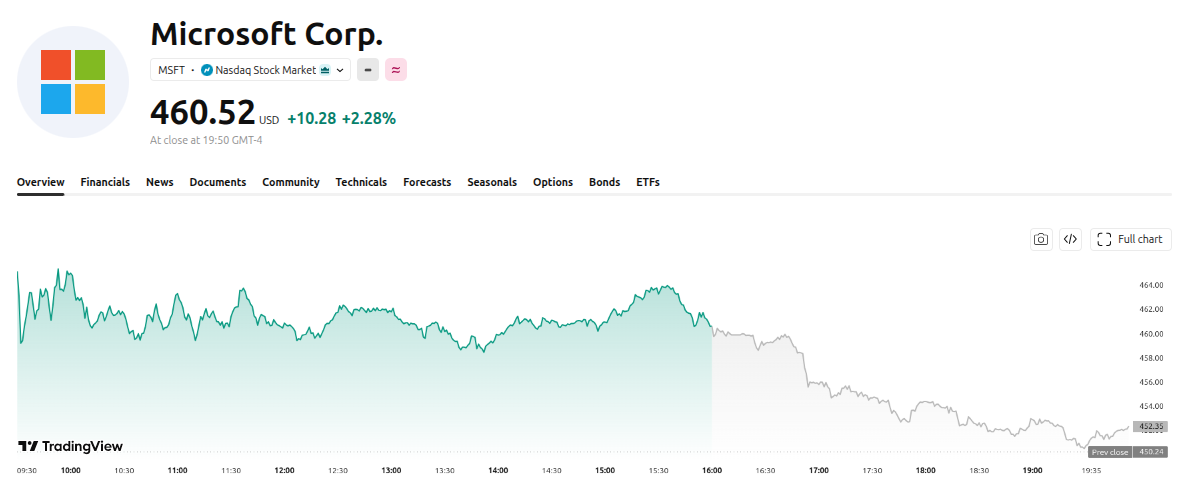
On the hyperscaler side, Microsoft tops his list. The company combines deep Azure integration with strong enterprise AI distribution, giving it leverage on both infrastructure spending and software monetization across multiple business lines.

Oracle rounds out the five. Its expanding cloud infrastructure footprint and growing AI workload base have made it an increasingly central player in the institutional AI buildout, fueling steady analyst upgrades and inflows.
“Now it’s spreading… second, third, fourth derivatives across AI. Every dollar spent on an Nvidia chip, there’s an eight-to-ten-dollar multiplier across the rest of tech. That’s why it’s the third inning,” he added.
What’s Next?
The next major catalyst is the Anthropic roadshow itself. Once the SEC review concludes, the company can begin formally pitching to institutional investors, with pricing dynamics likely to set the tone for the OpenAI and SpaceX listings expected later in the cycle.
Investors should also watch how capital expenditure guidance evolves at the major hyperscalers. Any signal that AI infrastructure spending will keep accelerating into 2027 would directly support the bullish thesis behind Ives’ five favorite stocks.
The post Dan Ives Names Top 5 AI Stocks to Watch Amid the Anthropic IPO Hype on Wall Street appeared first on BeInCrypto.
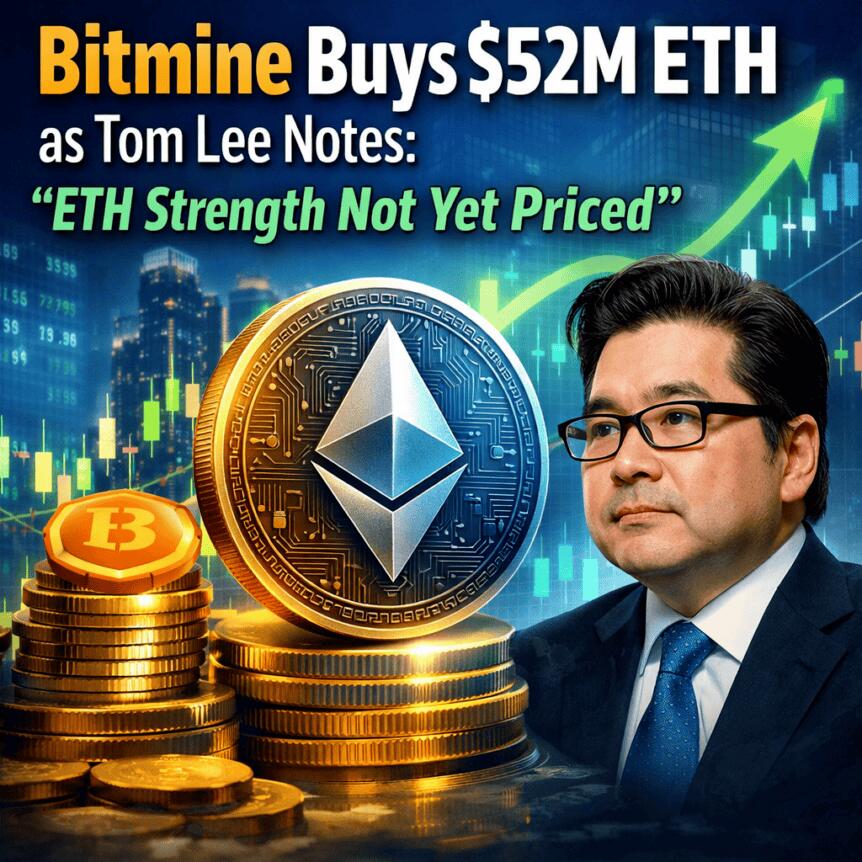
Bitmine Immersion Technologies has expanded its Ethereum holdings again, adding 26,497 ETH over the past week and lifting its total ETH reserves to about 5.42 million tokens. In a Monday statement, Bitmine chair Tom Lee reiterated that the move reflects a belief that Ethereum’s on-chain fundamentals are strengthening, even as crypto markets have faced choppier trading and broader sector volatility. The purchase adds to Bitmine’s reputation as the largest Ether treasury holder, a position reinforced by the company’s public disclosures and its ongoing accumulation strategy.
Bitmine now sits atop one of the most substantial crypto treasuries in existence, with estimates valuing its ETH stake at more than $10.5 billion at current prices. Earlier in the month, the firm slowed the pace of purchases after a stretch in which it scooped up more than 100,000 ETH per week for three consecutive weeks. The shift back to heavier buying signals the company’s continued confidence in Ethereum’s long-term appeal and its potential to weather near-term price softness.
According to Bitmine, the latest weekly addition brings its total ether holdings to roughly 5.42 million ETH, a level that underscores the company’s strategic thesis: that Ethereum stands to benefit from broader adoption, institutional interest, and the ongoing development of a sector-wide ecosystem around decentralized finance, tokenization, and scalable computing. The disclosure arrived via Bitmine’s X account, alongside the broader press materials that outlined the firm’s treasury targets and timeline.
Ether’s price action has chipped away at gains for the week. Data from CoinGecko show ETH down about 4.7% over the past seven days, trading in a wide band between roughly $1,963 and $2,126. In recent sessions, the token has hovered just under $2,000, illustrating the stubborn price rigidity that has characterized the market in recent months even as fundamentals push forward.
Lee spoke with CNBC on Monday to address the market backdrop, acknowledging that crypto sentiment has been softer as other technology sectors—particularly software—have shown resilience or even momentum. He framed the current lull as part of a familiar cycle, suggesting that the sector’s best days often follow a period that traders describe as crypto winter. The crypto market’s temperament, he implied, remains tied to the timing of macro catalysts and the pace of institutional adoption, rather than to short-term price swings alone.
Beyond price, Lee reiterated a conviction in the enduring usefulness of Bitcoin and Ethereum as foundational platforms for the next wave of digital money and commerce. He pointed to the parallel evolution of decentralized identity and verification as a natural complement to AI-enabled services and e-commerce, arguing that crypto’s core value proposition—trust-minimized verification and programmable money—will become increasingly central as digital interactions scale.
“As AI systems evolve, we’re talking about using commerce and operating websites, you need decentralized identity and verification, and that’s really what crypto does,” Lee said. “We know Wall Street wants to go toward tokenization; it’s a vast improvement in efficiency of how money actually moves, and that’s an innovation. The future isn’t changed.”
Bitmine’s public strategy has long centered on building a dedicated Ether treasury, a plan it outlined in July 2025. The target was to hold 5% of Ethereum’s circulating supply, a figure anchored to a ~120.6 million token base. With more than 5.4 million ETH already held, the firm has claimed roughly 90% of that goal—and it has signaled an expectation to complete the objective in 2026. The plan, if realized, would mark one of the most ambitious centralized treasury plays in crypto history and would position Bitmine as a persistent structural buyer in Ethereum’s market.
In context, Bitmine’s pace of acquisition has drawn attention to the potential role of corporate treasuries in crypto markets. While the weekly purchases in prior weeks signaled a robust, steady commitment, the subsequent slowdown reflected a balancing act as the market priced in uncertainty about macro conditions, regulatory developments, and sector-specific catalysts. The firm’s latest move, however, shows a renewed willingness to deploy capital in what it describes as a long-term, value-oriented strategy rather than a short-term trading bet.
From a market perspective, Ethereum’s fundamentals have continued to align with a narrative of digital identity, programmable money, and scalable, secure contracts. While price action remains a friction point for many active participants, the architecture of Ethereum—layered by upgrades, ecosystem maturation, and a growing array of decentralized applications—continues to attract attention from institutional and high-net-worth investors who view Ethereum as a long-duration asset with a compelling growth profile.
Key takeaways
- Bitmine’s ETH holdings rose by 26,497 ETH in the past week, taking its total to about 5.42 million ETH.
- The firm remains the largest Ether treasury holder, with an estimated value exceeding $10.5 billion at current prices.
- Ether’s price has weakened over the past week, down about 4.7%, trading in a range roughly between $1,963 and $2,126 per token.
- Tom Lee frames the current market as part of a broader crypto cycle, suggesting the “end of crypto winter” could be on the horizon as fundamentals strengthen.
- Bitmine’s long-term plan is to accumulate roughly 5% of Ethereum’s circulating supply (about 6.0 million ETH), with a target completion in 2026.
Bitmine’s ETH push deepens its treasury role
The latest purchase reinforces Bitmine’s strategy of building a robust Ether treasury as a core component of its business model. The 26,497 ETH addition adds to several weeks of aggressive accumulation that helped the company reach a multi-million-ETH position. The firm’s leadership has framed the stockpile as a bet on Ethereum’s continued network effects, including stronger on-chain activity, more robust DeFi liquidity, and an expanding ecosystem of smart-contract applications.
Industry observers have noted that such treasury commitments are relatively rare in scale, highlighting Bitmine’s willingness to deploy capital to a single-asset allocation that resembles corporate treasury behavior in traditional finance. The emphasis on a long-horizon strategy—rather than quick trades—suggests management’s belief in Ethereum’s role as a foundational layer of Web3 infrastructure and its potential to attract greater institutional participation as tokenization gains traction.
Bitmine’s leadership has repeatedly cited Ethereum’s ongoing upgrades, ecosystem growth, and the viability of smart contracts as the backbone for its conviction. The company publicly disclosed its Ethereum target and timelines, signaling that the treasury build is a deliberate, staged effort rather than a one-off accumulation. When viewed alongside other crypto institutions, Bitmine’s scale stands out, potentially influencing how peers think about treasury risk, liquidity, and strategic positioning in the coming years.
It’s worth noting that Bitmine began the year with a noticeably aggressive purchasing cadence, spurring conversations about the sustainability of such a pace. The company subsequently moderated its purchases, a move that some market participants interpreted as a cautious reassessment in light of evolving market conditions. The latest weekly addition, however, indicates a renewed commitment to enlarging the Ether treasury’s footprint in the near term.
Price backdrop and investor sentiment
ETH’s price action remains a key focal point for investors weighing the merits of such a treasury strategy. While Bitmine’s purchases demonstrate conviction in Ethereum’s longer-term trajectory, the near-term price dynamic continues to reflect a mix of macro uncertainty, regulatory risk, and shifting risk appetite across crypto assets. The price softness over the past week contrasts with the anticipated flow of capital from institutions and strategic buyers who view Ethereum as a core blockchain with scalable potential.
Lee’s remarks to CNBC emphasize a paradox often observed in crypto markets: while price moves can lag the underlying fundamentals, institutional and strategic interest can still intensify as the ecosystem matures. If Ethereum’s upgrade cycle, Layer-2 rollups, and the broader tokenization narrative begin to translate into tangible on-chain activity and liquidity, investor sentiment may begin to reprice risk more decisively. For now, the price remains a secondary indicator to the structural growth story Bitmine is betting on.
In parallel, industry watchers will want to monitor the progress of Bitmine’s 2026 target. Reaching 5% of circulating supply would require steady, sustained accumulation, and any deviation—whether due to liquidity constraints, tokenomics shifts, or regulatory headwinds—could influence how other corporate treasuries calibrate their own crypto exposure. The path from strategic buy-and-hold to realized influence in Ethereum’s market remains uncharted, but Bitmine’s evolving treasury could serve as a reference point for future large-scale corporate involvement in crypto.
Tokenization, identity, and the broader crypto thesis
Lee’s commentary underscored a broader narrative that crypto supporters have been advancing for years: that blockchain-based tokenization and decentralized identity are not only intrinsic to the technology’s value proposition, but are likely to accelerate as digital commerce expands and AI-powered systems proliferate. In practical terms, that means more efficient settlement, identity verification, and access control across financial services, supply chains, and digital services—areas where Ethereum and similar platforms could play a central role.
From a market structure perspective, the interaction between institutional tokenization ambitions and Ethereum’s on-chain capabilities could create a layered demand dynamic. If Wall Street and corporate treasuries continue to pursue tokenized assets, programmable money, and trust-minimized settlement, Ethereum’s ecosystem—the backbone for smart contracts—could see a more persistent bid, even in the absence of rapid price appreciation in the short term.
Bitmine’s strategy thus sits at a crossroads of technology, finance, and governance. It is a high-profile example of how large crypto treasuries operate, how they articulate their rationale to the market, and how they respond to shifting cycles of price and sentiment. While this week’s ETH purchases and the five-percent target are notable, the ultimate question remains: will the institutional appetite for Ethereum-scale holdings translate into sustained demand and price resilience as the ecosystem matures?
As the sector navigates regulatory developments and evolving market dynamics, readers should watch for three signals: the trajectory of Bitmine’s treasury target toward completion in 2026, any incremental data on Ethereum’s upgrade roadmap and Layer-2 adoption that could lift on-chain activity, and broader market reactions as institutional investors increasingly articulate long-term crypto exposure alongside traditional asset classes.
Source and official disclosures from Bitmine can be found in the company’s latest post on X and accompanying press materials, including the press release detailing ETH holdings and treasury status. For price reference, CoinGecko’s ETH data is used to outline recent movement, while Lee’s commentary is drawn from his CNBC interview and related remarks reported by industry outlets.
Readers should stay tuned to Bitmine’s ongoing disclosures and any regulatory developments that could affect large-scale crypto treasury strategies. The next couple of quarters will be telling as the firm pushes toward its 2026 milestone and as Ethereum-based use cases continue to mature in the real economy.
Note: This article reflects information disclosed by Bitmine and publicly available market data. All figures are subject to change with market pricing and corporate filings.
Crypto World
Strategy (MSTR) sold bitcoin in late May, and told the market in June. Here’s how Polymarket bettors are fighting over when it counts.


The Polymarket contract asked a simple question: did Strategy (MSTR) sell any bitcoin by May 31? The company’s filing says it sold 32 BTC between May 26 and 31. The filing came out June 1. That gap has split bettors into a $79 million fight over whether a sale counts when it happens, or when it’s confirmed.
The dispute turns on a single ambiguity: the rules ask whether Strategy sold bitcoin “by 11:59 PM ET” on May 31, but they don’t say whether that means the sale must have occurred by then or been confirmed by then.
Strategy executed the trades between May 26 and 31 and dated the activity “as of May 31, 2026, 4:00 p.m. Eastern Time” — inside the window. But the 8-K disclosing them wasn’t filed until June 1, after the market closed. So the sale date falls before the deadline; the filing date falls after it. Which one governs is the whole fight.
The fight breaks into three camps, and it plays out in the language of UMA’s voting options. One says the market is event-based and should resolve “Yes” (P2), because Strategy’s own filing dates the sale inside the deadline.
Another says it is effectively announcement-based and must resolve “No” (P1), because nothing confirmed the sale before the market closed. A third invokes P4 — the “too early” vote, meant for proposals made before an event has occurred — arguing the rules were too vague to resolve until Strategy’s filing landed.
CoinDesk went through the dispute threads on both Polymarket and UMA’s Discord channels, and with the assistance of AI, summarized the arguments the different camps are making.
The ‘Yes’ case: the sale is what matters
This camp reads the market as event-based, pointing to rules that resolve “Yes” if the firm “sells any of its Bitcoin” by the deadline, with no requirement that the sale be announced by then.
Their evidence is Strategy’s own disclosure, which lists the 32 BTC as sold “during period May 26, 2026 to May 31, 2026” and presents the activity “as of May 31, 2026, 4:00 p.m. Eastern Time” — inside the window. Because the rules name “information from MSTR” as the primary resolution source, they argue, the source itself confirms the sale.
Several add that Strategy reports weekly, usually on Mondays, so a late-month sale could never be confirmed before a month-end deadline — making a “No” reading a bet on filing schedules rather than events.
The ‘No’ case: only what was knowable by the deadline counts
This camp treats the market as announcement-gated, citing past Polymarket markets that resolved using only information available within the timeframe. The 11:59 p.m. ET deadline, they argue, defines a closed window: new information can always arrive later, but it doesn’t reach back to change a settled outcome, and nothing had confirmed a sale when the answer was proposed June 1.
Some note that the “as of May 31” language the other side leans on only surfaced in that day’s filing. Underpinning it is an integrity argument — that if a dispute can hold a market open until favorable evidence appears, anyone could extend any deadline for the price of a bond.
The ‘too early’ case: the rules can’t resolve this yet
A smaller group argues the market was too poorly drafted to resolve cleanly either way, noting the rules require the sale to occur “on the date specified in the title” rather than “by” it, leaving no coherent timeframe.
With Strategy’s filing due imminently and named as the primary source, this camp contends the market should have stayed open until that disclosure published rather than being resolved on a deadline they consider malformed. The “No” camp’s reply: P4 doesn’t apply, because the sale itself predates the deadline — the proposal wasn’t early, the confirmation was just late.
Polymarket’s clarification, and the catch
Polymarket has since added context backing the “No” reading, stating that no information from MSTR, on-chain data, or credible reporting confirmed a sale within the timeframe and that “confirmation achieved outside of the market’s time frame does not qualify.” Traders priced it accordingly, with the May 31 contract collapsing from 81% “Yes” during the dispute to under 1%.
But Polymarket doesn’t cast the final vote — UMA’s token holders do, and the two have split before. In 2024, UMA voted that Barron Trump wasn’t involved in the DJT memecoin; Polymarket overruled the oracle and refunded “Yes” holders anyway. For now, the two appear aligned.
The sale everyone can see is trading at less than a penny.
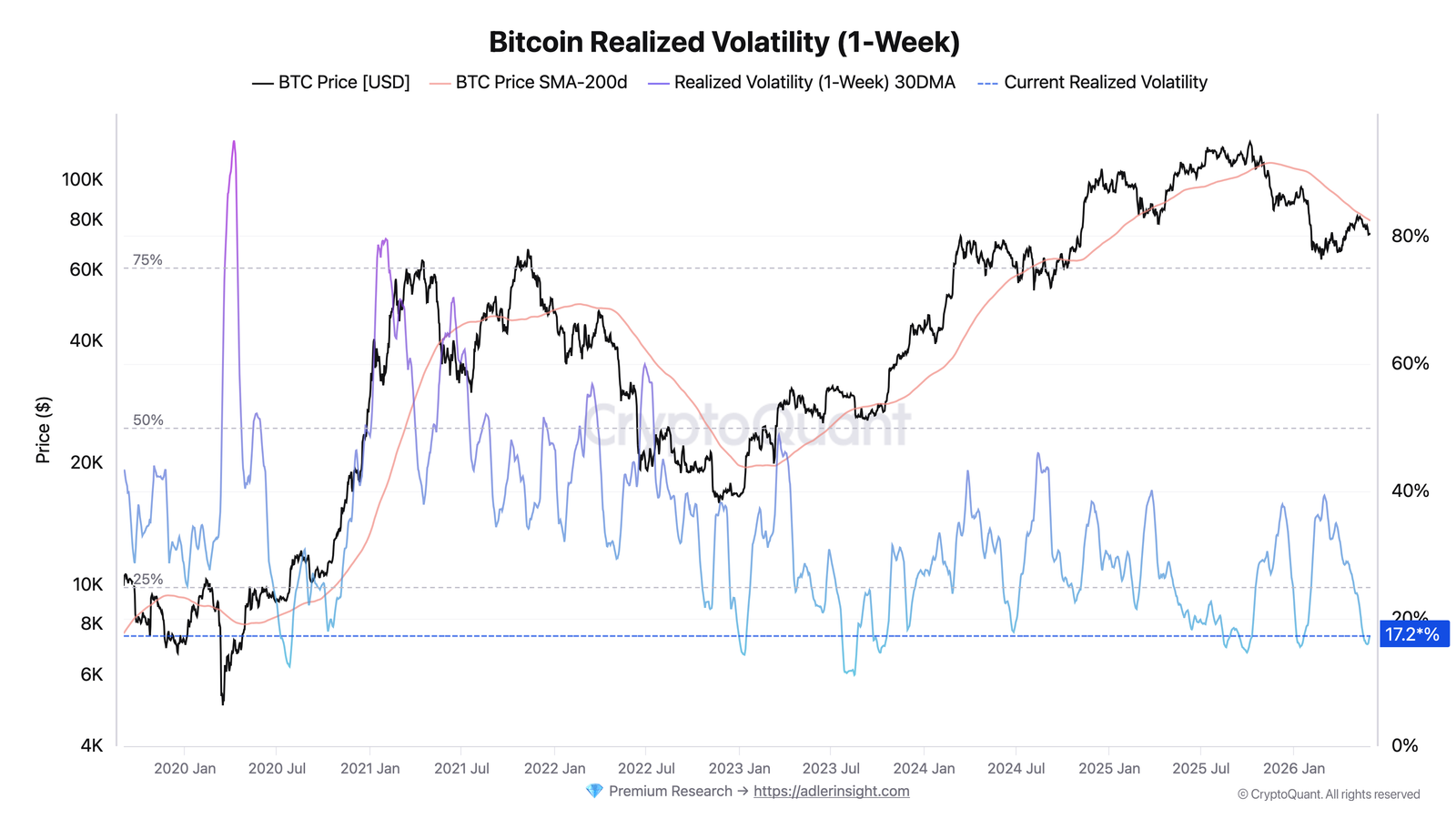
Bitcoin’s realized volatility has fallen to 17.2%, one of its lowest levels in recent months. Multiple Bitcoin analysts have said that long periods of price compression, alongside declining volatility, have historically preceded double-digit rallies.
Bitcoin realized volatility is down 56% in Q2
Bitcoin researcher Axel Adler Jr. said that BTC’s one-week realized volatility, smoothed over a 30-day period, has fallen to 17.2% from 39% this quarter, a 56% decline.
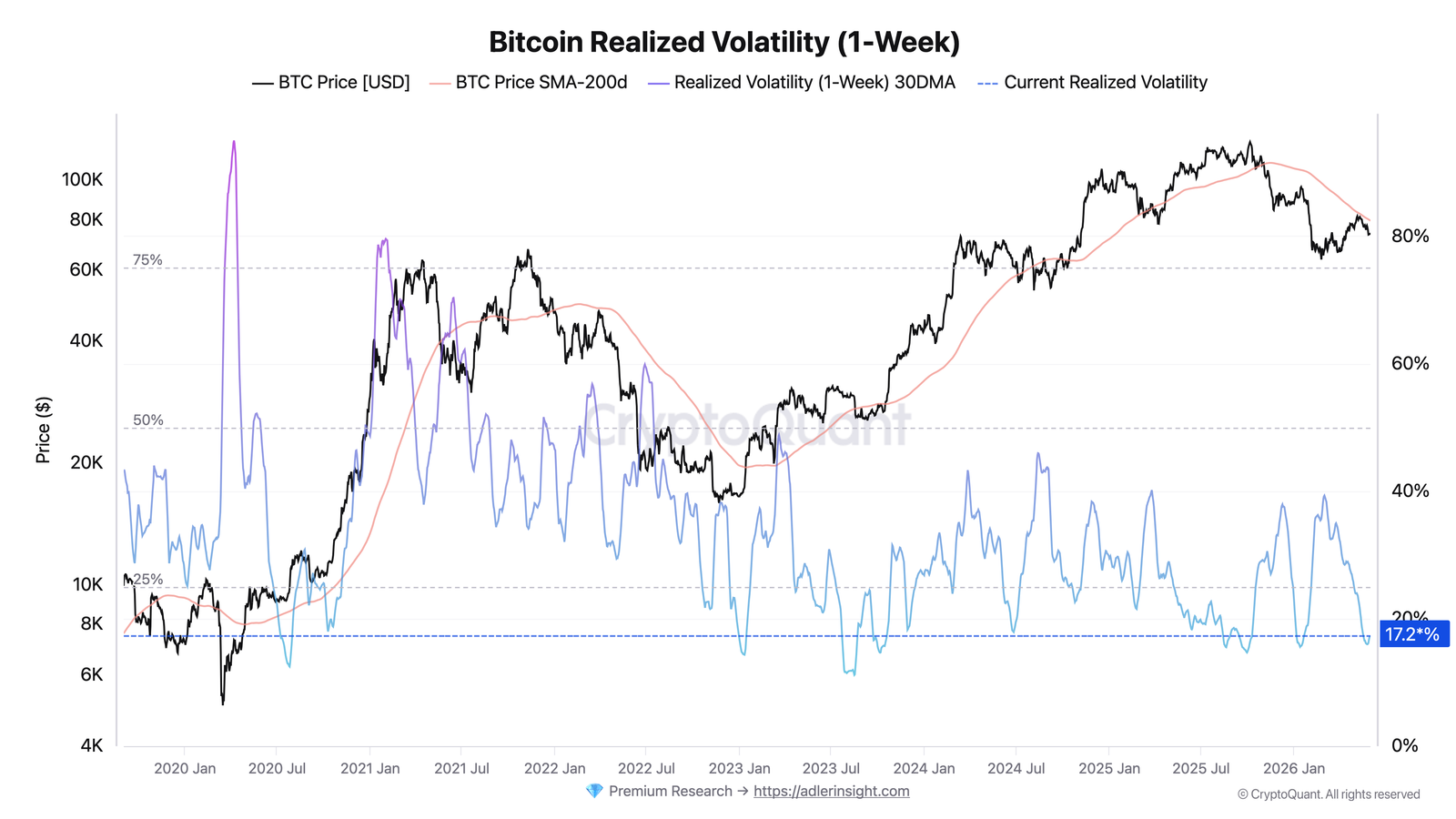
Bitcoin realized volatility (one-week). Source: CryptoQuant
The realized volatility, which measures how much the price has actually moved over a given period, sits well below its long-term median of 40%. Adler explained that such volatility compression may lead to a major price move.
However, the metric does not indicate direction. Instead, it measures how much momentum is building while the price movement slows.
The long-term volatility gauges tell a similar story. Three-month realized volatility has fallen to 80% from 109% since early April, while six-month realized volatility declined to 127% from 148%.
The drop across multi-time-frame volatility measures indicates that price movement has become compressed, a condition that may precede larger market moves.
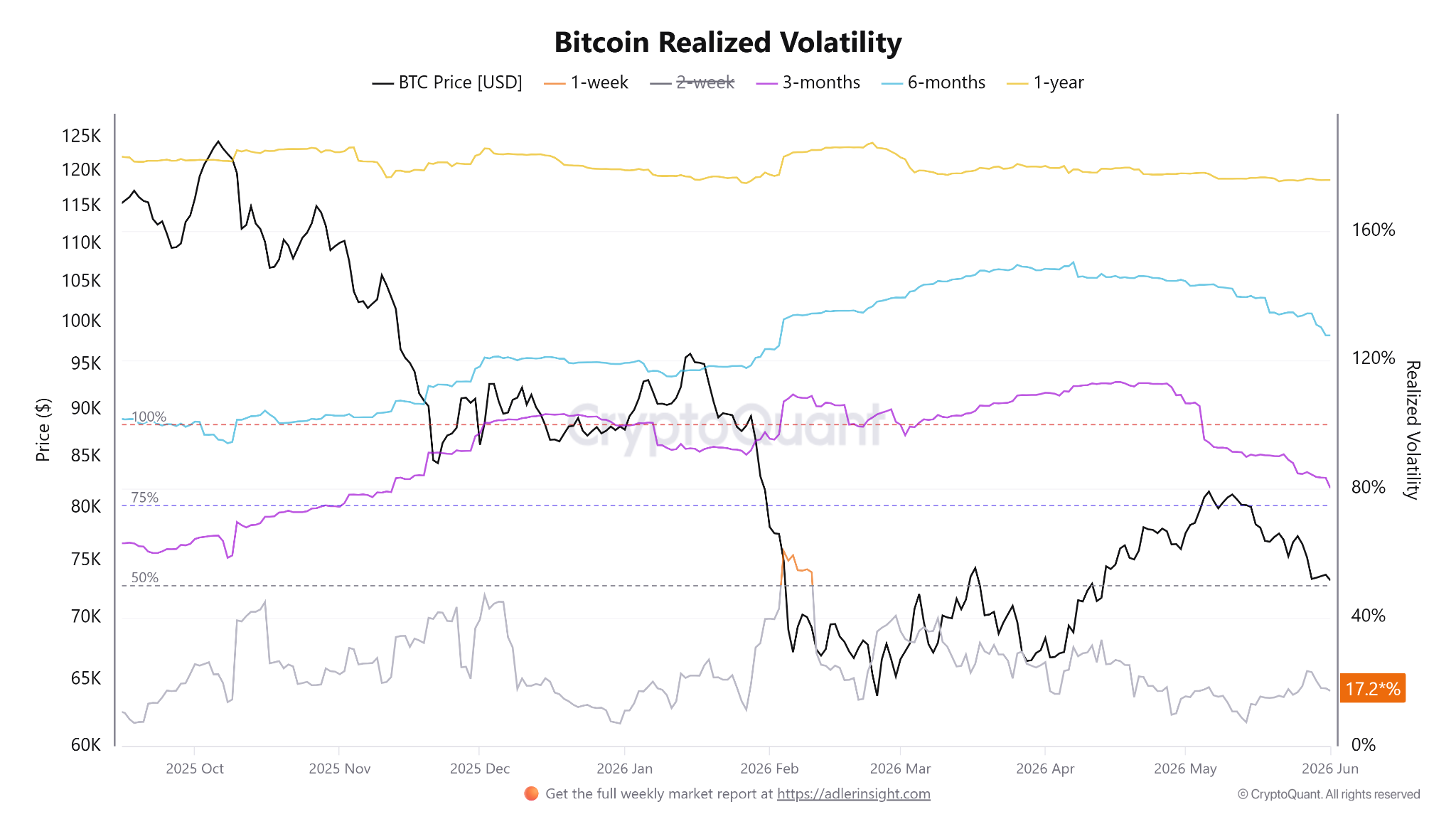
Bitcoin three- and six-month realized volatility. Source: CryptoQuant
The network valuation data adds another layer. The Bitcoin growth rate metric, which compares market capitalization growth to realized capitalization, has remained negative for more than six months. The delta, or 365-day moving average, recently slipped to -0.0013, indicating that BTC’s market value is growing more slowly than its realized value.
Adler said that the data points to a cooling market. Bitcoin’s price is not rising as quickly as the capital flowing into the network, suggesting investors are becoming more cautious amid reduced market volatility.
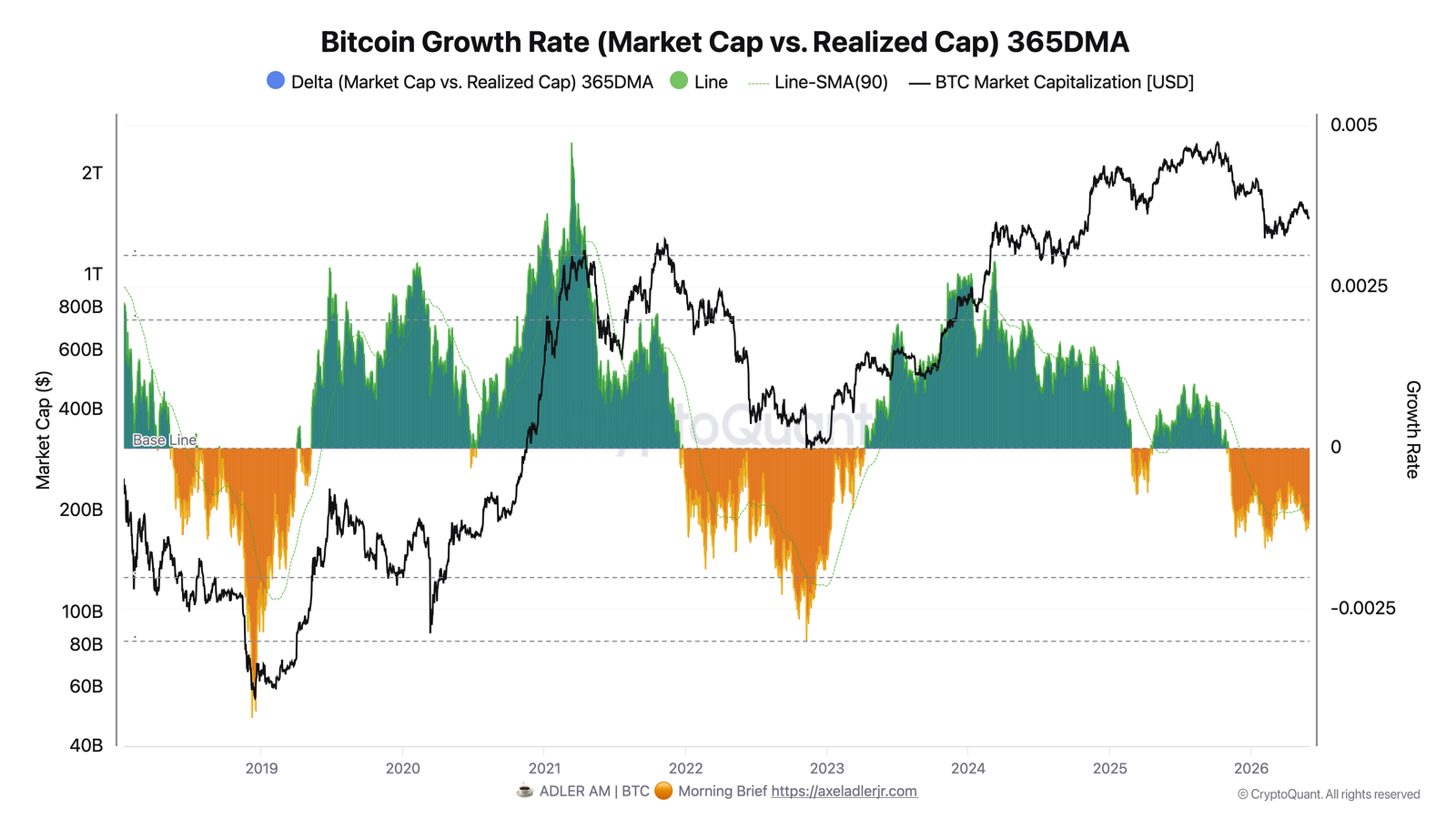
Bitcoin growth rate based on market cap and realized cap. Source: CryptoQuant
Related: Bitcoin price targets $78K as BTC holders defend ‘strongest near-term support’
Bitcoin enters a “tug-of-war” phase, says analyst
CryptoQuant analyst Maartunn said Bitcoin has spent 114 days trading within a broad range of $60,000 and $80,000, while the Bitcoin volatility index has dropped toward multi-month lows near 0.90.
According to Maartunn, similar periods of compression have historically preceded 10% to 20% moves once the price range breaks.
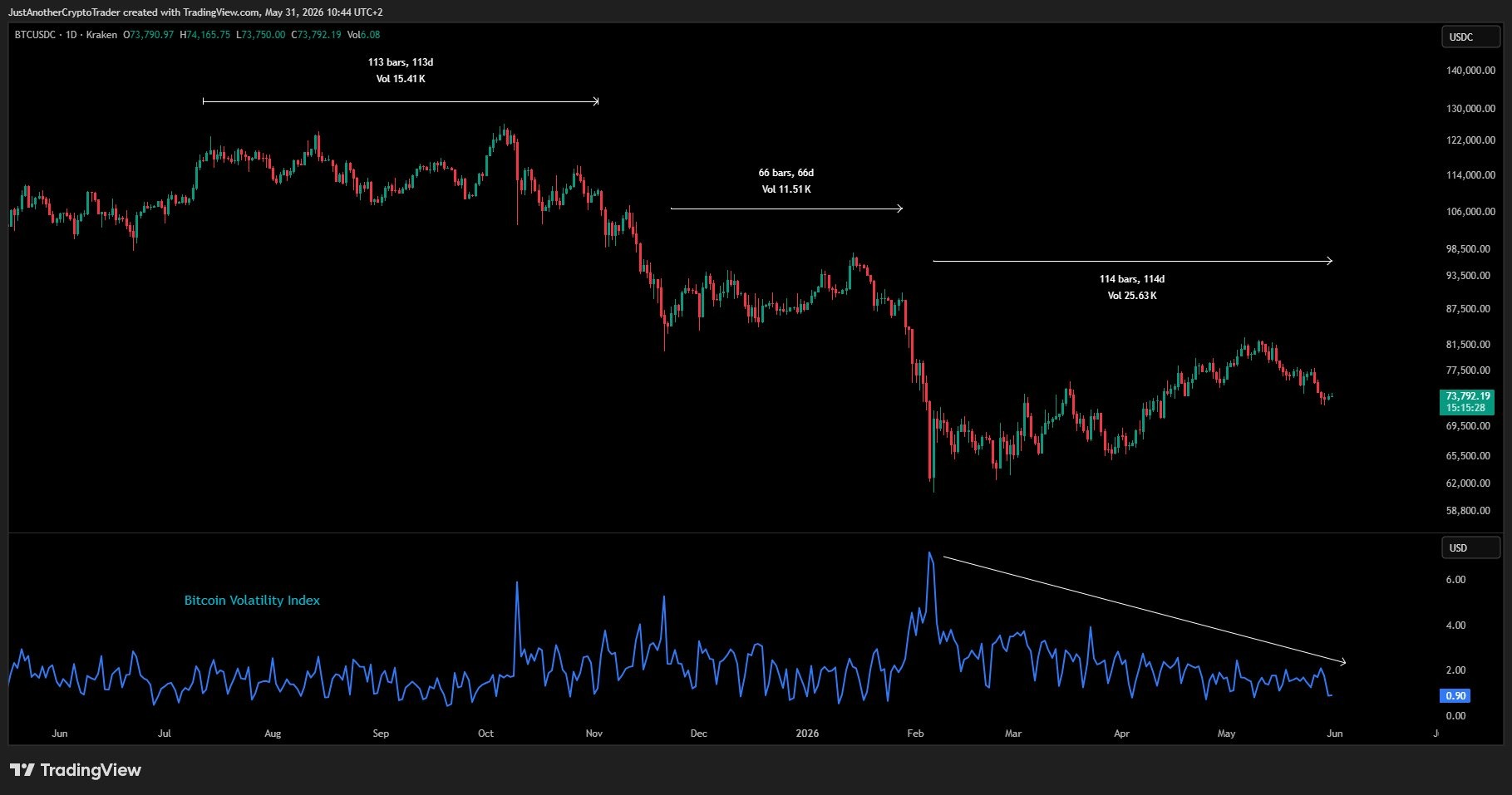
BTC price and volatility index analysis by Maartunn. Source: X
MN Capital founder Michael van de Poppe remained bullish on BTC, stating the current area as a key support zone. Van de Poppe said,
“If history repeats itself, that means that we’re going to see two great weeks of upwards momentum for Bitcoin and the end of this correction. It’s a crucial support zone for Bitcoin, which needs to hold in order to prevent a test at $61,000 to happen.”
Meanwhile, CryptoQuant analyst Amr Taha pointed to a growing split in market behavior. Binance’s 30-day Bitcoin inflows rose by roughly $5.6 billion since April across both retail and whale cohorts. Retail inflows increased by $3.6 billion, surpassing the $2 billion rise from whale wallets.
At the same time, wallets holding between 1,000 and 10,000 BTC accumulated 55,450 BTC on May 30, marking their strongest accumulation activity since February. Taha added,
“For Bitcoin, this points to a tug-of-war phase. Exchange inflows are increasing, which may create near-term selling pressure, but large wallet accumulation is also returning, which could provide underlying support if demand remains strong.”
Related: Trump says Iran will ‘work out well’: Five things to know in Bitcoin this week

Wockhardt shares pause massive 36% rally in 5 sessions; slip 7%. What’s behind the selloff?

Gnosis Pay exploit tied to Zodiac delay module as users exit

Praggnanandhaa, Gukesh, Divya shine as India stays in title contention | Other Sports News

Steven Gerrard disagrees with Gary Neville over ‘shock’ Chelsea and Arsenal claim | Football

US brings back mandatory military draft registration

Register Renaming | Hackaday

FINANCIAL ACCOUNTING | EXPECTED QUESTION| NON PROFIT ORGANISATION | FYUG BCOM CALICUT UNIVERSITY 2ND

Most vs least financially literate US states #usa #california #colorado #minnesota #finance #hawaii

LOL INVESTING IN XRP THE WRONG WAY? – BANK CRISIS LOOMS & BAIL-INS! – HIGHER PRICES & NOBODY CARES?
-

 NewsBeat6 days ago
Israel says it has killed new Hamas military leader in Gaza City airstrikes
-

 Tech6 days ago
NASA taps Blue Origin to deliver lunar rovers for Moon Base initiative
-

 News Videos6 days ago
XRP *JUST* SUCCEEDED!!!! CLARITY ACT EXPOSED!!! (SHE EXPOSED IT)
-

 News Videos4 days ago
This is BROKEN! INSANE 5x MONEY CAR WASH WEEK! The NEW GTA Online UPDATE Today! (GTA5 New Update)
-
 Crypto World6 days ago
Micron Crosses $1 Trillion Market Cap as AI Demand Reshapes Memory Sector
-

 Business6 days ago
Selena Gomez Reportedly Upset Over Benny Blanco’s Comments on Her ‘Terrible’ Diet
-

 Tech4 days ago
Waymo dominates autonomous vehicle registrations as Tesla trails behind
-
 Tech3 days ago
SpaceX just won a second Golden Dome contract. This one is $4.16 billion.
-

 Tech6 days ago
The Samsung pay deal is the moment Korean unions changed register
-
 NewsBeat3 days ago
FIRST NIGHT REVIEW: Take That bring the Circus back to life in spectacular sun-soaked style
-

 Entertainment6 days ago
Days of our Lives 2-Week Spoilers May 25-June 5: Gwen Rages, Abe Confesses & 2 Tragic Anniversaries!
-

 News Videos3 days ago
SHE IS KILLING XRP!!! WATCH URGENT AND ACT FAST
-

 Tech6 days ago
Millions of AI agents imperiled by critical vulnerability in open source package
-

 Business9 hours ago
Jade Biosciences, Inc. (JBIO) Discusses Positive Interim Results From JADE101 Phase I Healthy Volunteer Study and Development Plans Transcript
-
Crypto World6 days ago
SpaceX’s $2 Trillion IPO: Why Tech Giants Nvidia (NVDA), Apple (AAPL), and Microsoft (MSFT) May Face Pressure
-
Crypto World4 days ago
CFTC Has Approved the First Regulated Bitcoin Perpetual Contract in the U.S.
-
 Crypto World7 days ago
Bitcoin’s April recovery showed signs of structural accumulation
-
 Crypto World6 days ago
Spain blocks prediction markets Polymarket Kalshi
-
 Crypto World4 days ago
Snowflake (SNOW) Stock Rallies on Strong Q1 Results and AI Product Growth
-

 NewsBeat7 days ago
Family pay tribute to Eston ‘murder’ victim Peter Phillips
You must be logged in to post a comment Login