



A great many UK households share a boundary fence with a neighbour, and at some point, those fences will inevitably need replacing. It’s a tiresome business that few people relish dealing with.
But what are your legal rights when it comes to it, and who bears responsibility for the replacement? Property specialists Hamptons warn that fencing disputes can swiftly sour even the most friendly neighbourly relationships. Whether you’re planning to put up a new fence, dealing with one that’s fallen into disrepair, or simply trying to establish who owns what, having a clear understanding of your legal standing is absolutely essential.
They point out that in England and Wales, there is no automatic obligation to put up or maintain a boundary fence, but where one already exists, a specific set of rules comes into play. From height restrictions to planning permission, and from establishing ownership to settling disagreements, there are numerous legal considerations to navigate when it comes to fencing between neighbouring properties.
Hamptons says: “Disputes over fence ownership are one of the most common and often confusing issues between neighbours. If you’ve ever wondered who owns the fence between two houses or which side is yours to maintain, you’re not alone.”
Establishing fence ownership matters because it decides who is responsible for repairs, replacements or any alterations. While it might seem minor, making the wrong assumption can lead to legal problems, added costs and friction with your neighbour.
Hamptons say: “To clarify the situation, examine your title deeds and look for “T” marks. A T positioned on one side of the boundary line typically indicates that the property owner on that side is responsible for the fence. A double T, forming an H, often shows joint responsibility. Review the title plan. If it’s unclear or silent about the fence, you may need advice from a solicitor or to instruct a boundary surveyor.” But do not rely on informal chats or other such agreements.
Many homeowners believe they are responsible for the fence on a particular side, often the left when looking from the back of the house. This is a common misconception and not supported by UK law. Citizens Advice says: “Look at the legal documents for your home. They might say you have to keep the wall or fence that you’re disagreeing about in a good state of repair.
“You should also check if the wall or fence is safe – if it isn’t, your neighbour or the council could take action against you. “If the wall or fence is safe and there’s nothing about repairing it in your legal documents, it’s up to you whether you do what your neighbour’s asking.”
Another issue worth bearing in mind is H marks. Estate agents Jones Robinson note that where the title plan displays an H mark (two T marks joined together), responsibility for the fence is shared equally between both neighbouring properties.
Yet they note that where one neighbour has looked after a boundary feature informally for a long time, that history can become legally relevant. Even an undocumented arrangement like this could affect how a dispute is resolved if it ends up in court.
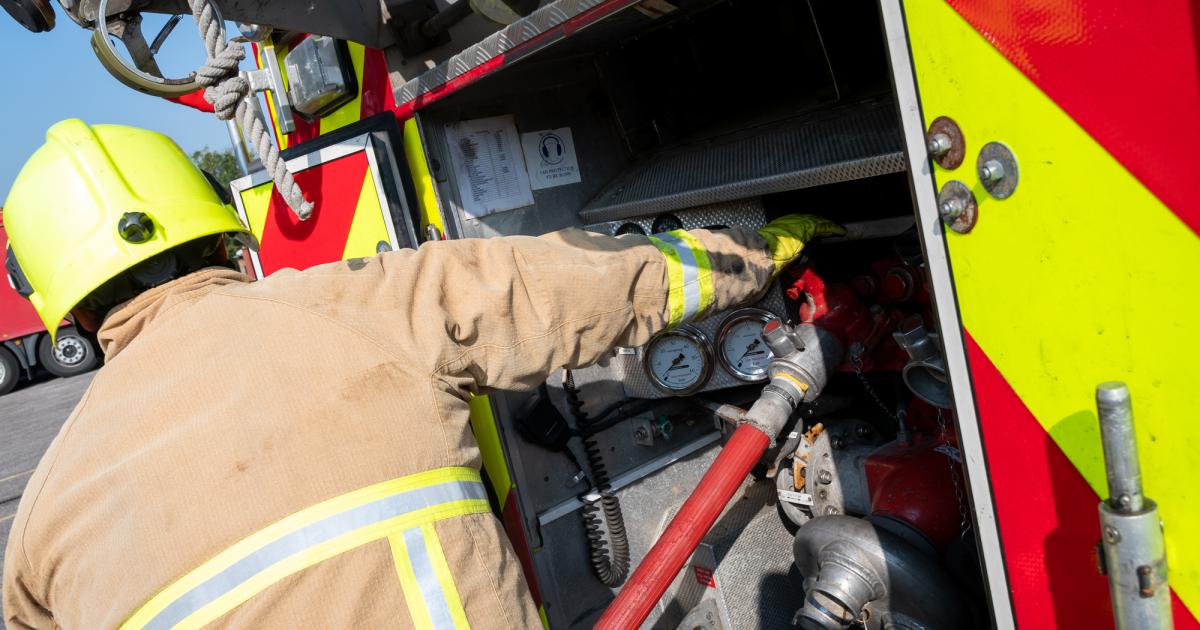
Firefighters have brought the blaze in Queen Street, Scarborough, under control but the road remains closed at its junction with Elders Street on Saturday morning (August 8), North Yorkshire Police said.
Market Street and sections of pavement in the area are also closed while emergency services work on the scene.
Traffic can still access Friar’s Way but police are urging people to avoid the area.
“Please avoid this area to allow the crews to work safely,” a police spokesperson said.
Video showed two fire engines parked outside the Boyes department store in Queen Street.
A Boyes staff member said they understood the fire was at a unit opposite the store in Queen Street.
Police said a market is still running in the area.
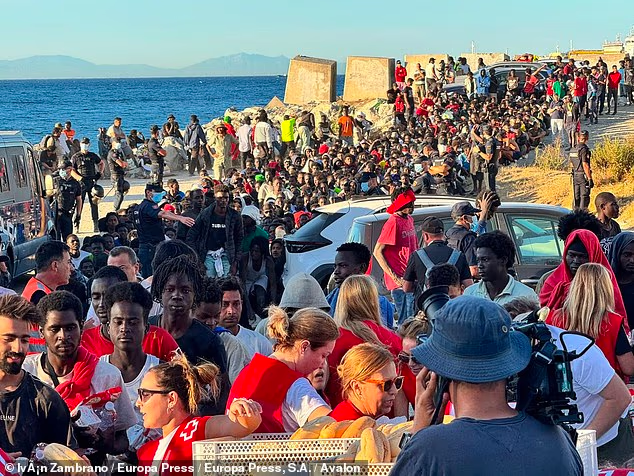
On the promenade overlooking the main tourist beach in the tiny Spanish enclave of Ceuta in Africa, a Sudanese teenager in a tattered T-shirt prays on his knees to Allah at three in the afternoon.
He arrived from neighbouring Morocco ten days ago, swimming miles to the beach, and now hopes for a free pass to Europe where, he says, he will work hard, make a new life, but never relinquish his Muslim faith.
After a six-year, 2,700-mile journey from his village, Abdelhadi Ali, a slim 18-year-old, is now in touching distance of the EU.
He, like 60,000 others from across Africa, broke into Ceuta – an hour’s boat ride from the Spanish mainland – during an orchestrated border invasion at the end of July.
It has huge implications for society in the EU and Britain, which are already reeling from repeated waves of uncontrolled immigration over the past decade.
Many of the adults who arrived in Ceuta with Abdelhadi have reluctantly returned to Morocco after being frogmarched out by Spanish border guards or leaving of their own accord in the face of a hostile reception from terrified, and devoutly Christian, locals.
Entire families hid in their houses for days, only emerging to throw stones at what they called an ‘Islamic armada’ of young men and boys who ran amok, breaking into private properties and looting supermarkets, which are now guarded by the army, as they searched for food and water.
But a deceitful narrative is being peddled by politicians, including our own new Prime Minister, that this crisis is over. The truth is it’s only just beginning.
The Red Cross and the Sur Sur organisation distributing aid in Ceuta on August 3, 2026

Despite Andy Burnham’s claims that 98 per cent of the migrants have left, many remain on the beach in Ceuta, seen here playing football while others rest and sunbathe, on August 6, 2026

Huge numbers of migrants, pictured on August 6, gather on Benitez beach in Ceuta
This week, to my horror, I have witnessed a migration catastrophe unfolding in Ceuta, with a multitude of children, some only 11 or 12, at the heart of it.
For make no mistake, between 2,000 and 4,000 young north African and sub-Saharan boys have not budged an inch since arriving – and have no intention of doing so.
They have become pawns in a migration disaster sparked by families sending their children to find a better life in Europe, spurred too by an avalanche of social media messages flooding Africa that encourage the young to up sticks and leave via Ceuta, which is seen as a gateway to Madrid, Berlin or London.
Over two days in the enclave, which covers just seven square miles, I spoke to 50 of the young arrivals, who all said they are going nowhere but onwards to Europe.
They are sleeping on pavements, doorways, in the hills and even under beach umbrellas.
At the only industrial estate, there is now a shanty town where youngsters run up and down alleyways in which they have built shelters from old beds and upturned bathtubs draped in sheets or blankets to shade themselves from the sun.
Outside the main police station, I watched hundreds of children on Wednesday and Thursday sitting pathetically in rows on the street as they waited in the vain hope that the Spanish authorities would give them the paperwork necessary to allow them to board ferries to mainland Spain.
But with Spain’s Left-wing prime minister Pedro Sanchez enjoying a summer holiday on Lanzarote, in the Canary Islands, there has been no indication from the political establishment in Madrid that they will be granted their wish.
Join the discussion
How should Europe respond to the growing numbers of young migrants entering through Ceuta?

Two masked police officers stand guard as migrants queue for food and aid from the Red Cross

Migrants form a line started by a police officer as they wait to receive support from charities

Abdelhadi Ali, 19, who travelled from Libya to Ceuta, told the Daily Mail that the Cueta migrants ‘want to find our place in Europe’
Sanchez was the first politician to peddle the myth that 98 per cent of the ‘invaders’ had gone back across the border into Morocco.
This line was later parroted by Andy Burnham, who quoted Sanchez in a speech as he stood on the White Cliffs of Dover last week, before he, too, departed on holiday.
Nothing could be further from reality. This is a humanitarian disaster unfolding in real time, which also threatens the national security of Europe.
Spanish intelligence services say ISIS jihadis from across war-torn Africa have been caught among the tens of thousands who seized the chance to enter Ceuta.
I met a Moroccan-born thug of 31, calling himself by the pseudonym Mamoud, one of the many thousands who swam into Ceuta.
He spoke English with a London accent because he spent ten years in England, much of it in prison, and now wants to return.
We spoke at a petrol station near the port, where he told me that he had travelled across the Channel on a lorry as a young teenager.
After being placed with foster parents, he spent time ‘inside’ for two convictions of grievous bodily harm and various other offences.
This boastful ex-jailbird says he left the UK voluntarily ten years ago ‘because they were going to throw me out anyway’.
He adds: ‘I spent more time locked up than living free in your country. But I miss England. This is my chance to go back.’
This extraordinary invasion has its roots in Pedro Sanchez’s announcement last January of an amnesty for all illegal foreigners living in Spain.
It was pushed through by royal decree, ostensibly to solve a worker shortage and boost the economy.

Hordes of migrants wait in line together as police officers keep order on the Spanish enclave

Hamza, 17, travelled from Tangiers, Morocco and swam across the border into Ceuta

Adam who is 14-years-old swam in on Monday, days after the initial incursion to the enclave
But the move went down badly with the voters, who reacted by routing socialist candidates at an election a few weeks later in the bellwether region of Aragon.
Since the amnesty, 1.2 million north Africans (mostly Moroccans and Algerians), Latin Americans and sub-Saharan illegals in Spain have taken advantage of the Sanchez deal, sending a message ricocheting across the world that the country is now an open door to Europe.
‘When one member state acts alone over migration, the whole European bloc is put at risk,’ Right-wing politicians in Brussels said in a statement.
If they were angry then, today they are apoplectic over the Ceuta disaster and call it an Angela Merkel Mark 2 in the making, a reference to the former German chancellor’s decision to open her nation’s borders to Syrians fleeing a civil war in 2015.
Naturally, Merkel’s unilateral and inexplicable decision provoked the biggest wave of inward migration into Europe since the Second World War.
In came 1.2million strangers during one year, many of them not Syrians but chancers from elsewhere.
It is an influx that has turned a nation that was once post-war Europe’s economic powerhouse into a near basket-case, as it struggles to support people who lack the skills to find employment and have to be supported by the state.
The numbers of migrants entering Germany is still more than one million annually (a total swelled by thousands of Ukrainians given sanctuary from the war in their homeland).
As a result, the face of Europe has been changed for ever, as many move to other countries, often choosing to take a Channel boat to Dover.
Now tiny Ceuta lies in the crosshairs of another migration surge thanks to its highly insecure land and sea border with neighbouring Morocco.
Ever since January’s amnesty, social media posts on TikTok and Instagram have been advertising ways to get to Europe from Africa using Ceuta as the stepping stone.
Traffickers have been offering ‘pay when you arrive’ deals couched in snappy Arabic-language slogans, which offer ‘swimming partners’ or jet-ski rides.

Red Cross aid workers prepare supplies for a group of migrants sitting down awaiting instructions

Saifedine Armrani, 15, from Sudan, only told his parents his whereabouts when he called them from Ceuta

Adil Cheddad, 20, who was found on a street corner with his 25-year-old brother said they want to move to London for a better life
In mid-June – six weeks before the main migrant invasion – an online video captioned ‘Ceuta is calling’ attracted 1,370,000 views in north Africa within a few hours.
Another piece of footage claiming arrivals would easily be transferred to Spain, both officially by the Sanchez’s authorities and illegally by smugglers, was watched by 646,053, many of them impressionable youngsters.
The scene was set. But if social media was the push factor here, the pull factor was in full swing, too.
Many of Europe and the UK’s powerful refugee charities, backed by socialist politicians, oppose strict national borders.
Reputable freelance journalist Charlotte Gill reported this week that £700million in taxpayer funding is handed annually to British charities which support a borderless world or new safe routes for migrants who want a new life in the West.
They include outfits such as the Refugee Council, Migrant Help and Refugee Action. ‘They don’t need democracy or to win at the ballot box,’ Gill pointed out in an online broadcast. ‘They are very powerful.’
Andy Burnham, in his Dover speech, also promoted ‘safe routes’ for migrants to stop traffickers controlling the Channel boat crossings.
John Swinney, the hard-Left First Minister of Scotland, went even further, offering safe passage for all the thousands of Ceutan arrivals.
Both are on the same page as Sanchez, who vigorously opposes a ‘Fortress Europe’.
This week on Ceuta, I saw the result of this socialist dream: utter chaos. Spanish police, wearing face masks as a guard against infection, marshal the endless queues of migrants on the main Benitez beach as Red Cross teams in fleets of white vans distribute food and water.
Ambulances are on hand to test for HIV, hepatitis and tuberculosis, and ferry the sickly to the island’s 249-bed hospital, which is now so overstretched it is turning away locals.
‘We were very scared,’ said 21-year-old student nurse Javier who lives with his parents in central Ceuta.

Moussef Elrmromi, 15, and three young friends, two aged 19 and one aged 17, pictured at an electric vehicle charging station

Two young Moroccan men wearing a Gucci cap and a PSG football short pictured smiling together in Ceuta
‘Now all our public services are collapsing. The hospital, police station, all overwhelmed by strangers we didn’t invite in.’
The enclave’s mayor Juan Jesus Vivas – who has called for the immediate expulsion of all the arrivals and ‘real’ EU border reinforcement to protect his beleaguered people – begged the European Parliament for more emergency help on Tuesday.
He admits he has no inkling of how many would-be migrants remain in his enclave, as he does not have the manpower to count them.
What we do know is that 900 are inside the main migration camp. Tents have been erected in the grounds to house the overflow, while a further 2,000 are living rough nearby.
Thousands more are sleeping in doorways, in gardens, in parks, anywhere they can find to lay their heads.
On the outskirts of the ferry port, I meet a 15-year-old called Moussef Elrmomi from Tangier in Morocco. He is an orphan who was sent by his grandmother ‘who wanted him to have a life in Europe’.
Moussef is with three friends, one aged 17 and the other two 19, who are living in a forest in the hills. ‘We are all here because our families told us to come,’ says Moussef, speaking through a translator.
‘We are not going back. This is the chance of our lifetimes. There is nothing for us at home.’
He says they have eaten nothing for two days and he and his friends are delighted when I hand them a packet of cheese biscuits.
But, more pitiful, still, was the sight of Saffiedine Amrani, 15, who was born in Sudan and is now sleeping on the Ceuta foreshore under a beach umbrella.
He left home a year ago to head for Europe with his parents’ blessing. He is completely illiterate, unable to write his name in either Arabic or English, and has never been to school.
‘I called my father on my mobile when I had swum in,’ he says, his voice full of misplaced hope.
‘I said I was now nearly in Spain. They are praying for me.’ It’s enough to break the hardest heart.
Moroccans Hamza, 17, Adil, 20, and 14-year-old Adam swam in on Monday, days after the initial incursion, belying the official story it is over.
‘Our friends are still coming. There is no border really,’ said Hamza, posing for his photo near the sea.
‘It is easy. Some of the swimmers have wet suits so they float. At low tide I know some boys have waded here. The barriers are nothing.’
At the port, where I catch a ferry back to Algeciras on the Spanish mainland, I ask a police officer what he thinks. ‘Ceuta will never recover from this,’ he says.
‘These Arab and African children will now be sent to Spain, even to your country. But more will come. We are the new back door to Europe.’
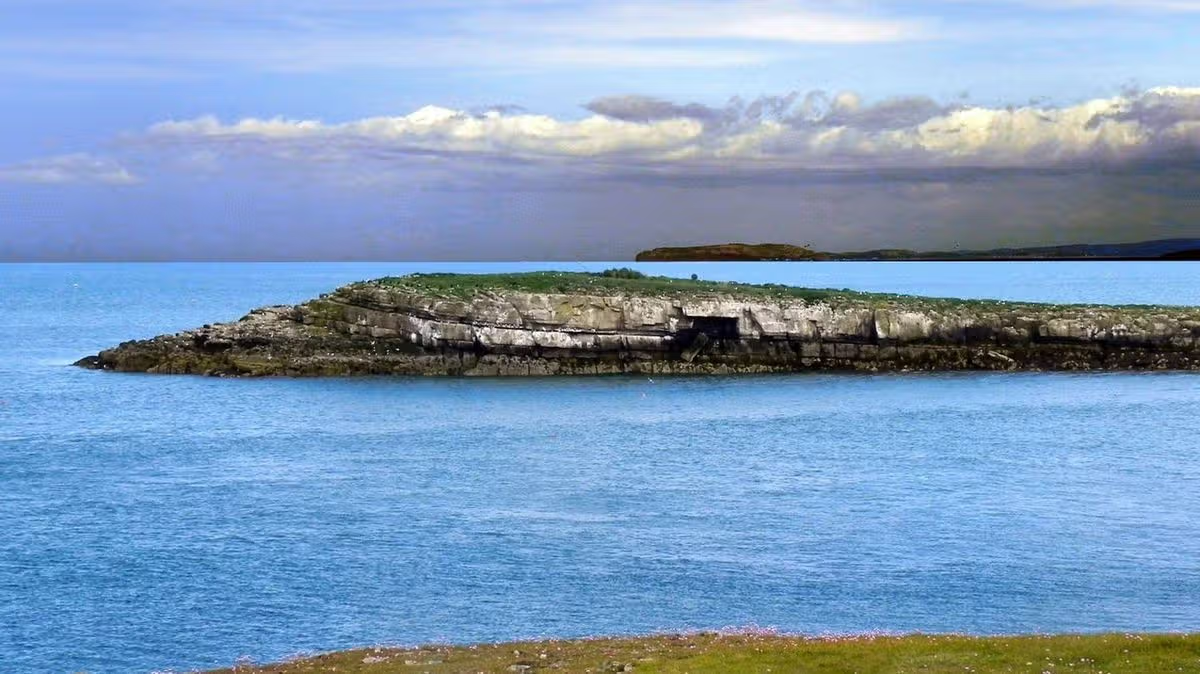
An off-duty coastguard who was out walking his dog launched a rescue mission after hearing a kayaker call for help. The man was rescued after finding himself in difficulty off a small island near Anglesey.
The incident took place on Friday morning close to Ynys Moelfre, known to some locals as ‘Rat Island’.
The kayaker had capsized in the water and was calling out for help. Fortunately, his calls were heard by an off-duty coastguard officer who happened to be walking their dog nearby. For the biggest stories in Wales first sign up to our daily newsletter here
The officer spotted the overturned kayak and raised the alarm. Moelfre RNLI swiftly responded – having only just completed another rescue operation, reports North Wales Live.
The lifeboat crew tracked down the stricken kayaker and brought him to safety.
A spokesperson for Moelfre RNLI said: “The crew had just washed the ALB and readied her for service when a second call came in. An off-duty coastguard member, out walking their dog, heard cries for help and spotted someone in the water from a capsized kayak on the northeast side of Moelfre Island. This highlights the importance of being alert and ready to respond in emergencies.
“The Inshore Lifeboat (ILB) was quickly launched, and it found that the person had managed to climb back onto his kayak and was trying to reach shore.
“Having been in the water for around 15 minutes, he was exhausted, so the ILB brought him onboard and took him back to Traeth Bychan beach. He was medically fine but shaken by the frightening experience. Thankfully, he was wearing proper safety gear, which likely saved his life.”
ILB Helm Aled Owen said: “The man was very lucky and came out of his ordeal relatively unscathed. Wearing a brightly coloured buoyancy aid made him visible and, more importantly, saved his life. Always wear a lifejacket or buoyancy aid, carry a means of calling for help, and let someone know where you’re going and when you plan to return.”
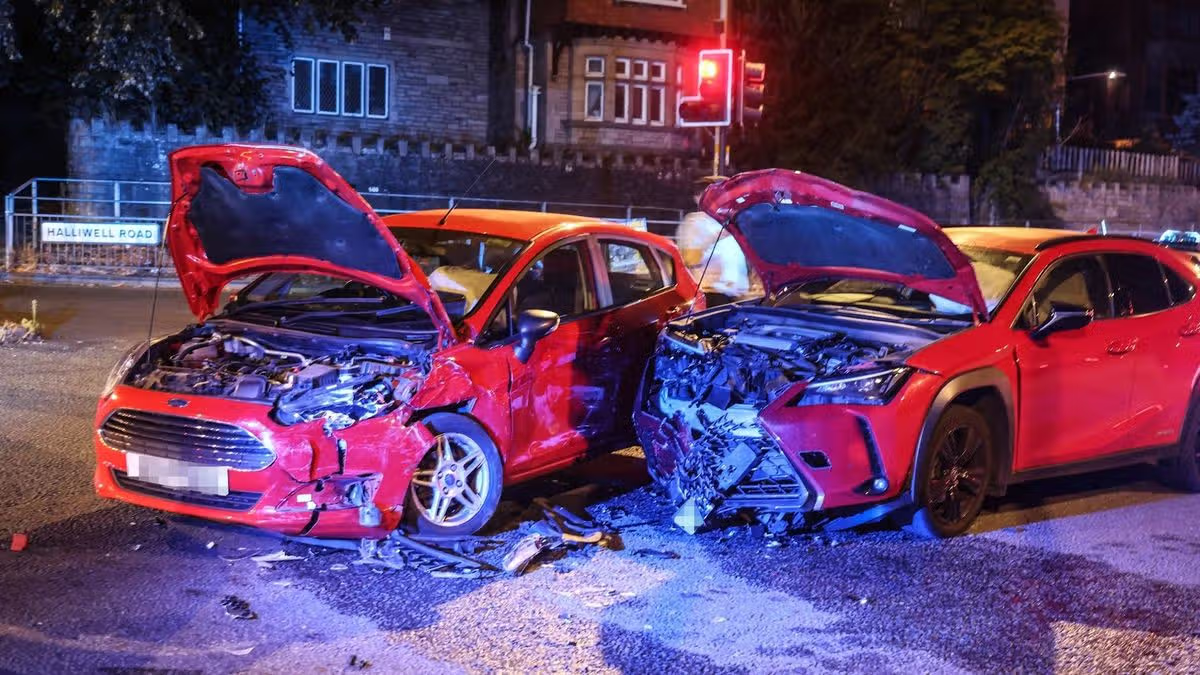
Six people were hospitalised following a crash which left one car ablaze and a casualty needing to be cut out of a vehicle.
Police, firefighters and paramedics were called out to Moss Bank Way in Bolton on Friday night (August 7). It followed a collision involving two cars. Greater Manchester Police said a man in his 30s has been arrested on suspicion of drink driving and remains in custody.
Greater Manchester Fire and Rescue Service said that a fire involving one of the cars had to be put out, and ‘specialist equipment’ had to be used to free a casualty. Police said the injuries sustained are not ‘life-changing’.
Click here to get the biggest stories straight to your inbox in our Daily Newsletter
A spokesperson for GMFRS said: “Shortly after 9:33pm yesterday evening (Friday 7 August), two fire engines from Bolton Central and Bolton North fire stations and an enhanced rescue unit from Leigh fire station were called to reports of a road traffic collision involving two cars on Moss Bank Way in Bolton.
“Crews arrived quickly at the scene. Firefighters used a hose reel to extinguish a fire involving one of the cars and specialist equipment to free one person.
“They also provided trauma care and first aid to six casualties alongside North West Ambulance Service. All six were taken to hospital. Crews worked with Greater Manchester Police to make the area safe.”
“Crews were in attendance for around one hour and 45 minutes.”
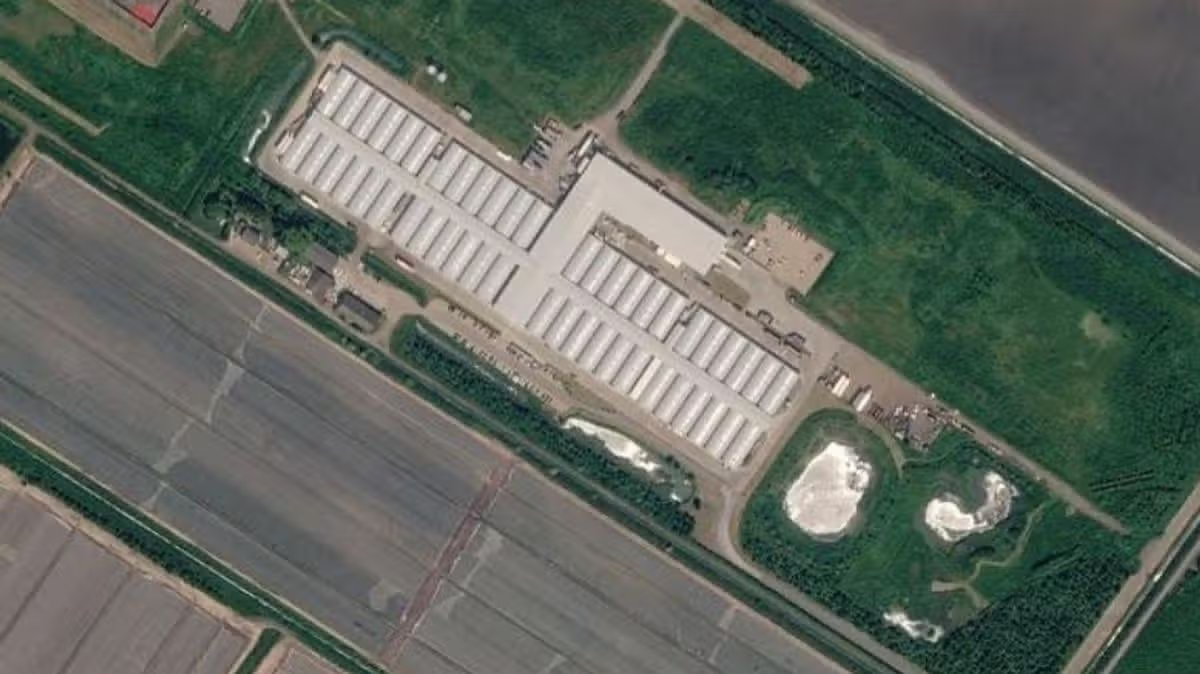
Plans have been submitted for 30 cabins for workers at a mushroom farm. G’s Fresh Mushroom Farm in White House Road, Littleport, has proposed to build 30 three-bedroom self-contained cabins for workers.
The plans also proposed parking, bin stores, landscaping and a sports area. If approved, the new accommodation will aim to reduce transport needs for workers, according to planning documents.
The applicant said the accommodation will have “many positive impacts” for workers. They added: “A need has been identified for this type of seasonal worker accommodation on the site.”
The site has been developed over a number of years to create the mushroom growing facility. Workers on site include full-time staff and short-term staff who work for up to six months at a time.
The proposed site area is on grass land that isn’t used in connection with the mushroom growing facilities. Each accommodation unit is proposed to include three bedrooms, a bathroom, living space, and a kitchen area.
They would be arranged in three rows from south to north in a rectangle, approximately 80m wide by 100m deep. A total of 30 parking spaces are also proposed. A sports and recreation area is proposed to be constructed with a five-a-side football pitch, barbecue area, and space for other activities.
The site where the accommodation is proposed is on flood zone 3 land, which has the highest probability of flooding. An objection has already been raised to the land’s flood risk.
The objector, who lives in White House Road, described the land as “highly vulnerable” and there was an “unacceptable flood risk”.
To prevent flooding on the land, the applicant said the accommodation allows for “floor levels to be raised above ground level”. The applicant also said an “evacuation plan would be in place in the event of an emergency”.
As well as potential flooding, the objector also raised concerns about traffic along White House Road. They said: “White House Road is an unlit, single-track rural lane with only three passing places. The applicant argues this development removes minibus trips, but replacing a scheduled, employer-managed bus with 30 new onsite car parking spaces introduces continuous, unmanaged traffic.
“The influx of private vehicles, taxis, and delivery drivers at all hours poses an unacceptable safety and conflict risk to existing residents.”
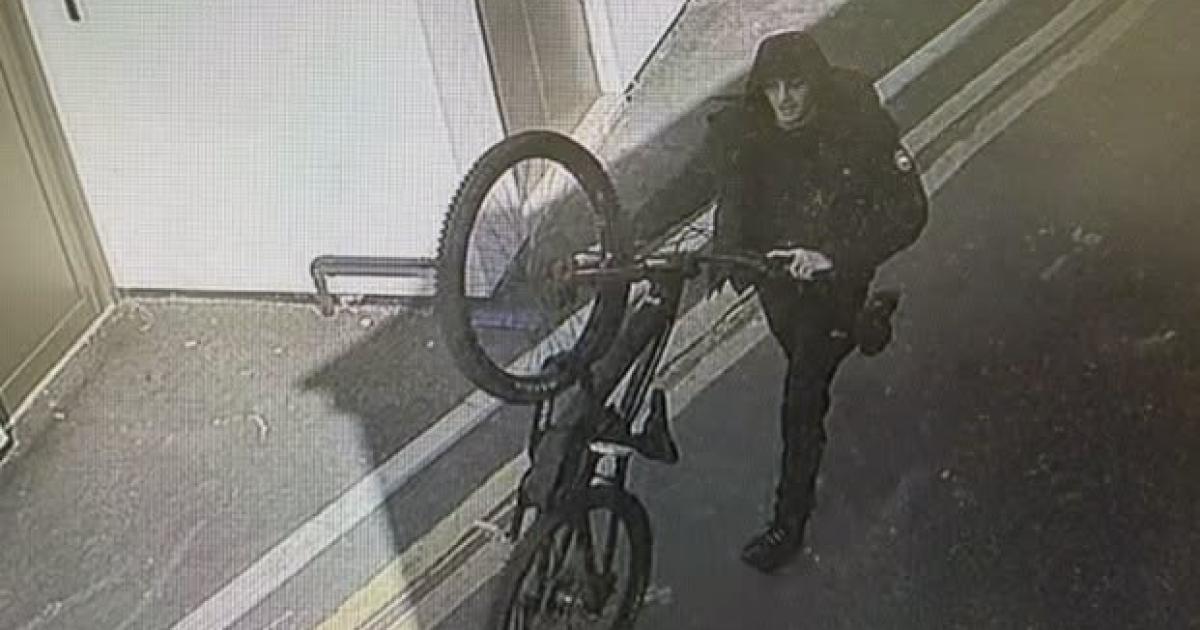
The bike was taken from Market Place in Harrogate on Monday, July 20, at 3.20pm, North Yorkshire Police said.
Officers are urging anyone who recognises the man pictured to contact the force.
“If you have any information that could assist our investigation, please make contact, quoting case reference 12260138531,” a police spokesperson said.
Those with information are asked to contact North Yorkshire online or by phoning 101.
Crimestoppers can be anonymously on 0800 555 111 or online via its website.
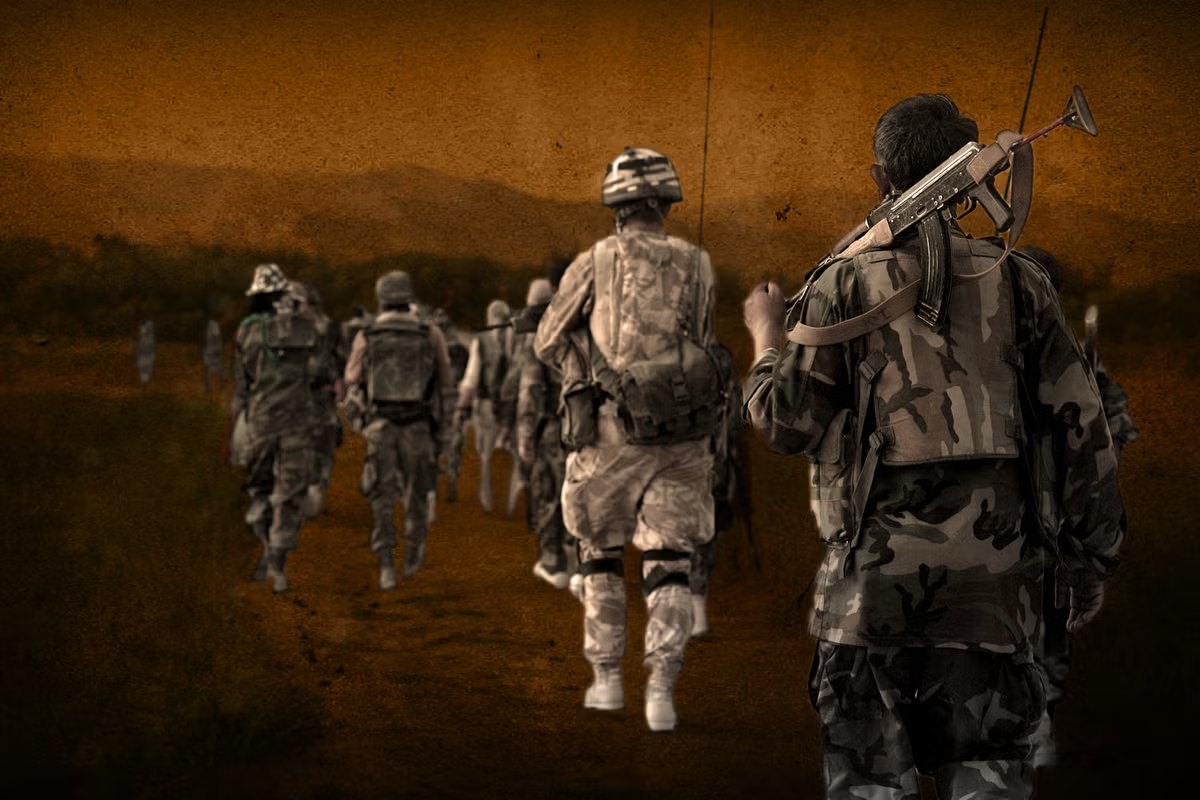
As a matter of national honour, the British government must stop dragging its feet in protecting those who served alongside our troops in Afghanistan. As we report today, the Ministry of Defence (MoD) has admitted in an internal review that Afghans who worked with British forces are still likely to be at risk from Taliban retribution.
Despite this admission, in June last year the government stopped evacuating families who had already been approved for sanctuary in Britain. Luke Pollard, the defence minister, announced in April this year that Afghan families eligible for relocation would have to flee the Taliban-run country on their own.
He told the Commons in a written statement that the thousands of Afghans still waiting would “need to make their own way to a third country when they are able to do so”.
The Independent can now reveal that a review carried out by the MoD in February concluded that “the risk to individuals who may be eligible … remains real, albeit diminished”.
The review tried to minimise the dangers to Afghans who served with or worked for British forces during the 20 years that Western troops occupied the country before the Taliban regained control in 2021. It described the threat as “selective and localised” and that recent attacks, including killings, of Afghans “may well be the result of recent transgressions, rather than their previous affiliation” to the UK government.
These excuses are beside the point. The British government made a solemn promise to those Afghans who worked with the British that they would be protected. Many thousands of them have been given sanctuary in Britain, but there remain about 7,000 who the MoD accepts are in danger and are therefore eligible for resettlement, but who are still in Afghanistan or neighbouring countries, mainly Pakistan and Iran.
This number is higher than it would have been because of the catastrophic data breach in 2022, when the MoD accidentally sent out a list of Afghans who had worked with the British by insecure email. This was an error for which the British government has to take responsibility, and yet too much of the response to it involved obfuscation and delay.
We are concerned that this approach, to make it difficult and slow to make it to safety, is typical of the British state’s attitude to its obligations to Afghans generally. We are proud to have played a role in the Home Office’s decision in 2023 to grant indefinite leave to remain for the Afghan pilot who was threatened with deportation to Rwanda.
But throughout The Independent’s long campaign to hold the government to account for its promises, we have suspected that the unspoken view among ministers and officials is that obstruction and delay are an effective way of discouraging applicants.
This is unacceptable. We understand that immigration is a sensitive political subject, and we share the public’s dismay at the previous government losing control of the system, allowing too many work visas and dependants. But the Afghan situation is specific, limited and a question of principle. Public opinion supports the government in delivering its obligations to those who served alongside our troops or who put themselves at risk by working to assist them as translators, guides or administrators.
It is now time, five years after the fall of Kabul, for the government to end the delays, the excuses and the attempts to minimise the dangers. Of course, applicants must be checked, and undesirables must not be allowed to take advantage of British generosity, but we are now talking about thousands of people who have been accepted for protection but are unable to make it to safety.
The UK must at long last finally discharge its obligations to our Afghan allies, promptly and in full.
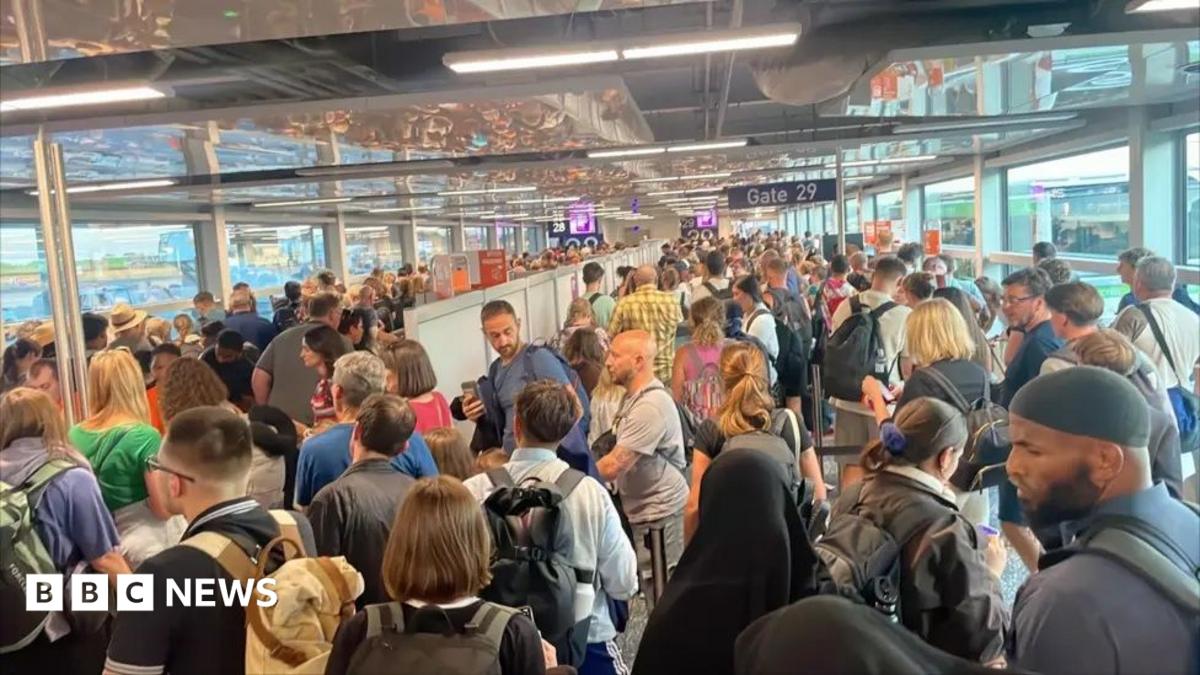
Anyone caught up in the disruption should contact their airline, they added.
No further official information about the nature of the defect has been released.
A number of people spoke to the BBC on Friday evening about their experience at the airport – among them Paul Smith, who was due to fly to Glasgow for his son’s 20th birthday but had to cancel his trip.
“The communication, advice and support for passengers has been really poor,” he said.
There were no announcements on the tannoy system for over an hour, he said, which meant EasyJet reps in the departure lounge were the only source of information.
“What we’ve heard is that there’s a hole in the runway.”
Dave Blackwell, travelling home from Rhodes in Greece, said it had been “a shambles” since his flight back to Bristol was diverted to Newcastle.
“We were in Rhodes Airport for three hours with no information. Now we have all been told our flight is going to Newcastle and then a five or six hour bus ride – why Newcastle? How appalling,” he said.
Are you waiting for a flight to or from Bristol Airport? Please use the form below to get in touch and tell us your experience.
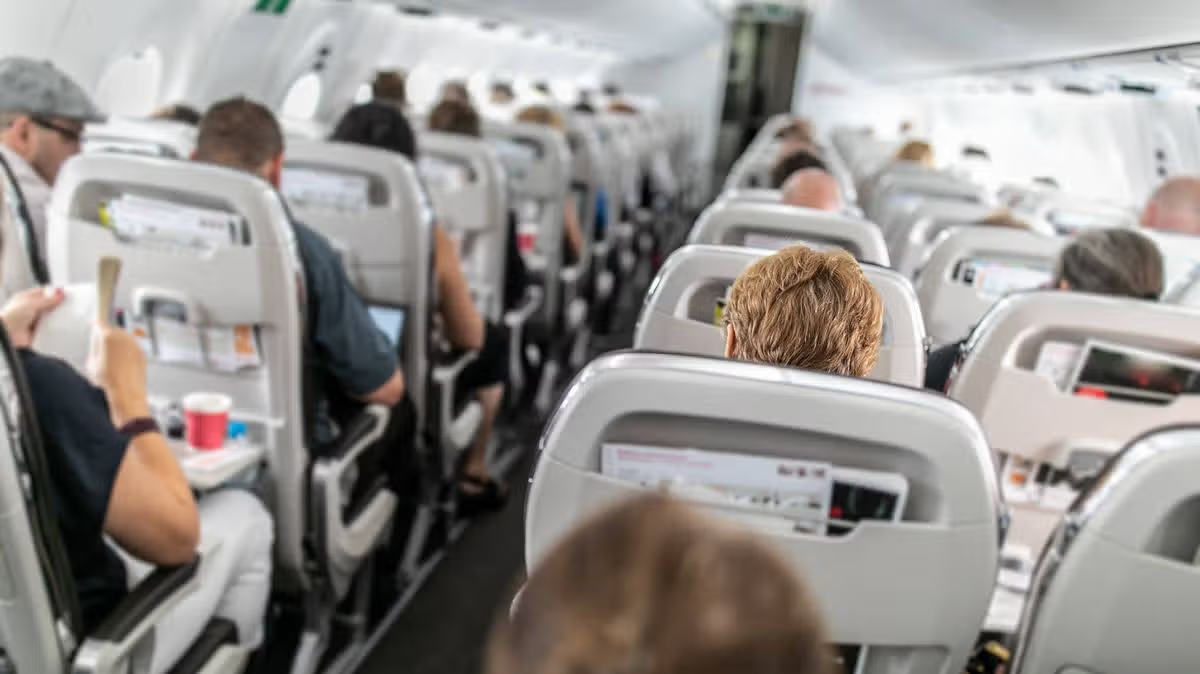
Flying can prove to be quite a stressful experience, especially if you’re not among the privileged few who can afford to fork out for business class tickets. No one wants to be stuck in the same seat for what can seem like endless journeys, boredom and discomfort often take over – particularly when you’re squeezed in on a row with total strangers.
While the cheaper economy class seats are known to be cramped, and on protracted flights, this frequently leads to significant discomfort and potentially severe health complications. Sitting down on a plane seat for longer periods of time has been proven to sometimes cause muscle cramps, bloating, and, in extreme circumstances, deep vein thrombosis or blood clots.
This is exactly why, if you’re planning to undertake a long-distance flight in the coming weeks or months, prioritising your comfort and physical wellbeing is absolutely essential.
While certain tactics can improve your comfort – including wearing baggy clothing, investing in noise-cancelling headphones, and packing a neck pillow – these remedies don’t always prove effective.
To help passengers in getting more comfortable in their seat, a flight attendant named Charlie Silver, from Manchester, has revealed her ultimate comfort hack for your upcoming flight, particularly when you’re wanting a bit more space in your seat.
In her video demonstration, Charlie is positioned in an aisle seat on board a plane, showing how the exterior armrest functions distinctly from the remaining armrests in that row – crucially, it doesn’t fold upwards.
“Are you sitting on the aisle seat, wondering why your armrest doesn’t go up?” she asked in her video. “Well, here you go. Here’s a little hack for you.”
She went on to share how to find a concealed button on the armrest, enabling her to move it as she pleased and thereby giving her more room in her seat.
“Press this little hidden button and voila. Your armrest will move freely up and down,” she said, pointing out the small lever-style button that was within easy reach while sitting down.
Using it means travellers can raise the armrest, creating more room in their seat for enhanced comfort. While it might just give you a couple of extra inches in the seat, this can mean a lot if you’re stuck in your seat for hours at a time.
Numerous viewers were quick to praise Charlie for her simple yet handy suggestion, though some noted it hadn’t worked on their flights.
“The flight attendants always make me put it down,” one person observed. Someone else explained: “You have to put it down for take off and landing, but you should be able to have it up during cruise.”
Another viewer wrote: “This hack is great for when you’re going into the row or getting out.”
“Nah! Needed to see this at the beginning of the year! Why’s it so hidden,” wrote another, clearly frustrated they hadn’t discovered it earlier.
However, not everyone was impressed by the revelation, with several expressing astonishment that it wasn’t widely known: “I thought everyone knew that.”




Zack Polanski: an incitement to murder Nigel Farage?


MicroStrategy Post-Earnings CLARITY Act Push Could Add New Catalyst for Its Stock


Crypto PAC spending tops $2M in Michigan House race


DTCR: Deleveraging And A Hedge Fund Collapse Point To A Possible AI Bottom


ESET tracks rise in malicious AI skills and adaptable malware


Frugal Friday’s Workwear Report: Cap-Sleeve Pointelle Crewneck Sweater


France Cricket implodes: letters hidden in a drawer and a board at war


XRP Ledger urges node upgrade after manifest flood


Financial Crash Expert: The 90-Day Collapse Timeline They Are Desperately Hiding.


Jordan Coyle & Cordiamo take Laya Arena Stakes at RDS


Weekend Open Thread: Mattifying Sunscreen


US Tech Stocks See Largest 5-Week Inflow in History: Can Nasdaq Break Its Downtrend?
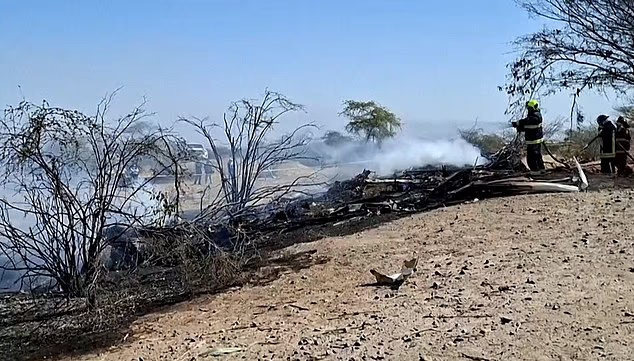
Tourist plane on sightseeing flight in Peru crashes into a field, killing all 13 people on board

US stocks: Dow closes at record on Mideast optimism; SpaceX, AMD drag Nasdaq


Arsenal reach full agreement with Newcastle over Bruno Guimaraes transfer | Football


Page Not Found | WIRED

Bikini-clad Jennifer Aniston, 57, kisses hypnotist boyfriend Jim Curtis as they enjoy a romantic getaway aboard a luxury yacht in Spain


Reform UK And Greens Sink To Lowest Favourability Ratings To Date


Nvidia Stock Climbs 2.5% as Chip Sector Rally Builds Ahead of AMD Earnings, Nvidia’s Own Report Looms


Polymarket targets $20 billion valuation as competition heats up in prediction market sector



You must be logged in to post a comment Login