












Ukrainian forces hit 116 shadow-fleet vessels in a week-long drone onslaught in the latest humiliation for Vladimir Putin and his army.
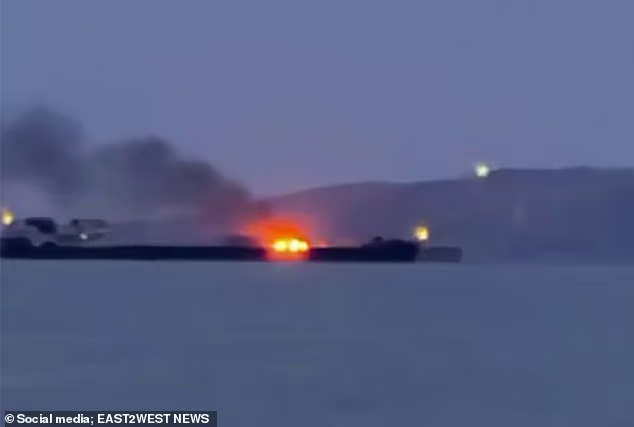
The most recent blow on July 14 saw explosions light up the night sky as Kyiv‘s drones swooped down and attacked Russian tankers in the Sea of Azov.
‘The shadow fleet is wasting away,’ said Major Robert ‘Magyar’ Brovdi, the commander of Ukraine‘s drone forces, in a post updating the operation’s ‘score-card’ on the morning of July 15.
He said that Ukraine had hit ‘116 vessels over the past nine days’, including several tankers and cargo ships, in the Azov Sea.
He said the aim was to damage Russia’s ‘shadow fleet’ and to limit Russia’s petrol supplies to Moscow-controlled Crimea.
The Azov Sea lies between Russia, the southern stretch of Ukraine that has been occupied by Moscow‘s army and Crimea.
It is an important export route for agricultural products – including grain from occupied Ukraine that Kyiv says is ‘stolen’ – and for supplies to Crimea.
The sea strikes come as Ukraine has massively intensified drone attacks deep into Russia, causing nationwide shortages.
FP-2 drones carry light payloads that enable them to travel at least 250 miles to hit Russian tankers

They target Azov vessels – small courier craft that transport fuel to Crimea or transfer it to larger Black Sea ships blocked from shallower waters
Ukraine’s success stems from three main factors: coordinated strikes on Russian air defences and oil refineries that distracted Moscow and weakened its anti-drone capabilities, the precise development of long-range FP-2 drones, and a strategic miscalculation by Putin.
To reach the Sea of Azov, drone teams launch from small, mobile positions inside Ukraine.
The aircraft then pass over Russian-occupied land, avoiding Moscow’s ‘softened-up’ air defences.
FP-2 drones carry light payloads that enable them to travel at least 250 miles to hit Russian tankers.
They target Azov vessels – small courier craft that transport fuel to Crimea or transfer it to larger Black Sea ships blocked from shallower waters.
To evade radar, these drones fly just above the waterline. During attacks, they strike the bridge to disable steering and communication systems rather than sinking the vessels.
This tactic forces Moscow to deploy tugboats to rescue drifting ‘ghost ships,’ creating new targets for Ukraine and straining Russian military logistics.
Major Brovdi aims to force Russia back onto land supply routes, which remain vulnerable to precise Ukrainian drone strikes.
With the new strikes in the Black Sea, Russia could face difficulty in exporting grain and petroleum through the city of Novorossiysk.

Industry sources said that several grain ships were hit on July 13 and July 14 and caught fire
Industry sources said that several grain ships were hit on July 13 and July 14 and caught fire.
‘They are standing there like targets before a firing squad. In a couple of days, there won’t be a single intact boat left in the Sea of Azov, only damaged ones,’ one of the sources said.
Russia on Tuesday accused Ukraine of terrorism over its escalating attacks.
‘What the Ukrainian regime is doing goes beyond even piracy. Pirates, at least, plunder and keep the spoils for themselves,’ Russian Foreign Minister Sergei Lavrov said.
‘But here, it benefits neither them nor anyone else – the goal is simply to cause damage and intimidate. It is terrorism, pure and simple,’ Lavrov said.
Shipping in the Sea of Azov remained restricted on Tuesday. It lies at the mouth of the Don River, which flows through Russia’s main southern grain-producing region, and handles mostly smaller, coastal ships.
A source said on Monday that commercial vessels were unable to enter or leave the Sea of Azov via the Kerch Strait or the Azov-Don channel connecting the sea with the Don River.
Ukraine’s operation forces Moscow into a dilemma. On 28 June, Putin directed his government to increase maritime fuel shipments to Crimea, reacting to intense Ukrainian drone strikes that turned the overland route into a deadly corridor.
However, the Moscow Times reports that Russian insurers have withdrawn war-risk coverage for tankers, and the state is refusing to step in.
Due to budget constraints, the finance ministry is actively blocking proposals for state-backed insurance guarantees.

With the new strikes in the Black Sea, Russia could face difficulty in exporting grain
The Agriculture Ministry acknowledged that exports may get diverted to other routes.
‘Given Russia’s significant capacity for transshipping agricultural cargo in various regions, supply logistics will be redirected if necessary,’ the ministry said in a statement.
A Ukrainian military source said: ‘The Ukrainian Armed Forces strike only military targets or targets that contribute to strengthening Russia’s combat capability.
‘Civilian cargoes are not among them. By talking about attacks on civilian vessels, Russia is looking for a pretext to justify its cynical strikes on Ukrainian civilian infrastructure.’
Russia has stepped up its strikes on Ukrainian Black Sea ports since the end of last year, and Ukrainian officials say ports in the Odesa region could see their monthly grain export capacity cut by as much as one-third.











































You must be logged in to post a comment Login