Connect with us
DAPA Banner
DAPA Coin
DAPA
COIN PAYMENT ASSET
PRIVACY · BLOCKDAG · HOMOMORPHIC ENCRYPTION · RUST
ElGamal Encrypted MINE DAPA
🚫 GENESIS SOLD OUT
DAPAPAY COMING

NewsBeat

Ex-criminal behind multimillion-pound fraud shares red flag you should watch for

Published

on

Daily Record

Reformed fraudster Alex Wood was a musical prodigy, but a wrist injury ended his violin-playing career and he turned to crime – now he shares his phone fraud warning signs to help you avoid being scammed

As a gifted musical talent, violinist Alex Wood travelled the globe, performing at Buckingham Palace and Windsor Castle alongside prestigious international concert venues. However, it was an entirely different type of fiddle that would come to define Alex’s life as an adult.

Advertisement

Alex’s musical journey ground to an unexpected halt at the age of 24. “I developed a bit of strain injury in my early twenties in my right wrist, ” he told us, “and it led to a very sudden sort of stop in my career.”

From his mid-twenties, he transformed into a prolific fraudster, occasionally pocketing as much as a million pounds through a single 40-minute telephone scam. “I certainly had a capacity for committing fraud, and I was very good at it,” he said. “I committed every sort of fraud you could possibly imagine for about 25 years.”

Today, following an extensive criminal history that resulted in three prison sentences, Alex has turned from poacher to gamekeeper, educating the public on protecting themselves from fraudsters. He is part of the BBC’s Scam Secrets team and has written a new book, Facing the Music: From Her Majesty’s Palaces to Her Majesty’s Prisons, which reveals the profitable realm of fraud.

He offers several straightforward tips for anyone receiving a call from someone purporting to represent a bank or other financial organisation.

Advertisement

How the scam worked

Alex’s most ambitious and – ultimately – final criminal venture resulted in a seven-year prison sentence. While Alex has since left his unlawful activities behind, similar scams continue to be perpetrated on a smaller scale virtually daily, with innumerable calls targeting ordinary consumers.

Describing how the operation functioned, Alex revealed: “The last case was a multi-million pound, cyber-authorised push payment fraud, which involved me phoning up companies pretending to be the bank and getting them to transfer tens of thousands of pounds.”

Alongside an accomplice he’d encountered while incarcerated, Alex successfully swindled 12 businesses throughout the UK. Losses across three firms totalled nearly £1.8 million, with a single company losing close to £1.3 million.

Advertisement

For Alex, the process was as straightforward as placing a telephone call. He said: “We were targeting medium-sized businesses, and I knew that in the UK, a medium-sized business either banks with Barclays or NatWest – they have about 85% of the market.

“So I phone up as Barclays and if somebody said ‘No idea what you’re talking about, mate, we don’t bank with Barclays.’ I’d just remember that number and phone back the week later and say I’m from NatWest.”

Alex deployed a persuasive approach that convinced victims to authorise what they believed were “test” transactions, while actually transferring substantial sums to accounts controlled by his accomplice.

How to avoid becoming the next victim

Alex highlights that fraud represents roughly 45% of all reported crime, yet receives merely one to two per cent of police funding. Numerous cases go unreported entirely for various reasons, he notes.

Consequently, Alex advises: “You can’t never trust anyone ever. Apply zero-trust principles to any unexpected request for a payment – even if it’s your kids phoning you up and saying, ‘Hi Dad, I need your help.’

“If it’s at work and you’re expecting to pay an invoice at the end of the month and they’re rushing you to pay it early or whatever, anything like that has a smell about it.”

Remain vigilant whenever you receive an unanticipated payment request, or sense someone attempting to rush you. Alex added: “Fraudsters would always try to rush their victims into making a mistake.”

Advertisement

Alex’s principal recommendation is that when somebody attempts to pressure you into transferring money rapidly, “that’s when it’s important to step back, take five, and just check”.

Should the bank contact you, they won’t object if you disconnect and ring back using a different number. They want you to remain secure, so there’s no need to fret about ending the call and causing offence.

He added: “If you think something’s up, then you can flag it with Report Fraud, which recently replaced Action Fraud as the National Reporting Service.”

A life of crime

Alex had already dabbled in criminal behaviour prior to his injury, while still attending the prestigious Purcell School for Young Musicians: “I was 16 and I got a summer job in Burton’s menswear. And I used to steal the gift vouchers because there were these old books of gift vouchers back in the days before vouchers were digitally recorded on the till system.”

These gift vouchers, he elaborates, were printed in books potentially worth around £5,000 in total. The teenage Alex would simply spend a small portion of each voucher’s value in high street retailers such as Top Shop or Top Man, pocketing the remaining change in cash.

However, following the loss of his musical career, Alex’s crimes “sort of graduated in seriousness,” he reveals. When he was implicated in a fraudulent share scheme, he was subsequently arrested and imprisoned. Yet his initial spell behind bars became, in essence, a masterclass in criminality, he admits.

During the opening week or so, prison proved “terrifying,” though inmates are swiftly divided into categories. He went on: “The officers very quickly vet you, and if you’re in for a low-level white-collar offence, you know, where you’re not interested in gang culture, you’re not smoking drugs all day, you’re not trying to attack prison officers, you’re seen as low risk and you’re literally shipped out to the countryside, and so I ended up in Hollesley Bay, which is an open prison.”

Advertisement

There, Alex explains that he learned from more seasoned offenders how to execute increasingly sophisticated frauds. He continued: “When in prison, I met people who were much better at crime than me … I formed a much deeper and darker conspiracy in prison.”

Following his release, Alex carried out some of his most notorious offences. Masquerading as the 13th Duke of Marlborough, he reserved rooms at prestigious London hotels, directing staff to forward the frequently substantial bills to Blenheim Palace. During one visit to Claridge’s in Mayfair, he ran up costs of nearly £1,800 across just three days.

Even after being arrested in relation to a fraudulent reservation at London’s Great Northern Hotel, Alex couldn’t resist the lure of living the extravagant lifestyle of an aristocrat and accumulated additional bills approaching £8,000 at hotels in Mayfair, Canary Wharf and South Kensington while on bail.

Advertisement

He received a second prison sentence in 2015. However, his most significant crime – the push payment fraud – was still to come.

Alex Wood is appearing at The Hunter and the Hunted event at Cheltenham Science Festival on Tuesday June 2. www.cheltenhamfestivals.org


Source link

Advertisement
Continue Reading
Click to comment

You must be logged in to post a comment Login

Leave a Reply

NewsBeat

Man accused of raping daughter and granddaughter in sick incest case

Published

on

Daily Record

A man from Brazil has been detained on suspicion of child rape after allegedly fathering his own grandchild and then going on to get the child pregnant in a horrific Amazon incest case.

Police are probing an alleged incest case in which a man is said to have not only fathered his own grandchild, but subsequently impregnated that child. The 50-year-old suspect, hailing from Brazil’s Apurinã ethnic group, was apprehended on Wednesday (20 May) on suspicion of child rape.

Advertisement

The incident occurred in the Bacuri Indigenous community near Tapauá, situated deep within Brazil’s Amazon rainforest.

According to authorities, the 12-year-old victim is simultaneously the man’s daughter and granddaughter.

Her mother, now 33, is understood to have endured repeated sexual assaults by her own father across numerous years, with the 12-year-old born as a consequence of that abuse.

Police were alerted to the case only after a local indigenous healthcare team demanded the girl – already six months pregnant – receive medical care.

Advertisement

The suspect had been concealing her from both health workers and other relatives, maintaining her in isolation and preventing her access to education.

Upon receiving the allegations, police mounted an operation to apprehend him. He initially absconded but was subsequently detained.

Lieutenant Colonel Castro Alves informed local media: “There were several days of intensive searches and operations to track down the individual.

Advertisement

“After a night of surveillance, carried out with careful planning, security and intelligence, the suspect was eventually arrested.” The 12 year old delivered her baby in Beruri. Both mum and infant are reported to be in good health and are currently being looked after by the girl’s mother – the accused’s daughter.

Inspector Jailton Santos commented: “This is a horrific case. For years, this man repeatedly raped his own daughter in that indigenous community. She is now 33 years old.

“As a result of the abuse, she had given birth to a girl. The child lived with her grandmother in the community until the grandmother died about two years ago.

Advertisement

“After her death, the man took the girl, isolated her from the rest of the family, and began living with her as his wife.”

The accused is scheduled to face a judge for a custody hearing.

He faces investigation for rape of a child or vulnerable person – concerning both his daughter and granddaughter – alongside false imprisonment and criminal neglect of a child’s education.

Source link

Advertisement
Continue Reading

NewsBeat

UK scientists developing Ebola vaccine that could be ready for trials in months

Published

on

UK scientists developing Ebola vaccine that could be ready for trials in months

“It is possible that doses of that could be available for clinical trial in two to three months, but there is a lot of uncertainty,” a spokesman added, saying it would depend on animal trials as to whether it could be considered “a promising candidate research vaccine” for Bundibugyo.

Source link

Continue Reading

NewsBeat

Unofficial Preview of the World Cup 2026

Published

on

Wales Online

This bumper 64-page special edition is your perfect guide to this year’s tournament

Advertisement

48 teams, three host nations, 16 venues, millions of fans watching around the globe – and one winner. This summer’s World Cup is the sporting highlight of the year.

The best players on the planet will be in action across the USA, Mexico and Canada over five weeks, promising drama galore.

And our bumper 64-page special edition is the perfect guide to what is the biggest World Cup ever staged. You can order your copy here

England enter the tournament among the favourites as the Three Lions look to end 60 years of hurt, while Scotland will be looking to cause a fair few shocks after qualifying on an electric night at Hampden Park.

Advertisement

Our World Cup preview includes analysis from the Daily Mirror’s chief sports writer Andy Dunn and chief football writer John Cross on England’s chances, while the Daily Record’s Keith Jackson gives us the lowdown on Scotland.

We have exclusive interviews with John Barnes, Stuart Pearce and Gordan Strachan, along with a host of features to put you in the mood for the tournament.

We profile all 48 teams, and take a look at the 16 venues across the three host nations which will stage the action.

And no guide will be complete without a World Cup wallchart, allowing you to chart your viewing – and the path to glory. Order your copy here or pick up at participating retailers from May 27, 2026. Online postage and packaging costs apply.

Advertisement

Source link

Continue Reading

NewsBeat

Spying, Southampton and economic pressure cooker of the ‘richest match in football’

Published

on

Spying, Southampton and economic pressure cooker of the ‘richest match in football’

In elite football, competitive advantage is pursued relentlessly. Big clubs invest heavily in performance data and tactical analysis in the pursuit of marginal gains.

Yet that desperate search for gains has now led to one club, Southampton FC, suffering an enormous loss. Southampton admitted to spying on their opponent’s training session and were charged by the English Football League. They have been expelled from a match that could have seen them win promotion to the Premier League.

That match, the Championship playoff final, is often described as the most lucrative in football. Promotion to the Premier League is worth around £200 million in increased revenue.

Hull and Middlesbrough (the club Southampton spied on) will now fight for that prize. Whether or not you agree with the punishment, the episode highlights the high financial stakes of English football. In an environment where a single result can materially alter a club’s economic trajectory, the pursuit of competitive advantage can take increasingly aggressive forms.

Advertisement

Beyond the specific case of Southampton and “spygate”, there is a bigger issue facing football and the incentives which drive it.

English football’s financial infrastructure does not simply reward success – it also amplifies the consequences of failure. Our research on the economics of English football has shown how the game’s financial structures can reduce competitive balance. The wealthiest sides dominate competitions and leagues. In this environment, clubs can often perceive promotion as transformational – and failure as existential.

This helps to explain why clubs sometimes behave the way they do. Decades of research into the finances of football show a strong relationship between spending and performance. Essentially, the more a team spends (particularly on players’ wages), the better it performs on the pitch.

Because of this, promotion to a higher league becomes more than a financial windfall. It creates a strategic imperative to invest quickly in the hope of staying in that league.

Advertisement

None of this can be used to excuse poor conduct. But it does help explain the environment in which these controversies emerge. Clubs are responding to the incentives the system creates.

And Southampton understands the reality of this system all too well.

Their 2022-23 season in the Premier League brought in revenue of £145.8 million. Immediate relegation back to the Championship reduced that figure to £85 million the following year, and promotion to the Premier League again in 2024-25 pushed it back up to £158.4 million.

Relegation means reduced revenues, strategic uncertainty and operational adjustment. Promotion offers relief and revenue, but not necessarily stability.

Advertisement

If anything, reaching the Premier League often introduces a different kind of pressure. There is an expectation to spend big, recruit aggressively and remain competitive. Any hint of under performance can be punished immediately.

The regulators

English football has repeatedly produced examples of clubs hunting competitive advantage, though normally through aggressive spending. This is a predictable consequence of a model that places extraordinary financial value on relatively narrow sporting outcomes.

This is precisely why regulation is becoming such a central issue in the game. Profit and Sustainability rules (PSR), ongoing debates around spending controls, and the emergence of an independent football regulator all point to a recognition that football’s economic model requires stronger governance.

Wembley Stadium, where the playoff final is held.
Alexey Fedorenko/Shutterstock

But regulation alone cannot solve the deeper issue if the underlying incentives remain distorted. If the difference between success and failure continues to be measured in hundreds of millions of pounds, clubs will continue to seek every possible edge.

Advertisement

Seen through that lens, Southampton’s spygate story is more than football controversy. It is a case study in how financial incentives shape organisational behaviour. When there is money to be made, people will continue to break the rules. Perhaps that explains why the penalty of expulsion – which will affect fans, commercial partners and sponsors – was so severe.

Unfortunately, the football world often treats these episodes as isolated ethical failings, when they are actually symptoms of a wider structural problem. The Premier League’s commercial success has made English football richer than ever, but also more financially unforgiving.

The sport has become subject to economic conditions that make marginal advantage extremely valuable. The Southampton case is not just about sporting or non-sporting behaviour. It is about the business model that dominates and shapes modern football.

Advertisement

Source link

Continue Reading

NewsBeat

Matthew Perry’s family details ex-assistant’s betrayal before sentencing

Published

on

Matthew Perry's family details ex-assistant's betrayal before sentencing

LOS ANGELES (AP) — Matthew Perry paid Kenneth Iwamasa $150,000 a year to be his live-in personal assistant. His role for the “Friends” star would expand to drug messenger, addiction enabler and de facto doctor, according to court filings.

Iwamasa injected Perry with the doses of ketamine that would prove fatal on Oct. 28, 2023, and then left the actor to run errands. He returned to find Perry dead in the Jacuzzi.

The ex-assistant became the first to reach a plea deal of five people indicted in connection with Perry’s death. On Wednesday, he’ll become the last to be sentenced. Prosecutors are asking for a prison term of three years and five months. That’s more than the 2 1/2-year sentence of the doctor who sold Iwamasa ketamine and taught him to inject it into Perry, but far less than the 15-year sentence of the admitted drug dealer who sold Iwamasa the final doses.

Iwamasa, 60, pleaded guilty to conspiracy to distribute ketamine resulting in death and became the case’s most important witness in the indictments of his four co-defendants. That is virtually certain to lead to a lighter sentence.

Advertisement

Family members blame the assistant above all others

“I have no sympathy for Kenny Iwamasa,” Perry’s younger sister Caitlin Morrison wrote in a letter to the judge. “I wasn’t there the night my brother died. I cannot read Kenny’s thoughts. I will never know if the lethal dose of ketamine was only lethal by accident. But I know that when Kenny left the house, he was doing one of two things. He was either escaping from something he knew he had done or he was willfully abandoning a vulnerable person in a dangerous situation.”

Perry’s mother Suzanne Morrison wrote that her son and the family had known Iwamasa for decades, and that relatives were relieved when Perry, who’d had recurring struggles with addiction throughout his life, hired the assistant in 2022.

“Mathew trusted Kenny. We trusted Kenny. Kenny’s most important job — by far — was to be my son’s companion and guardian in his fight against addiction,” she wrote. “We trusted a man without a conscience, and my son paid the price.”

Iwamasa’s lawyers argued that he was an employee doing the bidding of his boss.

Advertisement

In a presentencing filing, they said Iwamasa had “a particular vulnerability to the relationship dynamic which he fell into with the victim. In short, he could not ‘simply say no.’ That inability had tragic consequences.”

Suzanne Morrison said Iwamasa knew he could call any family member should Perry start making drug demands, and his job would be safe.

Family disgusted by Iwamasa’s behavior following Perry’s death

Perry’s mother wrote, “When he had killed my son, he kept a sharp eye on me. He sent me songs, he drew a little map to help me find my way around the cemetery. If he saw a rainbow — one of Matthew’s favorite things — he would call me. He insisted on speaking at Matthew’s funeral. He clung to me and the family as if he was somehow the good guy who tried to save Matthew.”

She said Iwamasa expected a financial payout, and when it was clear he wouldn’t get one, he threatened legal action.

Advertisement

Iwamasa did speak at the funeral, which would later leave the family disgusted.

“The person responsible for my brother’s death stood up and addressed the people who loved him most,” another sister, Madeline Morrison, wrote. “That is like a cruel joke I still struggle with. He didn’t just take my brother’s life — he tainted our final memories of saying goodbye.”

Truth about the ketamine was slow to come out

The LA County Medical Examiner found that ketamine, a surgical anesthetic that has become widely used for other purposes both legal and illegal, was the primary cause of Perry’s death. Drowning was a secondary cause.

On the day of Perry’s death, Iwamasa gave police a list of all the medications Perry was taking, but he left off ketamine and said nothing about the injections, prosecutors said.

Advertisement

After investigators served a search warrant on the house in January 2024, that began to change, and he would slowly admit his role in Perry’s death. Iwamasa said he had been giving Perry six to eight injections of ketamine per day in the last days of his life, and that Perry had told him, “Shoot me up with a big one” on the day he died.

Iwamasa said he had worked with middleman Erik Fleming, who was sentenced to two years in prison May 13, to get drugs from dealer Jasveen Sangha.

In his first text to Fleming, Iwamasa said, “Alfred here batmans butler. He said I can text you directly.”

Madeline Morrison wrote that when the truth emerged, “It felt like my brother died all over again. Everything I believed about the day he died—everything Kenny told us—was a lie. I had to relive Matthew’s death from an entirely new and devastating perspective.”

Advertisement

Iwamasa pleaded guilty in August 2024 before the case became public. Wednesday will be his first court appearance since.

Perry, who died at 54, became one of the biggest stars of his generation as Chandler Bing on “Friends,” NBC’s culture-changing sitcom that ran from 1994 to 2004.

“He was my Matso, my Manew,” his mother wrote. “He was, in spite of all we went through, my heart and my soul.”

Advertisement

Source link

Continue Reading

NewsBeat

Ebola outbreak in Congo poses ‘very high’ risk, WHO chief says

Published

on

Ebola outbreak in Congo poses 'very high' risk, WHO chief says

GENEVA (AP) — The head of the World Health Organization said Friday that the Ebola outbreak in Congo is “spreading rapidly” and now poses a “very high” risk at the national level.

WHO Director-General Tedros Adhanom Ghebreyesus said the U.N. health agency was revising upward to “very high” its assessment of the risk within Congo, which had previously been deemed as high. The risk remains high for regional spread and low at global levels, he told reporters.

The WHO chief noted that 82 cases have been confirmed in the Democratic Republic of Congo, with seven confirmed deaths, “but we know the epidemic in DRC is much larger.”

He said there are now almost 750 suspected cases and 177 suspected deaths. The situation in neighboring Uganda is “stable” with two cases confirmed in people who had traveled from Congo, with one death.

Advertisement

Earlier on Friday, the United Nations said it released $60 million from its Central Emergency Response Fund to accelerate the response in Congo and in the region. The U.S. has pledged $23 million in funding to bolster the response in Congo and Uganda, and said it would also fund the establishment of up to 50 Ebola treatment clinics in the affected regions of Congo and Uganda.

Ugandan authorities said they were not aware of any treatment centers being set up by the U.S.

Advertisement

Source link

Continue Reading

NewsBeat

Tesco to introduce major change for Clubcard holders

Published

on

Tesco to introduce major change for Clubcard holders

Shoppers will be able to choose from a range of breakfast and lunch options for £5.50 as part of a trial at 39 stores across the UK.

Hot food selections include sausage rolls, croissants, and paninis.


As with the existing meal deal, customers can add a drink and a side such as fruit or crisps.

Some of the options include a beechwood smoked bacon brioche-style roll, a sausage, bacon and scrambled egg wrap, and a mozzarella, tomato and pesto panini.

Advertisement

The supermarket chain will also introduce new chilled “breakfast-to-go” items in larger stores.

New hot meal deal offerings from Tesco:

  • Tesco Beechwood Smoked Bacon Brioche Style Roll
  • Tesco Cumberland Pork Sausage Brioche Style Roll
  • Tesco Sausage, Bacon and Scrambled Eggs Wrap
  • Tesco Smoked Ham and Mature Cheddar Croissant
  • Tesco Smoked Ham and Mature Cheddar Panini
  • Tesco Mozzarella, Tomato and Pesto Panini
  • Tesco Tuna, Cheese and Onion Melt Panini


Tesco staff to receive bonus

Tesco recently revealed that 22,000 of its staff, mainly in stores and distribution, are eligible for significant payouts.

Colleagues who cash out are expected to make average profits of between about £5,000 and £8,000 each, it said.


Recommended reading:

Tesco Clubcard offering triple voucher rewards for restaurants

Advertisement

Thousands of Tesco staff in line for £134 million windfall

Tesco says Iran conflict increasing uncertainty over profit outlook


The company, which employs more than 300,000 people across the UK, runs one of the country’s largest save-as-you-earn schemes, with different schemes maturing each year.

This year has seen a particularly strong windfall for employee investors, on the back of gains in Tesco’s share price in recent years.

Advertisement

Shares in the retail giant have risen by almost 25% over the past year.

Which is your favourite supermarket? Let us know in the comments

Source link

Advertisement
Continue Reading

NewsBeat

How Chelsea can qualify for Europe on final day of Premier League season as race goes to wire

Published

on

How Chelsea can qualify for Europe on final day of Premier League season as race goes to wire

Chelsea head into the final day of the Premier League season unsure whether they will play in Europe next term.

Source link

Advertisement
Continue Reading

NewsBeat

Judith Chalmers dies aged 90 as tributes paid to presenter

Published

on

Judith Chalmers dies aged 90 as tributes paid to presenter

Her family said in a statement on Friday (May 22) that she died peacefully at home on Thursday (May 21) evening, surrounded by her family, after living with Alzheimer’s in her final years.

They said her health had been declining for some time and that she had become seriously ill in recent weeks, giving the family time to be together with her.

Born in Gatley, Cheshire, she began working for the BBC at just 13, going on to present BBC Radio programmes Family Favourites and Woman’s Hour in the 1960s.

Advertisement

She later hosted ITV’s daytime magazine show Good Afternoon before going on to present Wish You Were Here…?, an ITV series of 30-minute shows about travel and holidays, in 1974.

Chalmers presented the primetime show until 2003 and was appointed an OBE in 1994.

She leaves behind her husband, former sports commentator Neil Durden-Smith, and their two children.

Advertisement

Fans pay tribute to Judith Chalmers

Plenty of people took to social media to pay tribute to Judith after the news of her death broke.

One person, posting on X, shared: “Very sad…a pioneer of the travel programme”.

Another said: “She encapsulated the holiday and the better times of the 1980s and 1990s.

“Whenever I travel I often think of her reassuringly saying, ‘transfers included’ – which rarely happens in my case.”

Advertisement

The author Malcolm Prince posted: “Farewell lovely lady.

“A great broadcaster.”

Another commented: “Saddened to hear that Judith Chalmers has died.

“Loved her programme ‘Wish you were here!’ in the 1970s/80s.

Advertisement

“May she Rest in Peace.”

What’s your favourite memory of Judith Chalmers? Let us know in the comments.

Source link

Advertisement
Continue Reading

NewsBeat

Diver reveals inside story of grim mission to retrieve bodies in Maldives shark cave horror

Published

on

Daily Mirror

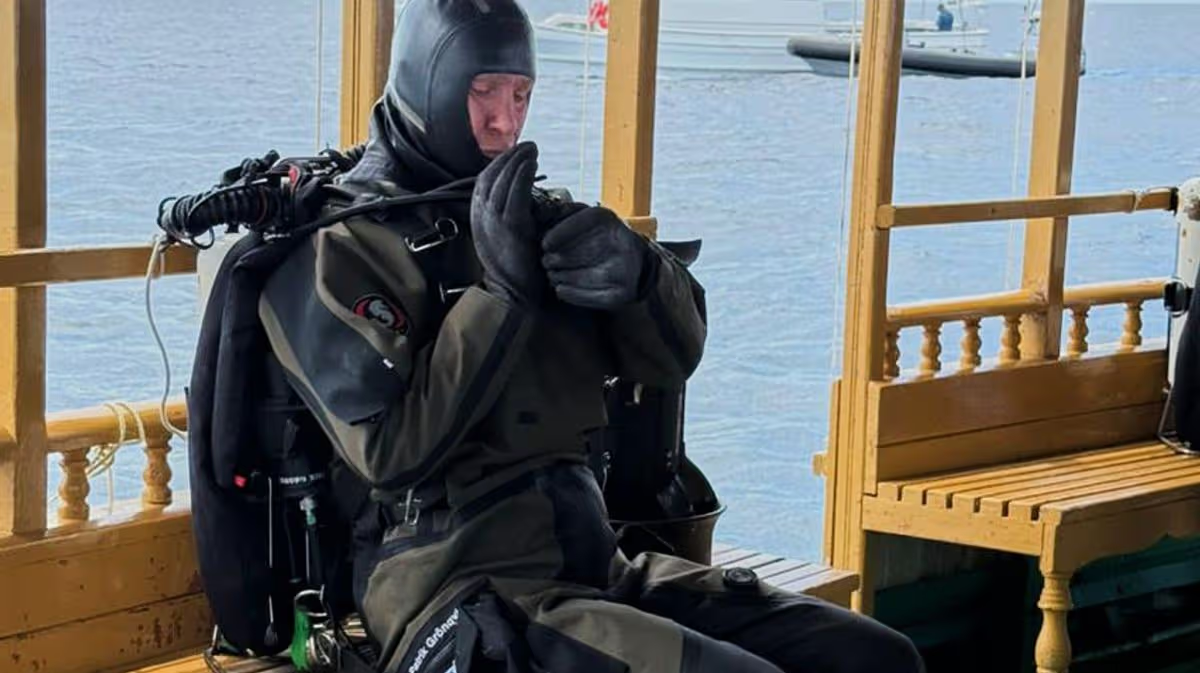
A group of three rescue divers managed to pull the bodies of five Italians back to the surface after they were found inside a cave complex in a Maldives holiday hotspot

A rescue heroic diver has revealed the inside story of a grim mission to retrieve bodies from a shark-infested cave in the Maldives.

Advertisement

Finnish rescue diver Sami Paakkarinen was part of an effort to retrieve the bodies of four Italians who died after delving into the depths where there are large underwater caves. The bodies of Muriel Oddenino, 31, Federico Gualtieri, also 31, Monia Montefalcone, 52, and her daughter Giorgia Sommacal, 20, were found near the mouth of a third and final chamber of one of the cave.

Their diving instructor Gianluca Benedetti, 44, was also found close to the entrance of the same chamber. Despite speculation, Sami said it was impossible the group had been sucked into the shark-infested cave.

READ MORE: Maldives cave divers ‘sucked into cave and unable to swim out before running out of oxygen’READ MORE: Family pay tribute to ‘loving husband and father’ killed in horror shark attack

Advertisement

Speaking to Italian newspaper Corriere della Sera said: “It’s a huge cave, but it’s not possible they were sucked in.” The comment was in response to a theory shared by Alfonso Bolognini, the president of the Italian Society of Underwater and Hyperbaric Medicine.

He said the group could have been pulled into the cavern’s narrow entrance by a strong current. But Sami said he could only share a comment based on his own diving experience.

He said: “The water moves in one direction for 12 hours and then in the opposite direction for another 12…Continuous currents.” Sami added currents are “very predictable” in coral reefs.

The experienced diver said when he and two others arrived at the cave they felt a “very light current inside it.” He continued: “It’s true that there is a current going in and out of the cave.

Advertisement

“The cave, so to speak, is breathing. But it’s really not very strong. It couldn’t have sucked anyone in.”

The diver said the Dhekunu Kandu cave had “never been mapped” and that going that far underwater required “a different type of equipment and approach.” He also believed it would be near impossible that divers accidentally entered the cave.

He added: “It’s a huge cave…in the Maldives, the sun shines up to 100 meters deep. So at 60 meters it’s still daylight, and when you enter a cave, you know it because it gets dark, you don’t risk accidentally entering a cave.”

Advertisement

After the bodies were recovered, Giorgia’s grieving boyfriend broke his silence and said he shared a message with her moments before she went for the dive. Sami believed that a so-called “sand wall illusion” could have been a cause behind the deaths.

Other divers, working with research organisation Dan Europe, said the group could have taken a wrong turn as they attempted to navigate their way out of “shark cave.”

Source link

Advertisement
Continue Reading

Trending

Copyright © 2025