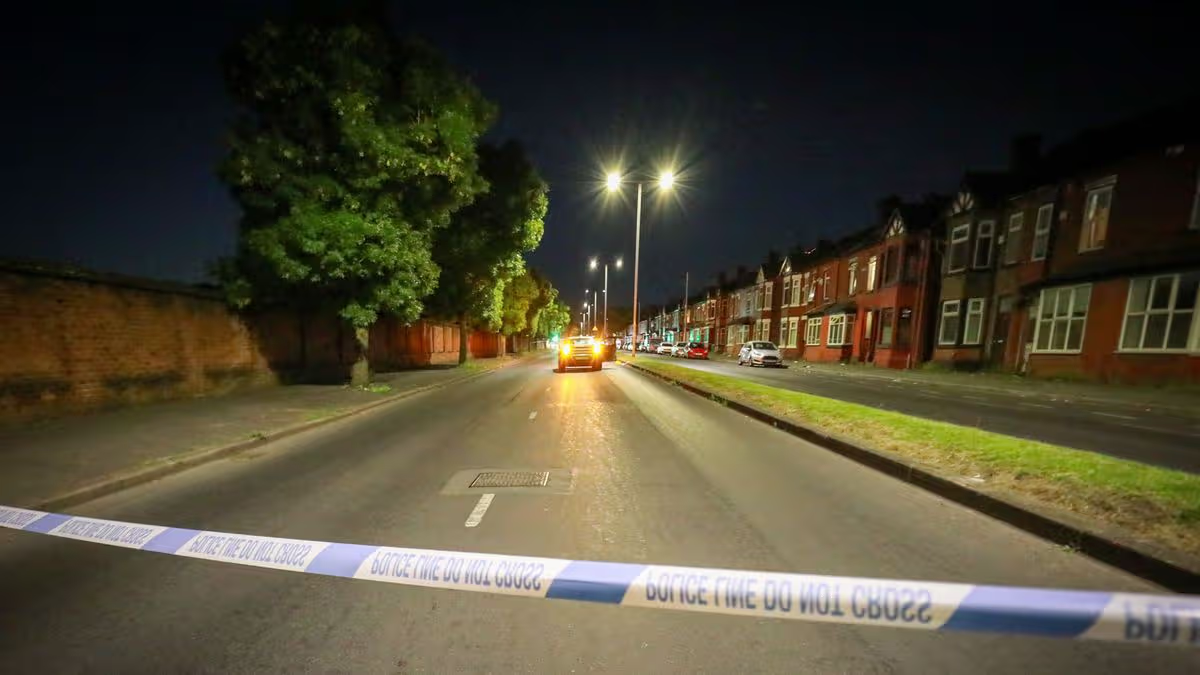
A road in Fallowfield has been shut off this morning after reports of a serious incident overnight.
Photos sent to the Manchester Evening News show a major police cordon in place on Moseley Road, close to the junction with Birchfields Road. Witnesses have said the cordon was in place after a serious crash ‘involving a pedestrian’.
The collision happened in the early hours of Sunday morning (June 28). Travel services show the road remains shut off this morning.
Advertisement
Click here to get the biggest stories straight to your inbox in our Daily Newsletter
Drivers have been warned to avoid the area. Photos from the scene show a silver car at the centre of police investigations.
Greater Manchester Police have been asked for more information on the incident.
Further updates will be posted in our live blog below.
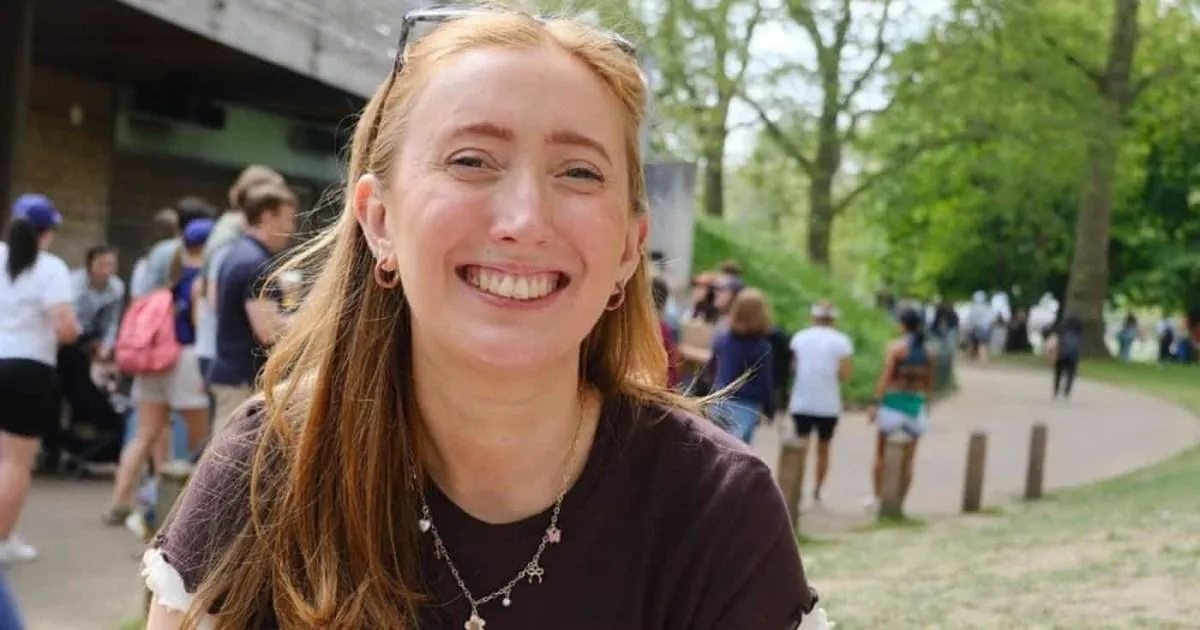
Chloe Moffat took her own life a year ago (Picture: Family handout)
A 26-year-old Treasury worker took her own life one day after an anonymous complaint was made about her, an inquest has heard.
Chloe Moffat ‘loved’ her role as a personal assistant in the government department, which she held for three years, and had an ‘exemplary employment record’.
She was also in line for a promotion after receiving a bonus for her work. Moffat died before she could hear the good news.
During the inquest at the Surrey coroner’s court, witnesses heard how Moffat was driven to a state of ‘distress’ following a meeting last May about the complaint.
Advertisement
The meeting was attended by her line manager and the Treasury’s head of global issues, but Moffat was not informed ahead of time what it would be about.
Sign up for all of the latest stories
Start your day informed with Metro’s News Updates newsletter or get Breaking Newsalerts the moment it happens.
Advertisement
Senior Treasury staff did not reassure her that her job was safe during the disciplinary process, the court also heard, even though a dismissal was unlikely.
Moffat’s mother is now calling for an overhaul in Treasury practices (Picture: Shutterstock/William Barton)
When she did ask if there was a possibility of being sacked, Moffat was told by a senior manager that she ‘couldn’t predict the outcome of any potential investigation’.
She was not allowed to bring a third party to the meeting either, and when Moffat asked her manager if she could bring her friend into the proceedings for support, she was told it would be ‘inappropriate’.
Questioned by the coroner, Anna Crawford, on why Moffat was not permitted a trade union representative or other colleague, the senior manager said: ‘Any alternative attendee would have made the meeting feel more formal.’
The coroner then asked: ‘Given these allegations, that were potentially serious, were going to be raised with her, was any consideration given to notifying her so she could prepare herself, seek support and respond?’
Advertisement
‘No, this could cause unnecessary stress,’ replied the senior manager.
She added that Moffat denied any accusations, so she ‘started to draft a letter’ to notify her of a formal investigation.
‘I was going to wait to send it until [the line manager] and I had spoken to Chloe to see how she was.’
The complaint in question accused Moffat of sharing confidential information about colleagues, which she could access since she managed her director’s inbox.
Advertisement
She had been advised not to speak to her co-workers about the matter, and she temporarily lost access to her director’s emails and diary.
When informed of the anonymous filing, Moffat appeared ‘shocked’ and started ‘crying at points’.
Her family recalled how ‘devastated’ she was in the aftermath and ‘convinced’ she would lose her job.
They further described her as someone who ‘took great pride in her work’ and ‘never made a mistake’.
Advertisement
A friend told the court that Moffat sent her a text on the same day the proceedings were initiated, reading: ‘I am going to be fired.’
This friend then met up with her in central London, where Moffat ‘broke down’ and expressed her concerns about the ‘reputational impact’ of the allegations made, all despite her pal’s attempts at reassurance.
Moffat died by suicide the next day.
Her grieving mother, Anne, is now calling for an overhaul in Treasury practices, with the inquest having heard how Moffat’s line manager should’ve been in charge of her ‘pastoral care’, despite her direct oversight role.
Advertisement
‘The evidence establishes a clear sequence of events,’ said Anne.
‘Had Chloe been properly supported and advised of her rights before the meeting, she would not have been so devastated and isolated.’
She is pushing for the department to be required to ‘assess employees’ mental welfare’ amid disciplinary proceedings. It is understood that changes are already being implemented.
Where serious or gross misconduct is alleged, she adds the matter should be ‘treated as formal from the outset, and the accused is informed of their rights’.
Advertisement
Lawyers representing the department have stated that managers are undergoing additional training, with a Treasury spokesperson saying: ‘We are deeply saddened by the death of our colleague Chloe last year.
‘Our thoughts remain with her family, friends and those affected by her loss.’
At least three people have been killed and another 15 people injured after a huge explosion ripped through a restaurant in Moscow.
The blast took place in Kudrinskaya Square, which is located just over a mile from the Kremlin, at around 8.10pm local time on Saturday.
Initial reports blamed a gas explosion in the restaurant’s kitchen but investigators are now examining whether it could have been a bomb.
Other unconfirmed reports indicated there had been an explosion in the dining area of the restaurant.
Advertisement
A spokesperson for Moscow police said: ‘From the information we have, an explosion happened today at around 8.10pm (5.10pm GMT) near a summer cafe, causing three deaths and 15 injured, of varying degrees of seriousness.’
Officials from the Russian Ministry of Health said the exact number of people killed in the blast is yet to be determined.
They added that those injured are all receiving the necessary medical care.
Advertisement
Emergency services are pictured at the scene following an explosion at a cafe in Moscow
People gather at the scene of an explosion in Moscow on Saturday evening
Pro-Kremlin Readovka channel reported: ‘A forensic team from the Ministry of Internal Affairs and emergency services are working at the scene.’
With just under three weeks to go until kicking off the defence of their Premier League crown, Arsenal continue their pre-season preparations this evening against Girona. The Gunners have played one summer friendly thus far, beating MK Dons in a behind-closed-doors match at the training ground last weekend, but a step up in quality from the opposition is expected at the Estadi Montilivi.
Nathan Slater, from Wallasey, was just 18 when he died on Saturday, November 9, 2024. His mum Lisa Slater, 41, had no idea he was struggling with his mental health, and is now urging anyone who might be suffering to speak out
Megan Banner Reporter and Matt Jackson Live News Network Reporter
19:28, 01 Aug 2026
A mother mourning her teenage son’s death has shared what his loss has taught her about existence, and the ways she preserves his legacy. Nathan Slater, from Wallasey, was just 18 when he ended his own life on Saturday, November 9, 2024.
His mother Lisa Slater, 41, said she was completely unaware he was battling mental health difficulties and that Nathan’s passing arrived as a “total shock.”
Only months beforehand, Nathan had discussed his aspirations for the years ahead and expressed hopes of starting a family eventually. Lisa, who has seven children, is now encouraging anybody experiencing mental health challenges to reach out.
Advertisement
On his final day, Nathan rang a mate at 1am saying he was “sorry, you’re a good friend”. His concerned friend travelled to his house the following day to see if he was okay but received no answer when knocking at his door.
The family had to force his bedroom door open to discover that, tragically, Nathan had ended his own life, reports the Liverpool Echo.
Lisa previously spoke to the ECHO, where she paid tribute to her “funny, kind and caring” son. As she nears the anniversary of one of their most treasured moments together, she said: “He was an amazing, popular, funny boy. He was so talented, he taught himself to play the guitar. He asked for a guitar for Christmas one year and he just picked it up and taught himself to play it. He could play any song.
Advertisement
“I took him to his first Creamfields [in 2024], he was in awe of the DJs. When we got home he got himself a set of decks and had been making his own mixes, he was forever calling me at stupid hours to say ‘mum listen to my new mix.’”.
“We had the best time and we were really looking forward to going together again. I just can’t believe he’s gone, he’s going to leave a massive hole in everyone’s lives.
“He always had the biggest smile on his face all the time, he had just started boxing training and he was planning on doing a charity boxing match in memory of his dad, who passed away from cancer. He wanted to do that for his dad.”
She continued: “None of us saw this coming. We had no clue at all that he had been suffering with his mental health. It was a total shock for us all. It’s just unbelievable. He was making so many plans”.
Following her son’s passing, Lisa has attempted to maintain a sense of normality for her six other children. She reflects: “Tthe only plus is that Nathan’s death brought us all closer together.
“We’ve realised how short life is and make the most of holidays, concerts and doing things together. We try to make the most of our time. I’ve surprised myself at how strong I’ve been, but it’s been hard keeping it together. I have moments when everything goes quiet, after a long day at work, where it’ll catch up with me.
“For the first few months I didn’t know how I was going to get through the day, never mind a week, or a month, then the days turned into years.”
Advertisement
In tribute to her son, Lisa made the journey to Amsterdam last year to mark his birthday — a trip the pair had always planned to take together. She also attended Creamfields in his honour, a festival that holds some of her most cherished memories with Nathan.
With the 2026 festival now on the horizon, Lisa is sharing Nathan’s story to spark a wider conversation about men’s mental health, urging anyone who may be struggling to speak up without hesitation.
She said: “Men just don’t talk enough. I want to urge people to talk if they are feeling any certain way. I can’t stress enough if anyone is having these thoughts to please talk to somebody.”
Advertisement
Lisa is also calling on authorities to improve mental health provision in Wallasey for those in need. She added: “Grief is life-changing, I hope by sharing Nathan’s story we can help even just one family.”
When life is difficult, Samaritans are available day or night, 365 days a year. You can call them for free on 116 123 or visit samaritans.org.
Ensure our latest headlines always appear at the top of your Google Search by making us a Preferred Source. Click here to activate or add us as Preferred Source.
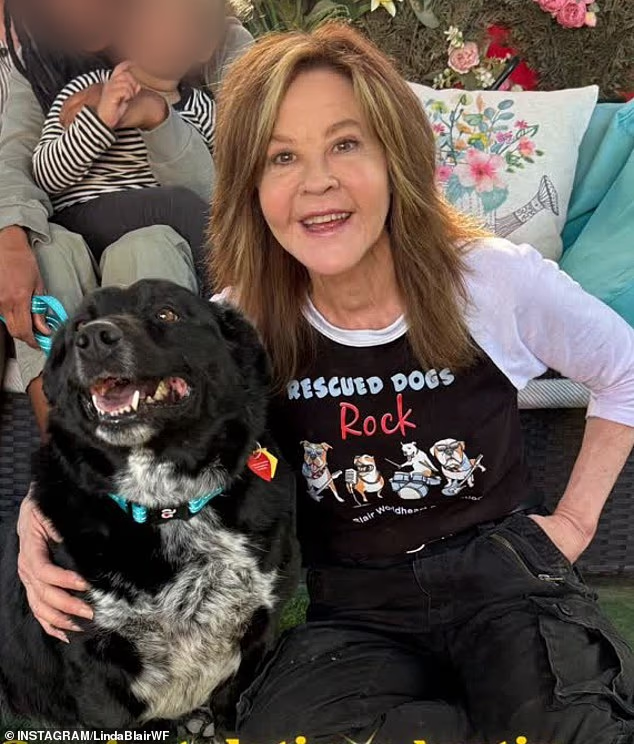
The Exorcist star Linda Blair took a snarky swipe at law enforcement after her Los Angeles home was raided by authorities on Friday and 200 rescue dogs were discovered on her property.
The 67-year-old actress asked why officials couldn’t have just sent a letter regarding her expired permits. ‘I don’t know why mail isn’t used more often to notify somebody. Just saying,’ she said in an Instagram video after the incident.
The raid was a joint operation between Los Angeles County Department of Regional Planning and Los Angeles County Department of Animal Care and Control (DACC). A representative from the DACC told the Daily Mail the actress’s permits to house rescue animals have been expired since 2023.
Blair has not been accused of criminal activity, but an inspection warrant was issued after multiple attempts to contact her kennel went unanswered.
Advertisement
According to TMZ, the horror movie star is permitted to house about 60 dogs, but 200 canines were discovered at her residence. It was reported that agents arrived to the property at 6am.
The Daily Mail has contacted Blair for comment.
The Exorcist star Linda Blair’s home was raided by law enforcement on Friday, mandated by the Los Angeles County District Attorney
Advertisement
Blair, 67, is best known for her depiction of Regan MacNeil, a possessed girl, in the 1973 horror film
The inspection involved evaluating animal care, safety conditions, and the overall welfare of the dogs housed on the property.
Per TMZ, Blair was present throughout the raid and ‘extremely cooperative.’
Blair later addressed the incident by sharing a video to her main Instagram page on Friday.
Advertisement
‘Hey everybody it’s me, Linda B. I just wanted to check in because today we got a really big surprise visit.’
The star continued, ‘And as it turns out, there is nothing but some paperwork and some new diagrams.’
Blair shared that she wanted to give the update to her followers and fans since the inspection reached the news.
‘I’m fine, the animals are fine. And we just have some paperwork that has to be dealt with and that’s all. That’s what this was all about.’
Advertisement
Blair is the president and founder of Linda Blair Worldheart Foundation, launched in 2003.
After the raid the actress fired a snarky reply via an Instagram video, asking why officials couldn’t have just sent a letter regarding her expired permits
‘I don’t know why mail isn’t used more often to notify somebody. Just saying,’ she stated
A mission statement on the website says its goal ‘is to alleviate suffering, while rescuing, rehabilitating and rehoming abused, neglected and abandoned animals.’
Advertisement
It further notes, ‘We aid in crisis situations, while educating, encouraging and empowering the public to make a difference in the lives of those whom have no voice.’
Less than one week ago Blair called upon her 100,000 Instagram followers to donate to her cause.
‘I’m coming to you because a lot of you think I just run an organization, but I’ve been hands-on [with] animal welfare since 1984 when someone stole my Jack Russell Terrier, Shiba,’ she said at the start of a video.
She continued: ‘It’s hot. It’s hot around the country; the whole country is suffering right now, so it’s really hard to ask for donations, but I’m asking you, for those of you that have the means.’
Advertisement
Blair reiterated in an accompanying caption: ‘I am hands-on in my foundation. I am the main rescuer… healer, behaviorist, trainer and matchmaker for adopters.’
The star has a goal of $5,000, which she indicated will go toward getting a group of rescue dogs spayed, neutered, microchipped, and given rabies shots.
After establishing herself as a Scream Queen with The Exorcist, Blair starred in horror films including 1978’s Stranger in Our House, 1981’s Hell Night, and 1988’s Grotesque.
Blair is the president and founder of Linda Blair Worldheart Foundation, launched in 2003; pictured in October 2023
Advertisement
In 1996 she made a cameo in Scream and appeared on Broadway the following year in Grease.
Then in 2006, she guest-starred on Supernatural, playing the role of Detective Diana Ballard.
In 2010, she appeared as herself on the cable series Pit Boss and Jury Duty.
And in 2021 she returned to The Exorcist franchise, reprising her role as Regan MacNeil.
Emergency crews were alerted to the incident at Stoneyfield Quarry on the Longhaven area at around 3:10pm on Saturday.
Police have locked down the road between Auchiries and Cairn Catto and locals are advised to avoid the area.
Drone footage shows plumes of black smoke billowing out of a building at the quarry with flames visible inside.
A Police Scotland spokesperson said: “Emergency services are in attendance following a fire in Longhaven, Peterhead, at Stoneyhill Quarry, which was reported around 3.10pm on Saturday, 1 August, 2026.
Advertisement
“Road closures are in place between Auchiries and Cairn Catto. Members of the public are asked to avoid the area at this time”
Get more Daily Record exclusives by signing up for free to Google’s preferred sources. Click HERE.
Yorkshire Burrito, a takeaway which sells a variety of different Yorkshire Pudding wraps, has opened its doors in 17 Coney Street for the first time today (August 1).
Previously, the unit’s windows had been covered with brown paper with a hole cut out – inviting passersby to ‘take a peek’ where they would see a QR code that gave those who scanned the code offers on food.
Advertisement
Originally launching in 2015, Yorkshire Burrito has five outlets in the London boroughs of Camden, Leicester Square, Vauxhall and Wembley – with staff adding that opening their doors today is a ‘soft launch’ for the venue and that they’re eager to get started in York.
The shop offers four different burritos including beef, chicken, roast topside beef, and cauliflower cheese, alongside upgrades and a mash menu.
Yorkshire Burrito in Coney Street (Image: Alice Kavanagh)
A planning application is still ongoing for signs on the outside of the shop, with branding in place through a window decal, with inside of the shop having dark walls, neon signs, and a large menu above the counter.
The plans are the latest of those submitted or approved for buildings in Coney Street in recent months.
Advertisement
Beauty store Space NK is set to open this autumn after the council approved the conversion of the former JD Sports store in 3-7, Coney Street.
An application from the Manchester-based Federal café to licence 5 Coney Street for alcohol sales has also been lodged and is awaiting a decision.
If you have your back door open often and have dogs running in and out all the time, you might want to make sure your garden is completely safe for your pet.
Gardening expert Monty Don has shared a few tips about how to make a pet-friendly space in your garden.
There are a few things he shared that you should avoid having in your garden to make it more suitable for them.
Advertisement
How can I make my garden safe for dogs?
BBC Gardeners’ World Magazine shared a clip on YouTube where Monty Don shared he always has dogs alongside him in the garden.
He said there are a few things people with pets should be aware of, including plants to avoid to keep dogs safe.
He said: “As regards dangerous plants, that isn’t something I worry about too much because, in my experience, and I’ve had lots of dogs, dogs don’t go looking to munch on poisonous things any more than you and I do.
Advertisement
“The one plant I would keep an eye on with a puppy is yew, Taxus.
“If you see a puppy chewing some yew, and that’s often happened to me, don’t panic.
“Just take it out of its mouth.
“The chances are the worst that will happen is it might make it sick but, if it eats a lot, well then it can do more damage.
Advertisement
“So keep an eye out for that, but don’t worry too much about the horror stories that you read online or people tell you.”
While many people think it is a good idea to throw sticks around the garden for dogs to play fetch with and tire them out, they can be very dangerous and should be removed from your garden.
Sticks can cause serious injuries to dogs as well as painful splinters and cuts.
If a dog ingests some of the wood, it can block their airway or cause obstructions in their stomachs and intestines.
Advertisement
Monty Don said: “The one thing though that I don’t do anymore at all is don’t throw sticks for dogs.
“Dogs love it, and nine times of out 10 there’s no harm whatsoever, but I had a dog I threw a stick for, it went and got it, and the stick pierced the back of its mouth and came out through its neck.
“Luckily it survived, but that was not good.”
Does your dog love spending time in the garden? Let us know in the comments.
This article contains affiliate links, we will receive a commission on any sales we generate from it. Learn more
Advertisement
Holidaymakers still have the chance to book a long stay at a seaside cottage this summer at a reduced cost. With bouts of sunny conditions becoming more and more common throughout 2026, now is the perfect time to spend some time away and enjoy the seaside.
Situated on the Jurassic Coast, a UNESCO World Heritage Site, the village of Beer provides access to a wide variety of quaint pubs, restaurants, shops, and more. Visitors also have easy access to the coast, while also having the opportunity to take part in the South West Coast Path, which provides a stunning coastal walk from Beer to Seaton.
The property is also well-equipped for a comfortable stay, providing a variety of furnishings, a private entrance, and an open-plan living area designed to provide views of the surrounding village and coast. This also includes a well-equipped kitchen paired with a breakfast bar and a dining table for evenings when you want to stay inside.
However, if you want to book a stay somewhere else near the coast, you could opt for Sunny Breeze, Malborough, which is allowing stays from £333 for seven nights. This beach hut-style cottage provides two bedrooms, an open-plan living space, and is in close proximity to the beach, shops, and pubs.
Advertisement
Otherwise, you could book a stay at Woodland Cottage from £728 for seven nights. This classic-style cottage has three generous bedrooms and plenty of amenities to enjoy, including a fully stocked kitchen and off-road parking for two cars.
Another added: “One of the loveliest holidays we’ve had.” While a third said: “Beer has to be the best small seaside village, the cleanest beach, never crowded, lovely walks and a good selection of eateries for such a small place. Been to Beer many times and never tire of the place.”
“The bed was very comfy with lovely bedding. Great shower with loads of hot water. Very worth staying here.”
A sixth said: “Lovely view of the sea and though the flat is very small, it is very well equipped.”
Advertisement
However, another visitor said: “We found the stairs rather treacherous and a lot of the ceilings very low. Not for us I’m afraid.”
Another added: “Lovely apartment, ideal spot for reaching the beach and not having to drive to one!! Not ideal for anybody will walking aids as up two very steep flights of stairs!!”


























































You must be logged in to post a comment Login