



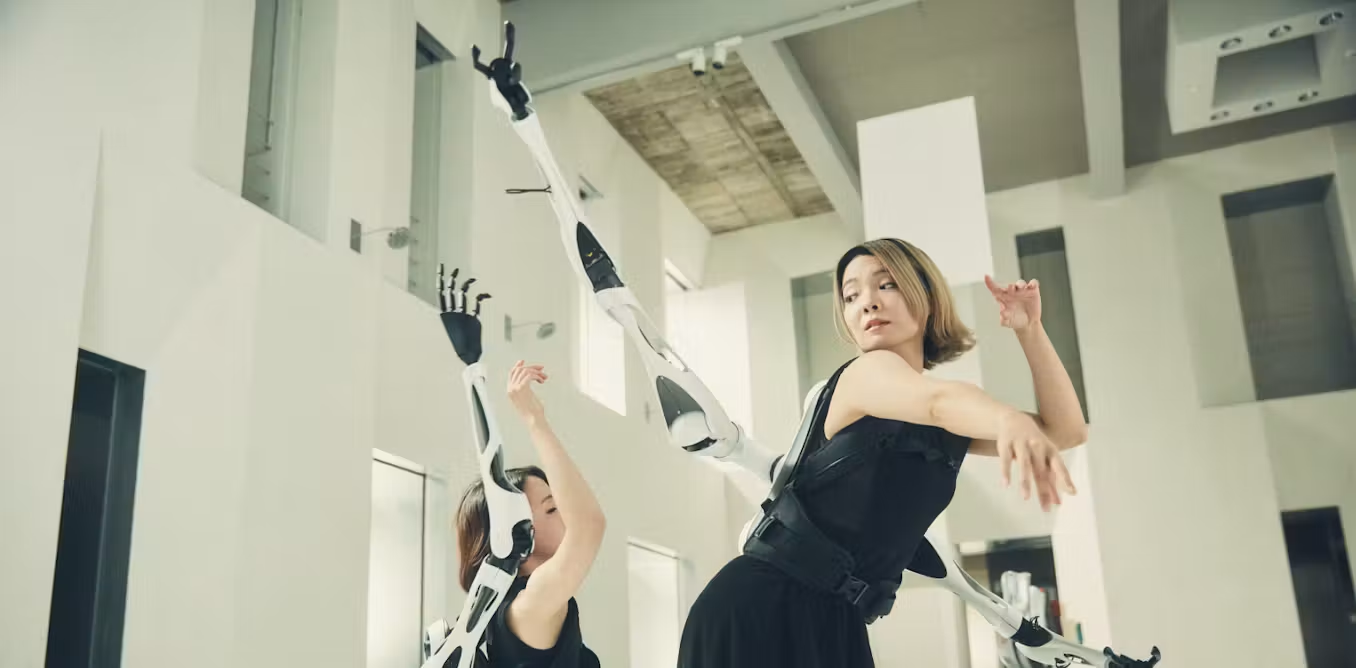
How many times have you asked someone to hold open a door while carrying something, or fumbled with your front-door keys with your arms full of shopping? Wouldn’t it be great if you could give yourself the extra hand you need?
This is one of the goals of human movement augmentation, a new and growing area of research that aims to extend human capabilities beyond their natural limits. Within this field, researchers are developing and studying artificial limbs that can be added to the human body. These are known as supernumerary robotic limbs, or SRLs.
Current SRLs are largely experimental, but in the future wearable robotic limbs could help in a range of areas. They could have an impact in manufacturing, healthcare, space, music, arts, gaming and rehabilitation.
Technology that boosts people’s physical and mental abilities is no longer the preserve of science fiction. In this new series, we explore cutting-edge ways that human capabilities could be augmented now and in the near future – and the ethics of these innovations.
Unlike prostheses, SRLs increase the overall capacity of the human body, rather than restoring the capacity of a missing limb. If you’re familiar with the Marvel universe, think of Doctor Octopus – his mechanical arms are fictional examples of this type of technology.
In the real world, scientists have created extra arms a little like Doc Ock’s (but benign) as well as additional legs and fingers.
These extra limbs don’t look or behave like actual human arms or legs. They’re combinations of rigid materials, motors and actuators – mechanical devices that produce force. They can be worn like a backpack or watch.
So far, they tend to be controlled using another body part, most often the foot. By using pedals or shoes fitted with sensors, a person can generate forces or make movements with their feet that are then translated into movements of a robotic limb. Recent research has also investigated using the muscles around the ears for control.
Designers typically avoid using the arms and hands as controllers. This is to maximise the added capacity additional limbs provide.
A common question is whether robotic limbs could be controlled by the brain. They aren’t yet, though scientists have explored the idea.
When the brain sends electrical signals through the nerves to control muscles, only certain frequencies of those signals actually convey information that instructs movement. There is essentially spare bandwidth in the body’s nervous signalling network.
Some researchers have tried to see if this spare capacity can be harnessed – independently of actual muscle movement and non-invasively – to control SRLs.
Although promising, this approach has had a low success rate. Its complexity and the long calibration and training period needed for users probably makes it unsuitable.
Two arms good, four arms better?
Supernumerary robotic limbs are designed to provide something additional to the natural body. They should work alongside our natural limbs, without limiting their natural functions. The goal isn’t to create autonomous entities that can do a job in place of someone’s body. Rather, it’s to give people additional tools they can control and use.
For example, you might one day wear a backpack with two robotic arms attached and use these to keep a ceiling panel in place while you screw it to the ceiling. Or you could have a belt with two extra legs to keep you stable in an unnatural position, leaving your hands free to fix something. Or you could have a sixth finger, which could allow you to open a bottle with one hand.
These examples might seem science fiction, but they’ve all been realised and tested in the lab.
Industrial uses are beginning to be explored. A future surgeon might operate four surgical tools at the same time, for instance. Or a rescue operator could immediately extract an earthquake victim while lifting debris, without needing to wait for support.
But for now, such uses remain ambitions. This field is still largely experimental, and the performance of SRLs is limited. Existing devices are often heavy, bulky and difficult to wear, and their speed is usually limited for safety.
Learning to use them well also takes a lot of effort, especially as current control interfaces tend to be complex and unintuitive. That said, studies of how people respond to using supernumerary robotic limbs have found that they can learn the basics of controlling a third arm or sixth finger in less than an hour.
Feedback plays a key role in this learning process. Vibrating motors and electrodes that provide a small current can help people “feel” a robotic limb they’re controlling.
This is crucial for motor learning: when you try to play tennis or the piano, your haptic senses play an important role in allowing your brain to learn the correct movement. The same applies with a robotic limb. Sensory feedback is also essential for getting the brain to treat the SRL like it is part of the natural body.
Despite the challenges of learning how to use them, research shows that people become more adept at using extra robotic limbs over time, and that the brain seems to adapt and incorporate these extra limbs to the point that it feels natural having them. This suggests there’s real future potential in the field.
In the meantime, it’s important to raise awareness about human movement augmentation and SRLs specifically. Most people have no idea what human augmentation means or that these devices exist.
Now that you know that they do, what would you use these limbs for?


























































You must be logged in to post a comment Login