Record View says the new cohort of MSPs entering Holyrood must take concerns over teen violence seriously.
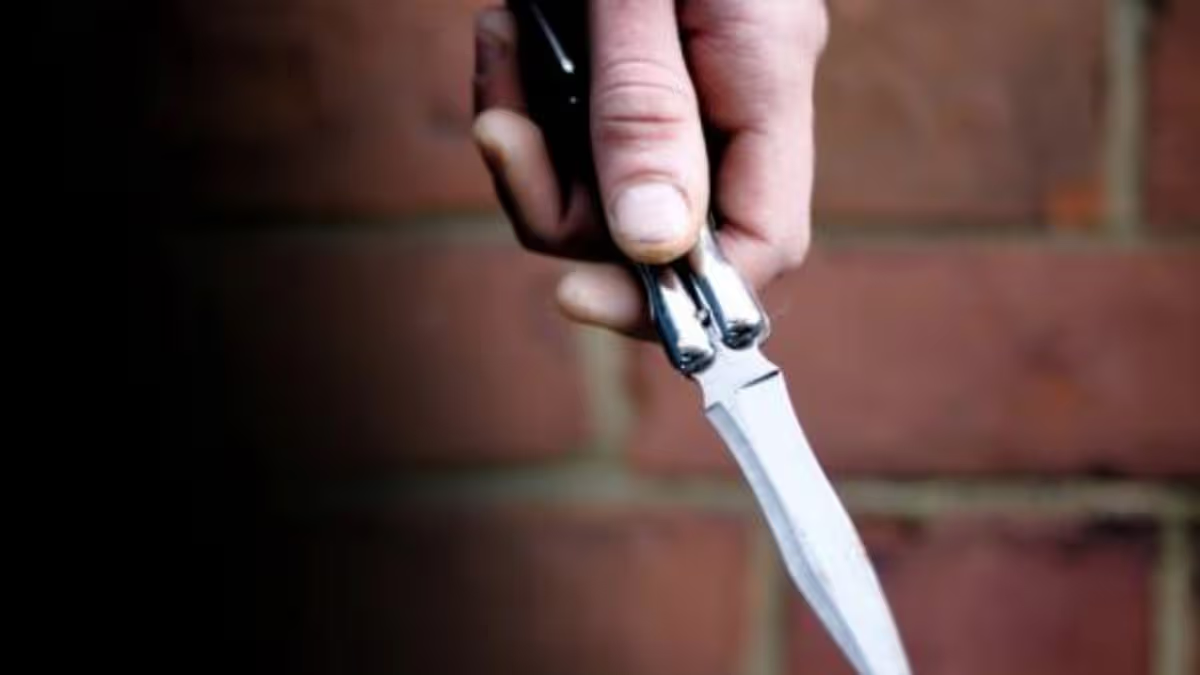
Kory McCrimmon was just 16 when he was stabbed to death in a dispute over £50 by a younger teenager in Glasgow’s east end.
The tragedy was followed by a series of horrific knife incidents involving young men in Scotland over the following year.
Advertisement
Two teenagers, 15-year-old Amen Teklay and 16-year-old Kayden Moy, died in street stabbings that shocked the country.
Now Kory’s best friend has spoken out in the Daily Record in the hope that no more lives will be lost.
He has singled out our political leaders, claiming young people of his generation have been “failed and forgotten”.
That should be a wake-up call to the new cohort of MSPs entering Holyrood after yesterday’s election.
Advertisement
To give credit where it is due, First Minister John Swinney has taken concerns over teen violence seriously.
He called an anti-violence summit after the Daily Record’s Our Kids… Our Future campaign highlighted growing concerns over knife crime and bullying –much of it filmed for online “likes”.
Swinney also met with bereaved parents of knife crime victims to hear first hand the devastating effects ofScotland’s blade culture. Whether he returns as FM is up to the voters.
But whoever has the keys to Bute House once the votes are counted today needs to make sure we don’t endure another summer of pointless knife-related deaths.
Advertisement
That means investment in community facilities to give young people alternatives to hanging about the streets.
But politicians can only do so much. Every parent can do their bit to tackle teen violence by getting involved in their community to help our young people.
Whether it’s supporting the local youth football team, helping out at local clubs or even just watching out for your kids and their pals, we can all do our bit.
If Scotland’s kids feel they are “failed and forgotten” let’s show them they are loved and respected instead.
Advertisement
Fantasy footie job
They say God loves a trier. So 10 out of 10 to John Walker for his bold attempt to land the best job in world.
The Tartan Army stalwart from Airdrie has applied for the role of Fifa’s World Cup Watcher. The tough gig involves sitting watching every single minute of the summer football festival in New York’s Times Square.
Best of luck to John – and we hope he lands the job of his dreams.
As for the rest of us, we may not become professional World Cup Watchers.
Advertisement
But we will be more than happy to do it for free.
Get more Daily Record exclusives by signing up for free to Google’s preferred sources. Click HERE.
Nathan Emerson, chief executive officer of property professionals’ body Propertymark, said: “The rate of inflation remains a key concern for many people, especially as there is widespread speculation that the Bank of England may potentially need to implement measured base rate increases over the coming months to best regulate potential future financial instability.
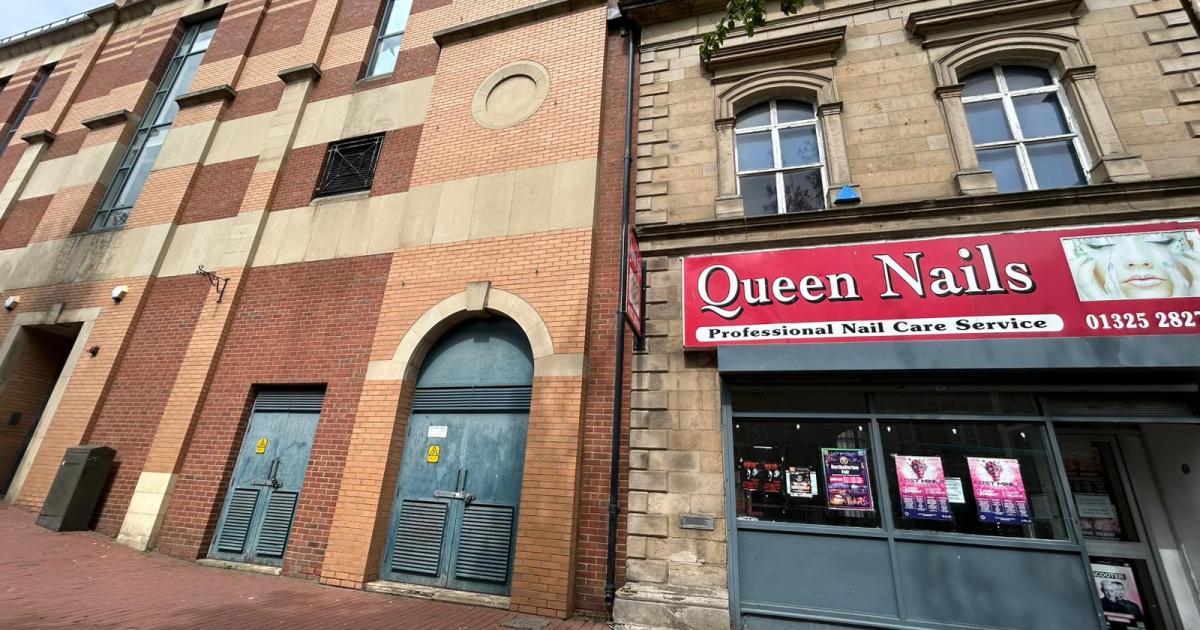
A proposal has been lodged with Darlington Borough Council to turn the first floor of 31 Tubwell Row into a one-bedroom flat, above what used to be Queen Nails next to the Cornmill Centre.
The scheme would see space previously used for business purposes converted into a single home. The applicant says all rooms will have natural light and meet building standards, with access from Tubwell Row.
The property has been in commercial use for at least two years and is not affected by planning restrictions that would prevent the change. The building is not listed.
Advertisement
The applicant says there are no known risks from flooding or land contamination.
A noise report, based on a previous scheme at the site, found traffic, buses and pedestrians to be the main sources of noise at the front of the building, with quieter conditions at the rear.
It recommends soundproof glazing and ventilation for front-facing rooms, while standard measures would be suitable at the back. The report concludes noise should not prevent approval.
No external changes are planned and no other properties would be affected.
Advertisement
The application is awaiting a decision from Darlington Borough Council.
WARNING: DISTRESSING CONTENT The trainee said he was undertaking a routine task burning rubbish, which turned into a nightmare when a huge fireball engulfed him, scorching his face, chin and hands
Bethan Finighan Science and Innovation Writer, Kirstie McCrum Deputy Head of News, Live News Network and Simon Lennon
08:05, 08 May 2026Updated 08:05, 08 May 2026
A teenage apprentice welder who was transformed into a ‘human fireball’ during a catastrophic workplace incident has revealed how he pleaded with medical staff to end his life. Dwayne Bell was merely 17 years old when he sustained appalling burns while employed at a steel facility in Wigan.
The trainee explained he was carrying out what seemed a standard task of burning waste, which descended into horror when an enormous fireball consumed him, searing his face, chin and hands.
He described how the explosion was so ferocious it melted portions of his nose and ear, resulting in third-degree burns. Now aged 22, Dwayne is speaking out to caution other young trainees about the hazards they may encounter on industrial sites, reports the Manchester Evening News.
Advertisement
He said: “I shouldn’t be here talking to you. I am lucky to be alive. It was so hot I feared I was going to be blinded – the heat was so intense.”
“This was an accident waiting to happen… I’m trying to move on. But I’m living in a body that feels like a prison. This shouldn’t have happened. I wasn’t supervised and no trainee should ever be put in that position. They were the adults and they didn’t look after me.”
Dwayne, from Ashton-in-Makerfield in Wigan, had barely begun his employment at Qualfab Steel Ltd when the incident occurred in March 2021. He recalls being directed to incinerate general refuse, including paper, cardboard and wooden pallets, within a metal container.
Advertisement
He said: “I was just a kid, doing what I was told. I was the youngest on site by 20 or 30 years.”
In court documents, Dwayne stated he felt he had not been given sufficient training for lighting fires to burn rubbish — something he described as “surprising”. Though he notes he did receive basic first aid and manual handling instruction.
He alleges he was frequently left without supervision despite his lack of experience, but had ‘seen the older lads do it a hundred times’. When a lighter wouldn’t ignite some damp timber, Dwayne says he grabbed a tin of paint thinner, as he claims he had witnessed others doing previously.
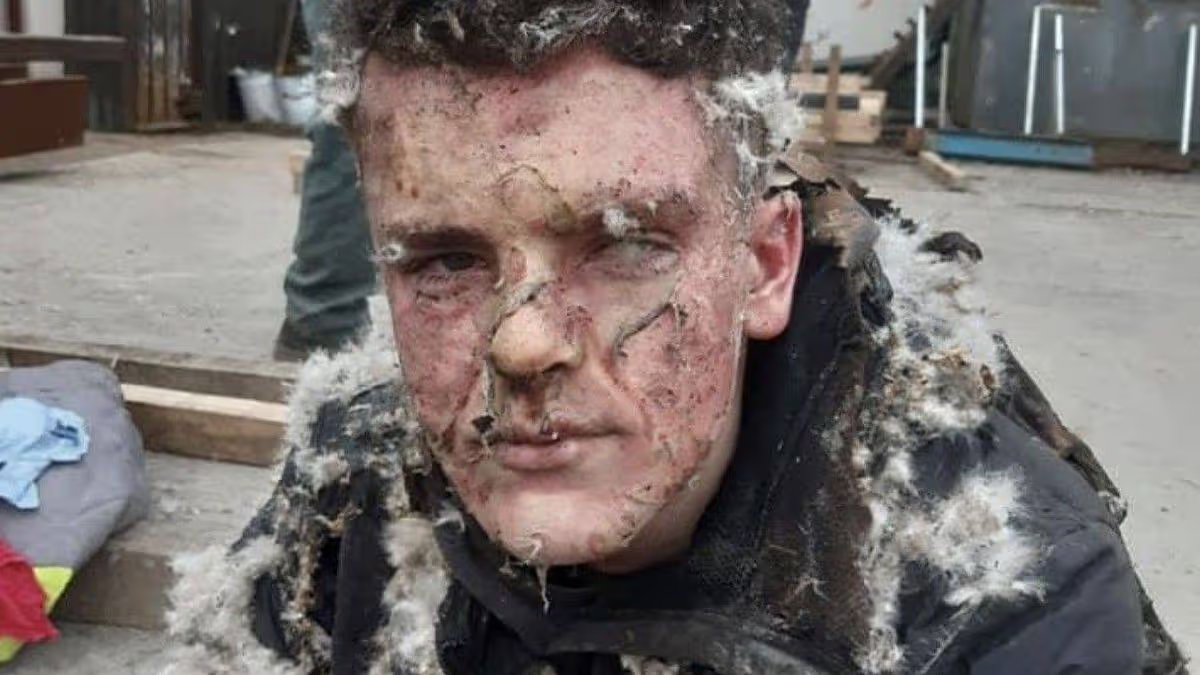
“I didn’t see the sparks that were already there as they were hidden by the wood,” he said. “The next thing I knew, the world just turned orange. The sound was like a jet engine. I was standing in the middle of a massive flame. As soon as I felt the whoosh of heat I shut my eyes as I didn’t want to go blind. It was like a bomb exploding in my face.”
He said his head and hands were ablaze and he threw himself to the ground in agony while his workmates extinguished the flames using a high-visibility jacket.
He said: “My colleagues came running over and tried to remove my gloves and overalls. As they did, my tracksuit bottoms underneath began to melt. But I opened my eyes and I was still alive and I was so thankful that I wasn’t blinded.”
Still reeling from the trauma, Dwayne even requested colleagues photograph his injuries before emergency services arrived. He added: “I had feathers on me from the jacket and my face was red with skin peeling off but I didn’t think it was that bad as I felt no pain. I never knew how bad it really was.”
Advertisement
He was airlifted to hospital and placed in an induced coma for a week after sustaining burns to eight per cent of his body. Upon regaining consciousness a week later in intensive care in March 2021, surrounded by ‘tubes coming out of him’, he believed he had only been asleep for a single night and was experiencing ‘indescribable pain’.
Dwayne said: “I looked at the nurses and I just begged them to let me die. I couldn’t see a future.
“I was wrapped in bandages, I couldn’t move, and the pain was the worst I had ever experienced. So I asked the nurses just to turn the machines off and let me go. But they wouldn’t. It was horrific.”
Advertisement
Following three weeks in hospital, Dwayne returned home, where his mother was required to assist him with getting dressed and even cutting up his meals.
He said: “My mum had to do everything I was helpless. The pain was so intense and my skin would break easily. I couldn’t sleep on my side because of my burnt ears so I hardly got any sleep – it was a living nightmare.”
Throughout the following year, he underwent three skin graft procedures on his hands, using skin taken from his stomach and thighs. While his facial wounds have largely recovered, his hands remain severely scarred and may necessitate additional surgery.
Advertisement
He has also been forced to abandon football and golf, as the friction involved triggers painful blisters. He added: “My hands feel really numb in the morning like a dead leg and I get extreme pins and needles. I get very anxious in social settings still as I have bad scarring on my hands, chin and forehead. The experts don’t know if they will get any better.”
Dwayne subsequently instructed workplace injury specialists Express Solicitors, and the case was resolved out of court for a substantial six-figure sum, with no admission of liability.
Senior Associate Neil Sagar, of Express Solicitors, said: “Dwayne has made a miraculous recovery from his life changing injuries. But he still lives with the consequences of what happened everyday and his ongoing scars will affect his future career. Businesses need to make sure appropriate supervision and training is given to apprentices especially when working with dangerous disposal methods.”
Advertisement
Dwayne has since returned to welding with a different company in the North. However, the heat and vibration from power tools can trigger painful blistering, restricting how long he is able to work.
He hopes that by sharing his experience, others may be spared from enduring similar injuries.
He added: “I have to live with the consequences of what happened there everyday. Now I just want to try and live as normal a life as possible.”
Qualfab Steel Ltd has been approached for comment.
Advertisement
Ensure our latest news and sport headlines always appear at the top of your Google Search by making us a Preferred Source. Click here to activate or add us as Preferred Source.
Belfast Live readers would vote overwhelmingly to remain in the United Kingdom if a border poll were held tomorrow, according to our latest reader poll.
6,955 responses were recorded in our reader poll between 18th and 26th March.
Of those respondents, 57 per cent (3981) said that they would vote to remain in the United Kingdom if a border poll were held tomorrow. 40 per cent (2781) said that they would vote for a united Ireland, 2 per cent (161) were undecided, while less than half a per cent (32) would not vote.
What the results tell us and what they could hide
Analysing the results, Prof. Fidelma Ashe from Ulster University said: “The question of a border poll has become heavily focused on numbers, reflecting the Belfast/Good Friday Agreement’s provision that the Secretary of State should call a poll when it appears likely, in his judgement, that a majority would express a wish for a change in Northern Ireland’s constitutional status.
Advertisement
“That provision helps explain why every new survey is quickly read as evidence for or against how close Northern Ireland might be to such a moment. No doubt there will be some eyerolling at the appearance of yet another unity poll.
“Belfast Live’s recent readership survey is another snapshot in that ongoing debate. As with any self-selecting readership poll, it should be treated cautiously; the findings cannot be assumed to reflect the wider electorate. Even so, it offers a useful opportunity to think more carefully about how people respond when asked to choose between two constitutional options, and what that response can and cannot tell us about the dynamics of the unity debate.”
What the survey findings suggest
Prof. Ashe added: “First, the survey tells us something straightforward: among Belfast Live readers who responded, there is a sizeable gap between support for Irish unity and support for remaining in the United Kingdom.
“A second, perhaps more striking feature of the Belfast Live survey is that very few respondents described themselves as “undecided”. The survey suggests the undecided share is just over 2 per cent, which is exceptionally low for a constitutional question that is widely recognised as complex and contested.
Advertisement
“That unusually small ‘undecided’ category is a prompt to interpret the findings carefully because the size of the undecided group often tells us as much about question format and context as it does about deep certainty on ill-defined constitutional choices.
Is the undecided category shrinking?
“In larger surveys using probability-based random sampling on Irish unity, the undecided group is bigger,” Prof. Ashe said. “The ARINS North–South project with the Irish Times regularly finds that a higher percentage of respondents in Northern Ireland say they are unsure how they would vote in a border poll. In the most recent ARINS survey published in 2025 by the Irish Times, 14 per cent were undecided, with 34 per cent favouring unity and 48 per cent opposed.
“So why might a readership survey produce such a small, undecided category? Has this survey uncovered a shift towards more binary choices in the form of for and against, or could there be another explanation?
“One possibility is not that voters have suddenly become more certain, but that many people respond differently when faced with a for or against choice framed in immediate terms (for example, unity “tomorrow” versus staying in the UK). When questions are posed in this way, some respondents who hold mixed views, conditions or reservations may still select an option rather than choose “undecided”. This does not mean their choice is insincere; rather, it reflects the way people often resolve uncertainty by choosing the option that feels more secure in the moment.
Advertisement
“This matters because constitutional preferences are frequently conditional. A voter might favour the Union in principle but worry about the performance of devolved governance. Another might support unity in principle but remain unconvinced that it is feasible, affordable or that it would be a better choice in the immediate future. Others may feel pulled in competing directions, as identity, economic considerations, public services, stability and rights rarely align neatly.
“When those considerations are compressed into a single immediate choice, uncertainty does not always present itself as ‘undecided’. Where details about a future constitutional arrangement are unclear, many people may reasonably prioritise what feels institutionally familiar. In a context of uncertainty, that may be a rational response.”
Risk, reassurance and constitutional futures
Prof. Ashe continued: “Concerns about economic security and social provision are central to how many people engage with questions of constitutional change, particularly where the practical implications of change remain uncertain. Findings from research I have conducted with collaborators highlight how everyday social and economic issues shape constitutional attitudes.
“Using more intensive participatory research methods, this work shows that questions of healthcare, welfare security, employment, housing, childcare and community resources are inseparable from constitutional futures as they are lived and imagined.
Advertisement
“That research captures a cautious concern with material, social and security consequences. Where people lack clear, credible information about how social and economic protections would be maintained in a new constitutional arrangement, uncertainty is bound to constrain support for immediate change. Constitutional questions, in this sense, are rarely abstract: they are evaluated through lived experience, everyday stability and perceptions of risk.
“My research highlights the importance of process: without clarity on economic and social outcomes, apparent certainty often reflects caution rather than settled constitutional preference. Research associated with the ARINS project, including focus group and participatory work by Jennifer Todd and colleagues, supports this interpretation.
“That long-running research similarly shows that individuals who express uncertainty about a future unity referendum often do so because of limited information, lack of prior discussion and unresolved questions about economic and social governance. Rather than articulating fixed opposition or endorsement, participants frequently express conditional views and emphasise the need for deliberation and detail before being asked to make a definitive choice.
“Taken together, this research helps explain why uncertainty may not register as ‘undecided’ in a binary survey format. Faced with unanswered questions about the organisation of healthcare, pensions, welfare provision or employment protections, some voters may reasonably default to remaining in the UK. Additional research from the ARINS/Irish Times, including survey findings and associated focus group analysis by Jennifer Todd, Joanne McEvoy and John Doyle, suggests that undecided voters want much more discussion and information on the issue.”
Advertisement
What this means going forward
“If there is a single lesson here, it is that polls do not merely measure opinion. They also reflect how opinion is shaped by uncertainty, question format and what voters believe is realistically on offer,” Prof. Ashe concluded.
“That is not a judgment on the legitimacy of union support (or unity support). Belfast Live readers are perfectly capable of evaluating survey findings and assessing the validity of this recent survey themselves. It is, however, a reminder that in constitutional politics, headline “certainty” often sits alongside a deeper and more complex political context that can be obscured by headline numbers. Despite these survey results, there may be a wider landscape of conditionality and contingency that suggests the need for wider deliberation. More deliberation does not imply a particular outcome; it simply clarifies what different outcomes would entail.”
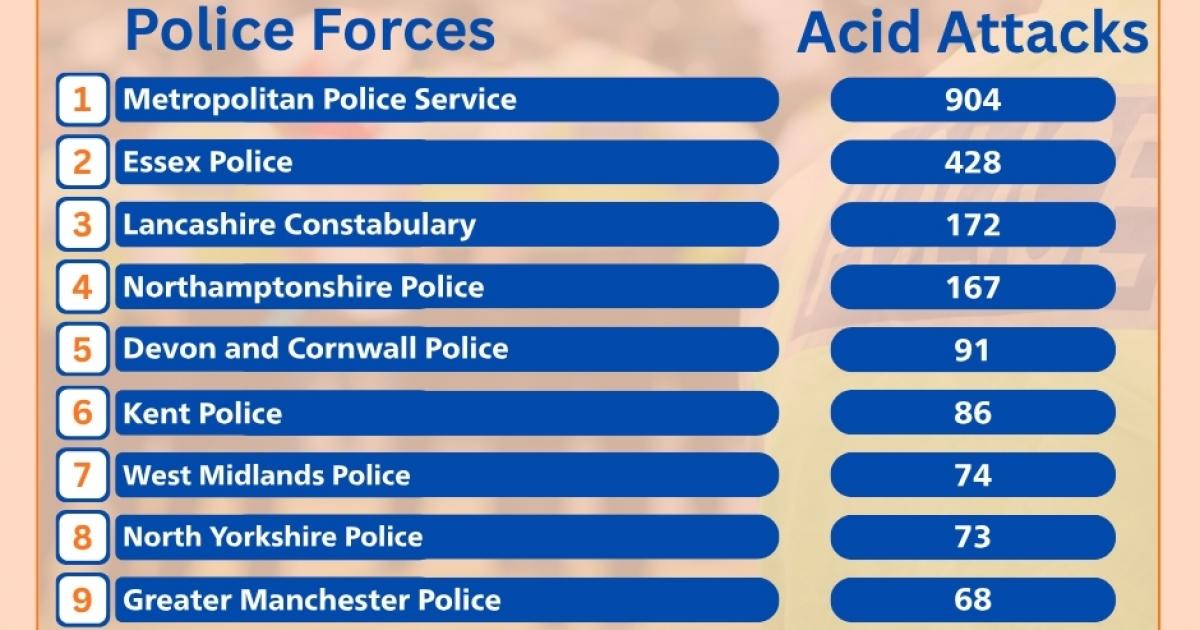
In the past three years, North Yorkshire Police recorded 73 acid-related offences — among the highest in the UK.
Of these, just eight per cent were closed without a suspect being named or identified, contrasting sharply with national figures showing more than 800 attackers remain at large.
Ellie Lamey, a Criminal Injuries Compensation Authority specialist at Legal Expert, said: “These figures highlight a deeply concerning lack of accountability for what is a barbaric and life-altering crime.
“When perpetrators of such horrific attacks go unidentified, victims are robbed of the justice and closure they so rightfully deserve.
Advertisement
“Corrosive substance attacks leave victims with devastating physical and psychological scars that can take a lifetime to heal.
“It is absolutely vital that survivors understand they are not alone and that they can still seek specialist support and financial compensation to help rebuild their lives, even if their attacker has completely evaded the courts.”
Just eight per cent of North Yorkshire cases were closed without a suspect being named or identified (Image: Legal Expert)
The findings come from new research by legal injury specialists Legal Expert, based on UK-wide police data from 2023 to 2025.
London topped the list with 904 recorded acid attacks, followed by Essex with 428 and Lancashire with 172.
Advertisement
Other high-ranking forces included Northamptonshire (167), Devon and Cornwall (91), Kent (86), West Midlands (74), North Yorkshire (73), Greater Manchester (68), and West Yorkshire (66).
Victims’ rights campaigners say the latest figures reveal a “deeply concerning” lack of accountability and support for those left with lasting injuries.
Legal Expert is encouraging survivors to seek legal advice and support regardless of whether a suspect has been caught.
The organisation offers free consultations through a 24-hour helpline, with tailored advice on accessing compensation and care.
Advertisement
The issue has gained renewed attention following the death of 38-year-old Plymouth father Danny Cahalane, who died in April 2025 — ten weeks after being attacked with industrial sulphuric acid.
A high-profile court case in Hampshire has also placed national focus on the use of corrosive substances as a weapon.
Other recent cases, such as the January 2024 attack in Clapham, have further highlighted the urgent need for action.
Every election is a storytelling contest, with campaigning parties competing to frame the plot. This year’s local elections, the largest test of voters’ mood since the 2024 general election, have been dominated by two master-narratives.
The first is about the demise of the old two-party system under which Labour and Conservatives have been the battling giants for almost 100 years. Vast regions of England have long been regarded as safe electoral zones. They have been disrupted only occasionally by strategic incursions by the Liberal Democrats or mid-term revolts against whoever formed the Westminster government.
The story of the 2026 local elections is one of a conspicuous public impulse to punish the old incumbents, resulting in the ascendancy of the new kids on the political block – Reform UK and the Greens.
In the 2024 general election, Reform won 15.3% of the vote in English constituencies and the Green Party won 7.3%. Since then, Labour’s poll ratings have fallen and the Tories have hardly recovered from their devastating result when they lost 238 seats.
Advertisement
But the story amounts to more than numbers. We are witnessing a pervasive and powerful expression of desire by the electorate – not just for radical political alternatives, but for a radical alternative to politics itself.
The rise of the outsider
This is a story about the rejection of anyone who looks or speaks like a conventional politician. Both Reform leader Nigel Farage and Zack Polanski, the leader of the Greens in England and Wales, have cultivated images of themselves as outsiders who eschew the caution and attachment to well-rehearsed cliche that has so discredited their opponents.
It was an election in which voters came to believe that what these political mavericks say is what they actually mean. Left-inclined voters might feel repelled by Farage’s strident nationalism and right-inclined voters might regard Polanski as a dangerous dreamer. But neither doubts that they are up against genuine commitments.
Meanwhile, Labour and Conservative candidates have continued to campaign in the way they have been for decades. This means they have often actually been talking about local policies relating to refuse collection, libraries and care services. The newcomers have tended to ignore the rules of the game and fought their campaigns on headline values rather than policy detail.
Advertisement
Reform UK has said that it planned to open migrant detention centres in areas where the vote for the Green Party is high, while Green candidates in Haringey produced an election video stating that if elected they would uphold the inalienable rights of the Palestinian people.
The fact that elected local councillors lack any power to place detention centres in other areas or determine UK foreign policy was ignored. Local elections were turned into a showcase for a style of politics in which cultural symbolism outweighed the prudential technicalities of local governance.
However, as Reform politicians are learning in the few areas where they already hold local power, attention to policy complexity calls for rather more than the repetition of populist slogans, leading several of their councillors to leave the party as the responsibility of hard policy choices has dawned upon them.
Advertisement
For many voters, these local elections present a chance to gamble on the promise of the untried. And this brings us to the second story of this campaign, which is taking place almost exactly a decade after the Brexit referendum.
That was a moment when the politics of “anything must be better than this” appealed to electoral gamblers. As an insurgency of the unheard, Brexit reflected a feeling that the political establishment needed a good poke in the eye. This was regardless of the consequences for the assailants.
Unfinished business from 2016. Ms Jane Campbell/Shutterstock
A key story of this year’s local elections is that the division between Leavers and Remainers, far from fading into the distance, has hardened over the past decade. Socially liberal Remainers and culturally conservative Leavers have each sought political homes in which to complete what they see as unfinished business.
Advertisement
YouGov polling in early 2026 suggested that how people voted on Brexit is a key predictor of how they would vote in this year’s elections. Some 50% of those who voted Leave in 2016 intended to back Reform this year. Among Remainers, the largest number (28%) say that they will vote Labour, but both the Greens and the Liberal Democrats each have around a fifth of the Remainer vote, making them the largest political home for those who opposed Brexit ten years ago.
The results of these elections say a lot about how much voters are tired of the old incumbents and continue to dwell on changes that Brexit promised or threatened. In terms of how councils will be run between now and the next local elections, during a period of constrained public spending, hollowing out of services and energy insecurity, this election campaign has had precious little to say.
Recent concerns have prompted a collaborative clean-up effort and a long-term improvement plan involving rail operators, local councils, and the wider community.
Volunteers from the Durham City Riverscape Community Group recently removed more than 50 bags of litter from the station area, drawing public attention to the scale of the problem.
Councillor Carole Lattin, chair of the parish council’s environment committee, said: “This is a really positive step forward, and we are delighted to see partners coming together with a shared commitment to improving such an important gateway to our city.
Advertisement
“The Parish Council is very happy to support this collaborative work, and we look forward to playing our part in ensuring lasting improvements”.
The station is a key arrival point for visitors to Durham and sits just moments from the city’s World Heritage Site.
It also provides access to nearby attractions such as Wharton Park and offers visitors a first impression of the city and its heritage.
The parish council described recent talks with London North Eastern Railway (LNER) as “positive and forward-looking,” and said all parties share the ambition of making Durham Station the very best stop along the East Coast Mainline.
Advertisement
Suggested improvements include better waste management, new floral displays, closer coordination with local volunteer groups, and an application to the North East Combined Authority for funding to carry out a thorough jet washing of the station.
Cllr Lattin said: “Durham Station is a key arrival point for residents and visitors alike, and we want it to reflect the very best of what our city has to offer.
“We sincerely hope that the North East Combined Authority – who have recently announced some transport funding – will also get behind these plans.
“Our ambition is clear—we want Durham Station to be the very best along the East Coast Mainline, providing a clean, welcoming and high-quality environment for everyone arriving here or who passes through.”
Advertisement
The Durham City Riverscape Community Group welcomed the support, saying long-term progress will rely on continued cooperation between organisations and the public.
Graham Hollingworth, a lead member of the group, said: “The area around Durham Station had, quite frankly, fallen into a shocking state.
“As a community group, we felt strongly that something needed to be done, so our volunteers have been out litter picking and working hard to restore the site to a condition that the city can be proud of.
“Since then, we’ve been really encouraged by the positive and constructive conversations we’ve had with the City of Durham Parish Council about how we can maintain this space for the long term.
Advertisement
“We’re extremely grateful for that support and collaboration.
“This is such an iconic part of Durham, offering some of the most fantastic views towards the World Heritage Site.
“It should always provide a warm and welcoming first impression for visitors arriving in our city.
“We’re also grateful to LNER and Network Rail for engaging with us, and we would remind everyone that keeping Durham beautiful is a shared responsibility.
Advertisement
“It belongs to all of us, and together we can ensure it remains a place we’re proud to call home.”
All parties involved have stressed that keeping the area clean is a shared responsibility.
There is growing confidence that with continued cooperation, Durham Station can set an example of effective partnership between residents, volunteers, and organisations.
The wider public is encouraged to take pride in the city and play their part in maintaining its welcoming character.
Bonnie Tyler revealed a shocking fact about one of her biggest hits “Total Eclipse Of The Heart” during her last TV appearance before health scare.
Appearing on Lorraine in February, the singer said that she earns little to nothing from streaming royalties for the iconic 1983 song, despite it surpassing one billion streams on Spotify.
Lorraine Kelly pointed out that the song reached number one in the US. “They can never take that away from you,” she reassured Tyler.
Advertisement
The 74-year-old singer underwent emergency surgery for a perforated intestine last week.
We hope you love the products we recommend! All of them were independently selected by our editors. Just so you know, HuffPost UK may collect a share of sales or other compensation from the links on this page if you decide to shop from them. Oh, and FYI — prices are accurate and items in stock as of time of publication.
Travelling without kids is enough of a minefield. But add a squirming, squealing, hungry body (or bodies) into the mix, and you have yourself a few hours in purgatory.
You can tell yourself it’s worth it as much as you want, but there are no two ways around it: it’s going to feel long, and (if we’re being honest with ourselves) probably difficult at times.
Advertisement
So, why not make it easier? To help you prepare for your journey, we’ve found the best essentials you need for travelling with kids.
Whether you’re journeying with a newborn or toddler, boarding a plane, train or driving in the car, keep reading for our round up of the best kids’ suitcases, travel cots, airplane-friendly prams, and more to shop now.
Best travel cots, prams, and carriers
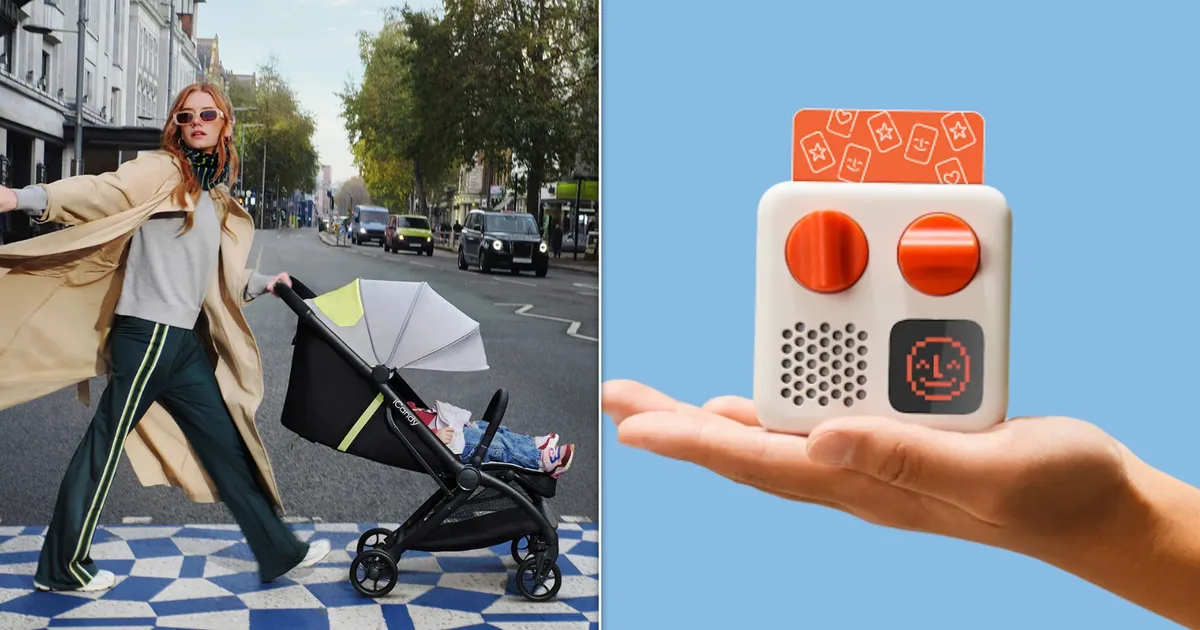
Not only does this lightweight pushchair look sleek, but it is easy to use and practical too. As well as being approved for most major airlines (iCandy recommends double checking with your airline first) it can fold with one hand and the canopy uses UPF50+ coverage, ideal for if you’re travelling somewhere hot. Plus, it’s suitable for all ages, thanks to having a wide and tall seat that can lie flat for newborns, or be folded into a seating position for kids as they grow.
Advertisement
Your world doesn’t have to stop during your little one’s quick snooze; this pram shade offers 99% UV protection and blocks the sunlight out if you want to be out and about while they’re trying to get some Zs in. It can be worn in a whole load of ways, and also comes in this stroller size for older kids.
This clever board clips on to your buggy so your toddler can ride alongside your baby, saving their tired legs – and yours.
Leopard print is a neutral, okay? But style shouldn’t come at the cost of comfort, which is why this carrier is ultra padded and won’t strain you or your babe. Designed to carry children up to the age of two, you can adjust it between three different styles, depending on your (or their) mood.
If you’re looking for something to help carry your toddler or preschooler, this sling is adjustable and works for children between nine months and four years old. The clip on and off design also makes light work of scooping them up in an instant.
Travelling requires tons of lifting luggage and navigating boarding pass barriers. This baby carrier means you’ll be able to keep your hands and arms free, and thanks to the eco-friendly knitted material it will pack up nice and small to squeeze into your luggage when you’re not using it.
We love a multi-purpose product, which is why we’re so fond of this Najell number. As well as being a stylish carrier for when you and your babe are on the go, it fits into prams to transform into a cosy sleeping space and, when the sides unfold, turns into a play mat.
This zip open sleeping bag makes on-the-go nappy changes easy as. It’s also made with adjustable shoulder poppers so it can fit exactly to your baby’s size for comfy, cosy and clean nap times.
Sometimes bed time is urgent, so you don’t want to fuss around with transforming a seat or finding a comfortable position for them to sleep in. This blow up foot rest can be added on to the end of their plane or car seat to turn it into a bed big enough to lie down on.
Tired of having meltdowns when you can’t assemble a travel cot? Our parenting editor can relate, but she ranks this cot as the easiest one she’s ever used. All you have to do to assemble it is pull it out of the bag, and stretch the legs outwards until they click into place. It has padded sides, and comes with a UPF50 blackout cover for emergency naps.
There’s nothing like ferrying one kid around in a pushchair while trying to carry another in your arms or run after them as they decide to make a game of hide and seek in a totally new country. This wagon makes light work of trying to keep multiple kids in the same place, as you can seat up to four children, making it ideal for a family holiday with friends or a festival day out.
Best kids’ suitcases and luggage
Sit on suitcases are not only a lifesaver when you’re rushing through the airport, but this one has a lift-up top, which extends their aeroplane seat into a bed, or turns it into a footrest so they can sit comfortable while you wait for your transport.
Already got the footrest situation covered? This space-print also provides endless fun in the form of zooming around on their bums or tums. Should the celestial print not interest them, it also comes in a ton of other prints, like this unicorn one.
Somehow kids always come back from holiday with way more than they left with (oops!), which you’ll inevitably end up having to carry. This expandable backpack accounts for all eventualities, and it’s waterproof and wipe-clean, so they can wear it for daily use, too.
Instead of doing the jigsaw of trying to balance a million tiny Tupperwares in your bag, this compact little snack box has 12 compartments to stock full of their favourite snacks, is slim enough to slot into a backpack, and it’s dishwasher safe.
Best kids’ toys and entertainment for long journeys
If you need something you can whip out at a moment’s notice, the Switch is pretty much unbeaten. It weighs less than 300g, and you don’t even need to remember to carry extra games around with you thanks to the device coming with 32GB of in-built memory.
If you want to give their little eyes a rest from screens, this audio player and radio is completely analogue, and has kid-friendly controls they can power up without your supervision. Choose from Yoto’s range of stories, music, and learning materials – including everything from K-Pop Demon Hunters to The Gruffalo and Friends – hand them the matching headphones, and you’re away. It even has 14 hours of play per charge, so it can last you a whole day of travelling, if needs be.
Let them escape into their own world with these wireless headphones that won’t trip them up on the way to the bathroom. As well as being padded on the ear pads and headband, to make sure they can wear them for long stretches of journeying, they can be controlled by the JBL app, so you can monitor their play time and make sure the volume is safe for their ears.
Colouring is a fail-safe for hours of entertainment, but crayons on a plane can also land you with the responsibility of scrambling around on your hands and knees looking for them. These ones from Kores are triangular, so they won’t roll away.
When the situation gets dire, there’s nothing easier than popping a tablet in their hands and calling it a day. This kids-specific tablet comes with everything from books, to games, and kid-friendly TV shows. It does it all, folks!
Take ‘I spy’ to a whole new level with this camera. As well as being shaped like a cat – adorable – it prints photos immediately, to encourage them to capture their journey as it happens. The finished photos also make for great crafting material on the journey home, and you’ll have memories the whole family can cherish forever.
If there’s anything more demanding than your child, it’s a tamagotchi. These little creatures require constant attention, and they can be tied to a rucksack for quick and easy access.
Even for adults, journeys can get long and monotonous. If you need something that will add some novelty and excitement back into travelling, these Disney balls come with a surprise gift – the suspense will add at least a little distraction from minds wondering if you’re there yet.
Pool and beach essentials for kids
Whether you’ll be in the pool or the sea, this sunscreen is water resistant for up to 80 minutes. It smells like oranges, in case you needed a helping hand convincing them to layer up. Plus, it’s reef-friendly, so you don’t have to worry about its environmental impact, and is loaded with broad spectrum protection.
We’re past the point of having to lug around a clunky beach umbrella. This stripey tent is not only anti-UV, to protect them from the sun, but it’s a perfect nest to curl up in come nap time.
Some swimming vests can be clunky, but this one provides just enough coverage to keep them safe while giving them (and you) plenty of confidence to venture out and explore the waves. Or the pool, whatever floats your boat.
To little ones, arm bands might seem like an annoying addition to hitting the waves. But having a cute pattern on them can never hurt, can it?
For the spots sunscreen can’t easily cover, this sun hat is UV protective, and ties on to avoid you having to awkwardly chase it down the beach.
These stripey sandals will protect their tootsies from sharp objects on the beach, and you can even get a matching towel cover up to boot. Cuuute!
Whether you’re in the hottest heat or the cold English sea, kids can be particularly susceptible to the cold. This shark-splattered suit will keep them warm and protected from the sun too, thanks to its full-body UV coverage.
If swimming won’t tire them out, learning how to dive will. To stop your older kids from complaining about you lying poolside (god forbid), make a game out of throwing these to the bottom of the pool and having them catch them before they hit the bottom.
Forget boring old sandcastles, this silicone set opens up a whole new world of possibilities for sandscaping, including fruit-shaped moulds and towers a regular bucket could only dream of recreating.
A new law that will strengthen the rights of renters in England came into force
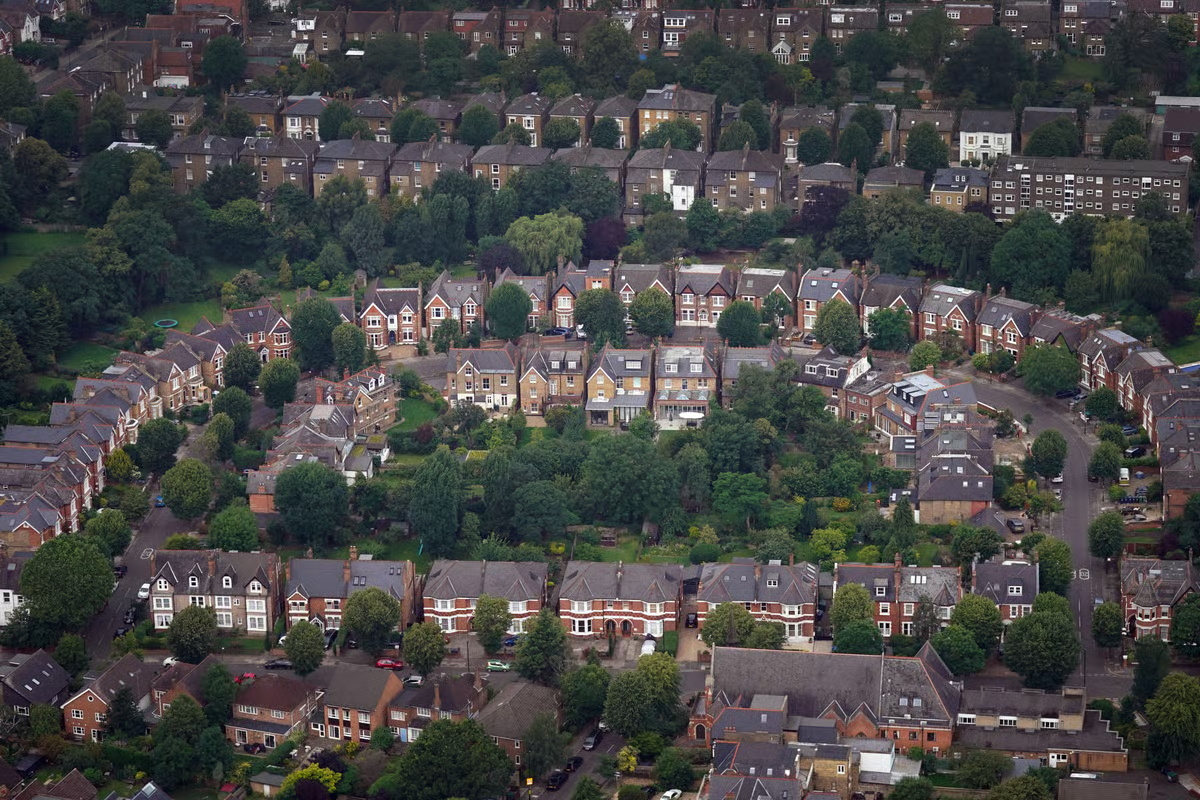
On Friday, 1 May, the Renters’ Rights Act will take effect in England. The long-awaited law, which is the first set of significant reforms to rental housing legislation since 1988, includes several changes that will affect renters and landlords alike.
One of the most significant is the abolition of ‘Section 21’ or no-fault evictions. Previously, landlords could evict tenants without a specific reason, which some campaigning groups say is a leading cause of homelessness. Now, landlords will only be able to evict if they plan to sell or move into a property. Notice periods will also increase from two months to four.
Another major change is around tenancies, which will revert to rolling contracts as opposed to being fixed for 12 or 24 months. The ability for tenants to challenge rent hikes will also be introduced. Additionally, Awaab’s Law, which already requires social landlords to respond to emergency hazards and serious damp and mould within fixed timeframes, will also be extended next year to cover a wider range of health and safety risks. It’s named after two-year-old Awaab Ishak, who died in 2020 after prolonged exposure to mold.
Advertisement
Groups such as homelessness charities and unions welcomed the legislation. Acorn, a renters and community union, said that the act will affect around 12 million renters across the country and is the biggest change in a generation. Chelsea Phillips, Acorn national chair, said: “We won this. This wasn’t just handed to us from above. It came from more than 10 years of tenants organising, taking action, and refusing to accept a system that wasn’t working for us.”
Critics, however, say that the new law could force landlords with smaller operations out, while favouring larger corporate landlords. Some landlords fear that it will give them reduced powers to remove genuinely problematic tenants, while others argue that rent prices could edge upwards if the volume of properties on the market decreases.













































You must be logged in to post a comment Login