The former officer was suspended after allegations were made
A former police officer was found making indecent content of children. Robert Askew, 27, and a former Suffolk Police officer, appeared at Norwich Magistrates Court today (Wednesday, May 27).
Advertisement
Askew, of Quay’s Road in Risby, pleaded guilty to one count of making a category C movie of children. He will be sentenced on July 13.
Askew was arrested on August 13, 2024, after information was received regarding the uploading of illegal material online. Officers attended an address in Stowmarket and during a search of the property, police seized digital devices which were later examined by specialist forensic officers.
Askew was interviewed following his arrest and then charged. He was suspended as soon as the allegations were reported to the police’s Professional Standards Department (PSD).
DCC Dan Vajzovic said: “The overwhelming majority of our officers and staff are professional, committed and passionate about safeguarding our communities. This former probationary officer’s actions were abhorrent and undermine the fantastic work of so many of our officers and staff in protecting our communities.
Advertisement
“The public rightly expects the highest standards of behaviour from both police officers and staff, and we remain steadfast in our determination to continue to root out those who betray the confidence of the community we serve and fellow colleagues.”
Holland Brogan, 21, from Wishaw, who played for Scotland at the Women’s Six Nations, and has captained her club side Glasgow Warriors graduated from the University of Stirling with a Psychology of Sport degree.
A Scottish rugby star gained a different cap this week – having graduated from university this week.
Advertisement
Holland Brogan, 21, from Wishaw, who played for Scotland at the Women’s Six Nations, and has captained her club side Glasgow Warriors graduated from the University of Stirling with a Psychology of Sport degree.
She will now turn professional after signing a new contract with Glasgow Warriors.
Holland said: “My greatest achievements have been getting my first international cap for Scotland, and captaining Glasgow Warriors, while also balancing my studies alongside training and competition.
“These experiences helped me develop resilience, confidence and leadership skills, and I’m proud of what I achieved both individually, and as part of a competitive team environment.
Advertisement
“I chose the University of Stirling because of its strong reputation for sport and its excellent sporting environment.
“And I liked that the University combines academic learning with opportunities to be involved in sport at a high level.”
Honorary graduates Kieron Achara and Dr Walter Humes join hundreds of students at Stirling’s summer graduation
Kieron – the youngest person ever to be capped for Scotland at basketball, at the age of 16 – was awarded an honorary doctorate in recognition of his outstanding contribution to sport in Scotland, particularly basketball.
Advertisement
Also receiving an honorary degree today was education leader Dr Walter Humes, in recognition of his outstanding contribution to the field of education.
A former Honorary Professor at the University of Stirling, Walter is renowned for his research and writing on educational policy, curriculum studies, the history of education, and teacher education.
He began his career as an English teacher before moving into higher education and has also held Professorships at the University of Aberdeen, University of Glasgow and University of the West of Scotland.
Professor Sir Gerry McCormac, Principal and Vice-Chancellor of the University of Stirling, said: “Summer graduation is always a highlight in the University calendar and we are proud to not only recognise the hard work and academic achievements of our students and staff, but to welcome two distinguished honorary graduates into the Stirling family.
Advertisement
“Kieron’s sporting journey, his accomplishments in the field of basketball, and his exceptional advocacy work, are an inspiration to our graduates.
“Walter’s contributions to educational policy and teacher education have been outstanding, and we are proud of his close association to the University. On behalf of the University, I send congratulations to them both.”
*Don’t miss the latest headlines from around Lanarkshire. Sign up to our newsletters here.
And did you know Lanarkshire Live had its own app? Download yours for free here.
DUBAI, United Arab Emirates (AP) — A Liberian oil tanker made its way out of the Strait of Hormuz on Thursday despite threats to shipping from Iran’s paramilitary Revolutionary Guard and using a new route close to Oman’s shore that has been promoted by a U.N. maritime agency.
The transit of the Stoic Warrior and the threats come as tensions rise between Iran and the United States over the terms of their interim accord aimed at permanently ending the Iran war. From getting ships through the narrow mouth of the Persian Gulf to the future of Iran’s stockpile of highly enriched uranium, the two nations are increasingly debating the terms of the deal signed last week.
Through the signing of the memorandum of understanding, the U.S. and Iran agreed to a 60-day period to iron out these and other details. Until that happens — during private talks — leaders from both countries will also continue to negotiate in public, raising the risks of derailing the shaky ceasefire in the region.
A major threat to the deal is the flareup of fighting in Lebanon between Israel and the Iranian-backed militia Hezbollah. On Wednesday. Israel launched an airstrike that killed two people in southern Lebanon, the country’s state-run news agency said. It was Israel’s first airstrike on Lebanon since the latest ceasefire took effect on Saturday.
Advertisement
Tanker sails through Strait of Hormuz
The Stoic Warrior — signaling that it planned to transit the Strait of Hormuz — took off early Thursday morning on a trip that saw it hug the coast of the United Arab Emirates and then Oman.
The vessel then traveled around Oman’s Musandam Peninsula fairly close to the shore, part of a route that Oman laid out alongside the International Maritime Organization, an agency of the United Nations that oversees shipping at sea.
North of the route is the Traffic Separation Scheme, the route in the center of the strait that for decades ships moved through freely. The route is used for transport of about a fifth of all the world’s oil and natural gas.
However, there has been the report of at least one mine sighted in the water after the Guard said that it mined the passage during the war that started on Feb. 28 with U.S. and Israeli strikes on Iran. The threat of mines shut off the route.
Advertisement
The naval arm of the Revolutionary Guard, apparently reacting to Oman and the IMO’s route, gave an angry warning Thursday, carried by Iran’s state-run IRNA news agency.
Advertisement
Sign up for Morning Wire:
Our flagship newsletter breaks down the biggest headlines of the day.
“A few hours ago, without notice or coordination with the Islamic Republic of Iran, some authorities announced a new route for ship traffic in the Strait of Hormuz, which is unacceptable and completely dangerous,” the Guard said.
Advertisement
“It is hereby notified to all that the only authorized route for passing through the Strait of Hormuz is the one declared by the Islamic Republic of Iran,” the Iranian force said. “Vessel traffic outside these routes is extremely dangerous and prohibited.”
It added: “Violators will be dealt with,” without elaborating.
There were no immediate reports of any incidents in the strait as the Stoic Warrior passed. Several ships trailed behind it, according to ship-tracking data.
Anwar Gargash, a senior Emirati diplomat, warned Iran on Thursday over trying to impede the strait or put fees on vessels plying its waters.
Advertisement
“New geopolitical facts cannot be imposed on the Arab Gulf states as a result of a treacherous aggression against them,” Gargash wrote on X. “It sows new seeds of discord and conflict for the future. And this is precisely what applies to the Strait of Hormuz.”
Lebanon remains a flashpoint
Israel’s military said on Thursday that a reservist soldier was killed and another hurt in southern Lebanon, where troops are occupying swaths of the country. At least 37 soldiers have been killed in Lebanon or northern Israel during the fighting, as well one civilian defense contractor. Two civilians in northern Israel have also been killed.
Over 4,000 people in Lebanon have been killed in Israeli strikes since this latest Israel-Hezbollah war began in March, two days after the Iran war started and when the Lebanese militant group fired at Israel.
Iran has insisted that fighting in Lebanon be stopped and that Israel give up the land it occupies there to reach a permanent deal with the U.S. on the Mideast war. Israel insists it must maintain a freehand to counter Hezbollah attacks as pressure from the U.S. on its campaign grows.
Advertisement
___
Associated Press writer Julia Frankel in Jerusalem contributed to this report.
Scotland face a very nervous wait to see if their World Cup hopes end or extend after losing to Brazil in their third group game.
Another poor start from Steve Clarke’s men saw Brazil take an early lead on the way to a routine 3-0 win.
Scotland had hoped for a narrow loss as they vie with the 11 other third-placed teams to sneak into the knockout stages – with the top eight advancing to the round of 32..
Advertisement
But a three-goal defeat means their hopes are hanging by a thread.
How Scotland can qualify for World Cup knockout stage
A Scotland loss to Brazil has made things extremely difficult, and must now wait on the remainder of the group stage to play out to learn their fate as one of the best third-placed teams.
The top eight of 12 third-place teams will advance, and Scotland currently sit seventh, with the five teams below them all set to play.
Advertisement
Scotland need all of Cape Verde, Belgium, DR Congo, Ecuador and Senegal to not win their final group game.
Ecuador face Germany tonight, but the key fixtures will be unbeaten Cape Verde taking on Saudi Arabia and Senegal facing Iraq on Friday.
Elsewhere, Belgium then play New Zealand before DR Congo take on Uzbekistan in the final night of group-stage action.
The odds are firmly stacked against Scotland, with almost all of their rivals being firm favourites to win their third group game.
Advertisement
If Scotland do qualify in third, their reward will be a last 32 clash against a group winner – A/E/I – and as things currently stand, a showdown with tournament co-hosts Mexico is scheduled for Wednesday, July 1.
Pos.
Team
P
Advertisement
W
D
L
GD
Advertisement
Pts
1
Bosnia
3
Advertisement
1
1
1
-1
Advertisement
4
2
Sweden
2
Advertisement
1
0
1
0
Advertisement
3
3
Croatia
2
Advertisement
1
0
1
-1
Advertisement
3
4
South Korea
3
Advertisement
1
0
2
-1
Advertisement
3
5
Algeria
2
Advertisement
1
0
1
-2
Advertisement
3
6
Paraguay
2
Advertisement
1
2
1
-2
Advertisement
3
7
Scotland
3
Advertisement
1
1
2
-3
Advertisement
3
8
Cape Verde
2
Advertisement
0
2
0
0
Advertisement
2
9
Belgium
2
Advertisement
0
2
0
0
Advertisement
2
10
DR Congo
2
Advertisement
0
1
1
-1
Advertisement
1
11
Ecuador
2
Advertisement
0
1
1
-1
Advertisement
1
12
Senegal
2
Advertisement
0
0
2
-3
Advertisement
0
How are the eight best third-placed teams decided?
The eight best third-placed teams are ranked based on several criteria.
First, teams are compared by the total number of points they obtained in all group matches. If teams are still level, their goal difference across all group matches is considered. If a tie remains, the total number of goals scored in all group matches is used.
Advertisement
If teams cannot be separated using these criteria, the Fair Play ranking is applied, taking into account the number of yellow and red cards received during all group matches. As a final tiebreaker, the FIFA World Ranking is used.
A former high-security prisoner has spoken out on what awaits ‘horrid monster’ Jamie Varley
08:38, 25 Jun 2026Updated 08:39, 25 Jun 2026
A former prisoner who served his sentence in a high-security jail has shared what he believes child killer Jamie Varley is facing behind bars. Earlier this month, Varley was convicted of sexually abusing and murdering his adopted 13-month-old son, Preston Davey, receiving a whole life order, ensuring he will never be released.
He subjected Preston to horrific physical, sexual and emotional abuse. Varley, who maintained the baby had accidentally drowned in the bath, was convicted following an eight-week trial at Preston Crown Court.
Click here to get the biggest stories straight to your inbox in our Daily Newsletter
Varley has reportedly stayed inside the infamous West Yorkshire jail, HMP Wakefield, often referred to as “Monster Mansion”, where he is said to have encountered a “traditional prisoners’ welcome” and reportedly spent his initial night “sobbing and quaking.”
Now, Ricky Killeen, who previously served time in the same facility as Soham murderer Ian Huntley, has revealed details about the torment he believes lies ahead for the “horrid monster”, reports Lancs Live.
He disclosed on his Behind Bars TV channel on YouTube: “He will spend the rest of his sorry days, sh*****g himself, petrified, waiting for that fateful day when karma comes a-knocking and looking for him.”
Ricky claimed Varley would have been placed on an ACCT (Assessment, Care in Custody and Teamwork) – the process used to support prisoners considered at risk of suicide or self-harm.
He said: “When Varley asks for help, and he starts talking to the screws out the door, then obviously they’ve got a duty because he’s on an ACCT to make sure he doesn’t do anything to himself.
“So they have got to talk to him and mother the little wrongun and make sure he doesn’t do anything to himself. But he is going to be living in misery for the rest of his life. He will be feeling despair, anxiety, hopelessness.”
Ricky suggested that he’d be having “sleepless nights” and would be “watched round the clock”, while also receiving “abuse” from fellow inmates. He added: “So they will be tormenting and torturing him and giving him the utmost of grief.”
But Ricky said it isn’t just the threat of violence Varley would face. He added that there were “more ways to skin a cat” than being openly aggressive.
He added: “There’s ways where they can irritate him, banging little things outside his door and getting under his skin. He is going to live out the rest of his life in a sick, sorry world where he belongs.”
Advertisement
A source has also commented on the killer’s fate, previously telling The Daily Star: “There’s a bounty on his head, everyone wants to be the one to hurt him first, and he was made very aware of that as he entered the prison.
“The other prisoners knew he was coming and they waited for him. They want him scared and they want to make his time inside as awful as they can – and now he knows he has a lot of time inside to serve.
“He is never getting out, there is no way out of this hell for him.”
Callum Kerr, from Warrington, boarded the Jet2 flight from Larnaca in Cyprus with his girlfriend on June 21. He was restrained by fellow passengers after he reportedly became ‘disruptive’ during the flight, and later died in hospital.
A father and bareknuckle fighter has passed away after being rushed from an aircraft at Manchester Airport in a life-threatening state. Callum Kerr, from Warrington, had embarked on the Jet2 service from Larnaca in Cyprus alongside his girlfriend on June 21.
However, eyewitnesses reported the man, aged in his 30s, grew ‘disruptive’ mid-flight following what was described as substantial alcohol consumption prior to boarding. Authorities were summoned regarding an alleged assault aboard the aircraft after Callum had purportedly turned ‘aggressive’.
Advertisement
Police boarded the plane following its arrival at Manchester Airport in the early hours of June 22, discovering that fellow travellers had subdued Callum. Footage and images circulated online captured the moment officers entered the aircraft before discovering he had stopped breathing.
They promptly commenced CPR and requested a defibrillator, before Callum was transported to hospital having fallen ‘critically ill’. His death has now been confirmed by relatives to the Manchester Evening News, reports the Manchester Evening News.
Heartfelt tributes have flooded social media following Callum’s passing. “Can’t believe I’m writing this RIP Callum Kerr wtf,” one mourner wrote, while another posted: “God bless mate we’ll catch up again.
“I thought I was dreaming when I seen someone write it last night.. goodnight godbless cal,” another person penned, with a fourth commenting: “Gunna miss that cheeky grin of his.”
A Greater Manchester Police spokesperson previously stated: “An investigation is underway after a man became critically ill following reports that the same individual had been aggressive and disruptive towards a passenger and crew members on a flight heading into Manchester Airport”.
“At around 2.25am we were called to reports of an assault that had taken place on a flight from Larnaca, Cyprus. Officers attended and located a man who had been restrained. The man – in his 30s – was taken to hospital due to his condition. He remains in a hospital in a stable but critical condition. Enquiries are ongoing.”
A Jet2 representative also commented: “We can confirm that flight LS966 from Larnaca to Manchester requested a priority landing on (Monday 22nd June), due to a disruptive passenger incident.
“We can confirm that a passenger has been taken to hospital. As an investigation is underway, it would be inappropriate for us to make any further comment at this time.”
Two men have been arrested on suspicion of drug offences.
The two were arrested on Bradford Park Drive, The Haulgh.
Officers from Greater Manchester Police’s North Neighbourhood Team executed a warrant under Section 8 of the Police and Criminal Evidence Act at an address on the drive.
The warrant, carried out with support from the force’s Tactical Aid Unit, was in response to intelligence about suspected criminal activity.
Advertisement
(Image: GMP)
Greater Manchester Police (GMP) said via social media: “Officers actively work on all intelligence that is received from members of the public, assisting in executing warrants such as this one today, and with your help we can deter and prevent criminal offences.”
Both men remain in police custody for questioning.
The raid is the latest on properties in Bolton.
Two were conducted in Halliwell only last week which resulted in arrests.
Advertisement
Ward councillor Rabiya Jiva told The Bolton News at the time that tackling drugs in Halliwell remains a priority, with residents bringing the issue up at meetings.
Residents with any innformation can do this via Crimestoppers anonymously
Problems with after-death care came to light after the parents of Harriet Hawkins, who was stillborn at NUH in 2016, discovered her body had been allowed to decompose so badly that it had to be triple-bagged for her funeral.
A subsequent investigation found 17 areas of concern and prompted an examination by the independent maternity review into the after-death care provided to 16 other babies and one mother.
They found that one early gestation baby had been disposed of as clinical waste, the wrong baby had been passed to funeral directors and a mother who died had deteriorated so badly that her family were advised not to see her prior to her funeral.
“The Review found evidence of recurring examples of failure to protect the dignity of the deceased… including inadequate arrangements for undertaking paediatric post-mortems,” Ockenden said in her report.
Advertisement
The problems prompted the Human Tissue Authority (HTA), which regulates mortuary care in England, Wales and Northern Ireland, to examine the trust’s services.
In an unannounced inspection, external in March it found three critical, six major and one minor shortfalls against its standards at the two hospitals run by the trust, the QMC and City Hospital.
The HTA found lack of freezer space at both Nottingham hospitals meant some bodies had been put in a refrigerated area instead.
Eight of the bodies were showing “advanced deterioration” because they had not been transferred to a freezer in time.
Advertisement
Instead of being conducted in a post-mortem suite, some baby post-mortem examinations were carried out in a lab that was inadequately ventilated, with support staff who had not been trained in mortuary care, the HTA found.
An accompanying audit found just more than half of the 145 recorded incidents that should have been escalated to the regulator were not.
The blaze broke out at around 10pm on Wednesday evening
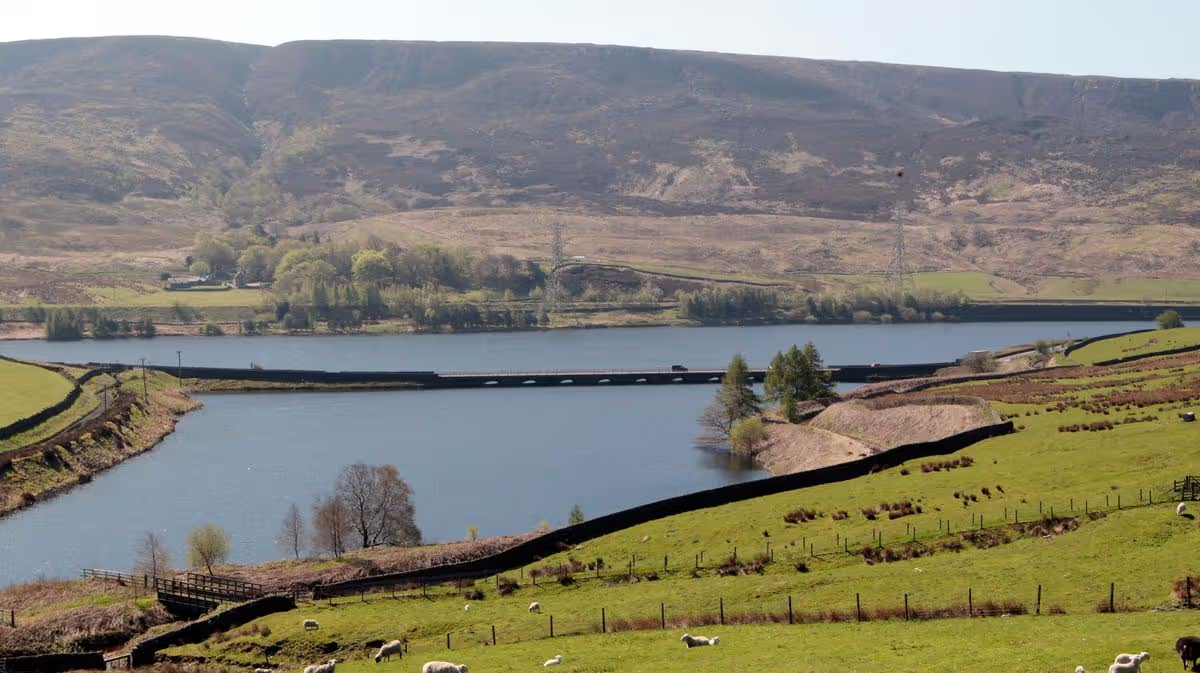
Fire crews are tackling a blaze on moorland near Glossop with people urged to avoid the area.
Advertisement
The wildfire broke out on Tintwistle Moor at around 10pm on Wednesday evening (June 24). Large flames and plumes of smoke could be spotted from the Woodhead Pass as the fire raged on into the early hours of this morning.
People were urged to avoid the area and residents nearby were urged to keep their windows and doors shut. The Derbyshire Fire and Rescue Service said crews Glossop and New Mills were sent to the scene.
Click here to get the biggest stories straight to your inbox in our Daily Newsletter
They left the area just after 2am ‘for safety reasons due to failing light’. This morning crews are back on the scene working to manage the wildfire.
Advertisement
Plumes of smoke can still be seen on the moorland. The fire service is continuing to urge people to avoid the area.
In a statement last night, a Derbyshire Fire and Rescue Service spokesperson said: “Firefighters are currently dealing with a wildfire on Tintwistle Moor, above Woodhead Road in Glossop. Crews from Glossop and New Mills are in attendance. Thank you to everyone who has called 999 and made us aware of the incident.
“If you can see or smell smoke, please keep your windows and doors closed. Please avoid the area.”
In an update at 7.30am this morning, the spokesperson added: “Firefighters are continuing to tackle to wildfire on Tintwistle Moor. Crews left the scene shortly after 02:00 hours this morning (Thursday 25 June 2026) for safety reasons due to failing light.
Advertisement
“Firefighters from Chapel-en-le-Frith, Buxton and Hathersage were then mobilised at 04:00 hours and remain on scene. Please continue to keep windows and doors closed if you can see or smell smoke, and avoid the area.”
Rogers is keen on moving to north London and it is believed that personal terms will not be an issue. While Villa accept the player’s career ambitions, they see the England attacker as one of their key players and their clear preference is for the 23-year-old to be involved in their Champions League campaign during the 2026-27 season.
This series of images from NASA’s Hubble Space Telescope of the fragmenting comet C/2025 K1 (ATLAS) was taken over three days (Picture: NASA, ESA, Dennis Bodewits (AU)/Cover Images)
An interstellar comet that passed through the Solar System last year may be up to 12 billion years old – far older than the Sun.
As the comet moved away, heat from the Sun transformed its ancient ice into a glowing cloud of gas, allowing researchers to analyse its chemical composition in unprecedented detail.
The findings, published in the journal Nature on June 22, suggest the object originated in a distant planetary system during a period known as the Universe’s ‘cosmic noon’, when star formation across the galaxy was at its peak.
Advertisement
Researchers say the comet could have formed between 10 and 12 billion years ago, making it significantly older than the Sun, which is around 4.5 billion years old.
Comet 3I/ATLAS is only the third confirmed interstellar comet ever detected. Its name reflects both its status as the third known visitor from beyond the Solar System and the NASA-funded ATLAS (Asteroid Terrestrial-impact Last Alert System) telescope that first spotted it.
The Juice spacecraft’s view of 3I/ATLAS (Picture: NASA, ESA, Dennis Bodewits (AU)/Cover Images)
Using Webb’s Near-Infrared Spectrograph (NIRSpec), scientists measured chemical signatures unlike those seen in any known Solar System comet.
Among the most striking discoveries was an exceptionally high concentration of deuterium, a heavier form of hydrogen. The levels were around 30 times greater than those found in comets originating within the Solar System.
Advertisement
The researchers say this points to the comet having formed in an extremely cold environment early in the Milky Way’s history. The material that eventually became part of 3I/ATLAS appears to have remained deeply frozen for billions of years. The telescope also detected only trace amounts of carbon-13 compared with the lighter carbon-12 isotope.
Because galaxies gradually become enriched with carbon-13 as successive generations of stars live and die, the low levels found in the comet provide further evidence of its ancient origins.
‘This was a unique opportunity to study an ancient object from the distant Galaxy, probably pre-dating our Sun and Solar System,’ said astro-chemist Martin Cordiner of NASA’s Goddard Space Flight Center and lead author of the study. ‘On the one hand, we get direct insight into that distant time and place, and on the other, we learn something about how unusual our own Solar System may be.’
The James Webb Space Telescope can map specific chemical and molecular signatures, as seen here in its three images of comet 3I/ATLAS (Picture: NASA, ESA, Dennis Bodewits (AU)/Cover Images)
Astronomers from a range of disciplines collaborated to observe the comet during its brief journey through the Solar System. The team secured permission to interrupt Webb’s planned observing schedule in order to study the object. A separate study led by Cyrielle Opitom of the University of Edinburgh, using the European Southern Observatory’s Very Large Telescope, also examined the comet’s chemical makeup, focusing on forms of carbon and nitrogen contained in cyanide.
Scientists believe such observations could help answer broader questions about the origins of life in the Universe.
Advertisement
‘For us as scientists, finding these rare isotopes is fascinating, but the bigger picture here is looking at the possibilities of prebiotic chemistry elsewhere in the galaxy,’ said Stefanie Milam of NASA Goddard, a co-author of the study.
‘So far, we know of only one place in the vast cosmos where chemical ingredients led to life – our Solar System, our Earth. Analysis of these interstellar objects is a major step towards learning how common, or uncommon, the conditions for the evolution of life are in the Universe.’
















































You must be logged in to post a comment Login