Connect with us

NewsBeat

Have they no humanity? How Spanish police have intensified the grief suffered by families of nine British expats killed in a wildfire – with one woman left to find her father’s bones in his burned-out BMW FIVE WEEKS later

Published

on

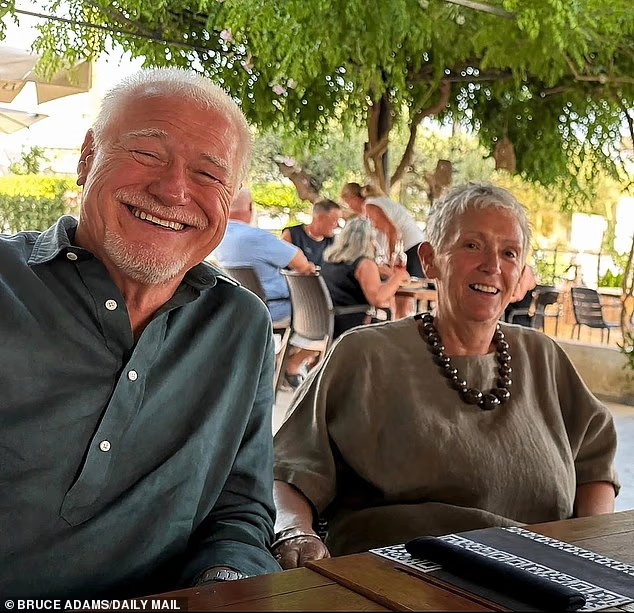
Pictured: Danielle Gillam-Kirton parents, Pete and Fran Gillam who were among the Brits killed in Spanish wildfires this summer

As a local funeral director handed Danielle Gillam-Kirton a small urn containing the ashes of her parents, who were among the nine Britons killed in a Spanish wildfire this summer, she had no reason to suspect there was anything more to remember them by.

After all, a female police officer had assured her that the burnt-out black BMW 5-series car, in which they had vainly sought to escape when flames raced towards their hilltop villa, had been forensically searched and ‘nothing’ more had been found.

Soon afterwards, the lives of popular expats Pete and Fran Gillam were celebrated at a moving memorial service in the village of Bedar, 60 miles from Almeria, where they had retired after building a successful business in the education sector.

For Danielle, 42, an assistant headteacher and mother-of-three from Nottinghamshire, and her elder sister, Natalie Lindsay, it was a small but important milestone in the healing process.

Advertisement

Two months on from the deadly July 9 conflagration, however, closure is nowhere in sight. As with some other bereaved families, Danielle says she is locked in an ‘ongoing nightmare’. Though she is too measured and dignified to say it in so many words, it is being caused by the shameful incompetence – and some might say the cold indifference – of the Spanish authorities’ handling of the aftermath of the wildfire.

Instructed to go to a municipal car pound where the wrecked BMW had been dumped and photograph it for an insurance claim, she and her husband, Mark, were surprised to see a padel racquet belonging to Mr and Mrs Gillam lying in the open boot.

This was on August 12, four weeks after they had been assured that nothing had been left inside. If police searchers had overlooked the racquet, or chosen to leave it there, they later surmised, what else might the car contain?

Then on August 19, after securing permission to return to the pound, this gnawing question was answered in the grimmest way imaginable.

Advertisement

Pictured: Danielle Gillam-Kirton parents, Pete and Fran Gillam who were among the Brits killed in Spanish wildfires this summer

A female police officer had assured her that the burnt-out black BMW 5-series car (pictured) had been forensically searched and ‘nothing’ more had been found

A female police officer had assured her that the burnt-out black BMW 5-series car (pictured) had been forensically searched and ‘nothing’ more had been found

Pictured: Billows of smoke rise into the sky as flames tear through the fields of Almeria, Spain on July 10

Pictured: Billows of smoke rise into the sky as flames tear through the fields of Almeria, Spain on July 10 

Advertisement

‘Firstly, we found my father’s mobile phone lying on the central console, where he always left it,’ Danielle told me this week.

‘And there were all their keys, some coins, and bits of jewellery. The clothes they had taken with them [when they evacuated] had gone, but the [clothes] hooks were still lying down, as if they hadn’t been disturbed.’

But it was when she reached down to pick up a large object lying in the steering well that Danielle recoiled in horror.

‘Oh my God, it’s a bone!’ she cried out, instantly realising she must be holding part of her father’s body.

Advertisement

‘I’m no scientist, but it looked to me like every picture of a hip joint, or part of a pelvis, that I’ve ever seen. My husband then recovered fragments of other bones.

‘One looked like part of a rib and I think there were some forearm bones. I was convinced it was my father, and I was beside myself.

‘I kept saying, “I can’t believe he has been left here for five weeks”.

As shock gave way to anger, she photographed the remains, placed them in a tub, and took them to Bedar town hall.

Advertisement

‘Look, these are my father’s bones! Look at them!’ Danielle challenged the mayor, Angelo Francisco Collado. ‘He was as shocked and horrified as we were,’ she says, and urged her to take them to the Guardia Civil, the national police who conducted the search.

There she met with a very different response. Though she was told the bones would be examined at a Madrid forensics lab, senior officers added dismissively that they must belong to animals.

Since the bones were so big and the only sizeable creatures living in the Bedar Mountains are goats and wild boar, this prompted Danielle to ponder sardonically how and why a ‘cow would have climbed into the passenger seat of the vehicle during a fire’.

Two forensic anthropologists have since examined the pictures she took and both say the bones are human.

Advertisement

One told the Daily Mail: ‘There were bone fragments from a finger of an adult, a portion of the pelvis and a fragment from the scapula, which are not something easily confused with animal bones.’

Danielle is now convinced that the police didn’t even trouble to search the car, which would mean that the female officer was either given the wrong information or lied to her.

However, on Thursday, when I last spoke to her, she was in purgatory. For she had just received a message from the British Consul saying that three weeks after handing the bones to the police, they were yet to say where they were being kept, and whether they had been tested.

‘I understand that, for them, my story is just about one night that happened months ago, but for us this is an ongoing nightmare,’ Danielle told me, her stoical demeanour giving way to tears.

Advertisement

‘It seems we are fighting an uphill battle for decency and respect. Surely they [the Spanish authorities] want to alleviate our distress and give us comfort. But there is just this silence… we feel quite alone with it.’

The Bedar wildfire in July, thought to have been sparked by a fallen power cable, went curiously under-reported in Britain given that nine expats were among the 15 multi-national victims killed in one small village.

Perhaps this was because people back home were absorbed by the World Cup, Wimbledon and our own heatwave problems. But near Almeria temperatures soared close to 40 degrees.

The ninth British victim, Michelle Leake, had survived her 40 per cent burns for eight weeks but succumbed to complications from her injuries in a Seville hospital on Tuesday.

Advertisement
Danielle says she is locked in an ‘ongoing nightmare caused by the shameful incompetence of the Spanish authorities’ handling of the aftermath of the wildfire

Danielle says she is locked in an ‘ongoing nightmare caused by the shameful incompetence of the Spanish authorities’ handling of the aftermath of the wildfire

Pictured: Burnt out vegetation following the wildfires in the Spanish province of Almeria

Pictured: Burnt out vegetation following the wildfires in the Spanish province of Almeria

The care worker died a heroine, having stayed with the 93-year-old woman she was looking after, Audrey Curry, as the fire closed in, before carrying her in her arms as they attempted to flee.

Ms Curry was a neighbour of the Gillams on a mountain locally known as ‘English Hill’, whose panoramic views of the Almeria coast make it a desirable settlement for more affluent British incomers. Accessible only via one perilously narrow and twisting road that was challenging for me to negotiate this week, even in daylight and good weather, one shudders to imagine how difficult it must have been for panicking residents shrouded in smoke and flames at nightfall.

Advertisement

The Gillams had reached only the second hairpin bend, about 300 yards from their elegant, ochre-coloured villa, when they became hopelessly trapped.

Perhaps because he suffered from asthma, Pete remained inside the car to the last, while Fran, who may have been trying to direct other stuck vehicles, was outside on the road.

Ms Curry is thought to have died near this same spot, now marked by a bouquet and the distinct outline of the Gillams’ BMW scorched in the tarmac.

The other victims were living or staying in Paraje el Curato, another remote hamlet of high-end villas, a few miles from English Hill.

Advertisement

Inching along its only access road, with its sheer drops and impossible bends, one wonders whether planners gave any thought to the safety of its residents when they signed off on the development.

Given that this area is notoriously vulnerable to wildfires stoked by the searing summer sun and whipped by fierce winds that howl through the canyons, were the incomers warned that they were settling in the heart of a potential inferno?

Certainly, their family members say they received no warning before the July fire sealed them into the hamlet, which now resembles an eerie moonscape of blackened rock and skeletal trees.

The contrasting condition of the villas bears testimony to the wildfire’s devilish capriciousness. While some were badly damaged, others remained untouched as the wind meant flames suddenly leapt in different directions.

Advertisement

If we believe officials such as Mayor Collado and Antonio Sanz, the regional minister responsible for emergency response, it would have been counterproductive to send out a blanket evacuation order to Bedar’s 970 residents using Spain’s recently installed ES alert system, which sets off a mobile phone alarm.

Though the system was used when wildfires raged in other parts of Spain, where only one person died, they insist the best option was for a local official who knew the terrain to deliver the warning house-by-house.

The dangerous task was left to Bedar’s lone police officer, Diego Castro, but how many homes he reached is a moot point. Danielle says all her parents heard was the sound of his siren as he rushed past their villa.

As with many of the expats, the Gillams were not members of a municipal WhatsApp group where the town hall belatedly posted some warning messages. It is mainly used by Spaniards.

Advertisement

Soon after the fire, however, Andalucia’s regional president, Juanma Moreno, added to the families’ distress by claiming residents were given ample time to evacuate but some had ignored the advice.

‘Failure to follow those recommendations probably caused the tragic outcome,’ he said, effectively accusing them of causing their own deaths.

Among those incensed by this hasty and wholly unproven claim is Duncan Chard, whose elderly parents, Michael and Christine, were killed.

Originally from Bristol, they retired to Bedar 25 years ago, and Mr Chard, 82, had built their home in el Curato himself to ‘create their little bit of paradise in the sun’.

Advertisement

‘My father has two prosthetic knee replacements,’ his son said this week. ‘There was no way he was going to try to run for his life through the valley unless that was his only option as a last resort.

‘He was being brave. He died fighting. He did not die because he was being stupid or not following instructions.

‘There were no instructions. What the Spanish authorities said afterwards has been very hurtful… they are trying to protect their arses.’ The Chards had tried to drive to safety in a convoy of five or six cars carrying several other residents, three of them British.

Finding the only road out impassible, however, they were forced to retreat down a dirt-track until they reached a dead-end.

Advertisement

The only man to get out alive was Malcolm Timbrell, 70, who found his property when he and his wife, Annette Kilgore, 69, appeared on the Channel 4 programme ‘A Place in the Sun’.

Remembering they had left their cats, Charlie and Lilly, in the villa, he dashed back on foot to fetch them. When he got back, he took shelter in a car that for some reason didn’t combust in the fire, but Annette was in another of the vehicles that burst into flames.

As the fire moved towards the trapped group, at terrifying speeds of 300 yards a minute, they gathered on a natural platform, below which was a valley of tinder-dry bush and scrub.

Yet they still had good phone signals, and from Belgium, Thomas-Wolf Verdonckt was in contact with his 63-year-old father, Stanislas, for about an hour before the end came.

Advertisement

A keen wildlife photographer, Mr Verdonckt knew the terrain ‘like his backyard’, his son says, but as he described his fast-diminishing options he says he remained admirably calm.

It is unclear why a helicopter wasn’t sent to rescue them from the platform, but it is thought it was too dangerous to land in the high winds and thick smoke.

A Spanish man whose two friends were among the group told me he repeatedly phoned 112, the emergency number, and gave their GPS co-ordinates, but by the time a fire truck was able to reach them it was far too late.

Mr Verdonckt had escaped with his black rescue dog, Schubi, and asked Thomas to take care of him if he did not make it out alive. But four days later, when the Belgian virologist had discovered that Schubi had died by her owner’s side, he returned to recover the dog and was deeply disturbed by what he saw.

Advertisement

He found himself trampling on the victims’ scattered remains and remnants of their belongings: their spectacles, buckles, shoes and jewellery.

He assumed they would soon be cleared away. Yet to his anger, on August 9 when he returned with other relatives to create a memorial for the victims – a cairn of painted stones bearing poignant messages – the bones and personal effects were still there.

Determined to spare people from suffering the same indignities when, as it surely will, the next wildfire comes, several families, including the Gillams and the Chards, have banded together.

Their aim is to have the fire investigated, to understand how it occurred, whether mistakes were made in dealing with it and if so by whom – and how it might have been prevented.

Advertisement

As Danielle told me, their intention is not to scapegoat any individual but to gain answers to the many pressing questions surrounding this avoidable tragedy, and in so doing help to save lives.

It is a noble aim.

The police and governmental officials might begin to make redress by explaining how Danielle was put through the torment of finding her father’s bones – and return them to her for burial as soon as possible.

  • Readers wishing to support efforts to establish how this tragedy happened and help prevent loss of life in wildfires can visit helpbedar.com to contribute
  • Additional reporting by Gerard Couzens

Source link

Advertisement
Continue Reading
Click to comment

You must be logged in to post a comment Login

Leave a Reply

NewsBeat

Andy Burnham among Great North Run 2026 finishers

Published

on

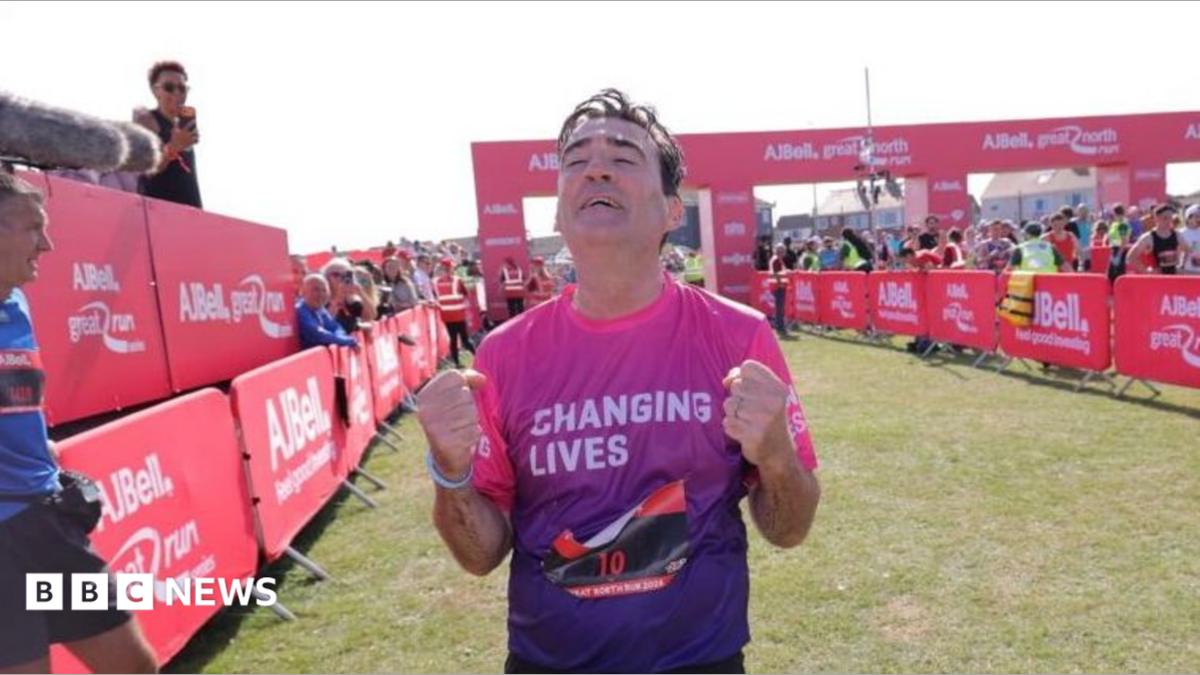
Andy Burnham crossing the finishing line in South Shields. He is clenching his fists and looking upwards with an expression of strain, and wearing a pink and purple T-shirt with changing lives on it. Behind him stretch out the hoardings with crowds of spectators, and another runner leans on it to the left, with two more standing on the right.

The prime minister said he was “very happy” with his finish time of under two hours – 01.57 – and was raising money for North East charity Changing Lives, which he visited last month to launch a national drive to end rough sleeping.

“You see the causes people are running for, all pulling together for the bigger cause,” Burnham said. “It’s just a day that reminds you how good this country is when it’s together like this.

“This part of the world, it doesn’t half shine on a day like this. The warmth of the people comes out – the people in the race with you, the people on the sidelines.”

As always, runners donned a variety of costumes in the bid to raise funds for good causes. Among them were nuns, horses and a pair of ovaries.

Advertisement

Source link

Continue Reading

NewsBeat

Big Brother UK contestants we lost too soon as show returns for 23rd season

Published

on

Daily Mirror

Big Brother UK has suffered heart-breaking losses over the years, here we remember the beloved housemates who passed away too young

Over more than 26 years, Big Brother has given us some of the most talked-about moments in British television history.

Advertisement

But behind the diary room confessionals, the late-night arguments and the tearful evictions, the show’s story is also one of profound human connection and, at times, devastating loss.

As the much-loved competition returns to ITV tonight at 9pm for its 23rd series overall, with presenters AJ Odudu and Will Best back at the helm, a new group of housemates prepare to step through those famous doors.

Before they do, we take a moment to remember the former contestants who lit up our screens and left an enduring mark on the show’s history, those who passed away far too soon.

Jade Goody

Long before the phrase “reality star” became commonplace, there was Jade Goody. She first appeared in Big Brother’s third series, and from the moment she walked into the house, she was impossible to ignore. Funny, unpredictable and utterly authentic, she became one of the most beloved housemates the show has ever seen.

Her fame only grew after she left, with appearances on 8 Out of 10 Cats, Loose Women and Eggheads helping to cement her status as a genuine household name. She returned to the Celebrity edition in 2007, five years after her debut, before heading to India in August 2008 to take part in Big Boss, the country’s own adaptation of the format.

But her world soon changed forever. Jade was diagnosed with cervical cancer and was forced to withdraw from the show. She faced the illness with a courage that inspired millions, and her openness about her diagnosis is widely credited with prompting a surge in cervical cancer screening across the UK. She passed away at her home on 22 March 2009. She was just 27 years old.

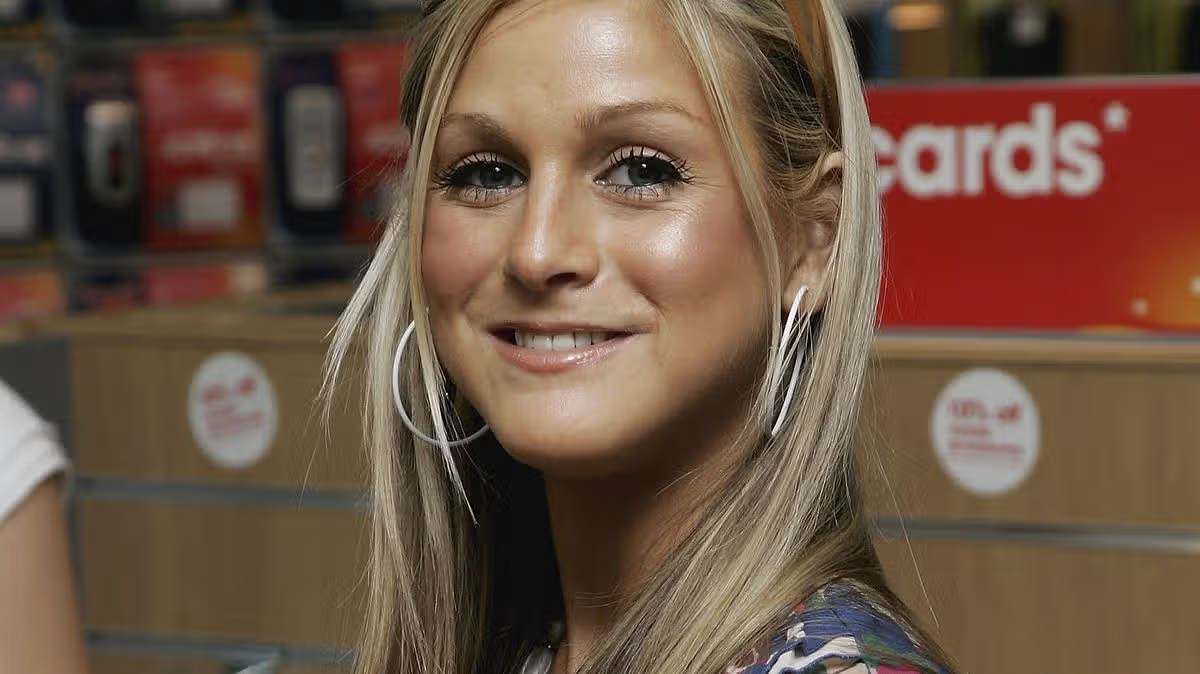
Nikki Grahame

Nikki Grahame became memorable after her appearance on Big Brother’s seventh series in 2006. She is best remembered for her now-legendary catchphrase “Who is she?”

After leaving the house, she headlined her own E4 series, Princess Nikki, in which she tackled a range of demanding jobs, from refuse collection to deep sea fishing and waste management roles. She was fearless on screen, but off it she fought a long and painful private battle with anorexia.

In early 2021, Nikki suffered a relapse. Her loved ones launched a public fundraising campaign to help cover the costs of her treatment, and fans rallied around her in. Sadly, she passed away from anorexia-related complications on 9 April 2021, shortly after being discharged from hospital. She was only 38.

Ben Duncan

Ben Duncan was, by all accounts, someone who made every room brighter simply by being in it. A London-born socialite who had studied at the University of St Andrews alongside Prince William and Kate Middleton, he brought that easy charm and warmth to the Big Brother house when he appeared in series 11, reports OK!.

He tragically died in October 2025 after falling seven floors from the rooftop of The Trafalgar St. James hotel in London. He was just 45 years old.

Fellow former housemate Glyn Wise, who appeared in series seven, paid a heartfelt tribute on X, formerly Twitter. “While filming a Big Brother tribute to mark the end of its run on Channel 4, I met Ben and he was such a joy to be around. Rest in peace buddy xx,” he wrote in part.

Sophia Brown

Some housemates need only a matter of days to leave a lasting impression. Sophia Brown entered the Big Brother house during its 10th series in 2009 and stayed for just nine days, she moved viewers deeply with her openness about living with Lupus.

Rather than shying away from her diagnosis, she spoke candidly about how the autoimmune condition had shaped her outlook, giving her an unshakeable positivity and zest for life that radiated through the screen.

She departed the house early but never left the hearts of those who had watched her. Sophia tragically died in 2012, aged just 30.

Big Brother returns to ITV2 and ITVX at 9pm tonight (Sunday, September 13).

Advertisement

Source link

Continue Reading

NewsBeat

Man United vs Man City – Premier League LIVE: Enzo Maresca gears up for his first Manchester derby as Red Devils fans target Sir Jim Ratcliffe and the Glazers with protest outside Old Trafford

Published

on

Man United vs Man City - Premier League LIVE: Enzo Maresca gears up for his first Manchester derby as Red Devils fans target Sir Jim Ratcliffe and the Glazers with protest outside Old Trafford

Advertisement

Follow Daily Mail Sport’s live coverage for the latest updates of the Manchester derby at Old Trafford in the Premier League.

Advertisement

Advertisement

Source link

Continue Reading

NewsBeat

UK economy being held back by ‘five giants’ – neglect, gridlock, discouragement, myopia and powerlessness – warn business grandees

Published

on

The Prosperity 2030 Alliance group of business grandees is chaired by Rick Haythornthwaite, also chair of NatWest bank

Advertisement

A group of business grandees has hit out at the ‘five giants’ putting a straitjacket around the UK economy.

In their dire warning, the Prosperity 2030 Alliance – which includes the chairs of FTSE 100 giants NatWest, Diageo and National Grid – said neglect, gridlock, discouragement, myopia and powerlessness were the main factors choking off growth.

The first of five reports assessing the main challenges facing the UK economy drew on the famous Beveridge Report of 1942, which identified five ‘giant evils’ to overcome in a post-war society.

The Alliance is chaired by Rick Haythornthwaite, also chair of NatWest bank.

Advertisement

He said: ‘Ask any young person whether they expect a better life than their parents, and increasingly the honest answer is no.

‘That’s not defeatism, it’s 20 years of growth we didn’t deliver. Beveridge named his giants for a different generation.

‘We think today’s giants are solvable too, but only if politicians start investing and planning for the country they want to pass on, not just the next few years.’

Advertisement

The Prosperity 2030 Alliance group of business grandees is chaired by Rick Haythornthwaite, also chair of NatWest bank

The report said the British economy was suffering from ‘neglect’ because of a lack of investment from the private sector amid poor choices by the Government, leaving the UK trailing other G7 nations.

It said ‘myopia’ referred to a lack of long-term thinking in Government that could lead to better outcomes, while ‘gridlock’ had been caused by creating too much red tape. This has left businesses struggling to navigate a proliferation of growth-destroying regulations in recent years.

Meanwhile, a badly designed tax system laden with disincentives has prompted ‘discouragement’.

Advertisement

The report finally identified the excessive concentration of power in the central state, leading to ‘powerlessness’.

‘Britain is one of the best places to work, invest and do business,’ Mr Haythornthwaite concluded, adding: ‘But realising the potential of the 2030s will require greater ambition and a willingness to confront the choices needed to strengthen our economy.’

It comes amid heightened speculation of more tax rises in next month’s Budget, the first of Andy Burnham’s premiership, to help pay for a series of unfunded commitments the new Prime Minister made during his first few weeks in Downing Street.

While it emerged last week that the economy unexpectedly grew 0.4 per cent in July, more tax hikes threaten to further choke off Britain’s sluggish growth amid rising debt repayments.

Advertisement

Source link

Advertisement
Continue Reading

NewsBeat

Manchester United protest LIVE updates as fans march against ticket bans ahead of Manchester derby

Published

on

Manchester Evening News

Some Manchester United fans have been threatened with having their season tickets revoked after allegedly breaking the club’s ticketing terms and conditions. On Tuesday, a large number of supporters received emails from the club to say their accounts had been temporarily restricted. In those cases, United claimed that they “identified sustained activity” associated with the accounts.

The email asked fans to respond by confirming every device regularly used to access their account, including mobile phones, tablets, laptops and desktop computers.

Read more here>>>

United fans have announced a protest before the Manchester derby.(Image: 2026 Getty Images)

Advertisement

Source link

Continue Reading

NewsBeat

Boris Johnson’s train is evacuated in Ukraine after Russian drone strike hits passenger service nearby

Published

on

The incident came as another train travelling on the Kyiv-Warsaw route was struck by a Russian drone near the Polish border

Advertisement

Boris Johnson was reportedly aboard a special train that was abruptly evacuated after a Russian drone attack near the Ukrainian border with Poland.

The former British prime minister was travelling back towards Poland after attending a major security conference in Kyiv when the train stopped at around 5am amid a drone alert.

Passengers in part of the train were woken by conductors and temporarily evacuated as drones were detected near the railway line, according to German newspaper Der Spiegel.

Mr Johnson is understood to have escaped unharmed, with an all-clear given shortly afterwards when no further drones were detected.

Advertisement

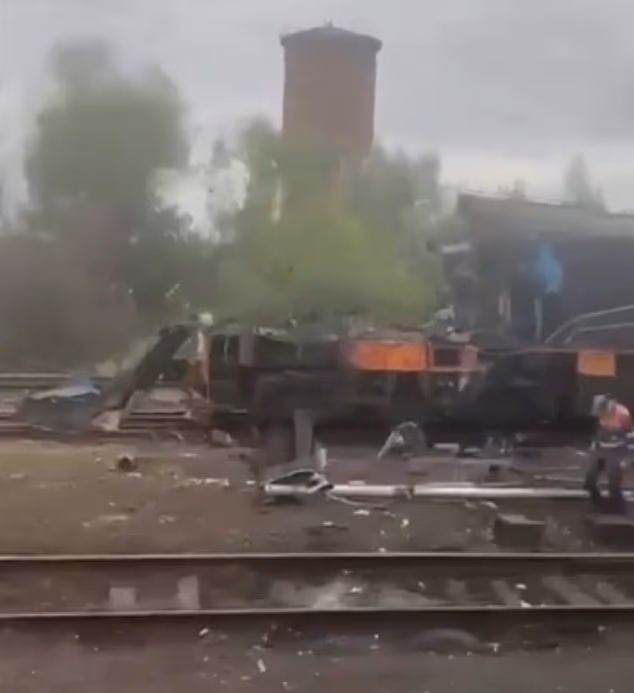
The incident came after another train travelling on the Kyiv-Warsaw route was struck by a Russian drone near the Polish border.

The locomotive was hit but, according to Ukrainian railway authorities, nobody was injured. The train was carrying 206 people, who were seen running in fear after the attack.

There was no indication that the privately chartered train carrying Mr Johnson was itself hit.

It was also carrying Günter Sautter, one of German Chancellor Friedrich Merz’s closest foreign and security-policy advisers, as well as security advisers from Britain, France and Italy, German MPs, diplomats and academics.

Advertisement

The incident came as another train travelling on the Kyiv-Warsaw route was struck by a Russian drone near the Polish border

The locomotive was hit but, according to Ukrainian railway authorities, nobody was injured. The train was carrying 206 people, who were seen running in fear after the attack

The locomotive was hit but, according to Ukrainian railway authorities, nobody was injured. The train was carrying 206 people, who were seen running in fear after the attack

Boris Johnson (aboe on a recent visit to Ukraine) was reportedly aboard a train hit by a Russian drone near the Polish border today

Boris Johnson (aboe on a recent visit to Ukraine) was reportedly aboard a train hit by a Russian drone near the Polish border today

Advertisement

Mr Johnson and the other officials had been in Kyiv for the 2026 annual meeting of the Yalta European Strategy, an international security conference where Western officials held discussions with President Volodymyr Zelenskyy’s government about possible peace negotiations with Russia.

Ukrainian Foreign Minister Andriy Sybiha said a Russian drone had also struck the Yahodyn-Dorohusk border crossing, one of the country’s most important links with the European Union.

Footage circulating on social media appeared to show trucks on fire at the crossing, while Ukrainian media reported that a petrol station had also been hit. There were no immediate reports of casualties and the Polish military confirmed the attack.

The attack came just two kilometres from the Polish border, according to Ukrainian railway officials, raising concerns about Russian strikes reaching increasingly close to NATO territory.

Advertisement

Russian drones have increasingly targeted Ukrainian rail infrastructure, with Ukrainian Railways accusing Moscow of carrying out systematic attacks on the network.

The state-owned operator said its monitoring centre and staff were ‘on high alert’ following nationwide attacks, warning passengers of possible evacuations, delays and diversions.

Robin Wagener, a Green Party member of the German Bundestag who was also aboard the special train, described the attack as a dangerous escalation.

‘These drone attacks are blind terror against Ukrainian civilians and a dangerous escalation in Putin’s war,’ Wagener told Der Spiegel.

Advertisement
Mr Johnson and the other officials had been in Kyiv for the 2026 annual meeting of the Yalta European Strategy, an international security conference where Western officials held discussions with President Volodymyr Zelenskyy's government about possible peace negotiations with Russia

Mr Johnson and the other officials had been in Kyiv for the 2026 annual meeting of the Yalta European Strategy, an international security conference where Western officials held discussions with President Volodymyr Zelenskyy’s government about possible peace negotiations with Russia

The MP said he believed the strikes were also intended as a warning to countries supporting Ukraine.

‘Russia is becoming increasingly unscrupulous and is playing with fire right on the border of the European Union and NATO; we must finally put a clear stop to this terror,’ Wagener demanded.

The attack came as Russia launched a major wave of strikes across Ukraine, with Ukrainian authorities reporting hundreds of drones being used overnight. A separate Russian drone attack on the Kyiv-Warsaw line also damaged a passenger train near the Yahodyn crossing but caused no casualties.

Advertisement

The railway route is regularly used by foreign dignitaries travelling between Ukraine and Poland, making the incident particularly sensitive as European governments step up their support for Kyiv.

Russian attacks near the Polish frontier have also prompted heightened concern in Warsaw, with Polish authorities activating defensive measures following the latest strikes.

Advertisement

Source link

Advertisement
Continue Reading

NewsBeat

Police ‘hunt gunman’ after man found dead at house in Armadale

Published

on

Daily Record

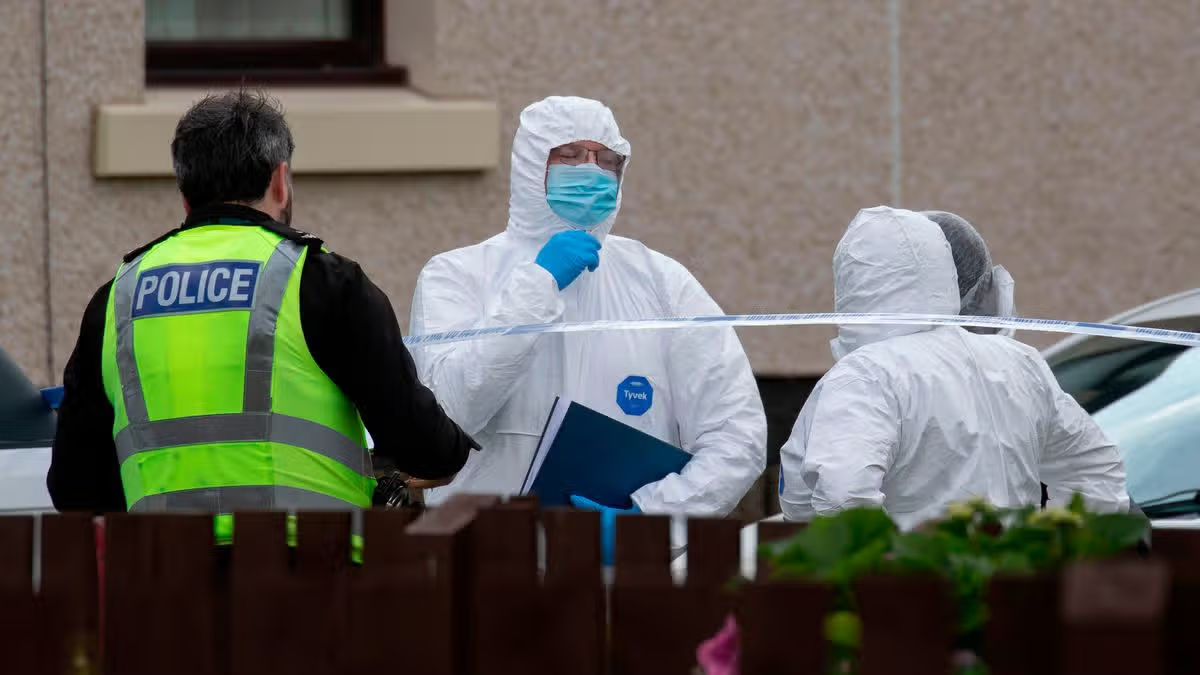
Forensics are combing the home on Harestones Road in Armadale.

Police are hunting a gunman after a man was found dead at a house in West Lothian.

Police and emergency services descended on Harestones Road in Armadale shortly before midday on Saturday following reports of an injured man.

A 35-year-old man was pronounced dead at the scene. His next of kin are aware.

Advertisement

A short time later a car was found on fire nearby in the Netherhouses area. It is understood to be linked to the shooting.

Forensic officers have been pictured at the scene where the victim was discovered. Detectives were spotted in the garden area of the property, taking bags of evidence away from the residential street.

Police said enquiries are ongoing to establish the full circumstances of both incidents.

Advertisement

They confirmed a line of inquiry is that a firearm may have been involved in the incident.

Detective Superintendent Michelle Findlay, of the Major Investigations Team, said: “Our thoughts are with the family of the man who has died in this incident.

“Officers remain in the area and anyone with concerns or any information can approach them or call us on 101, quoting incident number 1361 of Saturday, September 12, 2026.”

Pauline Stafford MSP for Bathgate, said she is “deeply concerned” about the incident, adding: “My thoughts are with the family and all of those affected. While investigations are at an early stage I would encourage anyone with information to share it with the Police.”

Advertisement

Get more Daily Record exclusives by signing up for free to Google’s preferred sources. Click HERE.

Advertisement

Source link

Continue Reading

NewsBeat

Major EES update for 9 UK tourist hotspots including Portugal

Published

on

Daily Mirror

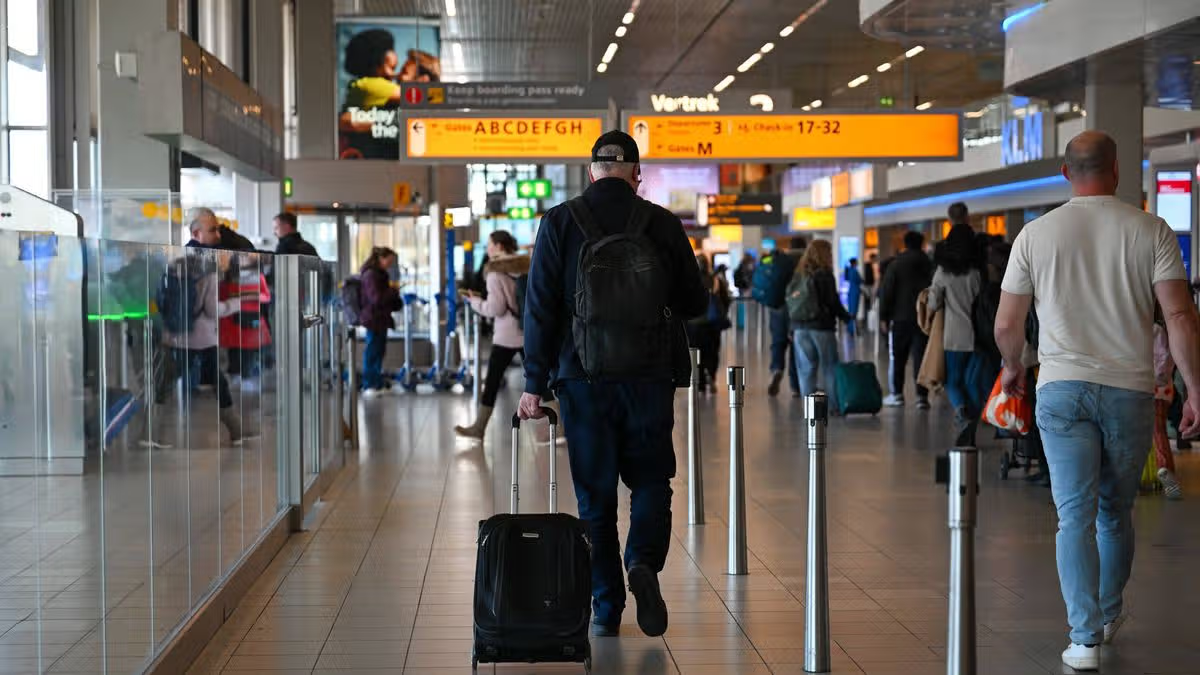
The European Union entry-exit system (EES) has caused repeated delays for Brits at major EU airports this year

British holidaymakers heading abroad may finally be able to breathe a sigh of relief over the widely-criticised EES system. The scheme forces non-EU residents to queue at special machines in airports before gaining entry to 29 nations within the so-called Schengen area – essentially the majority of the European Union.

Advertisement

However, there have been persistent reports of lengthy delays – some stretching to as long as four hours. A new report in the Sunday Times now reveals that the European Union has shelved the controversial entry-exit system (EES) across at least nine countries.

Portugal, Italy, France, Belgium, the Netherlands, Germany, Malta, Greece and Switzerland are all understood to have been granted permission to postpone full implementation of EES. The newspaper reports that there appears to be no deadline by which these countries must adopt the scheme, which has already sparked widespread reports of enormous queues at European airports this summer in destinations such as Mallorca, Faro, the Canary Islands and Milan.

The scheme has faced fierce criticism from Ryanair and others. The European Union describes the Entry/Exit System (EES) as an automated IT system designed to register non-EU nationals travelling on short stays each time they cross the external borders of participating European countries.

Following years of postponements, the system was rolled out from October 2025, with full implementation originally anticipated by the following April. However, faced with the prospect of significant border queues due to software failures, officials granted countries a 150-day grace period during which they could drop the checks to avoid travel chaos.

Advertisement

That rule ended on September 6. The EU previously insisted there would be no extension.

Yet the Sunday Times reports that at least nine Schengen countries are understood to have told the European Commission, which is responsible for overseeing the EES, that they would not enforce the new controls in full until the technology and systems were working correctly.

They have informally been allowed to do so with no time limits apparently in place to adopt the system, it is being reported. One of the main purposes of the system is to track whether non-EU citizens have spent more than their permitted 90 days in the bloc in a rolling 180-day period.

Advertisement

Social media has been awash with debate about the scheme. One post on Reddit saw a traveller say: “They made a mess of it. Seems many basic things like it is hit and miss on the document scanning but also things like people walk up with hats and headphones and the machine doesn’t tell them to remove them, and organisational things like if the machine errors the traveller has to back out and has no where to go.

“The right way to do this would have been progressive: start by getting some people eg 5% going through the machine lane, everyone else through normal.

“The vendor observes problems, fixes them, once machine working well, increase to 10%, then 20% and so on.” Another person said: “The general lack of functionality of so many IT systems across the EU is kind of astonishing.”

A third added: “It’s worse than that. There isn’t even consistent protocol/IT support within a single EU airport.”

Advertisement

Another put it more simply, saying: “I just miss having stamps.”

‘People are missing their flights’

Nadia, from Greater Manchester, told the Guardian in August she had made two trips to Schengen areas this summer. A trip to Tenerife in June was “quite straightforward”, but her experience in July at Frankfurt airport where she was picking up a connecting flight home, was much less so.

“The queue there was ridiculously long, and there was very limited information,” she says. “People were wandering around trying to work out where they needed to go.

“I’m very well travelled and pretty confident, but even I was slightly unsure and was thinking, is there some other queue I should be joining? There was no one nearby to check with without losing your place.”

Eventually, her passport was checked. “He didn’t actually take fingerprints then,” says Nadia, who is a solicitor. “I think the queue was so long they decided to dispense with that.

“It’s the efficiency of the system I question and the fact that individual member states’ systems do not talk to one another. They shouldn’t need to get information again if you have already gone through. It’s pretty shambolic, and I think people missing their flights because of it is just not acceptable, especially when there’s no recourse; it’s not your fault.”

Ryanair chief executive Michael O’Leary has repeatedly complained about EES. Speaking earlier this year, he said: “There’s a bit of Brexit in this too. Here, you voted for Brexit – f***ing join the queue.”

Advertisement

Source link

Continue Reading

NewsBeat

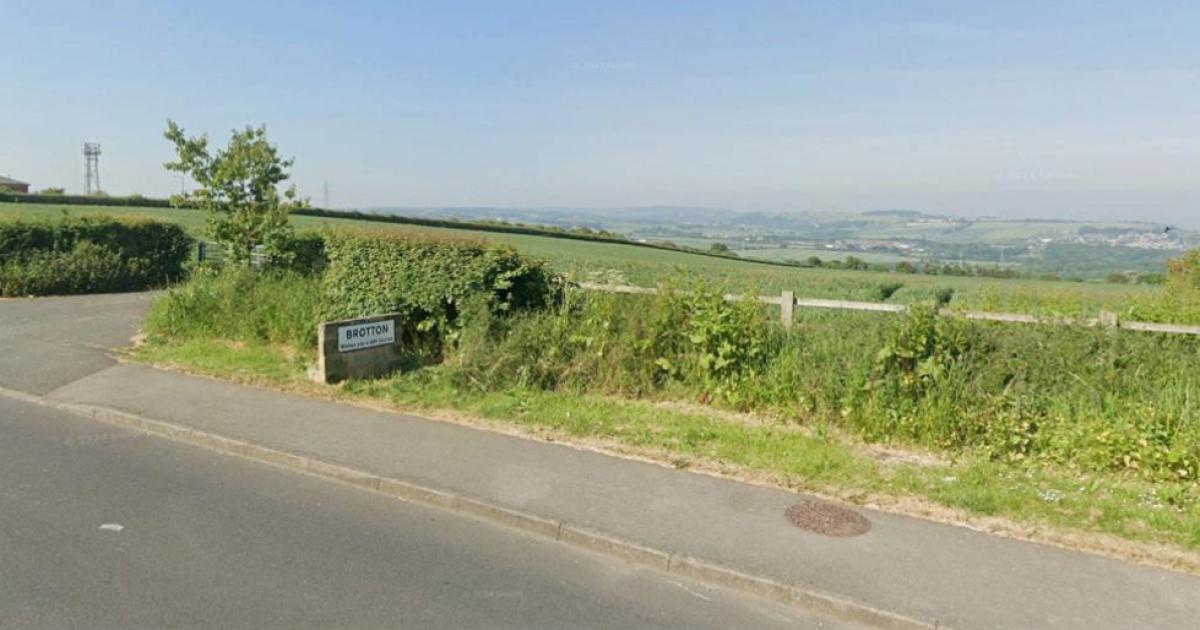
87 new homes approved for Brotton housing development

Published

on

87 new homes approved for Brotton housing development

Developer Gleeson Regeneration Limited submitted the plans for farmland south of Alford Road and west of Kilton Lane to Redcar and Cleveland Council last year.

Members of the council’s regulatory committee followed a recommendation from a council officer who deemed the development acceptable in planning terms, also declaring: “The proposal is considered to provide a suitably designed, scaled and orientated development which would not pose any significant effect upon the character of the wider area”.

It will consist of 14 two bedroom semi detached, 50 three bedroom semi detached and 23 four bedroom detached properties.

A typical Gleeson Homes street scene. Picture/credit: Acer Architectural Ltd/Gleeson Homes. Free for use for all LDRS partners.A typical Gleeson Homes street scene. Picture/credit: Acer Architectural Ltd/Gleeson Homes. Free for use for all LDRS partners.

A new access route will be provided from Kilton Lane for vehicles with a pedestrian access proposed linking to Landsdowne Road to the north west of the site. 

Advertisement

Fifteen objection letters were received by the council from members of the public.

Meanwhile, Skelton and Brotton Parish Council raised a number of issues stating there was a lack of local facilities, the visual impact on the surrounding area and a loss of green space, among several grounds for objection.

The council’s development engineers, in their assessment, said a number of amenities were a ten minute walk away, while the nearest bus stop, on Alford Road, was a quarter of a mile away.

In relation to a transport assessment and travel plan prepared on behalf of the developer they concluded: “It has been demonstrated that the site does offer legitimate means of sustainable transport connectivity in accordance with local and national transport planning policy.”

Advertisement

Brotton ward councillor Graham Cutler described a potential knock-on effect on the A174 Kilton Lane roundabout suggesting improvement measures were needed due to an increase in traffic using the busy route, although this was deemed outside the scope of the development.

The predicted travel demand in terms of vehicles was 46 arrivals and departures in the morning peak each day and 45 in the evening peak, and said not to pose an adverse impact on road networks.

The development engineers advised that a T-junction providing access onto Kilton Lane would be sufficient to cater for the proposal with suitable visibility splays, and had no significant highway safety concerns.

Financial contributions have been agreed in relation to school provision, the local NHS, and leisure in order to address the demand generated by the proposal, a report said, amounting to more than £300,000.

Advertisement

Nine of the homes planned will also be in the ‘affordable’ category.

A design and access statement accompanying the application promised an “attractive and high quality environment” for householders occupying the new properties.

Much of the debate at the decision meeting centred on the pedestrian access planned to Landsdowne Road with concerns that it could be used as a “cut through” for bikers carrying out criminal activities.

A resident claimed it could “totally ruin” the peace and security of those living in existing properties.

Advertisement

Brotton councillor Barry Hunt said: “It will be used by bikes and for anti-social behaviour, delivering drugs.

“People will be terrorised.”

Chris Dodds, representing the applicant, said he understood the feeling expressed, but the pedestrian route would support access into the local centre in Brotton.

He said it would “narrow in as you get further up” with a barrier to restrict bikes and motorbikes.

Advertisement

Nonetheless, one committee member asked if the planned footpath could be removed entirely from the plans, but the council’s development services manager Claire Griffiths said it encouraged and maintained connectivity.

The council was also described as owning a section of land to the north, falling outside of the development boundary, which it could choose to remove access to in order to control any problem with anti-social behaviour.

The site of the proposed housing, along with further adjoining parcels of land, was previously allocated for residential development in the council’s Local Plan, being considered suitable for up to 270 homes that should be “well integrated with the existing built up area” and completed by 2032.

Advertisement

Source link

Continue Reading

NewsBeat

UK weather maps reveal 3C cold snap with 108 counties plunging below 10C

Published

on

Daily Mirror

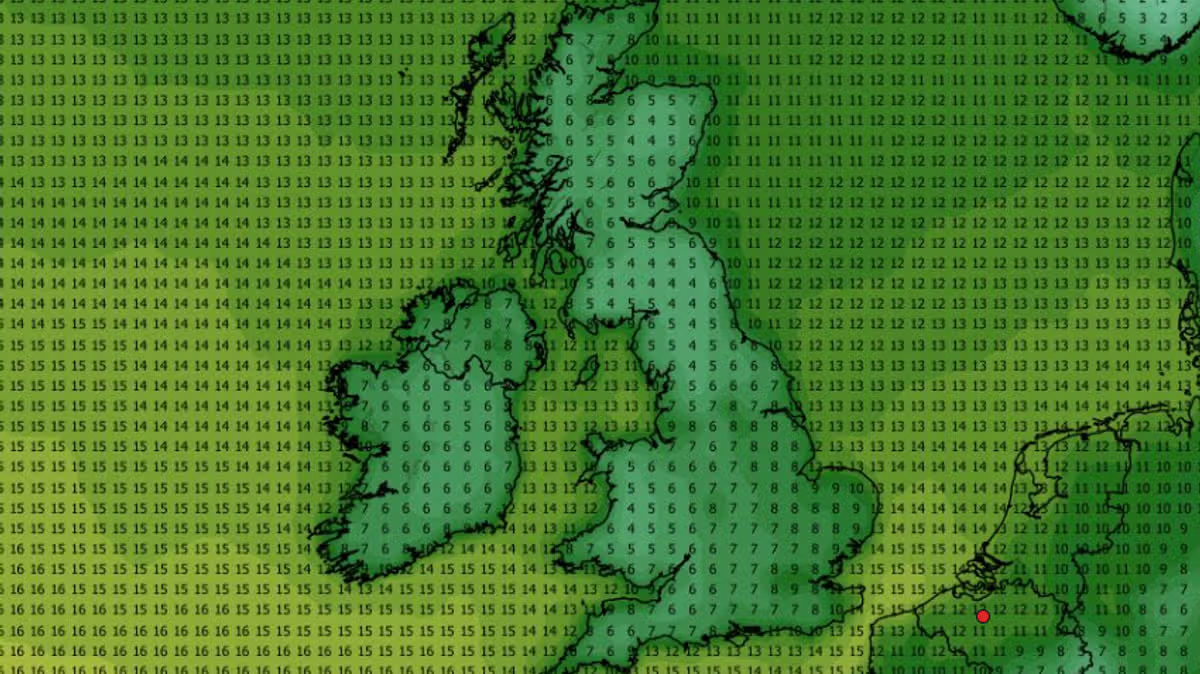
The GFS weather forecasting model suggests daytime temperatures could plunge below 10C in every county across the UK as Brits face a cold snap later this month

Weather forecasting data suggests the UK faces a cold snap later this month, with daytime temperature dropping below 10C in all 108 counties across the country.

The GFS weather model shows minimum possible temperatures dropping as low as 3C at midday on September 23 in Scotland, with 5C in Northern Ireland, Wales and the northern England, and just 11C in the south-east where temperatures tend to be warmer.

Data for later in the afternoon shows highs of just 14C in the south-east, 12C in the Midlands and Wales, 11C in Northern Ireland and 10C in Scotland.

Advertisement

Similar conditions are expected on September 24. The GFS model shows minimum possible temperatures below 10C in every county at midday, with 5-9C on the cards across much of the UK.

By 6pm, the data suggests late afternoon highs might reach just 15C in the south-east, 13C in the Midlands and Northern Ireland, 12C in South Wales and 11C in Scotland.

This all comes as the strongest El Nino on record is expected over the coming months.

Advertisement

Met Office meteorologist Aidan McGivern has described this year’s El Nino as a “beast” and said the UK is facing “uncharted territory” – as not only is it expected to be the strongest El Nino on record, but it will also be bolstered by global warming.

El Nino will peak towards the end of this year and have varying impacts in different places – bringing increased rainfall to some areas and drier spells to others.

Mr McGivern said: “Very wet conditions [are expected] through the Pacific as well as southern California. Other southern states in the US, into Mexico, coastal parts of South America [all face] above average rainfall and more storms.”

Advertisement

For the UK, “well above average rainfall, especially to the south-west of the UK” is on the cards.

Mr McGivern clarified that El Nino is not the only thing that can impact our weather, so these outcomes are not guaranteed. “And we’ve got global warming to think about, the fact that sea surface temperatures are significantly warmer than average in many places,” he said.

“That combined with El Nino could fuel more rain when storms happen. So if we get more storminess in the UK… those storms will contain more moisture as they’re passing over warmer seas.”

Advertisement

El Nino occurs every few years when temperatures in the tropical eastern Pacific rise 0.5C above the long-term average. It generally causes an increase in global temperatures in the summer, while autumn and winter tend to be wetter and stormier.

Source link

Continue Reading

Trending

Copyright © 2025