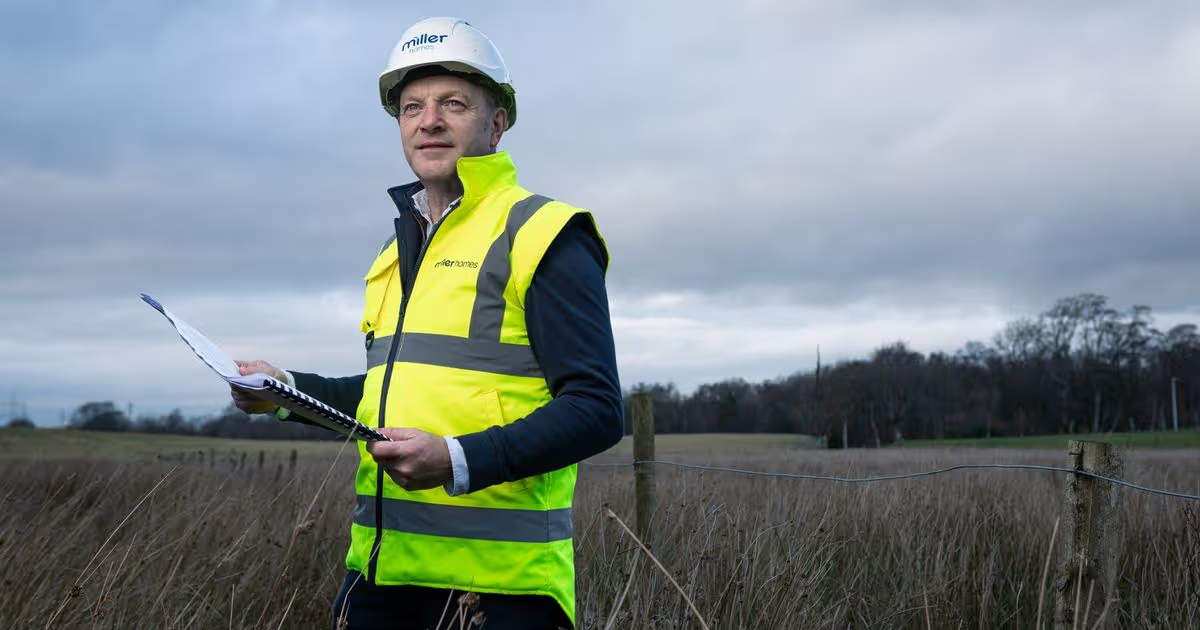
Miller Homes will build their new Maplebrook development at a site on Meikle Earnock Road
A 7.5-acre site in Hamilton is to be developed for housing, with 64 new properties to be constructed and the first residents set to move in at the end of the year.
Advertisement
Miller Homes has announced its acquisition of the site at Meikle Earnock Road for its new Maplebrook development, which will consist of three- to five-bedroomed properties and is due to be launched this summer with a showhome then opening in autumn.
The company says it marks 25 years of building in the town, following previous developments including Highstonehall Park and nearby Highstonehall which were both completed in 2025, and described the latest project as a “significant milestone”.
Maplebrook is described as providing energy-efficient homes, with five house types including terraced, semi-detached and detached.
The company says the new Hamilton site “reflects Miller Homes’ long-standing presence and commitment to the area”, adding: “Over the past quarter-century, Miller Homes has helped create thriving communities across the region, and the team is excited to bring forward a new neighbourhood as part of its continued investment in South Lanarkshire.”
Advertisement
Regional operations director Andrew McArthur visited the site, in a growing residential part of the town, to mark the acquisition announcement; with the company saying the first properties are scheduled for completion in November.
He said: “As we mark 25 years of building in the area, we are delighted to be bringing forward our next development in Hamilton.
“With demand for energy-efficient family housing remaining strong, we will maintain our focus on identifying and investing in land opportunities that support the area’s expansion and align with our regional growth strategy.
Advertisement
“The acquisition of Maplebrook further strengthens our land position in the west of Scotland, and this latest purchase will enable us to continue delivering the new communities that South Lanarkshire requires.”
*Don’t miss the latest headlines from around Lanarkshire. Sign up to our newsletters here.
And did you know Lanarkshire Live had its own app? Download yours for free here.
As a researcher in autism and education and a former secondary school teacher, it took me a while to realise that autistic school staff were rarely included in conversations about inclusion and diversity in schools.
With colleagues, I started the Autistic School Staff Project in 2019, focusing on the experiences, needs and aptitudes of autistic teachers and other education staff.
Our findings show that autistic school staff can experience significant sensory issues in school. These can be from bright, flickering lights, odours from the canteen, and crowding in corridors or during meetings. The greatest impact of all comes from noise: shouting from children and staff during break times, the clang of the school bell and the roar of traffic when windows are open in the summer.
Interestingly, it’s not only a question of volume levels. Whispering from children and humming from technology can also be highly distracting and contribute to feelings of fatigue and overload.
Advertisement
Autistic teachers also told us that the ways neurotypical colleagues communicated and interacted with them could be disorientating and exclusionary. Staff meetings that seemed to lack focus, chit-chats in the school corridor, gossip and school politics could be experienced as confusing and irrelevant.
At the same time, autistic teachers felt their own communication style of being direct and to the point could be misunderstood as rudeness. Similarly, staff social events were often not enjoyed by autistic teachers, even though neurotypical colleagues seemed to really rate them. Changes announced at the last minute by the school leadership team, with instructions that did not seem to make sense, could be highly stressful for autistic teachers. Covering for absent teachers was also found to be very unsettling.
Noisy school environments can cause sensory issues for autistic teachers. Shutterstock
Most tellingly, a number of participants felt they could not be open about being autistic. A key reason for this concerned negative and stigmatising attitudes towards autism that they had to face in school. The teachers also said that autistic children could be poorly treated. Autistic teachers sometimes had to sit through autism training, conducted on the assumption that no-one present was autistic, where the same negative attitudes were evident.
As a result, autistic school staff could be extremely wary about sharing with anyone that they were autistic. They worried that this information would have a negative impact on their careers. Suppressing an autistic identity, known as masking, has been linked with mental health issues.
Advertisement
While some of our participants had been able to disclose being autistic in school, and had even had a good experience of this, others said that it had made life even harder. This was because attitudes would change towards them in a negative way, or they might not even be believed.
Passion and support
Fortunately, a number of positives also came out of our study. Monotropism – a key autistic trait that denotes a tendency to have very intense interests – can mean that autistic teachers develop strong subject expertise and teach with passion. Even the job itself links with monotropic tendencies, as autistic teachers told us that they loved their work and were highly motivated by it. In addition, autistic teachers felt that they were very thorough and organised.
Above all, autistic teachers felt they were making a significant contribution to supporting inclusion in school. They were sensitive to the needs of neurodivergent children and others at risk of marginalisation, and were willing to try alternative approaches with children who were struggling. One teacher said:
I never gave up on a child because I think probably too many people gave up on me. I could see myself in a lot of the children.
In addition, some of those who had been open about being autistic were valued by colleagues because of their insights in relation to neurodiversity. Autistic teachers also felt that they could be a role model for autistic children and their parents.
Advertisement
Autistic teachers are a valuable part of the school workforce and are already making an important contribution to inclusion. However, it’s important to remove the barriers they can face across their careers.
This includes providing more flexibility and support for autistic student teachers. Making recruitment practices inclusive and accessible – such as by providing questions in advance, and offering in-person and remote options for interviews – would also benefit autistic teachers, as would developing neurodiversity-inclusive school communities.
Participants were clear that autism training should be run by autistic people, and that withdrawing to a quiet space should not be misinterpreted by colleagues as being anti-social. Addressing the sensory impacts of schools would benefit both children and staff. Providing staff with agency in decision-making can be empowering. We also need to reconsider the conventional role of the teacher, and question if the current format of standard duties, such as parents’ evenings and covering for absent colleagues, should be re-evaluated through a neurodiversity-inclusive lens.
The new DIY aisle is in partnership with Wilko, with it opening last week at the Speke store in Liverpool.
However, reports say that it will be rolled out to further stores this year.
Morrisons launches new DIY aisle in partnership with Wilko
The new aisle offers shoppers the opportunity to purchase Wilko favourites, such as paint and other decorating tools, various household essentials and car accessories.
The aisle is adorned with Wilko’s iconic red branding and will offer the products during standard weekly shops.
Advertisement
A Morrisons spokesperson said: “We are pleased to have launched our new Wilko’s concession in our Speke store, marking the start of an exciting new partnership.
“We are looking forward to rolling this out to further stores later in the year.”
The rollout in Liverpool began towards the end of March, with more than 20 more proposed locations coming in 2026, according to The Grocer.
Rami Baitieh, Morrisons’ chief executive, said the changes were a “necessary part of our plans to renew and reinvigorate” the chain and invest in areas that “customers really value”.
It was suggested at the time that some fresh food counters or cafes could be replaced with specialist offers from third-party companies.
Holland & Barrett partnered with Morrisons to open concessions in a small number of Morrisons stores towards the end of last year.
Advertisement
Other changes at Morrisons
The new Wilko aisle is not the only change that has come to Morrisons in recent months.
The change is designed to help shoppers manage their condition with greater dignity and independence.
The updated facilities include hooks for clothing or bags, a shelf for medical supplies, a bin for discreet disposal and a mirror to help people check their stoma appliances.
Advertisement
Morrisons has recently made accessible toilets in its stores stoma‑friendly (Image: David Parry/PA)
New, sleeker black versions of the technology have come in to replace older checkouts, as part of the big refresh, which aims to provide “excellent levels of service”.
However, not all changes have been well-received by customers.
The popular Fox News host used her opening monologue on The Ingraham Angle on Monday to talk about the utter mess that’s unfolded since the US and Israel launched a joint attack on Iran on February 28 — and questioned whether President Donald Trump was fully aware of the consequences of this decision.
“Now, knowing what little time we have and how quickly this can spiral out of control, we still have a lot of questions,” Ingraham said. “For instance, was the president fully briefed about the risks of all of this from the beginning? And was he then able to take it all in and understand the complexity of this? How complex it could actually get, and further possibilities of casualties or other damage –– the difficulty of dealing with these people? Or was he told this would be relatively quick, in and out?”
Ingraham’s opening monologue began with her mentioning that Trump’s self-created April 6 deadline to “strike a deal” with Iran is looming, and how it could act as “a defining moment for this conflict and perhaps for his presidency.”
Ingraham questioned if that even matters.
Advertisement
“But how much power does Mohammad Bagher Ghalibaf actually have?” Ingraham wondered. “The New York Times is reporting that the regime is having some trouble coordinating after so many people were killed. They’re scared to meet in person — these individuals — or to have their calls apparently hacked. With different leaders in place, Iranian negotiators may have little knowledge about what their government is willing to concede. Or even whom precisely to ask. So if we cannot come to some type of peace deal with people who can’t be trusted, then what?”
Major supermarkets including Tesco and Aldi, fashion retailers like Primark, and fast food outlets such as Greggs will close — here’s a complete guide.
Shania King-Soyza and Nicola Roy Spare Time writer
14:40, 01 Apr 2026
This week, customers throughout the UK will find some of their go-to high-street shops closing for an entire day. Leading retailers that stock groceries, clothing and fast food will close for 24 hours.
Household names like Tesco, Primark and Greggs are amongst those giving employees a day off to celebrate the Easter holiday.
Advertisement
Shoppers are being encouraged to plan in advance to prevent inconvenience, especially for essential purchases. Most businesses are recommending customers visit their websites for local branch details.
Here’s a full guide to all the shops taking part in the one-day shutdown on Easter Sunday, April 5.
Supermarket opening hours for Easter weekend 2026
Leading supermarkets will function on different schedules during this time, with opening and closing times varying depending on the size of each outlet.
Sainsbury’s
On Easter Sunday, most Sainsbury’s outlets will be closed. However, branches in Scotland will stay open and some Sainsbury’s Local shops may operate. Customers are recommended to check the hours for their local store.
On Easter Monday, April 6, most larger outlets will be open from 8am to 8pm, while Sainsbury’s Local shops are typically expected to run as usual, reports the Express.
Tesco
All Tesco outlets will be shut on Easter Sunday, except for large stores in Scotland, which will keep to their regular hours.
On Easter Monday, most stores operate reduced hours from 8am to 6pm.
Advertisement
Morrisons
The majority of Morrisons outlets will be shut on Sunday, with only some locations in Scotland expected to open. Shoppers wanting to visit are advised to check their nearest branch for confirmation.
Asda
Most Asda outlets will be closed on Sunday. On Easter Monday, most will open from 8am to 10pm.
Co-op
On Sunday, some Co-op outlets will be closed, but convenience stores may be open. Co-op’s website says: “During bank holidays and special times of year, some of our stores may open later and close earlier than normal.”
Lidl
All Lidl outlets in England and Wales will be closed on Sunday, while Scottish branches will stay open. Opening times will vary on Easter Monday, so it’s best to check your local.
Advertisement
Waitrose
Waitrose branches will be open on Good Friday and Easter Monday, with some operating on reduced hours.
On Easter Sunday, the majority of shops will be closed, with the exception of a small number of convenience stores. We advise customers to check the times of individual shops using the branch finder page on our website.
Aldi
Most Aldi outlets will be open from 8am to 9pm on Good Friday and Easter Saturday.
Shops will be closed on Easter Sunday, except for some in Scotland, so check locally. On Easter Monday, most will open from 8am to 8pm.
Advertisement
M&S
Marks & Spencer’s opening times will differ across the UK, so shoppers should check their nearest store.
The majority are expected to be shut on Easter Sunday, with reduced hours expected throughout the rest of the bank holiday weekend.
Household retailers
Home Bargains
Home Bargains will shut 560 stores on Easter Sunday, affecting branches across England and Wales. Approximately 70 stores in Scotland will remain open as normal.
Advertisement
Shoppers can still visit on Good Friday and Easter Monday, but hours will vary so it’s best to check their store locator.
B&M
B&M will close the vast majority of its stores throughout the UK on Easter Sunday, with Scottish branches expected to stay open as normal. Stores in England, Wales, and Northern Ireland will be shut for the day but will reopen for the remainder of the Bank Holiday weekend.
A spokesperson confirmed that all B&M stores will trade normally on Good Friday and Easter Monday. Customers uncertain about whether their local B&M will be open can verify this by using the store locator tool on the retailer’s website or via the store locator tool on its mobile app.
IKEA
All 22 IKEA outlets in the UK will trade as normal over the Easter weekend, apart from on Easter Sunday.
Advertisement
On Sunday, 20 branches in England, Wales, and Northern Ireland will shut, while the Glasgow and Edinburgh sites in Scotland will stay open.
Customers can visit all outlets on Good Friday, Saturday, and Easter Monday, although opening hours may differ, so it’s recommended to check your local branch before setting off.
Fashion retailers
Primark
Primark will shut all of its UK outlets on Easter Sunday, April 5. The retailer has approximately 190 sites across the country, including 160 in England.
Advertisement
A spokesperson said some branches may have modified hours over the Easter weekend, so customers are advised to check their local outlet before visiting.
As reported by the Mirror, a Primark spokesperson said: “Primark stores across the UK will be open across the Easter weekend; however, on Easter Sunday, only stores in Scotland will be open, and all stores in England, Wales and Northern Ireland will be closed.
“Stores may also be operating different hours to normal, so we recommend that customers check our website for their local store opening times before visiting to avoid disappointment.”
Food
Many Greggs outlets are shut over Easter, though some petrol station and travel sites may open with restricted hours. Since opening hours can differ by location, it’s recommended to check before visiting.
Advertisement
You can visit the Greggs Store Finder on the official website for the latest opening times, search “Greggs near me” on Google Maps, or check delivery apps. For absolute peace of mind, especially during bank holidays, it’s worth ringing your nearest branch directly.
On the official website, a spokesperson said: “Greggs stores often operate on reduced hours during holidays and some branches may close completely on major festive days.
“Timings can vary by location, especially for outlets in shopping centres, airports, and petrol stations. To avoid disappointment, it’s always best to check your local Greggs store finder for the most accurate schedule.”
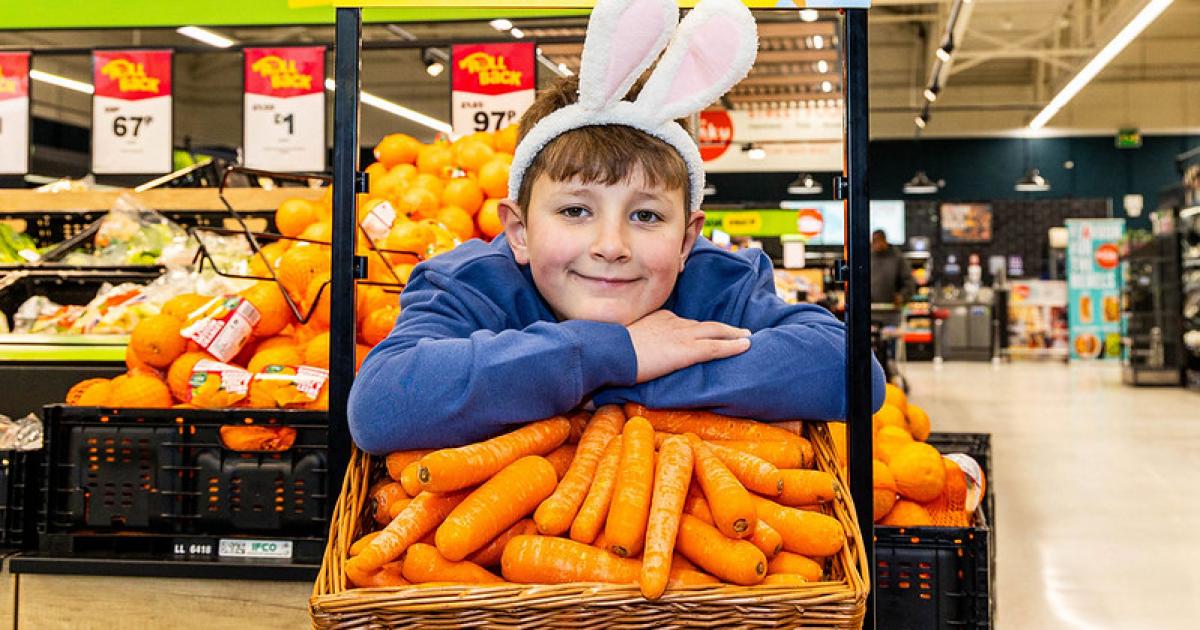
Asda has announced it will give away free carrots to customers across 581 stores on Good Friday, stepping in to support a rapidly growing UK tradition of leaving a carrot out for the Easter Bunny on ‘Easter Eve’, as nearly 45% say they’ve previously left out a carrot for the Easter bunny in the past, with over 10% growth in the tradition in the last two years alone.
As families look for new ways to extend the magic of the Easter holidays beyond the Sunday morning chocolate rush, this playful custom is becoming a staple of the spring calendar.
Inspired by the long-standing Christmas Eve ritual of leaving mince pies out for Santa and carrots for his reindeer, ‘Easter Eve’ is swiftly becoming a key seasonal moment itself, with families leaving a treat out for the bunny.
Asda has announced it will give away free carrots to customers for ‘Easter Eve’ (Image: Content Cover / Neil Terry)
New research suggests the tradition is already taking root in homes across the UK, with 58% of those who leave a carrot out for the Easter Bunny, having done so for at least five years.
Advertisement
The findings also highlight a noticeable rise in enthusiasm among 18–29-year-olds, 22% of whom took part last year, suggesting that younger adults are not only embracing the custom, but actively reviving and reinventing childhood Easter rituals more than any other age group surveyed.
And leaning fully into the ‘Santa style magic’ of the Easter Bunny, many families admitted to staging evidence to prove the Bunny had made a stop. One in eight (12%) confessed to biting or nibbling the carrot themselves to mimic bunny teeth marks, while 10% scattered a few crunchy crumbs on the plate, all in the name of crafting a believable Easter morning moment.
To help further fuel the excitement, Asda is temporarily rebranding its fresh produce as ‘Easter Bunny Carrots’ alongside other ‘Easter’ vegetables including parsnips, broccoli and potatoes, with selected produce on rollback to 30p, or 5 items for £1 linksave instore from today until 6th April.
The retailer will be handing out loose carrots in stores, encouraging children to prepare a special snack for their long-eared visitor after an evening spent prepping for egg hunts.
Advertisement
An Asda Spokesperson said: “The new-age tradition of leaving a carrot out for the Easter Bunny offers a simple, accessible way for families to build anticipation for a special Easter Sunday, and we are delighted to be helping families create magical moments together this year. And, unlike reindeer, rabbits genuinely love carrots, making the tradition surprisingly logical!”
And for parents looking for an easy, budget-friendly way to keep kids entertained during the holidays, Asda is offering a free in-store Easter Bunny hunt, where kids can search for the letters that spell ‘BUNNY’ to keep boredom at bay during the weekly shop*.
Shoppers can pick up their free ‘Easter Bunny Carrot’* in participating stores on Friday April 3, while stocks last.
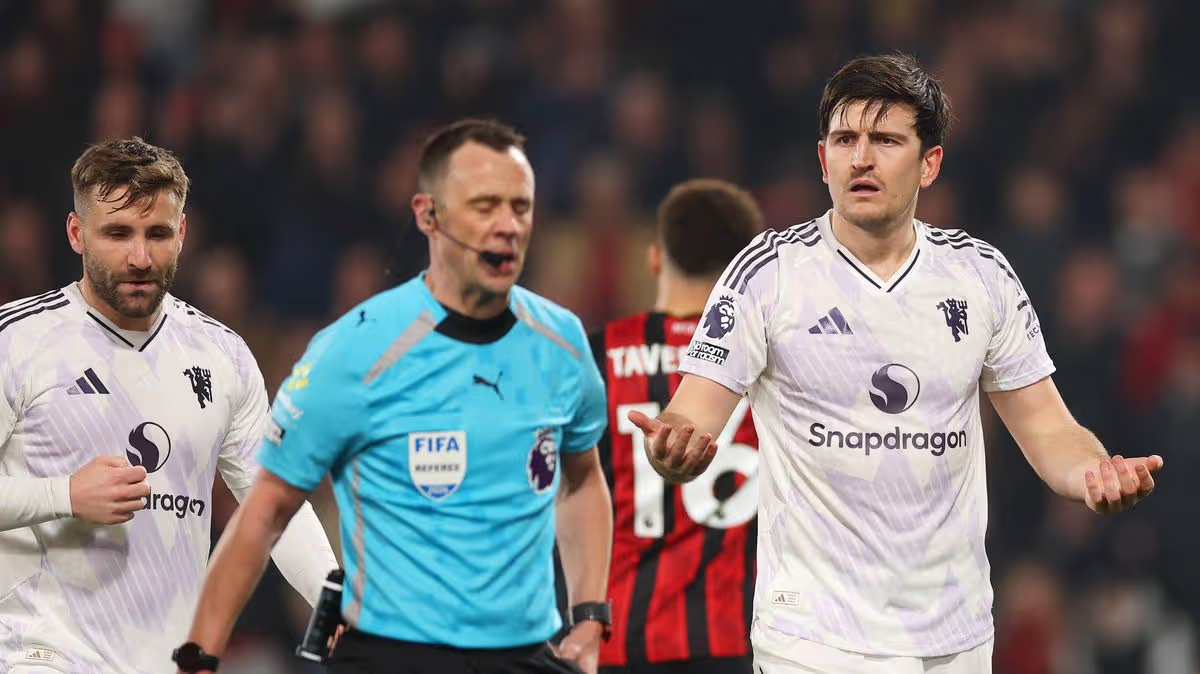
Harry Maguire was shown a red card in the 78th minute of Manchester United’s 2-2 draw away to Bournemouth last month, and his reaction has seen him charged by the FA
Referee Stuart Attwell’s decision was later ratified by VAR and the hosts scored the resulting penalty. Maguire was incensed by the decision, confronting both Attwell and the fourth official, Matt Donohue.
And his reaction has got him in trouble. A statement from the FA read: “Harry Maguire has been charged after being sent off in the 78th minute of Man Utd’s Premier League match against Bournemouth on March 20.
Advertisement
“It’s alleged that the defender acted in an improper manner and/or abusive and/or insulting words and/or behaviour towards the fourth official following his dismissal. Harry Maguire has until April 2 to provide a response.”
Maguire was hit with a one-match suspension, ruling him out of the Red Devils’ clash with Leeds United on Monday, April 13. But his ban could be extended given the charge.
United’s next game after Leeds is away to Chelsea on Saturday, April 18. Interim manager Michael Carrick was unhappy with Maguire’s red card, arguing that his side should’ve also got a penalty earlier in the game.
There will be more to follow on this breaking news story and Mirror Sport will bring you the very latest updates, pictures and video as soon as possible.
With thousands looking to get away for the long weekend, a “rapidly deepening area of low pressure” is likely to scupper many plans and cause transport chaos.
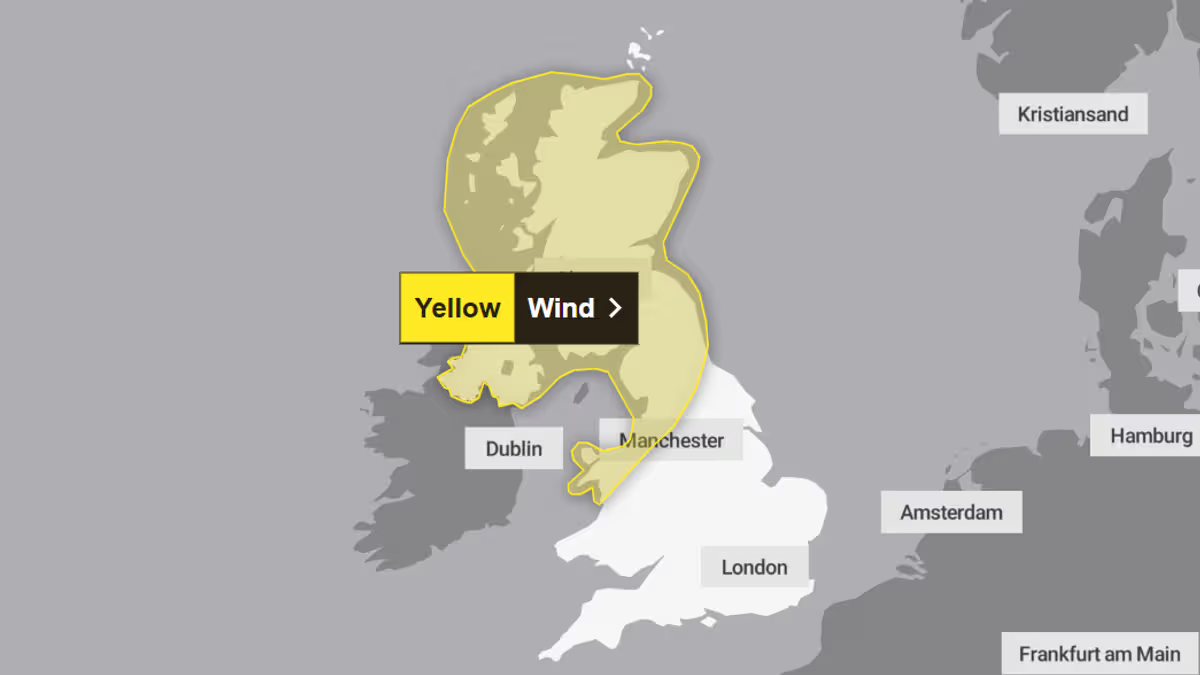
Lanarkshire homes face an Easter battering after the Met Office issued a weather warning.
Advertisement
With thousands looking to get away for the long weekend, a “rapidly deepening area of low pressure” is likely to scupper many plans and cause transport chaos.
Bridges could close with restrictions places on high-sided vehicles, especially on exposed routes. The Met Office says there is a “slight chance” of power cuts, as well as damage to buildings.
Households are being encouraged to secure loose items such as bins, garden furniture, trampolines, tents, sheds, and fences. The warning runs from 6pm on Saturday, April 4, until midnight on Sunday, April 5.
It states: “A rapidly deepening area of low pressure is likely to move northeastwards close to or across northwestern parts of the UK during Saturday evening and night, clearing to the North Sea by Sunday.
Advertisement
“Whilst there is some uncertainty over the exact track, intensity and shape of this area of low pressure, a period of strong west to southwesterly winds is expected during Saturday night and into the first part of Easter Sunday, before gradually easing through the day.
“Peak gusts of 50-60 mph will be possible fairly widely, with 60-70 mph in more exposed locations.
“There is a slight chance of some very strong winds across parts of Scotland, particularly in the west, where gusts of 80-90 mph may be possible in exposed areas for a time.”
The warning covers 20 of Scotland’s local council areas including North and South Lanarkshire.
The mum of a seven-year-old girl tragically discovered dead at a golf course had been suggested a new childminder on Facebook just days prior to the incident, close friends have revealed.
Nyla May Bradshaw was found in a pond at Owston Hall golf course, near Doncaster, on Monday. The autistic girl had been reported missing from the village of Skellow at 9.50am on the same day.
Advertisement
Heartfelt tributes have poured in from distraught family members, including Nyla’s mum Hailey, who referred to her as her “sweet little girl”. Charlotte Emma, a close friend of Nyla’s mother, has now disclosed that Hailey had sought recommendations for a childminder from a local Facebook group and had been suggested someone professing to be an autism specialist, reports YorkshireLive.
However, within two hours, the mother reportedly received a text informing her that Nyla was missing – and she was subsequently found in the pond.
Charlotte told The Metro: “A lot of us blame ourselves because Hailey doesn’t usually leave her with anybody, she goes to a special school. But the school holidays have come up and her mum was desperate for a child minder. She’d asked a Facebook group if anybody knew of any in the area.”
Advertisement
Kieran Bradshaw, her father, has paid tribute to his “best friend” and an “amazing daughter” in a heartfelt post on Facebook. He expressed: “Sat here feeling so alone with everybody around us but not knowing what the rest of our lives look like without our little girl, noises around the house, songs coming on and adding them to her own Spotify playlist for the car, seeing a McDonald’s and wanting it calling out, Thursdays we’re baking days and having a right good song along while dancing.
“You were so loved Nyla you touched everyone’s heart that ever met you. I’ll never ever go a moment without you in my thoughts.
“You saw the world as your playground free from any worries or fears and I learnt from you in my darkest of places that your smile and outlook was something so bright and I can’t believe I’ll not hear your voice again it took a long time for you to start saying ‘I love you’ or ‘I miss you’ only a year ago. You are my best friend and my amazing daughter. I hope grandad had a balloon waiting for you when you meet him he will look after you.”
A GoFundMe page has been established to assist the family with funeral expenses. The organisers stated that the family is “now facing the unimaginable pain of losing their beautiful daughter, alongside many unanswered questions and the overwhelming responsibility of arranging her funeral,” according to the fundraiser.
Advertisement
Get more Daily Record exclusives by signing up for free to Google’s preferred sources. Click HERE.
Advocacy groups and experts condemned YouTube for serving up low-quality artificial intelligence-generated videos to its most vulnerable audience: children.
In a letter to YouTube CEO Neal Mohan and Sundar Pichai, the CEO of YouTube’s parent company Google, children’s advocacy group Fairplay expresses “serious concern” about the spread of AI-generated videos on both YouTube and YouTube Kids. The letter, which was sent on Wednesday morning, was signed by more than 200 organizations and individual experts such as child psychiatrists and educators.
“This ’ AI slop ’ harms children’s development by distorting their sense of reality, overwhelming their learning processes and hijacking their attention, thereby extending time online and displacing offline activities necessary for their healthy development,” the letter reads. “These harms are particularly acute for young children.” The letter calls on YouTube to clearly label all AI-generated content and ban any AI-generated content on YouTube Kids. They also propose barring AI-generated videos from being recommended to users under 18 and implementing an option for parents to turn off AI-generated content even if their child searches for it.
The letter is signed by 135 organizations including the American Federation of Teachers and the American Counseling Association, and around 100 individual experts like “The Anxious Generation” author Jonathan Haidt. The letter is part of a larger campaign from Fairplay that also includes a petition.
Advertisement
Much of this AI-generated content is fast-paced with bright colors, lively music and clickbait titles that work to grab the attention of young viewers, the letter outlines. There has been a growing movement online against AI-generated content, particularly when it looks or feels low quality or leans into the meaninglessness of “ brainrot.”
Spokesperson Boot Bullwinkle said in a statement that YouTube has “high standards for the content in YouTube Kids, including limiting AI-generated content in the app to a small set of high-quality channels.”
“We also provide parents the option to block channels. Across YouTube, we prioritize transparency when it comes to AI content, labeling content from our own AI tools, and requiring creators to disclose realistic AI content,” Bullwinkle said. “We’re always evolving our approach to stay current as the ecosystem evolves.”
YouTube’s current policy regarding AI-generated content requires creators to disclose when content that’s “realistic” is made with altered or synthetic media, including generative AI. Creators are not required to disclose when generative AI is used to create content that is clearly unrealistic, including animated videos and those with special effects.
Advertisement
YouTube said it is actively working on developing labels for YouTube Kids.
In its letter, Fairplay argues that voluntary disclosure policy and what it sees as an “extremely limited” definition of altered and synthetic content mean kids still see a flood of AI-generated videos that are not labeled as such. They also argue that many children who watch YouTube videos are not yet able to read or to comprehend something like an AI disclosure. That leaves children “to fend for themselves or their parents to play whack-a-mole,” the letter reads.
Fairplay’s campaign comes shortly after Google’s AI Futures Fund invested $1 million into Animaj, an AI animation studio that makes videos for kids and draws in staggeringly high viewership numbers, according to Bloomberg.
The campaign follows a landmark verdict in a social media addiction trial in which a California jury found that YouTube designed its platform to hook young users without concern for their well-being. Meta was also found liable on the same counts as YouTube in the same case.
Advertisement
“Pushing AI slop onto young children is just another testament to how YouTube and YouTube Kids are designed to maximize children’s time online — including babies. AI slop hypnotizes young children, making it hard for them to get off their screens and move onto essential activities like play, sleep and social interaction,” said Rachel Franz, the director of Fairplay’s Young Children Thrive Offline program, in a statement. “What’s more, YouTube’s algorithm makes it impossible for kids to avoid AI slop.”
Earlier this year, YouTube head Mohan listed out “managing AI slop” as one of the company’s priorities for 2026. In a January blog post, he wrote that the company was “actively building on our established systems that have been very successful in combatting spam and clickbait, and reducing the spread of low quality, repetitive content.”
Around 1.3 million more UK households are facing a jump in their mortgage costs following the economic “shock” caused by the conflict in the Middle East, the Bank of England has warned.
The Bank’s latest financial stability report (FSR) said the UK economic outlook has “deteriorated”, increasing pressure on UK households and businesses.
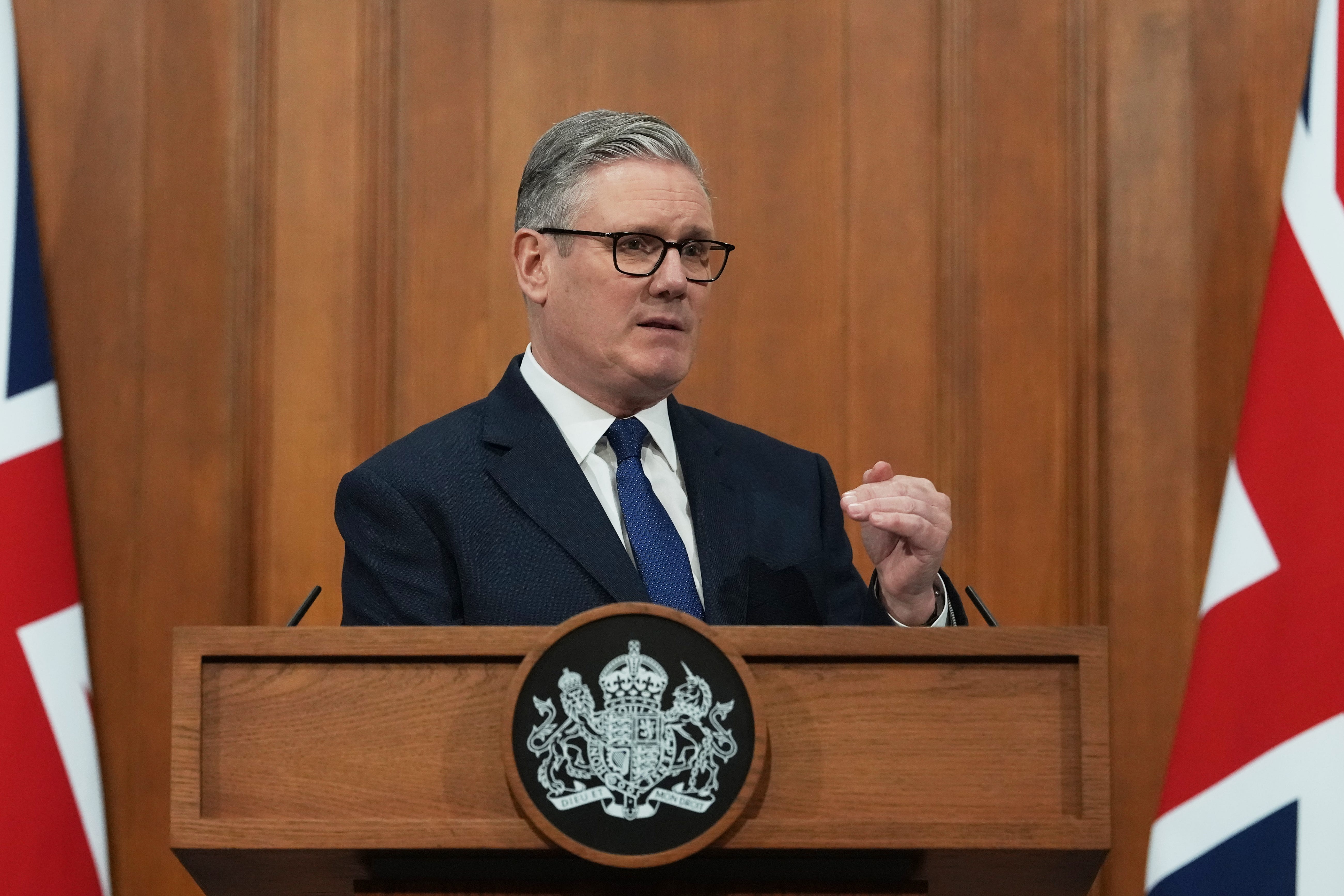
It came as Sir Keir Starmer warned the coming weeks “will not be easy”, adding that “how we emerge from this crisis will define us for a generation”.
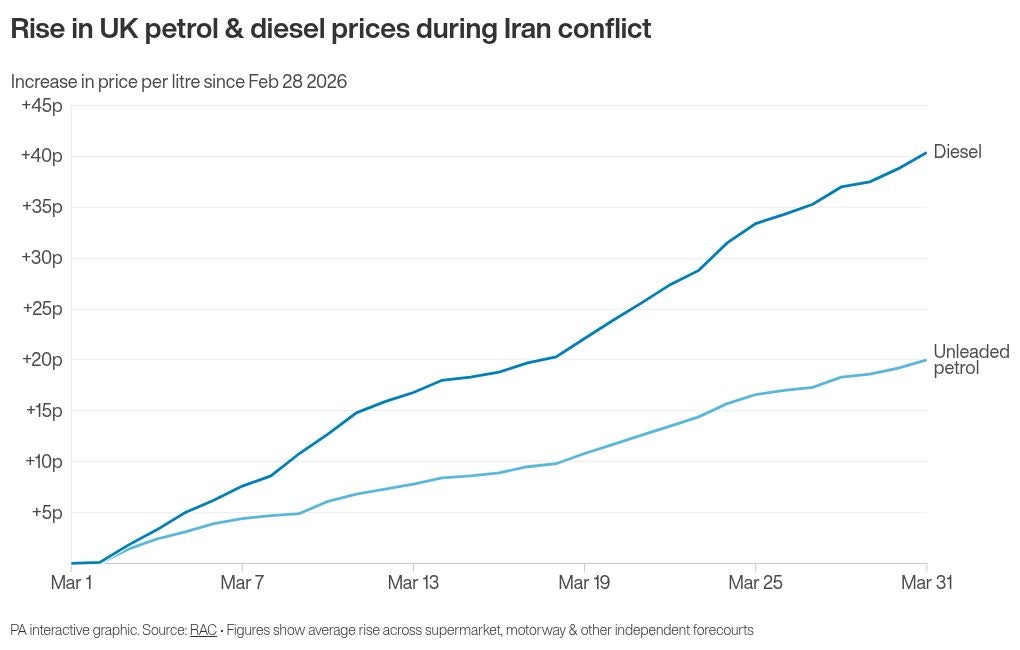
Oil and gas prices have increased sharply since the conflict began between US-Israeli forces and Iran at the end of February, with equity markets also shaken by the significant volatility.
“The shock will weigh on growth, increase inflation and tighten financial conditions,” according to the report.
Advertisement
Nevertheless, the central Bank’s financial policy committee said the UK financial system has been “resilient so far”.
It added, however, that the global macroeconomic backdrop is more unpredictable following the conflict, with this coming at a time when global risks were “already elevated”.
Giving a Downing Street press conference to address the cost of living spike caused by the war, the prime minister signalled the government would seek stronger ties with the EU as part of an attempt to mitigate the conflict’s impacts.
Sir Keir said the “volatile” international situation caused by the US-Israeli conflict with Tehran meant Britain’s “long-term national interest requires closer partnership with our allies in Europe and with the European Union”.
He added: “As the chancellor has rightly pointed out, Brexit did deep damage to our economy, and the opportunities to strengthen our security and cut the cost of living are simply too big to ignore.”
Advertisement
Meanwhile, Rachel Reeves has insisted that any cost of living support offered by the government will be based on household income and refused to commit to immediate support for drivers amid rising fuel costs.
Sir Keir Starmer says he will act in the national interest as he reiterates Britain will not get ‘dragged into’ the conflict in the Middle East (PA Wire)
“I want to learn the lessons of the past because when Russia invaded Ukraine, the richest, the best-off third of households got more than a third of the support. That makes no sense at all”, the chancellor told the BBC on Tuesday.
The Bank of England’s report said: “This increases the possibility of large, frequent and potentially overlapping shocks, and periods of intense volatility.”
Experts at the Bank indicated there is a risk that pressure on the global economy could result in “multiple vulnerabilities” crystallising at the same time.
This would have an increased impact on financial stability and “the provision of vital financial services to UK households and businesses”.
Advertisement
The report highlighted that UK households are set to face greater financial pressure following the conflict, due to increased energy prices and elevated mortgage rates.
Last month, the Bank’s monetary policy committee held the UK interest rate – which heavily influences mortgage rates offered by lenders – at 3.75 per cent but hinted they could lift this in future due to inflationary pressures.
Banks have therefore significantly increased the mortgage rates they offer and pulled a number of products from the market.
Households are set to face greater financial pressure following the conflict in Iran (Alamy/PA)
The FSR said average rates for two-year fixed-rate mortgages have increased by around 0.8 percentage points, while five-year fixed-rate mortgages have seen a roughly 0.7 percentage point rise.
Current rates indicate that about 5.2 million UK mortgage holders could face an increase in their repayments by the final quarter of 2028.
Advertisement
This compares with a prediction of 3.9 million from the Bank’s previous report before the start of the conflict in the Middle East.
Typical increases in mortgage payments would “remain modest” compared to many rises seen in recent years, it added.
The Bank also reported that the total number of mortgage products available in the UK had fallen from 8,500 to 7,000.
This is nevertheless still higher than following the initial Covid-19 period and during the gilt market stress amid the 2022 mini-budget by Liz Truss’s government.













































You must be logged in to post a comment Login