Connect with us
DAPA Banner

NewsBeat

how technology can help you to notice nature in new ways

Published

on

how technology can help you to notice nature in new ways

On a chilly yet beautifully clear evening last November, I sat on a video call with colleagues and happened to mention the live feed from the International Space Station – a real-time broadcast from onboard cameras as the station orbits earth.

Several people hadn’t heard of it, and so I dug out the link and sent it over. We then turned to Nasa’s spot the station smartphone app, which shows you the ageing satellite’s orbital track and provides a countdown to when you can next see it. Again, I found the link and shared it on the chat.

I suddenly realised the station was going to pass directly overhead – in just a few minutes. Video beamed from the station as it advanced over the Atlantic, crossed the terminator (the line that separates day from night), and hurtled towards the southwestern tip of the UK, where I live.

Running outside, I took my phone and the live feed with me. And as I looked up at the bright, impossibly fast-moving smudge traversing the sky above, the feed showed the station’s birdseye view – and perhaps the view of the astronauts aboard – looking down on me, too.

Advertisement

Just 25 years ago, this kind of experience would have been hard to imagine. Yet as our lives have become increasingly interwoven with technology, so too have our encounters with the world around us. And nowhere is this more true than when it comes to viewing the night sky.

Smartphone apps now help us to identify planets, catch views of satellite clusters (for better and worse), and plan how to view supermoons. These experiences could be crucial in helping to reconnect people with the night sky and preserve a darkness that is increasingly under threat.

Simulations that allow people to view the Earth from afar, via apps or computer games, could even recreate a fascinating phenomenon reported by astronauts: the overview effect. Recently referred to by the Artemis II crew, the overview effect is described as a “a profound reaction to viewing the Earth from outside its atmosphere”. It represents a powerful form of awe and wonder and digital tools might help us unlock similar feelings from Earth too.

On May 11 2024, residents marvelled at the aurora borealis (northern lights) across parts of the UK including in southern England where they are rarely seen. The sightings made headlines across Europe, an excitement that was made possible by digital technology and heightened by digital shares and updates.

Advertisement

Public interest began with the National Oceanic and Atmospheric Administration’s Deep Space Climate satellite picking up particularly strong solar winds. This triggered an alert to users of Lancaster University’s Aurorawatch app. These stargazers started taking photos of the northern lights, which they promptly shared via social media.

The display happened close to midnight when most people in the UK were in bed – but still scrolling. And as real-time images of the aurora quickly circulated online, masses of people went outside to see it for themselves. But, as one witness reported, many people struggled to make out the display: “I could see nothing by eye, but it was there on the camera screen, and on my phone camera too.” And so images of the sky were captured through ultra-sensitive smartphones.

From webcams in bird boxes to big-budget nature documentaries, these digital connections have come to define modern interactions with the natural world. They are now interwoven into everyday routines.

Ten million people watched the first episode of BBC’s Planet Earth III in 2023 – the same number who visit the Peak District in a year. Nature-based “relaxation” videos have achieved viral status on YouTube, amassing hundreds of millions of views each. Spotify, Audible and Netflix have made nature content a core offering to their combined half a billion subscribers. Instagram is home to pictures of 346 million sunsets – and counting.

Advertisement

Online relationships

Being online can also have serious consequences for mental health, but when it comes to the natural world, digital connections could also provide exciting opportunities to bolster wellbeing. Growing research has shown that engaging with digital forms of nature can lead to improvements in emotion regulation, stress reduction and attention restoration – a pathway that is already being explored by apps hoping to boost wellbeing for people who spend large amounts of time online.

These digital encounters also have the potential to affect how people behave towards the environment.

Some academics are worried that these trends might be degrading our relationship with nature, but there is substantial nuance to be found here. The real value in these experiences may lie not in their ability to simulate natural worlds, but in their capacity to stimulate interest in nature.

Harnessing technology to “rewild” our digital lives could be especially relevant when it comes to an emerging generation of young people. Take for example, the perspectives of generation alpha, the first wave of which are entering their late teens, and who, after gen Z, represent the second cohort of digital natives – hyper-connected visual learners who have never known a world without smartphones, social media, instant access to information, and for some, artificial intelligence.

Advertisement

Perhaps, as some have suggested, modern and digital tools could even mean that young people’s opportunities to connect with nature are unprecedented.

And so, as with some other innovations, these technological connections might enhance human experience, understanding and capability.

It could be time to recognise and embrace digital tools as part of the dynamic, evolving, and exciting way we interact with the natural world – approaches that might bring us closer to nature at a time when its future hangs in the balance.

Advertisement

Source link

Continue Reading
Click to comment

You must be logged in to post a comment Login

Leave a Reply

NewsBeat

US Democrats join progressive leaders in Barcelona in a rally defending global order

Published

on

US Democrats join progressive leaders in Barcelona in a rally defending global order

BARCELONA, Spain (AP) — Progressive leaders from around the globe gathered in Barcelona on Saturday to try and galvanize their forces and defend a rules-based world order.

Spanish Prime Minister Pedro Sánchez, an outspoken critic of U.S. President Donald Trump and the U.S.-Israeli war against Iran, hosted two overlapping events about democracy and progressive politics in Spain’s second-largest city.

Democrats U.S. Sen. Chris Murphy and Minnesota Gov. Tim Walz were present alongside the leaders of Brazil, South Africa and high-ranking officials from other left-leaning governments.

While no foreign leader criticized Trump by name in public, the staunchly unilateral position of the American president that breaks with decades of U.S. foreign policy, including his derision of NATO and the United Nations, hung over the meetings.

Advertisement

“We all see the attacks against the multilateral system, the repeated attempts to undermine international law and the dangerous normalization of the use of force,” Sánchez said.

Trump again lashed out on Saturday on social media at Sánchez, who has faced Trump’s scorn for not allowing the U.S. to use jointly operated military bases in Spain for operations related to the Iran war and for refusing to raise military spending from 2% to 5% of GDP.

“Has anybody looked at how badly the country of Spain is doing. Their financial numbers, despite contributing almost nothing to NATO and their military defense, are absolutely horrendous. Sad to watch!!!” Trump posted on Truth Social.

Sánchez says the right’s time is running out

Spain, like the U.S. and other developed countries, is in debt, but it has one of the world’s leading economies under Sánchez.

Advertisement

Sánchez told the rally of progressive politicians and party members held later on Saturday that the populist right “screams and shouts not because they are winning but because they know their time is running out.

“They know their vision of how the world should be ordered is falling apart due to the tariffs and wars,” he said. “Their embrace of climate change denial, of xenophobia, or sexism is their greatest error.

“They have tried again and again to make us embarrassed of our beliefs. That ends now. From now on they can be the ones who feel ashamed.”

Brazilian President Luiz Inácio Lula da Silva, Mexican President Claudia Sheinbaum, South African President Cyril Ramaphosa and Colombian President Gustavo Petro, and other leaders and officials, including Cabinet members from the United Kingdom and Germany, were in attendance at the IV Meeting in Defense of Democracy that kicked off Saturday’s double-header of political events at the Barcelona convention center.

Advertisement

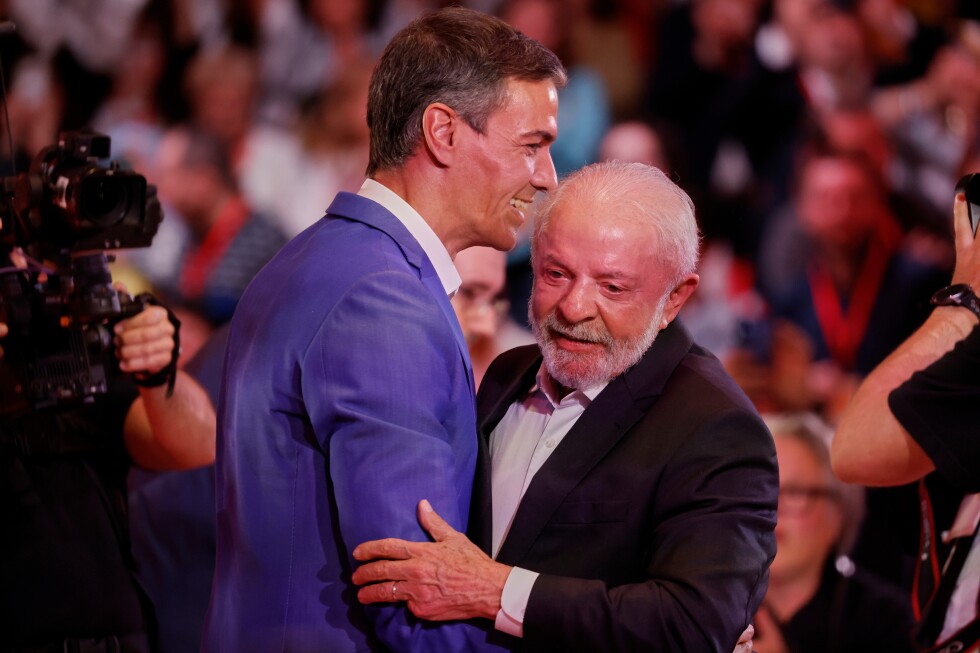
Later in the day, Sánchez, Lula and Ramaphosa stayed put to attend the inaugural Global Progressive Mobilization, where some 6,000 left-leaning elected officials, policy analysts and activists exchanged ideas.

“The far right is international, so we must be too,” German Vice Chancellor and Finance Minister Lars Klingbeil told a crowd of activists.

Advertisement

Democrats join rally

Sen. Murphy, a Democrat from Connecticut, spoke at the progressive rally and he didn’t shy away from blasting Trump while celebrating the loss of power of Trump’s ally Viktor Orbán in elections in Hungary last week.

“Donald Trump is out to end our democracy,” Murphy said. “We are not on the verge of a totalitarian takeover, we are in the middle of it.”

But, he said, “Americans are watching what is happening across the world, and the victory in Hungary just one week ago lifted our sails.”

Walz, Kamala Harris’ vice presidential candidate who has faced a violent U.S. Immigration and Customs Enforcement migration crackdown in Minnesota, threw barbs at U.S. Vice President JD Vance, who campaigned for Orbán and has backed far-right parties in Europe.

Advertisement

“Unlike our current vice president, I’m not here to arrogantly lecture or scold you, I am not here to pick a fight with the Pope or host a rally for any local wannabe authoritarians,” Walz said.

New York Mayor Zohran Mamdani, former U.S. presidential candidate Hillary Rodham Clinton and Sen. Bernie Sanders all sent video messages played at the rally.

Progressives exchange ideas

Among concrete proposals to come from the events, Ramaphosa said South Africa will present a draft resolution to establish an International Panel on Inequality, aiming to tackle the growing wealth gap both within and between nations, to the U.N. General Assembly in September.

Sheinbaum plugged her idea that governments commit to spending the equivalent of 10% of their military budgets on reforestation projects.

Advertisement

“Each year, instead of planting the seeds of war, we will plant the seeds of life,” she said.

Sánchez argued for the importance of regulating social media to stop the spread of hate speech and disinformation. His government also said that it is working with Lula’s Brazil on a tax for the ultrarich.

Lula, who met with Sánchez in a bilateral summit on Friday in Barcelona, kept the focus on how to invigorate the progressive moment. He avoided naming Trump except when he called for U.N. Security Council members to “fulfill their obligation and guarantee peace.”

“Stop this madness of war because the world cannot bear any more wars,” Lula said.

Advertisement

Source link

Advertisement
Continue Reading

NewsBeat

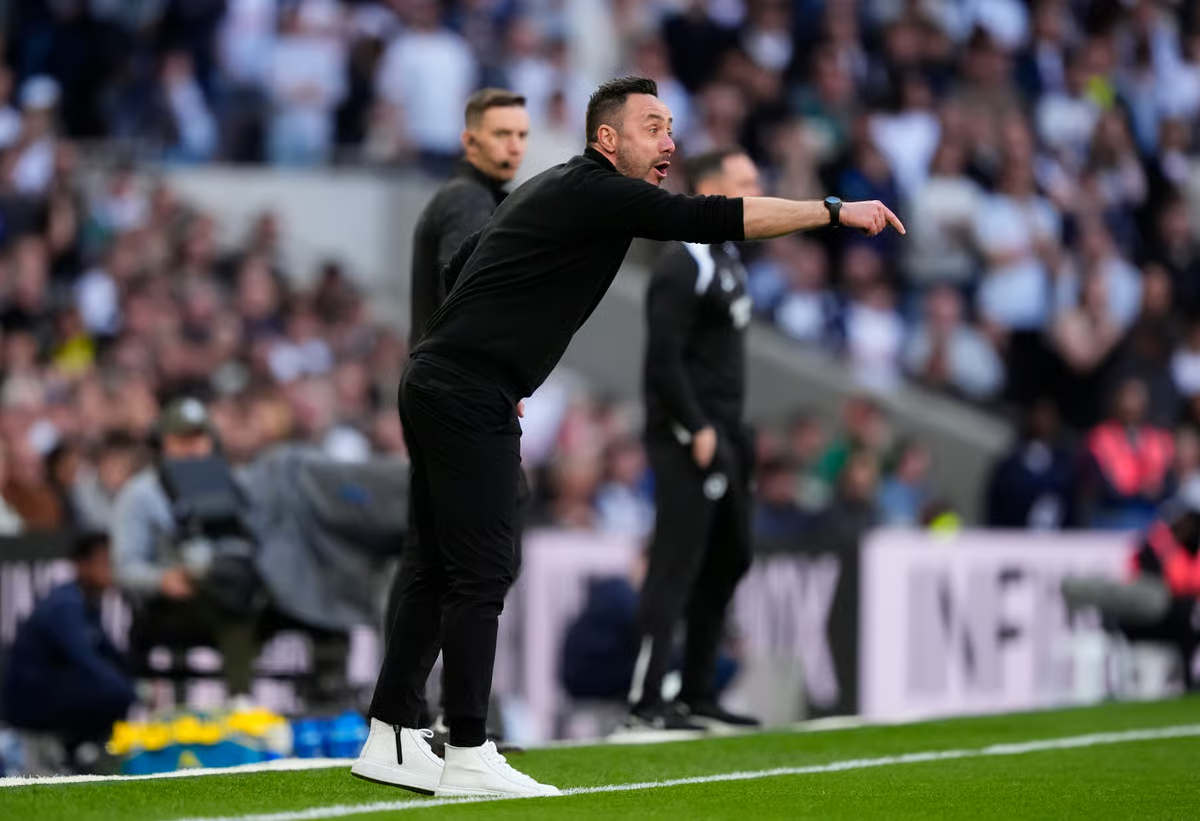
Three things we learned from Tottenham draw as Roberto De Zerbi impact clear

Published

on

Three things we learned from Tottenham draw as Roberto De Zerbi impact clear

Source link

Advertisement
Continue Reading

NewsBeat

Key points after 11th week of Noah Donohoe inquest

Published

on

Belfast Live
Key points after 11th week of Noah Donohoe inquest | Belfast Live