Connect with us
DAPA Banner
DAPA Coin
DAPA
COIN PAYMENT ASSET
PRIVACY · BLOCKDAG · HOMOMORPHIC ENCRYPTION · RUST
ElGamal Encrypted MINE DAPA
🚫 GENESIS SOLD OUT
DAPAPAY COMING

NewsBeat

I went undercover on the Tube to test how safe women really are. Within hours, men followed me, touched me and ignored my pleas to stop. It was bone-chilling, writes MIMI YATES

Published

on

Mimi Yates travelled across London’s transport network at all hours of the day and night, secretly filming what happened to her and documenting how it felt to move around the capital as a young woman on her own

It’s around 2am on the Piccadilly Line and the Tube carriage is empty – apart from me and a man twice my age. His eyes never leave me during the 40-minute journey.

Potbellied and with a menacing grin, he moves suddenly from the seat opposite, plonking himself down next to me. He’s desperate to get my attention, talking at me over the deafening noise of the train.

Unnerved, I get off before my stop. But he follows me and on to another near-empty train – this time the Jubilee Line towards Stratford. Again and again he tries to engage me in chat, staring at me and licking his lips.

I finally manage to lose him somewhere between the platform and the escalators at North Greenwich station.

Advertisement

Half an hour later, I’m on the platform at Green Park when another man starts trying to attract my attention, calling out to me. He’s well dressed in a Barbour-style jacket with fashionable glasses. He beckons me to sit down next to him while we wait for the train.

‘Beauty needs a seat, now. Come sit down,’ he says. I tentatively take up a place with two seats between us. He tells me he has a daughter who is my age.

He keeps asking me where I live, and after failing to get an answer starts to threaten me. ‘I will find the pub or restaurant next door to you. I’m going to come to look for you and I will find you.’

He doesn’t give up, repeatedly demanding my phone number. I tell him politely ‘no’ 20 times – I counted.

Advertisement

Mimi Yates travelled across London’s transport network at all hours of the day and night, secretly filming what happened to her and documenting how it felt to move around the capital as a young woman on her own

I board the train I’ve been waiting for. Laughing, he follows me into the same carriage, sitting down opposite me as he persists asking for my number. It’s around 3am now and the carriage is busy but that doesn’t deter him.

‘You have to give me your number, you have to. I am asking for yours. You have to meet up with me.’

Advertisement

Then he reaches over and strokes my thigh. ‘Please don’t touch me,’ I hear myself say.

A girl and her partner see what’s happening but say and do nothing.

By the time I get home, it’s almost 5am. I am badly shaken and film my reaction on my phone. ‘My heart is still beating quite fast. I just don’t think I expected it to be that bad.’

This wasn’t a normal night out. I had been working undercover for the Daily Mail’s investigative series, Underground UK.

Advertisement

Over two months earlier this year, I travelled across London’s transport network at all hours of the day and night, secretly filming what happened to me and documenting how it felt to move around the capital as a young woman on her own.

What I experienced has changed the way I view the city I love.

I was verbally sexually harassed around eight times and physically assaulted once on four journeys in the course of my undercover investigation, at night and during the day

I was verbally sexually harassed around eight times and physically assaulted once on four journeys in the course of my undercover investigation, at night and during the day

In March this year, a London Assembly report described ‘unacceptable’ levels of violence against women and girls across the capital’s public transport network.

In 2025, 4,593 sex-based offences against women and girls were recorded yet only a tiny proportion, around 3 per cent, led to a charge or summons. Some 58 per cent of cases identified no suspect at all, despite an extensive network of CCTV and ticketing data that can help trace journeys. Recent cases show why. In May, Salman Yousaf, 46, was jailed for eight sexual assaults and one count of outraging public decency on the Night Tube.

Advertisement

He targeted lone women who’d fallen asleep on the Central and Jubilee Lines, but police only connected him to the attacks when he was already in prison for another crime.

In March, Craig Anderson, 38, was jailed after sexually assaulting four women and stalking another across the railway network. Prosecutors described him as a man who ‘did not take no for an answer’.

I travelled before work, after work, at weekends and on Night Tube routes on seven lines – the Victoria, Piccadilly, District, Circle, Central, Jubilee and the DLR (Docklands Light Railway).

For my safety, a producer accompanied me, close enough that I could signal if I needed help, but far enough away that any man who approached me wouldn’t know I was being monitored.

Advertisement

And I dressed carefully: a buttoned-up checkered shirt, long baggy trousers and a denim jacket, concealing the wires connecting to a hidden camera and sound recording equipment. I wasn’t laying myself out as bait.

I began my first journey at Holborn Tube Station in central London at 1.30am on April 25. Less than 15 minutes into the journey, on an eastbound District Line train, I noticed a group of young men staring in my direction.

I did what women so often do in these situations: looked away, kept my face blank, pretended to be absorbed in my phone. When I got off at Dagenham East, they got off too. They walked ahead of me, deliberately slowly and kept turning back as if to check I was still there. I walked out of the station, hoping they’d disappear, but they lingered.

It was only when I turned back and headed down to the platform again did they finally drift away.

Advertisement

Things got worse later – when I encountered that man in trendy spectacles at Green Park who assaulted me. The audio I recorded is muffled in places but I can hear, and I remember, my intense anxiety as he became ever more angry and insistent.

As one unpleasant interaction ended, another began. It was relentless. Within a minute of me standing up to get away from the man in the glasses, I noticed another group of men. One stocky man with sunken eyes came over and asked for my number. I said ‘no’ nine times. He stood so close to me I could smell the rank odour of the pub he’d been in as his hand ran down the pole near my leg. ‘What are you scared of?’ he asked, rolling his eyes.

There was a girl slumped against the wall of the carriage, clearly intoxicated. At one point he gestured towards her and said: ‘Look at her.’ All I could think was, what might happen to her if nobody was there.

In March this year, a London Assembly report described ‘unacceptable’ levels of violence against women and girls across the capital’s public transport network

In March this year, a London Assembly report described ‘unacceptable’ levels of violence against women and girls across the capital’s public transport network

Advertisement

With each incident I felt the burden was on me to stay calm, polite enough not to escalate the situation, firm enough not to encourage it and alert enough to work out whether I needed help.

Advertisement

By the time I got home I was exhausted, drained yet still in fight or flight mode.

I was verbally sexually harassed around eight times and physically assaulted once on four journeys in the course of my undercover investigation, at night and during the day.

Esme Rice, 31, didn’t have a hidden camera when she was aggressively sexually assaulted on the Tube recently – but her recollection is crystal clear.

On June 6, at around 11pm, Esme was travelling home on the Elizabeth Line after dinner with friends when two men orchestrated a sexual assault – blocking her exit to the doors as she got off and groping her. ‘They were not remorseful,’ she said. ‘They were happy with themselves that they’d just sexually assaulted me.’

Advertisement

At Stratford, where she exited the train, Esme says she told a member of staff.

There was no police presence at the station, a major Tube and rail interchange, and she was advised to text British Transport Police (BTP) on 61016.

She sent the message within two minutes. Fifteen minutes later, she received an automated response saying her report was ‘urgent’. It took 13 hours for BTP to call her back.

Frustrated, she posted about her experience on TikTok. Hundreds of women flooded her account sharing similar experiences. ‘I stayed up for hours waiting for the phone call,’ she told me. ‘I received nothing. I’ve just been sexually assaulted. How can they not be getting back to me?’

Advertisement

It wasn’t her first experience of policing failures.

In 2024, Esme says that a man masturbated over her on the Jubilee Line during rush hour. She screamed at him in the carriage but no passengers intervened.

The case was closed two weeks later because no positive identification could be made, despite the police having CCTV, according to Esme, and photos she’d taken of the man. Now she avoids travelling on the Tube when she can, scans the faces of passengers around her, always wondering whether she might see any of the men who assaulted her again.

Across the Transport for London (TfL) network, posters urge passengers to call out sexual harassment and encourage women to report incidents and text BTP under the famous, ‘see it, say it, sorted’ slogan.

Advertisement

But does it ever really get ‘sorted’? When I reported the physical assault I experienced to 61016, I was told it was ‘great’ I had photo evidence because the CCTV ‘would have expired about a week ago’. In fact, during a follow-up phone call, the officer told me the line I was on ‘doesn’t really have CCTV on it, anyway’.

A recent BBC investigation found this is far from unusual, and that many sex offenders are escaping justice due to serious issues with CCTV on public transport. Hundreds of women who have been assaulted are then told by police that they could not find their attackers because there was no available footage.

In more than 250 of 560 reports where officers requested CCTV, the incident had not been recorded, there was a system fault, the footage was unusable or it had already been overwritten.

Of course, not all men who use the Tube behave like this. But for many women, all it takes is one to determine if they can ever feel safe again

Of course, not all men who use the Tube behave like this. But for many women, all it takes is one to determine if they can ever feel safe again

Advertisement

British Transport Police investigate offences, but CCTV is maintained by TfL and rail operators, which also set their own retention periods. There is no legal requirement for working CCTV on passenger trains, meaning potential evidence doesn’t exist or can be deleted before police request it.

On the Tube specifically, there are three major lines with little to no CCTV camera coverage in carriages. TfL says these lines have some of the oldest trains on the network, so are ‘unable to support on-train CCTV’ that would meet requirements needed for prosecution by the police.

For women, the gap between official advice and the reality of what happens after they have reported an incident is risible.

‘There is a big lack of trust in the reporting process,’ says Susan Leadbetter, a transport design expert at WSP, a global engineering and professional services consultancy. She has spent years researching how public spaces and transport can be made safer for women.

Advertisement

‘A lot of the women that I spoke to who had been assaulted or harassed – 20 per cent said that they would never report it again because of how it was handled.’

When she first began collating women’s experiences for a university undergraduate dissertation, she was shocked by what she discovered. ‘Women were telling me how they’d been groped, ejaculated on while on the Tube, followed home, stared at,’ she told me. ‘It was just so harrowing.’

The very design of the Tube, according to Leadbetter, is part of what makes harassment on public transport feel so frightening. 

‘You’re enclosed within that space,’ she said. ‘There’s no staff. There’s not much phone signal or data on some of the lines as well. So if something did happen, there’s a bit of nervousness around: how do I actually report it?’

Advertisement

There is, of course, a limit to how much London’s Underground can be physically transformed. The Tube is the oldest underground railway in the world, its narrow platforms and ageing trains built long before anyone was thinking about women’s safety, phone signal or CCTV coverage.

But there are things TfL could do. London graduate Camille Brown, 22, has made headlines with her petition calling for women-only carriages on the Tube, with a YouGov poll from last year finding a majority in favour.

‘I remember girls arriving at school in tears after incidents on the Tube. It was from about Year 7 [age 11-12] onwards,’ she says, adding that as a schoolgirl and student negative experiences on the Underground felt grimly routine.

Camille looked at the systems used in Tokyo, Mumbai and Mexico City. She suggests a designated carriage, at one end of the train close to the driver, where women who feel vulnerable could choose to travel.

Advertisement

Susan Leadbetter is not convinced. She says we need to work on what we can fix now: visible staff, working cameras, reliable signals and better-lit stations – and designing new routes with that in mind.

‘The Elizabeth line is great. The platforms are really wide, the lighting is really bright and you don’t feel tight and constrained on the platforms.’

She is careful not to suggest that design alone can solve violence against women. ‘You can’t out-design bad behaviour.’

The bigger problem, she explains, is that women are being made to feel unsafe because of people’s – largely men’s – behaviour. ‘These incidents do start at a low level.

Advertisement

‘They do evolve and grow into more severe instances because they get away with these smaller instances of harassment and violence… repeat perpetrators could be doing this to so many other people on the network.’

For all the young women I spoke to, the case of Sarah Everard looms large. The 33-year-old marketing executive was abducted from a street in Clapham, south London, in March 2021 as she walked home.

Mimi Yates is approached by a man on the Victoria Line tube at Tottenham Hale very early in the morning

Mimi Yates is approached by a man on the Victoria Line tube at Tottenham Hale very early in the morning

Her murder, by serving Metropolitan Police officer Wayne Couzens, forced a national reckoning about women’s safety. Couzens had previously been linked to incidents of indecent exposure before he abducted, raped and murdered her.

Advertisement

Things are changing, albeit slowly. On June 9, BTP secured the first sentence in England and Wales under new sex-based harassment legislation on the railways.

David Stroud, 44, pleaded guilty after grabbing a young woman’s hair and trying to kiss her on an overground train, describing it as ‘banter’. For campaigners, it was a landmark moment: an acknowledgement that behaviour that is too often dismissed can, in fact, be criminal.

Stroud was sentenced to a 12-month community order and 150 hours of unpaid work.

For Esme Rice it isn’t enough. ‘Women have been systematically let down… it just feels like I don’t have a voice through the authorities.’

Advertisement

I tell Esme what had happened to me during my investigation and I ask her whether she sees those experiences as sexual harassment.

‘I’ve had people say, ‘oh he just grabbed your bum, it’s hardly rape’. It doesn’t matter, Mimi. Unwanted touching, unwanted interactions… no is, no. It’s that simple.’

Esme is right. As for me, I do move differently about the city I grew up in now. I scan faces on platforms, look twice at men behind me on busy platforms and wonder whether I would recognise the ones who followed me, touched me or would not leave me alone during my investigation.

Of course, not all men who use the Tube behave like this. But for many women, all it takes is one to determine if they can ever feel safe again.

Advertisement

A spokesman for Transport for London told the Daily Mail: ‘We are working closely with the police to make the transport network a hostile place for offenders.

‘The behaviour that Mimi experienced on our network is appalling and totally unacceptable. We encourage anyone who experiences or witnesses this kind of behaviour to report it to the police or a member of staff. We are also committed to improving CCTV coverage, image quality and data retention across the network.’

British Transport Police said: ‘We urge anyone who experiences or witnesses an offence on the railway to immediately report it to 61016 so our officers can make urgent enquiries. That number receives over a quarter of a million texts every year – and this figure continues to rise as confidence grows among passengers in reporting historically underreported crimes, such as sexual offending.’

And in response to Mimi’s assault, it said: ‘On 29 June we received a report of a sexual assault that happened two months prior, in the early hours of 26 April.

Advertisement

‘This report was immediately triaged by staff in our force Contact Centre, before being passed to police officers in London who contacted the victim directly by phone within 90 minutes of the report.’

Source link

Continue Reading
Click to comment

You must be logged in to post a comment Login

Leave a Reply

NewsBeat

Putin’s revenge: Kyiv is hit by huge drone and missile attack in Russian retaliation for Ukraine’s long-range strikes

Published

on

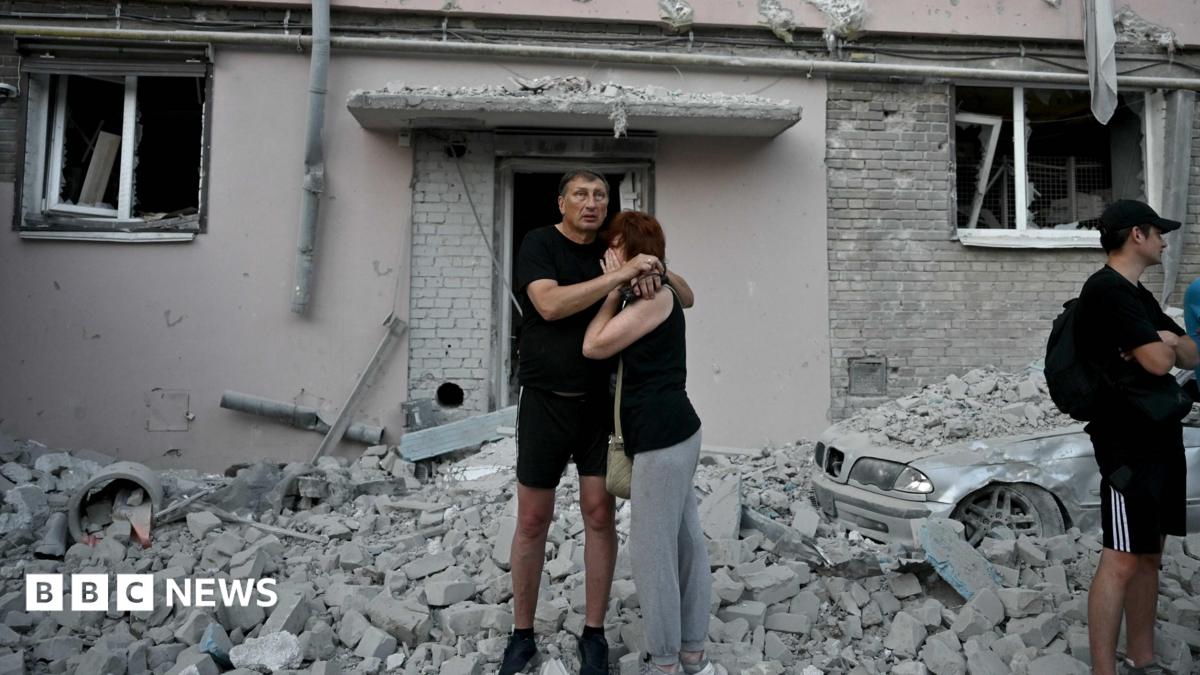
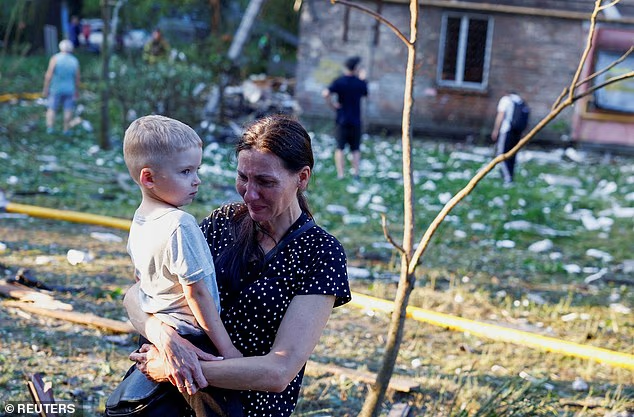
A woman cries holding a child near the site of an apartment building damaged during overnight Russian missile and drone strikes, amid Russia's attack on Ukraine, in Kyiv, Ukraine, July 2

Russian forces attacked the Ukrainian capital Kyiv on Thursday, killing at least 10 people and wounding more than 50, as drones and missiles struck residential buildings in what Russia said was a retaliation for recent attacks on its civil infrastructure.

Ukrainian President Volodymyr Zelensky had earlier warned of a possible overnight attack and said he was cutting short his visit to Dublin for the start of Ireland’s six-month term in the rotating presidency of the EU. 

Kyiv Mayor Vitali Klitschko, writing on Telegram, said 10 people were killed, while damage included six floors of an apartment building that had partially collapsed after a direct hit from a Russian projectile.

Reuters video footage showed emergency services working through the rubble of what used to be a nine-story building as the sun was rising over Kyiv and as fires flared up around the city.

Advertisement

Tymur Tkachenko, the head of the capital’s ​military administration, said 56 people, including two children, were injured and three dozen locations across the city had been damaged in the attacks.

‘The enemy has once again deliberately targeted residential neighborhoods and killed civilians. We have sustained extensive damage and a significant number of casualties, including children,’ he wrote on Telegram.

In an earlier post, Klitschko said the injured included paramedics and drivers at an ambulance station, and that some people were still trapped inside damaged residential buildings.

Pictures posted online showed a fire burning out of control at the top of a building on the central Shevchenko Boulevard, while elsewhere in the city, windows blew out and cars were destroyed.

Advertisement

A woman cries holding a child near the site of an apartment building damaged during overnight Russian missile and drone strikes, amid Russia’s attack on Ukraine, in Kyiv, Ukraine, July 2

Residents react near the site of an apartment building damaged during overnight Russian missile and drone strikes, amid Russia's attack on Ukraine, in Kyiv, Ukraine, July 2

Residents react near the site of an apartment building damaged during overnight Russian missile and drone strikes, amid Russia’s attack on Ukraine, in Kyiv, Ukraine, July 2

Smoke rises over the city following a Russian air attack on Kyiv, on July 2

Smoke rises over the city following a Russian air attack on Kyiv, on July 2

Advertisement

Multiple explosions were heard in Kyiv, a Reuters witness said, and authorities in the region surrounding the capital said on Telegram separately there were also casualties there. 

People crowded into underground stations carrying children, belongings, tents and pets as air raid alerts were issued for most of Ukraine’s territory overnight in Russia’s worst attack on the country since mid-June.

‘Do not delay decisions on air defense for Ukraine! This is our main request to our partners after Kyiv suffered a night of horror,’ Ukrainian Foreign Minister Andrii Sybiha said on X as he visited Japan, a Ukraine ally, on Thursday. 

Neighbouring Poland, a NATO and European Union member, briefly scrambled fighter jets on Thursday as a preventive measure before calling those back and saying no airspace violation was recorded. 

Advertisement

Finland also briefly issued a temporary aviation restriction zone in the eastern Gulf of Finland before lifting it later, its defense forces said on X.

Russia’s Defence Ministry, in a Telegram post, said its ‘massive attack’ using long-range, high-precision air-, land-, sea-launched weapons and drones hit military and energy facilities, as well as airports in Kyiv and other locations.

The ministry said it was a retaliation for Ukraine’s attacks on Russian civil infrastructure, without elaborating. 

Russia downed 327 drones overnight, the ministry said. This number includes drones shot down over Russian-occupied parts of Ukraine.

Advertisement
Rescuers extinguishing a fire in a residential building damaged following missile strikes on the Ukrainian capital of Kyiv, amid the Russian invasion in Ukraine, on July 2

Rescuers extinguishing a fire in a residential building damaged following missile strikes on the Ukrainian capital of Kyiv, amid the Russian invasion in Ukraine, on July 2

Residents stand next to a crater formed at a site during overnight Russian missile and drone strikes, amid Russia's attack on Ukraine, in Kyiv, Ukraine, July 2

Residents stand next to a crater formed at a site during overnight Russian missile and drone strikes, amid Russia’s attack on Ukraine, in Kyiv, Ukraine, July 2

Tymur Tkachenko, the head of the capital's ​military administration, said 56 people, including two children, were injured and three dozen locations across the city had been damaged

Tymur Tkachenko, the head of the capital’s ​military administration, said 56 people, including two children, were injured and three dozen locations across the city had been damaged

Zelensky has proposed talks with Russian President Vladimir Putin to end the more than four-year-old war that the Kremlin leader has rejected. 

Advertisement

Ukraine has recently intensified strikes deeper into the Russian territory, triggering a widespread fuel crisis in the world’s third-biggest oil producer and forcing it to import gasoline from as far away as India.

The governor of the remote Russian region of Novosibirsk, Andrey Travnikov, said on Telegram the fuel crisis was worsening for the area more than 1,860 miles east of Moscow, and re-fueling priority would be given to emergency services.

Elsewhere in Russia, one person was killed, four people wounded and an industrial facility damaged in a drone attack on the Nizhny Novgorod region, Governor Gleb Nikitin said on Thursday. 

The region is home to NORSI oil refinery, one of Russia’s largest.

Advertisement

Governor Alexander Drozdenko of Russia’s northwestern Leningrad region, Putin’s home and where large export and oil refining facilities are located, said on Telegram that Russian forces brought down seven drones on Thursday.

In the Russian Belgorod region bordering Ukraine, a man was killed and his wife injured after a drone hit their home, local authorities said separately on Telegram.

Reuters could not independently verify details of the casualties. Russia and Ukraine say they do not deliberately target civilians.

This is a breaking news story. More to follow.

Advertisement

Source link

Continue Reading

NewsBeat

Maternity care needs more than answers: it needs change

Published

on

Another statutory inquiry into maternity care would be a mistake – here’s why

The Ockenden Review into maternity and neonatal services at Nottingham University Hospitals NHS Trust was damning. It confirmed what families, staff and previous reviews have been saying for years: the failures in maternity care are serious, repeated and systemic.

The Nottingham review examined more than 2,500 family cases and engaged with more than 830 current and former staff. It found long-standing failures, including women and families not being listened to, poor responses when things went wrong and missed opportunities to act on concerns that were raised consistently by staff.

Within days, a second review by Baroness Amos – the National Maternity and Neonatal Investigation – widened the lens by reviewing care across 12 NHS trusts. It found consistent national patterns: staffing did not match demand, services were under pressure from rising complexity and capacity problems, leadership was lacking, responses to harm were often slow or defensive and inequalities affected women’s experiences and outcomes. Families affected by the Nottingham scandal are now calling for a statutory public inquiry into maternity and neonatal care across England, arguing that “safe care can only be consistently delivered when the full truth is known”. That call deserves to be taken seriously. Accountability cannot be treated as optional.

But a decision to hold another inquiry must take into account the fact that public inquiries do not, in themselves, deliver change. They make findings and recommendations to inform change made by others.

Advertisement

A statutory inquiry has powers to compel witnesses to give evidence. A non-statutory inquiry does not have these powers. However, it does not follow that statutory inquiries are inherently superior. Each type of inquiry has its own strengths. Statutory status alone does not guarantee greater learning, better implementation or safer care. Patients don’t necessarily benefit when healthcare staff are subjected to prolonged scrutiny through overlapping investigations and inquiries, litigation, regulation, media coverage and internal reviews over many years.

A study found that medical professionals changed their practice in response to fear of litigation, inquiries, complaints or professional regulation. Researchers call this “defensive practice”: when doctors, nurses or midwives make decisions partly to avoid blame or complaints, rather than simply because they believe those decisions are best for the patient.

In maternity care, that might mean ordering extra tests, asking senior colleagues to approve decisions the doctors, nurses and midwives would usually make themselves, recommending an intervention earlier than needed, or writing longer records because they fear being criticised later.

A midwife or doctor may spend more time recording why they made a decision than explaining that decision to a woman in labour. They may ask someone senior to take over, not because the situation has changed, but because they feel exposed. They may recommend the option that looks safest on paper, even when the woman’s circumstances are more complex.

Advertisement

Those actions are not automatically wrong. In some cases, they may be exactly what safe care requires. The problem arises when fear starts to shape clinical judgment.

An international literature review tells us serious failures must always be investigated. But investigations that drag on for years without leading to change can make staff more cautious and less confident, without making care safer. It can encourage staff to protect themselves rather than use their judgment confidently, communicate openly and focus on what women and babies need.

Amos supports this concern. Across the trusts reviewed, staff described burnout, stress and heavy workloads. The report says staff were working under intense scrutiny, fearful of making mistakes and operating in what they experienced as a blame culture. It also found that structural and systemic problems can make compassionate care harder to deliver. Staff wellbeing is therefore a patient safety issue.

Our own ongoing research, carried out with maternity and newborn care staff working under years of scrutiny by multiple bodies, found a similar pattern. Staff described losing confidence in their clinical judgment, doubting whether their employer would support them if something unavoidably went wrong, and seeing public trust in the service collapse. Experienced clinicians left, or considered leaving, the profession altogether, because the distance between delivering high standards of care and the care they were able to provide was too great. The impact on mental and physical health was significant, showing how poor staff wellbeing should be considered a patient safety issue.

Advertisement

The case for caution is stronger because the central problems are already extensively documented. Reviews into maternity failures at Morecambe Bay, Shrewsbury and Telford, East Kent and Nottingham have all identified recurring failures in listening, leadership, staffing, governance, safety culture and organisational learning.

Amos makes the implementation problem impossible to ignore. Its report found a maternity and neonatal system that is fragmented, overly complex and too slow to learn. It also examined why avoidable harm continues despite repeated reviews and recommendations.

The issue is no longer a lack of evidence about the main failures. Recommendations have not been translated into reliable change. The government has responded to Amos by announcing a Maternity and Neonatal Commissioner, a National Action Plan due in December 2026, new national maternity triage standards and additional investment in maternity and neonatal facilities. These steps will only improve care if they have authority, funding, transparency and clear accountability attached to them. Most importantly, a concerted effort to address the cultural issues that have created the conditions for poor psychological safety and impeded the delivery of compassionate care.

Advertisement

Families are entitled to ask why so many warnings were missed, ignored or minimised. But the government should not allow calls for another large statutory inquiry to defer changes that are already evidenced.

Statutory inquiries are slow and resource-intensive. The government’s response to the House of Lords Statutory Inquiries Committee noted that statutory inquiries completed in the previous five years took nearly five years on average, with insufficient transparency and accountability around the implementation of accepted recommendations.

Where people may have acted dishonestly, unlawfully or in breach of professional standards, that should be pursued through professional regulation, disciplinary processes, inquests (where deaths are involved) and, where the evidence warrants it, prosecutions.

Individual accountability should not delay organisational and cultural changes already recognised as urgent. The question is whether another statutory inquiry is an effective route to safer maternity and neonatal care, or whether the most urgent need is implementation with transparent accountability.

Advertisement

Acting on Ockenden and Amos’s recommendations will mean funding the workforce and infrastructure needed to make change real, measuring progress publicly, and giving services enough stability to rebuild trust.

Appropriate scrutiny should continue. But it should be designed to enable learning and delivery of safe, compassionate care.

Source link

Advertisement
Continue Reading

NewsBeat

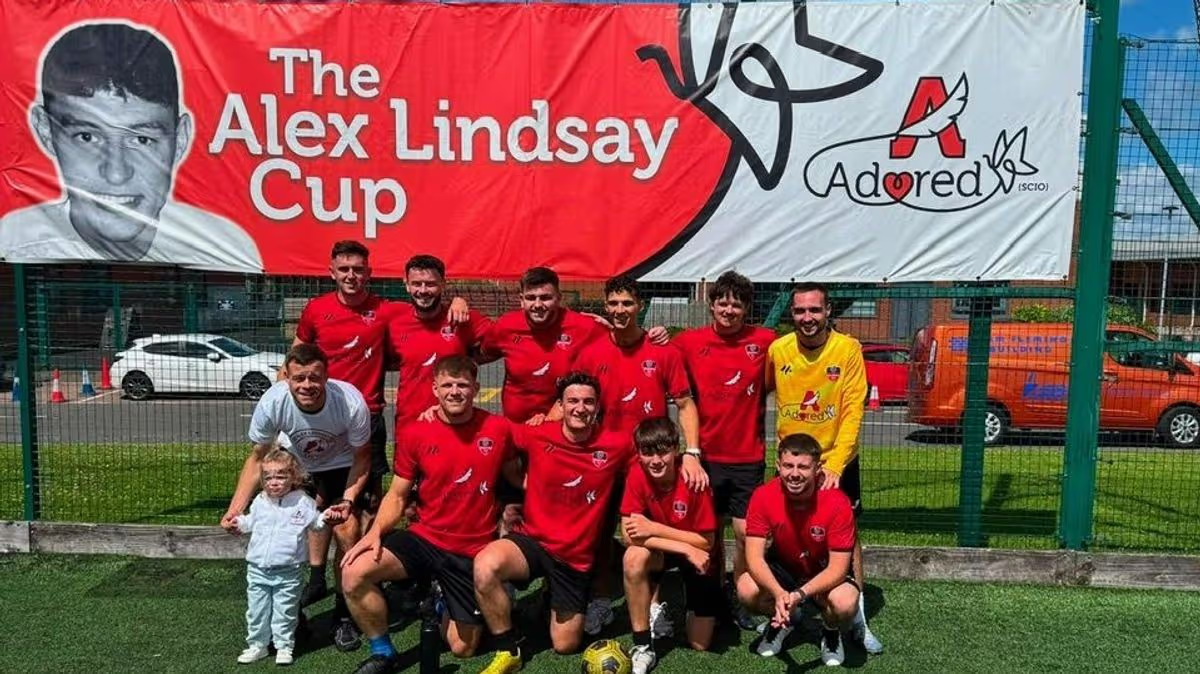
The annual Alex Lindsay Cup raises thousands for mental health charity

Published

on

Daily Record

A dozen teams turned out to honour the youngster in a knock-out tournament at Alex’s former school, Calderglen High.

The annual Alex Lindsay Cup pulled in an incredible £3500 at the weekend for a charity set up in memory of the much-loved 18-year-old.

Advertisement

Adored aims to raise vital awareness of mental ill-health in young men following the tragic death of the popular St Leonards teen in 2018.

Sunday’s event saw a dozen teams turning out to honour the youngster in a knock-out tournament at Alex’s former school, Calderglen High.

And Alex’s mum Jill said: “The weather in terms of the football players was probably perfect, because it wasn’t too hot and there was a bit of a wind.”

And she joked: “However for those of us with a stall and a gazebo up, the wind was not exactly ideal, there was a couple of moments where a couple of the gazebos went off to Oz, but it was all fine, it stayed dry. The important thing was to try and bring people out, and it went well.”

Advertisement

The Alex Lindsay Cup is held each year in memory of Alexander Iain Bonomy-Lindsay and raises funds for the family’s dedicated mental health charity Adored.

It has raised tens of thousands of pounds for mental health charities and remembers Motherwell FC fan Alex who tragically took his own life in July 2018.

As well as Adored being there on the day, grassroots mental health initiative Men with Issues was also present along with fitness, mindset and life coaching organisation No Limits Coaching, and Jill said it was potentially helpful for the crowds to link in with them, adding: “It was good for them to see that they were there, see that those agencies are out there.

“You just never know, one person noticing and thinking ‘Oh wait a wee minute, that might be useful for me’, that could be as simple as saving a life.”

Advertisement

The tournament was won for the second year in a row by The Other Team, who defeated Muirend in the final.

After the action on the pitch, everyone went along to a fund-raising after-party in the Village Inn.

Jill said: “We had less teams playing this year, we were down to 12 teams. I think the fact there was another football tournament going on at the same time and just other circumstances like the boys who have traditionally always played in the cup were generally people that Alex was friendly with and at school with, and these boys are now men of 28 years old, people’s lives move on, a lot of Alex’s friends have moved abroad and live away and all the rest of it.

Advertisement

“So I think what we need to do is try and bring fresh blood in, but it was very successful, the 12 teams played well, the runners-up were the team from Muirend, called ‘Muirend’ and the winners were the team called ‘The Other Team’, they won last year so that’s their second year winning.”

She added: “After the tournament we have our traditional after-party and it was down at the Village Inn, courtesy of Paul Jardine who gave us that venue for free, and Ross Martin, one of Alex’s friends who always does the live music, so he played his guitar and sang down at the Village Inn and that’s where we did the raffle draw.

“We had lots of good prizes, lots of local businesses like Ruby’s, Bond’s, Pergola, Once Upon a Table, Arigo all gave vouchers, lots of the barbers in the village gave vouchers.”

Advertisement

And looking forward to next year, Jill said: “I think one decision that we have made is that doing it up at the school is a good venue; we’ve tried different venues in East Kilbride but the school have never let us down, and it’s a good space for both the football and setting up any other vendors.

“And Mr Bell, one of the teachers from the school,he has been pivotal in all of the cups, that we’ve run. Every one, whether it’s been at Calderglen or not, he’s been there to help out and do whatever he can, he’s an absolute star.

“You get great teachers who go above and beyond, and he’s one of those people that go above and beyond, and I can’t thank him enough, his dedication to the tournament has been phenomenal.”

She continued: “I think what we’re going to try and do is get some younger teams involved, we’re going to start looking at the youth teams in East Kilbride to see if we could perhaps split the tournament and maybe have youth teams playing the morning and maybe eight teams have a mini-tournament, and then have another mini-tournament with the more mature players afterwards.

“But I think it’s really important that we keep the young people in East Kilbride involved in it, because really what the charity is doing is supporting young people in East Kilbride, so we want to try and link all of that together just so that more families, more young people in the community really begin to recognise Adored for the work they’re doing and recognise the link between the Alex Lindsay Cup and Adored, and the support for mental health within the community.”

And a special thank you went to event organiser Jack Smith, with Jill saying: “Jack was one of Alex’s closest friends and he was the person who set up the very first football tournament which was really a memorial tournament and what it’s turned out to be now is a supportive tournament for the charity which developed from it.

Advertisement

“Jack is the person who every year runs the tournament, he’s the one that seeks out all the football teams, he’s works tirelessly trying to make sure that it’s a really, really exciting event every year, making sure that the trophies are right, that the medals are right, organising all the prizes for the after-party as well, so it’s a massive thank you to Jack Smith because without his enthusiasm for the tournament it would probably have dwindled away and I know how dedicated he is in making sure it stays alive in Alex’s memory.”

And the Adored charity will be continuing its work in schools next term, with Jill saying: “We are excited to be working alongside South Lanarkshire Council in their new venture, their outreach venture, and I think what this is going to enable Adored to do is to help more people than if I was just accessing the schools myself.

“So I just feel that we’ll be able to broaden the horizon in terms of how many pupils we’ll be able to actually reach.”

*Don’t miss the latest headlines from around Lanarkshire. Sign up to our newsletters here.

Advertisement

And did you know Lanarkshire Live had its own app? Download yours for free here.

Source link

Continue Reading

NewsBeat

‘Two weeks after her death I got a call’: Thousands of Gaza patients still waiting for evacuation

Published

on

A woman with shoulder-length blonde hair talks into a microphone

The desperation of patients haunts Gaza’s hospitals – their exterior walls eaten away by gunfire and Israeli strikes, the health-care system inside them still unrepaired.

Eight months after the ceasefire deal instructed that “full aid” be sent into the Gaza Strip, aid workers say the continued lack of essential medicines and equipment has meant doctors are rationing or loaning each other essential life-saving drugs, or turning patients away from chemotherapy or dialysis appointments.

“The fact that the medical evacuation list is thousands long is a sign that people in Gaza don’t have access to what they should have – which Israel, as the occupying power under international humanitarian law, has an obligation to allow them access to,” said Pat Griffiths, spokesman for the International Committee of the Red Cross (ICRC) in Jerusalem.

Shortages, he said, run from basic consumables like gauze dressings and painkillers, all the way up to advanced medical equipment.

Advertisement

“There is no doubt in my mind that people in Gaza are dying because they can’t receive the care they need – and that there are preventable deaths happening because of the limits on what can be brought in, in terms of healthcare.”

Asked about the reports of critical shortages, Cogat said in a statement that 17,000 tons of medicines and medical aid had entered Gaza since the ceasefire, including wheelchairs, cancer medications, insulin pens, anaesthetics, X-ray machines, CT scanners, dialysis machines and medical consumables.

“Despite claims to the contrary,” it said, “Israel has approved every request for medicines submitted by international aid organisations.”

In response, one humanitarian official involved, speaking to me anonymously, said that Israeli authorities often used anecdotal examples to mask shortages of key medicines and equipment, and that aid supplies continued to be restricted.

Advertisement

“You don’t count medical aid in terms of trucks and pallets; that’s not a denominator we use,” said the WHO’s Reinhilde Van de Weerdt. “We talk about the needs patients have, and the needs that are met.”

“If medical supply is unrestricted, you don’t have these discussions about what is given versus what is needed,” she said. “We need certain buffer stock levels of medical supplies, [and] you can’t run a hospital hoping the generator doesn’t break down.”

Source link

Advertisement
Continue Reading

NewsBeat

People smuggler convicted in France now seeking asylum in UK, BBC discovers

Published

on

A woman with shoulder-length blonde hair talks into a microphone

Jamal’s case is not isolated. Law enforcement officers in Europe have told us they know of 15 people smugglers with convictions from courts in France, Germany and Belgium, who they believe are now living in the UK and claiming asylum under false names.

We learned about one man convicted in France, who is now living in Manchester selling used cars and thought to be still involved in people smuggling.

Another man, also with a French conviction, is based in Blackpool. He has claimed asylum under a false name and boasts on social media of being given leave to remain.

Since Brexit, the UK no longer has a data-sharing agreement with many countries in the EU, making it more difficult to check criminal and immigration records of asylum seekers, according to Lucy Morton of the Immigration Services Union.

Advertisement

“If we were able to share databases, even if just with our nearest neighbours, with Germany, with Belgium, with Holland and France, say – then, yes, we’d know that they had a conviction for people smuggling,” she said.

Asylum seekers are fingerprinted on arrival in the UK and checked against UK police databases, but these would not necessarily show a conviction from another country.

The Home Office told us: “All asylum claimants are subject to mandatory security checks to confirm their identity for the purpose of immigration, security and criminality checks.”

This point was also made last November, external by the Minister for Border Security, Alex Norris, who added that to protect the integrity of the checking processes, details about the checks “are not disclosed publicly”.

Advertisement

The Home Office went on to say that the UK has “a number of agreements with countries which enable the sharing of criminal record information”, and that immigration enforcement action is currently at its highest level in history, with arrests for illegal working up 83%.

Source link

Continue Reading

NewsBeat

Russia launches deadly large-scale missile strikes on Kyiv

Published

on

A woman with shoulder-length blonde hair talks into a microphone

Russia also hit military bases in central and eastern Ukraine, according to the Ministry of Defence, quoted in Russian media.

It claimed to have targeted Ukrainian defence and energy infrastructure in response to recent attacks on Russian power stations from Moscow to the Black Sea.

The attacks led to a rare concession by Russian President Vladimir Putin that his country was facing fuel shortages.

On Wednesday, Zelensky cut short his visit to Dublin after he said fresh intelligence had emerged suggesting that Moscow was planning to strike Ukraine.

Advertisement

“I urge our people to be especially careful, to protect themselves, their children, and, of course, their families,” he said.

He added that Russian President Vladimir Putin “has been preparing this massive strike against Ukraine for some time now”.

Poland has also activated fighter jets to protect its airspace, describing it as a “preventative” measure. There are no reports of attacks on Polish territory.

“These actions are of a preventive nature and are aimed at securing and protecting the airspace, especially in areas adjacent to the threatened regions,” Poland’s military wrote on X., external

Advertisement

Poland is a member of Nato, a signatory to the military alliance’s Article 5 provision that states “an armed attack against one Nato member shall be considered an attack against them all”.

Russian troops recently advanced into the city of Kostyantynivka, one of Ukraine’s last key bulwarks in the east. If Moscow secures the city, it would provide a gateway to the entire Donbas region.

Meanwhile, Ukrainian commanders say they have recaptured more territory this year than they have lost, disrupting Moscow’s crucial supply lines between the Russian border and occupied Crimea.

The war has otherwise stalled for months with each side’s troops largely entrenched in their positions.

Advertisement

Russia controls approximately one-fifth of Ukrainian territory, mostly seized in the first few months of its full-scale invasion in February, 2022.

Source link

Continue Reading

NewsBeat

Watch: People smuggler tracked down and confronted by BBC

Published

on

Sue Mitchell (L) holds microphone to Twana Jamal (R)

Convicted people smuggler Twana Jamal, once described as “the godfather” of the French migrant camps, is living and working in Leicestershire, and believed to be seeking asylum, a BBC investigation can reveal.

Jamal was given a five-year jail sentence in France in 2016. Following a tip-off this year, the BBC traced Jamal to Blaby in Leicestershire, where we witnessed him working illegally, driving a car without a licence and apparently using a false name.

We have also been told by law enforcement officials in mainland Europe that 15 other convicted people smugglers are now living in the UK under false names, raising serious concerns about whether existing border controls are effective in checking asylum seekers who have committed serious crimes overseas.

The Home Office told the BBC: “All asylum claimants are subject to mandatory security checks to confirm their identity for the purpose of immigration, security and criminality checks”, and that the UK has “a number of agreements with countries which enable the sharing of criminal record information”, adding that immigration enforcement action is currently at its highest level in history.

Advertisement

You can hear the full story now: Search for ‘To Catch a King’ on BBC Sounds

Source link

Continue Reading

NewsBeat

AP reporter recounts a month covering Ebola in Congo’s outbreak

Published

on

AP reporter recounts a month covering Ebola in Congo's outbreak

BUNIA, Congo (AP) — Mourners stood at a distance as a small coffin was lowered into the grave. Health workers wearing masks and gloves joined a priest who prayed.

A 6-month-old girl was the latest victim of the Ebola outbreak sweeping through eastern Congo. She was the third child in her orphanage to die.

After a month reporting from the outbreak’s epicenter with AP photographer Moses Sawasawa, this quiet scene has stayed with me the most.

From afar, the epidemic is often measured in numbers: over 1,300 confirmed cases, hundreds of deaths, tens of thousands of people who may have had contact with them.

Advertisement

The funeral is when we truly realized the gravity of the outbreak. Ebola does not distinguish between young and old, educated and uneducated, rich and the poor, civilians and health professionals.

And of course it’s not over. Experts say the peak of infections hasn’t been reached. There are no approved treatments for this type of Ebola, Bundibugyo, and the arrival of any vaccine is said to be months away.

Another death that stayed with us was that of a medical student a few months from graduation. She had been the hope of her family and a badly needed health professional in a remote region where outbreaks, like this one, can go undetected for weeks.

At her funeral, her mother was inconsolable.

Advertisement

Reporting on this outbreak means multiple dangers

It is hard to imagine a more challenging place for a deadly outbreak to unfold.

Every day of reporting began and ended with a careful process of protection and disinfection. Ebola is highly contagious and can be contracted via bodily fluids such as vomit, blood or semen. That meant putting on gloves, masks and hair nets in 80-degree Fahrenheit heat (26 Celsius) and 80% humidity.

Our driver’s vehicle, our microphones and other equipment had to be disinfected after entering outbreak-affected areas. The routine became second nature.

As we reported at struggling health centers, the sound of crying families followed us. The air was thick and humid, and people were slick with sweat. Health workers moved between crowded wards, washing their hands again and again.

Advertisement

Seeing the grief and lives cut short reminded me of covering the previous crisis in this region, the capture of Goma city, a humanitarian hub, last year by M23 rebels. Wounded babies, children and adults were rushed to hospitals to the sounds of weeping loved ones.

The Ebola outbreak is centered in neighboring Ituri province, scarred by years of such conflict. Armed groups control some areas and nearly a million people have been displaced. Economic hardships have now deepened.

Advertisement

We found some people trying to keep their hands clean with oatmeal and sand.

In the first three weeks after this outbreak was declared in mid-May, at least 520 security incidents, including attacks on health workers, impacted the work of responders, the World Health Organization said.

Attacks continue to be reported. We saw hospital beds left charred, the patients having fled.

Other people with confirmed or suspected Ebola infections have been abducted, disappearing into a world of poor mobile phone signal and bone-shaking unpaved roads.

Advertisement

In these surroundings, local people like Husein Twaibu are coordinating the community response.

Twaibu told me at least four health zones in Ituri, encompassing thousands of people, remain inaccessible because they are under rebel control. Unable to enter, response teams are relying in part on rebel leaders to pass on Ebola prevention messages and encourage participation in measures meant to slow the spread of the virus.

But that brings up another problem.

Misinformation and fear are the biggest challenges

I repeatedly heard the concern from doctors and aid workers: Many residents do not trust the Ebola response. Some believe the disease is not real.

Advertisement

In a region long traumatized by attacks and exploitation of rich natural resources, people are wary of outsiders. A lack of understanding of Ebola, whose symptoms like fever can be mistaken for others like malaria, means the strict prevention measures can be jarring.

There has been anger especially around burials, with people told not to do what comes naturally: bathe and prepare a loved one for the grave.

The distrust is one reason health officials don’t know the outbreak’s true size. Authorities still haven’t identified the first person who became ill.

Some residents avoid health centers. At times, community health workers who survived an Ebola infection find it difficult to persuade people to take the disease seriously.

Advertisement

One is Étienne Ezo, a nurse who contracted Ebola earlier this year.

He told me that many people ask why he survived and others didn’t.

“Some say that health workers have been paid off, which is why so many people are dying. Others claim that medical staff are actually killing people,” Ezo said. This is the kind of misinformation that he and others battle.

Journalists are not spared. At times, people accused us of being part of a conspiracy to invent the disease. Once, an angry crowd gathered outside a health center where we planned to report. Its director told us to come back another day.

Advertisement

And yet, life goes on

People are learning to adjust to the outbreak even as it grows.

At bars, face masks, temperature checks and socially distanced dancing are now part of a night out. Weddings have continued, with veils replacing face masks. At churches, attendants in nurse-like white gowns marked with red crosses hand out Communion wafers.

And during a World Cup match between Congo and Portugal, hundreds of fans embraced and cheered on the team at bars and roadside viewing areas, overjoyed at Congo’s first World Cup showing in over half a century.

For a few hours, for all of us, social distancing gave way to celebration.

Advertisement

___

Justin Kabumba is a journalist based in Goma, eastern Congo. He and Sawasawa are isolating after returning from Ituri.

___

For more on Africa and development: https://apnews.com/hub/africa-pulse

Advertisement

The Associated Press receives financial support for global health and development coverage in Africa from the Gates Foundation. The AP is solely responsible for all content. Find AP’s standards for working with philanthropies, a list of supporters and funded coverage areas at AP.org.

Source link

Advertisement
Continue Reading

NewsBeat

Mutant bed bugs surge in the UK after building resistance to insecticides | News UK

Published

on

Mutant bed bugs surge in the UK after building resistance to insecticides | News UK
New bedbug infestations – such as this one – are popping up all over the UK (Picture: James Rhoades)

Bedbug infestations are soaring in the UK as the critters are becoming more resistant to the chemicals used to kill them, Metro can reveal.

One London borough alone has had to tackle 40% more bedbug infestations this year, compared to the same period in 2025, data shows.

Pest controllers say they are being flooded with cases and that the parasites are now resistant to most major insecticides.

The cost-of-living crisis has also meant that more people are turning to ineffective DIY treatments that cause infestations to spread out of control.

Advertisement

Bedbugs are small insects that feed on human blood and typically shelter in mattresses, bed frames other cracks or crevices close to where people sleep.

Data gathered by Metro from across the pest industry has revealed a spike in bedbug infestations in 2026.

0207metro - bed bugs
Bedbugs are no longer being struck down by the crucial insecticides needed to eradicate them

One London borough – which we have agreed not to name – has already been called in to fight 155 infestations in the first half of this year.

That number is 40% higher than in first six months of 2024, and 50% larger than the same period in 2024.

The 52 infestations the council dealt with in June 2026 is their largest monthly total since before the Covid pandemic.

Advertisement

The bedbug spike is not isolated to London.

James Rhoades, whose company ThermoPest covers the whole of the UK, said he was dealing with double the number of calls out for bedbugs this year.

Chemical sprays using insecticide are one the most common methods used to kill bedbugs.

Latest London news

To get the latest news from the capital, visit Metro’s London news hub.

Advertisement

However there is growing evidence that the insects are becoming increasingly resistant to the toxic treatment.

Rhoades, who employs more offers high-heat treatment rather than chemicals, said his company has recorded a 30% increase in customers turning to them after a failed professional pest control treatment.

Advertisement
0207metro - bed bugs
James business has soared this year as more people come to him with unresolved infestations (Picture: James Rhoades)

He told Metro: ‘Year on year, we are seeing more cases where people are coming to us.

‘The data definitely suggests that there is a lot more resistance to chemicals than there ever has been.’

Rhoades said he had heard stories from other pest controllers of bedbugs being sprayed with chemicals and ‘just running around like nothing’s happened.’

World-renowned bedbug expert Chow-Yang Lee that insecticide resistance was ‘probably the single most important reason’ infestations have ‘increased dramatically over the year’.

He told Metro: ‘The insecticides used to kill bedbugs increasingly fail to do so, and insecticide resistance is now a leading cause of control failures.’

Advertisement

He said that the pyrethroid class of chemicals were particularly ineffective.

Prof Lee continued: ‘This pushes up infestation numbers in two ways. First, when a treatment doesn’t fully work, the infestation isn’t cleared.

‘Bedbugs survive, keep breeding, and can spread into other rooms or neighboring homes.

‘Second, and more insidiously, every time a population is hit with a chemical it can withstand, the few weakest bugs die, and the toughest survive to reproduce.

Advertisement

‘Repeat that over many treatments and you’re left with a population that’s almost entirely resistant.’

Some bedbug infestations, such as this one, can spiral out of control(Picture: Sarah Spratt)

While bedbug resistance has always been a problem, the challenge is that resistance ‘has deepened, broadened across chemical types and become much harder to overcome’.

London is at the heart of the global resurgence of bed bugs due to the capital’s housing density, international tourism and large rental market.

Since the return of worldwide travel after the Covid pandemic, some London boroughs have faced more than double the number of bedbug infestations, data provided to Metro shows.

One local authority had only 84 infestations in 2021, but as many as 441 in 2023.

Advertisement

Dr Matthew Davies, an advisor to the Greater London Pest Liaison Group, told Metro that this rise in infestations has continued into 2026.

The expert, who is Head of the Technical Department at Killgerm Chemicals blamed the problem in part on a drop in insecticides on the market, making it harder to tackle resistance.

Dr Davies also stressed that resistance is not a ‘doomsday scenario where there are no available options’.

Instead the key route to success in tackling bedbugs is an ‘integrated’ treatment solution where different strategies are used at once.

Advertisement

He explained that alongside chemicals ‘this includes steam treatments, heat treatments, and monitoring for problems with lures.’

Bedbugs in a Matress seam - close up photo; Shutterstock ID 2644077805; purchase_order: -; job: -; client: -; other:
Bedbugs like to hide in the seams of mattresses and other hard to reach crevices (Picture: Shutterstock / Mehes Daniel)

There are also fears that the cost of living crisis is pushing more families to swerve professional bed bug treatments.

Many are then turning to DIY methods which can often make the problem worse.

Prof Lee said people are ‘fall[ing] back on cheaper sprays, including shop-bought foggers and aerosols that barely work.

‘Every one of those partial treatments does two unhelpful things: it leaves enough insects alive to keep the infestation going, and it kills only the susceptible individuals, leaving the resistant ones to survive and breed.

Advertisement

‘In other words, over-relying on insecticides that no longer fully work is actively making the resistance problem worse.’

Get in touch with our news team by emailing us at webnews@metro.co.uk.

For more stories like this, check our news page.

Advertisement

Source link

Advertisement
Continue Reading

NewsBeat

Cadbury confirms it has shrunk Heroes and Roses tubs

Published

on

Cadbury confirms it has shrunk Heroes and Roses tubs

Heroes and Roses tubs, popular with buyers particularly at Christmas time, have been reduced in size after “careful consideration” from the business.

The move comes after Cadbury says it has experienced “significantly higher input costs across our supply chain”.

But it will be a blow to shoppers, as the price of the tubs remains the same.

Cadbury confirms it has shrunk Heroes and Roses tubs

Both Heroes and Roses tubs now weigh 475g, which is 14% less than last year’s 550g versions.

It will mean about seven fewer chocolates per tub, with options including Dairy Milk, Twirl and Fudge in Heroes and Hazel Whirl and Creamy Orange in Roses.

Advertisement

Despite the shrinkage, prices remain the same, which are typically about £4.50.

A spokesperson for Cadbury confirmed the change to Newsquest.

A statement reads: “We understand the economic pressures that consumers continue to face and raising prices is a last resort for our business.

“However, as a food producer, we are continuing to experience significantly higher input costs across our supply chain.

Advertisement

“This means that our products continue to be much more expensive to make and while we have absorbed these costs where possible, we still face considerable challenges.

“As a result, we made the carefully considered decision to reduce the weight of our Cadbury Heroes and Roses tubs (475g), so that we can continue to provide consumers with the brands they love, without compromising on the great taste and quality they expect.”

Tubs of Quality Street, Roses, Heroes, Celebrations and Lindt on a marble coffee table with Christmas tree in the backgroundCadbury’s Heroes and Roses tubs are among the popular options during festive periods (Image: Newsquest)

Reacting to the news, one shopper said: “Won’t buy anymore.

“Shrinkflation is unacceptable and trying to recycle those plastic tubs responsibly is a problem.”

Advertisement

Another, however, had a different view, saying: “Dont care will still [buy] them at Christmas!”

Cadbury to launch new twist on classic Dairy Milk bars

In other Cadbury news, the business has recently rolled out three new Dairy Milk bars designed for on-the-go snacking.

The Cadbury Dairy Milk Grab & Go bars will be available from July, offering consumers a resealable 56g option in three flavours: Dairy Milk, Dairy Milk Marvellous Creations, and Dairy Milk Chopped Fruit & Nut.

Intended for portability, the bars are designed to be portioned and enjoyed throughout the day rather than eaten all at once.

Advertisement

Phoebe Morris, junior brand manager at Cadbury’s parent company Mondelez International, said: “We’re seeing a clear shift in consumer behaviour, particularly among younger shoppers, towards more frequent, on-the-go snacking throughout the day.

“Shoppers are looking for options that fit seamlessly into their routines, creating a strong opportunity for formats that deliver convenience without compromising on taste.”

Phoebe added: “Our Grab & Go bars bring the trusted Cadbury Dairy Milk chunk taste into a format designed specifically for these high-frequency snacking moments.”


Recommended reading:

Advertisement

The Grab & Go range follows another recent launch from Cadbury aimed at younger consumers.

Earlier this month, the confectionery giant introduced the limited-edition Dairy Milk Strawberries & Creme Frappe bar, inspired by chilled summer drinks.

The bar combines classic Dairy Milk chocolate with a strawberries-and-cream-frappe-inspired filling and is designed to be eaten chilled.

What’s your favourite Cadbury bar? Tell us in the comments below.

Advertisement

Source link

Continue Reading

Trending

Copyright © 2025