

Iceland has voted to stay out of the European Union in a major blow to Brussels’ expansion plans.
With just a few referendum ballots left to be counted, the island’s 400,000 people rejected the chance to join the 27-strong bloc despite government claims it was a ‘now or never’ moment that would shield it from trade wars and Arctic rivalry.
The EU was said to have been keen to welcome a new ‘wealthy member’ and had even outlined a willingness to compromise on thorny issues to facilitate accession, including access to Iceland’s productive fishing waters.
Officials in Brussels viewed the island as a low-risk case which could have helped to ease scepticism toward EU enlargement and strategically strengthen the bloc when Arctic security is in focus.
But early this morning the country’s ‘No’ camp had accrued 52.5 per cent of the vote with just a few ballots left to be counted in one of the six voting districts.
The key points of contention ahead of the referendum centred around Iceland’s sovereignty and fishing, over which Reykjavik wanted to retain exclusive control.
The war in Ukraine and President Trump’s ambitions for neighbouring Greenland – a nation which he has confused for Iceland on multiple occasions – also featured in discussions.
Reform leader Nigel Farage was among those who congratulated Icelanders for voting ‘to keep their independence’.
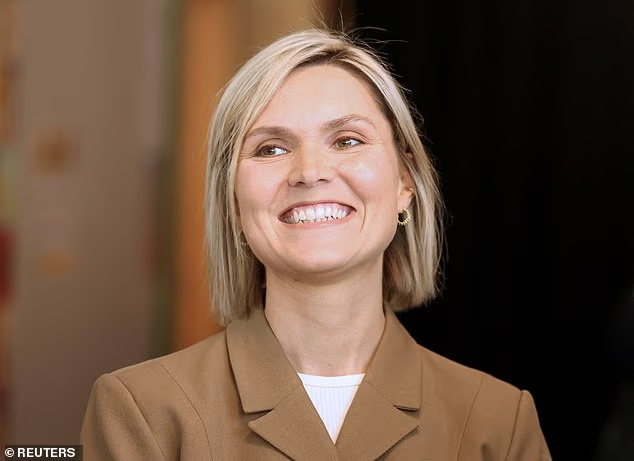
Iceland has voted to stay out of the European Union amid fears over its fishing industry and Donald Trump (Icelandic Prime Minister Kristrun Frostadottir is pictured)

Icelanders gathered across the country on Sunday morning as the results of the vote came in

Early this morning the country’s ‘No’ camp had accrued 52.5 per cent of the vote with just a few ballots left to be counted in one of the six voting districts

The key points of contention ahead of the referendum centred around Iceland’s sovereignty and fishing, over which Reykjavik wanted to retain exclusive control
As a member of the European Economic Area the country is already in the EU Single Market which allows freedom of movement.
‘Yes’ campaigners claimed joining Brussels could ease interest rates and offer the island greater security, while voters of the conflicting persuasion were keen to maintain Iceland’s independence.
However, barring a major last-minute turnaround, it appears as though the country will remain out of the EU.
Prime Minister Kristrun Frostadottir told voters in August that a ‘no’ would put all EU speculation aside.
Ms Frostadottir said ahead of a government press conference later on Sunday: ‘This is a great day. We’ve been waiting years to have a vote.’
Iceland first applied to join the EU in 2009 when a financial crisis hit its small, exposed economy. A Eurosceptic government later called a halt to talks in 2013.
The EU was however said to have been keen to add another wealthy member, and even appeared willing to compromise in a bid to facilitate Iceland’s accession.
The fisheries sector had been fiercely opposed to joining the bloc – 90 per cent of companies in the industry are against the idea – and the EU had tried to woo them with a conciliatory approach ahead of the vote.
‘Iceland’s unique specificities on fisheries and agriculture are well known. They would have to be carefully considered,’ EU Enlargement Commissioner Marta Kos had said.
‘I’m confident that, together with EU member states, we would find creative solutions.’
Only months ago Trump’s special envoy Jeff Landry touched down in Greenland for talks amid the US’s push to acquire the Arctic outpost.
Trump had, however, confused Iceland for Greenland on a number of occasions, sparking fears over the nation’s sovereignty.
Iceland has a 1951 Cold War-era defence treaty with the US, guaranteeing its security in return for access to military bases but some worry Trump’s unpredictability could threaten its survival.

President Donald Trump has confused Iceland for Greenland on more than one occasion
Brussels had hoped to be able to present Icelandic membership as an example of positive enlargement that could also make it more palatable for member states to agree to take in poorer countries like Montenegro.
It would also have enabled it to enlarge its presence in the strategic Arctic region, and perhaps helped change some minds in ultra-wealthy non-EU member Norway.
Yet the impending result means that Iceland will stay out of the EU until at least 2028, when the current Prime Minister’s mandate comes to an end.
The country of 400,000 is already a member of the European Economic Area and part of the free-movement Schengen zone, both of which will remain unchanged by the vote.
Though the referendum was non-binding, Ms Frostadottir’s coalition government – led by her pro-EU Social Democrats – promised to respect the result.
The government will hold a press conference on Sunday at 1pm to present its plans.


















































You must be logged in to post a comment Login