Connect with us
DAPA Banner
DAPA Coin
DAPA
COIN PAYMENT ASSET
PRIVACY · BLOCKDAG · HOMOMORPHIC ENCRYPTION · RUST
ElGamal Encrypted MINE DAPA
🚫 GENESIS SOLD OUT
DAPAPAY COMING

NewsBeat

If Europe wants to ‘go it alone’ on security, countries need to learn to sing from the same songsheet

Published

on

If Europe wants to ‘go it alone’ on security, countries need to learn to sing from the same songsheet

The G7 summit at Evian from June 15 to 17 is most revealing not for what was agreed, but for what was exposed about the state of play among Europeans, and their relationship with the US. For all the choreography and displays of unity, the summit was, in large part, theatre. It was an attempt to paper over what is becoming increasingly obvious: many of the most critical international issues are now decided without the EU. Brussels is now, at best, an informed bystander.

This was obvious when the US president, Donald Trump, signed a physical copy of his deal with Iran at a post-G7 dinner at the Palace of Versailles hosted by Emmanuel Macron. It was a diplomatic coup for France, rather than a plan hatched by the EU.

The G7 produced nine joint declarations and seemingly reaffirmed more than just the bare minimum of western unity that has been possible of late. The leaders’ statement on geopolitical issues included strong language on Ukraine. The G7 promised “to increase the delivery of air defence capacities, additional systems and interceptors, and long-range capabilities” and “to increase the pressure on the Russian war economy”.


À lire aussi :
Macron plays ‘Trump whisperer’ as the US president signs Iran ceasefire deal after a successful G7 summit

Advertisement

Yet, it fell short on concrete provisions and timelines. And it notably lacked the commitment to the “robust and legally binding security guarantees” and “the deployment of the Multinational Force – Ukraine” that France, Germany and the UK (the “E3”) had emphasised in their joint declaration with Ukraine’s president, Volodymyr Zelensky on June 7.

The E3 and Ukraine mini-summit showed European diplomatic coordination at its most effective. Évian, by contrast, showed how little of that coordination carries into the decisions that ultimately matter.

Europe’s struggle for relevance is also obvious in relation to Ukraine. The last meaningful – if hardly constructive – negotiations occurred in the so-called “Geneva track” in February. Mediated by Trump’s Witkoff-Kushner team (which was also involved in talks with Iran), this brought Russia and Ukraine together for talks.

But while Washington reported “meaningful progress”, Zelensky commented that “sensitive political matters … have not yet been sufficiently addressed” and called for European to be involved in the next round of talks. This has not happened.

Advertisement

Meanwhile, Europe’s own efforts also failed. Putin immediately rejected the call from E3 and Ukraine for direct talks. This was reinforced in a June 19 essay penned by Russia’s foreign minister, Sergey Lavrov, accusing Europe of complicity in the 2014 political crisis in Ukraine which ousted the pro-Russian president, Viktor Yanukovych, and precipitated the conflict. He added they had sabotaged any attempts at peace.

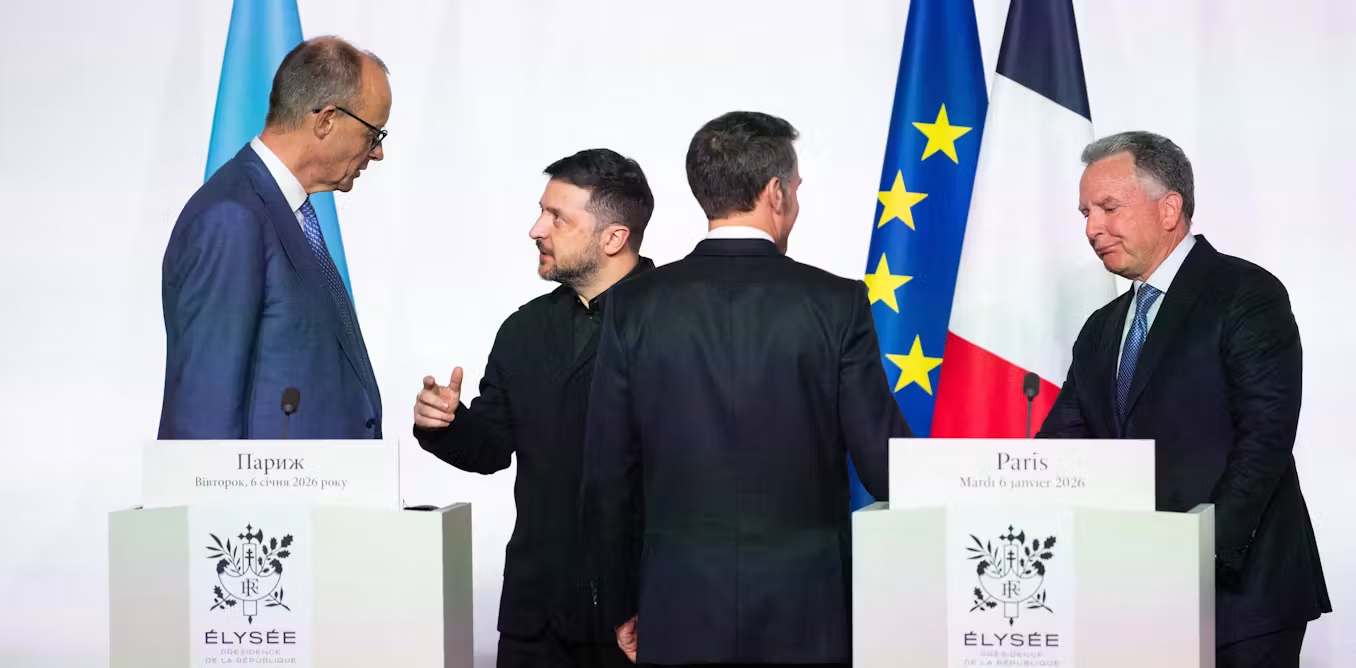
But the EU was already at loggerheads with itself. Earlier that day, EU leaders gathering for a summit in Brussels discovered that António Costa, the European Council president, had instructed his office to reach out to the Kremlin — without consulting member states — to lay the groundwork for potential peace negotiations with Russia over Ukraine. Their reaction ranged from surprise to outrage. Germany’s chancellor, Friedrich Merz, and Macron both publicly pushed back against Costa. Macron stated that “he [Costa] cannot represent [EU states] when security guarantees are at stake”.

The episode was damaging for reasons that go well beyond procedural embarrassment. The spectacle of European leaders publicly repudiating their own council president will have given Moscow the satisfaction of knowing that Europe still cannot speak with a single voice.

The European Commission president, Ursula von der Leyen, tried to bring the message under control. At her press conference after the EU leaders’ summit, she noted that “sooner or later Russia will need to come to the negotiating table, and when that comes we need a united European message to President Putin”. That ambition, however, contrasts sharply with the reality of the earlier Costa episode.

Advertisement

A unified approach

Diplomatic embarrassment is not the only issue when it comes to how quickly Europe will be able to close the persistent gap between ambition and reality.

On June 8, the German government formalised its withdrawal from the Future Combat Air System (FCAS), the €100 billion (£86 billion) joint fighter jet project launched in 2017 as the flagship expression of Franco-German defence ambition. FCAS also included engines, sensors and a digital intelligence network known as “combat cloud”.

One point of contention was reportedly the leadership role played by French aerospace giant Dassault. Germany wanted more of a leadership role and the partners are reported to have had divergent visions of the end product.

Germany’s aspiration to “lead or substantially shape” future European air combat systems may seem rational given the country’s financial muscle and engineering prowess. With more than €750 billion committed to rebuilding its armed forces by 2030, Germany’s instinct that this investment should produce proportionate industrial and strategic leadership is understandable. But when applied to European defence cooperation, it is counterproductive.

Advertisement
Vladmir Putin and Donald Trump in Alaska, August 2025: the aggression of one and unreliability of the other are encouraging European nations to make their own securoity arrangements.
EPA/Sergey Bobylev/Sputnik/Kremlin pool

While European states, including Germany, have repeatedly stressed the need for collective action on defence, there is a repeated fallback on national initiatives. It’s hard to escape the conclusion that Europe continues to struggle to effectively coordinate efforts.

In a development that neatly illustrates this point, on June 20 the UK unveiled three prototype long-range strike missiles built without any US-manufactured components. The product of an 18-month programme known as Project Brakestop, the explicit purpose of developing this capability is to remove Washington’s ability to veto their deployment in Ukraine.

On the positive side, the UK’s ability to pull this off is commendable. It encapsulates the transformation in European thinking about the transatlantic relationship under Trump – and the capability to follow through on this.

But as an act of strengthening European strategic sovereignty, it falls short. It is British rather than European.

Advertisement

Europe’s ambition to rise to the simultaneous challenges of Trump’s transactionalism and Putin’s adventurism has been stated loudly and clearly on more than one occasion over the past 18 months or so. This ambition is most commonly expressed in the quest for strategic autonomy or “going it alone”. But it is not matched with an ability to act coherently.


Source link

Advertisement
Continue Reading
Click to comment

You must be logged in to post a comment Login

Leave a Reply

NewsBeat

Boy, 17, dies and three seriously injured in horror Eastbourne crash

Published

on

Daily Mirror

The teenager tragically died in a two-car crash near Eastbourne, that saw three others seriously injured, as police are appealing for witnesses of the collision

A 17-year-old has died in a horror two-car crash near Eastbourne, with three others seriously injured.

Advertisement

The boy died after the collision took place on Friday evening, police say.

The car, in which the teenager was a passenger, crashed with another car car near Shooters Bottom car park, by Beachy Head, at around 9.30pm on June 26.

The collision involved a blue VW Golf and a white VW Polo.

Two other men in the car, a 19-year-old from Polegate and a 21-year-old from Hellingly, were also seriously injured.

Advertisement

The 21-year-old driver of the second car was also seriously injured.

The police are appealing for witnesses.

Detective Sergeant Ian Foxton, from Sussex Police’s serious collision investigation unit, said: “This is a tragic incident and are thoughts are with those involved and their families.

“We are aware there were a number of people in the area at the time of the collision and we would ask anyone who hasn’t spoken to us or has any video or dashcam footage to get in touch. Please email collision.appeal@sussex.police.uk, quoting Operation Nashville.”

Advertisement

Source link

Continue Reading

NewsBeat

Rylan Clark misses Radio 2 show but blames ‘everyone but himself’ in cheeky post

Published

on

Daily Mirror

Rylan Clark, presenter on Radio 2, has issued a cheeky response as to why he was not on his weekly radio show and it includes him blaming ‘everyone but himself’

Rylan Clark missed his Radio 2 show yesterday but in a cheeky post he explained why.

Advertisement

Rylan, 37, has been presenting the radio station’s Saturday afternoon slot since 2019 but yesterday Rylan On Saturday, which airs weekly on BBC Radio 2 from 3pm to 6pm, was presented by Mark Goodier who had to step in last minute to cover for Rylan.

Taking to his Instagram story Rylan said: “Soz about today’s show. I blame everyone but myself. Genuinely had it all sussed out and then flights all cancelled. Thanks Mark for stepping in you legend. Gonna have a rosé and think of you all.”

It comes after the presenter complained about the fact that his weekend show still hasn’t received any awards back in May.

Advertisement

Rylan aimed a cheeky swipe at The ARIAS (The Audio and Radio Industry Awards) for failing to nominate him, saying: “Always snubbed at The ARIAS even though I host the thing. It kills me, I’m the host of it and I can’t even get a nomination!”

Last week Rylan was asked if he regretted telling his husband he had cheated on him as he addressed it for the first time in a new interview. Rylan revealed his infidelity to his husband, Dan Neal, which caused the downfall of his six-year marriage back in 2021.

And now on The Assembly one audience member asked him: “When you told your husband you cheated on him, he divorced you. Is honesty always the best policy?”

Stunned, he replied: “Yeah, I think it is. I’m okay admitting I’m in the wrong, because actually I don’t deal well with guilt, and I don’t deal well with secrets. It made me so ill, like so ill. It sounds a terrible thing to say, but I’m glad it happened.”

Advertisement

Like this story? For more of the latest showbiz news and gossip, follow Mirror Celebs on TikTok, Snapchat,Instagram, Twitter,Facebook,YouTube andThreads.

Source link

Advertisement
Continue Reading

NewsBeat

Steve Clarke steps down from Scotland role after World Cup exit is confirmed

Published

on

Steve Clarke steps down from Scotland role after World Cup exit is confirmed

The Scots, backed in the USA by tens of thousands of Tartan Army, then suffered a 1-0 defeat by AFCON champions Morocco at the same venue after losing a goal in 70 seconds before a sobering and, in parts, self-inflicted loss to five-times winners of the competition, Brazil, in Miami.

Source link

Continue Reading

NewsBeat

Cambridgeshire’s top police officer slams ‘truly disgraceful’ WhatsApp culture

Published

on

Cambridgeshire Live

A dozen officers have been investigated over their conduct arising from a ‘toxic’ culture created by Paul Street

Cambridgeshire’s most senior police officer has slammed a group of cops over “truly disgraceful” conduct that involved a toxic WhatsApp culture. Ex-police sergeant Paul Street, 41, encouraged his team to bully a teenage detainee and asked a colleague to send him a sex video of a female suspect.

Advertisement

The offences were committed while Street was working at Cambridgeshire Constabulary, leading a team at Cambourne Police Station which dealt with county lines drug supply and organised crime. Street, of Huntingdon, was convicted of two charges of misconduct in a public office after a trial at the Old Bailey.

The trial was told 12 other officers had been investigated over their conduct arising from the ‘toxic’ culture Street had created. PC Josh Williams, 38, from Huntingdon, pleaded guilty to misconduct in public office.

Of 11 others who were investigated, two resigned, one was dismissed for gross misconduct, one received a final warning, two received written warnings, and five others were dealt with for low level performance issues.

Chief Constable Simon Megicks said: “The behaviour of these former officers was truly disgraceful and does not reflect the high standards we expect of our police officers. Their actions will understandably undermine the trust and confidence of our community – they did not reflect the values we hold as an organisation, nor did they treat their colleagues or members of the public with the respect and integrity they deserve.”

Advertisement

Mr Megicks said Street “thought he was beyond reproach and encouraged his colleagues to feel the same”. He praised those who “stand up for what is right, especially highlighting the inappropriate behaviour of someone in a higher rank to them – it is the ethical thing to do, even if it is difficult”.

He continued: “I want to reassure the community of Cambridgeshire that both criminal behaviour, and not upholding policing standards by our officers and staff simply will not be condoned. Allegations against any of our officers or staff are always subject to a thorough investigation, either by our professional standards department or by the IOPC, to ensure that those who do not meet the high standards expected of them, in order to maintain public trust and confidence, are dealt with robustly.

“We recognise the impact the behaviour of the officers in this case will have both on the people of Cambridgeshire and our own colleagues, however, I would like to reassure everyone that the vast majority of our officers and staff come to work each day to protect the public and do so with honesty and integrity.”

Jurors cleared Street of assaulting a drug dealer during an arrest occasioning actual bodily harm, and perverting the course of justice afterwards. He appeared on BBC show Britain’s Teenage Drug Runners in 2017, and in 2019 was on Channel 4’s Famous And Fighting Crime documentary.

Advertisement

Officers within the anti-corruption squad uncovered Street’s two WhatsApp groups in 2021 after a new police officer reported him. The court heard the probes focused on two WhatsApp groups created by Street, one including 17 colleagues and a second for his “inner circle”.

Source link

Continue Reading

NewsBeat

Who will England play next in World Cup? Potential last-32 opponents and route to final revealed

Published

on

Who will England play next in World Cup? Potential last-32 opponents and route to final revealed

England are through to the last-32 of the 2026 World Cup after securing top spot in Group L – and will likely face either Senegal or DR Congo in the knockout round.

After a first half of frustration against Panama in New Jersey, second-half goals from Jude Bellingham and Harry Kane secured England’s second win of the tournament with a 2-0 victory.

It means Thomas Tuchel’s side will move on to Atlanta for their next match, as their route to the final became clear on Saturday night.

See below for details of England’s knockout route.

Advertisement

When will England play next?

After topping Group L, England will face a best-ranked third-place team on Wednesday, 1 July at 5pm (BST) in Atlanta.

Who will England face in the round of 32?

England’s win, alongside Croatia beating Ghana, confirmed top spot in Group L.

Advertisement

They will face the third-place team from one of Group I/J/K in the round of 32. As things stand, these are the teams that could be in the mix to face the Three Lions:

  • Group I: Senegal
  • Group K: DR Congo

It is currently Senegal, but a win for DR Congo against Uzbekistan on Saturday night would see them play the Group L winners.

What is England’s route to the final?

In the last-16, England could face Group A winners Mexico (or Ecuador) in the high-altitude cauldron of the Estadio Azteca on the evening of Sunday 5 July at 1am (BST).

If they overcame that serious test of resolve, Group C winners Brazil could be their quarter-final opponent on Saturday, 11 July.

Advertisement

Argentina, following a fine start with Lionel Messi’s five goals, may then be their potential semi-final opposition on Wednesday, 15 July. France would be the likely opponents in the final in New Jersey on Sunday, 19 July.

Source link

Advertisement
Continue Reading

NewsBeat

Photos of the scars of war among survivors in Sudan

Published

on

Photos of the scars of war among survivors in Sudan

KHARTOUM, Sudan (AP) — Three years of war have devastated much of Sudan. The impact has been pressed into the skin of survivors, and their memories.

Thousands of people are dead. Millions are displaced. Associated Press journalists spent more than a week in and around the capital after the army retook Khartoum last year. It continues to fight elsewhere against the paramilitary Rapid Support Forces.

Here are some of the war’s survivors and their stories. A member of the military media accompanied the AP during the visit, including during interviews. The AP retains full editorial control of its content.

Soccer dreams shattered

When I saw that my leg was amputated, I knew that this is my fate.”

– Omer al-Toum

Advertisement

Omer al-Toum had dreamed of playing for Sudan’s national soccer team. But everything changed in October, when an unexploded weapon went off in his house as he tried to use it to loosen a nail. He lost part of his right leg and left arm. His remaining leg was shattered.

Calm and good-natured, the 33-year-old swoons these days over his 8-month old daughter, trying to stay positive.

“When I knew that my leg had been amputated, my family expected more of a reaction from me but I didn’t show them how affected I was,” he said.

Now al-Toum can’t bathe or get out of bed alone, and some doorways in the house aren’t wide enough for his wheelchair. He wants prosthetics but must travel abroad for good ones.

Advertisement

He’s found solace in coaching soccer, and tells young players to stay in school to keep other options alive.

“As long as you are still breathing, you are still capable of doing many things. And when God takes something away from you, he will surely compensate you with other things,” he said.

A sister’s death

I used to serve people … Now I feel like I am a burden.”

– Tariq Abuzeid

Advertisement

My world has darkened … What did they do to deserve this? They are children.”

– Omar Bakar, father of 16-year-old Noon Madani

Advertisement

Noon Madani didn’t want to leave the house that day in August nearly three years ago, but her older sister insisted. Paramilitary forces controlled her neighborhood outside Khartoum, but an overdue bill needed to be paid.

On the way home, a missile killed her 18-year-old sister and crushed the 16-year-old Madani’s legs.

Soft-spoken in her wheelchair, her legs in casts, she recalled looking at missile fragments in her sister’s head as she lay beside her, unable to move.

Advertisement

“You can’t imagine when someone suddenly tells you that your daughters were hit by an artillery shell. You enter a phase of breakdown,” said their father, Omer Bakar.

Madani remained in a hospital for six months for surgeries, battling infections and sometimes waiting for a doctor to be found after others fled.

Advertisement

Doctors say she should be able to walk again. Her younger brothers wheel her to school every day. She studies science and dreams of becoming a doctor.

“We are trying to forget the war,” her father said, “the nightmare we finally woke up from.”

8 years old

When her house was struck in February 2025, Fatma Ageb’s husband was asleep. Her older daughters had just discussed what to get their baby sister for her birthday. That was the last thing the 38-year-old remembers of that day.

The shelling killed her husband and their older daughters, 10 and 12. It pierced her body with shrapnel and badly injured their 8-year-old.

Advertisement

“If it wasn’t for Zeinab I wouldn’t want to live. She’s always calling for her sisters and father,” Ageb said, wiping tears from her cheeks.

The attack scarred her daughter’s face and she lost her right eye. She wears a glass one in its place.

Sitting beside her mother at a hospital and wearing a necklace with a character from the movie “Frozen,” Zeinab shyly held up a drawing she made and winced in pain while a doctor attended her wounds.

Friends and relatives pooled money for the girl’s operations but she needs more, and her mother doesn’t know where she’ll find the money.

Advertisement

While she tries to be strong for her daughter, Zeinab’s scars are a reminder of what they’ve lost.

A volunteer shaken

Tariq Abuzeid had spent years helping others, raising money to run soup kitchens out of his house and distributing medicine to the sick. When the war came to Khartoum, the construction worker kept assisting people.

But in December 2023, he was caught in intense shelling after distributing food. He lost his right leg.

Surrounded by family, the 52-year-old now tries to be stoic, yet breaks down when he thinks about how circumstances have changed.

Advertisement

“I used to serve people. … Now I feel like I am a burden,” he said.

The attack caused massive bleeding, which he said compromised his immune system. He takes dozens of pills a day but is still in pain. He struggles to find a good prosthetic and a wheelchair, not easy in Khartoum.

And yet his volunteer work continues. Large metal bowls were stacked in his yard as he prepared to serve others their next meal.

Fleeing sexual assault

The scars of war are inside my heart, not just on the outside.”

– Woman who endured beatings and sexual assault for months by paramilitary forces

Advertisement

By July the hunger had become too much to bear, so the 50-year-old woman fled the besieged town of Dilling in South Kordofan with her two daughters. But she says they were abducted by the paramilitary RSF.

Hands bound, faces covered, they said they were driven for hours to a makeshift base in the desert with more than a dozen other women. The woman said she was gang-raped there until she bled, and was beaten regularly for months.

The AP does not name people who have been sexually assaulted. The United Nations has called sexual violence one of the Sudan war’s “defining features.”

Each night, the woman would cringe hearing fighters’ footsteps approach the room where they were held. The men would point to the woman they wanted and take her away, she said.

Advertisement

When they came for her daughters, 25 and 20, she told them to take her instead.

One night when the fighters were out, she fled with her daughters into the desert. Terrified and weak, they walked for days before finding help in another town.

The RSF did not respond to request for comment.

Now they are in a center for women in Khartoum. Crying, she said a doctor told her the injuries from sexual assaults were so bad that her uterus should be removed.

Advertisement

___

For more on Africa and development: https://apnews.com/hub/africa-pulse

The Associated Press receives financial support for global health and development coverage in Africa from the Gates Foundation. The AP is solely responsible for all content. Find AP’s standards for working with philanthropies, a list of supporters and funded coverage areas at AP.org.

Advertisement

Source link

Continue Reading

NewsBeat

States look to drop prescription costs by reining in middlemen

Published

on

States look to drop prescription costs by reining in middlemen

TOPEKA, Kan. (AP) — As consumers worry about medication costs, states are trying to lower drug prices by reining in big companies that oversee prescription coverage for health insurers.

Some of those companies, called pharmacy benefit managers, also own pharmacies, and one of them, CVS, has spent millions of dollars fighting the regulations.

Affordability is a key issue ahead of this year’s midterm elections. Legislators in at least a dozen states passed laws this year to limit compensation to the companies, set minimum payments from the companies to pharmacists and require the companies to disclose more information to their clients, states and the public.

A Tennessee law will bar pharmacy benefit managers from operating retail pharmacies as of July 1, 2028, though CVS Health Corp. has filed a federal lawsuit to avoid having to close its 136 pharmacies there.

Advertisement

About 6 in 10 U.S. adults said in a poll conducted earlier this year by healthcare research nonprofit KFF that they were at least somewhat worried about being able to afford their prescriptions. About 4 in 10 said costs had led them not to take medications as prescribed within the previous year, either by taking less than the prescribed dose, using over-the-counter substitutes or not filling prescriptions.

Dozens of proposals emerge across the US

Pharmacy benefit managers, particularly CVS and two other large companies, handle most U.S. prescriptions.

Lawmakers in at least 26 states introduced more than 120 bills this year on PBMs, according to an Associated Press search using the bill-tracking software Plural, with about a quarter of the bills clearing at least one chamber.

The companies manage pharmacy claims for health insurers and negotiate with manufacturers over drug prices and what medications will be covered. Critics concede that the size of the top companies gives them leverage that health plans wouldn’t have on their own.

Advertisement

The benefit managers argue that they’re the only player in the drug supply chain created to help push drug costs down and they claim credit for an increased used of less-expensive generic drugs, now 90% of U.S. prescriptions.

“If PBMs already didn’t exist, you’d need to invent one,” said Prem Shah, president of the CVS Health group overseeing its pharmacy and PBM operations, in a recent interview. “Blaming PBMs for high drug prices is like blaming umbrellas for the rain.”

CVS fights restrictions in Tennessee

Drug companies, PBMs and their allies have spent at least $24 million on opposing broadcast and digital advertising since the start of 2025 to influence public opinion, according to the ad-tracking firm AdImpact. CVS spent $4 million this year on ads opposing Tennessee’s new law.

CVS sued Arkansas last year after it enacted similar legislation, and a federal judge blocked its law. CVS also settled three lawsuits in which Louisiana accused it of unfair trade and deceptive practices in lobbying against legislation there last year, agreeing to pay $45 million without acknowledging wrongdoing.

Advertisement

The CVS lawsuit in Tennessee alleges that the company, which operates 9,000 pharmacies nationwide, is facing “naked protectionism” from lawmakers who operate independent pharmacies — including the law’s main sponsor, state Sen. Bobby Harshbarger and co-sponsor Sen. Shane Reeves.

Independent pharmacies say they’re being squeezed

In Knoxville, Seth White, who manages a CVS pharmacy, will have to find a new job if the Tennessee law stands, and he’s also worried about hundreds of its customers having to go elsewhere for their medications.

Advertisement

Some 900 miles (1,400 kilometers) away in Coldwater, Kansas, Lisa Gales is on the opposite side of the debate. She and her husband operate the Main Street Pharmacy, and she said they rely heavily on sales of non-pharmacy items to offset low reimbursements from pharmacy benefit managers.

Gales calculates she lost money on 86% of the prescriptions she filled last year. A new Kansas law will require PBMs to pay a $10.50 dispensing fee per prescription. Gales called it a “great win,” even though, “It’s still way under what it’s costing us.”

A new Louisiana law imposes an $11.81 dispensing fee. Another says PBMs must operate for the benefit of their health-insurer clients and people enrolled in health plans.

Critics deride each mandatory dispensing fee as an extra “pill tax” that will drive up consumers’ costs. Backers dispute that, saying the laws also limit what PBMs charge health plans for the cost of medications themselves — so that it’s often well below wholesale prices.

Advertisement

Pharmacy benefit managers push drugmakers to give big discounts on those wholesale prices but face criticism for keeping any portion of them. Some states now require PBMs to pass along all discounts.

Patients are watching the debate

It all worries consumers, particularly in small towns, who fear it could become harder to get their medications if PBMs squeeze independent pharmacies on reimbursements to the point of endangering their businesses.

In southeastern Kansas, Faith Sanders, a 79-year-old retired nursing home administrator, said the pharmacy in her hometown of Cedar Vale is important because without it people would have to drive 35 miles (56 kilometers) “to go out of town to get anything.”

For her many elderly neighbors, she said, “We get to the point where it’s hard for us to get out of town.”

Advertisement

Meanwhile, even some PBM critics question whether states can effectively regulate them. In Tennessee, state Rep. Robert Stevens, a Nashville-area Republican, told colleagues during a debate that cracking down on PBMs “needs to be done by Congress and not by us.”

Congress did pass new PBM regulations in February. One law will prevent PBMs from keeping any rebates they’ve negotiated on drug prices for health plans that supplement federal Medicare coverage for Americans over 64.

___

This story has been updated to correct the name of CVS executive Prem Shah, not Prem Shaw.

Advertisement

Source link

Advertisement
Continue Reading

NewsBeat

Every confirmed World Cup 2026 last-32 fixture

Published

on

Every confirmed World Cup 2026 last-32 fixture

The World Cup group games are drawing to a close as the knockout stages draw near.

World champions Argentina, spearheaded by Lionel Messi, and five-time winners Brazil have booked their spot, along with all three co-hosts USA, Mexico and Canada.

France and Norway have joined, before England got the job done against Panama in their third group game.

Source link

Continue Reading

NewsBeat

A small plane crashes into a Beijing high-rise, killing the pilot and injuring 13

Published

on

Beijing's tallest tower is damaged after small airplane reportedly crashed into it

BEIJING (AP) — Chinese authorities on Saturday said a small plane that crashed into a building in Beijing the day before had killed the pilot and injured 13 others.

The authorities of the Chaoyang district, a vibrant business area, said a two-seat light sport aircraft collided with a high-rise building near the East Third Ring Road at 5:55 p.m. on Friday and caused the casualties.

The short statement on WeChat did not identify the building or the pilot, who the authorities said was the only person on the craft.

The global flight-tracking service provider Flightradar24 on Friday said the plane crashed into the CITIC Tower, also known as China Zun, which rises more than 1,700 feet (528 meters), just east of a major ring road in a cluster of skyscrapers.

Advertisement

The 108-story CITIC tower, shaped like an ancient Chinese wine vessel, is one of the most recognizable skyscrapers in Beijing and is the tallest building in the city.

Flightradar24 posted on social media the path of the plane, a Sunward SA 60L Aurora, which took off from an airport about 50 kilometers (30 miles) east of Beijing. It headed westward and ended just east of the East Third Ring Road.

Associated Press photos showed on Saturday apparent marks of the crash on the glass facade on one side of the CITIC Tower. A hole there had been covered up.

It was not immediately known what caused the crash in a city with strict airspace controls, including a recent ban on drones. An investigation is underway into the situation, the authorities said.

It was also unclear whether the injured were in the building or were hit by debris, but the statement said they were receiving treatment.

Advertisement

The CITIC tower is just a roughly 20-minute drive from Zhongnanhai, a former imperial garden that now serves as headquarters of China’s top leadership, and a 15-minute drive from the Forbidden City, a popular tourist attraction.

Social media posts about the crash were scrubbed from China’s walled-off internet on Friday, though footage has made its way outside of China’s firewall and is circulating on overseas sites such as X.com. A report by financial news platform Caixin about the crash’s casualties soon became inaccessible on Saturday. Chinese authorities consider such incidents to be a sensitive matter.

Advertisement

Images and videos shared on social media appeared to show debris from a small aircraft near the skyscraper. While the images were consistent with the location, it was not possible to independently confirm their authenticity. One image of the wreckage shows a partial registration number of “B-12.” The full registration number of the aircraft is B-12PP.

Advertisement

According to Flightradar24, the aircraft was operated by Shuangyue General Aviation, an apparent reference to Dongshi Shuangyue (Beijing) General Aviation, whose website was not accessible on Saturday. The firm provides services ranging from private pilot training to aerial sightseeing tours, said an online platform citing official data.

SA 60L is a product of Starair Aircraft, based in China’s central Hunan province. According to Starair’s website, the single-engine aircraft accounts for more than 70% of China’s light sports aircraft market and has been exported to Australia and the United States.

Its maximum cruise speed is 220 kilometers (137 miles) per hour and its maximum takeoff weight is 600 kilograms (1,322 pounds), the website said.

Advertisement

Source link

Continue Reading

NewsBeat

Taylor Swift and Travis Kelce’s wedding: What we know

Published

on

Taylor Swift and Travis Kelce's wedding: What we know

Are Taylor Swift and Travis Kelce really getting married at Madison Square Garden?

Frenzied speculation surrounding the superstar singer and football player’s upcoming wedding has spiked over the past few days as reports swirl that the two are getting married the first week in July at one of New York’s iconic landmarks.

Yet nearly a year after Kelce and Swift announced their engagement with the caption “Your English teacher and your gym teacher are getting married,” they have disclosed little about their plans.

Here’s what we know and don’t know.

Advertisement

The wedding date is unconfirmed, but reports say early July

Nothing has been publicly confirmed by the couple, despite The Associated Press’ multiple requests to Swift’s representative for comment.

Citing an entertainment industry executive and another person with knowledge of the matter, The New York Times reported that the couple were planning a gathering of 100 people at Madison Square Garden — an arena that seats up to 19,500 people — on July 2 followed by a second event at the arena for about 1,000 guests on July 3.

The Associated Press has been unable to independently confirm those details, but there are no public events planned at the Garden from June 29 until a Bon Jovi concert on July 7.

Public records show that the city issued a permit for loading and unloading theatrical materials at the arena from June 29 to July 4. Winick Productions, a company that has produced red carpet events for the Grammy and Tony award shows and movie premieres, also applied for a permit to set up a canopy or tent outside the Garden for an event involving up to 999 people.

Advertisement

Meanwhile, just a few weeks prior, New York City Mayor Zohran Mamdani jokingly referenced the reports of Swift and Kelce’s wedding during a press conference. Mamdani was answering questions about safety during the World Cup when he said, “We know it coincides with July Fourth, America 250, Taylor Swift’s wedding all happening at the same time, and we are so excited to welcome the world here.”

Mamdani, however, said he was not invited to the wedding.

“I wish them a lovely wedding. I’ll listen to ‘Only the Young’ at home on my own,” he said, referencing one of Swift’s songs.

MSG is a fortress, but has hosted weddings before

Madison Square Garden may not scream “bridal,” but the venue is available for private rentals, advertising a banquet capacity for 1,250 — or 2,000 if you are only serving cocktails. And it has hosted weddings before. Sly Stone got married to Kathy Silva there in 1974 before thousands of fans. And more than 2,000 couples were wed in a mass ceremony at the Garden officiated by the Rev. Sun Myung Moon in 1982.

Located above Penn Station, the busiest rail hub in the U.S., the Garden doesn’t scream “privacy” either.

Advertisement

But it does have guarded entrances, a secure garage and a lack of windows, which would allow Kelce, Swift and celebrity guests to stay out of sight of photographers or camera-equipped drones.

That need for privacy popped up earlier in June when a large tent appeared next door to Swift’s Watch Hill estate in Rhode Island. Despite organizers denying the event was for Swift, a wave of speculation bubbled up online as photographers and some Swifties headed to the town to see if they could catch a glimpse of a possible wedding.

Yet others have theorized that the MSG buzz could be an elaborate smoke screen to throw off attention to the couple’s real wedding plans. Swift did once write, “No, you can’t come to the wedding,” in her song “But Daddy I Love Him,” which some fans have been reupping lately as a reminder that the wedding isn’t supposed to be a public spectacle.

Friends, family, and plenty of celebrities expected to attend

Swift joked in October that “anyone I’ve ever talked to” would be invited to the wedding, telling Graham Norton that she believed “the only stressful weddings” are those that are small and force people to make aggressive cuts to the guest list.

Yet just who exactly will show up is to be determined. Aside from family, Kelce’s Kansas City Chiefs teammate Patrick Mahomes and his wife, Brittany Mahomes, will likely be in attendance. For Swift, close friends like Selena Gomez, Abigail Anderson Berard, the Haim sisters, Emma Stone and Gigi Hadid will all likely attend.

Advertisement

Chiefs coach Andy Reid said he couldn’t talk about it when asked by The Associated Press if he was going to the wedding.

“If it’s like when I got married, my wife did everything, so I just kind of followed her lead on it, showed up, right? Maybe he’s doing more but he looks like he’s pretty focused in on this job here, too,” Reid said in early June.

Swift has a history of Fourth of July parties

Perhaps another clue why the week of the Fourth of July makes sense for Swift and Kelce’s wedding is that the popstar has long been known for throwing elaborate parties over the American holiday.

It wasn’t too long ago that fans dubbed her Fourth of July events as “Taymerica,” where celebrities showed up at her Rhode Island estate wearing red, white and blue swimsuits, waving American flags and eventually shared some social media photos with the public.

Advertisement

The timing also works with Kelce’s football schedule, given the tight end once joked on his “New Heights” podcast, “Don’t make my friends have to choose whether or not they have to sell their tickets that week.”

___

Associated Press writers Anthony Izaguirre and Maria Sherman in New York and David Skretta in Kansas City, Missouri, contributed reporting.

Advertisement

Source link

Continue Reading

Trending

Copyright © 2025