Connect with us
DAPA Banner
DAPA Coin
DAPA
COIN PAYMENT ASSET
PRIVACY · BLOCKDAG · HOMOMORPHIC ENCRYPTION · RUST
ElGamal Encrypted MINE DAPA
🚫 GENESIS SOLD OUT
DAPAPAY COMING

NewsBeat

‘If you can give back, you should’: NI woman on 46 years of volunteering at hospital

Published

on

Belfast Live

It comes as the South Eastern Trust marks 70 years of its Volunteer Service

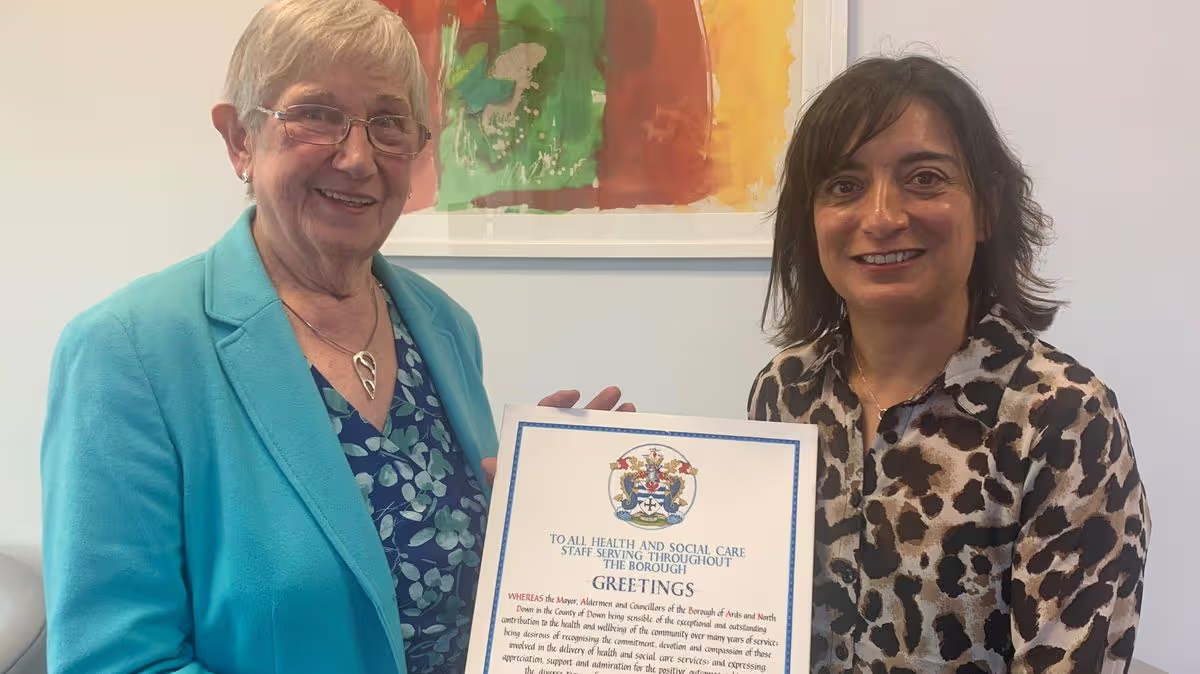
A woman from Northern Ireland has spoken about her love for volunteering after 46 years spent dedicating her time at a Co Down hospital.

Advertisement

Angela Martin is a member of the Ards Hospital Ladies Committee, and is one of the South Eastern Trust’s longest-serving volunteers. This week the committee joined the Trust for a special afternoon tea at the Ulster Hospital to mark 70 years of volunteering with the Trust’s Volunteer Service.

For 70 years, members of the Ards Hospital Ladies Committee have dedicated their time to supporting patients and raising funds for vital medical equipment for use in hospital wards, outpatient clinics, and departments throughout Ards Hospital.

Angela joined the Committee in 1980 and explained that volunteering has always been an important part of her life. She said: “I was brought up in a family where people volunteered. Everybody was involved in something and gave their time to the community.

“I always felt that if you can give back to the community, you should. We have fundraised over the years for patient comforts to furniture for the Nurse’s homes at that time to early detection cancer equipment, wheelchairs, trolleys, pulse oximeters and medical equipment.

Advertisement

“I am very proud to have volunteered these 46 years, I enjoy telling people in the Outpatients in Ards Hospital that some of the equipment you are using we fundraised to buy it.”

When asked if she was going to volunteer for another 46 years, the 82-year-old replied: “I hope so, but I don’t think so!”

She added: “I’ve been Chair of the Committee on three different occasions now and also held the role of Secretary. I’m still going strong and you make the most of it. Ards Hospital is there for everybody and by volunteering you are helping the whole community.”

Advertisement

Treasurer of the Committee, Concepta Meredith explained how the Committee has spent £60,000 over the past ten years in purchasing medical equipment for the hospital. “We raised it by hosting coffee mornings and myself and another Volunteer, Julia Henderson counted it on my dining room table!” laughed Concepta.

“I am very proud to be a Volunteer, it helps and that is what it is all about. It is very important that the Committee continues, we have purchased ECG machines, blood pressure machines, loads of stuff and that keeps people out of hospital.

“I would encourage young and old, those who are retired, to Volunteer as it is so rewarding.”

Volunteer, Maureen Boyd, who joined in 2020, explained how her mother-in-law, Helen was a founding member of the original committee.

Advertisement

She said: “It is fantastic to look over the old photos, there are so many stories behind them in terms of getting together to organise things. Generations of our family have been involved as Volunteers and it means an awful lot to me.

“There is great camaraderie with the Committee and knowing that what you are doing, is benefitting someone, is big thing.”

South Eastern Trust Chairman, Jonathan Patton shared how it is a “privilege” to meet Trust Volunteers and to share a cup of tea with members from Ards Hospital Ladies Committee.

Advertisement

He said: “It is incredible how our hospitals have benefitted from our Volunteers who are working for patients, working for staff and raising funds that have provided equipment and assistance to so many people.

“I am incredibly privileged in the role, as Chairman, to meet our Volunteers, to see their passion, and to work alongside them and hear their stories.

“I think it is vital that we find the next generation of Volunteers. Volunteers have been the life blood of this hospital and Trust for so many years, and I would love to find the next generation of Volunteers coming forward offering some time, an hour, a day that could help us, support us and our staff deliver the care that we do.”

South Eastern Trust, Volunteer Services Manager, Sonya Duffy added: “It is such an amazing feeling to be able to work with people, who are so kind and who are so generous. They do so much for our patients and clients.

Advertisement

“We have 370 volunteers with an age range of 16-25 who are keen to help and learn and then we have our older, more mature Volunteers who come with a wealth of life experience and skills. It is really important to our society that we have people volunteering to help others and for our younger generation to see the generosity and thoughtfulness shown for other people.

“It is amazing to mark seven decades of volunteering in the South Eastern Trust, I am so proud of that and I am so proud of our Volunteers, we want them to stay with us forever as they make such a difference to our patients and clients.”

If you are interested in volunteering, contact the Team at volunteer@setrust.hscni.net or call (028) 9056 4817 to find out more.

For all the latest news, visit the Belfast Live homepage here and sign up to our daily newsletter here.

Advertisement

Source link

Continue Reading
Click to comment

You must be logged in to post a comment Login

Leave a Reply

NewsBeat

M62 updates RECAP as crash sees two lanes closed near Eccles – latest updates

Published

on

Manchester Evening News

Drivers on the M62 could face disruption for another hour after a crash on the westbound carriageway between junctions 12 and 11.

Traffic England has described the incident as ‘severe’, with normal traffic conditions not expected until around 10.30pm-10.45pm tonight.

There’s also queues on the M62 westbound entry slip at junction 12, with delays of around 10 minutes.

Advertisement

Source link

Continue Reading

NewsBeat

No new laws on puppy farming without providing money says council

Published

on

Belfast Live

Belfast Council took DAERA to court after it stopped funding for animal welfare enforcement

Belfast Council is telling Stormont it is “undermining” animal welfare by refusing to fund council services while introducing new laws in the city and around Northern Ireland.

Advertisement

Belfast Council has agreed to write to the Stormont Department of Agriculture, Environment and Rural Affairs stating it is “concerned that introducing additional animal welfare responsibilities, without providing adequate resources, risks undermining both existing enforcement activity and the successful implementation of new legislation.”

The council is saying in a letter to Alliance MLA Andrew Muir, Minister for DAERA that “Animal welfare cannot be improved through regulation alone, and requires properly resourced services capable of investigating complaints, tackling illegal breeding and protecting vulnerable animals.”

READ MORE: Designated memorial spaces at all Belfast parks to be considered

READ MORE: Sinn Féin says “many parts and cultures of the city” will be excluded from Belfast Stories project

Advertisement

The animal welfare service within councils was fully funded, at around £1.25 million per year, by DAERA until August 2023, when the department said it was unable to continue to provide funding for councils in relation to non-farmed animal welfare services.

A judicial review was then lodged in the High Court by Belfast City Council and Fermanagh Omagh District Council on behalf of SOLACE (Society of Local Authority Chief Executives) against the Stormont department, to challenge its decision. The court found that there was a breach on the grounds of a “procedural legitimate expectation.”

The final court order required that before making any decision the department must give advance notice to the AERA Committee for its consideration and must notify councils once it has done so. The court order also said DAERA must reimburse the councils’ full legal costs in relation to the Judicial Review.

A Belfast Council report states: “Officers are now aware that a letter from the minister/permanent secretary was tabled at the AERA Committee on April 16 2026. The letter advised the committee that DAERA does not intend to provide funding to councils for animal welfare services in 2026/27 due to budget constraints.”

Advertisement

In February, Minister Muir said he would take forward legislation to require sellers and suppliers of puppies, and sellers of kittens, under six months of age, to register with their local council. The seller and supplier will be required to meet specific conditions of registration.

The council report states: “Whilst officers welcome any steps to improve animal welfare, it has been stressed to departmental officials that councils do not have the capacity to implement this legislation and therefore there needs to be appropriate assurance around the resources which will be provided to councils to deliver this additional function.

“The department has indicated that the registration scheme would be self-financing. Council officers have asked for evidence to demonstrate that would be the case. To date this additional, supporting financial information has not been provided by the department.”

Green Party Councillor Anthony Flynn spoke this week at the monthly meeting of the full Belfast City Council at City Hall about the outcome of the Judicial Review in relation to animal welfare services and new animal welfare legislation. He said: “I think it is deeply important that we actually recognise the excellent work carried out by animal welfare officers across Belfast and Northern Ireland.

Advertisement

“These officers deal with some of the most distressing cases of neglect, cruelty and illegal breeding, and the types of animal cruelty that exists in our community should horrify all of us.”

He added: “But what concerns me about the department’s response at the end of this case is the contradiction in its approach. On one hand the DAERA minister is talking about strengthening animal welfare legislation by introducing new registration requirements for puppy and kitten sales. This I wholeheartedly agree with, and I have fought for, for years.

“However, on the other hand the department is withdrawing funding from the very officers that are responsible for enforcing animal welfare on the ground. This follows a pattern of behaviour from Executive ministers, and particularly the DAERA minister.

“(It means) local councils, and local council officers, will have tonnes of extra responsibility, but without the resources necessary to actually deal with that responsibility. If Stormont is serious about improving animal welfare standards, it cannot continue to place additional responsibilities on councils without demonstrating those responsibilities will be properly resourced.

Advertisement

“We can’t continue to expect that our ratepayers in Belfast absorb those additional costs, while departments announce new schemes, without the funding to back them up. That is not good for the state of animal welfare in our city, and it is not good for our ratepayers.”

He said: “Good animal welfare standards are achieved through properly funded enforcement, through trained officers and effective regulation. Laws that cannot be enforced properly do not improve animal welfare standards in our city.”

He successfully proposed an amendment to the council’s letter to the Agriculture, Environment and Rural Affairs Committee at Stormont.

DUP Councillor Ruth Brooks at the meeting announced her “full agreement” with the Green Party on the matter. She said: “Issues that we really want to deal with in this city are being held back because of the amount of resources we as a council are having to put into animal welfare and our dog warden service”

Advertisement

She said: “We are as a council failing to get some of the basics right, because we are being asked to do so much, but if we are going to tackle these issues, we can’t be left as sole funders. There has to be funds that come from DAERA.”

For all the latest news, visit the Belfast Live homepage here and sign up to our daily newsletter here.

Source link

Advertisement
Continue Reading

NewsBeat

Fried chicken chain Popeyes submits plans for Belfast City Centre location

Published

on

Belfast Live

This will be the third location in Northern Ireland

Fast-food chain Popeyes has submitted plans to open a location in Belfast City Centre.

Advertisement

Plans have been spotted on the planning portal for signage and a fascia which don the chicken shop’s logo and signature colours.

Popeyes currently have two locations across Northern Ireland. It opened its first location at Lesley Forestside in September 2024, then followed with The Junction in Antrim in July 2025.

The new chicken restaurant is set to open its doors in the former GAME store on Castle Place. There are no further details on when the location will open.

Signage has also been spotted at Lesley Bloomfield, indicating that Popeyes is set to open in Bangor. A sign with the logo and ‘coming soon’ has appeared, and it is set to open in 2027, according to the shopping centre’s Facebook.

This follows shortly after Popeyes announced they were set to open its very first location in the Republic of Ireland. Their Blanchardstown location will open on June 6, 2026.

Popeyes Louisiana Chicken, founded in New Orleans in 1972, is known for serving up American Southern-style chicken dishes and sides. Customers can expect chicken sandwiches, chicken tenders, hot wings, wraps and more when they open the doors of their new location .

Having launched in the UK in November 2021, Popeyes now has over 80 sites in the UK with plans to open more than 45 new restaurants in 2025. The chain employs approximately 3,000 people in the UK and expects to create another 2,500 new roles this year.

Popeyes is joining Wingstop as the second chicken chain to submit plans to open on the same street. Plans were spotted in March of this year for the famous wing joint to open up in the Costa on Castle Place.

For all the latest news, visit the Belfast Live homepage here and sign up to our daily newsletter here.

Source link

Advertisement
Continue Reading

NewsBeat

Suspect in French missing girl case was already known to police

Published

on

Daily Record

The man arrested following the discovery of the body of a missing 11-year-old is reportedly the father of one of her friends

The main suspect in the death of a missing 11-year-old girl is reportedly the father of one of her friends – who was previously accused of rape but remained free.

Advertisement

French investigators have been searching for missing Lyhanna for days.

She disappeared in the southwestern Gers region on May 29, and the searches ended with the discovery of her body in a disused grain silo.

Police notices said she had been wearing a black-and-white striped top, black shorts and yellow socks with branding from the Japanese manga series “One Piece”.

On Thursday authorities announced a child’s body dressed in “similar clothes” had been found.

Advertisement

READ MORE: Teen killer pictured wielding baton before fatal stabbing of Kayden Moy at Irvine beach

READ MORE: First picture of ‘lovely woman’ killed in crash horror as two in hospital

Police were led to the grain silo by a tip-off that the suspect in custody had previously worked there, Gers-region prosecutor Olivier Naboulet said on Friday evening.

DNA matching confirmed the body was Lyhanna’s but more autopsy work is needed to determine the cause of death, Naboulet said.

Advertisement

Speaking earlier Friday, French President Emmanuel Macron joined the outpouring of dismay, saying the case revealed cracks in the system and that he was “shocked”.

“Things didn’t happen as they should have done. That is clear. And so it is unacceptable,” Macron said. “We cannot look her family in the face and say everything went well.”

French media reported the 41-year-old man taken into custody was seen in front of Lyhanna’s school in the Gers town of Fleurance and, on surveillance cameras, later spotted driving with her in his car.

He told investigators that he dropped her off near the municipal swimming pool, media reports said.

Advertisement

Another Gers-region prosecutor, Clemence Meyer, said this week that young girls and their families had previously lodged multiple complaints about the suspect, including allegations of rape.

An allegation that the man raped a minor at his Gers-region home in 2020 was looked into, with medical evaluations and police interviews, but authorities closed the case in 2024 for lack of evidence, the prosecutor said.

The man was the subject of another, still ongoing police investigation for alleged rape when Lyhanna disappeared.

Advertisement

The child in that case alleges the suspect raped her repeatedly at his home in 2024 and 2025, the prosecutor said.

That case has bounced between jurisdictions.

She also said another allegation of raping a minor was lodged against the man this week.

The government has now launched an overarching investigation.

Advertisement

Justice Minister Gerald Darmanin said officials will look at the time it took for casework to be transferred between jurisdictions, why information is transmitted on paper, not electronically, why police seemingly didn’t follow orders and “why we didn’t intervene despite many months of complaints against the man”.

“It’s completely unacceptable,” Darmanin said, speaking Thursday. “We are all terrified by this malfunction.”

He said it reveals “our poor organisation and without doubt, the fact that at the Justice Ministry and elsewhere, we don’t take the words of children seriously”.

Advertisement

Source link

Continue Reading

NewsBeat

London researchers find lymph node change could indicate breast cancer risk

Published

on

London researchers find lymph node change could indicate breast cancer risk

Lymph nodes play a key role in the immune system, helping the body fight infections and cancer. In breast cancer, the lymph nodes in the armpit are often the first place the disease spreads to and, at the moment, everyone with invasive breast cancer undergoes surgery to remove lymph nodes for examination.

Source link

Continue Reading

NewsBeat

Breakthrough AI tech which colour-codes body parts during operations used for first time in UK

Published

on

Breakthrough AI tech which colour-codes body parts during operations used for first time in UK

A pioneering AI tool which colour-codes body parts during live operations has been deployed by surgeons for the first time in the UK.

Medics at St Mark’s, the National Bowel Hospital, utilised the system on Thursday during surgery on a patient in her 60s.

The tool, known as Eureka, works alongside robotic or laparoscopic procedures, projecting real-time, colour-coded highlights onto a screen.

This visual aid helps surgeons identify and protect or dissect specific tissues, such as nerves appearing green or connective tissue in turquoise, enhancing precision and safety.

Advertisement

Experts have praised the portable AI unit for boosting efficiency in the operating theatre. It was developed by Japanese surgeons who trained the AI using thousands of surgical video recordings.

The operation on Thursday was the first time the technology has been used in the UK
The operation on Thursday was the first time the technology has been used in the UK (PA)

The operation on Thursday was the first time it has been used in the UK.

It was also the first time that it has been used during surgery outside Japan.

The patient, who has not been named, received a bowel resection at the hospital, which is part of London North West University Healthcare NHS Trust.

Consultant surgeon Mr Kapil Sahnan described the tool as an “extra helping arm”.

Advertisement

He said that it helps “look at your live surgery and start telling you which are the hidden structures which perhaps you can’t see”.

He added: “And the hope and the idea being is, that if you can identify these, that the operation becomes safer, you have this kind of extra helping arm with artificial intelligence running at the same time as your surgery, preventing errors and making everything a lot more safe.

“And we were the first hospital in the world outside of Japan to use it.”

Medics at St Mark’s, the National Bowel Hospital, used the tool to operate on a patient in her 60s
Medics at St Mark’s, the National Bowel Hospital, used the tool to operate on a patient in her 60s (PA)

He went on: “Another way of thinking about it is, I remember that my mother used to use an A to Z when she had to plan routes. Now we all use Google Maps and Waze.

“And this is that version of kind of navigation that now has been applied to surgery.

Advertisement

“The difference has been that real time aspect, so you can see it at the same time as you’re operating.

“The idea being is you want to prevent any errors happening before they do, and one way to do that is use, not human intelligence but intelligence, which has been derived from thousands and thousands and thousands of operative videos where people have gone through and labelled things.

“So the computer can see things before the human eye can.”

He added: “You get these really beautiful images, they put colour overlays over the operative images. which can either be on constantly, or they can pulse.”

Advertisement

Mr Sahnan said work was under way to work out how “we can genuinely prove that this is going to be advantageous and, more importantly, how we can start rolling it out.

“We’re lucky to have it today, but it would be amazing if everybody had it in the next couple of years, it would make surgery for everybody a lot safer.”

Source link

Advertisement
Continue Reading

NewsBeat

US military shot down Iranian drones launched toward Strait of Hormuz

Published

on

US military shot down Iranian drones launched toward Strait of Hormuz

The U.S. military says it shot down four Iranian drones that were launched toward the Strait of Hormuz on Friday and then struck some of the Islamic Republic’s coastal surveillance radar sites in response.

“The attack drones posed an immediate threat to regional maritime traffic,” U.S. Central Command said on social media.

It was the latest in back-and-forth attacks that have strained the tenuous ceasefire in the war.

Source link

Advertisement
Continue Reading

NewsBeat

Former-BBC presenter questioned by police over alleged sexual assault claims

Published

on

Daily Record

A former presenter of a BBC show has been questioned by police after a woman claimed she was sexually assaulted while appearing on his programme, according to reports

A former BBC presenter has been quizzed by officers after a woman alleged she was sexually assaulted while appearing on his show, according to the Sun.

The tabloid claims the unnamed star, who was a recognisable face for decades, has already been spoken to by detectives regarding the accusations. The woman’s allegations centre on unwanted sexual touching on set, with the Met Police confirming the incidents occurred “between September 2005 and December 2006”.

The male presenter was reportedly left “stunned” following his police interview in May, and firmly denies all allegations made against him. The woman, who now resides outside London, was referred to the Met after initially approaching another police force. Sources indicate the accuser either worked alongside the star or featured as a contestant on the programme, reports the Daily Star.

Advertisement

A source told the Sun: “The case is quite shocking and the star involved was stunned when told about the investigation.

“But he’s co-operated and went in for the interview under caution at an arranged time and place. The alleged victim now lives outside London and her case was referred to the Met from an outside force, which caused a bit of a delay.

“The claims are linked to his time working on the show and she’s believed to have either worked with him or been a contestant.

Advertisement

“Police have taken her complaint very seriously. They are doing everything they can to investigate, although it dates back 20 years.” The TV personality has not been taken into custody and has merely been questioned in connection with the claims.

The Metropolitan Police told The Sun they were “investigating a report of sexual assault against a woman which took place in Stratford between September 2005 and December 2006”.

A spokesman added: “On Thursday, 14 May, a man was interviewed under caution. We remain in contact with the woman, and she continues to be supported by officers. Enquiries remain ongoing and no arrests have been made at this stage.”

The BBC, who said the accused worked for an independent production company, would not comment on a live police investigation.

Advertisement

Source link

Continue Reading

NewsBeat

What Does Draw No Bet Mean? World Cup Betting Explained

Published

on

What Does Draw No Bet Mean? World Cup Betting Explained

The draw no bet market provides a twist to match odds, offering a bit of security to punters wagering on World Cup games at UK betting sites.

Simply, draw no bet (DNB) means that your stake will be returned if the match ends level, whilst winnings are paid out if your backed team wins.

Draws weren’t all that common at the last World Cup in 2022 with 10 out of 48 group stage games ending all square. However, in a game that’s expected to be tight, draw no bet can prove a valuable betting tool.

Advertisement

If you’re new to the draw no bet football market, The Standard’s sports team has unpacked how it works.

Essentially, draw no bet removes the draw as a possible outcome. If the match ends level, your stake is refunded. However, if the team you backed wins, your bet will be settled as a winner. Of course, if the other team wins, your wager loses.

Because of the added security and removal of an outcome, the prices on both teams are shorter than the standard match result market.

How does a draw no bet work?

Advertisement

Draw no bet should not be confused with the match result market, where the draw is still an option. Instead, it is a separate market on World Cup betting sites.

A punter picks the team they think will win from the draw no bet section, adds it to their bet slip, and places a stake as normal.

Take England’s first World Cup game as an example. The Three Lions play Croatia in their first group-stage match, and in the match result market, England are priced 13/20, a draw is priced 27/10, and Croatia ar 7/2.

In comparison, on the draw no bet market, England are priced at 2/7, and Croatia 5/2 – showcasing how the odds quickly shorten.

Advertisement

Match result odds – England vs Croatia

Selection

Odds

England

Advertisement

13/20

Draw

27/10

Croatia

Advertisement

7/2

Draw no bet odds – England vs Croatia

Selection

Odds

Advertisement

England

2/7

Croatia

5/2

Advertisement

Advantages of draw no bet

Draw no bet acts as a safety net, with your stake refunded if the match ends in draw. This is useful for cautious bettors or backing credible underdogs in tight matches.

Also, a favourite who is losing or drawing mid-match offers much better draw no bet potential in-play than pre-match, still with that same safety net.

However, that all comes at the cost of a smaller payout than if the bet had been placed on the match result market. Some bookmakers won’t allow free bets to be used on draw no bet markets.

Advertisement

Draw no bet vs other betting options

There are numerous betting markets available for every game at the World Cup, with draw no bet just one option. Double chance is quite similar to DNB, as it covers two of the three possible outcomes – typically one team winning and the draw. With double chance, more outcomes count as a winner, but the odds are even shorter than draw no bet.

The Asian handicap market assigns a virtual goal advantage or deficit to one side, which can offer better value but can be tricky for novice bettors to get to grips with. If you want to learn more about different bet types, visit our World Cup betting markets explainer.

Do you get your money back on a draw no bet?

Advertisement

Yes. If the match ends in a draw, the stake is refunded as cash. This is the main appeal of the market, and the reason prices are shorter than the standard match result market.

What happens to a draw no bet in an accumulator?

If a draw no bet leg in an acca ends level, the leg is voided and the acca reduces to fewer selections, which also leads to the odds being recalculated. For example, a five-leg acca with one drawn draw no bet selection becomes a four-leg acca, with the odds recalculated.

Can you use a free bet on a draw no bet?

Advertisement

Yes – but most bookmakers void World Cup free bets staked on draw no bet markets if the match ends level, rather than returning them, so the safety net only really applies to cash bets.

We aim to offer every online gambler and reader of The Standard a safe and fair platform through unbiased reviews and offers from the UK’s best online gambling companies.

Gambling can be addictive, always play responsibly and only bet what you can afford to lose. Gambling sites have a number of tools to assist you to stay in control, including deposit limits and time outs. If you think you have a problem, advice and support is available for you now from BeGambleAware or Gamcare.

Any offers or odds listed in this article are correct at the time of publication but are subject to change. Terms & Conditions apply to all offers.

Advertisement

Source link

Continue Reading

NewsBeat

How a simple blood test could help detect heart damage during breast cancer treatment

Published

on

How a simple blood test could help detect heart damage during breast cancer treatment

Modern breast cancer screening and treatment have transformed survival. Many women now live long and healthy lives after diagnosis, thanks to increasingly effective chemotherapy and targeted therapies: medicines designed to attack particular features of cancer cells.

But as cancer outcomes improve, another challenge has become more apparent: protecting the heart from the side-effects of treatment.

Some breast cancer treatments can affect heart health. These include anthracyclines, a group of chemotherapy drugs, and trastuzumab, a targeted therapy used to treat HER2-positive breast cancers: cancers that have high levels of HER2, a protein that helps cells grow and divide.

In some patients, these treatments can weaken the heart’s ability to pump blood around the body or contribute to heart failure. Other cancer treatments can increase the risk of abnormal heart rhythms.

Advertisement

Early changes may not cause obvious symptoms. By the time a patient experiences breathlessness, fatigue or palpitations, the sensation that the heart is pounding or beating irregularly, damage may already have occurred.

A small study, which is yet to be peer reviewed, suggests that regular blood tests and heart traces could help doctors detect warning signs earlier.

Researchers followed 50 women with stage 1 to 3 breast cancer, cancer that had not spread to distant organs, through six cycles of chemotherapy. They measured cardiac troponin I, a protein released into the blood when heart muscle cells are injured. They also recorded electrocardiograms (ECGs), which measure the electrical activity controlling the heartbeat.

Advertisement

They found that troponin levels rose during treatment. ECG abnormalities also became more common, including prolonged QT intervals, which is the time the heart’s lower chambers take to contract and prepare for the next beat. If this takes longer than usual, the risk of a dangerous irregular heartbeat can increase.

Larger studies are needed to confirm these findings, but the research adds to evidence that signs of heart stress can sometimes be detected before a patient develops symptoms.

Troponin and heart health

Troponin tests have been used for more than two decades to help diagnose a heart attack (myocardial infarction).

A raised troponin level does not always mean that someone has had a heart attack, because heart damage can have other causes. During chemotherapy, raised levels may reveal small amounts of heart muscle damage before conventional measures of heart function begin to worsen.

Advertisement

A 2004 report identified troponins as promising biomarkers: measurable signs in the body that can indicate injury or disease.

A later clinical study found that persistently raised troponin levels during high-dose chemotherapy predicted a decline in the pumping ability of the left ventricle, the heart’s main pumping chamber. Troponin may therefore offer an early warning that a patient is at greater risk of future heart problems.

Adding pieces to the puzzle

Established forms of heart monitoring remain important. One commonly used measure is left ventricular ejection fraction, or LVEF. This is the percentage of blood pumped out of the left ventricle with each beat. It is usually assessed using an echocardiogram, an ultrasound scan of the heart.

Echocardiograms remain central to heart monitoring during cancer treatment. But LVEF can remain normal while subtler changes are developing.

Advertisement

Doctors can also use a measure called global longitudinal strain, which looks more closely at how well the heart muscle squeezes and relaxes. It may reveal changes before they show up in the ejection fraction.

Blood tests and ECGs could provide additional pieces of the puzzle. An ECG is quick, painless and widely available. Some chemotherapy drugs can disrupt electrical activity in heart cells, increasing the risk of abnormal rhythms, or arrhythmias. Regular ECG monitoring may help to identify patients who need closer observation.

A more personalised approach

A raised troponin level does not necessarily mean that a patient will develop heart failure. An abnormal ECG does not guarantee a serious irregular heartbeat. These tests identify signs that the heart may be under strain and help doctors assess risk.

The emerging field of cardio-oncology focuses on protecting the heart health of people with cancer before, during and after treatment.

Advertisement

Doctors are increasingly tailoring monitoring to each patient’s risk. Existing heart health, age, blood pressure, diabetes risk and previous exposure to treatments that may damage the heart can influence the level of monitoring required.

If doctors detect rising troponin levels or ECG changes, they may carry out tests more frequently, refer the patient to a heart specialist with expertise in cancer care or consider treatments intended to protect the heart.

This does not necessarily mean stopping cancer treatment. The aim is to manage risks while allowing patients to continue receiving effective care wherever possible.

Advertisement

The latest research does not provide a standalone test for predicting who will develop heart problems after breast cancer treatment. Troponin levels and ECG changes must be interpreted alongside other information. Scientists still need better evidence about how early warning signs should influence treatment decisions.

But the principle is important. As more people survive breast cancer, protecting their long-term health becomes increasingly urgent. The goal is no longer simply surviving cancer. It is maintaining heart health after treatment has ended.

Source link

Advertisement
Continue Reading

Trending

Copyright © 2025