

At a Treasury briefing in 1997, Ed Balls, then Gordon Brown’s economic guru, sidled up to me. He wanted to tell me why his boss was so determined to keep government borrowing under control.
Every pound spent servicing the national debt, he rightly explained, was money wasted – money that could instead be spent on public services.
Only a decade later, Balls’s rare kernel of economic wisdom had been forgotten. Brown was forced to borrow heavily to shore up Britain’s collapsing banking system – and ever since then, the principle Balls outlined to me that day has been callously abandoned by his party. And you and I are paying for it.
Earlier this week, it was revealed that, in August alone, our spendthrift Government squandered an eye-watering £8.8billion on servicing the national debt. Meanwhile, the country is facing ever-surging borrowing costs – expected to reach at least £130billion by the end of this year.
Sensible people would look at these figures and conclude that the only remedy is to reduce our borrowing by keeping the current budget (spending and tax receipts) in balance.
Our Labour Government, however, is not sensible. And the fundamental tenet, familiar to every household, of ‘living within your means’ is alien to them.
As such, while we fritter away billions on servicing our debt, the cost of running Britain’s pensions and welfare system is out of control.
The Government has locked the nation in a doom loop of spending and higher taxes, from which there can be no painless escape. It is a socialist approach that paralyses enterprise and, as I have previously written, is driving top taxpayers overseas.
Worse, it means that our Government is so mistrusted by the bond markets that Britain is forced to pay the highest interest rates of all our international competitors in the Group of Seven (G7) richest countries.
There’s one policy announcement that would send a monumental signal to the bond markets that this Government is set on fiscal responsibility: dismantling the ‘triple lock’, writes Alex Brummer
So what should our recently installed Chancellor John Healey do to start limiting the nation’s monstrous interest rate bill ahead of his October 28 debut Budget?
Well, there’s one policy announcement that would send a monumental signal to the bond markets that this Government is set on fiscal responsibility: dismantling the ‘triple lock’.
Every economic think-tank in Britain knows that, thanks to our ageing population, the state pension triple lock – an election-winning gambit (a bribe, in other words) introduced by former Tory Chancellor George Osborne in the distant days of 2010 – is an unsustainable burden.
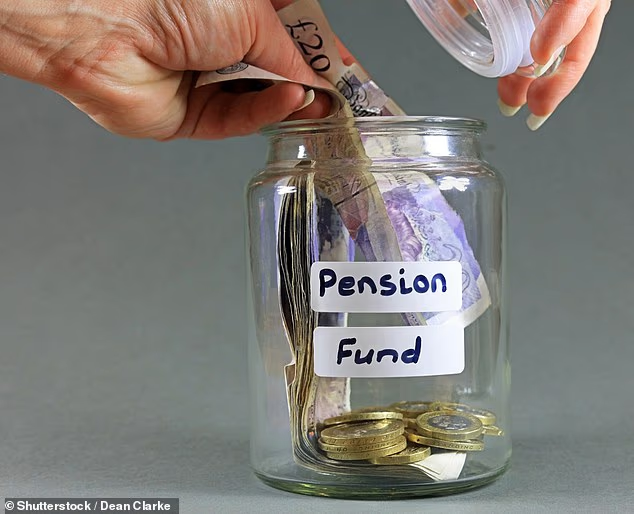
Under the triple lock, Britain’s happy silver surfers, me included, can look forward every year to an increase in their state pensions by whichever is the highest of average earnings growth, the consumer prices index (CPI) or a 2.5 per cent uplift.
It was manna from heaven when introduced, back when the basic pension for a single person (paid at 65 for men and 60 for women) was £97.65 per week and £156.15 a week for a married couple – among the meanest pensions in the industrial world.
Some 16 years later, the state pension (paid at 66) has jumped to £241.30 a week or £12,547.60 a year and we are no longer lagging behind our European competitors.
The Daily Mail is committed to supporting Britain’s pensioners and their lifelong contribution to the nation’s economic wellbeing. But it’s undeniable the cost of maintaining the triple lock – projected to cost £15billion per year by 2030, more than three times what was originally anticipated – is far too high.
Doing away with it might seem like an act of electoral suicide to Labour MPs with fragile majorities – but it is the opposite.

What should our recently installed Chancellor John Healey do to start limiting the nation’s monstrous interest rate bill ahead of his October 28 debut Budget, Alex Brummer asks
It would show that Andy Burnham’s Government understands the economic maelstrom Britain faces. And it’d be hard for opposition parties, in the face of ever-higher borrowing and interest rates, to oppose scrapping it. But if the annual state pension rise is to be ‘unlocked’, there must be a quid pro quo: changes to the way working-age welfare payments are uprated; reforms to disability benefits; and an overhaul of the extraordinarily generous pension arrangements enjoyed by public sector employees.
As matters stand, more than 24million people in Britain – around 35 per cent of the population – receive some form of welfare payment. Remarkably, payouts to these citizens, some of whom have never worked, increase each year automatically in line with average earnings.
The Office for Budget Responsibility calculates that if the annual uprating was based on CPI inflation, rather than earnings, the projected cost could be slashed from 6 per cent of national output to just 3 per cent, saving tens of billions of pounds for the Exchequer in future years.
Then there is the public sector. Since Labour took office, the public payroll has swollen with 270,000 new employees. Of course, these government jobs come with gold-plated, defined-benefit pensions (meaning the amount paid in retirement is guaranteed, determined by salary and how long someone was employed) – increasingly rare in the private sector.
That disparity is grotesquely unfair. Thanks to Gordon Brown, millions of private-sector workers are automatically enrolled into defined-contribution pensions, in which their eventual retirement income depends on how much they and their employers put aside and how those investments perform – despite their taxes funding far more generous, guaranteed public pensions.
Bringing public sector pension provision closer to the arrangements faced by the workers who ultimately pay for it could deliver substantial long-term savings – making the system considerably fairer.
Of course, the burden of Labour’s spend-and-tax bonanza should not fall solely on the nation’s elderly. As Kemi Badenoch argued yesterday, those living on welfare and those working for the state must also shoulder some of the sacrifice if Britain is to have any prospect of digging itself out of its fiscal hole.
Indeed, Labour’s biggest failure as keeper of the public purse has been its shameful refusal to get to grips with the alarming surge in Personal Independence Payments (PIP), which are not means-tested, to people with disabilities.
The attempt by Keir Starmer and Rachel Reeves to trim the burgeoning welfare bill was sabotaged by Labour backbenchers – a rebellion that catalysed that odd couple’s political downfall.
Anyone arriving from Mars might have imagined ministers were proposing to snatch benefits from the most severely disabled people in the country. The reality, as ever, was different.
Spending on disability payments has soared in real terms from £14billion in August in 2020 to £25billion in the last fiscal year.
The number of under-30s claiming the benefit has rocketed to 689,000 at a cost of £5.5billion a year.
It would be grossly inequitable to take the triple lock away from pensioners, who’ve earned their retirement, simply to subsidise this group of welfare recipients.
Since William Beveridge’s landmark wartime report laid the foundations of the modern welfare state, successive governments have accepted that Britain should provide a social safety net for the elderly, the sick and disabled, the destitute and those who lose their jobs.
But neither Beveridge nor the politicians who constructed the post-war settlement envisaged today’s system: a state pension almost guaranteed to rise unsustainably, alongside a disability benefits system so generous it discourages work.
Unless these issues are confronted with urgency by Andy Burnham’s Government, the decision will be made for us.
The markets will wrestle us into emergency cuts to the size of the state and benefits – and millions will be even worse off.































































You must be logged in to post a comment Login