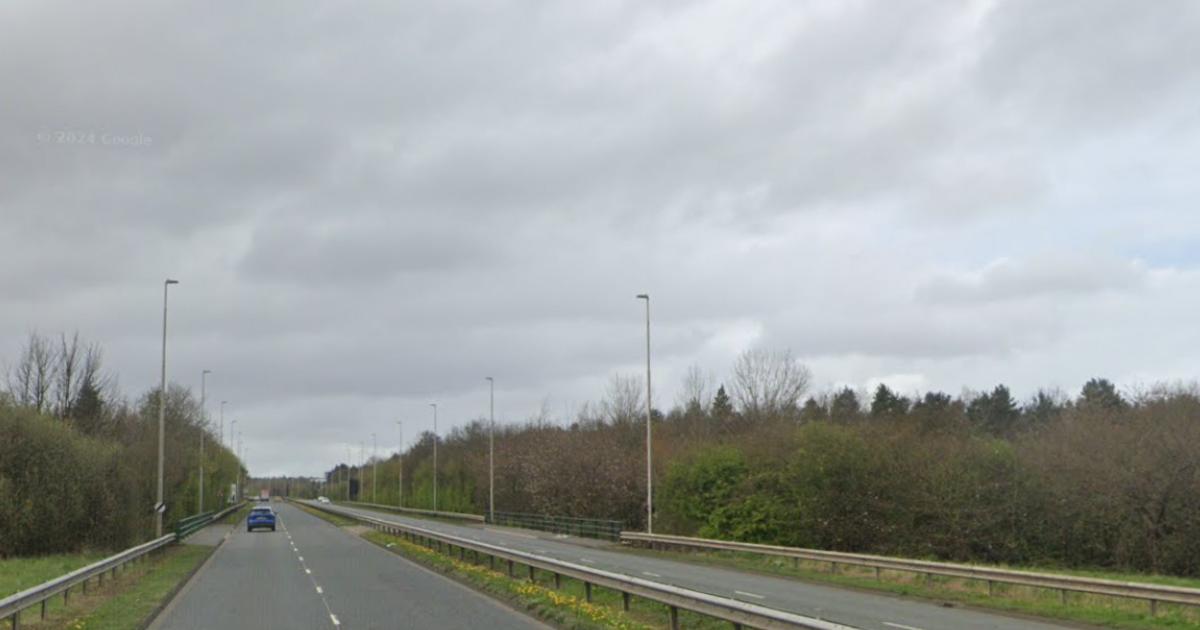
Emergency services, including the air ambulance, were called to the crash on the A182 Washington Highway near Houghton-le-Spring on Wednesday, May 27, around 2.45pm.
The man was sadly pronounced dead at the scene.
The road was closed for several hours while the emergency services and crash investigators attended.
Advertisement
The man’s next of kin have been informed.
A spokesperson for Northumbria Police said: “Our thoughts remain with them at this sad time.
“A report is being prepared for the coroner.”
A spokesperson for the Great North Air Ambulance said previously: “Our doctor and paramedic team were activated to an incident at 2.51pm. They flew to scene and arrived within 13 minutes.
Advertisement
“They worked alongside the North East Ambulance Service (NEAS).”
A NEAS spokesperson adedd: “We dispatched one ambulance crew, one rapid response paramedic, one specialist paramedic, one clinical team leader and were supported by our colleagues at Great North Air Ambulance Service.”
Kay proposed on Christmas Day in 2002 at Taley’s family home and the couple tied the knot the following year in Bolton.
After their first wedding in Kay’s stomping ground, the couple renewed their vows in 2013 with their two daughters, Phoebe and Amber, present.
Advertisement
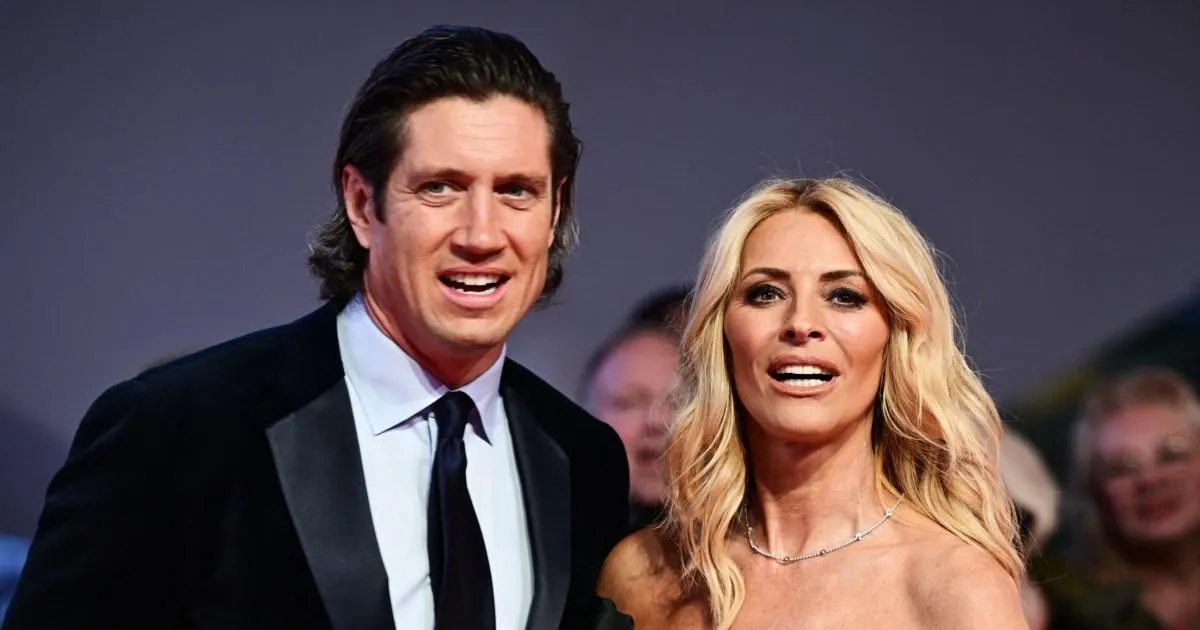
Daly, 57, and Kay, 52, are now said to be planning a quick divorce to keep proceedings stress-free and inexpensive, having reportedly decided how their assets will be split.
A source told The Mirror: ‘Tess doesn’t want to spend thousands on solicitors for a divorce. A friend suggested they look at getting a quickie divorce online.
‘They don’t see there’s anything to fight over and know they’ll agree on everything fairly’ (Picture: Anthony Harvey/Shutterstock)
‘They don’t see there’s anything to fight over and know they’ll agree on everything fairly.
‘They’re still living under the same roof and have effectively re-coupled as friends. They won’t be fighting over assets and will always stay close.’
‘After much consideration, and with a deep sense of care and respect for one another, we have made the decision to separate amicably,’ the statement read.
‘This has not been an easy choice, but it comes from a place of mutual understanding and a shared desire for what is best for both of us.
‘We remain great friends and most importantly, fully committed to our roles as loving and supportive parents, which will always be our priority.’
The pair hosted The One Show together earlier this year (Picture: X/BBC)
Tess Daly and Vernon Kay’s relationship – key events
2001 – Tess and Vernon meet while Vernon is working at Channel 4 and Tess is at ITV
2002 – Vernon proposes on Christmas Day at Tess’ parents’ home
Advertisement
2003 – they marry at St. Mary’s Catholic Church in Vernon’s hometown, Horwich, near Bolton
2004 – first daughter Phoebe is born
2009 – second daughter Amber is born
2010 – Vernon admits to sending explicit messages to Page 3 model Rhian Sugden and other women for four months
Advertisement
2010 – a month later, Tess addresses the sexting scandal, insisting that their marriage was ‘worth fighting’ for
2013 – Vernon surprises Tess with a vow renewal in the South of France, 10 years on from their first wedding
2017 – Tess says their marriage is a constant ‘work in progress’
2020 – appearing on I’m A Celebrity… Get Me Out Of Here!, Vernon says his infidelity is ‘in the past’ and has been ‘forgotten about’, adding that they’ve ‘moved on’
Advertisement
2025 – Vernon celebrates as Tess receives her MBE in one of their final major public appearances together
February 2026 – the couple appear on screens together for the last time, co-hosting BBC’s The One Show
May 2026 – Tess and Vernon announce that, ‘after much consideration’, they have separated ‘amicably’
Advertisement
They concluded: ‘There are no other parties involved in this decision. We kindly ask for privacy during this time as we navigate this transition together.
‘We will not be making any further public comments.’
He later admitted to sending flirty messages to ‘four or five girls’ during that period. However, his representatives insisted that these interactions were not physical.
The radio presenter also reflected on his actions on Radio 1, revealing that his wife was ‘extremely upset’.
‘I’ve let down my wife, Tess. I’m an idiot,’ he said live on-air. ‘I’ve been stupid and daft, but I’m not a sex pest.’
He added: ‘In some ways, I’m glad this story has come out. It feels like a weight has been lifted from my shoulders.’
Advertisement
Metro contacted Tess Daly and Vernon Kay’s representatives for comment.
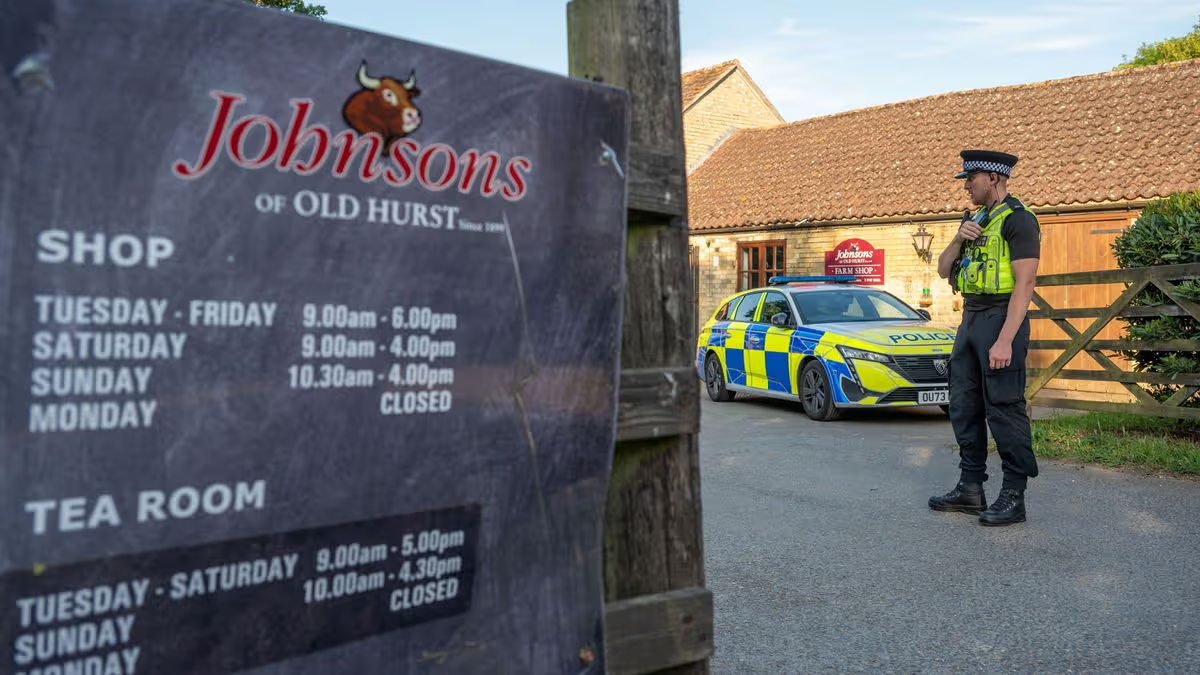
The boy is in a critical but stable condition at Addenbrooke’s Hospital in Cambridge after Thursday’s incident at Johnsons of Old Hurst in Huntingdonshire
Wowcher has come under fire after issuing an apology “unreservedly” for what it admitted was “unacceptable” wording in a marketing email that appeared to make light of a horrific crocodile attack on a three‐year‐old boy at a Cambridgeshire zoo.
Advertisement
The youngster is fighting for his life in Addenbrooke’s Hospital, where he remains in a critical but stable condition following Thursday’s (June 18) shocking incident at Johnsons of Old Hurst in Huntingdonshire.
He is believed to have been attacked by at least one crocodile after allegedly being thrown into the enclosure. But on Saturday, as the family reeled from the ordeal, Wowcher customers were stunned to receive a promotional email pushing “special deals”, with the headline: “Snap up these deals quicker than a croc can catch a kid.”
Fury mounted as screenshots of the message circulated on social media networks and discussion forums. Norwich Norfolk UK Community Notice Board posted: “Why do wowcher think its ok to use this as a heading on their emails? ?”.
Advertisement
One subscriber declared themselves “now unsubscribed” while another branded it “disgusting”, adding “if that’s real someone needs to be fired”.
A further customer commented: “Emailed them back but no answer. Won’t be using them again for sure, even if its a poor effort at a joke somehow.”
A Wowcher representative stated: “We are extremely sorry for an email subject line sent by Wowcher yesterday. The wording was unacceptable. It should never have been written. It was never approved for use.
“The responsibility sits with us and we are urgently reviewing how our processes failed. We recognise the hurt and distress it has caused, particularly for the young child’s family at this unimaginably difficult time.
Advertisement
“We are reviewing all scheduled marketing content while we urgently strengthen our creative, approval and sign-off safeguards. There is no excuse for this. We apologise unreservedly and will take the necessary steps to make sure this does not happen again.”
A 30-year-old man detained on suspicion of attempted murder following the youngster’s fall into the enclosure is understood to have learning difficulties and had been visiting with a carer.
Cambridgeshire Police confirmed the arrested man, from Norfolk, was “assessed as not being fit for interview”. He has been bailed until September 18.
Advertisement
Officers were alerted to the zoo at 1.24pm on Thursday by ambulance crews following reports that the boy, who had no connection to the man, had sustained serious injuries. Cambridgeshire Police stated the youngster “sustained serious injuries while in the enclosure” and “was pulled out by staff from the zoo”.
Tracey Johnson, spouse of the zoo’s owner, is reported to have leapt into the enclosure to rescue the child. Officers confirmed the boy “received medical treatment at the scene before being taken to hospital”.
Detective Inspector Verity McCann said previously: “Our inquiries are ongoing as we continue to understand the circumstances surrounding this distressing incident.
“Our thoughts remain with the boy and his family and specialist officers continue to support them through this difficult time.”
Advertisement
Ensure our latest stories always appear at the top of your Google Search by making us a Preferred Source. Click here to activate or add us as your Preferred Source in your Google search settings.
Analysis: When it comes to Keir Starmer’s replacement, where are all the women?
As the prospect of Sir Keir Starmer’s resignation looms over the start of the coming week like the heatwave, one thing strikes me above all else. Whenever conversation does grudgingly turn to the prospect of a contest rather than a coronation for Andy Burnham, the key players are all men, writes Kat Brown.
Notwithstanding Labour’s glaringly obvious reluctance to vote for women in leadership contests, let alone get behind one as leader, this feels like the Starmer drama has caused memory leaks in the PLP.
I know a lot’s been going on, but let’s try and cast our minds back a whole five months to February, when Labour was in the grips of the Mandelson scandal. Starmer met with the Women’s PLP to “discuss” the boys’ club culture in his government that had factored in Peter Mandelson’s appointment. Harriet Harman told the PM he needed to “transform the political culture in government around women and girls”.
Advertisement
Starmer’s chief of staff, Morgan McSweeney, eventually resigned over Mandelson’s appointment. Yet, just four months later, The i Paper reported three Government sources as saying he was back, advising Starmer over the phone. And on Friday week Baroness Harman was back to say what we really should all be thinking: “There must be a woman in the contest”, she told Radio 4’s Today programme. “We cannot have a male beauty parade again.”
Read the full piece here:
Holly Bancroft22 June 2026 01:43
Advertisement
Recap: Trump says Starmer will resign after ‘failing badly on immigration and energy’
US president Donald Trump has said that Sir Keir Starmer “will resign” as prime minister, accusing him of “failing badly” on immigration and energy.
Writing on social media platform Truth Social on Sunday, Mr Trump said: “Keir Starmer will resign as prime minister of the United Kingdom. He failed badly on two very important subjects – immigration and energy (Open North Sea oil!). I wish him well! President DJT”.
The post is thought to be based on media reports as the two have not spoken this weekend.
Holly Bancroft22 June 2026 00:56
Advertisement
‘Far too much Westminster gossip’: Labour MP warns
Preet Kaur Gill, Labour MP for Birmingham Edgbaston, has criticised her fellow parliamentarians for indulging in “far too much Westminster gossip”.
Writing on X on Sunday afternoon, she wrote: “There is far too much Westminster gossip and not enough focus on the people we are here to serve. The public expect us to focus on the job we were elected to do, not indulge in endless internal noise.”
Holly Bancroft21 June 2026 23:59
Advertisement
Changing leader ‘will invite calls for general election’, Labour MP warns
Changing leader “will invite incessant demands for an early general election”, Labour ally of Sir Keir Starmer warns.
Writing in Labour List, Michael Payne, MP for Gedling, said on Sunday that replacing Sir Keir as prime minister would “risk distracting the government from the work of national renewal.”
He continued: “Whether you think changing leader is a mistake or not Labour’s responsibility is to remain focused on delivering for the country that elected us to govern. The British people elected a Labour government to govern, not to spend its time indulging Westminster psychodrama.
Advertisement
“And while our political opponents – not least Nigel Farage and those who would happily reverse the progress we have made – seek to talk Britain down, Labour should never lose confidence in what we have achieved together.”
Holly Bancroft21 June 2026 22:52
Labour MP says members are ‘livid’ about ‘stitch-up’ to remove Starmer
Neil Coyle, Labour MP for Bermondsey, has said that Sir Keir Starmer is a victim of “an utter stitch-up”.
Advertisement
Posting on X on Sunday, Mr Coyle said: “My members are livid about the prospect of an utter stitch-up and the media circus being rewarded. When the next leader cannot change Trump, Iran, Ukraine, Putin, Musk, broadcast editorial and algorithm bias overnight they’ll bay for his blood too. Better keep that guillotine sharp.”
Holly Bancroft21 June 2026 21:57
Burnham would need time to prepare for power, says Labour MP
As a nation waits on a potential announcement by Sir Keir Starmer tomorrow, discussions are already taking place over what happens next, with some debating the timeline for Andy Burnham possibly becoming PM.
Advertisement
A source told The Independent that the prime minister is now “working towards” a handover in early September after the summer recess, but MPs have also suggested it could be as early as mid-July.
But Clive Lewis, Labour MP for Norwich South, has told The Telegraph that Mr Burnham should take the time to prepare properly for power.
He said: “Starmer failed to do this. And as my dad always used to drill into me before exams – fail to prepare then prepare to fail.”
Clive Lewis is the Labour MP for Norwich South (PA) (PA Archive)
Alex Ross21 June 2026 21:21
Advertisement
Badenoch played ‘critical’ role in Tory victory in Aberdeen South
Conservative leader Kemi Badenoch played a “critical” role in the party’s victory in the Aberdeen South by-election, Russell Findlay has said.
The Scottish Conservative leader said people in the seat had recognised the vote was “effectively a referendum on oil and gas”, and the victory came after a “huge team effort” from the party.
The Conservatives took Aberdeen South from the SNP in emphatic fashion, with Douglas Lumsden elected as the new MP after winning by more than 6,000 votes.
Advertisement
It was the party’s first by-election victory in Scotland since 1967. Mr Findlay said voters were drawn to the Tories’ message on oil and gas.
He told the BBC’s The Sunday Show: “The people of Aberdeen knew this was effectively a referendum on oil and gas.
“Kemi Badenoch and I are crystal clear. We wanted to give the people of Aberdeen the choice to say No to the net zero madness of Labour and the SNP.
“We want an affordable transition, but it cannot come at the cost of thousands of jobs and destroying an entire industry, and that’s why people came out with record numbers to vote for our candidate, Douglas Lumsden, an oil and gas champion, who will go down to Westminster and take that message directly to Keir Starmer or whoever might be in Downing Street next.”
Advertisement
Kemi Badenoch (PA Wire)
Holly Bancroft21 June 2026 21:09
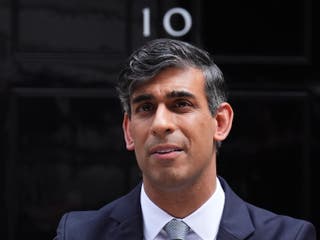
Former PM Rishi Sunak warns Burnham he must have ‘clear plan’ of action within hours of arriving in No 10
Former prime minister Rishi Sunak has warned Andy Burnham that he could see his support drain away if he takes the highest office.
Writing in a column for The Times, the former Tory leader warned that all leaders across Europe are facing pressure to deliver faster than ever.
He said: “Political capital depreciates more quickly than ever before. That Starmer and Merz are both facing such leadership speculation less than two years after winning elections is an illustration of that.
Advertisement
“Burnham must recognise that if he reaches No 10, he’ll never have more power than on his first day in the job. It is vital he has a clear and achievable plan for what he wants to do in those opening hours.”
Former prime minister Rishi Sunak (PA Archive)
Holly Bancroft21 June 2026 20:03
Analysis: Labour MPs invite to photocall with Burnham feels like a coronation
It is fair to say that when Labour wins a by-election there is usually a photo call invite to Labour MPs when the winner arrives in parliament, writes Political Editor David Maddox.
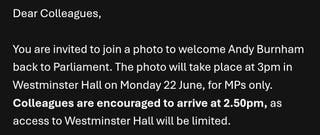
But this one has been received differently. An invitation for the Parliamentary Labour Party (PLP) office has gone out for a photo call with Andy Burnham at 3pm in Westminster Hall on Monday.
Advertisement
With an expectation that prime minister Sir Keir Starmer is working up a deal to hand over the leadership of the party and his job as PM over to Mr Burnham the invitation is already being described as “a coronation.”
Normally most MPs do not make it to these photo calls but this one is expected to have almost everyone present. The 3pm timing is conveniently after the morning time that the prime minister is expected to make his fateful announcement at the podium in Downing Street that he is to relinquish power.
The only issue now maybe is if enough MPs back an alternative candidate to run against Mr Burnham in a contest. Otherwise the photo call may as well be a coronation.
(Independent )
David Maddox21 June 2026 19:32
Advertisement
Waiting till September for Starmer to resign will mean ‘Burnham premiership will be defined by Starmer’s decisions’
Concerns are growing around suggestions that Sir Keir Starmer could wait until September to step down, despite reports that the prime minister could announce a timetable as early as Monday.
One minister has told The Times that Andy Burnham’s premiership could be “defined by Starmer’s decisions” if the handover does not happen until the autumn.
There are Nato and EU summits next month, where key decisions on defence spending, will need to be made, The Times’s Aubrey Allegretti writes.
One MP said: “A summer of waiting is stupid and incredibly self-indulgent”.
Advertisement
Starmer is reportedly mulling whether to step down as PM (Reuters)
The venue where some of the biggest names in the music is officially reopening today after 10 years.
The Barfly, where the likes of Ed Sheeran, Adele and Amy Winehouse have played, is relaunching in a boost to London’s nightlife.
With the building just a 10 minute walk away from the Camden gift shops and the goths you can pay £10 to take a picture with, it feels like one of the last true music institutions in an area so steeped in artist history.
Advertisement
And it was not just home to some visiting acts. It was known as the stage to debut new singers and music to a lively crowd and agents tucked away in the corner.
The Strokes, Coldplay and The Killers played some of their earliest London shows here.
To the thrill of music fans, the venue is being brought back under its original Barfly name, and Metro has been given an exclusive look around at the building as it prepares for its launch.
Dan Ickowitz-Seidler, who is relaunching the venuem said: ‘I went to my first gig here, I had my 18th birthday party here, I have even DJed here.
Advertisement
‘It’s such a full circle moment to be bringing it back.’
‘I hated walking past it, seeing that it was no longer Barfly’
DICE’s 25 grassroots artists to see in 2025
Ticketing app DICE has put together a list of their 25 grassroots artists you need to see in London over the next six months.
With tickets ranging from free to £27.50, these shows will ensure a great night to suit all tastes and budgets.
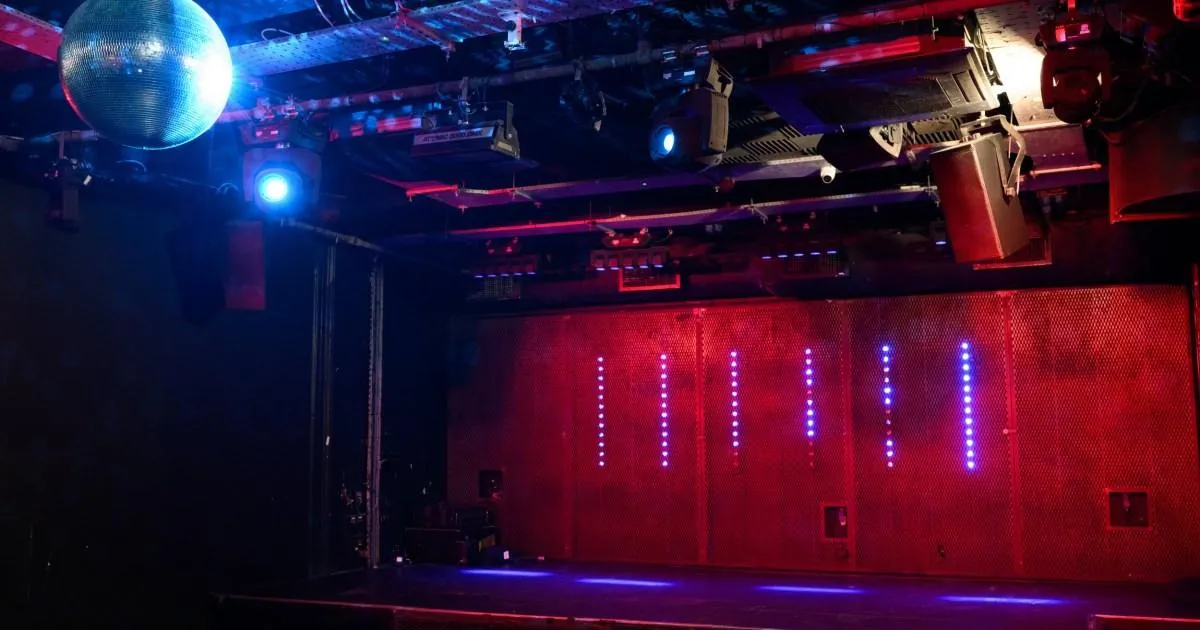
The iconic Camden Barfly stage. The room can fit around 220 people (Picture: Justin Griffiths-Williams)
Backstage at the Barfly (Picture: Justin Griffiths-Williams)
The venue has been somewhat quiet over the last 10 years, having lost its identity as one of the main grassroots venues in the city.
It was sold and became the Camden Assembly, where live music and gigs were still put on. Yungblud, Olivia Dean and the Last Dinner Party all played there – but without the legendary barfly name
Be rozzo, who was one of the founders, says he is ‘abolsuted delighted’ the venue is coming back.
Advertisement
Chris McCormack (left), Dan Ickowitz-Seidler (middle) and Be Rozzo (right) are part of the team relaunching the venue (Picture: Justin Griffiths-Williams)
The stairs leading up and down the venue (Picture: Justin Griffiths-Williams)
He said: ‘This place was very much my life at one point. My flat was literally metres away, and I was always on hand when help was needed.
‘So when I walked past it and saw it wasn’t running as Barfly, it was quitre sad really.’
Be has been consulted on may of the decisions bringing the venue back, as they want to capture what made it so great in the first place.
‘I played my best shows here’
Chris McCormack played some of his first gigs at Barfly (Picture: Justin Griffiths-Williams)
Chris McCormak, guitarist for 3 Colours Red, played at Barfly ‘more times than he can count’ during his music career.
He said the venue was home to his favourite shows, as the packed, lively room which can fit around 220 people offered sound quality most-often seen on more high-brow stages.
And it was here he was signed by an agent standing on the staircase.
Advertisement
He told Metro: ‘It was one of those things where he asked to sign me. I said a ridiculously high price as a joke, and he agreed.’
‘This place holds so many happy memories for me, I can’t wait to play here again.’
A sneak peak backstage
From left to right: Chris, Dan and Be sat in the artist’s backstage room (Picture: Justin Griffiths-Williams)
Metro was also shown around the backstage dressing rooms where artists would get ready before shows.
Climbing up three flights of stairs lit up with red lights, the room suddenly becomes bright.
Singers including Adele and Amy Whinehouse have all sat back and relaxed in the rooms, but this time they have been modernised with a flat screen TV and a mini snooker table.
Advertisement
Frank Turner will be taking to the stage tonight to officially reopen the venue. And upcoming shows include Violet Grohl in September.
Dan said: ‘Barfly means so much to us all, and we’re honoured to be starting a new chapter in its story.
‘We’ll be announcing more very special shows shortly, but Frank Turner is the perfect artist to relaunch the Barfly stage. He embodies everything Barfly stands for.’
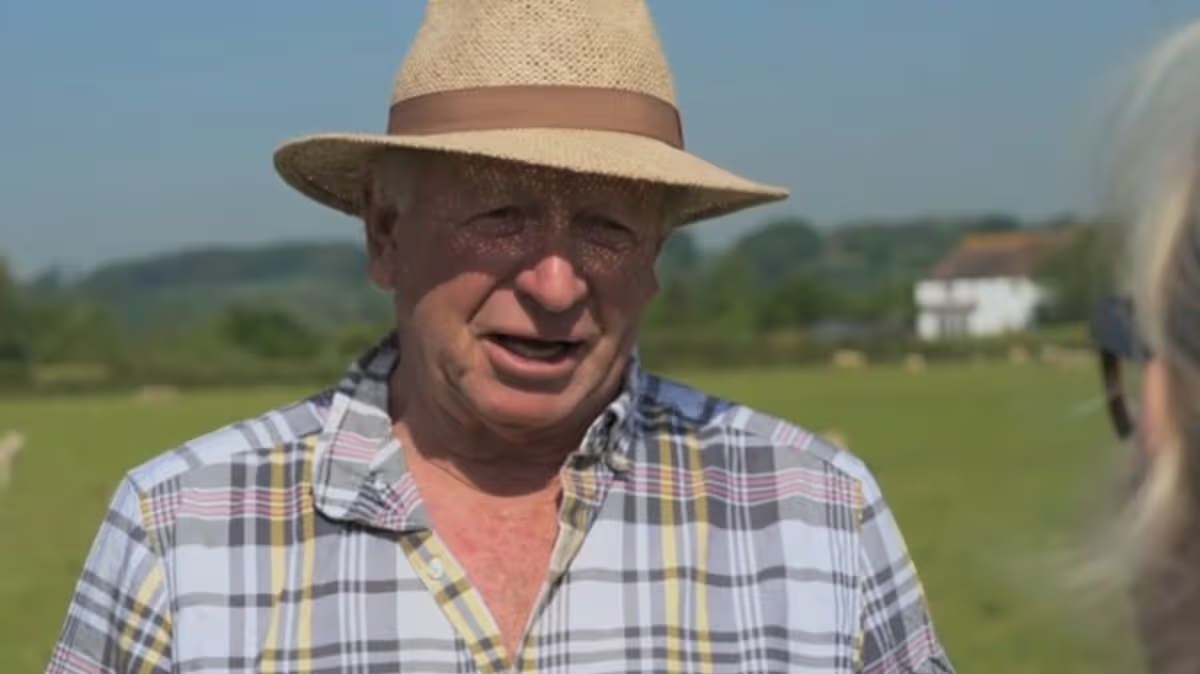
Countryfile presenter Charlotte Smith visited East Sussex to speak to farmer Frank Langrish about the impact of UK seasonal worker visa changes on sheep shearing
Tianna Corbin TV Reporter
21:20, 21 Jun 2026Updated 21:21, 21 Jun 2026
Presnter Charlotte Smith travelled to East Sussex during the most recent episode of the BBC programme to speak with farmer Frank Langrish about visa alterations affecting one particular group of workers.
With approximately 4,000 sheep in his flock requiring shearing, he discussed the matter of overseas sheep shearers being permitted to work in the UK for a longer period.
Advertisement
The Countryfile star informed viewers: “With a short window of a few weeks to shear, Frank says the job can mean the difference between life and death for some of his flock.”
He explained to the BBC presenter that at this time of year, the sheep carry extremely heavy fleeces, which could cause them to become stuck and, within a short period, perish.
He further revealed that they could also get ‘eaten alive with maggots’ as the warmth attracts flies, underlining the urgency of removing the wool from the sheep promptly.
As Charlotte explained to viewers, roughly 15 million sheep require shearing across Britain, a task that typically falls to farmers themselves, though some operations bring in additional specialists to assist, reports the Express.
Countryfile viewers discovered that professionals from Australia and New Zealand travel over to lend a hand, as they are capable of shearing hundreds of sheep daily. Frank recalled that he once employed a young woman who could shear 400 sheep in a single day.
Commonly referred to as Antipodean shearers, they have been a staple of British farming for many decades. However, earlier this February, the government announced it would not be permitting foreign shearers to work in the country over the summer.
Although the government subsequently announced a temporary visa reprieve, permitting overseas shearers to work in the country for one final summer.
Advertisement
This year, for the first time, individuals were required to pay £700, a figure expected to rise considerably next year should they opt to use a two-year Youth Mobility Scheme visa.
While Frank is able to call upon trained family members to assist on his farm, he raised concerns about what the changes to visa regulations could mean for others.
He told Charlotte: “I’m very worried because, you know, it’s not only going to add a lot of extra cost, but the animal welfare issues will be huge.
Advertisement
“We are a relatively well-organised, but there are lots of smaller farmers who really won’t get the shearers to come in and do the sheep at all.”
Despite the government being unavailable for an interview with Countryfile, the Home Office informed the BBC programme that ‘this had been the final extension for visa concessions. ‘.
Charlotte told viewers: “A government spokesperson said such concessions were temporary and designed to give sectors in the UK space to build a resilient, domestic workforce.
Advertisement
“They said they’ve been working closely with the farmers’ organisation British Wools to train more sheep shearers, adding that ‘Since 2021, the the British Will] have invested more than £67,000 to support over 800 trainees and produce 317 commercially qualified sheep shearers.’”
The BBC presenter explained that the government had announced temporary visa arrangements, which have offered a ‘much-needed’ supply of commercial shearers while domestic training continues to expand.
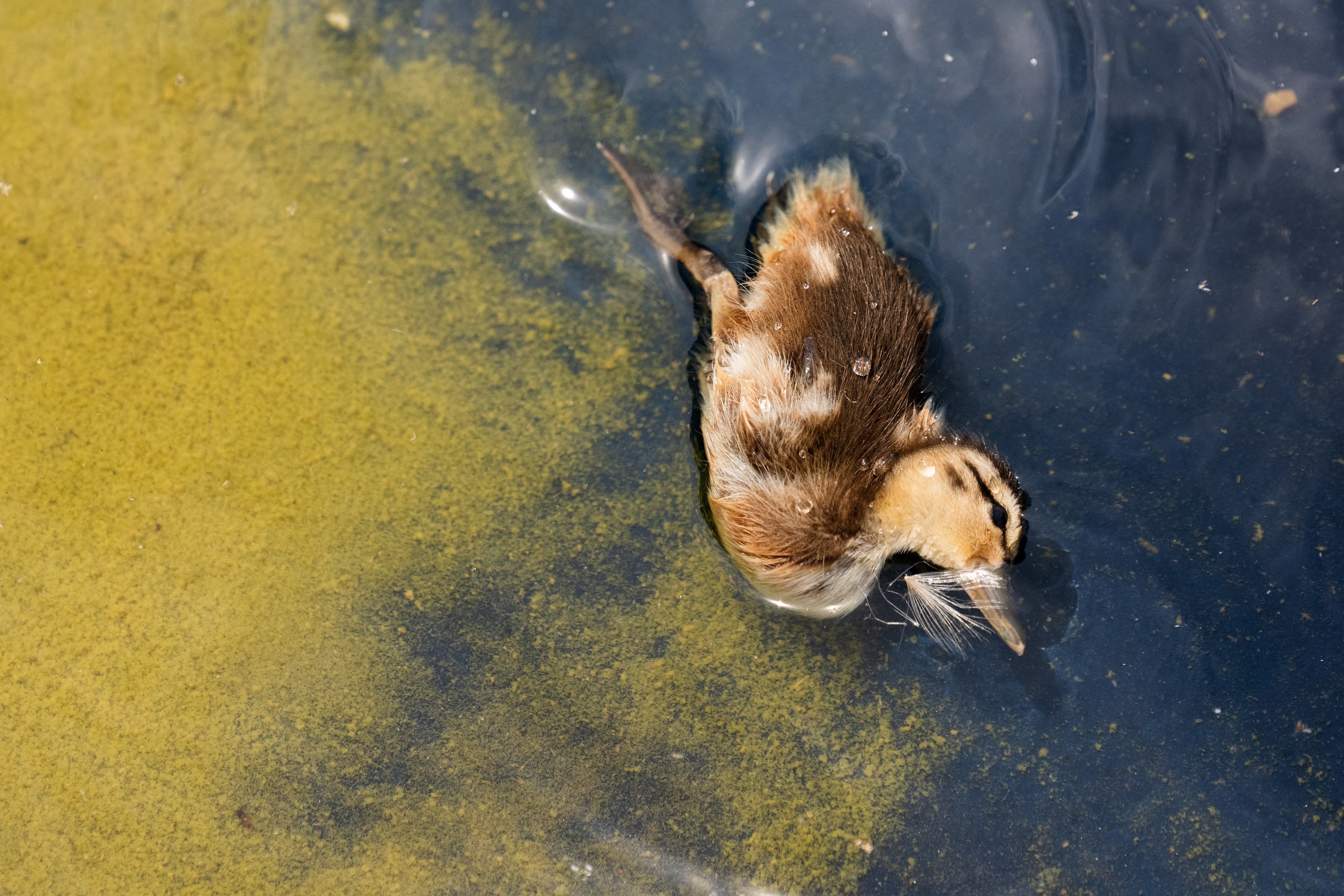
A duckling was found dead Sunday in the Lincoln Memorial Reflecting Pool, marking the latest — and most tragic — twist in President Donald Trump’s troubled, $14.7 million renovation of the iconic Washington landmark.
Photos showed the poor creature floating in algae-fouled water after local U.S. Attorney Jeanine Pirro vowed to aggressively prosecute anyone accused of vandalizing the popular attraction on the National Mall.
During an appearance on Fox News’ The Sunday Briefing, Pirro — a former network host — said that “there are several citations that have been handed out to individuals. And these are cases that will be prosecuted to the full extent.”
“And if you damage, vandalize or do anything to impact something like the Reflecting Pool, you can be prosecuted,” she added.
Advertisement
The cause of the duckling’s death was unclear, and neither the National Park Service nor the Interior Department immediately returned inquiries from The Independent.
The duckling’s cause of death wasn’t immediately clear (Reuters)
Trump ordered that the Reflecting Pool be renovated ahead of the nation’s 250th Independence Day celebration on July 4 and took credit for selecting the “American flag blue” sealant for its basin.
Hydrogen peroxide is generally considered less dangerous to the environment than chlorine bleach because its components easily break down in water, but in high concentrations it can post a risk to ducks and birds who swim in the pool, according to The New Republic.
Advertisement
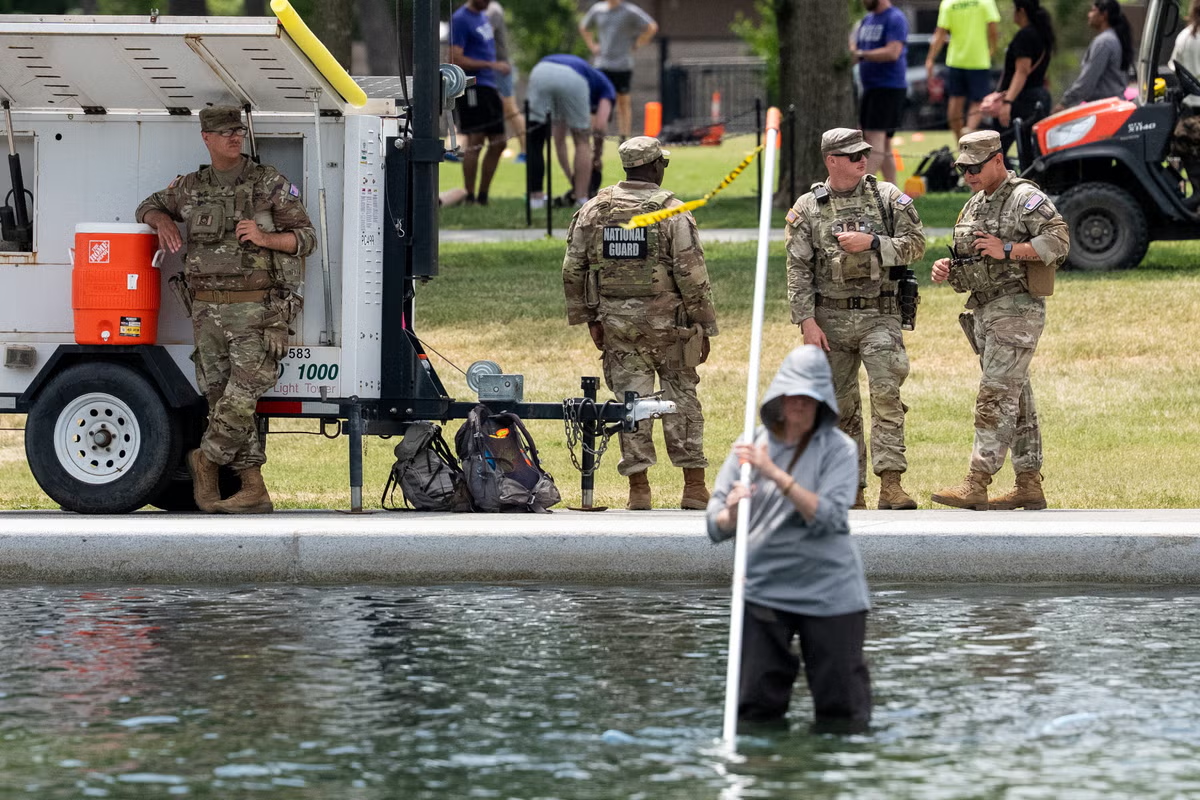
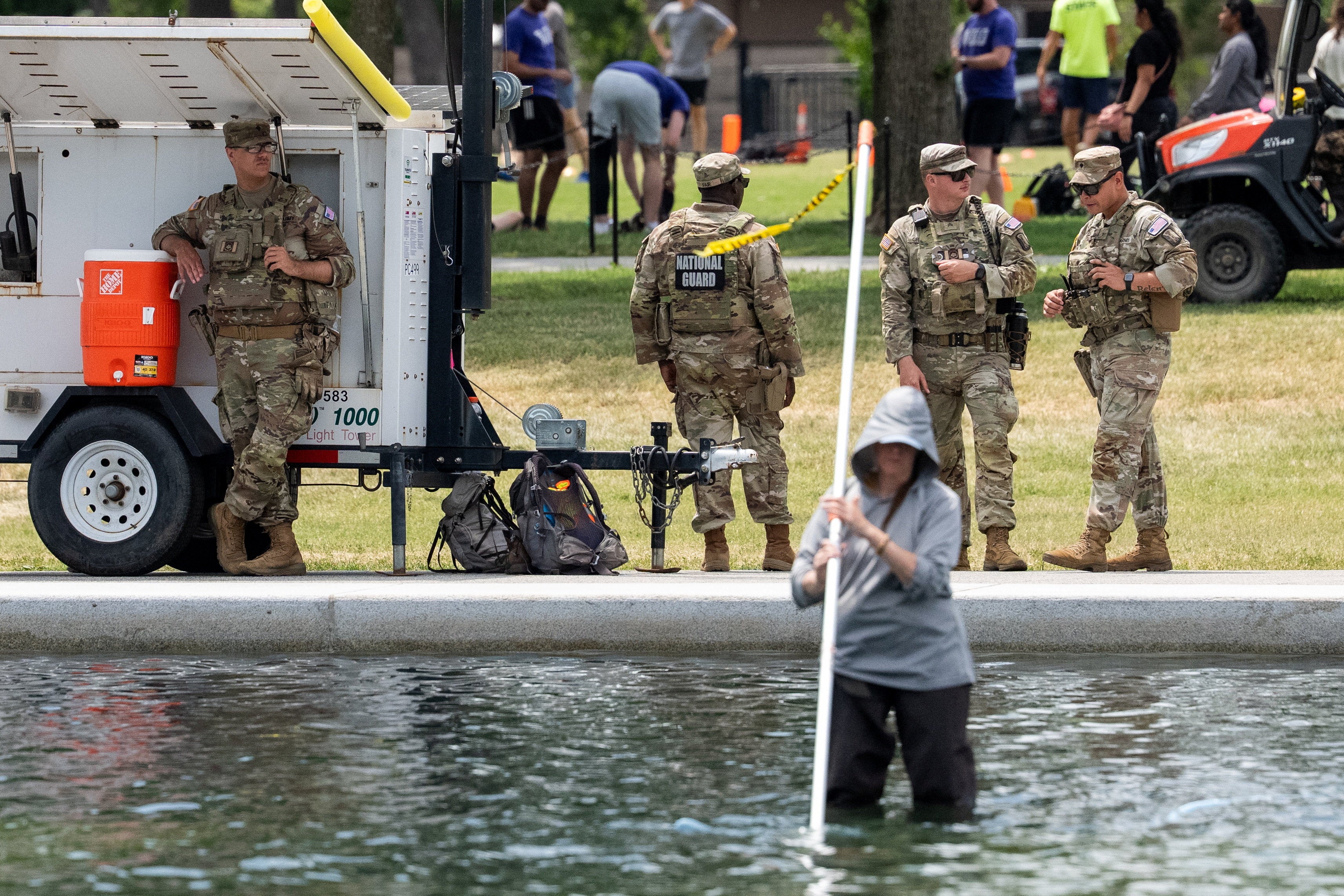
Workers in hip waders have been physically removing algae from the water and the Interior Department has said it’s also using nanobubble ozone technology to combat the aquatic, plant-like organisms.
A dead duckling was found in the Lincoln Memorial Reflecting Pool, where repair work continues under watch by the National Guard (Reuters)
On Wednesday, the online MeidasTouch Network reported that an email sent to National Park Service employees seeking people to help with “critical pre-July 4th operational needs” at the Reflecting Pool.
The email reportedly declared the “scrubbing and pump out operations” were a “regional and national priority” that required willing personnel to work daily, 12-hour shifts through the weekend.
Trump on Friday claimed without evidence that vandals were responsible for the pool’s dismal state and he repeated that assertion throughout the weekend, saying Sunday that work would “begin immediately” to repair the “seriously vandalized Reflecting Pool.”
”I just inspected it, and could only say to myself, and those gathered around me, WOW, who would do such a thing? SICK, DERANGED PEOPLE!” the president wrote on social media.
Advertisement
On Friday, three-time Olympic canoeist David Hearn, 67, was arrested by Park Police officers and charged with misdemeanor destruction of government property for allegedly vandalizing the pool.
The following day, the Bethesda, Maryland, resident admitted reaching into the pool to touch a “flapping piece” of sealant but denied causing any damage.
“I didn’t vandalize anything,” he told The Washington Post. “I didn’t destroy or break or peel anything. By the time I realized what was going on, I was being put in handcuffs.”
Later Saturday, Trump claimed without evidence that the Park Police had “arrested multiple individuals” for vandalizing the pool and threatened, “Years in jail!”
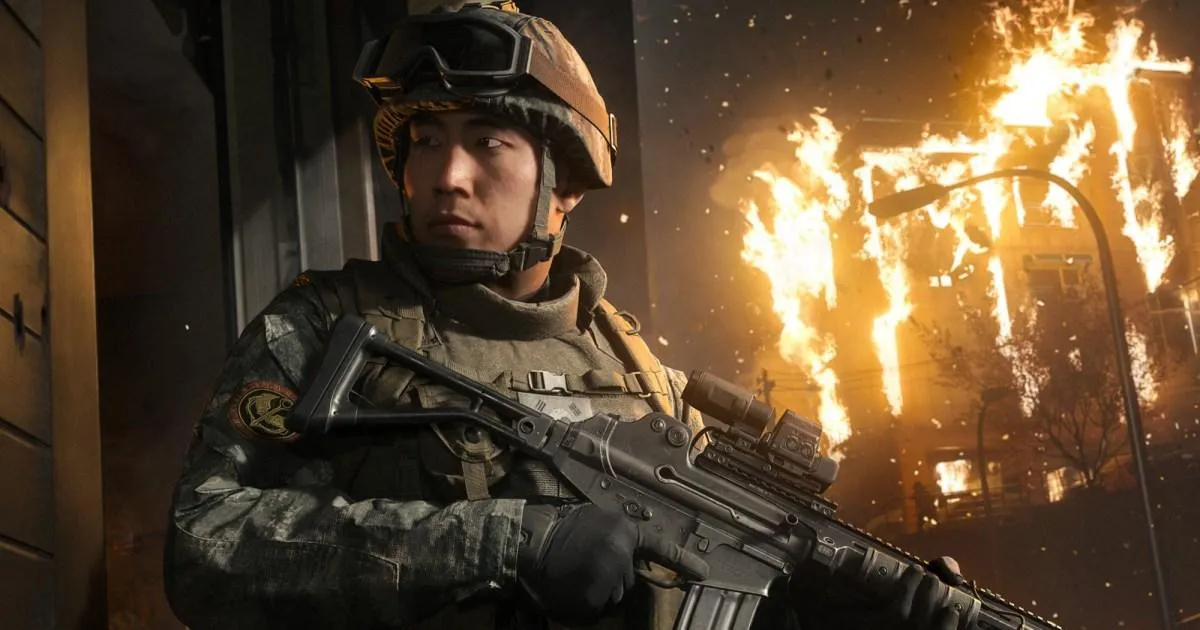
Call Of Duty: Modern Warfare 4 is a very important sequel (Activision)
The Monday letters page is getting very excited about GTA 6 pre-orders, as a reader suggests IO Interactive could make a Mission: Impossible video game.
Games Inbox is a collection of our readers’ letters, comments, and opinions. To join in with the discussions yourself email gamecentral@metro.co.uk
The cost of failure A lot of us would probably be glad if Call Of Duty went the way of the dodo, and consider it something worthy of a great laugh if it happened just after Microsoft bought Activision. A few years ago I would’ve definitely thought that, but now that I’m a bit older and wiser all I can think of is the poor wage slaves who will be sacrificed because their bosses made dumb decisions.
Call Of Duty has been without a direction for years, and just coasting by on its name, and the fact that it’s now in trouble shouldn’t have come as a surprise to anyone sensible. Although as we see, those sort of people are rarely in charge of games companies.
Advertisement
So now we’re hearing that nobody’s interested in Modern Warfare 4 and it could end up being just as big a flop as last year’s game. But before you start celebrating that the witch is finally dead, remember just how popular Call Of Duty is and how far it’s got to fall before it’s not economically viable. It’s going to be around for a decade even when it’s a dead man walking.
It’s going to be a long painful death and hundreds, if not thousands, of people are going to lose their job. It’s not too big to fail but it is too big to not go quietly. Taylor Moon
Expert, exclusive gaming analysis
Sign up to the GameCentral newsletter for a unique take on the week in gaming, alongside the latest reviews and more. Delivered to your inbox every Saturday morning.
Advertisement
Games bill I don’t get why people don’t know why people pre-order games. Not only do you get the odd bit of extras included but it’s about budgeting. What with bills like energy and food prices going up on nearly a daily basis it’s about guaranteeing you can afford it and knowing you won’t spend that money on anything else on the store.
I’ve got £130 in my PSN wallet and on the 25th I’ll be pre-ordering not because they might run out of a digital game but so I can say, yes I’ve paid for it and that money is gone. People say gaming is getting more expensive, well so is living a normal life with bills going up all the time that’s why we pre-order. David
Same old story With all this talk of studios being shutdown I did a quick google and it was interesting to see Sony is in the lead with it closing 14 studios since 2012. Microsoft has closed down 12 since 2007 (looks like they may take pole position soon). Nintendo, a grand total of zero since entering the industry.
Advertisement
We hear a lot of late, on Nintendo not buying a lot of studios, but I’d rather they didn’t if they are only going to buy them to close them down the line, like the other two.
On the other hand maybe independent studios shouldn’t be swayed too much by the big bucks on offer from Sony and Microsoft, if they actually cared about the studios.
Those that don’t learn from history are bound to repeat it or something… Anon
Promoting the Commodore The Kickstarter for the Commodore 64: The Birth of a Cultural Icon documentary has just launched which is about the Commodore 64 computer and it’s games. The documentary is being made by the people who made The PlayStation Revolution documentary and The Rubber Keyed Wonder documentary, among other classic computers documentaries and their games.
I didn’t own a Commodore 64 but I would of played some of the games from the C64 on my Amstrad CPC 464. I know there is at least one Commodore fan among GameCentral readers, besides me (Commodore Fan). I’ve backed the Kickstarter for a physical copy but you can back it for a digital copy for less money. Andrew J. Just completed: Eriksholm: The Stolen Dream (PC) – I highly recommend it if you like the Plague Tale games. Although there is no rats in it, it has you using stealth and distraction to get past stronger enemies, much as you do in the Plague Tale games.
Second choice If Amazon takes the Bond licence away from IO Interactive they will be absolutely crazy, if you ask me. But money’s involved so we can’t count on there being a sensible outcome.
Advertisement
If the worst happens I wonder if IO could get the Mission: Impossible licence instead? It’s not as big but Tom Cruise would probably be quite interested in helping, because he can’t really do the stunts anymore and the series has ended.
Mission: Impossible doesn’t have anything like the history and traditions as Bond though, so I really hope Amazon do the sensible thing, because 007 First Light is my game of the year. Diem
Dream edition Grand Theft Auto 6’s pre-order date being unveiled as June 25th is the highlight of last week, when it comes to the gaming news circulating. For many and myself, it’s the early coming of Christmas. Because even if it certainly kills me, I am snagging that collector’s edition no matter what. I’ve never done so for any other game, but has there ever been a title such as highly anticipated, as Grand Theft Auto 6? Certainly not in living memory.
Instead of celebrating in joyful merriment, the fans and trolls are partaking in nitpicking. Judging a mere glimpse as lacking in reflections, or prowess on a technical scale. It is petty to say the very least, but for my personal opinion on the topic at hand, it would have sufficed more positively if the glimpse was of daylight.
Advertisement
A city brimming with neon and colour is suited to a daytime preview. Choosing that shot and proceeding with it as the final cut, is a very milquetoast presentation. That, however, heightens the expectations of a third trailer very much. At least it should officially open the floodgates for every storefront, digital market, and site to crash simultaneously, just as Silksong did.
I am deeply hoping the collector’s edition is also revealed and I am able to secure it. It’s my first ever buy and considering the eventual steep price tag, it will have to be justified. My main worry is that the game will not be included in the package. It’s been seen time and time that certain editions fail to bear fruit, in that regard. It would also affect the goodwill that has been generated thus far. If the game is included with the edition, my wallet is ready to endure the pain. If not, my heart shall endure. Shahzaib Sadiq
GC: A collector’s edition has neither been announced nor leaked, it’s just assumed.
Good security So, on Thursday we’re going to get the price of GTA 6 and probably find out about the other editions. Seems wild to finally be sorting out this kind of detail after literally years of waiting and endless delays.
Advertisement
After that it’s going to be full speed ahead on the hype, the marketing, and the silly fan theories. Has a single one of them been true since the game was announced? I kind of like the fact that no one really knows what to expect other than the obvious. Whatever Rockstar is doing to keep their secrets I approve. Flint
Don’t miss Gaming news! Add us as a Preferred Source
As a loyal GameCentral reader, we want to make sure you never miss our articles when searching for gaming stories. We have all the latest video games news, reviews, previews, and interviews, with a vibrant community of highly engaged readers.
Click the button below and tick Metro.co.uk to ensure you see stories from us first in Google Search.
GameCentral has been delivering unique games news and reviews for over a decade
The shape of things to come A lot of people have pointed out that Nintendo has two N64 remakes coming out this year (Star Fox and Zelda: Ocarina Of Time) and I’ve been trying to figure out if this is a coincidence or a sign of things to come. A remake of Star Fox is the quickest way to get something out there and see if people are interested in a new game. And an Ocarina Of Time remake is, I think, the Nintendo game almost nobody would object to seeing a remake of.
But assuming they’re both hits what happens after that? Will they make more remakes? Zelda: Majora’s Mask and F-Zero GX look like pretty good options to me but there are lots of games that could be suitable.
Will Nintendo start to use remakes the way they used Wii U ports for the Switch 1? They’re not as quick or easy to make but the big name ones are virtually guaranteed to be a hit. Thing is, I don’t know how I feel about that. A part of me does want to see these come back and be modernised but I don’t like the idea of Nintendo devs spending time remaking old games when they could make new ones.
Advertisement
They all sound like a good idea until you realise a massive team has got to spend four or five years making them, tying them up for a long time. Vate
Inbox also-rans Saros is such a frustrating game. I want to love it because of the action but I just hate the story and the atmosphere. Returnal is definitely better, in my opinion. Sanders
Saw a rumour that Gears Of War: E-Day has a budget of $400 million. Even if that’s not true the fact that we can’t instantly rule out because it’s too much blows my mind. And they made that an Xbox console exclusive?! Rinda
The small print New Inbox updates appear every weekday morning, with special Hot Topic Inboxes at the weekend. Readers’ letters are used on merit and may be edited for length and content.
You can also submit your own 500 to 600-word Reader’s Feature at any time via email or our Submit Stuff page, which if used will be shown in the next available weekend slot.
You can also leave your comments below and don’t forget to follow us on Twitter.
Shaun Burton, 60, was at the controls of an East Midlands Railway service when the crash occurred, killing him and injuring 100 others
Carrington Walker Live News Journalist
18:02, 21 Jun 2026Updated 18:09, 21 Jun 2026
The train driver killed in Friday’s collision near Bedford has been identified as Shaun Burton, aged 60.
Mr Burton was at the controls of an East Midlands Railway service travelling from Corby to London when it struck the rear of another train heading from Nottingham to the capital, reports Nottinghamshire Live.
Advertisement
In a statement, his family said they were “devastated by his loss” and extended their sympathies to all those affected by the crash. “We are devastated by his loss. Our thoughts are also with those affected by this incident,” the family said in a statement released by the British Transport Police, alongside a photograph of Mr Burton, while requesting privacy as they begin to come to terms with their grief.
Passengers aboard the Nottingham service described the collision as “bewildering and frightening”. Speaking to the BBC, Alistair Adamson, who was travelling on the Nottingham to London St Pancras train, said he feared an explosion following the initial impact.
“All of a sudden, a really big impact,” he said. “I immediately felt myself lurching forward and saw my colleagues across from me getting thrown around.”
Advertisement
The incident left 100 people injured, 11 of whom sustained serious wounds, while 57 suffered minor injuries, the East of England Ambulance Service (EEAS) confirmed. Buckingham Palace announced that King Charles was “greatly saddened” by the rail crash and that his “thoughts and sympathies are with the family of the deceased and with all those injured of affected by such a tragic incident”.
Dave Calfe, general secretary of Aslef, the train drivers’ union, said: “We are all heartbroken by the death of Shaun Burton which leaves a hole in the lives of his family, friends, and colleagues, which will never be filled. Shaun, a driver at East Midlands Railway, joined the railway relatively late in life.
“He loved public transport – he used to work on buses and coaches – before he became a train driver seven years ago. He was dedicated to the job, and devoted to his colleagues and enormously popular at his depot.
“The railway family grieves his passing; no-one should go off to work in the morning and not come home. Our thoughts are with his family and friends tonight.”
Advertisement
The crash occurred on Friday afternoon, June 19, when the 4.40pm EMR service from Corby to London St Pancras slammed into the rear of the 3.50pm service from Nottingham to London St Pancras.
The incident took place near Bedford, leaving 100 people injured in total, of whom 11 sustained very serious injuries, 32 suffered serious injuries and a further 57 walked away with minor injuries.
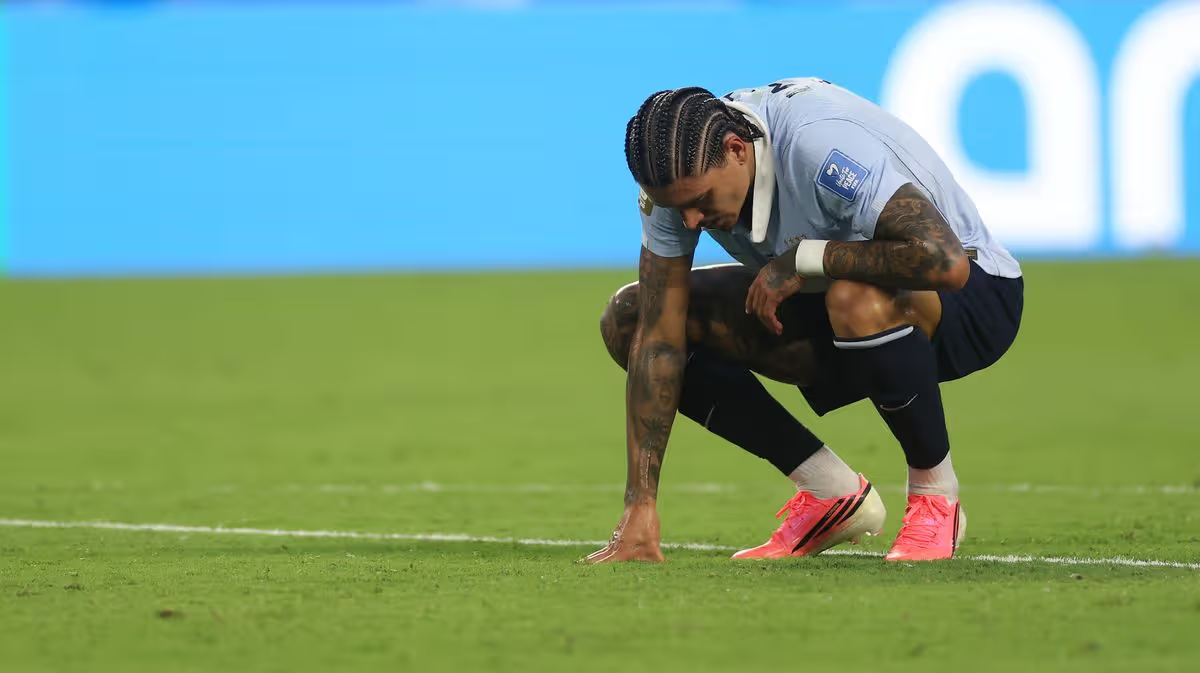
Liverpool Premier League-winner Darwin Nunez was dropped amid criticism following Uruguay’s 1-1 draw with Saudi Arabia, he came on against Cape Verde as they avoided a World Cup shock
01:37, 22 Jun 2026Updated 01:39, 22 Jun 2026
Former Liverpool striker Darwin Nunez couldn’t inspire Uruguay as they struggled in a 2-2 draw with World Cup minnows Cape Verde. The 26-year-old was dropped by Marcelo Bielsa ahead of the clash with the South Americans looking to respond after their 1-1 draw with Saudi Arabia in the opener.
Nunez was introduced with 20 minutes remaining as he was handed the responsibility of leading the Uruguayan attack and dragging them over the line. The Al-Hilal striker was a threat and showed promising signs, including a cross that captain Fede Valverde couldn’t convert from close range, in an embarrassing night for Uruguay.
They now need to pick up at least a point against Spain in their final Group H match to be in with a chance of progressing to the knockout stages. As it stands, they sit second on two points, level with Cape Verde who face Saudi Arabia.
Advertisement
But the pressure will build on the former Leeds United head coach after struggling against the nation ranked 67th in the FIFA world rankings amid reports that the squad is already fractured.
Uruguayan icon and former Liverpool striker Luis Suarez watched on from the stands and was animated throughout the contest. Cameras panned to the veteran striker after the full-time whistle as he looked crestfallen with his nation’s World Cup hopes hanging in the balance with the need for a result against Spain to bolster their chances of progression.
Last week, reports suggested that Nunez was set to re-sign for Liverpool after the World Cup as part of the rebuild under new head coach Andoni Iraola. Speculation emerged from South America that the 26-year-old, who won the Premier League before the lucrative move to Saudi Arabia, has signed a deal to return to Merseyside but first had his sights set on the World Cup across North America.
The noise surrounding such a sensational return has simmered with numerous outlets dismissing the suggestion. On the pitch, Nunez’s struggles continued after a nightmare in the Middle East with Al Hilal, where he was de-registered in order for Karim Benzema to be included in his place.
The striker’s goal drought for his country will stretch ever-closer to two years when they take on Spain on June 27 (1am) after Nunez last found the back of the net for Uruguay on June 28, 2024 when he scored once in their 5-0 rout over Bolivia at the Copa America.
But against Cape Verde, he couldn’t do much more after the Uruguayans shot themselves in the foot on multiple occasions. They found themselves behind in the first-half after Kevin Pina’s long-range free-kick stunned Fernando Muslera.
A quickfire two-goal salvo from Maxi Araujo and Agustin Canobbio on the stroke of half-time turned the game in their favour.
Advertisement
However, a huge mistake at the back from Mathias Olivera was punished as Cape Verde equalised. The Napoli defender miscued a clearance from their own throw-in, and as Muslera charged out of his goal to rectify the error, Helio Varela nipped in and fired into an empty net.
Speaking as part of BBC Sport’s coverage, former Premier League striker Benni McCarthy dismissed Uruguay’s chances against Spain: “You can’t (not) want to pick yourself up but in football, anything is possible. They will make themselves believe that they can get a result against Spain, I highly doubt it but what a complete missed opportunity for Uruguay.”


















































You must be logged in to post a comment Login