Connect with us
DAPA Banner
DAPA Coin
DAPA
COIN PAYMENT ASSET
PRIVACY · BLOCKDAG · HOMOMORPHIC ENCRYPTION · RUST
ElGamal Encrypted MINE DAPA
🚫 GENESIS SOLD OUT
DAPAPAY COMING

NewsBeat

Megalodon’s legendary life revealed by fossil rediscovery

Published

on

Megalodon’s legendary life revealed by fossil rediscovery

Museums are supposed to be havens for the collective cultural and scientific heritage of the planet, but specimens sometimes go missing.

Happily, they can also be rediscovered, as a new study shows, with the vertebrae of the legendary predatory shark known to the world under its old name of Megalodon (now properly Otodus megalodon) turning up on a museum shelf decades after they were seemingly lost.

The new paper takes another look at the size and growth of this giant shark that lived between 15 and 3.5 million years ago. The study confirms previous estimates that these animals might have been longer than 24 metres. To put that in context, even the most unnaturally exaggerated sharks in the Jaws franchise topped out at 10.5 metres. These were seriously big fish.

The work is based on an analysis of several 11-million-year-old vertebrae from one animal, found in Denmark. Apart from the jaws and teeth, shark skeletons are mostly cartilage, so vertebrae are rare and important. Compared to a tooth, they give a much better indication of the size of the owner and here these are the largest known of any O megalodon (23cm in diameter).

Advertisement
One of the study researchers, Mette Elstrup, holding a 10.8-million-year-old vertebral fossil specimen of Otodus megalodon, and a reconstructed O. megalodon jaw model in the background.
Museum of Southern Jutland, Denmark, Author provided (no reuse)

These important specimens were thought to have been destroyed in a move from the Geological Museum of Copenhagen (now part of the Natural History Museum of Denmark) to the Museum of Southern Jutland in 1989. The scientific records of them were limited to old photos and descriptions. A couple of these vertebrae have now turned up, having apparently sat on a shelf unrecognised for decades. This allowed for the new study, which also estimated that a newborn O megalodon might be 3.6 metres long and live for nearly a century.

How can museums and palaeontologists lose valuable fossils?

All manner of unlikely and unfortunate actions can lead to the loss of fossils from museums.

Most obviously this can happen during times of conflict. The second world war saw the loss of dinosaur fossils on both sides of the conflict. The original specimens of the sail-backed dinosaur Spinosaurus were destroyed in Munich by an allied bombing raid in 1944. Earlier, a number of specimens, including parts of the early dinosaur Thecodontosaurus, were destroyed in Bristol after an Axis raid in 1940.

Huge dinosaur skeleton suspended from ceiling.
Skeletal mount of the Spinosaurus at the Fukui Prefectural Dinosaur Museum.
Palaeotaku, CC BY-NC

These were not even the first losses from enemy action in international wars. In 1916, the Canadian ship SS Mount Temple was sunk by a German ship. Although it was mostly carrying wheat, it also had a cargo of dinosaur fossils from Alberta that were being moved to the UK. The cargo lists are vague so we don’t even know what dinosaurs were on board.

Indirect action could be problematic too. In 1941, the Chinese attempted to move as many as 40 specimens of “Peking man” (Homo erectus), the first of our relatives to have human-like proportions, to the US to try to save valuable early hominid fossils from the invading Japanese forces. They never arrived, and might have been lost at sea after the ship they were on was sunk. Although it’s possible they never even made it on board the vessel.

Advertisement

Things can also be simply lost or fall apart. An apparent giant sauropod dinosaur similar to Diplodocus was named by the US palaeontolgist Ed Cope in 1877 as Amphicoelias fragillimus. He described it from a single, incomplete, fragile, but giant, vertebra.

Cope gave differing measurements of the vertebra at various times, making it unclear quite how large it actually was. When he died, his collection was sold to the American Museum of Natural History, but they were never able to find this specimen. Given how fragile it was, it may simply have disintegrated on the shelf and been overlooked or thrown away.

Museums are not immune to losses either. If you have an enormous number of specimens (the Natural History Museum in London has an estimated 80 million objects in its collection), it is inevitable that one or two may simply get lost.

I’ve been an eyewitness to lost specimens turning up in a museum when a colleague spotted a dinosaur skull and pterosaur skeleton sitting on the wrong shelf like misplaced library books. Then there’s the more nefarious activities – I’ve heard of researchers deliberately moving specimens to make them hard to find so other researchers cannot examine them, and occasionally things are stolen from collections.

Advertisement

On top of this, natural disasters and accidents can wipe out history. The Fukushima earthquake and tsunami of 2011 in Japan caused major damage to the nearby Iwaki museum with damage to some of the fossils in their collections. And in 2018, one wing of the Nation Museum of Brazil in Rio de Janeiro burned down with the loss of many fossil specimens that were on display.

For all the examples raised here, museums are inherently safe places for specimens. There are millions and millions of fossils that have been held in institutions around the world for decades and even centuries. It is inevitable that accidents will happen, and that bad actors will cause occasional losses. Fortunately, at least on occasion these do reappear and give us some exciting new research opportunities.

Source link

Advertisement
Continue Reading
Click to comment

You must be logged in to post a comment Login

Leave a Reply

NewsBeat

Venezuela earthquakes highlight the limits of early warning systems

Published

on

Venezuela earthquakes highlight the limits of early warning systems

Earthquakes still arrive without warning. That is the hard truth scientists have been forced to accept, despite a decade of advances in artificial intelligence, satellite monitoring and dense seismic networks.

We are getting better at detecting earthquakes once they start. We are now better at estimating the damage they may cause. But we still can’t predict the exact time, place and size of a future earthquake.

That may sound like failure. It is not. Over the past ten years, earthquake research has become more realistic. Instead of chasing precise prediction, scientists have focused on what can actually save lives: better risk forecasting, faster detection and earthquake early warning systems that can give people a few seconds to act before the strongest shaking arrives.

A few seconds may not sound like much. In an earthquake, it can be the difference between standing under falling glass and getting under a sturdy table.

Advertisement

What is an early warning system?

Early warning systems work by detecting the first fast-moving seismic waves after a fault starts to rupture. These waves are less damaging than the stronger shaking that follows. Because electronic signals travel faster than seismic waves through the ground, alerts can sometimes reach people first. In countries prone to earthquakes such as Japan, Mexico, Taiwan and the US, even a warning of five to 20 seconds has been shown to reduce injuries and help protect infrastructure.

But the last decade has also shown the limits of these systems. They do not work equally well for everyone. People close to the epicentre may get little warning or none at all, because the earthquake waves arrive before the alert can be processed and sent. This is sometimes called the blind zone. It is not a design flaw. It is a physical limit.

Another lesson is that large earthquakes are often more complex than expected. They do not always rupture in one clean break. Some jump across several fault segments or trigger cascading ruptures. That makes it harder to estimate the size of the event quickly and can reduce the accuracy of early warnings in the first crucial seconds. The earthquake may still be unfolding while the warning system is trying to understand it.

Artificial intelligence is helping with this. Deep learning systems can detect earthquake signals faster than some traditional methods and can improve rapid estimates of location and magnitude. But AI has not solved the prediction problem. It still depends on high-quality seismic data and strong monitoring networks.

Advertisement
The 2026 Venezuela earthquakes caused extensive damage.
EPA/Ronald Pena R

Pocket seismic sensors

One promising development is the use of smartphones as seismic sensors. The earthquake network app is a public earthquake early warning system that uses smartphones. It turns users’ phones into motion sensors to detect earthquakes in real time. When an earthquake is detected, the app quickly sends warning alerts to users. Apps such as MyShake and Android earthquake alerts show that millions of phones can act as a distributed warning network. This is especially important for lower-income countries that cannot afford dense traditional seismic infrastructure. A recent global rollout of earthquake detection software (the earthquake network app) through Android phones expanded earthquake warning coverage to 2.5 billion people across 98 countries.

Research has also shown that technology alone is not enough. A warning only helps if people trust it, understand it and know how to respond. Public education, clear communication and simple protective actions such as identifying safe spots in the house, preparing emergency kits and practising mock earthquake drills matter just as much as sensors and software. A warning that confuses people is not much of a warning at all. For example, a new warning after every aftershock is not as effective as alerting people to a new major earthquake.

These lessons help explain what appears to have gone wrong in Venezuela. The country has not developed a mature nationwide public earthquake early warning system on the scale seen in countries such as Japan or Mexico. That means warning capacity was limited from the start. However some people received warnings seconds to minutes before the shaking began through Google’s Android earthquake alerts system.

Several weaknesses probably compounded the problem. If people live close to the rupture zone, the window for warning becomes extremely small. Early reports indicated two large earthquakes happened in quick succession, a pattern that would make rapid detection harder for any warning system. This seems to have created signal confusion in smartphone apps as well as national early warning systems.

Advertisement

The lesson from the past decade is clear. The biggest advances have not come from predicting earthquakes before they happen, but from improving how quickly societies detect them, communicate risk and respond. For at-risk countries such as Venezuela, the way forward is not complicated: invest in dense monitoring networks, protect communication systems, expand public education and build warning systems people can trust. Earthquakes cannot be stopped. But with the right preparation, disasters on this scale do not have to become tragedies of this magnitude.

Source link

Advertisement
Continue Reading

NewsBeat

Putin’s revenge: Kyiv is hit by huge drone and missile attack in Russian retaliation for Ukraine’s long-range strikes

Published

on

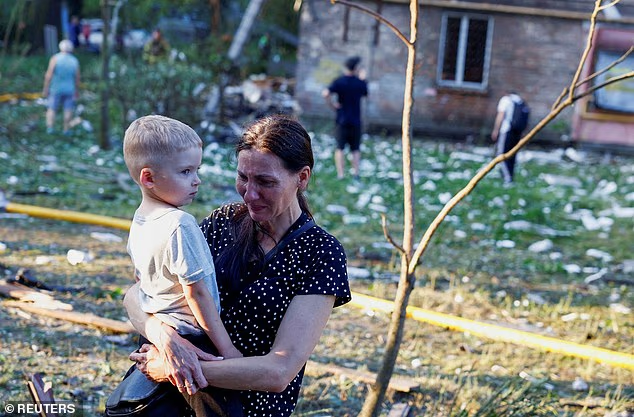
A woman cries holding a child near the site of an apartment building damaged during overnight Russian missile and drone strikes, amid Russia's attack on Ukraine, in Kyiv, Ukraine, July 2

Russian forces attacked the Ukrainian capital Kyiv on Thursday, killing at least 10 people and wounding more than 50, as drones and missiles struck residential buildings in what Russia said was a retaliation for recent attacks on its civil infrastructure.

Ukrainian President Volodymyr Zelensky had earlier warned of a possible overnight attack and said he was cutting short his visit to Dublin for the start of Ireland’s six-month term in the rotating presidency of the EU. 

Kyiv Mayor Vitali Klitschko, writing on Telegram, said 10 people were killed, while damage included six floors of an apartment building that had partially collapsed after a direct hit from a Russian projectile.

Reuters video footage showed emergency services working through the rubble of what used to be a nine-story building as the sun was rising over Kyiv and as fires flared up around the city.

Advertisement

Tymur Tkachenko, the head of the capital’s ​military administration, said 56 people, including two children, were injured and three dozen locations across the city had been damaged in the attacks.

‘The enemy has once again deliberately targeted residential neighborhoods and killed civilians. We have sustained extensive damage and a significant number of casualties, including children,’ he wrote on Telegram.

In an earlier post, Klitschko said the injured included paramedics and drivers at an ambulance station, and that some people were still trapped inside damaged residential buildings.

Pictures posted online showed a fire burning out of control at the top of a building on the central Shevchenko Boulevard, while elsewhere in the city, windows blew out and cars were destroyed.

Advertisement

A woman cries holding a child near the site of an apartment building damaged during overnight Russian missile and drone strikes, amid Russia’s attack on Ukraine, in Kyiv, Ukraine, July 2

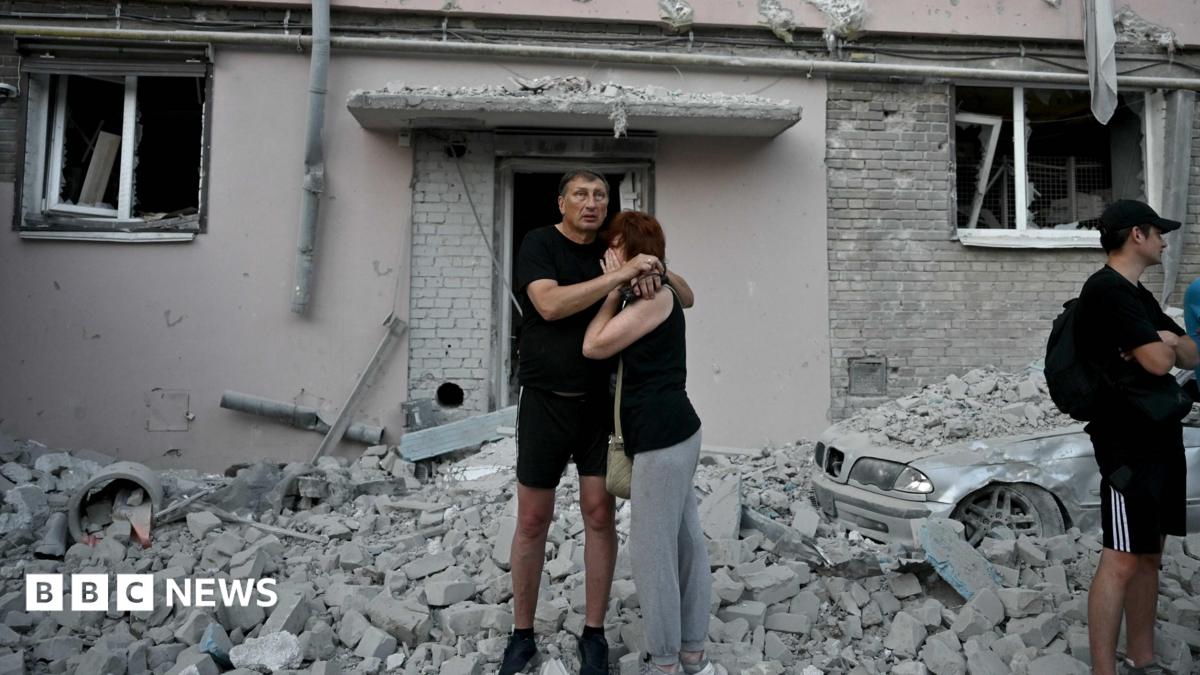
Residents react near the site of an apartment building damaged during overnight Russian missile and drone strikes, amid Russia's attack on Ukraine, in Kyiv, Ukraine, July 2

Residents react near the site of an apartment building damaged during overnight Russian missile and drone strikes, amid Russia’s attack on Ukraine, in Kyiv, Ukraine, July 2

Smoke rises over the city following a Russian air attack on Kyiv, on July 2

Smoke rises over the city following a Russian air attack on Kyiv, on July 2

Advertisement

Multiple explosions were heard in Kyiv, a Reuters witness said, and authorities in the region surrounding the capital said on Telegram separately there were also casualties there. 

People crowded into underground stations carrying children, belongings, tents and pets as air raid alerts were issued for most of Ukraine’s territory overnight in Russia’s worst attack on the country since mid-June.

‘Do not delay decisions on air defense for Ukraine! This is our main request to our partners after Kyiv suffered a night of horror,’ Ukrainian Foreign Minister Andrii Sybiha said on X as he visited Japan, a Ukraine ally, on Thursday. 

Neighbouring Poland, a NATO and European Union member, briefly scrambled fighter jets on Thursday as a preventive measure before calling those back and saying no airspace violation was recorded. 

Advertisement

Finland also briefly issued a temporary aviation restriction zone in the eastern Gulf of Finland before lifting it later, its defense forces said on X.

Russia’s Defence Ministry, in a Telegram post, said its ‘massive attack’ using long-range, high-precision air-, land-, sea-launched weapons and drones hit military and energy facilities, as well as airports in Kyiv and other locations.

The ministry said it was a retaliation for Ukraine’s attacks on Russian civil infrastructure, without elaborating. 

Russia downed 327 drones overnight, the ministry said. This number includes drones shot down over Russian-occupied parts of Ukraine.

Advertisement
Rescuers extinguishing a fire in a residential building damaged following missile strikes on the Ukrainian capital of Kyiv, amid the Russian invasion in Ukraine, on July 2

Rescuers extinguishing a fire in a residential building damaged following missile strikes on the Ukrainian capital of Kyiv, amid the Russian invasion in Ukraine, on July 2

Residents stand next to a crater formed at a site during overnight Russian missile and drone strikes, amid Russia's attack on Ukraine, in Kyiv, Ukraine, July 2

Residents stand next to a crater formed at a site during overnight Russian missile and drone strikes, amid Russia’s attack on Ukraine, in Kyiv, Ukraine, July 2

Tymur Tkachenko, the head of the capital's ​military administration, said 56 people, including two children, were injured and three dozen locations across the city had been damaged

Tymur Tkachenko, the head of the capital’s ​military administration, said 56 people, including two children, were injured and three dozen locations across the city had been damaged

Zelensky has proposed talks with Russian President Vladimir Putin to end the more than four-year-old war that the Kremlin leader has rejected. 

Advertisement

Ukraine has recently intensified strikes deeper into the Russian territory, triggering a widespread fuel crisis in the world’s third-biggest oil producer and forcing it to import gasoline from as far away as India.

The governor of the remote Russian region of Novosibirsk, Andrey Travnikov, said on Telegram the fuel crisis was worsening for the area more than 1,860 miles east of Moscow, and re-fueling priority would be given to emergency services.

Elsewhere in Russia, one person was killed, four people wounded and an industrial facility damaged in a drone attack on the Nizhny Novgorod region, Governor Gleb Nikitin said on Thursday. 

The region is home to NORSI oil refinery, one of Russia’s largest.

Advertisement

Governor Alexander Drozdenko of Russia’s northwestern Leningrad region, Putin’s home and where large export and oil refining facilities are located, said on Telegram that Russian forces brought down seven drones on Thursday.

In the Russian Belgorod region bordering Ukraine, a man was killed and his wife injured after a drone hit their home, local authorities said separately on Telegram.

Reuters could not independently verify details of the casualties. Russia and Ukraine say they do not deliberately target civilians.

This is a breaking news story. More to follow.

Advertisement

Source link

Continue Reading

NewsBeat

Maternity care needs more than answers: it needs change

Published

on

Another statutory inquiry into maternity care would be a mistake – here’s why

The Ockenden Review into maternity and neonatal services at Nottingham University Hospitals NHS Trust was damning. It confirmed what families, staff and previous reviews have been saying for years: the failures in maternity care are serious, repeated and systemic.

The Nottingham review examined more than 2,500 family cases and engaged with more than 830 current and former staff. It found long-standing failures, including women and families not being listened to, poor responses when things went wrong and missed opportunities to act on concerns that were raised consistently by staff.

Within days, a second review by Baroness Amos – the National Maternity and Neonatal Investigation – widened the lens by reviewing care across 12 NHS trusts. It found consistent national patterns: staffing did not match demand, services were under pressure from rising complexity and capacity problems, leadership was lacking, responses to harm were often slow or defensive and inequalities affected women’s experiences and outcomes. Families affected by the Nottingham scandal are now calling for a statutory public inquiry into maternity and neonatal care across England, arguing that “safe care can only be consistently delivered when the full truth is known”. That call deserves to be taken seriously. Accountability cannot be treated as optional.

But a decision to hold another inquiry must take into account the fact that public inquiries do not, in themselves, deliver change. They make findings and recommendations to inform change made by others.

Advertisement

A statutory inquiry has powers to compel witnesses to give evidence. A non-statutory inquiry does not have these powers. However, it does not follow that statutory inquiries are inherently superior. Each type of inquiry has its own strengths. Statutory status alone does not guarantee greater learning, better implementation or safer care. Patients don’t necessarily benefit when healthcare staff are subjected to prolonged scrutiny through overlapping investigations and inquiries, litigation, regulation, media coverage and internal reviews over many years.

A study found that medical professionals changed their practice in response to fear of litigation, inquiries, complaints or professional regulation. Researchers call this “defensive practice”: when doctors, nurses or midwives make decisions partly to avoid blame or complaints, rather than simply because they believe those decisions are best for the patient.

In maternity care, that might mean ordering extra tests, asking senior colleagues to approve decisions the doctors, nurses and midwives would usually make themselves, recommending an intervention earlier than needed, or writing longer records because they fear being criticised later.

A midwife or doctor may spend more time recording why they made a decision than explaining that decision to a woman in labour. They may ask someone senior to take over, not because the situation has changed, but because they feel exposed. They may recommend the option that looks safest on paper, even when the woman’s circumstances are more complex.

Advertisement

Those actions are not automatically wrong. In some cases, they may be exactly what safe care requires. The problem arises when fear starts to shape clinical judgment.

An international literature review tells us serious failures must always be investigated. But investigations that drag on for years without leading to change can make staff more cautious and less confident, without making care safer. It can encourage staff to protect themselves rather than use their judgment confidently, communicate openly and focus on what women and babies need.

Amos supports this concern. Across the trusts reviewed, staff described burnout, stress and heavy workloads. The report says staff were working under intense scrutiny, fearful of making mistakes and operating in what they experienced as a blame culture. It also found that structural and systemic problems can make compassionate care harder to deliver. Staff wellbeing is therefore a patient safety issue.

Our own ongoing research, carried out with maternity and newborn care staff working under years of scrutiny by multiple bodies, found a similar pattern. Staff described losing confidence in their clinical judgment, doubting whether their employer would support them if something unavoidably went wrong, and seeing public trust in the service collapse. Experienced clinicians left, or considered leaving, the profession altogether, because the distance between delivering high standards of care and the care they were able to provide was too great. The impact on mental and physical health was significant, showing how poor staff wellbeing should be considered a patient safety issue.

Advertisement

The case for caution is stronger because the central problems are already extensively documented. Reviews into maternity failures at Morecambe Bay, Shrewsbury and Telford, East Kent and Nottingham have all identified recurring failures in listening, leadership, staffing, governance, safety culture and organisational learning.

Amos makes the implementation problem impossible to ignore. Its report found a maternity and neonatal system that is fragmented, overly complex and too slow to learn. It also examined why avoidable harm continues despite repeated reviews and recommendations.

The issue is no longer a lack of evidence about the main failures. Recommendations have not been translated into reliable change. The government has responded to Amos by announcing a Maternity and Neonatal Commissioner, a National Action Plan due in December 2026, new national maternity triage standards and additional investment in maternity and neonatal facilities. These steps will only improve care if they have authority, funding, transparency and clear accountability attached to them. Most importantly, a concerted effort to address the cultural issues that have created the conditions for poor psychological safety and impeded the delivery of compassionate care.

Advertisement

Families are entitled to ask why so many warnings were missed, ignored or minimised. But the government should not allow calls for another large statutory inquiry to defer changes that are already evidenced.

Statutory inquiries are slow and resource-intensive. The government’s response to the House of Lords Statutory Inquiries Committee noted that statutory inquiries completed in the previous five years took nearly five years on average, with insufficient transparency and accountability around the implementation of accepted recommendations.

Where people may have acted dishonestly, unlawfully or in breach of professional standards, that should be pursued through professional regulation, disciplinary processes, inquests (where deaths are involved) and, where the evidence warrants it, prosecutions.

Individual accountability should not delay organisational and cultural changes already recognised as urgent. The question is whether another statutory inquiry is an effective route to safer maternity and neonatal care, or whether the most urgent need is implementation with transparent accountability.

Advertisement

Acting on Ockenden and Amos’s recommendations will mean funding the workforce and infrastructure needed to make change real, measuring progress publicly, and giving services enough stability to rebuild trust.

Appropriate scrutiny should continue. But it should be designed to enable learning and delivery of safe, compassionate care.

Source link

Advertisement
Continue Reading

NewsBeat

The annual Alex Lindsay Cup raises thousands for mental health charity

Published

on

Daily Record

A dozen teams turned out to honour the youngster in a knock-out tournament at Alex’s former school, Calderglen High.

The annual Alex Lindsay Cup pulled in an incredible £3500 at the weekend for a charity set up in memory of the much-loved 18-year-old.

Advertisement

Adored aims to raise vital awareness of mental ill-health in young men following the tragic death of the popular St Leonards teen in 2018.

Sunday’s event saw a dozen teams turning out to honour the youngster in a knock-out tournament at Alex’s former school, Calderglen High.

And Alex’s mum Jill said: “The weather in terms of the football players was probably perfect, because it wasn’t too hot and there was a bit of a wind.”

And she joked: “However for those of us with a stall and a gazebo up, the wind was not exactly ideal, there was a couple of moments where a couple of the gazebos went off to Oz, but it was all fine, it stayed dry. The important thing was to try and bring people out, and it went well.”

Advertisement

The Alex Lindsay Cup is held each year in memory of Alexander Iain Bonomy-Lindsay and raises funds for the family’s dedicated mental health charity Adored.

It has raised tens of thousands of pounds for mental health charities and remembers Motherwell FC fan Alex who tragically took his own life in July 2018.

As well as Adored being there on the day, grassroots mental health initiative Men with Issues was also present along with fitness, mindset and life coaching organisation No Limits Coaching, and Jill said it was potentially helpful for the crowds to link in with them, adding: “It was good for them to see that they were there, see that those agencies are out there.

“You just never know, one person noticing and thinking ‘Oh wait a wee minute, that might be useful for me’, that could be as simple as saving a life.”

Advertisement

The tournament was won for the second year in a row by The Other Team, who defeated Muirend in the final.

After the action on the pitch, everyone went along to a fund-raising after-party in the Village Inn.

Jill said: “We had less teams playing this year, we were down to 12 teams. I think the fact there was another football tournament going on at the same time and just other circumstances like the boys who have traditionally always played in the cup were generally people that Alex was friendly with and at school with, and these boys are now men of 28 years old, people’s lives move on, a lot of Alex’s friends have moved abroad and live away and all the rest of it.

Advertisement

“So I think what we need to do is try and bring fresh blood in, but it was very successful, the 12 teams played well, the runners-up were the team from Muirend, called ‘Muirend’ and the winners were the team called ‘The Other Team’, they won last year so that’s their second year winning.”

She added: “After the tournament we have our traditional after-party and it was down at the Village Inn, courtesy of Paul Jardine who gave us that venue for free, and Ross Martin, one of Alex’s friends who always does the live music, so he played his guitar and sang down at the Village Inn and that’s where we did the raffle draw.

“We had lots of good prizes, lots of local businesses like Ruby’s, Bond’s, Pergola, Once Upon a Table, Arigo all gave vouchers, lots of the barbers in the village gave vouchers.”

Advertisement

And looking forward to next year, Jill said: “I think one decision that we have made is that doing it up at the school is a good venue; we’ve tried different venues in East Kilbride but the school have never let us down, and it’s a good space for both the football and setting up any other vendors.

“And Mr Bell, one of the teachers from the school,he has been pivotal in all of the cups, that we’ve run. Every one, whether it’s been at Calderglen or not, he’s been there to help out and do whatever he can, he’s an absolute star.

“You get great teachers who go above and beyond, and he’s one of those people that go above and beyond, and I can’t thank him enough, his dedication to the tournament has been phenomenal.”

She continued: “I think what we’re going to try and do is get some younger teams involved, we’re going to start looking at the youth teams in East Kilbride to see if we could perhaps split the tournament and maybe have youth teams playing the morning and maybe eight teams have a mini-tournament, and then have another mini-tournament with the more mature players afterwards.

“But I think it’s really important that we keep the young people in East Kilbride involved in it, because really what the charity is doing is supporting young people in East Kilbride, so we want to try and link all of that together just so that more families, more young people in the community really begin to recognise Adored for the work they’re doing and recognise the link between the Alex Lindsay Cup and Adored, and the support for mental health within the community.”

And a special thank you went to event organiser Jack Smith, with Jill saying: “Jack was one of Alex’s closest friends and he was the person who set up the very first football tournament which was really a memorial tournament and what it’s turned out to be now is a supportive tournament for the charity which developed from it.

Advertisement

“Jack is the person who every year runs the tournament, he’s the one that seeks out all the football teams, he’s works tirelessly trying to make sure that it’s a really, really exciting event every year, making sure that the trophies are right, that the medals are right, organising all the prizes for the after-party as well, so it’s a massive thank you to Jack Smith because without his enthusiasm for the tournament it would probably have dwindled away and I know how dedicated he is in making sure it stays alive in Alex’s memory.”

And the Adored charity will be continuing its work in schools next term, with Jill saying: “We are excited to be working alongside South Lanarkshire Council in their new venture, their outreach venture, and I think what this is going to enable Adored to do is to help more people than if I was just accessing the schools myself.

“So I just feel that we’ll be able to broaden the horizon in terms of how many pupils we’ll be able to actually reach.”

*Don’t miss the latest headlines from around Lanarkshire. Sign up to our newsletters here.

Advertisement

And did you know Lanarkshire Live had its own app? Download yours for free here.

Source link

Continue Reading

NewsBeat

‘Two weeks after her death I got a call’: Thousands of Gaza patients still waiting for evacuation

Published

on

A woman with shoulder-length blonde hair talks into a microphone

The desperation of patients haunts Gaza’s hospitals – their exterior walls eaten away by gunfire and Israeli strikes, the health-care system inside them still unrepaired.

Eight months after the ceasefire deal instructed that “full aid” be sent into the Gaza Strip, aid workers say the continued lack of essential medicines and equipment has meant doctors are rationing or loaning each other essential life-saving drugs, or turning patients away from chemotherapy or dialysis appointments.

“The fact that the medical evacuation list is thousands long is a sign that people in Gaza don’t have access to what they should have – which Israel, as the occupying power under international humanitarian law, has an obligation to allow them access to,” said Pat Griffiths, spokesman for the International Committee of the Red Cross (ICRC) in Jerusalem.

Shortages, he said, run from basic consumables like gauze dressings and painkillers, all the way up to advanced medical equipment.

Advertisement

“There is no doubt in my mind that people in Gaza are dying because they can’t receive the care they need – and that there are preventable deaths happening because of the limits on what can be brought in, in terms of healthcare.”

Asked about the reports of critical shortages, Cogat said in a statement that 17,000 tons of medicines and medical aid had entered Gaza since the ceasefire, including wheelchairs, cancer medications, insulin pens, anaesthetics, X-ray machines, CT scanners, dialysis machines and medical consumables.

“Despite claims to the contrary,” it said, “Israel has approved every request for medicines submitted by international aid organisations.”

In response, one humanitarian official involved, speaking to me anonymously, said that Israeli authorities often used anecdotal examples to mask shortages of key medicines and equipment, and that aid supplies continued to be restricted.

Advertisement

“You don’t count medical aid in terms of trucks and pallets; that’s not a denominator we use,” said the WHO’s Reinhilde Van de Weerdt. “We talk about the needs patients have, and the needs that are met.”

“If medical supply is unrestricted, you don’t have these discussions about what is given versus what is needed,” she said. “We need certain buffer stock levels of medical supplies, [and] you can’t run a hospital hoping the generator doesn’t break down.”

Source link

Advertisement
Continue Reading

NewsBeat

People smuggler convicted in France now seeking asylum in UK, BBC discovers

Published

on

A woman with shoulder-length blonde hair talks into a microphone

Jamal’s case is not isolated. Law enforcement officers in Europe have told us they know of 15 people smugglers with convictions from courts in France, Germany and Belgium, who they believe are now living in the UK and claiming asylum under false names.

We learned about one man convicted in France, who is now living in Manchester selling used cars and thought to be still involved in people smuggling.

Another man, also with a French conviction, is based in Blackpool. He has claimed asylum under a false name and boasts on social media of being given leave to remain.

Since Brexit, the UK no longer has a data-sharing agreement with many countries in the EU, making it more difficult to check criminal and immigration records of asylum seekers, according to Lucy Morton of the Immigration Services Union.

Advertisement

“If we were able to share databases, even if just with our nearest neighbours, with Germany, with Belgium, with Holland and France, say – then, yes, we’d know that they had a conviction for people smuggling,” she said.

Asylum seekers are fingerprinted on arrival in the UK and checked against UK police databases, but these would not necessarily show a conviction from another country.

The Home Office told us: “All asylum claimants are subject to mandatory security checks to confirm their identity for the purpose of immigration, security and criminality checks.”

This point was also made last November, external by the Minister for Border Security, Alex Norris, who added that to protect the integrity of the checking processes, details about the checks “are not disclosed publicly”.

Advertisement

The Home Office went on to say that the UK has “a number of agreements with countries which enable the sharing of criminal record information”, and that immigration enforcement action is currently at its highest level in history, with arrests for illegal working up 83%.

Source link

Continue Reading

NewsBeat

Russia launches deadly large-scale missile strikes on Kyiv

Published

on

A woman with shoulder-length blonde hair talks into a microphone

Russia also hit military bases in central and eastern Ukraine, according to the Ministry of Defence, quoted in Russian media.

It claimed to have targeted Ukrainian defence and energy infrastructure in response to recent attacks on Russian power stations from Moscow to the Black Sea.

The attacks led to a rare concession by Russian President Vladimir Putin that his country was facing fuel shortages.

On Wednesday, Zelensky cut short his visit to Dublin after he said fresh intelligence had emerged suggesting that Moscow was planning to strike Ukraine.

Advertisement

“I urge our people to be especially careful, to protect themselves, their children, and, of course, their families,” he said.

He added that Russian President Vladimir Putin “has been preparing this massive strike against Ukraine for some time now”.

Poland has also activated fighter jets to protect its airspace, describing it as a “preventative” measure. There are no reports of attacks on Polish territory.

“These actions are of a preventive nature and are aimed at securing and protecting the airspace, especially in areas adjacent to the threatened regions,” Poland’s military wrote on X., external

Advertisement

Poland is a member of Nato, a signatory to the military alliance’s Article 5 provision that states “an armed attack against one Nato member shall be considered an attack against them all”.

Russian troops recently advanced into the city of Kostyantynivka, one of Ukraine’s last key bulwarks in the east. If Moscow secures the city, it would provide a gateway to the entire Donbas region.

Meanwhile, Ukrainian commanders say they have recaptured more territory this year than they have lost, disrupting Moscow’s crucial supply lines between the Russian border and occupied Crimea.

The war has otherwise stalled for months with each side’s troops largely entrenched in their positions.

Advertisement

Russia controls approximately one-fifth of Ukrainian territory, mostly seized in the first few months of its full-scale invasion in February, 2022.

Source link

Continue Reading

NewsBeat

Watch: People smuggler tracked down and confronted by BBC

Published

on

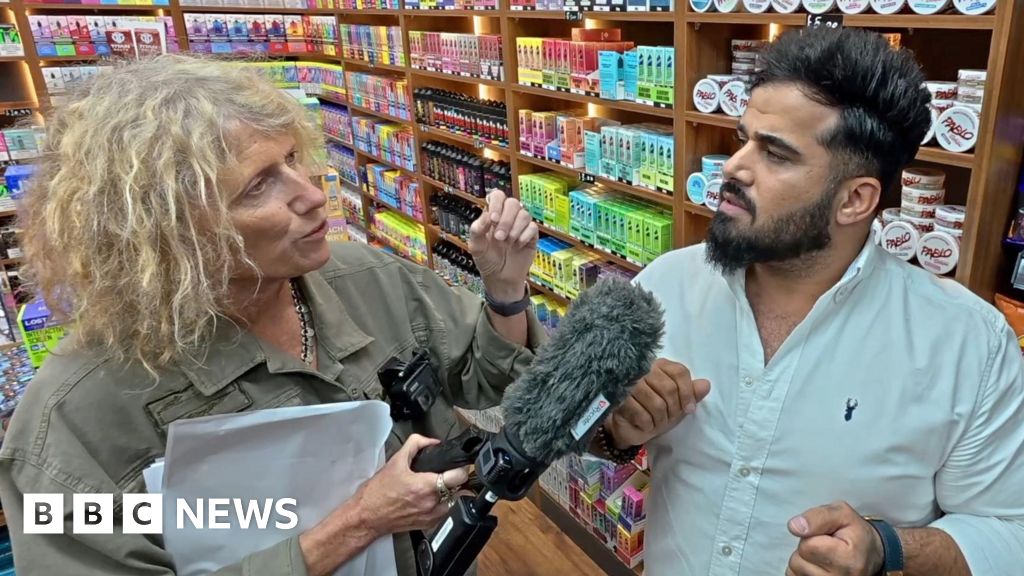
Sue Mitchell (L) holds microphone to Twana Jamal (R)

Convicted people smuggler Twana Jamal, once described as “the godfather” of the French migrant camps, is living and working in Leicestershire, and believed to be seeking asylum, a BBC investigation can reveal.

Jamal was given a five-year jail sentence in France in 2016. Following a tip-off this year, the BBC traced Jamal to Blaby in Leicestershire, where we witnessed him working illegally, driving a car without a licence and apparently using a false name.

We have also been told by law enforcement officials in mainland Europe that 15 other convicted people smugglers are now living in the UK under false names, raising serious concerns about whether existing border controls are effective in checking asylum seekers who have committed serious crimes overseas.

The Home Office told the BBC: “All asylum claimants are subject to mandatory security checks to confirm their identity for the purpose of immigration, security and criminality checks”, and that the UK has “a number of agreements with countries which enable the sharing of criminal record information”, adding that immigration enforcement action is currently at its highest level in history.

Advertisement

You can hear the full story now: Search for ‘To Catch a King’ on BBC Sounds

Source link

Continue Reading

NewsBeat

AP reporter recounts a month covering Ebola in Congo’s outbreak

Published

on

AP reporter recounts a month covering Ebola in Congo's outbreak

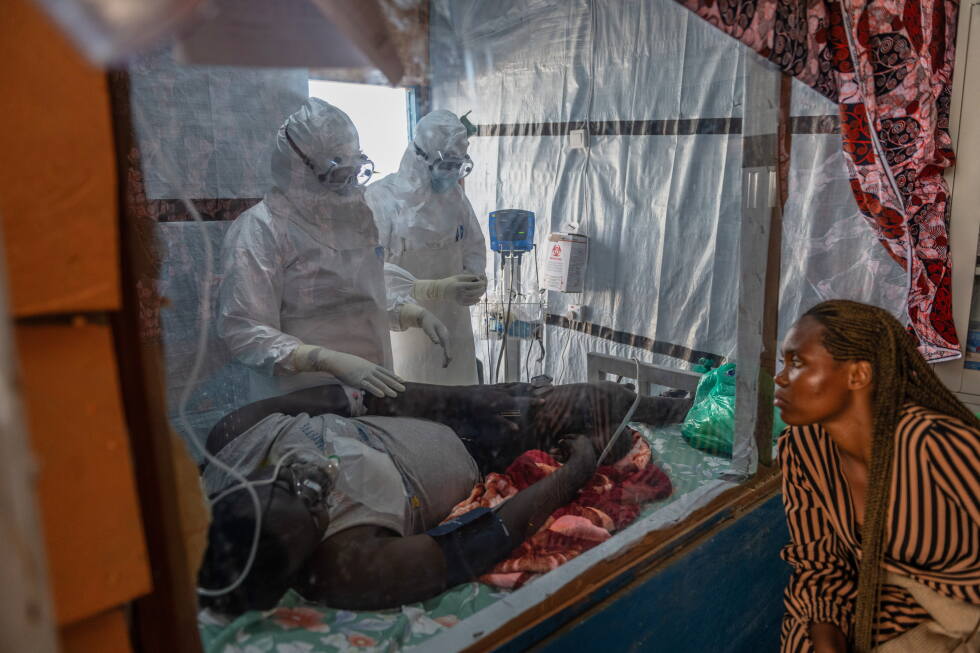
BUNIA, Congo (AP) — Mourners stood at a distance as a small coffin was lowered into the grave. Health workers wearing masks and gloves joined a priest who prayed.

A 6-month-old girl was the latest victim of the Ebola outbreak sweeping through eastern Congo. She was the third child in her orphanage to die.

After a month reporting from the outbreak’s epicenter with AP photographer Moses Sawasawa, this quiet scene has stayed with me the most.

From afar, the epidemic is often measured in numbers: over 1,300 confirmed cases, hundreds of deaths, tens of thousands of people who may have had contact with them.

Advertisement

The funeral is when we truly realized the gravity of the outbreak. Ebola does not distinguish between young and old, educated and uneducated, rich and the poor, civilians and health professionals.

And of course it’s not over. Experts say the peak of infections hasn’t been reached. There are no approved treatments for this type of Ebola, Bundibugyo, and the arrival of any vaccine is said to be months away.

Another death that stayed with us was that of a medical student a few months from graduation. She had been the hope of her family and a badly needed health professional in a remote region where outbreaks, like this one, can go undetected for weeks.

At her funeral, her mother was inconsolable.

Advertisement

Reporting on this outbreak means multiple dangers

It is hard to imagine a more challenging place for a deadly outbreak to unfold.

Every day of reporting began and ended with a careful process of protection and disinfection. Ebola is highly contagious and can be contracted via bodily fluids such as vomit, blood or semen. That meant putting on gloves, masks and hair nets in 80-degree Fahrenheit heat (26 Celsius) and 80% humidity.

Our driver’s vehicle, our microphones and other equipment had to be disinfected after entering outbreak-affected areas. The routine became second nature.

As we reported at struggling health centers, the sound of crying families followed us. The air was thick and humid, and people were slick with sweat. Health workers moved between crowded wards, washing their hands again and again.

Advertisement

Seeing the grief and lives cut short reminded me of covering the previous crisis in this region, the capture of Goma city, a humanitarian hub, last year by M23 rebels. Wounded babies, children and adults were rushed to hospitals to the sounds of weeping loved ones.

The Ebola outbreak is centered in neighboring Ituri province, scarred by years of such conflict. Armed groups control some areas and nearly a million people have been displaced. Economic hardships have now deepened.

Advertisement

We found some people trying to keep their hands clean with oatmeal and sand.

In the first three weeks after this outbreak was declared in mid-May, at least 520 security incidents, including attacks on health workers, impacted the work of responders, the World Health Organization said.

Attacks continue to be reported. We saw hospital beds left charred, the patients having fled.

Other people with confirmed or suspected Ebola infections have been abducted, disappearing into a world of poor mobile phone signal and bone-shaking unpaved roads.

Advertisement

In these surroundings, local people like Husein Twaibu are coordinating the community response.

Twaibu told me at least four health zones in Ituri, encompassing thousands of people, remain inaccessible because they are under rebel control. Unable to enter, response teams are relying in part on rebel leaders to pass on Ebola prevention messages and encourage participation in measures meant to slow the spread of the virus.

But that brings up another problem.

Misinformation and fear are the biggest challenges

I repeatedly heard the concern from doctors and aid workers: Many residents do not trust the Ebola response. Some believe the disease is not real.

Advertisement

In a region long traumatized by attacks and exploitation of rich natural resources, people are wary of outsiders. A lack of understanding of Ebola, whose symptoms like fever can be mistaken for others like malaria, means the strict prevention measures can be jarring.

There has been anger especially around burials, with people told not to do what comes naturally: bathe and prepare a loved one for the grave.

The distrust is one reason health officials don’t know the outbreak’s true size. Authorities still haven’t identified the first person who became ill.

Some residents avoid health centers. At times, community health workers who survived an Ebola infection find it difficult to persuade people to take the disease seriously.

Advertisement

One is Étienne Ezo, a nurse who contracted Ebola earlier this year.

He told me that many people ask why he survived and others didn’t.

“Some say that health workers have been paid off, which is why so many people are dying. Others claim that medical staff are actually killing people,” Ezo said. This is the kind of misinformation that he and others battle.

Journalists are not spared. At times, people accused us of being part of a conspiracy to invent the disease. Once, an angry crowd gathered outside a health center where we planned to report. Its director told us to come back another day.

Advertisement

And yet, life goes on

People are learning to adjust to the outbreak even as it grows.

At bars, face masks, temperature checks and socially distanced dancing are now part of a night out. Weddings have continued, with veils replacing face masks. At churches, attendants in nurse-like white gowns marked with red crosses hand out Communion wafers.

And during a World Cup match between Congo and Portugal, hundreds of fans embraced and cheered on the team at bars and roadside viewing areas, overjoyed at Congo’s first World Cup showing in over half a century.

For a few hours, for all of us, social distancing gave way to celebration.

Advertisement

___

Justin Kabumba is a journalist based in Goma, eastern Congo. He and Sawasawa are isolating after returning from Ituri.

___

For more on Africa and development: https://apnews.com/hub/africa-pulse

Advertisement

The Associated Press receives financial support for global health and development coverage in Africa from the Gates Foundation. The AP is solely responsible for all content. Find AP’s standards for working with philanthropies, a list of supporters and funded coverage areas at AP.org.

Source link

Advertisement
Continue Reading

NewsBeat

Mutant bed bugs surge in the UK after building resistance to insecticides | News UK

Published

on

Mutant bed bugs surge in the UK after building resistance to insecticides | News UK
New bedbug infestations – such as this one – are popping up all over the UK (Picture: James Rhoades)

Bedbug infestations are soaring in the UK as the critters are becoming more resistant to the chemicals used to kill them, Metro can reveal.

One London borough alone has had to tackle 40% more bedbug infestations this year, compared to the same period in 2025, data shows.

Pest controllers say they are being flooded with cases and that the parasites are now resistant to most major insecticides.

The cost-of-living crisis has also meant that more people are turning to ineffective DIY treatments that cause infestations to spread out of control.

Advertisement

Bedbugs are small insects that feed on human blood and typically shelter in mattresses, bed frames other cracks or crevices close to where people sleep.

Data gathered by Metro from across the pest industry has revealed a spike in bedbug infestations in 2026.

0207metro - bed bugs
Bedbugs are no longer being struck down by the crucial insecticides needed to eradicate them

One London borough – which we have agreed not to name – has already been called in to fight 155 infestations in the first half of this year.

That number is 40% higher than in first six months of 2024, and 50% larger than the same period in 2024.

The 52 infestations the council dealt with in June 2026 is their largest monthly total since before the Covid pandemic.

Advertisement

The bedbug spike is not isolated to London.

James Rhoades, whose company ThermoPest covers the whole of the UK, said he was dealing with double the number of calls out for bedbugs this year.

Chemical sprays using insecticide are one the most common methods used to kill bedbugs.

Latest London news

To get the latest news from the capital, visit Metro’s London news hub.

Advertisement

However there is growing evidence that the insects are becoming increasingly resistant to the toxic treatment.

Rhoades, who employs more offers high-heat treatment rather than chemicals, said his company has recorded a 30% increase in customers turning to them after a failed professional pest control treatment.

Advertisement
0207metro - bed bugs
James business has soared this year as more people come to him with unresolved infestations (Picture: James Rhoades)

He told Metro: ‘Year on year, we are seeing more cases where people are coming to us.

‘The data definitely suggests that there is a lot more resistance to chemicals than there ever has been.’

Rhoades said he had heard stories from other pest controllers of bedbugs being sprayed with chemicals and ‘just running around like nothing’s happened.’

World-renowned bedbug expert Chow-Yang Lee that insecticide resistance was ‘probably the single most important reason’ infestations have ‘increased dramatically over the year’.

He told Metro: ‘The insecticides used to kill bedbugs increasingly fail to do so, and insecticide resistance is now a leading cause of control failures.’

Advertisement

He said that the pyrethroid class of chemicals were particularly ineffective.

Prof Lee continued: ‘This pushes up infestation numbers in two ways. First, when a treatment doesn’t fully work, the infestation isn’t cleared.

‘Bedbugs survive, keep breeding, and can spread into other rooms or neighboring homes.

‘Second, and more insidiously, every time a population is hit with a chemical it can withstand, the few weakest bugs die, and the toughest survive to reproduce.

Advertisement

‘Repeat that over many treatments and you’re left with a population that’s almost entirely resistant.’

Some bedbug infestations, such as this one, can spiral out of control(Picture: Sarah Spratt)

While bedbug resistance has always been a problem, the challenge is that resistance ‘has deepened, broadened across chemical types and become much harder to overcome’.

London is at the heart of the global resurgence of bed bugs due to the capital’s housing density, international tourism and large rental market.

Since the return of worldwide travel after the Covid pandemic, some London boroughs have faced more than double the number of bedbug infestations, data provided to Metro shows.

One local authority had only 84 infestations in 2021, but as many as 441 in 2023.

Advertisement

Dr Matthew Davies, an advisor to the Greater London Pest Liaison Group, told Metro that this rise in infestations has continued into 2026.

The expert, who is Head of the Technical Department at Killgerm Chemicals blamed the problem in part on a drop in insecticides on the market, making it harder to tackle resistance.

Dr Davies also stressed that resistance is not a ‘doomsday scenario where there are no available options’.

Instead the key route to success in tackling bedbugs is an ‘integrated’ treatment solution where different strategies are used at once.

Advertisement

He explained that alongside chemicals ‘this includes steam treatments, heat treatments, and monitoring for problems with lures.’

Bedbugs in a Matress seam - close up photo; Shutterstock ID 2644077805; purchase_order: -; job: -; client: -; other:
Bedbugs like to hide in the seams of mattresses and other hard to reach crevices (Picture: Shutterstock / Mehes Daniel)

There are also fears that the cost of living crisis is pushing more families to swerve professional bed bug treatments.

Many are then turning to DIY methods which can often make the problem worse.

Prof Lee said people are ‘fall[ing] back on cheaper sprays, including shop-bought foggers and aerosols that barely work.

‘Every one of those partial treatments does two unhelpful things: it leaves enough insects alive to keep the infestation going, and it kills only the susceptible individuals, leaving the resistant ones to survive and breed.

Advertisement

‘In other words, over-relying on insecticides that no longer fully work is actively making the resistance problem worse.’

Get in touch with our news team by emailing us at webnews@metro.co.uk.

For more stories like this, check our news page.

Advertisement

Source link

Advertisement
Continue Reading

Trending

Copyright © 2025