





Ms Dorrian said in the last three months she has “been in the vicinity of Lisa’s suspect on three occasions”.
Families of two murdered women whose remains have never been found have called for tougher initial sentences in “no-body” murder cases.
Lisa Dorrian was 25 when she was last seen alive in February 2005 and is believed to have been murdered while Charlotte Murray was 34 when she was killed by her former fiancé, John Miller, who was later convicted of her murder.
Neither woman’s remains have ever been recovered despite extensive searches.
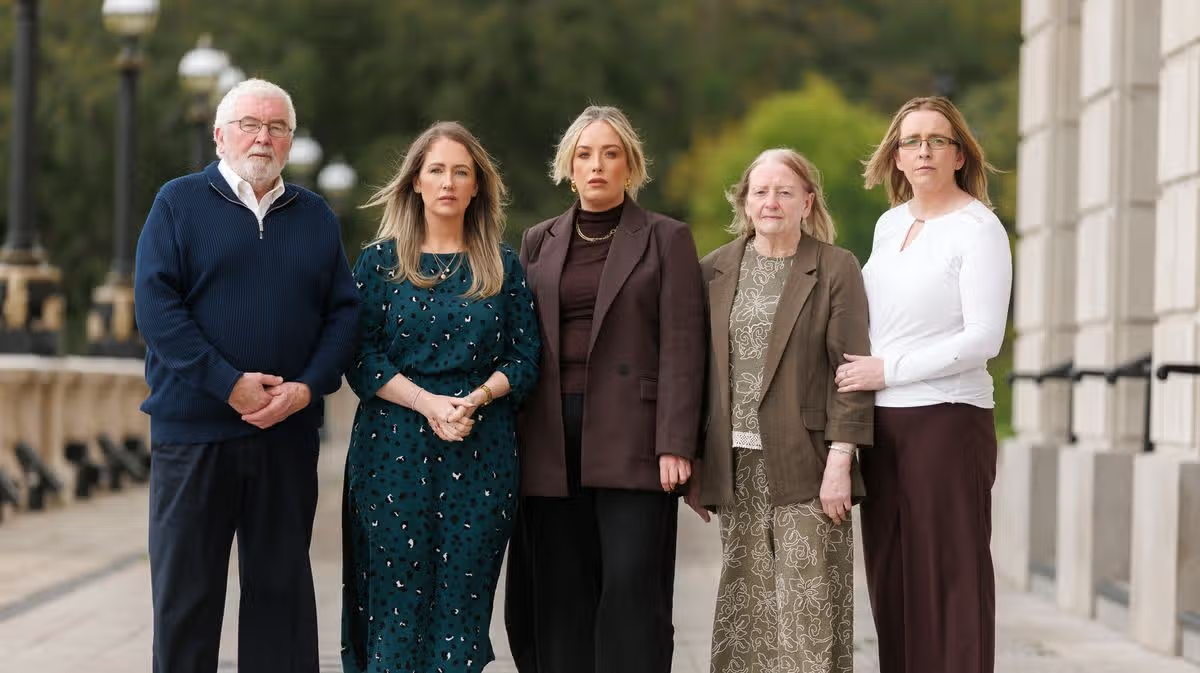
Members of the Dorrian and Murray family joined to give evidence to the Justice Committee about the Sentencing Bill currently being scrutinised by MLAs.
The wide-ranging reforms aim to strengthen the existing framework for sentencing for crimes, including bringing in Charlotte’s Law, which aims to reduce the trauma experienced by families of murder victims in no-body cases.
It would create a statutory aggravator for failure to disclose the location of victims’ remains and new sentence reductions for post-sentence disclosures.
Lisa Dorrian’s sister Joanne Dorrian outlined that the Sentencing Bill in its current form would require courts to increase an offender’s sentence by at least 30% in applicable “no-body” cases where they are believed to have information about where a victim’s remains are, or how they were disposed of, but have failed to disclose it.
If they later do disclose where a body was disposed of, a formula would decide how much their sentence would then be reduced by.
Ms Dorrian called for the original sentence increase to be strengthened, saying such a move “works as a deterrent”.
“People will then know when they commit a murder and are in the position where they’re deciding whether to give up a body or to hide a body, with case law going forward, that there is a significant number of years added to their sentence,” she told the committee.
“So, we would ask for you to consider strengthening that even to 40% just in order to increase the additional tariff, which would then obviously be reduced using the formula.”
The reduction is currently proposed at 50%, which Ms Dorrian also asked to be increased.
“I think if we were to look at something at around 70% – we’re giving them a bigger reduction on the sentence in order to incentivise that disclosure at the earliest point, and just to be in the strongest position to do that,” she said.
“It’s not an easy thing for any of us to sit here today and say that we want to be able to reduce the sentence of any murderer, and in an ideal world we would never want that.
“But when you’re in these really niche circumstances that we’re in, every one of us sitting here today, and I’m sure other families in this position without a conviction, would tell you we would do anything to get our loved ones back.
“We would not forego justice, but we’re trying to use the justice system to get what we need, and what we need is the return of the body of our loved ones.”
John Dorrian, Lisa’s father, referred to Helen’s law in place in England and Wales which puts a statutory duty on the Parole Board to take an offender’s failure to disclose the location of a victim’s remains into account when deciding whether they are safe to release.
Asked by Justice Committee chairman MLA Paul Frew if there “should be conditions placed on the perpetrator, even when they get out”, Mr Dorrian said: “I would think so, personally, it’s Northern Ireland, you know, it’s a small community.”
Ms Dorrian said in the last three months she has “been in the vicinity of Lisa’s suspect on three occasions”.
“That has been very difficult for me,” she said.
“He’s not aware of that, but I’m aware of seeing him in my locality three times in the last three months.”
For all the latest news, visit the Belfast Live homepage here and sign up to our daily newsletter here.

























































You must be logged in to post a comment Login