




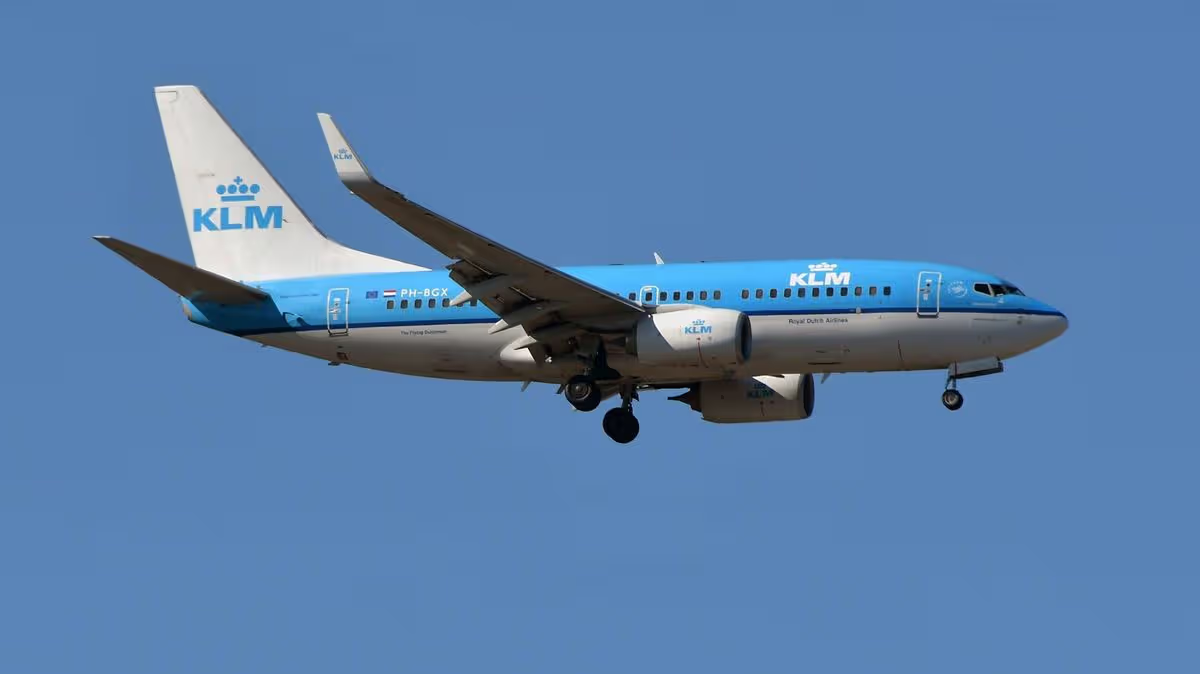
Two Boeing 747 passenger jetliners — KLM Flight 4805 and Pan Am Flight 1736 — suffered a horrific collision on the runway at Los Rodeos Airport, Tenerife, resulting in the deadliest plane crash in aviation history
March 27 stands as one of aviation’s darkest days, marking the anniversary of the deadliest air disaster in history, which claimed 583 lives and left a further 61 people injured.
The catastrophic crash involved not one, but two aircraft, and unfolded on the airport runway itself.
On 27 March 1977, two Boeing 747 passenger jets were involved in a horrific collision which resulted in loss of life on a scale never before witnessed in the aviation industry.
KLM Flight 4805 and Pan Am Flight 1736 met their tragic end at 5:06pm GMT amid thick fog on the runway at Los Rodeos Airport in Tenerife, Spain (now known as Tenerife North–Ciudad de La Laguna Airport).
Neither Boeing 747 was originally scheduled to land at Tenerife’s Los Rodeos Airport; both were bound for Gran Canaria Airport in Las Palmas.
However, a bomb blast at the latter earlier that day meant they were diverted to Los Rodeos, the only other nearby airport capable of handling a 747.
What happened on that fateful day
Los Rodeos, a modest airport more accustomed to handling smaller aircraft, was overwhelmed with diverted flights and had scant parking space for planes of the Boeing 747’s size.
To compound matters, KLM’s captain, Jacob Veldhuyzen van Zanten, was growing increasingly impatient with the hold-ups, as he and his crew were required to return to Amsterdam after depositing passengers at Las Palmas once the threat had been cleared.
The Dutch government had recently updated crew duty time restrictions, and a prolonged delay at Tenerife risked pushing the crew of KLM Flight 4805 well beyond their permitted duty hours, which would have resulted in significant operational and financial consequences.
Indeed, upon catching sight of the airport in Tenerife, senior pilot Zanten was heard saying: “I’ve seen postage stamps bigger than this place. Now we’re going to get boxed in here, goddammit.”
Zanten was undoubtedly carrying an enormous burden — he was KLM’s most senior pilot, head of safety and the airline’s chief flight instructor, his face emblazoned across the company’s advertising which proudly declared: “KLM. From the people who make punctuality possible.”
Zanten had opted to refuel the aircraft prior to departure, and it was the devastating combination of catastrophic miscommunication, treacherous weather conditions, and a full fuel tank that ultimately triggered the horrifying collision — with the now-defunct Pan American’s Flight 1736 still making its way along the runway as KLM Flight 4805 attempted to take off.
Captain Zanten mistakenly believed he had received clearance for take-off, sending the KLM aircraft hurtling down the runway at full speed, directly into the path of the taxiing Pan Am plane.
Pilot’s chilling last words
The cockpit voice recorder (CVR) recovered from the Pan Am’s Black Box following the crash captured the aircraft’s captain, Victor Grubbs, crying out: “There he is!” upon spotting the KLM craft’s landing lights piercing through the thick fog.
When Grubbs realised the KLM plane was hurtling towards them at full takeoff speed, the captain’s chilling final words were: “There he is… look at him. Goddamn, that son-of-a-b**** is coming!”, while first officer Robert Bragg screamed: “Get off! Get off! Get off!”
In a desperate bid to avert a collision, Grubbs applied full power to the Pan Am’s throttles and executed a sharp left turn towards the grass. However, by the time the KLM pilots spotted the other aircraft, they had already surpassed their V1 speed, making it impossible for them to abort.
In a last-ditch attempt to avoid a crash, the KLM pilots tried to lift off, resulting in a tailstrike instead. Although the KLM aircraft was briefly airborne, its fuselage carved through the Pan Am’s aft fuselage, obliterating it and tearing off the tail entirely.
The KLM 747 careered on and plummeted out of control 150 metres further ahead, sliding a further 300 metres down the runway, while simultaneously erupting into flames upon impact with the runway surface, igniting its full fuel load into a devastating fireball that took several hours to bring under control.
The catastrophic collision claimed the lives of all 248 people aboard the KLM flight, including all crew members, while 335 of the 396 passengers and crew on board the Pan Am flight also perished.
All 61 survivors from the Pan Am flight were seated in the forward section of the aircraft, with one survivor later remarking that being positioned in the nose of the plane likely saved his life.
Remarkably, all five in the Pan Am flight’s cockpit — the three-man crew plus two off-duty employees occupying the jumpseats — survived.
When KLM executives first received news of the catastrophic crash, they had reportedly attempted to contact KLM’s Golden Boy, Captain Zanten, hoping to send him to Tenerife to assist the investigation team, unaware that he was the captain of the flight involved in the accident and had perished in the crash.
The miscommunications and misunderstandings before the accident between the pilots, cockpit crew and Air Traffic Control tower prompted a comprehensive overhaul of international airline regulations, transforming them permanently.
Following the Tenerife disaster, air traffic controllers were mandated to use standardised English phrases and were required to make decisions through mutual agreement. In a significant advancement in crew resource management, guidelines were established which enabled pilots to challenge the captain with far less difficulty.




















































You must be logged in to post a comment Login