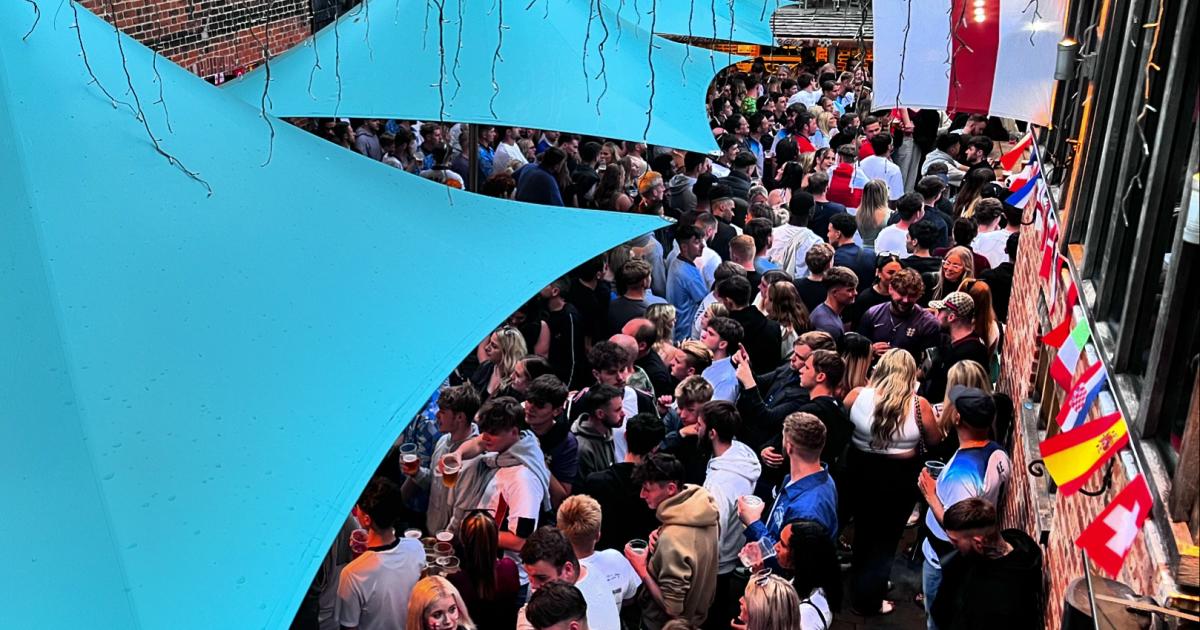
Their aim is to prevent incidents linked to the football and other events happening this evening, including Becky Hill’s performance at York Racecourse.
They are also continuing their crackdown on drug and drink driving.
A North Yorkshire Police spokesman said: “If you’re heading out to watch the game, or to one of the many events that’s taking place make sure your journey home is sorted in advance. Arrange a lift, book a taxi, or plan to stay over – but do not take the risk of driving after drinking or taking drugs.
Advertisement
Drink or drug driving puts lives at risk. Let’s make today about supporting England safely.”
The county-wide operation includes high visibility and targeted patrols that will cover York city centre, town centres and rural routes.
Defence chiefs have been accused of showing ‘shocking disregard’ for Britain’s war dead after destroying almost 800 First and Second World War gravestones of Commonwealth soldiers killed in the Iraqi desert.
The British Army removed dozens of gravestones and panels engraved with the names of the fallen from the Basra War Cemetery in southern Iraq in 2003 amid fears that they could be destroyed or vandalised by locals.
As well as hundreds of gravestones, 80 large, 2 in-thick slate panels bearing the regimental crests of Army units and the names of the war dead were also removed.
Advertisement
The remains of the soldiers –who died in the First and Second World Wars – stayed buried but unmarked.
Within 18 months, almost all of the gravestones and panels had been deliberately pulverised into gravel and used to fill a drainage ditch at another military base in southern Iraq.
The work was overseen by 64 Works Group, Royal Engineers and appears to have gone ahead after the assent of a padre.
Ben Soppitt, whose grandfather, Gunner Joseph Soppitt, was buried in Basra War Cemetery, claims the Commonwealth War Graves Commission (CWGC) and the Ministry of Defence tried to hide the truth about the demolition from the public.
Advertisement
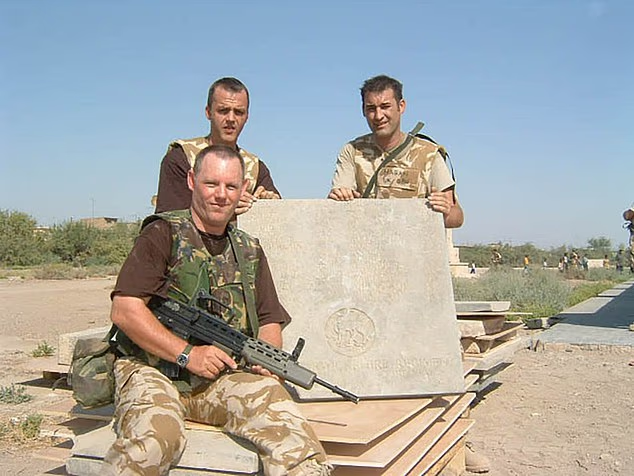
British Army Personnel with removed panels and gravestones, Basra 2003
Ben Soppitt’s grandfather, Gunner Joseph Soppitt, is among those buried at Basra War Cemetery
Details of the destruction of the gravestones only emerged recently after the publication of Freedom of Information (FoI)responses by Mr Soppitt, 55, who lives near San Francisco.
Advertisement
The MoD had to respond to his requests because the Information Commissioner stepped in to order their release.
The FoI disclosures reveal that the gravestones were crushed into gravel and used to build a drain inside the British Army’s Shaibah Logistics Base, nine miles south-west of Basra, in April 2005.
The Mail’s chief reporter David Williams visited the cemetery just the week before the US-led invasion of Iraq in 2003, and found that the local militia had been using the gravestones for target practice – explaining why the army removed them, though no such action was taken at any other graveyard in Iraq.
In footage from the time showing the operation to remove the gravestones, an unnamed officer said: ‘We have collected all the gravestones together along with the tablets which have the names of all those people who died bravely during the First World War and Second World War.
Advertisement
‘We have put them all into the back of the truck. We will take them back to our camp where we will hold them for the Commonwealth War Graves Commission, which will come back in the future and restore this cemetery to its former glory.’
The FoI disclosures show a SITREP (situation report) from 64 Works Group, Royal Engineers in April 2005 records: ‘The gravestones have now been crushed and are ready to be placed in the soakaway.’
Field Marshal The Lord Richards of Herstmonceux, the former chief of the defence staff, said he had no doubt the soldiers who removed the stones thought they were doing the right thing.
The vast memorial in the deserts outside the Southern Iraq city of Basra which contains the names of thousands of British Empire soldiers who died in the First World War, which now lies in semi-ruin
Advertisement
Lord Richards, who served as Assistant Chief of the General Staff at the time the gravestones were destroyed, told The Mail on Sunday: ‘I am deeply saddened by what happened to this cemetery. With the benefit of hindsight there is of course no excuse. However, I have no doubt that in the dangerous and febrile environment of Basra at the time, the officers who took this decision thought they were doing the right thing.’
But Lord Dannatt, the former chief of the general staff, said: ‘The Chairman of the Commonwealth War Graves Commission is the Secretary of State for Defence. A decision should be taken to either re-instate all the graves, probably now impossible, or otherwise put in place a memorial with all the names of those buried in the cemetery with a suitable explanation of recent events.’
Mr Soppitt travelled to Basra last year with a new granite gravestone to mark the grave of his grandfather, who died from dysentery in 1941. A service was held, attended by the Archbishop of Basra and local residents.
Gunner Joseph Soppitt was one of more than 360 Britons who lie in the cemetery alongside comrades from India, Poland and other Commonwealth nations.
Advertisement
Mr Soppitt has made a High Court application for Judicial Review into the destruction, with the aim of holding the MoD accountable.
He said: ‘The MoD is fighting this claim, unwilling to bear the cost of ensuring the over 3,000 men and women buried there are properly commemorated with the honour they deserve and that the public expects.
‘It is a bitter irony that a member of the public, a relative of one of the casualties buried at Basra, is having to pursue the MoD through the courts simply to secure the basic dignity of commemoration that those who died in service are owed.’
In contrast, Basra Memorial, only 30km away from the cemetery, was left untouched.
Advertisement
The MoD said it is unable to comment for legal reasons.
Callous disdain for the memory of the fallen
By COLONEL RICHARD KEMP
Among the 800 men whose gravestones and memorial panels at the First and Second War World cemetery in Iraq were summarily pulverised on the orders of the Ministry of Defence, 130 were from a forerunner of my own regiment, the Royal Anglian.
So you can appreciate why I am appalled at such a callous disdain for the memory of the fallen.
Advertisement
It does not matter that some of these men died over a century ago, what matters is that they did so fighting for their country. Such patriotism and heroism should never be treated so shabbily.
The Army removed the headstones for their own safety in 2003, after British forces invaded Saddam Hussein’s Iraq.
No doubt the removal was carried out by soldiers in good faith that the stones would be replaced when the time was right.
But that faith was betrayed after 18 months, when it appears that the MoD decided the stones should be destroyed. Having fought in Iraq and Afghanistan, I can sympathise with soldiers given wrong-headed orders from London, clueless as to the reality on the ground.
Advertisement
In Kabul, we had intelligence of a planned coup d’etat on the parliament building. We understood that the thrust of the assault would be carried out by tanks. Only, when I proposed to lay anti-tank mines around the insurgents’ tank enclosure, the MoD’s response was one of horror – along the lines of ‘You do realise Afghanistan is the most land-mined country in the world?’ A few more to prevent huge political upheaval seemed a price worth paying to me, but we thwarted the coup nonetheless.
Pictured: British Army soldiers are seen out on patrol in Basra, Iraq, in April 2003
Soldiers follow orders, and those in Iraq who helped in the destruction of the headstones would have done so with a heavy heart. It must have been galling to know that a drainage ditch had been filled in a way that was so obscene to the memory of past British soldiers.
But what twists the knife is the evasiveness of the top brass. They have stonewalled the attempts of relatives of those buried there to get to the truth. Only begrudgingly revealing the sorry episode after being taken to the Information Commissioner.
Advertisement
But even public shame about their behaviour has not prompted the MoD to make right the scandal. The cemetery in Basra is still bare, the fallen still unmarked. It beggars belief that new headstones have not been erected in their place.
These are soldiers who died in the most horrific of circumstances, often under constant gunfire, in punishing heat and with little in the way of sanitary facilities, meaning that death by dysentery was grimly common.
They deserve a cemetery that befits their sacrifice.
If the MoD believes new headstones would be vandalised I urge them to visit Kabul, where locals respectfully tend to a British cemetery I visited there. To ensure the upkeep of the Basra site, surely we could expect the co-operation of the Iraqi government, which is the recipient of many billions of pounds in British economic aid?
Advertisement
Even if the cemetery is vandalised, so be it: that can be repaired. What cannot is the permanent deletion of their memory from the ground where they are buried – effectively killing them twice.
The MoD must correct its terrible mistake: failure to do so shames our country.
In this second part in our series on how the UK has changed in the past 25 years, we look at the finances of both the nation and individuals, before turning to housing and business.
The economy
Steve Schifferes, honorary research fellow, City St George’s University
For most of the 2000s the economy grew strongly, raising living standards and allowing the government to invest more in public services such as the NHS. This was the “NICE” decade, an acronym coined by former Bank of England governor Mervyn King to describe a long period of “non-inflationary, continually expanding” growth – in contrast to previous decades of “boom and bust”.
How has the UK changed since the start of the century? From Blair to Burnham, from the dotcom era to AI agents, time has certainly not stood still. In this six-part series, a team of some 35 experts look at everything from defence spending to species populations to the rise of populism to try and make sense of the intervening years.
In contrast, the period since the 2008 global financial crisis has been characterised by low growth, static real incomes and a growing government debt burden – all exacerbated by the COVID pandemic and the energy supply crisis caused by the Ukraine war.
Underlying the deterioration in Britain’s economic performance since 2008 has been a sharp fall in the rate of productivity, meaning the amount of output produced per worker. Falling productivity reduces output for the same number of workers, which brings down both GDP and real incomes.
In the first decade of the 21st century, UK productivity grew at 2% per year, with the economy expanding by 2.5%-3% annually – this was the culmination in a long period of strong productivity growth driven by everything from North Sea oil to corporate investment in IT and the internet. Since 2008 productivity on average has increased by 0.4% per year, and economic growth has fallen to an average of just 1.5% per year. If productivity had continued to grow at its pre-2008 rate, the average British household would be £18,000 better off today.
Underlying this weakening productivity has been low levels of investment in infrastructure by both the private and the public sectors. This includes both physical investment in plant and equipment, as well as transport and energy, but also investment in training.
Despite prioritising improving productivity, there is little evidence that Keir Starmer’s Labour government managed to tackle this shortfall, at least in the short term.
Debt and spending
The stronger performance of the economy before 2008 allowed the government to boost spending while limiting tax rises and keeping the public debt below 40% of GDP. This changed after the financial crisis: government debt rose to 60% as it pledged over £1 trillion to bail out the collapsing financial sector.
Debt increased further to 80% during the COVID pandemic when the government spent £400 billion to subsidise wages, and has since kept on rising to 95% of the size of the economy – £2.9 trillion. This means the government is now paying out more in debt interest than it spends on any other service except the NHS.
Both government spending and tax revenues are now at 80-year highs as a percentage of GDP, with spending making up 45% of the total economy, and taxes 40%. This has severely limited the government’s scope to improve public services and invest in future growth, or to tackle the cost of living crisis.
Economic growth has also become even more uneven. The gap in GDP per capita
between the south-east and the rest of the country has continued to grow, with London’s average income now two and half times that of the poorest region – the north-east of England. The relentless rise in house prices has driven both regional and generational inequality.
The outlook
Advertisement
Though many countries were hit by the global financial crisis, Britain’s oversized financial sector meant it was both hit harder and recovered more slowly. It has fallen further behind its main G7 rivals both in long-term productivity growth and the level of real incomes.
With its economy more dependent on foreign trade, it is also more vulnerable to disruptions to the international economy, such as the Trump-era tariff wars and the effects of the Iran war on oil and gas output. The IMF has projected that despite a small upgrade the UK will only grow by 1.0% in 2026, dragged down by weaker international trade and higher oil prices.
In the 1970s, Britain was regarded as the “sick man of Europe”, falling behind while its continental rivals surged ahead. With the world more divided than ever, and with the emergence of new economic superpowers like China, the UK’s task in recovering its position will be even more difficult than the challenges it faced then.
Advertisement
Haves and have nots
Young people are finding it increasingly difficult to afford to own a home or find secure jobs. More working age adults, including those with low-paid jobs, are receiving benefits, while over a million people aged 16-24 are not in education, employment or training.
Overall unemployment is little changed, having fallen during the Tony Blair years, but now it is young people who are particularly hard hit as firms are not hiring new recruits. Meanwhile pensioners have benefited from the “triple lock”, which guarantees that state pensions grow generously each year.
Pensioners have done well in recent years. Rawpixel.com
Whereas poverty has decreased for pensioners, there has been a sharp increase in working age poverty and child poverty, including many who are working but still below the poverty line. The huge rise in house prices and the larger number of substantial private pensions being received by the baby boomer generation has meant that wealth is much more unequally distributed than 25 years ago.
Wealth
Mike Savage, professorial research fellow, International Inequalities Institute, London School of Economics
Britain has a far more equal distribution of wealth assets than in the early 20th century. Home-ownership, pension funds and various other financial investments have seen wealth shared much more widely among the middle and upper classes.
On the other hand, many have been left behind. The Resolution Foundation reckons that household wealth is now nearly 7.5 times GDP, up from around three times GDP in the mid-1980s, and the wealthiest have benefitted disproportionately.
There has been a stark rise in the “wealth gap” between the top 10% of wealth holders and sizeable numbers of the British population with little or no wealth. This is despite the fact that the share of total wealth taken by the top 10% has changed relatively little over the same period.
You don’t have to look all the way down the social strata to see what has happened. The Resolution Foundation calculates that the gap between the average family wealth per adult for the wealthiest 10% and those in the middle (the fifth decile) reached £1.3 million in 2020-22. This is up from £1 million in 2006-08 (once inflation is stripped out).
How wealth breaks down
Total household wealth in Great Britain reached £17 trillion in 2020-22, according to the wealth and assets survey of the Office for National Statistics. Some £5.5 trillion (32%) was held in property (mostly through owner-occupied housing) and £8.2 trillion (48%) in pension funds.
Middle-class homeowners have benefited from rising house prices – they’ve increased 8% in real terms since 2008, when the first edition of the survey was published. Since income levels grew at less than 1% in real terms over the same period, this has made the possibility of buying a house more remote for younger generations. Those who have retired in recent years have also benefitted from the inflation of pension stocks, whose contribution to total wealth rose from 35% to 48% over the period.
Advertisement
All this refers to what we could call “ordinary wealth”. Beyond that is another category called “strategic wealth” that’s tied up in financial investments, such as stocks and shares. This will include much of the 20% of total household wealth not tied up in pensions or property – though property wealth can also be strategic if it’s for rental.
Strategic wealth is predominantly held by a small number of very wealthy people. Those benefitting from these resources, often actively managed by a highly professionalised wealth management infrastructure, have done very well in recent decades.
Some commentators argue that we now live in an “asset society”. The capacity to earn economic rewards from assets plays an increasing role in shaping life prospects, as well as leading to greater socioeconomic inequality.
Wealth divides are strongly entrenched across many walks of life and may be becoming more evident. A striking example is the disparity between ethnic groups, where White Britons and the Indian diaspora have up to ten times more wealth than Black Africans and Bangladeshi communities.
Advertisement
Overall, this widening wealth gap poses significant challenges in British society. There are numerous concerns it is undermining social cohesion, by removing the ladder of opportunity and increasing younger people’s resentment of older generations. This is driving urgent policy discussions within the Labour party and beyond about how best to tax wealth.
Employment
Abigail Taylor, research fellow, Business School, University of Birmingham
In 2001 manufacturing accounted for the second-largest share of total workforce jobs (17%), reflecting a relatively strong industrial footprint remaining in regions such as the West Midlands. By 2025 manufacturing was down to just 7% of the total. Over the same period, employment in professional, scientific and technical activities – a key component of the knowledge economy – increased from 7% to 10%.
In 2001 as many as 23% of people aged 16-64 were economically inactive in England – in other words, not in work and not actively seeking work. This includes students, early retirees, long-term sick or disabled people, and those caring for family or homes. By 2025, the proportion had fallen slightly to 21%.
Advertisement
Yet there have been several striking shifts within the data. Among women the inactivity rate fell from 31% in 2001 to 24% in 2025, while among men it rose from 16% to 18%. The fact that women are participating more in the labour market reflects rising numbers of women working full-time, greater access to education and greater flexible work opportunities.
Women have become a bigger part of the workforce. William Perugini
Underlying this are changing social norms about women working, as well as increases in their state pension age (from 60 to 66, while men’s has risen from 65 to 66). The shift is despite the fact that women continue to do more unpaid care work than men, and mothers, especially of young children, continue to experience disadvantages in job quality.
Meanwhile, long-term sickness has become an increasingly common reason for individuals being inactive. In 2004, 23% of inactive people were not working because of long-term sickness, compared with 28% today.
The rise of remote working
Advertisement
In the 2001 census only 9% of working people aged 16-74 reported working mainly at or from home. By the 2021 census, the equivalent figure was 32%. While the latter figure reflected the COVID-19 pandemic when a national lockdown was in place, more recent evidence points to a sustained increase in remote and hybrid working (meaning partly in the workplace, partly at home). Between January and March 2025, 28% of working adults in Great Britain worked in a hybrid manner.
Working at home remains far more common than before the pandemic. Drazen Zigic
As we move into the second quarter of the 21st century, AI is beginning to transform work. It promises large-scale potential for making us more productive, but there are concerns about what will happen to jobs. There is also the prospect of widening inequalities between workers who can use AI and others that get left behind.
Another key concern is the number of young people not in education, employment or training: it now stands at one in eight and rising. The Milburn report published in June 2026 is calling for a whole-system reset of the UK’s youth support and benefits systems.
Housing
Ken Gibb, professor in housing economics, University of Glasgow
Advertisement
To take the abrupt changes first, the most notable was the financial crisis of 2007-08. It dampened mortgage lending, while the ensuing shift to austerity hurt spending on social housing.
Other important turning points include the Grenfell tower fire of 2017, which led to an overhaul of building regulations, while the tragic death of Awaab Ishak in Rochdale in 2020 from mould exposure in his family’s social housing led to new laws making landlords more accountable for hazardous living conditions.
We should not be dewy-eyed about the past – homelessness was worse in 2001, as were property conditions. Housing quality has particularly improved in the social sector – at least until the repairs backlog caused by COVID. New-build standards are much better in relation to everything from insulation to ventilation, even if pockets of poor-quality housing do remain across the system, including in parts of the rental market.
Advertisement
Yet in 2001 it was easier to buy a home, afford private renting and access social housing. Many would agree that housing outcomes and opportunities are materially worse now than then. So what happened?
We do not build enough homes to meet demand for housing. Debates rage about the extent to which this reflects how the planning system operates, and how much can be blamed on nimbyism and developers essentially building out more slowly to maintain selling prices (and share prices).
The social housing sector has shrunk. Social renting is now a scarce and prized commodity, with low vacancy rates, building levels way too low, and long queues to access what is available. The underlying composition of public spending is about 80% dominated by housing benefit, not building new housing.
The beneficiary from declining social housing and home ownership has been the remarkable growth in private renting, even if the above graph shows it peaked as a percentage of total tenure a decade ago. Initially rental growth was mainly in the form of small-scale buy-to-lets, but more recently it’s primarily from institutional investors such as pension funds building urban apartments to rent.
As for homelessness, despite overall figures well below that of 2001, everything from rough sleeping to precarity to temporary accommodation has been rising in recent years. This is beyond the capacity of many councils to cope.
These forces combine to reduce mobility, lengthen commutes, keep adult children in the family home, stretch public services and lower home-ownership rates. This has helped make housing more of a battleground in the debate about immigration, asylum seekers and refugees, amid misunderstandings (or worse) regarding how social housing is allocated.
Advertisement
Council tax and devolution
In England and Scotland, incredibly, the valuation basis of council tax remains at 1991 prices. Cumulative growth in property prices as a proportion of income over 35 years is not taken into account (between 1992 and 2023 house prices in England grew by 377% compared to median disposable household incomes growing by just 51%).
Meanwhile, the divergent housing policies across the UK’s four nations have been very noticeable. Scotland and then Wales abolished the right to buy; Scotland legislated for a strong rights framework to address homelessness; Wales then England (and now Scotland) have brought in stronger homelessness prevention laws.
The four nations have differing though converging approaches to the regulation of private renting, though only Scotland has tried rent control thus far. Devolution deals across England will also bring further housing divergence within England.
Finally, an influential short paper published in 2021 concluded that contemporary housing generates myriad economic, social and health-related problems, difficulties that require a systemic programme of long-term reform. It may take a further 25 years to reverse the problems we see across Britain’s housing today.
Business
John Colley, professor of practice, University of Warwick
Just over 25 years ago the dotcom boom collapsed. As finance was pulled from thousands of these businesses, most went bust. The boom had sucked investment away from traditional industries and into the brave new world of the internet.
The problem was that people weren’t ready for the immense change and the new business models would take time to become effective. So the early 2000s were littered with recent British failures like retailer Boo.com and health portal ClickMango. Among the few that survived – besides Amazon – the British names include travel broker Lastminute.com and retailer Asos.
Once again, investment is being diverted from many non-AI sectors in the gold rush. Professions ranging from lawyers and accountants to medical doctors and clerical work all know that AI is coming for their jobs, but the boom may well collapse before that happens. McKinsey for one believes that AI industry returns will fail to justify the investment.
Between these two events we have seen immense change in UK business, not least the rise of the gig economy and so much business now being conducted online. Taxis have vastly increased in number – from 63,000 in England in 2001 to 313,000 in 2024 – and the same is almost certainly true for takeaway food delivery people, as significant numbers of people are willing to work for low rates of pay.
High street shopping has collapsed over the same period, as the online share of UK retail has increased from very low digits to almost 30% today. Physical retail has shrunk back to a few major shopping centres, with high-street stores replaced by coffee and fast food outlets, and personal services such as barbers and nail bars.
Amazon may no longer necessarily be the cheapest, but it has become an extraordinary force in retail over the past 25 years. Its network of enormous distribution centres are dotted across the country. For many, this is the first point of call for almost everything except groceries.
The 2008 crisis
If the shift online has been the big theme, the key single event of the last 25 years was surely the banking crisis of 2008. Banks had to be rescued and have only recently been returned to the private sector.
The weakness in economic growth since then has meant that UK listed stocks have performed worse than inflation since 2001, rising 67% compared to a 93% rise in inflation. Many public companies have switched to a US listing – chip designer Arm, Paddy Power owner Flutter Entertainment, and heating/plumbing giant Ferguson are all examples. The perception is that stocks perform better there than in the UK. This has never really been proved, though we do know that board salaries are much higher in the US.
A bigger trend is that stock market-listed businesses have halved in number across the western world as vast sums of money have moved into private capital. This has taken the form of lots more private lending to businesses, and the rise of private equity, both of which have been encouraged by the fact that the low interest rates ushered in by 2008 made borrowing much cheaper.
Morrisons is one of numerous big UK businesses now owned by private equity. Gary Perkin
The private equity model sees investors ploughing money into vehicles that borrow to buy companies and try and run them more efficiently. This has delivered much higher returns than investing in stock markets, such that private equity now contributes between a third and 40% of all global corporate transactions, and has quadrupled in size to almost US$5 trillion (£3.8 trillion) of assets under management.
The chances of someone working in a private equity-owned company in the UK are now high, whether they like it or not. Examples include Morrisons, Boots and Thames Water.
The Insights section is committed to high-quality longform journalism. Our editors work with academics from many different backgrounds who are tackling a wide range of societal and scientific challenges.
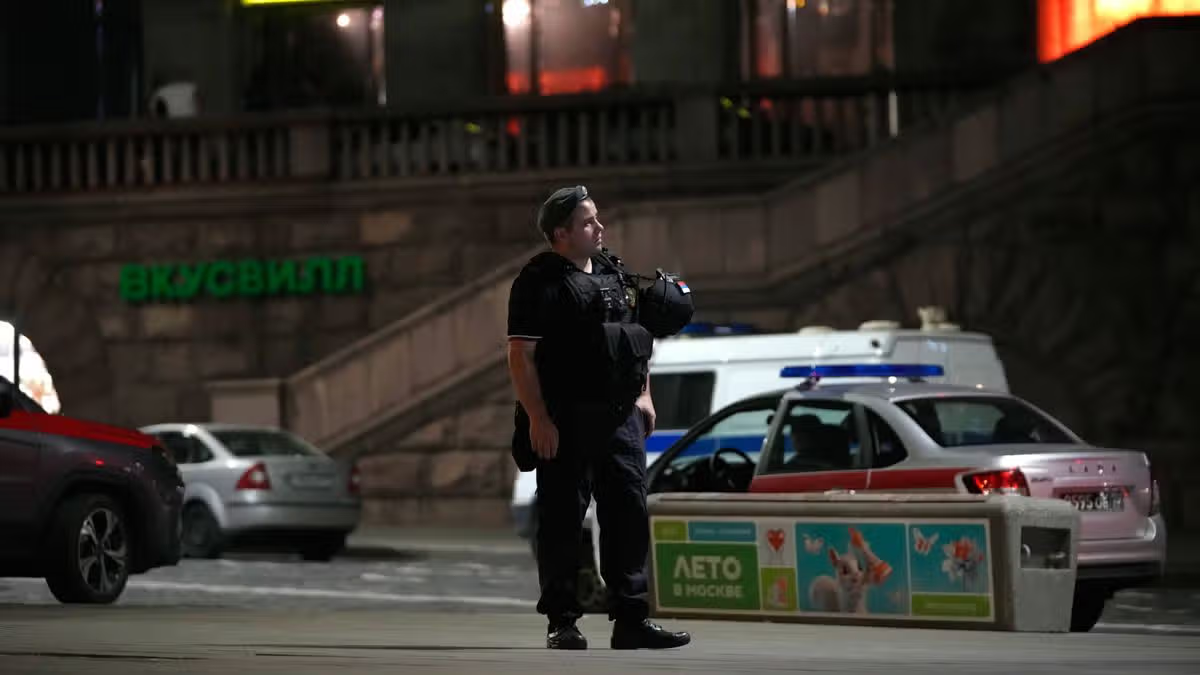
The explosion occurred close to a restaurant terrace on Kudrinskaya Square in Moscow on Saturday evening
Peter Hennessy UK & World News Editor and Laura Zilincanova
23:58, 01 Aug 2026
Three people have lost their lives and 21 others have been injured after an explosion near a restaurant in Moscow, police have confirmed.
The blast took place close to a restaurant terrace on Kudrinskaya Square in Moscow on Saturday evening at around 8:10pm (6:10pm BST), the Interior Ministry said in a statement on the Russian social media platform Max.
Advertisement
Officials told state news agency Ria Novosti that the explosion led to “three deaths and 15 injured, of varying degrees of seriousness”. The committee later revised the injury toll from 15 people to 21, taking the total number of casualties to at least 24.
Those hurt were being treated medically.
The deaths included “a security guard who prevented an unknown woman suspected of trying to carry the explosive device into the restaurant, the unknown woman and one of the visitors,” a committee statement reported by the Tass news agency said.
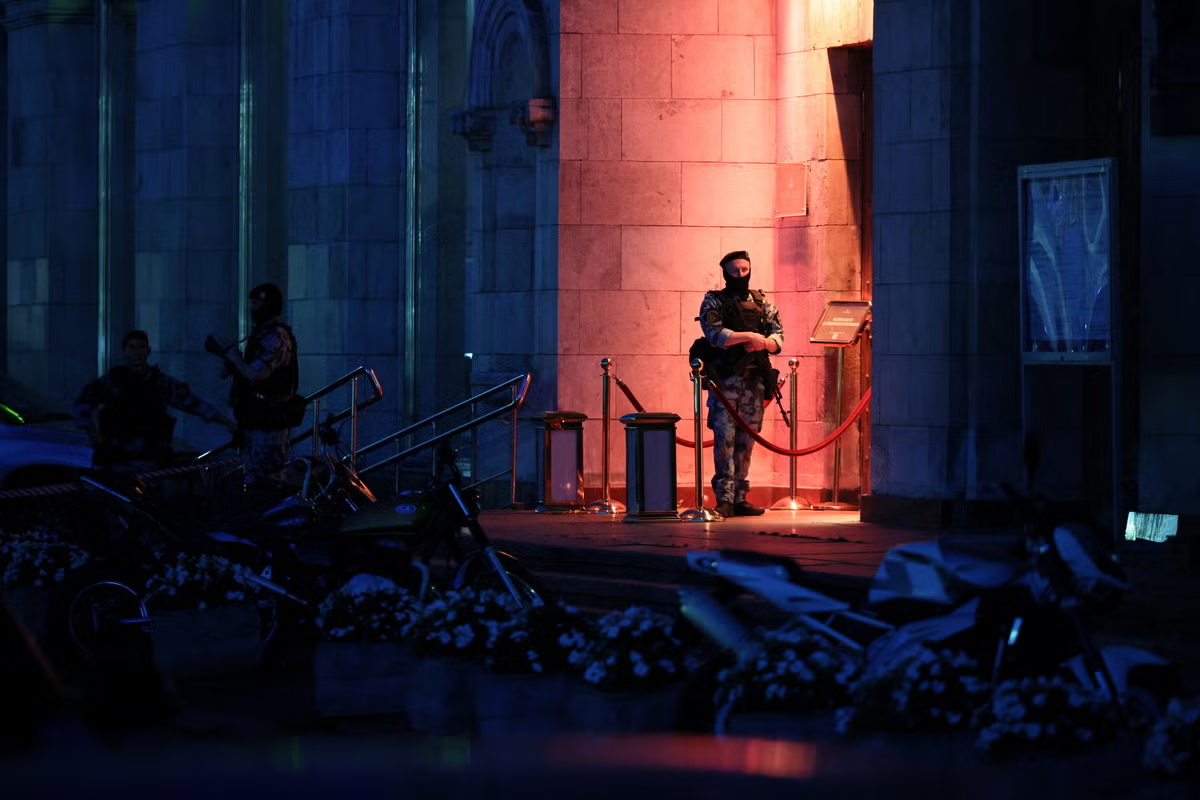
Video released by the agency showed heavily armed police officers at the scene, which had been sealed off from members of the public, the BBC reports.
The exact cause remains uncertain, though the Baza Telegram channel suggested it happened in the establishment’s kitchen.
A witness told the channel the venue was holding a wedding reception with approximately 50 guests present, adding that they saw people being carried out covered in blood after the explosion. Scores of cyclists had gathered in the vicinity for a planned evening ride through the city, though the event was subsequently cancelled.
Police and emergency services were deployed to the scene, with authorities confirming that an investigation into the cause of the explosion was under way.
Advertisement
Russian media reported that traffic in the area surrounding the square has been temporarily suspended, and the entrances to Barrikadnaya metro station have been closed.
Thirteen passengers have been killed after a tourist plane on a sightseeing flight of the Nazca Lines in Peru crashed into a field, police said.
The plane was taking passengers over the archaeological site in the South American country, Nazca’s municipal government said in a statement.
The aircraft, which belonged to local airline Aerodiana, departed from Pisco airport located in the region of Ica, it added.
The plane lost contact with the control tower minutes after it departed from the airport, local news outlet RPP reported.
Advertisement
Local authorities said that the plane crashed in the area of Pueblo Viejo, approximately six kilometres from the city of Nazca shortly after 1pm local time.
Two pilots and 11 passengers, who are believed to be ‘foreign tourists’ are among those who have been killed in the crash, local media reports.
Seven Italians, two Germans and two Spaniards are among those who have died, RPP radio said.
In a statement, municipal officials of Vista Alegre, where the plane crashed, said preliminary findings indicated there was an ‘in-flight emergency’.
Advertisement
Thirteen passengers have been killed after a tourist plane on a sightseeing flight of the Nazca Lines (pictured) crashed into a field, officials have said
The plane was taking passengers over the archaeological site in the South American country (pictured), Nazca’s municipal government said in a statement
A nearby resident said the aircraft exploded on impact. A probe has since been launched by local authorities, while the cause of the crash remains unknown.
Advertisement
‘We have information that 11 passengers and two crew members have died,’ Police Major Jorge Andrade told reporters at the crash site.
‘Given the severity of the accident, there are no survivors. We have recovered four bodies so far.’
Aerodiana, which says it has offered scenic flights over the Nazca Lines for the past 14 years, was not immediately available for comment.
The Nazca Lines, enormous drawings and geometric figures etched into desert plains, are one of Peru’s main tourist destinations.
Advertisement
And dozens of small planes operate from the airport in Pisco, handling a large volume of primarily foreign tourists hoping to visit.
They attract approximately 100,000 annual visitors, with tourists typically viewing them from small aircraft flying over the site.
On Friday, flights travelling over the site from nearby Maria Reiche were suspended due to winds exceeding 40km per hour kicking up dust and reducing visibility.
The gales forced a small plane carrying two Peruvian tourists and another aircraft carrying six tourists to be diverted to the Marcona Airport, local media said.
Advertisement
In 2022, seven people were killed in a plane crash over the site, including two Chileans and three Dutch nationals.
In October 2010, four British tourists and two Peruvian crew members died when an AirNasca plane crashed after taking the tourists to view the site.
Share or comment on this article:
Tourist plane on sightseeing flight in Peru crashes into a field, killing all 13 people on board
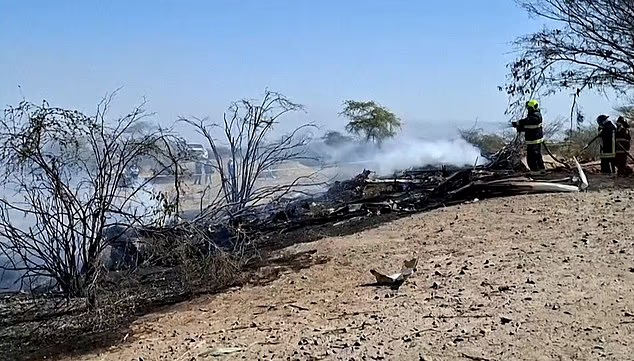
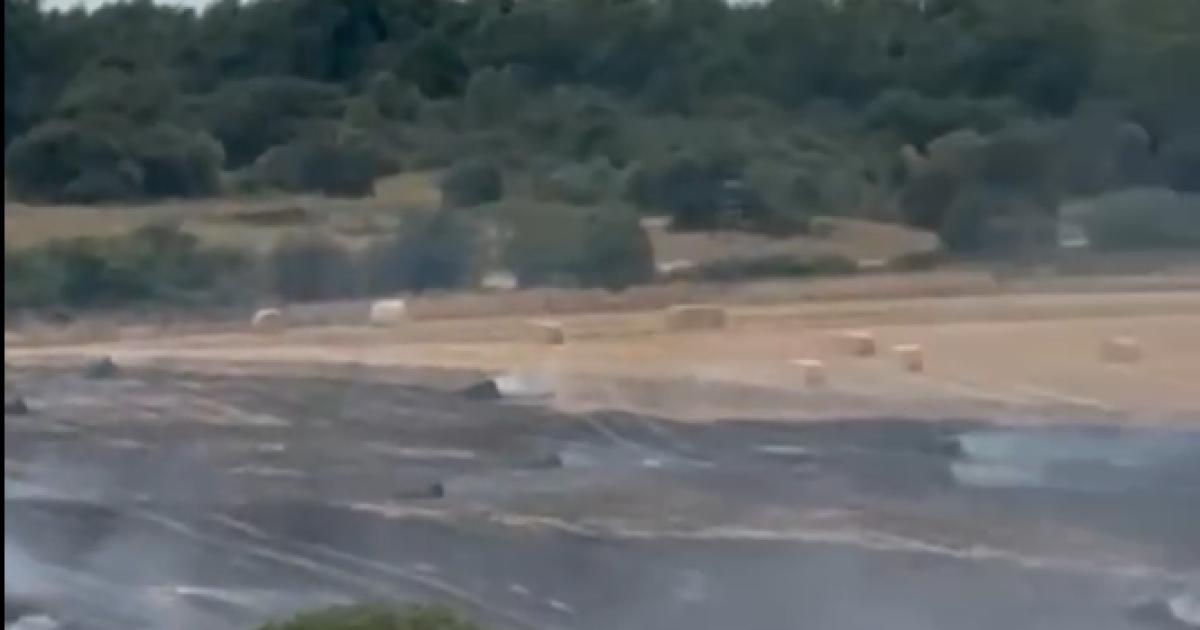
Firefighters responded to a call just after 3.00pm on Saturday (August 1) about the blaze at a farm between Craghead and Blackhouse.
The road near White House Farm was closed by police as drivers reported the flames and smoke sweeping over the carriageway on social media.
About 90,000 sq m of field was said to be on fire.
Advertisement
A County Durham and Darlington Fire and Rescue Service spokesperson said: “At 3.05pm we were called to a fire at White House Farm, Lower Lane, Craghead, Stanley, involving part of a cereal site.
VIDEO: STARBOY FITNESS & MASSAGE/FB
“At its peak, four fire appliances and one bulk water carrier were in attendance from High Handenhold, Consett, Durham and Spennymoor.
“Approximately 90,000 square metres of harvested field was involved in the fire. Crews utilised one jet, four hose reels and farm machinery.
Advertisement
“The fire was surrounded at 4.32pm and we were supported by police for road closures and by the farm owners for machinery.
“We remain at the scene damping down.”
A road closure remains in place on Lowery Lane between White House Farm and Humbleburn Lane while emergency services continue to work on scene.
Holly Willoughby became visibly emotional as she discussed the dangers of social media with campaigner Ellen Roome MBE who lost her 14-year-old son in unexplained circumstances
Presenter Holly Willoughby shared her fears for children and the use of social media in a touching conversation with campaigner Ellen Roome MBE.
Advertisement
Ellen sat down with Holly, 45, for the third episode of her Together YouTube show, which is available on Tuesday 4th August. The pair discussed the heartbreaking events that led to Ellen’s groundbreaking campaign surrounding children and social media after her 14-year-old son, Julian ‘Jools’ Sweeney died in unexpected circumstances in April 2022.
Speaking with Holly, Ellen shared how Jools’ death inspired her to search for answers as the pair highlighted her campaign to change the law, after believing he may have died attempting a viral challenge. Her story has seen her fighting for bereaved parents to be given greater access to their children’s digital data and for social media companies to take greater accountability for the content teenagers and children are exposed to on their platforms.
Speaking on the topic, Holly, who is a mum of three to Harry, 17, Belle, 15, and 11-year-old Chester, shared her own fears as she said: “For all parents out there, I think that and speaking on my own behalf with this as well, it’s such a scary thing social media and you want to protect your kids. And the fear is something like what happened to you, will happen to your own child, and it doesn’t bear thinking about.”
She added: “I think people want to get on board, because they want to do something and they want to see change. They want to protect their kids.”
Holly added that as a parent herself she struggles to comprehend what the best way to protect her children from the dark side of social media.
She said: “Sometimes as people we don’t really want to look into the dark corners because it’s too much. How can you bear that? How can you hold that pain?
“There might be people that will say, ‘Ok ban social media,’ but all that’s going to do is push our children into corners of the internet, you know you think we have the wild west now, but we can’t imagine what’s out there. What then? What do we do then?”
Ellen achieved a first in the UK last month when she won her battle to have Jools’ inquest reopened after the original conclusion was quashed at the High Court. The distraught mum wept as judges granted her bid to re-open the inquest.
Ellen tells her devastating story in full in episode three of Holly Willoughby Together, available on YouTube and other digital streaming platforms from 7:00am on Tuesday 4th August.
‘Iran will continue to pay’, White House press secretary says
White House press secretary Karoline Leavitt expressed the US administration’s frustration anew, stating that Tehran last month signed a memorandum of understanding with the US on a truce but then quickly “broke it, shot at commercial ships, and killed American soldiers.”
“President Trump is not going to stand by and allow this terrorist behavior to occur,” Ms Leavitt said in a statement on Friday evening.
“Iran will continue to pay until they come to the table in, what President Trump deems, a meaningful way.”
Advertisement
Alex Croft2 August 2026 01:01
‘Bing. Bing. Bing, Bing Bing’: Trump offers epic soundbite to recap US shooting down Iranian missiles
‘Bing. Bing. Bing, Bing Bing’: Trump offers epic soundbite to recap US shooting down Iranian missiles
Alex Croft2 August 2026 00:00
Advertisement
Read: Trump’s ‘roadmap’ for peace in Gaza in full
The US president hailed the agreement as a “major milestone” in the peace process, saying the deal included the total disarmament of Hamas and other groups in Gaza as well as the withdrawal of Israeli forces from the territory.
Published in full on Friday, the roadmap says that Hamas and ‘other factions’ agree that “all civilian governance and security functions in Gaza shall be handed over” to a new technocratic body set up to run the enclave.
With that, the technocratic body will take over responsibility for handling “internal security incidents.”
Senior reporter James Reynolds reports:
Advertisement
Alex Croft1 August 2026 23:00
Tehran warns Trump of ‘decisive and proportional’ response to any escalation
We’ve just heard from Iran’s foreign minister Abbas Araghchi, who has warned the US against carrying out fresh any fresh strikes.
Any such aggression from the US or Israel will be met with a “decisive and proportional response”, Araghchi warned.
Advertisement
It is the latest in a series of threats and counter-threats which are beginning to become a hallmark of this war, ever since an initial ceasefire was agreed in mid-April.
In a separate phone calls with his Turkish counterpart Hakan Fidan, and Pakistan’s army commander Field Marshal Asim Munir, Araghchi also declared that any “adventurous action” by the US would be responded to.
Iranian Foreign Minister Abbas Araghchi (AFP/Getty)
Alex Croft1 August 2026 22:11
Advertisement
UKMTO reports two tanker incidents off Oman
The United Kingdom Maritime Trade Operations (UKMTO) said on Saturday it had received reports of two maritime incidents off Oman, including one in which a tanker was struck by an unknown projectile.
In the first incident, a tanker was struck by an unknown projectile about 11 nautical miles northeast of Oman’s Lima, damaging its engine room and leaving the vessel not under command, UKMTO said. There were no reported casualties nor environmental impact, it added.
Later, UKMTO said it had received a second report of an incident, 21 nautical miles northeast of Oman’s Khasab. The master of a tanker reported seeing a large splash and an explosion in close proximity to the vessel, though no damage was reported.
Lima and Khasab are on Oman’s Musandam Peninsula at the entrance to the Strait of Hormuz, a strategic shipping chokepoint through which about a fifth of global oil consumption passes.
Advertisement
Shipping through the Strait of Hormuz has faced heightened risks in recent weeks, with vessels reporting security incidents and some shipowners adopting additional precautions as Iran and the United States stepped up hostilities.
Alex Croft1 August 2026 22:01
Israeli officials signal that peace road map does not align with their interests
Israel has not commented publicly on the road map towards peace that Trump has proposed but Israeli officials, speaking anonymously over the past two days, have signalled that the document does not align with the country’s interests.
Advertisement
The officials also reiterated that Israel would not withdraw from the Yellow Line in Gaza, which divides Israeli-controlled territory in the east with the western part of the enclave.
In recent months, the military has built a massive earthen barrier roughly along the same line, developing what it described as a “security zone” adjacent to the berm, equipped with intelligence and technological assets.
Israel has also carried out controlled demolitions and clearing operations across much of the territory it controls. Palestinians who lived there have yet to return — and are unsure whether their homes are still standing.
Holly Evans1 August 2026 20:00
Advertisement
Trump delivers childlike ‘bing, bing, bing’ recap of latest Iran war action
PresidentDonald Trump‘s attempt to describe the prowess of American air defense weapons left him making childish video game-like sounds as he recounted how U.S. anti-aircraft interceptors successfully downed a quintet of Iranian ballistic missiles over the weekend.
Speaking at a cabinet meeting on Friday, the president was answering a question on whether he’d permit Ukraine to manufacture Patriot missile interceptors under a license when he digressed into the onomatopoetic tangent.
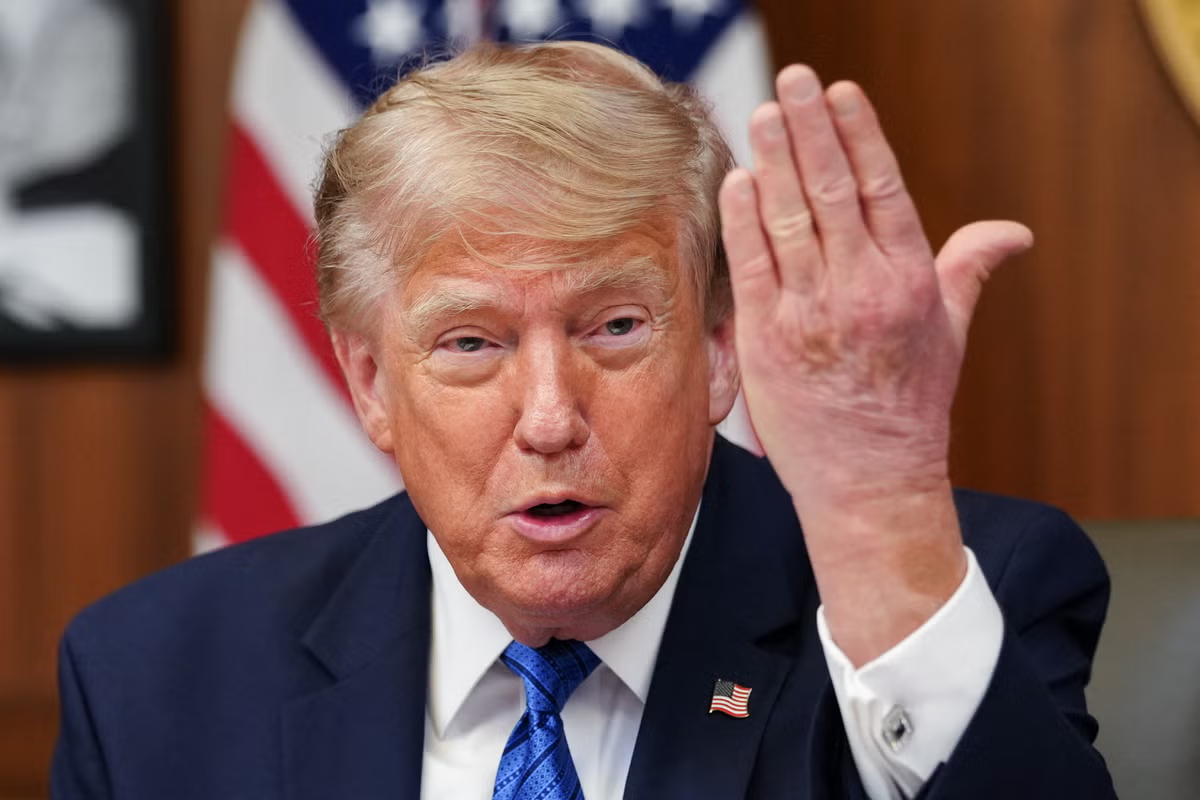
“The other day you read that five missiles were shot. They were going 8,600 miles per hour … and they were big missiles, and they were shot at Jordan, and our guys were there — bing, bing, bing, bing, bing. Five missiles, and we shot all before they got close,” he said.
Advertisement
Read the full article here:
Holly Evans1 August 2026 20:00
Palestinians in Gaza hope Hamas will disarm but fear Israeli forces won’t withdraw
For Palestinians in Gaza, President Donald Trump’s announcement that Hamas had agreed to disarm was a small sign of hope that Israel’s attacks might end, allowing them to rebuild their lives and what remains of their homes.
Advertisement
But it also clashed with the reality on the ground, where Israeli strikes have continued since Trump first touted the deal late Thursday in Washington, and where few steps have been taken to advance a broader ceasefire agreement that went into effect in October.
Photos show the scene after the latest Israeli strikes in Gaza (Copyright 2026 The Associated Press. All rights reserved)
Most of Gaza’s 2 million Palestinians are still displaced or live in tent camps, where poor conditions and overcrowding have led to rodent infestations and outbreaks of infectious diseases such as chickenpox.
“They can talk about withdrawal and disarmament,” said Abdel Moneim Aboul-Roos, 24, a tuk-tuk driver who lost his leg in an Israeli airstrike.
“I don’t care about any of it as long as there is no food or medicine.”
Holly Evans1 August 2026 19:01
Advertisement
Netanyahu yet to comment on proposed peace plan
Donald Trump on Thursday said there had been a breakthrough in his plan to end the war, which both Israel and Hamas agreed to last year and which started with the ceasefire.
Trump said that Hamas, which ruled Gaza for nearly two decades before carrying out the October 7, 2023, attack on Israel that triggered the Gaza war, had agreed to lay down its weapons.
However, Israeli prime minister Benjamin Netanyahu is yet to comment publicly, while his national security minister Itamar Ben-Gvir has called the agreement unacceptable and said that Israel must continue to carry out its policy of assassinating Hamas leaders.
Advertisement
Trump’s Board of Peace, established to implement his plan for ending the Gaza war, released a roadmap on Thursday outlining the final steps for carrying out the initiative. The document states that Israel will cease military operations as part of its commitment to Trump’s 20-point plan, which it signed last year.
Holly Evans1 August 2026 18:00
Trump blames Minnesota for cyberattack that feds have traced to Iran
President Donald Trump on Friday renewed an on-again, off-again feud with one of his 2024 election opponents by suggesting that an Iranian cyberattack against Minnesota’s water infrastructure was due to the state government’s incompetence rather than Tehran’s malfeasance.
Advertisement
Trump was speaking during a cabinet meeting at Camp David in Thurmont, Maryland when, unprompted, he downplayed an advisory from both the Federal Bureau of Investigation and Environmental Protection Agency, which had warned that Iranian hackers have been targeting water and sewage systems and other critical infrastructure sectors across the United States.
“Today, I just want to mention that we heard in Minnesota there was a cyberattack, and they blame it on Iran. I don’t think so. I think I blame it on Minnesota because they’re grossly incompetent. There was a cyberattack of 30 water plants, and I would blame it on Minnesota and the governor, the corrupt governor of Minnesota,” Trump said.
At least three people were killed and two others were injured in a mass shooting at an In-N-Out in Twin Falls, Idaho, on Saturday, according to police and local officials.
The explosion, which occurred at around 7:55pm local time (5:55pm BST), occurred near an upscale Italian restaurant located in one of Moscow‘s seven Stalin-era skyscrapers at Kudrinkskaya Square, police said.
Russia’s Anti-Terrorism Committee said that an unidentified woman had tried to get into the restaurant but was stopped by a security guard, Russian news agencies reported.
Among the dead were the security guard, the unnamed woman, and another visitor, the committee added.
Advertisement
The Kommersant daily newspaper cited sources as saying that the bomb had been intended to maim and kill guests who were enjoying themselves on the restaurant’s summer terrace outside.
The restaurant’s website said the venue had been closed on Saturday for a private event, but it is unclear who was present.
There is not yet any suggestion that the explosion is linked to the war in Ukraine.
Zelensky says latest attacks show Ukraine’s need for Patriot missiles
President Volodymyr Zelensky has pressed the US and other Western partners regarding Ukraine’s need for more Patriot anti-ballistic missile defence systems to counter aerial attacks from Russia.
“Every package of ballistic missile interceptors saves the lives of our people. And every night without them results in more casualties,” he wrote on X following the latest attacks.
The Ukrainian leader late Friday said he spoke to US vice president JD Vance and discussed a meeting with president Donald Trump earlier this week in Washington, which Zelensky described as “positive and productive.”
Advertisement
“The Russian air strikes on our country continue and air defence, specifically interceptors for Patriot systems against ballistic missiles, remains a top priority,” Zelensky said on Friday in a post on Telegram.
Alex Croft2 August 2026 00:00
Moscow bomb aimed to maim and kill guests of well-guarded party in upscale Italian restaurant – report
The Kommersant daily newspaper has cited sources as saying that the bomb had been intended to maim and kill guests who were enjoying themselves on the upscale Balzi Rossi Italian restaurant’s summer terrace outside.
Advertisement
The restaurant’s website said the venue had been closed on Saturday for a private event, but it is unclear who was present.
The party, the paper reported, was heavily guarded, which helped prevent casualties.
Kommersant added that preliminary reports suggest the courier likely didn’t know what the contents of the package were.
The newspaper reported that the Main Investigative Directorate of the Investigative Committee is investigating the incident as a terrorism crime.
Advertisement
Alex Croft1 August 2026 23:24
Latest pictures from the scene of the explosion in Moscow
The injury toll was revised up to 21 (Reuters)
Law enforcement officers and emergency services personnel work at the site of an explosion at a restaurant in central Moscow (Reuters)
The bomb was brought near an upscale Italian restaurant (AP)
Alex Croft1 August 2026 23:19
Russia strikes fuel storage in Ukrainian port of Odesa
Russian forces carried out strikes on fuel storage tanks in the Ukrainian port of Odesa, the Interfax news agency reported on Saturday, citing the Defence Ministry.
Advertisement
The strikes hit a marine tugboat repurposed for use by the Ukrainian army in the port of Mykolaiv.
The Independent could not verify the battlefield reports.
Alex Croft1 August 2026 23:00
Advertisement
Queue for hot meals in Crimea as Ukraine inflicts damage onto power supply
Under a blazing summer sun, a chef poured oil into huge pots set up on a street in the Crimean town of Massandra, preparing to serve dozens of people queuing for a hot meal after Ukrainian attacks cut power to their own kitchens.
Cities and towns across Crimea, which Russia annexed from Ukraine in 2014, have had to cope with limited fuel supplies for much of the summer amid Ukrainian attacks on power plants and other infrastructure.
Ukraine, whose own cities have been under repeated attack since Moscow sent thousands of troops into the country in 2022, says it is “bringing the war back home to Russia” by intensifying strikes deep inside the country and on territory its neighbour controls.
People line up for hot meals at a field kitchen set up by the local authorities in the settlement of Massandra, Crimea (Reuters)
Standing beside boiling vats of buckwheat, later to be added to plates of reheated tinned beef, Massandra town administration head Oksana Madyud said her workers were serving roughly 200 people per day.
“We’re preparng hot meals for people, as under the current circumstances not everyone has the means to cook hot food on electric hobs,” she said.
Advertisement
One local woman, Marina, said pain in her leg was making the climb down from her 10th-floor apartment difficult, but the lack of electricity had sent her hunting for a gas cooker and some cylinders.
“There’s nothing up there,” she said, referring to her apartment. “We’ve got an electric cooker – that’s it.”
Alex Croft1 August 2026 22:35
Advertisement
In pictures: Aftermath of Moscow cafe explosion as three killed
At least 3 people were killed in the explosion (Reuters)
The injury toll was revised from 15 to 21 (Reuters)
A woman allegedly tried to take the IED into a restaurant (Reuters)
Alex Croft1 August 2026 22:10
Injury toll revised to 21 as three killed by IED in Moscow restaurant – Russian officials
As we earlier reported, three people were killed in an explosion near a cafe in central Moscow, according to Russian officials.
Moscow’s National Anti-Terrorist Committee has now confirmed that the explosion was of an improvised explosive device that a woman attempted to carry into the eatery. The explosion took place at 7:55pm local time (5:55pm BST).
This followed previous reports that a gas canister had exploded.
Advertisement
The committee also revised the injury toll from 15 people to 21, meaning there are at least 24 casualties in total.
Those killed included “a security guard who prevented an unknown woman suspected of trying to carry the explosive device into the restaurant, the unknown woman and one of the visitors,” a statement from the committee read, according to the Tass news agency.
Law enforcement officers stand guard at the site of an explosion at a restaurant in central Moscow (Reuters)
Alex Croft1 August 2026 21:59
Watch: ‘Scared’ British tourist in Poland films moment air raid sirens sound during Russian strikes in Ukraine
A British tourist in Poland has captured on camera the moment air raid sirens started blaring during Russian strikes in Ukraine.
Advertisement
In the early hours of Thursday (30 July), Ryan, who was staying in Lublin, was woken to the sounds of sirens. “As a British tourist this scared the hell out of me,” he wrote.
The alarm was triggered by Russian airstrikes in neighbouring Ukraine, which killed eight people. The sirens stopped after a few minutes.
Poland’s defence minister Wladyslav Kosiniak-Kamysz said that the country endured an “extremely tough night”, which saw sirens blare, F-16 fighter jets scrambled and a suspected Russian missile crash into a field.
You can watch the moment here:
Advertisement
Alex Croft1 August 2026 21:00
Mapped: Where is the current Ukraine frontline?
Alex Croft1 August 2026 20:00
Advertisement
Three killed and 15 injured in explosion near Moscow cafe – reports
Three people were killed and 15 injured in an explosion near a cafe in central Moscow, TASS reported on Saturday, citing an official.
“The Interior Ministry’s Moscow branch is working at the site of the incident. According to available information, an explosion occurred near a summer cafe at about 08:10 p.m. (05:10 p.m. GMT) today, as a result of which three people were killed and 15 were injured in various degrees of severity,” the official told the agency.
A SCHOOL visit to York sparked a life-time love affair with our city for William Thackray.
William came to York aged 10 on a school trip from South Yorkshire in 1955 – and took in the Minster, the Bar Walls, Shambles, the Castle Museum and the old York railway museum.
“We must have whizzed round York in an afternoon like how Americans do in Europe,” said William with a smile when we met for a coffee to look through a very precious memento of that day.
William, now aged in his 80s, remembers that first trip to York so vividly because he has kept a scrap book filled with details of the visit as well as sketches and his own reflections on the day.
Advertisement
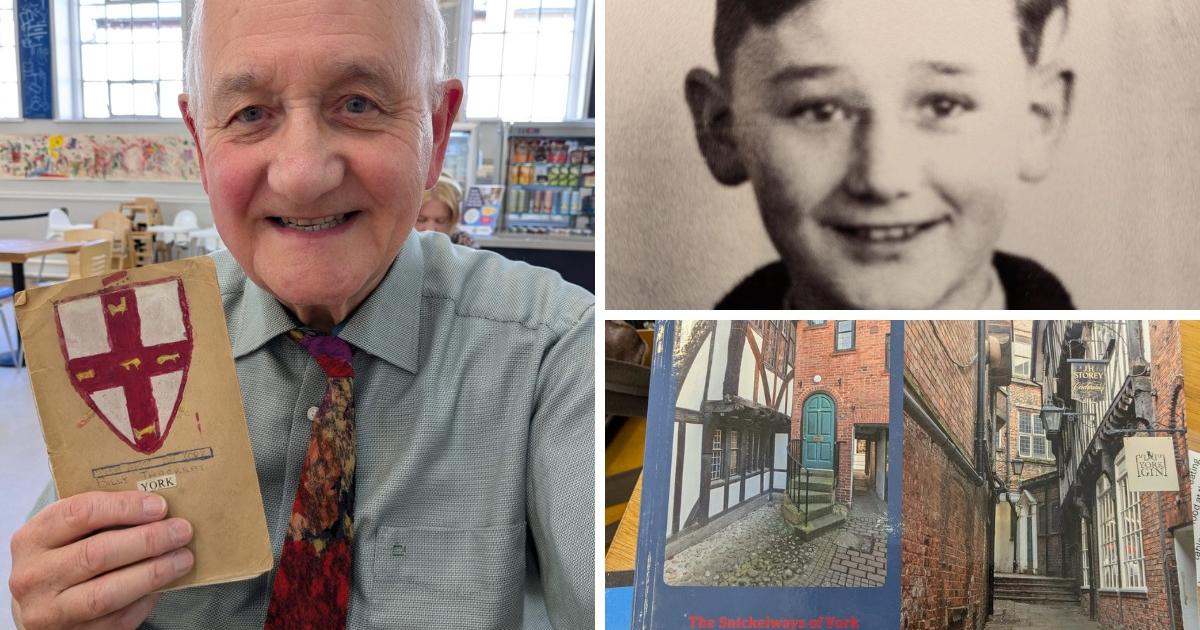
William Thackray who has created photobooks of York. Image by NQ
“My lasting memory is of the sheer wonder of York – as a dream place. Here was history – it really got to me. It was a place like nowhere else I’d seen.
“I’d been to London in 1953, but even a few days in London didn’t hit me like my one day in York.
“I remember walking along the York walls thinking, well, we don’t have these in Rotherham!”
William was able to indulge his affection for York further when he came to York to study at York St John to be a teacher.
Advertisement
William Thackray who has created photobooks of York inspired by this scrapbook of a school visit in the 1950s. Image by NQ
During this time, he took weekly organ lessons at York Minster under the instruction of Francis Jackson, the celebrated composer and organist, who was director of music at the Minster from 1946 to 1982.
William Thackray as a boy. William has created photobooks of York. Image by NQ
William enjoyed a career as a teacher before retraining to be a vicar.
And as an adult, he would regularly visit York, often taking photos on his digital camera.
Recommended reading:
Advertisement
Now retired and living in Northallerton, taking photos of York has been a hobby for many years. Although today, he takes images via his smartphone.
And he has created several photo-books documenting this deep regard for our city, across themes such as the city’s snickelways, its iconic buildings and many of its churches.
One of William Thackray’s photobooks of York on the city’s snickelways. Image by NQ
“I’ve done 12 books in total. I like taking photos. I am not a photographer and don’t know anything about photography; these days I just use a mobile phone.”
Each book can be reproduced, but at a cost of £85, so it not a mass-publishing nor profit-making venture, pointed out William.
Advertisement
Ultimately, he just loves taking photos of the city he first lost his heart to as a schoolboy.
“Walking around York is like walking around a stage set.”



















































You must be logged in to post a comment Login