


Connect with us

NewsBeat

Northumberland mining to be commemorated at Woodhorn Museum

Published

on

Northumberland mining to be commemorated at Woodhorn Museum

Woodhorn Museum in Ashington will host the event on Saturday, June 13, from 10am to 5pm.

The Picnic has its roots in 1864, when the first gathering took place at Blyth Links, bringing together mining communities from across Northumberland to celebrate, commemorate and campaign. It has been held at Woodhorn Museum since 1992, following the closure of the pits.

The day opens at 10.30am with a memorial service paying tribute to those who dedicated their lives to Northumberland’s coal industry, and those who lost their lives in it.

This year’s service will include a moving musical tribute from the Ashington and District Male Voice Choir, who will perform Woodhorn Disaster, a piece that names all 13 miners who died in the Woodhorn Colliery disaster of 1916.

Advertisement

From 11:30am, the main stage will feature a succession of brass bands including Ellington Colliery Band, Jayess Newbiggin Brass Band, Bedlington Brass Band and Ashington Colliery Brass Band, before a massed bands finale at 1:10pm.

The afternoon brings Northern Proud Voices, Ladies of Midnight Blue and the Northern Monkey Brass Band.

(Image: Supplied)

Around the site will be craft workshops, percussion sessions and a Bugs and Beasties parade at 2.10pm, while writer Ed Waugh presents talks on the ‘Cramlington Eight’ and the 1926 General Strike at noon, 1pm and 2pm.

A free shuttle bus runs between Ashington Leisure Centre and Woodhorn Museum throughout the day, with the last departure leaving Woodhorn at 5.15pm.

Advertisement

Entry is free, with parking available on site for £5.

Source link

Advertisement
Continue Reading
Click to comment

You must be logged in to post a comment Login

Leave a Reply

NewsBeat

Jewellery brand inspired by couture runways opens in Scots shopping centre

Published

on

Daily Record

It marks the fourth boutique from the brand now available in Glasgow.

There’s been a new addition to the Glasgow Fort. Popular jewellery brand Lovisa opened its the doors to its latest boutique in the major shopping centre today (July 29).

Advertisement

Located between Specsavers and FORTY, the new outlet will offer shoppers affordable, catwalk-inspired accessories. The opening marks the high street retailer’s fourth store across the city.

Other stores across Glasgow can be found in fellow shopping centres Braehead, St Enoch and Buchanan Galleries. It also takes Lovisa’s total stores across Scotland to 11, with other outlets found in the likes of Aberdeen, Inverness, Stirling, Dundee, and more.

Founded 16 years ago, Lovisa was created with the main aim of making fashionable jewellery more affordable. A statement on the firm’s website has described it as a “fashion-forward brand”, with 150 new styles being delivered to stores each week.

The new Glasgow Fort outlet will allow shoppers to browse a range of styles that have been inspired by some of the biggest current trends. The brand’s ‘trend spotting’ departments work to take inspiration from couture runways and street-style, creating “new, must-have styles.”

Advertisement

Since the opening of its first store back in April 2010, Lovisa has gone on to operate more than 900 stores across 45 countries. It reached a milestone of 100 in the UK earlier this year with the opening of its outlet located in Birmingham’s Bullring.

Excited shoppers rejoiced at the newest boutique in Glasgow Fort after the shopping centre shared the news on Instagram recently. The full post read: “Lovisa is opening at Glasgow Fort!

Content cannot be displayed without consent

“Lovisa is a brand that was born out of a passion for offering fashionable jewellery at affordable prices. Lovisa is jewellery that goes with fashion and is accessible to everyone!

Advertisement

“Get ready to discover your next favourite jewellery pieces!”

Expressing enthusiasm, one shopper responded with: “Can’t wait! Love Lovisa.”

While a second enthusiastic Facebook user added: “Looking forward to it xx.”

It’s just the latest addition to Glasgow Fort recently, with the shopping venue opening a host of new shops over the past year. This includes a new store for popular shoe chain OFFICE – making it the biggest in Scotland.

Advertisement

Now spanning a staggering 5,012 sq. ft, it is double the size of the previous unit that measured 2,249 sq. ft. It can be found next to neighbouring brands Deichmann, BPerfect and River Island.

The leading Glasgow shopping and leisure centre also unveiled major expansion plans back in May. If approved, this would see it upsized by a staggering 60,000 sq.ft, bringing even more options for shoppers.

Alongside a potential bowling alley and arcade, one of the highlights would be a new M&S. The plans aim to upsize its current branch by over 32,000 sq.ft, which would turn it into a new Scottish flagship for the brand.

There’s also been a host of new openings announced for outside of Glasgow. One of the latest is a new Rituals Cosmetics boutique that is set to open in Edinburgh’s Gyle Shopping Centre sometime this September.

Advertisement

Source link

Continue Reading

NewsBeat

Britain will value the hard hat as much as the graduation cap

Published

on

Britain will value the hard hat as much as the graduation cap

The Prime Minister has unveiled a fundamental change to the education system, with the launch of new prestigious technical educational routes. The new pathways will provide 14-year-olds with valuable early access to technical skills, work experience and connections with local employers.

Source link

Continue Reading

NewsBeat

how attitudes to reading have changed over three centuries

Published

on

how attitudes to reading have changed over three centuries

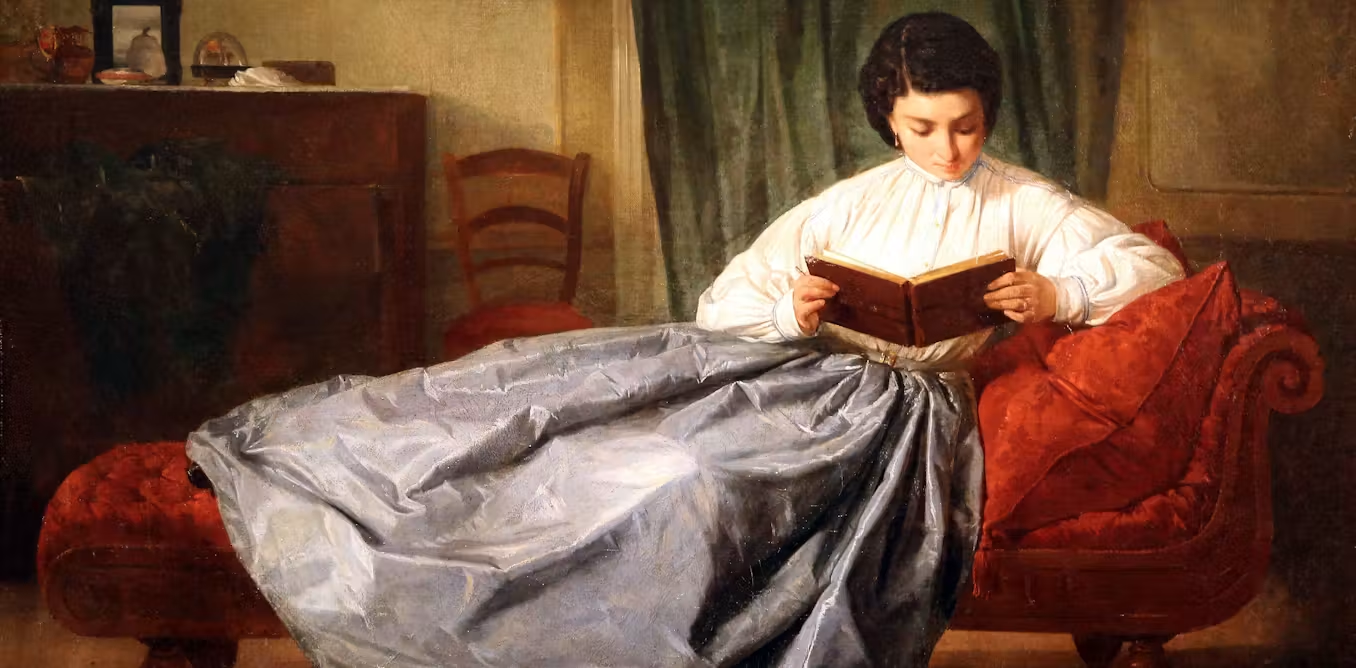
Ask someone today why they enjoy reading novels and they will likely say it allows them to escape real life and immerse themselves in a different world. This escapism is seen as positive, but for centuries novel reading was thought to corrupt readers for precisely these reasons.

This year is the UK’s National Year of Reading – a government-led campaign “to help more people (re)discover the joy of reading and make it part of their everyday lives”.

The campaign seeks to reverse declining levels of reading for pleasure, explored in two reports: Children and Young People’s Reading in 2025 and The State of the Nation’s Adult Reading 2024. It does not promote novels exclusively, but they are inevitably a popular choice for many readers.

Beginning from the premise that reading “expands worlds, sharpens minds and fuels creativity”, the campaign echoes ongoing research into the relationship between novel reading and personal wellbeing. For example, a 2023 study carried out at the University of Edinburgh recently showed that reading fiction promotes positive emotions, connection with others and personal growth.

Advertisement

Science writer Rita Matter giving her TEDx talk, Why Reading Matters.

At a time when we are being encouraged to read more, it is striking to consider how attitudes towards novel reading have evolved since the genre began to develop during the 18th century. In Britain, early examples were written by Daniel Defoe and Samuel Richardson. But the novel ultimately emerged from an earlier European tradition and was heavily influenced by nonfictional forms, including letters and histories.

Novel reading as guilty pleasure

Throughout the 18th and 19th centuries, the novel was generally considered low-brow literature, often being described by critics (in some cases seriously and in others more jokingly) as a kind of poison, waste or disease.

Around the turn of the 19th century, the novel’s reputation reached an all-time low. One reason for this was that more novels were being written in Britain than ever before. This was the Romantic period – best remembered today for giving us the novels of Jane Austen, Walter Scott and Mary Shelley, who gave the world Frankenstein.

Advertisement
Mary Shelley pioneered the science fiction genre with Frankenstein.
Penguin

But it was also a period in which a whole raft of other novels by now-forgotten authors were produced en-masse. Austen alludes to this in Northanger Abbey (1817) when, making fun of the idea that all novels are bad, she refers to “the trash with which the press now groans”.

The number of people reading novels also increased dramatically during these years, meaning that the dangers posed by novels seemed even more threatening. Novel reading was thus a kind of guilty pleasure – people knew that it was disapproved of, but still they indulged – much like fast food or trash TV today.

In the introduction to her 50-volume book The British Novelists in 1810 – one of the earliest attempts to canonise the novel – the poet Anna Laetitia Barbauld recognises this tension:

A collection of novels has a better chance of giving pleasure than of commanding respect […] but their leaves are seldom found unopened, and they occupy the parlour and the dressing-room while productions of higher name are often found gathering dust upon the shelf.

But why was novel reading considered so disreputable?

Advertisement

Evolving attitudes

As Barbauld suggests, novel reading was deemed frivolous and not nearly as valuable a use of time as reading, say, a work of history or moral philosophy, which offered new knowledge and ways of understanding the world.

There was also a concern that novel readers would become so immersed in fiction that they would either no longer be able to distinguish it from real life or neglect their daily duties. In Marriage (1818), a novel by Austen’s Scottish contemporary Susan Ferrier, the heavily satirised housewife Mrs Gaffaw “reads novels” and is therefore “above managing her house”.

Within Romantic-period novels, including those by Austen and Ferrier, numerous examples can be found of readers who become overly absorbed in fiction. The consequences of this are invariably bad – often including sexual misconduct and moral decay – thereby providing warnings to other readers.

A blue book cover of The Little Prince by Antoine de Saint Exupery
The Little Prince, published in 1943, is the bestselling children’s novel.
Penguin

Today, a different view is taken. As one young reader cited in a recent article on the wellbeing benefits of reading fiction put it, novels provide an opportunity to “calm down and just get away from the world”. Getting lost in a novel is a good thing – one that allows time for quiet and reflection.

The same message underpins our summer reading lists, such as the one in Condé Nast Traveller magazine, in which the mark of “a great holiday read is its ability to transport and immerse you into a completely different world”.

Advertisement

In this sense, we have come full circle. The escapism that made novel reading so dangerous 200 years ago is now craved by 21st-century readers and hailed as a means of necessary self-regulation. Regardless of personal reading preferences, it is clear that debates on the value of fiction, and how we engage with what we read, remain central to popular culture.


This article features references to books that have been included for editorial reasons, and may contain links to bookshop.org; if you click on one of the links and go on to buy something, The Conversation UK may earn a commission.


Source link

Advertisement
Continue Reading

NewsBeat

Three ways boredom can actually be a benefit

Published

on

Three ways boredom can actually be a benefit

Boredom is something many of us will do everything we can to avoid. We fill our time with social media, books and TV programmes and keeping our schedules packed with plans.

But boredom doesn’t always need to be seen as something negative. Boredom may, in fact, be good for you – but only if you effectively tap into its full potential.

1. It can push you towards positive change

Boredom tends to arise when we want to be mentally engaged but our current activity or environment isn’t providing the level of challenge, stimulation or meaning we need. This can leave us feeling restless – especially if we don’t know how to remedy the situation.

It’s for this reason that boredom can be used to push ourselves towards change and encourage exploration.

Advertisement

But in order to make boredom really work for you, it’s vital to avoid just reaching for the next easy distraction, like scrolling on your phone, online shopping or visiting the pantry for a snack.

Positive change comes not from asking “how do I stop feeling like this?” but asking yourself “what meaningful thing do I need next?” Focusing on doing something meaningful is key to making boredom a bridge to more productive or positive activities.

While determining what’s meaningful will differ for each of us, as a general guide meaningful activities require a bit of effort while still being doable and making us feel like we’re part of something bigger than ourselves.

So if you’re someone who enjoys exercise or being in nature, going for a hike is one meaningful way of quelling the boredom.

Advertisement

Or if you prefer creating things or doing crafts, the act of making something can be an opportunity to immerse yourself, which can improve wellbeing.

Sometimes boredom also indicates we need to get out of the house and see friends or family. Connecting with another person can provide meaning, responsiveness and a sense of belonging that doing something alone cannot.

2. It can improve problem solving and creativity

Ever taken a shower and found you’ve come up with a really great idea, or solved a problem that’s been bothering you? This it called the “shower effect” – and the reason it happens has to do with boredom.

The shower gives us a perfect, low-demand environment so our minds can wander. This lets the mind move into a state of “productive mind-wandering”, where attention can drift from the task at hand and thoughts can wander loosely.

Advertisement

When we let our mind wander, the process generates spontaneous thoughts that are random or only tangentially related to the immediate present. But these spontaneous thoughts often become productive ones – such as coming up with novel ideas, making new associations between previously encountered materials, solving problems we’ve been grappling with, consolidating goals or memories and boosting our creativity.

There’s a reason why many of us come up with our best ideas in the shower.
Lopolo/ Shutterstock

To make the most of mind-wandering’s problem solving capacity, and avoid it turning into a spiral of worry and rumination, preload your mind with good ingredients. If you know you’re going to have a block of time during your day where boredom may arise, engage your mind in advance with an analytical problem, creative project or prompt.

This primes your thinking with lots of stimulating material. That way, when you do let your mind wander, you can get creative and do something positive with your boredom.

3. It can improve memory and learning

Boredom may be unpleasant – but it can be useful in supporting our ability to build memories and retain important information.

Advertisement

Allowing our minds to go “offline” (also known as “wakeful rest”) provides an important buffer to help integrate and consolidate new information. Pausing and doing nothing, staring into space and doodling are all examples of wakeful rest.

New memories do not leap fully formed into our long term storage. Instead, after a novel experience or learning something new, the trace memory must be stabilised and integrated through a process called memory consolidation. Taking some time out of consuming information and letting the brain rest helps with this process.

Even just five to ten minutes of wakeful rest a day can protect fragile new memories from competing with unimportant information. Wakeful rest is also shown to help people better remember what they’ve just learned – even when asked to recall that information a week later.

Another key aspect of wakeful rest is that when the brain gets bored, it doesn’t just switch off, it changes modes.

Advertisement

The brain switches from focusing on external demands and tasks and moves into internal, self-focused processing. This kind of internal processing happens best during down time – such as when we’re bored. It supports us to make meaning, work out our values and who we are.

It also helps us to reflect on our experiences and is involved in processing memories, as well. Including a little wakeful rest in study time or when doing a new activity will not only support you in remembering what you learned, but it will also help you stay focused on who you are and what’s most important to you.

How to be bored

So how can we learn to tolerate boredom? By accepting it as a normal experience – rather than something negative.

You also don’t have to abandon technology entirely to better tap into your boredom – though it will help. Cutting back on the amount of rapid switching between videos, apps and social media platforms may help to improve attention, satisfaction and meaning.

Advertisement

If you manage to reduce switching, the next step is to practice staying with one ordinary experience, such as focusing on your breath. The more you can stay engaged in the present, the better you’ll be able to tolerate boredom.

Leaving space to do nothing and let a little boredom in is good for us – just be sure to make the most of these moments.

Source link

Advertisement
Continue Reading

NewsBeat

Doctor Who And James Bond Actor Tom Chadbon Has Died Aged 80

Published

on

Doctor Who And James Bond Actor Tom Chadbon Has Died Aged 80

Game of Thrones, Doctor Who, Peep Show, and James Bond actor Tom Chadbon has died aged 80.

In a statement, Fantom Events, a publishing company the actor had worked with, said: “We are sorry to hear the news that Tom Chadbon passed away last weekend.”

“Tom was a familiar face to many from his numerous television and film credits, including Doctor Who, James Bond and Game Of Thrones.

As iconic detective Duggan

“He was always a warm and friendly man to work with, and we send our condolences to his family at this sad time.”

Advertisement

The actor played beloved one-off character detective Duggan in Doctor Who, returning to star as robot Drathro’s servant Merdeen.

He also performed as High Septon Maynard in Game Of Thrones, Martin in Peep Show, and a stockbroker in Casino Royale.

Other appearances include Casualty, Poirot, The Bill, Sarah-Jane Smith, Holby City, and Midsomer Murders.

Peep Show fan account Dobby Club wrote on X, “RIP to the legend Tom Chadbon who starred in Peep Show as Martin aka Indiana Ashdown.”

Advertisement

TV writer Cavan Scott, who worked on Doctor Who, said on Instagram: “So sorry to hear the passing of the great Tom Chadbon who I shared many a happy studio session with while producing Blake’s 7, not to mention the story-filled meals after recordings.

“An absolute gent. God speed, Tom.”

The RADA-trained actor was born in Luton.

His first TV appearance was in 1968.

Advertisement

Source link

Continue Reading

NewsBeat

A170 remains closed near Pickering after serious crash

Published

on

A170 remains closed near Pickering after serious crash

North Yorkshire Police said the A170 is expected to remain closed near Pickering until “at least this afternoon (Wednesday, July 29)”.

Wrelton Cliff Road is closed both ways between Pickering and Wrelton after the crash in the early hours of Wednesday.

Advertisement

AA Traffic News said the closed road includes the junction for Cropton Lane.

North Yorkshire Police said its specialist crash investigators are carrying out inquiries at the scene.

A force spokesperson urged motorists to avoid the area and use alternative routes where possible.

The road is a principal route from the A1 and the A19 to the North Yorkshire coast.

Advertisement

Source link

Continue Reading

NewsBeat

I started litter picking on maternity leave: It turned into founding an organisation

Published

on

I started litter picking on maternity leave: It turned into founding an organisation
Hafsa saw there was litter in her local area, and decided to take things into her own hands (literally) (Picture: Supplied)

Not all heroes wear capes… our Unsung Heroes series celebrates ordinary people doing extraordinary work.

Today, it’s Hafsa Omar, 37, from Moss Side, Manchester, who keeps her community clean and tidy.

What do you do?

I’m founder of the Moss Side Eco Squad (@moss_side_eco). A volunteer group that picks up litter where we live.

How did it start?

On maternity leave, walking around with my baby in the pram, I noticed all the litter I had to dodge around. So, I thought, why not clear it up myself?

Advertisement

What next?

People approached me wanting to help. They just needed someone to organise them. So, I put a time on Facebook and seven or eight people turned up.

How did you fund equipment?

Ask Metro


Use AI to go deeper into the stories you care about – powered by Metro and trusted publications.

Advertisement

For my birthday, I asked for litter pick sticks and gloves instead of presents.

Where do you litter pick?

All over Moss Side. It’s given me a familiarity with my community. I’ve discovered cafés, shops and parks that I’d never seen before.

Is the social side fun?

We were strangers, now we’re all really good friends. We check on each other when sick, drop off food if needed and celebrate birthdays.

What’s been the reaction?

People often say thanks. We get offered free food from the takeaway. Or people come out of their house with a cup of tea for us. Locals donate bin bags.

Advertisement

Any tricky moments?

Some people assume we are 
ex-offenders doing community service!

What litter do you see most?

Takeaway wrappers. People chuck it out of car windows. I’ve caught them at it.

What happens then?

I ask, ‘Do you do that at home?’ They usually say sorry.

Any weird finds?

A dried-up stingray fish. No idea where it came from. Oh, and decapitated dolls.

Advertisement

What about dangerous items?

We don’t touch any drug paraphernalia. We report it to the council for disposal.

Do you see fly tipping?

Yes. Lots of landlords rent to students here. So people moving in and out every year and dumping mattresses outside.

How many items do you pick up?

We average two bin bags of rubbish per person – so maybe 20 bags each time. Most of us have family to care for and jobs to go to, so we’re all time-poor.

So there’s no pressure to commit

I’ve dipped in and out since we started in 2020, but other people continued.

Advertisement

Are you really tidy at home?

Yes, but not obsessively. I do love the BBC TV show Sort Your Life Out about helping people declutter. My dream job would be reorganising charity shop floors.

Why do you volunteer?

It gives me asense of belonging in the place where I live. I’ve moved around my whole life. This is the first place that really feels like home.

Any hobbies?

Swimming. I help organise the Junior Parkrun in Moss Side every Sunday for kids. And I take part in the adult run.

Become a litter hero for your area with keepbritaintidy.org

Advertisement

Source link

Advertisement
Continue Reading

NewsBeat

Cambridgeshire Iceland supermarket remains closed after roof collapses

Published

on

Cambridgeshire Live

No one was injured after the roof collapsed

A supermarket remains closed after its roof partially collapsed. Emergency services were called to Iceland in High Street, March, just before 3pm on Tuesday (July 28).

Advertisement

The supermarket’s roof had collapsed. No one was injured, but a cordon was put in place and the building next door was evacuated as a precaution.

The store closed on Tuesday and remains closed on Wednesday (July 29). An Iceland spokesperson said: “We are currently working with Cambridgeshire Police and Cambridgeshire Fire and Rescue Service following a roof collapse at our High Street store in March, Cambridgeshire. All colleagues and customers are safe, and the store remains closed as a precaution.”

Cambridgeshire Police assisted with the cordon on Tuesday. Cambridgeshire Fire and Rescue also assisted the police.

A fire spokesperson said: “A crew from Chatteris was called just before 3pm yesterday to assist police colleagues at an incident on High Street in March. Firefighters helped to make the area safe and returned to their station by 8.35pm.”

Advertisement

Fenland District Council has been contacted for more information.

Do you want more of the latest Cambridgeshire news as it comes in from across the county? Sign up to our dedicated newsletter to make sure you never miss a big story from Cambridge or anywhere else in the county. You can also sign up to our dedicated Traffic and Crime newsletters for the latest updates on the topics you are most interested in.

Source link

Advertisement
Continue Reading

NewsBeat

Transfer news LIVE: Arsenal FC get Vinicius Jr hope, Guimaraes update; Chelsea medical; Man Utd, Liverpool latest

Published

on

Transfer news LIVE: Arsenal FC get Vinicius Jr hope, Guimaraes update; Chelsea medical; Man Utd, Liverpool latest

The summer window is getting very busy as Arsenal, Chelsea, Manchester United, Liverpool and Tottenham all continue to chase some major signings. Arsenal may have been offered new hope in their ambitious pursuit of Vinicius Jr, though Real Madrid do not want to sell. The Gunners appear to have finally made a breakthrough over Bruno Guimaraes and have reportedly opened talks over Ivan Fresneda as they close in on another wonderkid in Axel Donczew, with Julian Alvarez also still on their radar.

Source link

Continue Reading

NewsBeat

Ruben Amorim’s honest answer on Manchester United came too late – ‘Mistakes’

Published

on

Manchester Evening News

AC Milan’s head coach Ruben Amorim has spoken honestly about what went wrong during his Man Utd tenure.

“Football is a game of mistakes. Whoever makes the fewest mistakes wins,” Johan Cruyff famously once said.

Advertisement

Managers are responsible for telling players how to play, so mistakes can be made before the referee blows for kick-off on a matchday.

Ruben Amorim made mistakes during his time at Manchester United, but the error that led to his downfall was his stubbornness and unwavering belief that his 3-4-3 system was the only way.

Amorim may have seen the light after six months of reflection following his sacking in January. He was appointed by AC Milan last month, and a recent interview suggests he recognises his shortcomings.

“They [Milan] appointed me because they felt I was the right guy for the way I want to play,” Amorim told Sky Italia. “They want to play the same way, but I think they signed me not just for my success, but also for my experience with a top club like Manchester United and the reflections I shared in our meetings with Mr Cardinale [Milan’s owner].

“They understood that I was prepared for this job, not just because of my past success, but also because of my failures. I think it helped a lot in those meetings.”

When asked what went wrong at United, Amorim said: “The first thing is that it doesn’t matter anymore. That is the feeling. There’s a history, then something happens, the context changes, and you focus on the next challenge.

“I learned a lot. It would be hard to point to one thing, but the important thing that I clearly know is that I made a lot of mistakes. When you do this kind of reflection, and you understand that it was not just their fault, but also my fault, I think you can be a better coach and a better man.”

Advertisement

Amorim’s answer was an honest admission that he was partly responsible for his tenure at United being a failure, although the response is open to interpretation about which particular mistakes he concedes.

Stubbornness was the biggest error. Amorim faced internal pressure to tweak his system in December, and he played with a back four in the win against Newcastle before reverting to 3-4-3 against Wolves at the end of that month.

Amorim felt undermined, suggesting the likes of Thomas Tuchel, Antonio Conte, and Jose Mourinho would not put up with being told how to coach, but it was obvious that he needed to tweak the formation.

Advertisement

Those changes of events led to his outburst at the end of his post-Leeds press conference at Elland Road. The tension with the board had reached a point of no return, and Amorim was dismissed, which club figures believed he wanted. A few days later, Amorim was pictured smiling with his wife outside their Cheshire home.

Whether or not Amorim has learned from the formation debacle at United will only be revealed when he encounters a rough patch at Milan. His United stint should have taught him that adaptability is not a weakness.

Amorim made other mistakes in Manchester that he should have reflected on during his time out of the game. He formed an opinion on Kobbie Mainoo from an early stage and didn’t back down from it.

He was brilliant in press conferences for journalists, but his honesty wasn’t beneficial for players who needed protecting. His handling of academy players, who he hung out to dry to the media, was also perplexing.

Advertisement

Milan released a video on social media of Amorim giving a speech to his new set of players following his appointment, and someone joked that the young players in the shot should pack their bags and leave before it’s too late.

However, there are still some positives to take from Amorim’s time at Old Trafford, and he deserves praise for improving the culture at Carrington by not being afraid to get rid of some big names (and big egos).

Amorim is guaranteed to be a better coach due to the experience he gained at United, but that is the reason he failed. United is not a club where you can learn on the job.

Source link

Advertisement
Continue Reading

Trending

Copyright © 2025