Connect with us
DAPA Banner

NewsBeat

Our Large Hadron Collider results hint at undiscovered physics

Published

on

Our Large Hadron Collider results hint at undiscovered physics

Recent findings from research we have been carrying out at the Large Hadron Collider (LHC) at Cern in Geneva suggest that we might be closing in on signs of undiscovered physics.

If confirmed, these hints would overturn the theory, called the Standard Model, that has dominated particle physics for 50 years. The findings suggest the way that specific sub-atomic particles behave in the LHC disagrees with the Standard Model.

Fundamental particles are the most basic building blocks of matter – sub-atomic particles that cannot be divided into smaller units. The four fundamental forces – gravity, electromagnetism, the weak force and the strong force – govern how these particles interact.

The LHC is a giant particle accelerator built in a 27km-long circular tunnel under the French-Swiss border. Its main purpose is to find cracks in the Standard Model.

Advertisement

This theory is our best understanding of fundamental particles and forces, but we know it cannot be the whole story. It does not explain gravity or dark matter – the invisible, so far unmeasured type of matter that makes up approximately 25% of the universe.

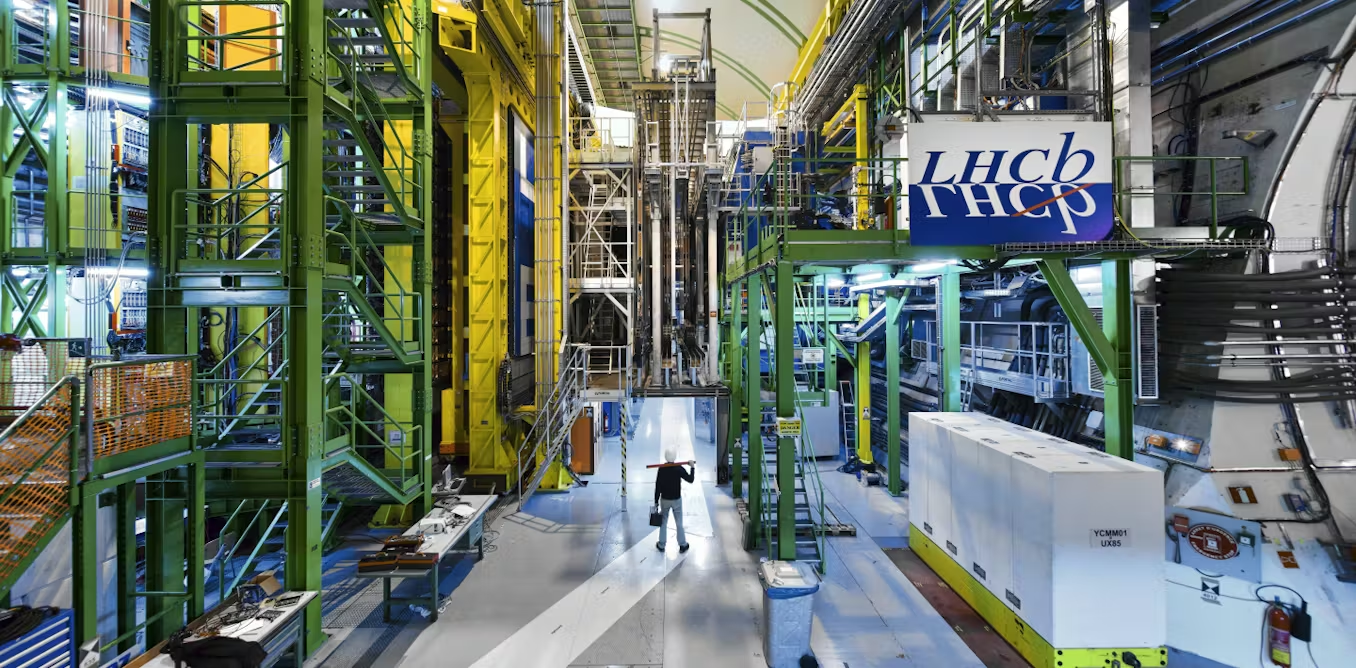
In the LHC, beams of proton particles travelling in opposite directions are made to collide, in a bid to uncover hints of undiscovered physics. The new results come from LHCb, an experiment at the Large Hadron Collider where these collisions are analysed.

The result comes from studying the decay – a kind of transformation – of sub-atomic particles called B mesons. We investigated how these B mesons decay into other particles, finding that the particular way in which this happens disagrees with the predictions of the Standard Model.

An elegant theory

The Standard Model is built on two of the 20th century’s most transformative advances in physics; quantum mechanics and Einstein’s special relativity.

Advertisement

Physicists can compare measurements made at facilities such as the LHC with predictions based on the Standard Model to rigorously test the theory.

Despite the fact that we know the Standard Model is incomplete, in over 50 years of increasingly rigorous testing, particle physicists are yet to find a crack in the theory. That is, potentially, until now.

The Standard Model is the best understanding of fundamental particles and forces, but we know it cannot be the whole story.
Alionaursu / Shutterstock

Our measurement, accepted for publication in Physical Review Letters, shows a tension of four standard deviations from the expectations of the Standard Model.

In real world terms, this means that, after considering the uncertainties from the experimental results and from the theory predictions, there is only a one in 16,000 chance that a random fluctuation in the data this extreme would occur if the Standard Model is correct.

Advertisement

Although this falls short of science’s gold standard – what’s known as five sigma, or five standard deviations (about a one in 1.7 million chance) – the evidence is starting to mount. Adding to this compelling narrative are results from an independent LHC experiment, CMS, that were published earlier in 2025.

Although the CMS results are not as precise as those from LHCb, they agree well, strengthening the case. Our new results have been found in a study of a particular kind of process, known as an electroweak penguin decay.

Rare events

The term “penguin” refers to a specific type of decay (transformation) of short-lived particles. In this case we study how the B meson decays into four other subatomic particles – a kaon, a pion and two muons.

With some imagination, one can visualise the arrangement of the particles involved as looking like a penguin. Crucially, measurements of this decay let us study how one type of fundamental particle, a beauty quark, can transform into another, the strange quark.

Advertisement

This penguin decay is incredibly rare in the Standard Model: for every million B mesons, only one will decay in this manner. We have carefully analysed the angles and energies at which these particles are produced in the decay, and precisely determined how often the process takes place. We found that our measurements of these quantities disagree with Standard Model predictions.
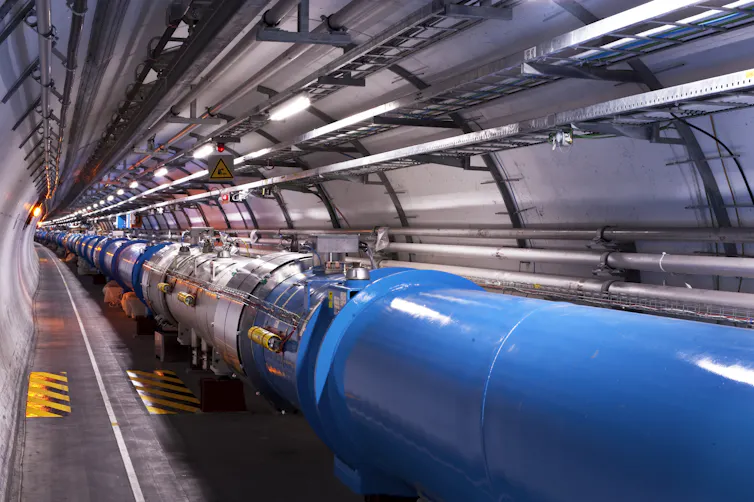
At the LHC, magnets bend proton particles around a 27km-long tunnel, built under the French-Swiss border.
Cern

Precise investigations of decays like this are one of the primary goals of the LHCb experiment, and have been since its inception in 1994. Penguin processes are uniquely sensitive to the effects of potentially very heavy new particles that cannot be created directly at the LHC.

Such particles may still exert a measurable influence on these decays over the small Standard Model contribution. This kind of indirect observation is not new. For example, radioactivity was discovered 80 years before the fundamental particles that are responsible for it (the W bosons) were directly seen.

Future directions

Our studies of rare processes let us explore parts of nature that may otherwise only become accessible using particle colliders planned for the 2070s. There are a wide range of potential new theories that can explain our findings. Many contain new particles called “leptoquarks” that unite the two different types of matter: “leptons” and “quarks”.

Other potential theories contain particles that are heavier analogues of those already found in the Standard Model. The new results constrain the form of these models and will direct future searches for them.

Advertisement

Despite our excitement, open theoretical questions remain that prevent us from definitively claiming that physics beyond the Standard Model has been observed. The most serious question arises from so-called “charming penguins”, a set of processes present in the Standard Model, whose contributions are extremely tricky to predict. Recent estimates of these charming penguins suggest their effects are not large enough to explain our data.

Furthermore, a combination of a theory model and experimental data from LHCb suggests that the charming penguins (and therefore, the Standard Model) struggle to explain the anomalous results.

New data already collected will let us confirm the situation in the coming years: in our current work we studied approximately 650 billion B meson decays recorded between 2011 and 2018 to find these penguin decays. Since then, the LHCb experiment has recorded three times as many B mesons.

Further advances are planned for the 2030s to exploit future upgrades to the LHC and accrue a dataset 15 times larger again. This ultimate step will allow definitive claims to be made, potentially unlocking a new understanding of how the universe works at the most elementary level.


Advertisement

Source link

Continue Reading
Click to comment

You must be logged in to post a comment Login

Leave a Reply

NewsBeat

X Factor finalist charged over Argyll Street crash as Klaudia Zakrzewska ‘Klaudiaglam’ fights for life

Published

on

Daily Mirror

A woman arrested on suspicion of attempted murder after a collision in central London has been named as a former X Factor star turned influencer Gabrielle Carrington, 29

A X Factor finalist has been charged after an influencer was left fighting for her life after a car ploughed into her on a London street.

Gabrielle Carrington, 29, known as RIELLEUK, was detained by the Met Police after social media star Klaudiaglam, real name Klaudia Zakrzewska, was left in a serious condition after she was hit by a car. The influencer and two other pedestrians were hit on Argyll Street, in Soho, in the early hours of Sunday morning.

Carrington, who had been in the TV show girl group Miss Dynamix, was taken into custody, where she remains.

Advertisement

Police confirmed this evening that the former X Factor star has been charged with attempted murder.

A Met spokesperson said: “A woman has been charged with attempted murder following a serious collision in Westminster.

“At around 04:30hrs on Sunday, 19 April, officers were called to Argyll Street following reports that a car had been involved in a collision with pedestrians.

Advertisement

“Police attended with the London Ambulance Service, a woman in her 30’s remains in a life-threatening condition.

“In the same collision, a man in his 50s sustained life-changing injuries and was taken to hospital. A third woman, aged in her 30s, was treated for minor injuries.

“Gabrielle Carrington, 29,, has been charged with attempted murder, grievous bodily harm with intent, actual bodily harm and drink driving. She has been remanded in custody ahead of her first appearance at Westminster Magistrates’ Court on Tuesday, 21 April.

Advertisement

“The incident is not being treated as terrorism-related.”

Polish-born Klaudia, who has over 258,000 followers on Instagram, had been at the Inca nightclub with friends on that night. A video circulating online appears to show the moment a black car drove into a group of people in the London street.

Klaudia appears to fall to the ground and becomes trapped under the vehicle, as other pedestrians are seen rushing over to help.

Advertisement

The Met Police added that a man in his 50s was taken to hospital and he sustained life-changing injuries. Police added that a third woman, aged in her 30s, was treated for minor injuries.

As a teenager Carrington made it to the live finals of X Factor as part of Miss Dynamix but they were eventually voted off. After the group was voted off the show, in October 2013, Carrington told the Xtra Factor show: “We’ve never been satisfied so far but our sing off, that was Miss Dynamix. That was us.”

The group split in 2014 and the singer in recent years became an influencer, with over 362,000 followers on Instagram. She posted herself on luxe holidays, fancy restaurants and appeared to have been creating a hair brand.

DCI Alison Foxwell – from Specialist Crime South – said: “As our enquiries continue, our thoughts are with those injured and their loved ones. While this incident took place in the early hours of the morning, venues in the area were still open, and we believe a number of people will have seen what happened.

Advertisement

“I would urge anyone who witnessed the collision, or any activity prior to it that they feel may be of relevance, to come forward. The information you have – however minor you believe it may be – could be of crucial importance to investigators.”

Source link

Continue Reading

NewsBeat

Fight between young people escalates to deadly shooting at North Carolina park

Published

on

Shootings at school and home in northeastern British Columbia leave 10 dead, including shooter

WINSTON-SALEM, N.C. (AP) — A planned fight among young people escalated into a mass shooting at a North Carolina park Monday morning that left two people dead, authorities said.

The shooting happened around 10 a.m. at Leinbach Park, which is near Jefferson Middle School, Winston-Salem police said in a social media post.

Several people were shot, including two fatally, the North Carolina State Bureau of Investigation said in a statement.

Winston-Salem police Assistant Chief Jason Swaim said two juveniles had agreed to meet at the park to fight. He said a firearm was discharged during the fight, which “resulted in multiple victims being shot.” He said authorities have identified “numerous people” involved in what happened, but that investigators were still trying to determine their exact involvement, including whether they were a suspect, victim or witness.

Advertisement

Swaim said schools nearby the park were safe and that parents of students at Jefferson Middle School could pick up their children there.

The shooting happened in a park in a suburban and residential area northwest of downtown Winston-Salem, a city of about 250,000 known for decades as the home of the R.J. Reynolds Tobacco Co.

Advertisement

Source link

Continue Reading

NewsBeat

Victory slips away as marathon runner celebrates too soon

Published

on

Victory slips away as marathon runner celebrates too soon

A dramatic finish at the Delaware Marathon on 19 April saw Joshua Jackson snatch victory in the final moment overtaking leader Carson Mello by less than a second. Mello, thinking a win was guaranteed, slowed in celebration before Jackson’s powerful late surge sealed the win.

Source link

Continue Reading

NewsBeat

James Rew: What do England do about Somerset batter?

Published

on

James Rew

A decision on Rew and the rest of the England squad will be influenced by the new selector, a role for which applications closed on Friday.

There is also still plenty of time for others to stake their claim – most counties have four more matches before the first Test, along with those two Lions games.

Crawley could find the form that keeps his place. If England decide to omit the Kent man and want a specialist opener as his replacement, then Durham pair Ben McKinney and Emilio Gay have started the season well. Asa Tribe is also opening for Glamorgan.

There could be two batting spots available in the Test squad, simply because England often pick a reserve to cover for the top seven. Elsewhere, there are questions over the spin and pace-bowling slots.

Advertisement

Shoaib Bashir had an awful winter, and is trying to move on with a new home and plenty of overs at Derbyshire. If England picked Bashir when he was not playing county cricket, would they then leave him out when he is?

If not Bashir, would England go back to Jack Leach, Liam Dawson, or even leg-spinner Mason Crane, whose only Test cap came more than eight years ago? Will Jacks is the incumbent, and other all-round options include Rehan Ahmed and James Coles.

England’s fast-bowling department is experiencing its most uncertain period for more than two decades, with James Anderson, Stuart Broad, Chris Woakes and -most likely – Mark Wood out of the picture.

Brydon Carse has a broken wrist and Jofra Archer is at the Indian Premier League. Gus Atkinson has not played so far this season following the hamstring injury he suffered at the Ashes, but should be able to join Josh Tongue in the squad to take on New Zealand.

Advertisement

There could be two or three vacancies at the beginning of the series. Sonny Baker has a central contract and has made a superb start to the season, after a struggle when he made his England white-ball debuts last year.

England are keen to find a new-ball bowler to replace the retired Woakes. Matthew Fisher was called into the Ashes squad and Tom Lawes is highly rated, though both are in a Surrey team that has struggled to take wickets in the first two rounds of the Championship. Sam Cook played one Test last year, too small a sample size to make a judgement on the prolific Essex seamer.

And is it finally time for England to bury the hatchet with Ollie Robinson? Still only 32, he has 76 wickets at an average below 23. He has not played for England in more than a year.

Now Sussex captain, leading his team to two wins from two, many rate Robinson as the best new-ball bowler in the country. Can England afford to ignore him?

Advertisement

Source link

Continue Reading

NewsBeat

Everything we know as women’s Tour De France 2027 route through Greater Manchester revealed

Published

on

Manchester Evening News
Everything we know as women’s Tour De France 2027 route through Greater Manchester revealed – Manchester Evening News