They’re everywhere. Crawling on the worktops, buzzing against the windows, hovering around food, humming and clustering near the bins and the fruit bowls. Britain is suffering a plague of flies.
Some towns are so badly affected that desperate residents in the worst affected places, such as Congleton, Cheshire, are putting their homes up for sale. More than 1,250 locals there have signed a petition begging the council to take some kind of action.
‘The flies are more than just an annoyance; they contaminate food and can carry diseases,’ pleads 27-year-old mother Francesca Davies, who launched the petition. ‘The toll on our daily lives is tremendous.’
One neighbour calls it ‘unbearable’. Another says: ‘Imagine never being able to open your doors or windows for more than a few seconds. No eating outside. Every action you take has to be considered in terms of how many flies it’ll let into your home.’ A third says her children can no longer play in the garden because of the swarms.
In Llanelli, west Wales, locals say they are prisoners in their own homes, unable to open a window without dozens of flies rushing in. And in Sileby, Leicestershire, residents say the fly infestations make their lives ‘intolerable’. One fed-up homeowner, Colin Readwin, told the BBC last month: ‘We’ve had candles going, we’ve had fly spray, we’ve been flicking them with dusters and they’re buzzing around your head. It’s awful.’
So what are the causes – and the cures? When candles and fly spray don’t fix the problem, what can you do? And what are the old wives’ tips to avoid?
Why is it so bad this year?
The heatwave that hit Britain in June, with temperatures rising to 37.7C (99.8F), breaking previous records for the month by more than two degrees Celsius, has created perfect conditions for flies to breed.
The heatwave that hit Britain in June, with temperatures rising to 37.7C (99.8F), has created perfect conditions for flies to breed
Dr Cameron Webb, a clinical lecturer at Sydney Medical School, says: ‘An old-school fly swat works a treat’
Flies of all kinds are coldblooded or ‘ectotherms’, meaning they are unable to regulate their own body temperature. In winter they are sluggish but are highly active in hot weather. Their metabolisms accelerate and larvae develop into adults far faster, in less than a week, so that their breeding cycle speeds up exponentially.
Wasps, which are one of the most effective predators of flies, have also been affected by this year’s unusual weather. Their numbers are down, thanks to the intense wet weather during spring followed by late frosts in May that killed off many wasp queens.
The subsequent heatwaves meant flowers dried up, starving the wasps of their nectar supply. Wasps are the apex predators in insect populations and even their larvae are carnivorous. Without them, flies will multiply unchecked – and they can mate on their first day of adult life.
Adults can live for up to a month and females will lay up to 100 eggs in a batch within two days of mating, several times during a lifetime.
Are they really a health hazard?
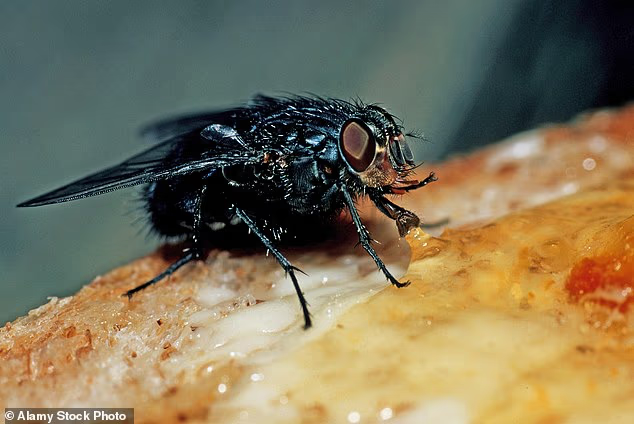
The common house fly carries so many germs that in Australia they are known as ‘filth flies’. Their feet and bodies become crusted in particles from anything they touch, from faeces to rotting animal carcases, which they use as beds for laying eggs.
When they land on food, they regurgitate a toxic sludge rich in bacteria which produces enzymes that help break it down so they can then suck it into their guts. They also excrete frequently.
In other words, if a fly lands on food even briefly, it is likely to be contaminated with their vomit and faeces, as well as ordure brought from other sources. They spread many serious types of disease and infection, including salmonella and E. coli, as well as bacteria that are increasingly resistant to antibiotics such as some strains of staphylococcus.
A 2023 study for the US National Library Of Medicine warned: ‘As gregarious and indiscriminate feeders, house flies bridge the gap between filth or other sources of bacteria (manure, feed waste, sick animals) and areas of human habitation.’
What can you do?
As Dr Cameron Webb, a clinical lecturer at Sydney Medical School, says: ‘An old-school fly swat works a treat.’
Locals in Llanelli have also been posting pictures of flypaper strips, coated with the bodies of hundreds of flies. You can buy ten rolls online for less than a fiver. They are effective, attracting insects with a sweet scent and trapping them on the sticky surface.
Strong scents can deter flies, such as coffee and cinnamon, as it confuses their sensitive odour receptors
But killing them doesn’t solve the problem. At best, it only keeps them at bay – and by the time you smack one with a rolled-up Daily Mail, it might already have transferred microbes to your kitchen surfaces. Instead, follow these tips to keep your family safe:
Put a fan on: Strong air currents make it difficult for flies to settle. An electric fan won’t keep them out of the kitchen but should keep them away from food.
Have a brew: Flies hate the smell of coffee. Biologists suspect the strong aroma confuses their sensitive odour receptors. They also avoid smoke, from an instinct to stay away from fire.
One effective remedy combines both these repellents. Take a couple of scoops of used coffee grounds and empty them into a baking tray. Place it in a hot oven for 15 minutes and leave the smouldering tray on a heatproof kitchen worktop. The fumes will keep flies away for around three hours, even if you leave your doors and windows open.
Use perfume: Burnt coffee isn’t everyone’s favourite smell. Rolls of cinnamon, roasted on the stove, can also be effective, if you don’t mind your home smelling like Christmas during the height of summer.
But other strong scents can work wonders. Boiled orange and lemon peel releases limonene, a fruity air freshener that flies dislike. Lavender is also a natural fly deterrent, thanks to its high linalool content – a natural form of terpene alcohol. Linalool also occurs in mint and citrus plants.
If you’re unable to grow these in your garden or window boxes, try using a cheap plastic spray bottle filled with water and about a dozen drops of essential oil of lavender, added to a teaspoonful of witch hazel to help the oil and water mix.
Another method is to add drops of eucalyptus or peppermint oil to white wine vinegar. Spray this liberally around doors and windows, as well as bins and drains. It’s important to empty your bins regularly, of course – and never put liquid in a bin. That makes any food waste rot faster, attracting more flies.
Go a bit mad: Flies detest vodka, though spraying this is not recommended unless you want your home to smell like the morning-after in a student bar. Bizarrely, they are also averse to cucumber. Chopped or sliced, and left on the windowsill, it might help to keep them away.
If you recycle food waste but find flies are buzzing around the tub, try putting it in a carrier bag instead – and keep the bag in the freezer until it’s time for the bin lorry to collect it.
You could try setting a trap too. Flies love the sugary smell of sweet apple cider vinegar, so pour some into a glass, cover it with clingfilm, and poke a few holes in the lid. The flies can get in… but they can’t get out.
What doesn’t work is filling a clear plastic bag with water, dropping in a few shiny coins and tying it up by the window.
The theory is that flies, which have fragmented, kaleidoscopic vision, will see multiple glittering images and buzz away with a headache.
In reality, the flies will just ignore the device – so it’s back to the rolled-up newspaper.





























































You must be logged in to post a comment Login