Connect with us
DAPA Banner
DAPA Coin
DAPA
COIN PAYMENT ASSET
PRIVACY · BLOCKDAG · HOMOMORPHIC ENCRYPTION · RUST
ElGamal Encrypted MINE DAPA
🚫 GENESIS SOLD OUT
DAPAPAY COMING

NewsBeat

Peterborough free parking slammed as ‘appalling misuse of money’

Published

on

Cambridgeshire Live

Readers have been debating the free parking scheme launching in Peterborough city centre this summer, and whether it really is ‘free’ or just subsidised

CambridgeshireLive readers have been discussing proposals for complimentary parking at certain car parks, with considerable debate over where the scheme actually operates and who funds it.

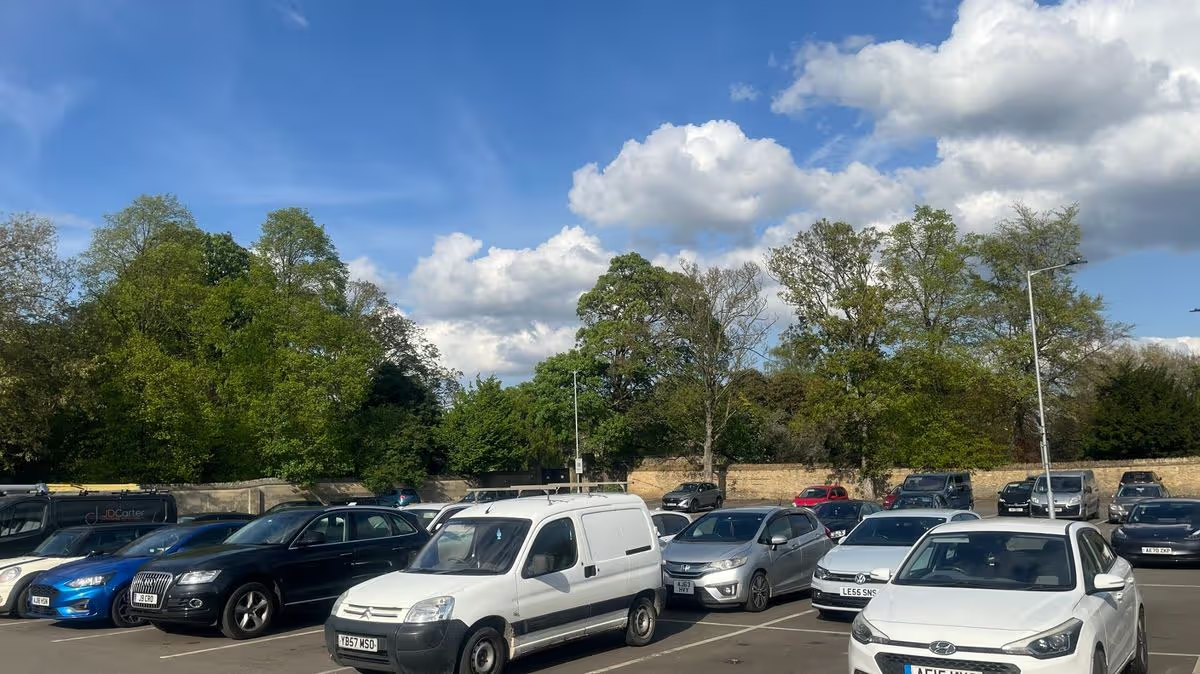
A launch date has been confirmed for free parking in Peterborough city centre. Pending approval from Peterborough City Council’s Cabinet, complimentary parking at four council-owned car parks will begin on Monday, August 3.

Advertisement

The four sites will be: Bishops Road; Car Haven; Riverside; Pleasure Fair Meadow. Parking at these locations will be free from 3pm onwards.

The initiative was promised by Mayor of Cambridgeshire and Peterborough, Paul Bristow in his manifesto. The Mayor allocated £1.5 million in his budget to introduce free parking across both Peterborough and Huntingdonshire.

“I said I would bring free parking and it’s happening this summer,” Mayor Bristow said. “I made this pledge because I believe our city centre needs a lift.”

The objective of the complimentary parking scheme, which will operate as a time-limited trial, is to generate increased footfall to support local businesses, and increase the health and vibrancy of the evening economy. Several commenters noted that the free parking being discussed is located in Peterborough rather than Cambridge.

Advertisement

One reader, Feelgood66 simply states: “I go to Ely, no problem.”

While Freddly adds: “There is no such thing as ‘free’ parking, only subsidised parking. This is just another example of the burden that car and van drivers impose on households without cars.”

Rootintootinredux writes: “Free buses were announced this week, too. Costing the taxpayer nearly £100 per person per journey.”

Bobs26 feels: “An appalling misuse of money originally intended to improve bus services.”

Advertisement

Banallbikes thinks: “It’s a start, but all car parking should be free, and then more people will visit places and support the local economy.”

While over on our Facebook page, Tarnia P comments: “Only in Peterborough. There’s no way Cambridge City Council would let people park for free.”

Robert EH replies: ” All day free parking at Park and Rides, free parking at the supermarkets and retail parks. There is no space in Cambridge for mass parking in the centre.”

Simon W says: “That’s great. I’m sure the people of Cambridge love the idea of subsidising other people’s parking through their Council Tax given how reasonably priced it is to actually park in and around Cambridge itself. Crack on.”

Advertisement

Do you think that free parking will bring people into the town? Comment below or HERE to have your say.

Source link

Continue Reading
Click to comment

You must be logged in to post a comment Login

Leave a Reply

NewsBeat

Former Federal Reserve Chairman Alan Greenspan dies at 100

Published

on

Former Federal Reserve Chairman Alan Greenspan dies at 100

WASHINGTON (AP) — Former U.S. Federal Reserve Chair Alan Greenspan died Monday from complications of Parkinson’s Disease, said his wife of 29 years, NBC News correspondent Andrea Mitchell. He was 100.

“To me he was my husband, who shaped my life from our very first date in 1984,” Mitchell said. “He had ‘irrational exuberance’ for baseball, the Washington Commanders, tennis, golf, and music, especially jazz. He will be remembered for his brilliance and his kindness. Being his life partner was the joy of my life.”

In his 18½ years at the helm of the Fed, Greenspan presided over a sustained era of American growth and prosperity, yet one that ended with devastating consequences in 2008, two years after he had left the central bank.

Era of US economic growth

Greenspan was so respected during his many years as head of the world’s most influential central bank that by the time he stepped down in 2006, he was widely celebrated as the “Oracle’’ and “Maestro.’’

Advertisement

He presided over a breathtaking surge in stock prices and a 10-year economic boom that began in March 1991. He was widely celebrated as a virtuoso who nurtured America’s economic well-being and whose nearly every utterance was parsed for clues as to where interest rates, the economy and the financial markets might be headed.

The intense scrutiny of Greenspan’s intentions gave birth to new Fed folklore: The “Briefcase Indicator.” A stuffed briefcase carried into Fed meetings implied changes might be afoot because Greenspan carried with him charts and research to make his point.

US housing crisis raised questions about policies

Greenspan’s reputation suffered a serious setback, however, soon after he left the Fed in 2006. The American housing market collapsed, igniting a global financial crisis that nearly toppled the U.S. banking system and plunged the economy into the worst recession since the 1930s.

Critics pinned much of the blame for the crisis on Greenspan’s easy-money policies and on what they believed was an overexuberant faith in lightly supervised financial markets.

Advertisement

Greenspan himself later acknowledged that “I made a mistake’’ in assuming the nation’s banks, whose stability undergirds the financial system and the entire economy, could essentially regulate themselves.

As housing values plummeted, millions of Americans, many of them stuck with outsize mortgage debt, lost homes to foreclosure. The spiraling financial crisis sent the U.S. economy sinking into the Great Recession of 2007-2009.

The crisis in the U.S. rapidly spread overseas, leading to a debt crisis for nations in Europe. China also engineered a massive government stimulus package to stabilize its economy.

Greenspan became the authoritative voice on the US economy

Until then, however, it seemed that Greenspan could do no wrong. Not only in the United States but across the world, he was regarded with a mixture of reverence and awe. Many openly dreaded the day when he would leave the Fed.

Advertisement

Investors hung on his sometimes inscrutable observations. In the most well-known such remark, Greenspan sent financial markets reeling on Dec. 5, 1996, when he suggested with just two words — “irrational exuberance” — that stock prices were too high.

Mindful of his power to move markets, Greenspan typically resorted to obfuscation. At times, he even satirized his habit of doing so.

“I know you believe you understand what you think I said, but I am not sure you realize that what you heard is not what I meant,” Greenspan once told a befuddled congressional committee.

A protégé is born

Born in the Washington Heights neighborhood of Manhattan, the young Greenspan was a math whiz who was trotted out by his mother to show off for visitors.

“I was a prop at parties,’’ he said in a 2007 interview with PBS NewsHour. A Julliard School dropout, he worked as a professional musician in his teens, playing clarinet and saxophone alongside the future jazz great Stan Getz — a humbling experience that persuaded the young Greenspan to seek another line of work.

He pursued undergraduate and graduate study in economics at New York University, eventually earning a doctorate there. For most of three decades, he ran an economic consulting firm. During the 1950s, he became a disciple of the libertarian philosopher Ayn Rand, who stuck him with the nickname the “Undertaker’’ for his dark clothes and quiet bearing. When Greenspan was sworn in as President Gerald Ford’s chief economic adviser in 1974, Rand stood beside him.

Advertisement

An early trial for a new Fed chair

President Ronald Reagan tapped Greenspan to run the Fed in 1987. He was tested almost immediately. On Oct. 19, 1987, which came to be known as “Black Monday,” the stock market suffered the worst one-day percentage loss in American history just two months into his term. The Dow Jones Industrial Average shed 22.6% of its value rapidly for reasons that weren’t entirely clear then, and remain opaque to this day.

Greenspan won credit for helping restore calm and stability. He assured Wall Street that the Fed would supply as much money to the financial system as was needed to restore calm. Stocks recovered, and the American economy emerged unscathed by the market crash.

Greenspan’s crisis management skills were tested again in 1997 and 1998, when a financial crisis in Asia threatened to spread economic devastation around the globe. Under Greenspan, the Fed arranged an emergency loan to Thailand and persuaded U.S. banks to roll over short-term loans to a teetering South Korea.

During his tenure at the Fed, Greenspan drew praise for presiding over what was at the time the longest economic expansion in American history. Over that time, the nation’s unemployment rate briefly dropped below 4% for the first time since 1970.

Advertisement

And inflation, which had bedeviled the United States and much of the global economy during the 1970s, was remarkably dormant during Greenspan’s chairmanship, something many economists had not thought could occur for so long a period.

During the long boom, Greenspan argued that improvements in technology had made the economy so efficient that it could run faster, at lower rates of unemployment, without unleashing inflation. As a consequence, the theory went, the Fed could keep interest rates low even when the economy was roaring.

A passion for numbers and life

As Fed chair, Greenspan relished poring over obscure economic data, from monthly boxcar loadings to steel production, all in a bid to assess where the economy was going. He would often phone economists at other government agencies to discuss details. He would rise early each morning for a two-hour soak in his bathtub, time that he used to review statistics and Fed staff memos.

Improbably, Greenspan also made the gossip pages as something of an unlikely ladies’ man. He dated the television journalist Barbara Walters and later married Mitchell after a 12-year courtship. They had no children.

Advertisement

Greenspan had dated Walters while working as an adviser to President Gerald Ford. According to a biography of Greenspan, “The Man Who Knew” by Sebastian Mallaby, when Ford read a newspaper item about the pair, he cut it out and sent it to his chief of staff, Dick Cheney, with a note that said, “I don’t believe it.”

A strong faith in self-regulating markets is challenged

All along, Greenspan held fast to the belief that financial markets could largely regulate themselves. With officials from President Bill Clinton’s White House, he helped block efforts by Brooksley Born, the nation’s top commodities regulator, to bring federal oversight in the late 1990s to the shadowy market in over-the-counter derivatives. The derivatives allowed speculators to make bets on everything from the price of oil to high-risk mortgages.

Eventually, history would vindicate Born, not the Maestro.

The low interest rates Greenspan had engineered helped swell housing prices into a dangerous bubble. And the financial deregulation he supported allowed banks and other financial firms to pile up huge risks, often hidden from government supervision. Bad derivatives bets helped sink insurance giant American International Group, which required a $180 billion taxpayer bailout.

Advertisement

The Financial Crisis Inquiry Commission, which was assigned to investigate the debacle by Congress, concluded:

“More than 30 years of deregulation and reliance on self-regulation by financial institutions, championed by former Federal Reserve chairman Alan Greenspan and others … had stripped away key safeguards, which could have helped avoid catastrophe.”

Life after the Fed

In the years after stepping down as Fed chairman in 2006 just shy of his 80th birthday, Greenspan kept busy doing what he loved to do most — following the economic data. He ran his own consulting firm, Greenspan Associates, through which he dispensed advice to Wall Street clients and collected handsome speaking fees.

He kept up a busy schedule well into his 90s, writing his memoir and two other books on the economy, as well as opining on the latest economic developments on television news shows.

Advertisement

He also signed onto opinion articles and statements defending the Federal Reserve’s political independence from President Donald Trump’s ongoing attacks. In January 2026 he signed a statement criticizing the Trump administration’s investigation of Fed Chair Jerome Powell. The statement, which was also signed by two other former Fed chairs and five former Treasury secretaries, called the investigation “an unprecedented attempt to use prosecutorial attacks to undermine” the Fed’s independence and warned it would have “highly negative consequences for inflation.”

Greenspan’s tenure as Fed chairman — from August 1987 through January 2006 — was just five months shy of the longest Fed chairman’s tenure. That distinction belonged to William McChesney Martin, who served from 1951 until early 1970.

In his 2013 book “The Map and the Territory,’’ Greenspan defended himself against critics who assigned him significant blame for the 2008 financial meltdown. He argued that traditional economic forecasting was no match for the irrational risk-taking that can feed catastrophic price bubbles.

“Bubbles go up very slowly as euphoria builds,” Greenspan said in a 2013 interview with The Associated Press. “Then fear hits, and it comes down very sharply. When I started to look at that, I was sort of intellectually shocked.”

Advertisement

————-

AP Economics Writers Christopher Rugaber and Martin Crutsinger contributed to this report.

Advertisement

Source link

Continue Reading

NewsBeat

Missing camera in Brazil bungee jump death ‘could hold key evidence’

Published

on

Daily Record

New details have emerged after Maria Eduarda Rodrigues de Freitas was thrown from a 130ft high bridge in in Sao Paulo state

A missing camera may hold information about the death of a young woman thrown to her death in Brazil at a popular bungee jump location, police have said.

On Saturday June 13, Maria Eduarda Rodrigues de Freitas, known as Duda, was thrown from a 130ft high bridge in Limeira, in Sao Paulo state, Brazil.

Advertisement

Footage of the horror incident showed the 21-year-old being carried to the edge of an abandoned bridge before being thrown off by two company employees – just moments later it emerged she had plunged without being attached to a rope.

São Paulo’s Civil Police have now released an update saying three people have been arrested in connection with the incident – one woman, 29, and two men, aged 25 and 27, the Mirror reports.

Police also confirmed that search and seizure warrants have been executed at their addresses, with the lead investigator saying there was suggestion of the “possible suppression of relevant evidence, especially related to the disappearance of the image-capturing equipment used by the victim during the jump”.

In an update, the police said they carried out three temporary arrest warrants on Saturday after court orders were issued by the 2nd Criminal Court of Limeira, which are valid for five days.

Police confirmed that warrants were served against a 29-year-old woman in Rio de Janeiro, and two men, aged 25 and 27, in Limeira and Indaiatuba, respectively. The three instructors arrested on the day of the accident remain in custody.

Along with the temporary arrests, the court also authorised the execution of search and seizure warrants at the addresses of those being investigated, with mobile phones, electronic equipment and other materials that “may contribute to clarifying the facts” seized.

According to Andréa Levy, who is leading the investigation, the investigation so far indicates that those arrested were part of the team responsible for organising and carrying out the activity.

Advertisement

“During the investigation, evidence was gathered suggesting the possible suppression of relevant evidence, especially related to the disappearance of the image-capturing equipment used by the victim during the jump,” Andréa said.

Evidence was also found suggesting that digital content potentially relevant to solving the case had been deleted after the incident, which formed the basis for the requests for the warrants by police.

Police confirmed the investigation is looking into the possibility of the commission of intentional crimes against life, in the form of implied malice, as well as possible procedural fraud.

According to the director of the Department of Judicial Police of the Interior 9, Kleber Altale, the Civil Police are continuing their investigations to fully clarify what happened, all those who may be criminally responsible and to find the camera used by Maria at the time of the fatal jump which is considered important to reconstruct what happened.

Advertisement

Maria’s relatives have now described their grief in an exclusive statement to the Daily Mail through an attorney, saying her sudden death had left an unbearable void.

READ MORE: Rod Stewart tells worried fans ‘I’m absolutely fine’ after using oxygen tank on stage

READ MORE: Keir Starmer resignation LIVE as Prime Minister confirms he will quit with Andy Burnham set for coronation

The family said: “With an immeasurable pain and a desolate heart the Rodrigues family addresses to the public in this very difficult moment, after the tragic and premature loss of our dear Maria Eduarda Rodrigues de Freitas, affectionately known as Duda, at the age of 21.”

Advertisement

The family statement added: “Her abrupt departure interrupts a life full of plans and dreams, leaving a deep absence in all of us who love her.

“Duda had many dreams for the future, she was dating and she planned to get married soon, with the desire to build her own family and give her grandparents the joy of meeting their children.” They added: “All these life projects have been ripped away.

“We greatly appreciate the support, the solidarity and the affection received from everyone, as well as the role of the press in the search for the truth and dissemination of this case,” the family said.

They signed the statement simply: “With a broken heart, the Rodrigues Family.”

Advertisement

The abandoned bridge is now set to be demolished after years of complaints about unregulated rope-jump and bungee-style operators using the structure. Work to bring down the bridge began on Wednesday, less than a week after Duda’s death.

Source link

Continue Reading

NewsBeat

Police update as boy, 3, remains in hospital after crocodile incident

Published

on

Cambridgeshire Live

A three-year-old boy suffered serious injuries after an incident at a Cambridgeshire zoo

A three-year-old boy who was seriously injured after being rescued from a crocodile enclosure is no longer in critical condition, according to Cambridgeshire Police.

On Thursday, June 18, police officers were called to Johnson’s of Old Hurst, near Huntingdon, at 1.24pm by the ambulance service, following reports that a three-year-old boy had sustained serious injuries.

The youngster, who suffered serious injuries after being thrown inside the enclosure, was pulled to safety by zoo staff and received medical attention at the scene before being rushed to hospital. The toddler remains in Addenbrooke’s Hospital, the force has confirmed.

Advertisement

The suspect, a 30-year-old man from Norfolk, who was not known to the child, was released on bail after police officers determined he was “not fit for interview”.

In an update on Monday, June 22, a spokesperson for the force said: “The toddler remains in Addenbrooke’s and is in a stable condition. No arrests or interviews under caution.”

The 30-year-old man has been bailed until September 18.

Source link

Advertisement
Continue Reading

NewsBeat

King Charles III to publish his own personal tax bill

Published

on

King Charles III to publish his own personal tax bill

The move is part of a wider effort to increase transparency and understanding of royal finances.

King Charles III will disclose his tax details as part of a new financial report from the royal household that aims to improve “clarity and accessibility” around the monarchy’s income and spending.

King to publish personal tax bill

A Buckingham Palace spokesperson said: “While this is the first time a monarch has shared this personal tax information, you may recall it was similarly released by His Majesty when he was Prince of Wales.

“The decision to do so as Sovereign has come at the express wish of the King himself, as part of the adaptations carried across since accession.”

Advertisement

The King’s income includes funds from private estates such as Balmoral and Sandringham, as well as investments and savings.

He also receives an annual income from the Duchy of Lancaster, a private estate comprising land, property, and investments.

For the 2024–25 financial year, this income was £26.8 million.

The Duchy of Lancaster is intended to provide the reigning monarch with an independent source of revenue, historically known as the Privy Purse.

Advertisement

This income is used to cover both official and personal expenses, as well as the costs of supporting other members of the royal family.

In line with the Memorandum of Understanding on Royal Taxation 2023, King Charles voluntarily pays income tax on all private income and capital gains tax where applicable.

His personal tax information will be published later this week, alongside separate reports detailing overall royal finances and spending.

His 2025–26 tax details will be released next year.

Advertisement

The Prince of Wales, however, has not revealed his own tax payments since becoming heir to the throne.

William receives an income from the Duchy of Cornwall, a billion-pound hereditary estate.

Last year the estate provided nearly £23 million in income.

While the Prince voluntarily pays the highest rate of income tax after official costs are deducted, the exact amount he pays is not publicly disclosed.

The Prince is reported to be investing £500 million from selling off a fifth of his duchy estate and other transactions to support ventures designed to “have a positive impact on the world.”

Advertisement

The Sovereign Grant, which funds the official duties of the royal family, will also be detailed in a financial report due to be released this week.

Last year, the grant totalled £86.3 million, with £51.8 million allocated for routine costs such as travel and payroll and £34.5 million dedicated to the Buckingham Palace Reservicing Programme.

A spokesman for Buckingham Palace said: “Our aim is to explain all elements of royal finances in a way that further enhances clarity and accessibility, while also placing it in its historical and constitutional context.”

Additional reports will also include the Duchy of Lancaster’s accounts.

Advertisement

The spokesperson said: “In order constantly to improve, and to encourage wider understanding of our accountability, the royal household has been considering options to enhance this transparency still further – and can today announce additional measures in keeping with our public service priorities.

“To put it simply: we continue to modernise and evolve.”

The new approach is part of a broader push to align royal practices with contemporary standards of transparency and public accountability.

While the King’s move is voluntary and not required by law, it sets a new precedent for royal disclosures.

It remains to be seen whether other members of the royal family will follow suit, but the palace has indicated that further steps to improve clarity and public understanding may be introduced in the future.

Advertisement

Source link

Continue Reading

NewsBeat

What temperature is too hot to work under UK law? Heatwave to bring 40C weather to London

Published

on

What temperature is too hot to work under UK law? Heatwave to bring 40C weather to London

Source link

Continue Reading

NewsBeat

Will schools close in the heatwave? Sweltering 40C heat set to hit London

Published

on

Will schools close in the heatwave? Sweltering 40C heat set to hit London

The heatwave will begin on Monday with temperatures of around 28C before climbing into the thirties on Tuesday and Wednesday. The mercury could hit 40C on Wednesday with the Met Office issuing a rare red extreme heat warning.

Source link

Advertisement
Continue Reading

NewsBeat

Tui among worst airlines for flight delays in the UK

Published

on

Tui among worst airlines for flight delays in the UK

Flights departing UK airports with the carrier were delayed by an average of 20 minutes and 24 seconds in 2025, according to Civil Aviation Authority (CAA) data.

Its Birmingham to Zante service recorded the highest average delay for a Tui route.

The figures were analysed by the Press Association.

Advertisement

Worst airlines for flight delays revealed

Rory Boland, editor of Which? Travel, said: “Airlines must do more to support travellers during delays, including clearly communicating their rights and eligibility for compensation.

“It’s worth putting in a claim with your airline if you think it’s responsible – and escalating the complaint if it refuses to pay.”

Tui Airways, owned by Tui Group, serves more than 20 UK airports and is closely linked to the group’s package holiday business.

The data covered all scheduled and chartered UK flight departures by the 34 airlines operating more than 2,500 flights last year, excluding cancelled flights.

Aage Dunhaupt, director of communications for Tui Group, said: “We fully understand that for holidaymakers, every minute counts.

Advertisement

“Minimising delays remains a top priority, and our teams work continuously to improve operational performance across our network.”

Mr Dunhaupt said the airline chooses to operate delayed flights rather than cancel them, preferring that customers reach their destinations even if late.

He said: “If we were to follow broader industry practices of cancelling flights more readily, our punctuality ranking would improve significantly.

“However, this would come at the expense of our customers.”

Advertisement

Tui Airways was the fifth worst-performing airline for punctuality in the analysis.

Topping the list for delays was Air India, with an average hold-up of 36 minutes and 36 seconds, making it the least punctual carrier for the second year running.

Other airlines with poor records included Blue Islands (25 minutes and 12 seconds), TAP Air Portugal (23 minutes), and Saudia (21 minutes and 18 seconds).

Scandinavian Airlines was the most punctual, with UK departures delayed by just eight minutes on average.

Advertisement

Virgin Atlantic followed with an average delay of 11 minutes.

Overall, the average delay across the airlines surveyed was 14 minutes and 48 seconds, an improvement from 18 minutes and 18 seconds in 2024.

CAA director Tim Johnson said: “can cause significant disruption and inconvenience for passengers.”

Advertisement

“We recognise the impact this can have, which is why there are rules in place to protect passengers.

“Airlines are expected to minimise the impact of delays where possible, by providing timely information and upholding passengers’ rights during disruption.”

Depending on the distance of the route and length of delay, passengers delayed on departing flights are entitled to assistance, such as a reasonable amount of food and drink, a means to communicate, and overnight accommodation if required.

Compensation of up to £520 may also be claimed if the delay was within the airline’s control, such as a fault with the aircraft or pilot sickness.

Advertisement

Airlines UK, the trade body for UK carriers, emphasised that most flights depart on time.


Recommended Reading


A spokesperson said: “The vast majority of UK airline flights depart on time and CAA data shows customer satisfaction levels are at an all-time high.

“Most delays are the result of issues that are entirely outside airline control, such as adverse weather, forced reductions in the number of planes that are able to land and take off each hour, and industrial action.

Advertisement

“When these delays do occur, airlines work hard to support customers and get them where they need to be as quickly as possible.”

Which airlines do you like the most? Let us know in the comments.

Source link

Advertisement
Continue Reading

NewsBeat

Malton Show’s future secured after Amotherby-based BATA deal

Published

on

Malton Show's future secured after Amotherby-based BATA deal

Malton Show was an annual fixture in the North Yorkshire agricultural calendar since the 1870s, but its committee had to make the difficult decision to cancel the 2026 show.

However, the immediate future of the historic Malton Show has now been secured after Amotherby-based, farmer cooperative BATA (Brandsby Agricultural Trading Association Limited), answered the call for support.

RECOMMENDED READING

Advertisement

The popular event, which features livestock, vintage machinery and sheep dog trials among other attractions, is run completely by volunteers.

Traditionally held on the last weekend in June, the show has faced increasing challenges due to volunteers retiring, growing legislation and compliance matters and increasing operational costs to put the show on.

The show is run by the trustees of a charitable organisation, supported by a number of volunteers who help to bring the event together. Funding is provided by several regular sponsors, entry fees and ticket revenue from visitors.

The headline sponsor support from BATA is a commitment of £10,000 per year for the next three years promises to breathe new life into the historic event and will see them become the show’s headline sponsor. BATA will also provide logistical and marketing support for the committee.

Advertisement

Charlie Breese, trustee of the Malton Show charity said: “The support BATA are offering to Malton Show comes at a critical time, is invaluable and will help us to overcome a number of challenges faced by the show.

“Securing this vital sponsorship enables us to recruit a replacement for our retiring secretary, as well as take a new look approach to how the show runs and how it is managed in the future.”

Stephen Greenfield, Chairman of BATA said: “As an organisation rooted in the local agricultural community, we are pleased to commit to on-going sponsorship over the next 3 years and to be able to provide support for the committee and volunteers that make the Malton Show so special.

“We look forward to working with the Malton Show team, old and new and to helping to ensure this much loved event is once again a major feature of the local community summer calendar.”

Advertisement

BATA, based in Amotherby was established in 1894, as a farmer’s cooperative and retains this structure today. Currently, there are more than 3,000 share members with a share ownership of more than £6 million. Profits from its business activities are distributed to members as interest, used to fund future investment and distributed to community and charitable causes in the areas where it operates.

The business offers a wide range of agricultural products and services along with petrol stations with convenience stores in Helmsley and Gate Helmsley and 10 BATA country stores.

The Malton Agricultural Society was formed in 1833, and the first recorded summer show or exhibition was held in the early 1870s.

In 1998, because of the lack of space at the Show Field Lane site in Malton, the show moved to Scampston Park.

Advertisement

Anyone keen to get involved with the show committee is asked to make contact using the show email: office@maltonshow.org

For more information go to www.maltonshow.com/

Source link

Advertisement
Continue Reading

NewsBeat

Explosion in Qatar gas export terminal hurts 54 as 18 missing

Published

on

Explosion in Qatar gas export terminal hurts 54 as 18 missing

DUBAI, United Arab Emirates (AP) — An explosion tore through Qatar’s key natural gas export terminal Sunday night as workers tried to resume operations there after Iran bombed it during the war, causing a fire that hurt at least 54 people as another 18 were still missing hours later.

The blast at the Ras Laffan industrial area could cause further chaos in global energy markets, particularly as Qatar remains one of the world’s top natural gas producers. Qatar shut down its production after Iran’s chokehold on the Strait of Hormuz meant it couldn’t get shipments out to its clients.

With Iran loosening its grip on the strait as negotiations continue over a permanent end to the war, Qatar began work to try to restart its export terminal. On Sunday night, that work sparked an explosion and fire at the Barzan gas supply facility, the state-run firm QatarEnergy said.

The scale of the damage remains unknown after the blast, with officials initially saying only a few people had been hurt. But hours later, Qatar’s Interior Ministry offered the far-greater casualty figures.

Advertisement

The Barzan plant had a capacity of almost 1.4 billion standard cubic feet of sales gas per day, which Qatar used primarily for local electricity generation and to power its crucial water desalination plants in the desert reaches of the Arabian Peninsula.

Qatar owns nearly all of the plant, with a small share also held by ExxonMobil. The oil company did not immediately respond to a request for comment.

In March, an Iranian missile hit Ras Laffan, sparking a fire that caused “extensive” damage before it was extinguished, authorities said. Qatar had already halted production there because of Iranian attacks.

Qatar shares its massive offshore natural gas field in the Persian Gulf with Iran. That natural gas production has made Qatar wealthy. It has used that money to raise its profile worldwide through hosting the 2022 FIFA World Cup, creating the Al Jazeera news network and funding its work as an international mediator, including the talks in Switzerland between Iran and the United States.

Advertisement

Source link

Advertisement
Continue Reading

NewsBeat

Boy, 3, allegedly thrown into crocodile enclosure at UK zoo now stable

Published

on

Belfast Live

A three-year-old boy was allegedly thrown into a crocodile enclosure at Johnsons of Old Hurst zoo in Cambridgeshire and left with serious injuries after being attacked by at least one of the reptiles, but is now in a stable condition in hospital

Police have provided a significant update regarding the three year old boy who was allegedly thrown into a crocodile enclosure at a UK zoo.

The toddler, who sustained serious injuries after ending up inside the crocodile pen at Johnsons of Old Hurst in Cambridgeshire on Thursday, is now listed as stable in hospital.

Advertisement

A spokesperson for Cambridgeshire Police confirmed: “The boy is no longer critical and is in a stable condition in hospital.”

In the shocking incident, zoo staff managed to pull the boy from the enclosure before emergency services rushed to the scene. According to the BBC, the boy was attacked by at least one crocodile after entering the enclosure at the zoo near Huntingdon.

The youngster, who hails from Cambridgeshire, received treatment at the scene before being transferred to Addenbrooke’s Hospital in Cambridge.

Advertisement

Police confirmed that the crocodiles involved have neither been seized nor destroyed as enquiries into the circumstances surrounding the incident remain ongoing.

The incident unfolded at Johnsons of Old Hurst, a zoo and farm attraction near Huntingdon, at approximately 1.30pm on Thursday. A 30 year old man from Norfolk was subsequently arrested on suspicion of attempted murder in connection with the incident.

The suspect, who police believe had no prior connection to the child, has since been released on bail until September 18. Officers revealed that the man was assessed as not being fit for interview.

The BBC reported that the suspect is understood to have learning disabilities and had been visiting the attraction with carers. Onlookers described hearing screams before emergency services, including an air ambulance, descended on the location.

Advertisement

Source link

Continue Reading

Trending

Copyright © 2025