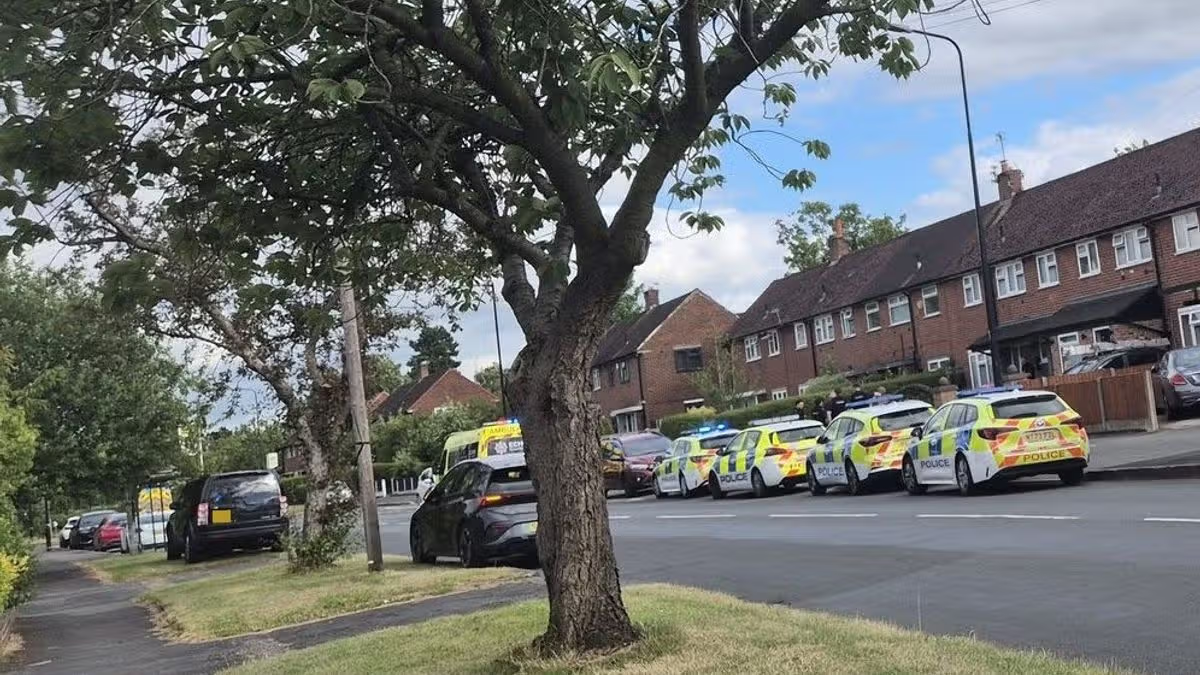
Police have issued an update after a woman was arrested following a ‘disturbance’ in Trafford. Emergency services attended Aimson Road East, in Timperley, at 5.20pm on Thursday evening (July 2).
Advertisement
Greater Manchester Police said it was called out to reports of a disturbance at a property on the street. An image from the scene showed at least four police cars and two ambulances as part of the response.
Witnesses reported seeing a large emergency services presence in the area. A man suffered an injury during the incident, police previously stated. A woman in her 60s was arrested on suspicion of assault.
Click here to get the biggest stories straight to your inbox in our Daily Newsletter
In an update issued today (Saturday), GMP confirmed she had since been released, with no further action to be taken against her. The man’s injury was previously described as ‘minor’ and ‘non-life threatening’ by GMP.
BEIRUT (AP) — Crude oil appeared to be leaking and spreading in recent days from a sanctioned tanker grounded off the coast of Oman, close to a marine protected area, satellite images reviewed by The Associated Press show.
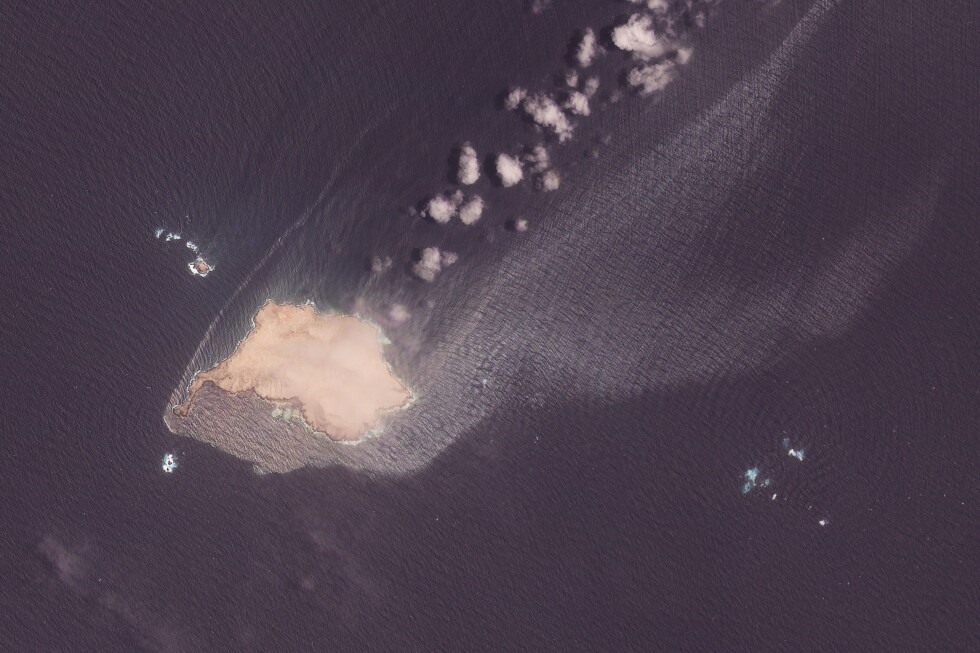
The images, the last of which was on Friday, show an oil sheen covering about 20 square kilometers (8 square miles) and dark spots of crude oil slicks on the shores of Dhofar’s Qibliyah Island, part of the Hallaniyat Islands.
The images indicated that the crude oil was gradually coming out of the tanker in low quantities over the last week, affecting shorelines in the area, and has spread into a thin sheen around the island, said Wim Zwijnenburg, an environmental expert for PAX, a Dutch peace organization that focuses on conflict and the environment.
“The last few days, the imagery indicates an increase in oil coming out, as the size of the … sheen is growing,” he said. “The main risk is the breaking of the ship” as the windy monsoon season “might take its toll on the hull.” Seas are rough and there are strong winds during the monsoon season of May to September.
Advertisement
Zwijnenburg estimated the tanker is carrying more than 800,000 barrels of crude oil.
Images from July 28 showed the crude was mostly in the bay northwest of the ship, which ran aground off Qibliyah Island, with the oil sheen enveloping the coast, he said.
The 274-meter (899-foot) long Suezmax tanker Caroline Bezengi is sanctioned by the U.K. for carrying oil that originated in Russia and “has been or is likely to be involved in activity whose object or effect is to destabilize Ukraine.” The Cameroon-flagged tanker is also sanctioned by the European Union, Canada and Switzerland.
The tanker has been grounded off the Dhofar coast since June, according to two shipping and maritime news outlets, who reported that the crew reported an explosion on board at the time. The AP was not able to independently confirm the reports.
Advertisement
SynMax Maritime, a geospatial data tracking company, said it obtained images in May showing the tanker at the Black Sea port of Novorossiysk, in Russia, before its most recent voyage.
“The situation surrounding the tanker Caroline Bezengi is yet another alarming example of the serious environmental risks posed by Russia’s so-called shadow fleet,” said Nina Noelle of Greenpeace Germany in a statement shared with AP. As of July 24, she said, the impacts of the leak were already evident. Stretches of coastline and the area’s sensitive marine ecosystem have been polluted and damaged.
Advertisement
Sign up for Morning Wire:
Our flagship newsletter breaks down the biggest headlines of the day.
Advertisement
“With oil apparently continuing to leak and the tanker stranded in a difficult location, there is a serious risk of a much larger oil disaster, with even more devastating consequences for the region’s coastlines and marine ecosystems,” Noelle said.
The area is part of the Arabian sea reserve, a marine protected area and host to unique mammals and birdlife, including endangered Petrels.
The Omani Ministry of Transport, Communications and Information Technology had ordered the owners of the vessel to remove it and its cargo by July 23. It is not clear if the owners have replied.
Pirro’s office, in a court filing on Friday, moved to drop criminal charges against a former Olympian, David Hearn, who had been accused of deliberately damaging the pool after it went through a renovation ahead of the nation’s 250th birthday celebration last month.
Trump, in a posting on social media, acknowledged that there “may have been some contractor difficulty” in the installation of a new pool liner. But he continues to insist “the major damage was caused by VANDALS!”
“I disagree 100% with Jeanine Pirro, the U.S. Attorney for the District of Columbia, on the Reflecting Pool,” Trump added in his post.
Advertisement
The dismissal was an embarrassing setback for a Justice Department that had previously echoed Trump’s claims and billed the prosecution as accountability for damage at a Washington landmark, a pet project of Trump. The president, without providing any clear new evidence, continued to allege on Saturday the majority of the damage to the pool was caused by vandals.
Government lawyers in their 20-page court filing on Friday said that additional documents provided by the Interior Department since the indictment of Hearn show that the damage was the result of a botched installation by a contractor as well as “the rush to complete the project prior to events associated with the America 250 celebration in the weeks surrounding Independence Day 2026.”
Advertisement
In addition, a recent visual inspection revealed damage throughout the pool, including in the middle — where prosecutors say a vandal would not likely have attempted to peel the lining.
Advertisement
Hearn, a former Olympic canoeist, was accused of pulling up a two-foot square piece of the pool’s lining.
“Given all of this newly discovered information, it is difficult to attribute the widespread damage to the Reflecting Pool to vandalism, let alone to establish that fact beyond a reasonable doubt,” Pirro, a Trump appointee, said in her filing which asked a judge to formally dismiss the case.
Trump on Saturday also posted a nearly four-minute video that appears to have been taken from a security camera, in which three individuals can be seen with their hands in the pool, including one for an extended period.
The president claimed the video shows “material is being cut with a knife or a box cutter, for all to see!”
Advertisement
It’s not clear from the video, which appears to be shot from some distance, that any vandalism occurred. Workers can also be seen standing nearby and don’t appear to notice the people sticking their hands in the water.
In May, Trump announced plans to beautify the Reflecting Pool this spring. Water was drained and Trump directed that the bottom be painted with what he called “American flag blue.”
But problems emerged within days of the project’s completion, with chunks of the new liner peeling off.
The work on the Reflecting Pool is just one of a number of projects Trump has spearheaded across the nation’s capital. Most prominently, he demolished the White House’s East Wing to build a $400 million ballroom and plans to build a towering arch between the Lincoln Memorial and Arlington National Cemetery.
Almost one in three home break-ins take place between 6pm and midnight, new data has revealed
19:58, 01 Aug 2026Updated 19:58, 01 Aug 2026
New data has revealed the most common recorded entry point for burglars breaking into homes across Northern Ireland.
Research by CompareNI.com found that thieves used the front door to gain entry in at least 420 burglaries last year, while the back door was used in 286 break-ins. Lower rear windows were the third most popular entry method recorded, accounting for 104 incidents.
Figures also show homeowners are most at risk of burglary between the hours of 6pm and midnight, with almost a third of home break-ins last year occurring during the evening, making it the most common time of day for criminals to strike.
Advertisement
The findings come as the PSNI launches its ‘Safer Summer Together’ campaign, warning people across Northern Ireland to avoid making their homes easy targets for opportunistic thieves.
Burglaries are particularly common during the summer months as criminals take advantage of empty houses while families are on holiday, or gain easier access as doors and windows are left open during hot weather.
Data obtained by a Freedom of Information request to police reveals there were 1,854 residential burglaries recorded across Northern Ireland last year, with 31% happening in the evening.
Just over a quarter (26%) occurred during the day between midday and 6pm, while a further 22% took place overnight between midnight and 6am. Morning was the least likely time for homes to be targeted, with break-ins between 6am and midday accounting for 18%.
Advertisement
Burglaries recorded by time frame
(Obtained by Freedom of Information request in June 2026)
Unsurprisingly, Belfast had the highest number of burglaries with 665 incidents, a rate of 189 break-ins per 100,000 people.
Newry, Mourne and Down recorded the second worst burglary rate at 110 per 100,000 people, with Derry City and Strabane coming a close third (107).
Advertisement
At the other end of the scale, Mid Ulster had the lowest burglary rate at 43, followed closely by Ards and North Down (50) and Fermanagh and Omagh (51).
While the overall number of burglaries across Northern Ireland have dropped by 3% year-on-year (down from 471 in Q1 2025 compared to 455 during the same period this year), over half of the region’s 11 council areas have seen a rise in break-ins.
Residents in Lisburn and Castlereagh saw by far the biggest increase, up by 67%. Burglaries in Fermanagh and Omagh also rose sharply by 45%, as did incidents in Mid Ulster (35%).
Burglaries recorded per council area in Northern Ireland
Advertisement
(Most recent full year)
With these figures in mind, home insurance experts from CompareNI.com are sharing some cost-effective tips to help households stay safe and reduce the risk of burglaries.
Homeowners should be particularly vigilant against thefts from gardens during the summer months, with tools, furniture, barbecues, children’s toys and bicycles frequently left out on patios and lawns when the weather is warm.
Ian Wilson, home insurance expert and Managing Director at CompareNI.com said: “It is quite shocking to learn that a third of break-ins in Northern Ireland happen in the evening when many people are still at home, with most thieves coming through the front door.
Advertisement
“The summer months create plenty of chances for burglars to strike, as homeowners leave doors and windows open for extra ventilation, or leave gates and sheds unlocked for children to play and valuable garden items used more regularly and perhaps left unsecured.
“Making a home safer doesn’t have to break the bank – there are plenty of affordable steps that homeowners can take to make their property less attractive to burglars, such as installing deadbolt locks, solar-powered motion lights, door and window sensor alarms, or even joining the local Neighbourhood Watch.
“As a bonus, many of these simple measures can also help save them money on their home insurance premiums.
“Homeowners should also check their home insurance policy to make sure they have adequate contents cover in place, as many people underestimate the value of their belongings and how much it would cost to replace them.”
Chloe Moffat took her own life a year ago (Picture: Family handout)
A 26-year-old Treasury worker took her own life one day after an anonymous complaint was made about her, an inquest has heard.
Chloe Moffat ‘loved’ her role as a personal assistant in the government department, which she held for three years, and had an ‘exemplary employment record’.
She was also in line for a promotion after receiving a bonus for her work. Moffat died before she could hear the good news.
During the inquest at the Surrey coroner’s court, witnesses heard how Moffat was driven to a state of ‘distress’ following a meeting last May about the complaint.
Advertisement
The meeting was attended by her line manager and the Treasury’s head of global issues, but Moffat was not informed ahead of time what it would be about.
Sign up for all of the latest stories
Start your day informed with Metro’s News Updates newsletter or get Breaking Newsalerts the moment it happens.
Advertisement
Senior Treasury staff did not reassure her that her job was safe during the disciplinary process, the court also heard, even though a dismissal was unlikely.
Moffat’s mother is now calling for an overhaul in Treasury practices (Picture: Shutterstock/William Barton)
When she did ask if there was a possibility of being sacked, Moffat was told by a senior manager that she ‘couldn’t predict the outcome of any potential investigation’.
She was not allowed to bring a third party to the meeting either, and when Moffat asked her manager if she could bring her friend into the proceedings for support, she was told it would be ‘inappropriate’.
Questioned by the coroner, Anna Crawford, on why Moffat was not permitted a trade union representative or other colleague, the senior manager said: ‘Any alternative attendee would have made the meeting feel more formal.’
The coroner then asked: ‘Given these allegations, that were potentially serious, were going to be raised with her, was any consideration given to notifying her so she could prepare herself, seek support and respond?’
Advertisement
‘No, this could cause unnecessary stress,’ replied the senior manager.
She added that Moffat denied any accusations, so she ‘started to draft a letter’ to notify her of a formal investigation.
‘I was going to wait to send it until [the line manager] and I had spoken to Chloe to see how she was.’
The complaint in question accused Moffat of sharing confidential information about colleagues, which she could access since she managed her director’s inbox.
Advertisement
She had been advised not to speak to her co-workers about the matter, and she temporarily lost access to her director’s emails and diary.
When informed of the anonymous filing, Moffat appeared ‘shocked’ and started ‘crying at points’.
Her family recalled how ‘devastated’ she was in the aftermath and ‘convinced’ she would lose her job.
They further described her as someone who ‘took great pride in her work’ and ‘never made a mistake’.
Advertisement
A friend told the court that Moffat sent her a text on the same day the proceedings were initiated, reading: ‘I am going to be fired.’
This friend then met up with her in central London, where Moffat ‘broke down’ and expressed her concerns about the ‘reputational impact’ of the allegations made, all despite her pal’s attempts at reassurance.
Moffat died by suicide the next day.
Her grieving mother, Anne, is now calling for an overhaul in Treasury practices, with the inquest having heard how Moffat’s line manager should’ve been in charge of her ‘pastoral care’, despite her direct oversight role.
Advertisement
‘The evidence establishes a clear sequence of events,’ said Anne.
‘Had Chloe been properly supported and advised of her rights before the meeting, she would not have been so devastated and isolated.’
She is pushing for the department to be required to ‘assess employees’ mental welfare’ amid disciplinary proceedings. It is understood that changes are already being implemented.
Where serious or gross misconduct is alleged, she adds the matter should be ‘treated as formal from the outset, and the accused is informed of their rights’.
Advertisement
Lawyers representing the department have stated that managers are undergoing additional training, with a Treasury spokesperson saying: ‘We are deeply saddened by the death of our colleague Chloe last year.
‘Our thoughts remain with her family, friends and those affected by her loss.’
At least three people have been killed and another 15 people injured after a huge explosion ripped through a restaurant in Moscow.
The blast took place in Kudrinskaya Square, which is located just over a mile from the Kremlin, at around 8.10pm local time on Saturday.
Initial reports blamed a gas explosion in the restaurant’s kitchen but investigators are now examining whether it could have been a bomb.
Other unconfirmed reports indicated there had been an explosion in the dining area of the restaurant.
Advertisement
A spokesperson for Moscow police said: ‘From the information we have, an explosion happened today at around 8.10pm (5.10pm GMT) near a summer cafe, causing three deaths and 15 injured, of varying degrees of seriousness.’
Officials from the Russian Ministry of Health said the exact number of people killed in the blast is yet to be determined.
They added that those injured are all receiving the necessary medical care.
Advertisement
Emergency services are pictured at the scene following an explosion at a cafe in Moscow
People gather at the scene of an explosion in Moscow on Saturday evening
Pro-Kremlin Readovka channel reported: ‘A forensic team from the Ministry of Internal Affairs and emergency services are working at the scene.’
With just under three weeks to go until kicking off the defence of their Premier League crown, Arsenal continue their pre-season preparations this evening against Girona. The Gunners have played one summer friendly thus far, beating MK Dons in a behind-closed-doors match at the training ground last weekend, but a step up in quality from the opposition is expected at the Estadi Montilivi.
Nathan Slater, from Wallasey, was just 18 when he died on Saturday, November 9, 2024. His mum Lisa Slater, 41, had no idea he was struggling with his mental health, and is now urging anyone who might be suffering to speak out
Megan Banner Reporter and Matt Jackson Live News Network Reporter
19:28, 01 Aug 2026
A mother mourning her teenage son’s death has shared what his loss has taught her about existence, and the ways she preserves his legacy. Nathan Slater, from Wallasey, was just 18 when he ended his own life on Saturday, November 9, 2024.
His mother Lisa Slater, 41, said she was completely unaware he was battling mental health difficulties and that Nathan’s passing arrived as a “total shock.”
Only months beforehand, Nathan had discussed his aspirations for the years ahead and expressed hopes of starting a family eventually. Lisa, who has seven children, is now encouraging anybody experiencing mental health challenges to reach out.
Advertisement
On his final day, Nathan rang a mate at 1am saying he was “sorry, you’re a good friend”. His concerned friend travelled to his house the following day to see if he was okay but received no answer when knocking at his door.
The family had to force his bedroom door open to discover that, tragically, Nathan had ended his own life, reports the Liverpool Echo.
Lisa previously spoke to the ECHO, where she paid tribute to her “funny, kind and caring” son. As she nears the anniversary of one of their most treasured moments together, she said: “He was an amazing, popular, funny boy. He was so talented, he taught himself to play the guitar. He asked for a guitar for Christmas one year and he just picked it up and taught himself to play it. He could play any song.
Advertisement
“I took him to his first Creamfields [in 2024], he was in awe of the DJs. When we got home he got himself a set of decks and had been making his own mixes, he was forever calling me at stupid hours to say ‘mum listen to my new mix.’”.
“We had the best time and we were really looking forward to going together again. I just can’t believe he’s gone, he’s going to leave a massive hole in everyone’s lives.
“He always had the biggest smile on his face all the time, he had just started boxing training and he was planning on doing a charity boxing match in memory of his dad, who passed away from cancer. He wanted to do that for his dad.”
She continued: “None of us saw this coming. We had no clue at all that he had been suffering with his mental health. It was a total shock for us all. It’s just unbelievable. He was making so many plans”.
Following her son’s passing, Lisa has attempted to maintain a sense of normality for her six other children. She reflects: “Tthe only plus is that Nathan’s death brought us all closer together.
“We’ve realised how short life is and make the most of holidays, concerts and doing things together. We try to make the most of our time. I’ve surprised myself at how strong I’ve been, but it’s been hard keeping it together. I have moments when everything goes quiet, after a long day at work, where it’ll catch up with me.
“For the first few months I didn’t know how I was going to get through the day, never mind a week, or a month, then the days turned into years.”
Advertisement
In tribute to her son, Lisa made the journey to Amsterdam last year to mark his birthday — a trip the pair had always planned to take together. She also attended Creamfields in his honour, a festival that holds some of her most cherished memories with Nathan.
With the 2026 festival now on the horizon, Lisa is sharing Nathan’s story to spark a wider conversation about men’s mental health, urging anyone who may be struggling to speak up without hesitation.
She said: “Men just don’t talk enough. I want to urge people to talk if they are feeling any certain way. I can’t stress enough if anyone is having these thoughts to please talk to somebody.”
Advertisement
Lisa is also calling on authorities to improve mental health provision in Wallasey for those in need. She added: “Grief is life-changing, I hope by sharing Nathan’s story we can help even just one family.”
When life is difficult, Samaritans are available day or night, 365 days a year. You can call them for free on 116 123 or visit samaritans.org.
Ensure our latest headlines always appear at the top of your Google Search by making us a Preferred Source. Click here to activate or add us as Preferred Source.
The Exorcist star Linda Blair took a snarky swipe at law enforcement after her Los Angeles home was raided by authorities on Friday and 200 rescue dogs were discovered on her property.
The 67-year-old actress asked why officials couldn’t have just sent a letter regarding her expired permits. ‘I don’t know why mail isn’t used more often to notify somebody. Just saying,’ she said in an Instagram video after the incident.
The raid was a joint operation between Los Angeles County Department of Regional Planning and Los Angeles County Department of Animal Care and Control (DACC). A representative from the DACC told the Daily Mail the actress’s permits to house rescue animals have been expired since 2023.
Blair has not been accused of criminal activity, but an inspection warrant was issued after multiple attempts to contact her kennel went unanswered.
Advertisement
According to TMZ, the horror movie star is permitted to house about 60 dogs, but 200 canines were discovered at her residence. It was reported that agents arrived to the property at 6am.
The Daily Mail has contacted Blair for comment.
The Exorcist star Linda Blair’s home was raided by law enforcement on Friday, mandated by the Los Angeles County District Attorney
Advertisement
Blair, 67, is best known for her depiction of Regan MacNeil, a possessed girl, in the 1973 horror film
The inspection involved evaluating animal care, safety conditions, and the overall welfare of the dogs housed on the property.
Per TMZ, Blair was present throughout the raid and ‘extremely cooperative.’
Blair later addressed the incident by sharing a video to her main Instagram page on Friday.
Advertisement
‘Hey everybody it’s me, Linda B. I just wanted to check in because today we got a really big surprise visit.’
The star continued, ‘And as it turns out, there is nothing but some paperwork and some new diagrams.’
Blair shared that she wanted to give the update to her followers and fans since the inspection reached the news.
‘I’m fine, the animals are fine. And we just have some paperwork that has to be dealt with and that’s all. That’s what this was all about.’
Advertisement
Blair is the president and founder of Linda Blair Worldheart Foundation, launched in 2003.
After the raid the actress fired a snarky reply via an Instagram video, asking why officials couldn’t have just sent a letter regarding her expired permits
‘I don’t know why mail isn’t used more often to notify somebody. Just saying,’ she stated
A mission statement on the website says its goal ‘is to alleviate suffering, while rescuing, rehabilitating and rehoming abused, neglected and abandoned animals.’
Advertisement
It further notes, ‘We aid in crisis situations, while educating, encouraging and empowering the public to make a difference in the lives of those whom have no voice.’
Less than one week ago Blair called upon her 100,000 Instagram followers to donate to her cause.
‘I’m coming to you because a lot of you think I just run an organization, but I’ve been hands-on [with] animal welfare since 1984 when someone stole my Jack Russell Terrier, Shiba,’ she said at the start of a video.
She continued: ‘It’s hot. It’s hot around the country; the whole country is suffering right now, so it’s really hard to ask for donations, but I’m asking you, for those of you that have the means.’
Advertisement
Blair reiterated in an accompanying caption: ‘I am hands-on in my foundation. I am the main rescuer… healer, behaviorist, trainer and matchmaker for adopters.’
The star has a goal of $5,000, which she indicated will go toward getting a group of rescue dogs spayed, neutered, microchipped, and given rabies shots.
After establishing herself as a Scream Queen with The Exorcist, Blair starred in horror films including 1978’s Stranger in Our House, 1981’s Hell Night, and 1988’s Grotesque.
Blair is the president and founder of Linda Blair Worldheart Foundation, launched in 2003; pictured in October 2023
Advertisement
In 1996 she made a cameo in Scream and appeared on Broadway the following year in Grease.
Then in 2006, she guest-starred on Supernatural, playing the role of Detective Diana Ballard.
In 2010, she appeared as herself on the cable series Pit Boss and Jury Duty.
And in 2021 she returned to The Exorcist franchise, reprising her role as Regan MacNeil.
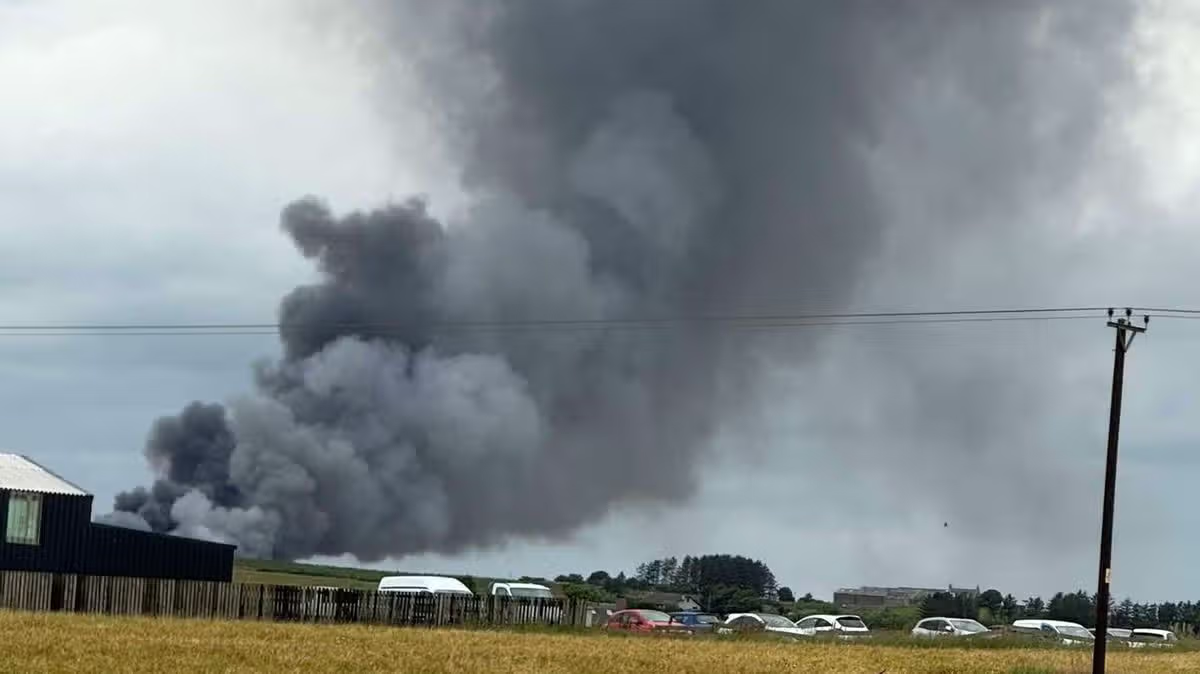
Emergency crews were alerted to the incident at Stoneyfield Quarry on the Longhaven area at around 3:10pm on Saturday.
Police have locked down the road between Auchiries and Cairn Catto and locals are advised to avoid the area.
Drone footage shows plumes of black smoke billowing out of a building at the quarry with flames visible inside.
A Police Scotland spokesperson said: “Emergency services are in attendance following a fire in Longhaven, Peterhead, at Stoneyhill Quarry, which was reported around 3.10pm on Saturday, 1 August, 2026.
Advertisement
“Road closures are in place between Auchiries and Cairn Catto. Members of the public are asked to avoid the area at this time”
Get more Daily Record exclusives by signing up for free to Google’s preferred sources. Click HERE.






















































You must be logged in to post a comment Login