Mr Polanski told Sunday Morning With Trevor Phillips on Sky News: “I think you can both recognise the bravery of officers who run towards incidents that most of us, including myself, would certainly want to run away from, and find the appropriate forum to say that no one, especially the police, should be above scrutiny.
Tomb Raider: Legacy Of Atlantis – not out this year (Amazon Game Studios)
As Sony announce Until Dawn 2, they also reveal release dates for multiformat games including Onimusha: Way Of The Sword, Silent Hill Townfall, and Ace Combat 8.
It may have been one of the longest State of Plays ever, at over an hour, but Tuesday night’s showcase was a little short on surprise announcements. There was God Of War Laufey, which took up 20 minutes at the end, but that had been heavily rumoured beforehand – not that that took anything away from the actual reveal.
In fact, almost everything shown, including both first and third party games, looked interesting and the one thing the event did provide was lots of release dates, with games such as Silent Hill Townfall, Control Resonant, Ace Combat 8, and Onimusha: Way Of The Sword finally revealing their schedules.
Tomb Raider: Legacy Of Atlantis was also dated, but unfortunately it confirmed previous rumours that it has been delayed. Either that or it’s trying to get out of the way of GTA 6 in November. It’s hard to tell, but at least it didn’t go with a September release date, unlike seemingly everything else.
Advertisement
Marvel’s Wolverine – September 25
Expert, exclusive gaming analysis
Sign up to the GameCentral newsletter for a unique take on the week in gaming, alongside the latest reviews and more. Delivered to your inbox every Saturday morning.
Advertisement
Surprisingly little time was spent on Wolverine, which may mean there’s a dedicated State of Play coming up in the future. It looked great, just as you’d expect, and extremely gory, with a cameo from Jean Grey and confirmation of villains such as Mystique and Sabertooh. Its release date wasn’t news though, as that had been previously announced.
Marvel Tōkon: Fighting Souls – August 6
The release date for Arc System Works’ one-on-one fighter also wasn’t a revelation, although Sony did announce a number of villains for the game, namely Doctor Doom, Magneto, Green Goblin, and Carnage. We weren’t sure who the character sitting on the throne was but apparently he’s called the Champion of the Universe (aka Tryco Slatterus) and he’s the big bad of the whole game.
Advertisement
Rayman Legends Retold – October 1
There’re almost no surprises in preview events nowadays, with everything being leaked out weeks and often months in advance. The reveal of a 3D remake of 2013’s Rayman Legends was a surprise though, in the fact that it looked really good. There are a few new into-the-screen sections but the gameplay is still mostly 2D and the new 3D visuals look really nice, and seem to maintain the same charm as the original.
Bancho The Chef – TBA
Speaking of charm, we’re not sure it’s a good idea to create a spin-off from not-indie game Dave The Diver that doesn’t maintain the same pixel art style graphics. That made the visuals look rather bland in comparison, but nevertheless there was a good energy to the trailer, with a prequel that shows how Bancho became the talented sushi chef you see in the original game. There was no mention of a release date though.
Advertisement
Kemuri – 2027
One of the only major surprises of the night was the latest from The Evil Within’s Ikumi Nakamura and her new studio Unseen. It seems to be a co-op action adventure, somewhat in the style of Devil May Cry et al. There’s lots of jumping and gliding around, as you fight yōkai and then… turn them into clothes you wear in order to use their powers. Because why not.
Tomb Raider: Legacy Of Atlantis – February 12, 2027
A delay for the (second) remake of the original Tomb Raider seemed inevitable after the rumours began but at least it still looks good, with some impressive visuals and lots of focus on dinosaurs. There was also lots to suggest the game is sticking pretty close to the original story, although we’re yet to see much evidence of how it will handle platforming, which was originally the antithesis of the Uncharted style action from the more recent games.
Advertisement
The Lost Wild – 2027
Speaking of dinosaurs (and there’s few things we enjoy doing more) this new game comes from Annapurna Interactive and is by a new British studio called Great Ape Games. It seems to be some kind of survival games, and a lot more scientifically accurate than most dinosaur media, with a lot of feathered dinosaurs and some gigantic Quetzalcoatlus flying reptiles (pterosaurs are not dinosaurs, ackchyually).
Dune: Awakening – September 22
A survival game and MMO that takes influences from both the books and movies, this has been out on PC for almost a year now. It’ll come to PlayStation 5 this September, bringing with it a new single-player story mode, which we imagine will also be made available for the PC and Xbox Series X/S versions.
Advertisement
Dynasty Warriors 3: Complete Edition Remastered – October 1
Not a remaster we look forward to with much enthusiasm but there you go. Like most of these games it’s available on Xbox Series X/S and PC at the same time, although unsurprisingly the State of Play made no reference to that.
No Rest For The Wicked – October
Despite what we just said this is coming to PlayStation 5 first, sometime in October, with Switch 2 and Xbox versions arriving only at a ‘later date’. This will be the final 1.0 version of the game, which will hopefully improve on the slightly questionable impression made by the early access release.
Advertisement
Onimusha: Way Of The Sword – September 25
This release date would’ve been one of the bigger reveals from the State of Play, except it leaked out early too. Either way, Capcom’s Resident Evil-esque zombie samurai game was already one of our most anticipated games of the autumn, as we were very impressed by our hands-on preview last year. Although you can give it a whirl yourself now, as there’s a free demo out today.
Silent Hill Townfall – September 24
For a game set in Scotland we’re still yet to hear a single Scottish accent in any of these trailers, which is weird because developer Screen Burn are actually Scottish. They’re responsible for the excellent Stories Untold and the awful Observation, so we’re not sure what to expect with this one, although in terms of Silent Hill atmosphere everything does seem to be on point.
Advertisement
Ace Combat 8: Wings Of Theve – October 2
Available in early access from September 29, presumably if you buy one of the more expensive editions, you can see what we mean about September getting very busy. It’s all obviously GTA 6’s fault but we hope this doesn’t get lost in the shuffle. Although there’s a pre-order bonus of a port of PlayStation 2 game Ace Combat Zero: The Belkan War on offer, to tempt you into making an early purchase.
Stuntman: Hollywood – TBA
It probably says a lot about us that the only licensed car we didn’t instantly recognise was the first one, which is apparently from Fast & Furious. Although apparently that’s not Mad Max towards the end, but the Jason Statham version of Death Race. The game itself is a revival of the old Stuntman series from Driver creator Reflections, which is surprising as the original’s trial and error gameplay made it an acquired taste.
Advertisement
Ill – 2007
There’s no doubting the craft in this first person action horror game but it is a very grim prospect, with some truly horrible imagery and some extremely difficult to kill zombie style enemies. It’s certainly going to scare off a lot of more casual Resident Evil fans but in terms of hardcore horror thrills this is definitely one to watch.
Control Resonant – September 24
A lot of these publishers will be finding out about the release dates of other games at the same time as you, so if they’ve any sense some of them will change them pretty quickly, because at the moment Remedy’s Control sequel is coming out on the same day as Silent Hill Townfall and a day before Onimusha: Way Of The Sword – which isn’t good news for any of the games.
Advertisement
RuneScape: Dragonwilds – autumn
Apparently, this is the first time a RuneScape game has been on a PlayStation console, although only in the form of this action-orientated spin-off, rather than the original MMO.
Until Dawn 2 – 2027
One of the only recent big name games not to be leaked in advance, Sony’s obsession with the series continues to defy explanation, considering none of the games and spin-offs seem to have made much impact. They are popular with streamers though and somehow this is the first actual sequel, with Horizon Call Of The Mountain creator Firesprite taking over development duties, which seems to have led to a lot more gore, if nothing else – which we consider a good thing when you’re dealing with a horror game.
The premise is that you’re part of a fake ghost hunter programme investigating an abandoned tropical island where something unpleasant is going on. Despite the change in setting there seems to be one recurring character, in the form of Peter Stormare’s psychologist Dr Alan Hill.
Advertisement
God Of War Laufey – TBA
It’s hard to say why Sony didn’t even given this a release year but it may be because they don’t want to imply anything about Naughty Dog’s Intergalactic: The Heretic Prophet, whose release plans are also a mystery. Surely one or the other will be out next year though, unless they’re being held back for the PlayStation 6 launch or something.
Don’t sleep on God Of War Laufey (Sony Interactive Entertainment)
WASHINGTON (AP) — President Donald Trump has tapped Bill Pulte, head of the Federal Housing Finance Agency, to serve as acting director of national intelligence — elevating a real estate scion with no clear national security credentials to a key post as the U.S. remains at war with Iran.
Trump made the surprise announcement Tuesday on social media that Pulte would be replacing Tulsi Gabbard, the former Hawaii congresswoman who had served as the director of national intelligence. Trump said Pulte will keep his other positions even as he fills in for Gabbard, who resigned last month after revealing her husband’s cancer diagnosis.
Advertisement
Director of National Intelligence Tulsi Gabbard speaks with reporters in the James Brady Press Briefing Room at the White House, July 23, 2025, in Washington. (AP Photo/Alex Brandon, File)
Advertisement
Director of National Intelligence Tulsi Gabbard speaks with reporters in the James Brady Press Briefing Room at the White House, July 23, 2025, in Washington. (AP Photo/Alex Brandon, File)
Advertisement
Advertisement
The Republican president cited Pulte’s work at the FHFA and his role as chair of the mortgage giants Fannie Mae and Freddie Mac as indicating that his real estate work would overlap with the skills needed to coordinate 18 federal agencies tasked with aspects of foreign and domestic security.
“William has deep experience managing the most sensitive matters in America, the safety and soundness of the Markets,” Trump posted on Truth Social.
Advertisement
Trump’s choice to elevate Pulte, who would also continue in his post at FHFA, shows how the president is putting a greater priority on loyalty to him, even as the Iran war has damaged Trump politically going into November’s midterm elections and raised concerns about the quality of advice that aides are giving to a president who has rewarded flattery.
It’s unclear what national security expertise Pulte brings to bear as the U.S. faces conflict in the Middle East, helps Ukraine defend itself against Russia’s assault and manages the emergence of artificial intelligence as a military tool. But Pulte, who’s 38 years old, has been a frequent guest on Air Force One as Trump has traveled to Mar-a-Lago, his home and club in Palm Beach, Florida.
On one such flight, the housing finance director stood in a doorway as Trump discussed with reporters the ballroom he’s building at the White House and handed Trump a series of renderings of the project that the president held up.
Questions about Pulte’s experience
Several Senate Republicans reacted skeptically to Pulte’s appointment, questioning whether the housing finance director has the experience necessary to oversee the intelligence agency.
Advertisement
“We don’t need a weaponized DNI. We need professionals there,” said Senate Majority Leader John Thune, a Republican from South Dakota. “I’m trying to get more information about the current state of their thinking about that position. And, again, if he’s somebody they want in that position permanently, he’s got, as you all know, a lengthy road ahead of him.“
Arkansas Sen. Tom Cotton, who leads the Senate Intelligence Committee, said in response to questions about Pulte’s national security credentials: “I have no observations on the matter.”
Republican Sens. Thom Tillis of North Carolina, Bill Cassidy of Louisiana and John Cornyn of Texas, all of whom are leaving the chamber after this year’s elections, joined the chorus of wariness against Pulte.
“Doesn’t seem qualified,” Cassidy said.
Advertisement
“I don’t see any evidence of qualifications for that job,” said Cornyn, a member of the Senate Intelligence Committee.
“When we looked at his background for the current confirmation, I thought most of his experience was in the building industry,” Tillis said. “I didn’t know he had any national security experience.”
Democrats noted that Pulte’s major qualification appeared to be his enthusiasm for fulfilling Trump’s requests.
“The concern is not only that Mr. Pulte lacks the ‘extensive national security experience’ required by statute for the job, which was created after intelligence failures led to the deaths of thousands of Americans on 9/11,” said Sen. Mark Warner, D-Va., in a statement. “It is that he appears to have been selected precisely because the White House believes he will provide the narrative it wants, not the intelligence we need.”
Advertisement
Sen. Elizabeth Warren, D-Mass., said Pulte has been “abusing his authority” as the federal housing finance director and Trump is now “rewarding his lackey — who has no national security experience — with a perch atop our nation’s intelligence community. What could go wrong?”
Robert Weissman, co-president of Public Citizen, the liberal consumer rights advocacy group, warned that Pulte was “Trump’s hatchet man” who would use the government against those Americans who object to the president’s actions.
“Placing Pulte in this post would position him to use the nation’s massive surveillance apparatus and police capacity to harass, intimidate and threaten the many, many people that Trump considers his enemies,” Weissman said.
Advertisement
Director of the Federal Housing Finance Agency Bill Pulte speaks with reporters at the White House, Sept. 2, 2025, in Washington. (AP Photo/Mark Schiefelbein, FIle)
Advertisement
Director of the Federal Housing Finance Agency Bill Pulte speaks with reporters at the White House, Sept. 2, 2025, in Washington. (AP Photo/Mark Schiefelbein, FIle)
Advertisement
Advertisement
Pulte’s attacks on Trump foes
As the grandson of the founder of PulteGroup, one of the country’s largest homebuilders, Pulte has cut a combative streak on social media and used his post at the FHFA to attack perceived opponents of the Trump administration.
His time overseeing mortgage finance has been linked with criminal referrals over allegations of mortgage fraud by public officials Trump sought to punish, including New York Attorney General Letitia James, a Democrat; Sen. Adam Schiff, D-Calif.; and Lisa Cook, a board member of the Federal Reserve, who was nominated by a Democratic president, Joe Biden.
Advertisement
The prosecution against James was dismissed in November after a judge concluded that the prosecutor who filed the charges was illegally appointed. Other referrals made by Pulte, including against Schiff and Cook, have not yielded any criminal charges. Lawyers for both have denied any claims of wrongdoing. But Trump did try to use the possibility of mortgage fraud as grounds for removing Cook from the Fed.
Cook’s lawyer accused Pulte of pursuing mortgage fraud on a partisan basis, focusing on Democrats and refusing to pursue similar allegations against Republicans.
Pulte told reporters at the White House several months ago that he had also made criminal referrals regarding at least one Republican official, but he declined to provide the name.
He has famously gone after then-Fed Chair Jerome Powell for not cutting the central bank’s benchmark interest rates as aggressively as the president wanted. He has also been linked to ideas such as the 50-year mortgage and efforts to lower mortgage rates through the purchase of home loan debt that have not paid off as promised, as mortgage rates began to climb after the Iran war started at the end of February.
Advertisement
Pulte has a reputation for cultivating enemies. In a legal feud pursued by Pulte that involved his family namesake’s homebuilding company, he accused his grandfather’s widow of insider trading. He was believed to be the driving force behind a website trashing an aunt as a “fake Christian.” And he publicly blasted another relative as “a fat slob,” “weirdo” and “grifter,” according to court records.
Politico reported in September that Treasury Secretary Scott Bessent threatened to punch Pulte in the face. The showdown occurred at a private dinner, and the treasury secretary claimed that he had heard Pulte had been badmouthing him to Trump.
Still, he had fans inside the White House elsewhere.
“Bill Pulte is a terrific guy, very careful person, very much in the details of things, trusted by the president, and a really, really close friend to everybody in the White House,” Kevin Hassett, the director of the National Economic Council at the White House, told reporters on Tuesday. “He’ll do a great job.”
Advertisement
If formally nominated, Pulte would need to be confirmed by the Senate to hold the position full-time.
In his first term, Trump at various points had acting officials leading the Justice and Defense departments and in top posts at Homeland Security and the Interior.
___
Associated Press writers Joey Cappelletti and Seung Min Kim in Washington contributed to this report.
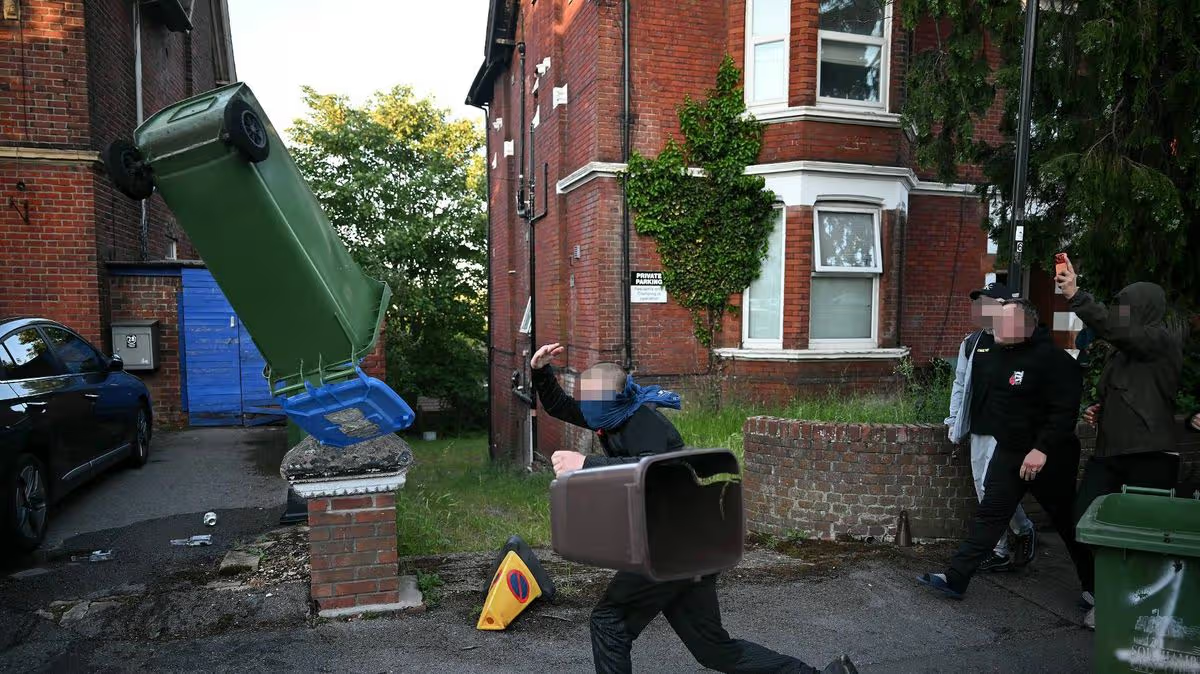
Riot police were called in as objects were hurled at officers during a Southampton protest sparked by outrage over bodycam footage showing Henry Nowak’s desperate pleas for help being ignored after he was stabbed by his killer Vickrum Digwa
Simon Hamalienko Publishing Lead and Emma O’Neill Content Editor
21:19, 02 Jun 2026Updated 21:19, 02 Jun 2026
Riot police have arrived at the protest scene in Southampton following fury over bodycam footage that revealed stabbed student Henry Nowak’s pleas for assistance were dismissed.
Officers have faced a barrage of projectiles near the location where Nowak was fatally stabbed, as masked individuals also hurled bikes at shield-carrying police.
After the demonstration outside Southampton Central Police station, a substantial crowd marched across the city to St Denys, adjacent to the murder site. While the vast majority of the hundreds present demonstrated peacefully, certain masked individuals began creating disorder with officers.
Advertisement
Police in riot equipment were pelted with chairs, cans and flares, ultimately compelling officers and three police vans to retreat from their established position. Visible damage to the surrounding vicinity included a torn-down fence. Officers were also observed forcing the crowd back with riot shields while chants of “I can’t breathe” echoed.
The murderer of finance student Nowak, 23 year old Vickrum Digwa, deceived attending officers at the Southampton stabbing scene on December 3 in 2025, claiming he had been targeted in a racist assault, reports the Daily Star.
Body-worn camera recordings from the incident captured Nowak repeatedly stating: “I’ve been stabbed,” to which an officer responds: “Don’t think you have, mate.” This footage provoked widespread anger, with the Prime Minister declaring he “felt sick” upon viewing it. A police helicopter was also spotted circling overhead following a largely peaceful demonstration outside the station, which far-right activist Tommy Robinson had joined.
Advertisement
Speaking to the gathered crowd, Robinson declared: “I heard someone say this wasn’t about race, this is about race. Because he (Mr Nowak) was white he was handcuffed.
“Even after they found out he (Digwa) had stabbed him five times, they still didn’t handcuff him. A white boy who done nothing was handcuffed, a murderer in possession of a knife who stabbed someone five times isn’t.”
The scenes unfolded after Nowak’s father Mark stated: “We do not want his death to be used to create further division, hatred or tension.”
Advertisement
The Independent Office for Police Conduct (IOPC) confirmed that investigators are scrutinising a substantial volume of body-worn camera footage alongside evidence presented throughout Digwa’s trial.
Sir Keir commented: “It is absolutely right that the IOPC are looking at this. There are clearly serious questions that need to be addressed, not least how accusations of racism informed the decision-making in this case.”
Digwa received a life sentence with a minimum term of 21 years for fatally stabbing Nowak with a ceremonial knife bearing a 21cm blade, which prosecutors identified as a kirpan — a blade carried as part of his Sikh faith.
The Department for Work and Pensions operates ‘Special Rules for End of Life’ (SREL), which allow those with a terminal diagnosis to fast-track their benefit payments – but Pensions Minister Torsten Bell has confirmed the rules do not extend to state pension access
The Department for Work and Pensions has specific ‘Special Rules for End of Life’, known as SREL, which enable those facing a terminal diagnosis to bypass assessments, waiting periods and other requirements to expedite their benefit claims and payments.
Advertisement
Nevertheless, Pensions Minister Torsten Bell has confirmed this provision does not apply to state pension payments. The DWP minister clarified that even this cohort of claimants must reach state pension age before gaining access to funds accumulated through years of National Insurance contributions.
MP Martin Wrigley posed a written question to the DWP, asking whether the Secretary of State for the Department would “make an assessment of the potential merits of enabling people below the retirement age with a terminal diagnosis to claim their pension earlier”.
Bell confirmed that advance access to the state pension is not presently available to those with a terminal diagnosis, though he emphasised that the system continues to be reviewed, reports the Liverpool Echo.
He responded: “The Department meets regularly with key stakeholders to understand the needs of people living with a terminal illness.
Advertisement
“Whilst it is the case that nobody can claim their State Pension before State Pension age, support is available through the Special Rules for End of Life.
“These rules enable people who are nearing the end of their lives to get faster, easier access to Personal Independence Payment, Employment and Support Allowance, Universal Credit and Attendance Allowance, without needing to attend a medical assessment, serve waiting periods and in most cases, receive the highest rate of benefit.”
The special rules underwent their most recent revision in 2023, expanding the eligibility requirements after claimants had previously been required to demonstrate they had six months or less to live. The amendment followed a successful campaign by the Marie Curie charity.
At present, to qualify for benefits under SREL, both of the following must apply:
Advertisement
You have an illness that gets worse over time
Your doctor or medical professional has said you might have 12 months or less to live
If you have not been given a specific timeframe for how long you might live, as this can prove difficult to predict, you may be able to ask your medical professional to support your claim under the SREL. Those making applications under these rules will also experience a different application process to other benefit claimants.
The state pension age represents the earliest point at which you can begin receiving your state pension payments. The current age is rising from 66 to 67, which will affect everyone who has not yet turned 66. However, you are under no obligation to claim your payments immediately upon reaching state pension age. You have the flexibility to defer and begin claiming at a later date, which could increase your payments but may also carry certain financial risks. The DWP advises obtaining independent financial guidance before choosing whether to postpone your payments. The approach could boost your future state pension payments by incorporating the sum you would have collected into your subsequent instalments.
Bear in mind, though, that you must postpone for at least nine weeks to be eligible for the enhanced payments. Your state pension is automatically postponed if you do not claim it when you reach state pension age.
There is no time limit by which you must claim your state pension, though experts point out that if you opt to increase your regular payments, you may need to weigh up whether you’ll live long enough to ‘break even’ on the sum you postponed.
A U.S. Department of Agriculture agency charged with protecting the country against invasive pests has repeatedly been infested with bed bugs, leading offices to be fumigated and staff to be sent home.
Employees reporting to the George Washington Carver Center in Beltsville, Maryland, were reportedly warned of the infestation in mid-May.
The irony of the outbreak happening in the offices of the Animal and Plant Health Inspection Service “was lost on no one,” a USDA employee told NOTUS.
Since then, USDA has reportedly fumigated the building, authorizing employees to work remotely, then letting them telework again when employees complained that lingering fumes inside the center were making them sick.
A USDA office that battles invasive pests has been repeatedly infested with bed bugs (AFP/Getty)
Bed bugs were reportedly observed inside the center again on Friday, and employees told NOTUS they were no longer being allowed to telework, prompting disgust about the conditions inside the building and concern that workers would bring the highly invasive pests home.
“They are scared,” one worker told the publication. “If you bring them home, the answer is to trash all of your belongings and fumigate your house at your own expense.”
Others said they were paranoid about getting bitten and feeling constantly itchy.
“USDA took prompt and robust action several weeks ago,” an agency spokesperson told The Independent. “Unfortunately, personal belongings left in the offices caused further issue. Animal and Plant Health Inspection Service management is working with employees to ensure the spaces are emptied for proper mitigation.”
Advertisement
Bed bug infestations can lead to people facing bites on their skin and unsanitary stains on their linens, plus time-consuming and costly efforts to find and eradicate the bugs.
The Department of Agriculture has lost thousands of employees since Donald Trump returned to office, one of the agencies hit hardest in his push to downsize the federal government (Getty)
The infestation comes as the USDA has multiple pressing matters on its hands, including an attempted reorganization meant to shift agency employees out of Washington as well as the threat that the flesh-eating, parasitic New World screwworm could return to the US, after being eradicated in the second half of the 20th century.
The USDA has been one of the agencies hit hardest in the Trump administration’s mass downsizing of the federal government, losing more than 24,000 people through a combination of firings and resignations since President Donald Trump took office.
“The whole country will be behind him and if we can do something in this tournament to make him feel a little bit better then great.”
Stunned Steve Clarke says his Scotland side will be striving to put a smile on the face of Kenny Dalglish at the World Cup after the bombshell news of the legend’s cancer diagnosis. The football world reacted in shock today when it emerged that the Celtic, Liverpool and Scotland idol is now facing up to the biggest battle of his life.
Advertisement
And Clarke, who was Dalglish’s right hand during their time together in the dugout at Anfield, believes nothing will perk up his old pal like watching the national side make history here in the States this summer. He said: “It’s obviously come as a bit of a shock for everyone.
“But I know Kenny well and I’m sure he’ll deal with this the way he has dealt with every other difficult situation in his life and we all wish him well. Obviously he’s got a very important status with the national side. He’s the record cap holder and joint record goal scorer and he’s a Scottish icon.
“The whole country will be behind him and if we can do something in this tournament to make him feel a little bit better then great. That’s what we will try to do – that’s what we want to do.
Advertisement
“I think, over the last seven years, we’ve helped a lot of people to maybe feel better about their country and better about the national team. So let’s continue that through the summer.”
Clarke has stayed in contact with Dalglish since their early days as players in the same Scotland squad. And the Scotland boss also revealed how Dalglish has been a mentor to Liverpool and Scotland skipper Andy Robertson during his ten years on Merseyside.
The manager went on: “We don’t speak regularly but we still keep in touch after we’ve had a game or whatever, there’s always a quick phone call.
Advertisement
“It’s a difficult one to answer because it comes up with no number on your phone and you can’t be sure who’s going to be on the other end of the line! He’s also been good for Andy Robertson at Liverpool in terms of his early years there, telling him what the club is about.
“But he’s had a big influence on the careers of a lot of people and he certainly had an influence on mine. So, just personally, I would like to wish him well.”
Get Daily Record Premium for just £1 per month in exclusive offer to celebrate the world cup. Click HERE.
The Telegraph Fantasy Football season is now coming to a heated end. As always, the award-winning experts at Fantasy Football Hub continue to bring you the very best in fantasy football knowledge, tips and tools to help you rise up the ranks and win your mini-leagues.
Join the Hub and get access to all their great resources and expert tips.
Telegraph Fantasy Football: last week’s insights
Gunners Champions!
Arsenal have waited over two decades to be called league champions, and after another shut-out for Gabriel Magalhães (£4.5m) and company, and City’s draw at Bournemouth, Arteta’s men lifted the trophy. TFF managers may be worried about mass rotation for the Gunners in the final round of fixtures.
Advertisement
City’s cup triumph
Prior to their league disappointment, the Citizens were celebrating another cup success after seeing off Chelsea 1-0 in the FA Cup final. January recruit Semenyo (£3.1m) hit the only goal of the game, marking it a cup double in Guardiola’s last season in Manchester.
Fight for Europe
With eighth place guaranteeing fans European away days next season, there are multiple teams still fighting for the remaining spots. Targeting players from those teams with a chance of qualification is a viable strategy for using any remaining transfers.
The Telegraph Fantasy Football player list has been analysed ahead of the upcoming games, and these look like the best players to transfer in:
Advertisement
1. Valentín ‘Taty’ Castellanos (£3.6m)
It’s perhaps a tale of ‘what could have been?’ had the forward been in from the off against Newcastle last weekend. With home comforts against Leeds next, and three points needed to stand any chance of avoiding relegation, it could be his opportunity to make himself a Hammers hero.
2. Dominik Szoboszlai (£4.1m)
The highest scoring Liverpool player in the game returned another eight points on Friday night, and should bolster his season tally of 148 points against Brentford in the last round of fixtures.
3. Zian Flemming (£2.7m)
The Dutch midfielder has an impressive five goals in his last nine outings, and is going under the radar. It’s table-propping Wolves at home on the last day of the season for the Burnley penalty-taker.
Telegraph Fantasy Football: Transfer stats
One of the most useful Telegraph Fantasy Football match facts to keep an eye on throughout the season is the average number of transfers used by managers in and around your league position. Ensuring you have a few extra transfers in hand is a sure-fire way to pull away from your closest rivals.
AUthenTISM is a new respite programme for neurodivergent children aged three to twelve with special educational needs
A Belfast woman is launching a new respite summer scheme for children with additional needs, which aims to provide a safe space for youngsters to make friends and enjoy themselves.
Advertisement
AUthenTISM is a new respite programme for neurodivergent children aged three to twelve with special educational needs, set up by Sharon Lyttle. It is due to officially launch at the end of June with a series of summer schemes.
She has worked with SEN children for a number of years with a variety of different projects and has now decided to set up their own group that will help children make friends and develop while also giving their parents a bit of a break and support during the summer.
Speaking to Belfast Live, Sharon said they have received a lot of interest from parents about AUthenTISM but still have a number of places available for their schemes. These include weeks for children aged three to seven and eight to twelve, with there also being friendship groups to support homeschooled children and transition groups to help children moving from primary to secondary school.
They said: “We know the pressures that parents and children can face in accessing respite services and are hoping to let as many people know about the summer schemes that we will have available this year. Our aim is to be available whenever children are off school, moving forward, and we will offer a safe space for children to have fun and make friends.
Advertisement
“We have worked with children with additional needs on programmes like this for years and felt that we could set up something on our own that could provide respite to families in need.
“We will be working out of Ballygomartin Baptist Church and will officially launch on June 29. We have dozens of children who have already signed up, but we still have space for lots more, and we are currently in the process of ensuring that we are able to accept respite direct payments.
“There are still a few weeks for parents to get in touch if they are interested in this years summer schemes and we are aiming to create a safe and fun space for neurodivergent children of all abilities.”
Four people have sustained minor to moderate injuries in a bear attack at Fukushima Steel Works in Japan.
Police and fire department officials rushed to a residential area in the Sasakino district of the city after receiving an emergency call from the steel works, saying multiple employees had been attacked by a bear.
Security camera footage shows a black bear chasing an employee near the entrance to the compound, knocking them to the ground, before running towards a building.
As of Tuesday evening, the bear had still not been caught by authorities, and was thought to be hiding inside a building somewhere on the premises.
Advertisement
Two types of bear are found in Japan – Asian black bears, and bigger brown bears which are found on the island of Hokkaido.
In 2025, the number of people killed by bears in the country reached a record high.
Kane said: “I can’t wait for young fans to pose next to figure-version of me in London, and I hope seeing this will inspire children to keep working hard, believing in themselves and enjoying every moment of the journey.”The figure will feature in Madame Tussauds London’s Culture Capital zone alongside a line-up of sporting stars, including Cristiano Ronaldo, Lionel Messi, Mo Salah, Mary Earps, Sir Lewis Hamilton, Anthony Joshua, Kylian Mbappe, and arriving later in summer 2026, Lando Norris.





















































You must be logged in to post a comment Login