

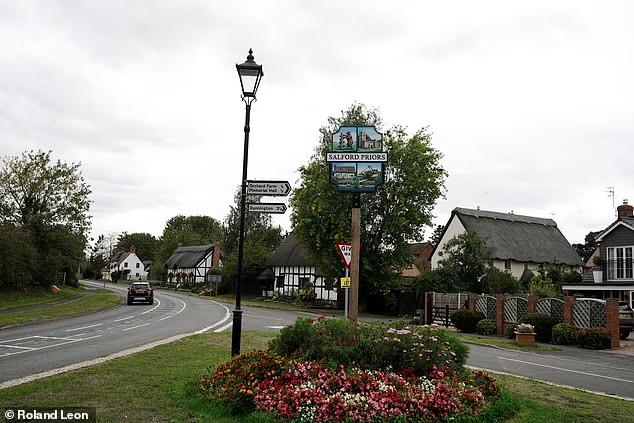
Surrounded by rolling farmland and boasting thatched Tudor cottages, a pub and a church recorded in the Domesday Book, one could say Salford Priors is the epitome of a classic English village.
But residents of the picturesque community – and others along Warwickshire’s border with Worcestershire – are up in arms over plans for what would become one of the UK’s biggest solar farms.
They say the scheme will turn prime arable land into a ‘crystal desert’ with communities blighted by glint and glare and natural habitats destroyed.
The proposed Arrow Valley Solar project will span an area of four square miles and see solar arrays and battery storage systems in four zones across both counties, all connected by a network of underground cables.
The project is of such a scale that it is classed as a Nationally Significant Infrastructure Project (NSIP) and could generate up to 500megawatts of energy, enough to power about 235,000 homes annually.
The site, which is expected to become operational by 2031 if planning permission is granted, covers 4,353 acres, equivalent to 2,468 full-size football pitches. Some of the panels will be ‘tracker’ variants the size of double-decker buses which follow the trajectory of the sun.
Paul Wareing, 68, said the farm would cover sections of the Vale of Evesham – renowned for its fertile land and an important fruit and asparagus growing region, and destroy ‘quintessential English countryside’.
The semi-retired former government project manager said: ‘People are only just waking up to the scale of this thing. It will destroy our green and pleasant land.’
Salford Priors in Warwickshire will be one of the closest villages to the giant solar farm

David Smith is upset this farmland near his home in Abbots Morton, Warwickshire, will be swallowed up by the solar farm

The project spans four square miles along the border between Warwickshire and Worcestershire
Mr Wareing, who lives with wife Joanna, 69, in Salford Priors – a former Warwickshire village of the year winner – said that a field designated as housing battery units to store excess energy was the site of a wildfire which threatened the village last month.
He added: ‘If there had been batteries in-situ then there would have been hell to pay.
‘This scheme will turn a beautiful area into a giant industrial estate.
‘The irony is that I live in a conservation area and if I wanted to put solar panels on my roof I wouldn’t be allowed. Instead schemes like this are allowed to blight the countryside around us.’
Much of the land for the scheme will be provided by the nearby 6,000-acre Ragley Estate – which was at the centre of a bitter High Court family trust dispute last year.
David Smith, a retired electricity board worker from Abbots Morton, accused Henry Seymour, the 9th Marquess of Hertford who inherited the £85million ancestral estate in 1991, of ‘destroying this corner of Warwickshire’.
Mr Smith, 68, said: ‘How will he be remembered after this?

St James’s church in Weethley enjoys a stunning vista overlooking the Cotswolds – but the view is set to be obliterated by solar panels, residents say

Salford Priors is a former Warwickshire village of the year winner
‘Landowners like the marquess are custodians, it is only his house for his duration.
‘A sizeable percentage of this scheme will be on the estate’s land, but not one square inch of it will be visible from Ragley Hall.’
Mr Smith said the new solar scheme will result in panels positioned just yards from his home. The land, currently used to grow oil seed rape, would flood because underground drainage pipes would be ‘smashed’ by the framework for the solar panels, he feared.
But the landowner, who said he had agreed to lease 200 acres for at least 30 years as part of the development, said farming was becoming ‘unviable’.
‘If the scheme gets the go-ahead there will be sheep on here – it’s going to be built so they can graze’, the farmer, who declined to be named, said.
‘I’m losing money growing crops’.
NSIPs require a specific type of planning permission called ‘development consent’, with the final decision resting with the Secretary of State.
A public consultation into the project opens at the end of this month.

Banners such as this one have been appearing in villages around the area

The scheme will turn prime farmland and rolling countryside used by walkers into a ‘giant industrial estate’, residents say
Land earmarked for the scheme spans at least 11 parishes, with other villages and hamlets affected including Broome, Cleeve Prior and the hamlet of Weethley, where a stunning vista behind St James’s church is set to be decimated by solar panels.
Dr Jane Cornwall, a psychologist and church warden at St James’s, runs a mindfulness group from the building for people with anxiety and depression.
She said: ‘People come here to enjoy the unadulterated view, to walk and enjoy the peaceful tranquillity. I’m very concerned and the company behind this scheme have done nothing to allay people’s fears.’
But a villager in Dunnington who was in favour of the scheme, and green energy in general, said: ‘The panels near here won’t be visible from the houses and will mainly be on estate land which isn’t used for much at the moment.’
Arrow Valley Solar is one of slew of super-sized solar parks to enter the planning system over the last year. Earlier this year, the government approved what was up until then the UK’s largest power-producing solar farm, following a planning inquiry.
The 800megawatt Springwell Solar Farm, between Lincoln and Sleaford, will cover 3,163 acres and power 180,000 homes.
A decision on a proposed 4,361-acre ‘Great North Road’ solar park, which could generate enough electricity for 400,000 homes, beside the A1 in Nottinghamshire is expected next month.

Fields between Salford Priors and Dunnington will form part of the solar farm
Jamie Gleeson, Project Development Manager for Arrow Valley Solar, said the development would be ‘sympathetic to the local area’s environment, character and history’.
He added: ‘The project is being developed to help meet growing demand for secure, home-grown renewable energy and will be shaped by a comprehensive programme of environmental and technical assessments, alongside feedback from local communities and stakeholders.
‘We recognise that people have questions about what the proposals could mean for the local area and would encourage anyone interested in the project to take part in our forthcoming public consultation’.
Ragley Estate said it understood some residents had concerns over the scheme, ‘for which Ragley is one of a number of landowners that are involved’.
It said that, ahead of the consultation, the ‘Arrow Valley Solar project team are best placed to respond to any queries or concerns’.
Last November, the Earl of Yarmouth, William Seymour, was saddled with a £1.3million legal bill after losing a battle over the running of the estate.
The earl, then 31, had been involved in a spat with his parents, the Marquess and Marchioness of Hertford, since 2018 when they objected to his wedding to former Goldman Sachs banker Kelsey Wells – now Lady Yarmouth.
The High Court was told that as the oldest son, the earl expected to be handed Ragley Hall, the 340-year-old family seat, when he turned 30.
But he was disinherited by his father after they fell out around the time of the earl’s marriage.















































You must be logged in to post a comment Login