

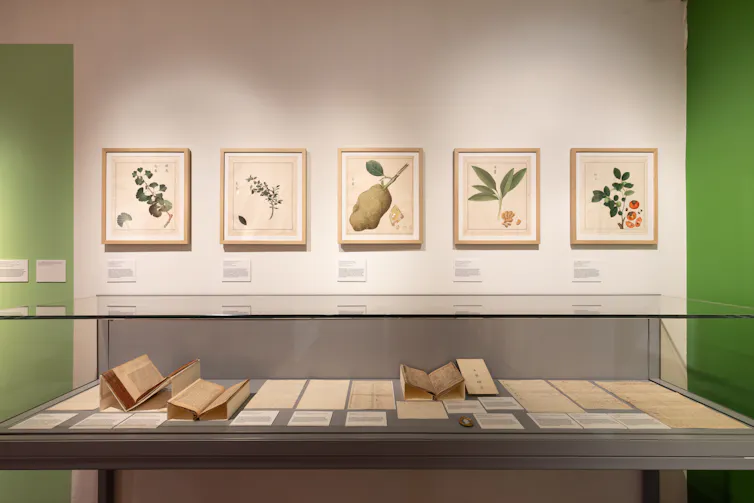
I’m standing in a deconsecrated church in Lambeth, London, now home to the Garden Museum. It has a warm and pleasant atmosphere, undeniably a church, yet far removed from its original purpose. On this quiet Friday morning, I met with Emma House, the lead curator of the exhibition Seeds of Exchange. We wandered around the exhibit, which is deceptively small for the scale of its story, crossing continents, cultures, languages and time.
Seeds of Exchange: Canton and London in the 1700s tells a story that is both local and global. It centres on a short-lived but remarkable collaboration between an English botanist and his Chinese counterparts. Together, they documented the plant life of Canton (modern-day Guangzhou) at a time when global trade, science and empires were becoming deeply entangled.
As a botanist I love plants – but this story is not only about them. It is about how knowledge moves, and who gets to shape it.
A meeting point of worlds
The late 18th century was a period of carefully controlled contact between China and Europe. Trade with the outside world in China was tightly regulated through licensed Chinese merchant guilds. Foreign traders could only operate during part of the year.
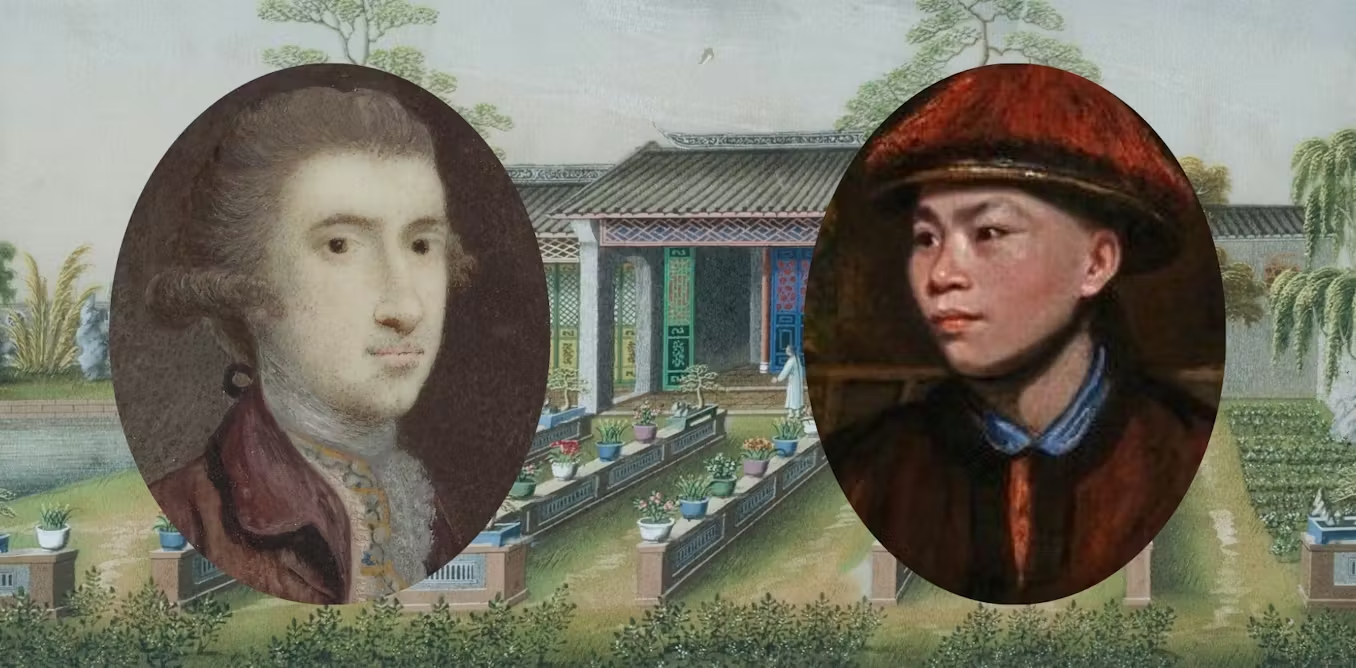
Into this system stepped John Bradby Blake, an employee of the British East India Company in the early 18th century.
Victoria and Albert Museum, London
Like many of his contemporaries, he was not simply a passive participant in imperial trade. The East India Company allowed its agents a degree of personal enterprise, and Blake – having suffered substantial financial losses in tea speculation – turned to botany as both scientific pursuit and potential commercial opportunity.
His project was ambitious: to catalogue Chinese plants in what he envisioned as a Compleat Chinensis (Complete Chinese). Between 1766 and his death in 1773, he commissioned over 150 botanical paintings, documenting many now familiar plant species, ranging from citrus fruits and camellias to turmeric and jackfruit.

Oak Spring Garden Foundation, Upperville, VA
What makes this project particularly striking is that it was not a solitary European endeavour. Blake relied heavily on local expertise, as he did not know the flora and did not speak Mandarin.
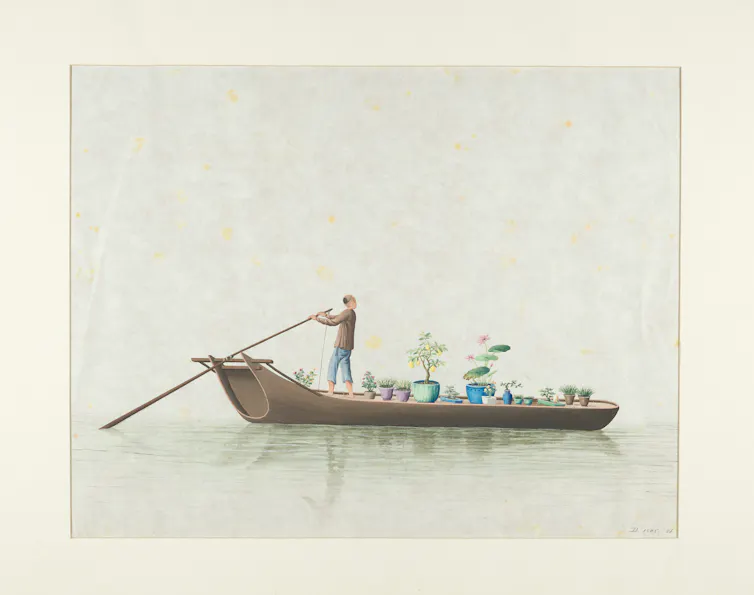
Mak Sau, a Chinese artist about whom we know very little, produced detailed botanical paintings that form the heart of this exhibition. These works are scientific documents, capturing colour and structure with fantastic precision. But they are also superb works of art and form a historically important collection of early botanically accurate watercolour paintings in China.
Local knowledge also helped identify species that Blake himself struggled to classify. Whang At Tong, Blake’s Chinese counterpart, was a merchant operating within the Canton system. He facilitated the exchange of materials, knowledge and, eventually, the transport of Blake’s collection back to Britain. The endeavour was, in many ways, a shared intellectual enterprise. Yet it unfolded within an unequal system shaped by imperial trade and economic ambition.
Plants, profit and empire
Many of the plants depicted in Seeds of Exchange hint at the economic motivations behind Blake’s work. Tea, citrus species, indigo and medicinal plants all had clear commercial value. Others carried horticultural interest that would later shape European gardens.

Oak Spring Garden Foundation Upperville VA
Blake cultivated plants in his own Canton garden, experimenting with germination and growth and sending seeds back to Britain. These botanical exchanges contributed, in small but significant ways, to breaking China’s monopoly on certain crops – particularly tea.
Yet the paintings also reveal a more complex botanical landscape. Some species, such as chilli peppers and watermelon, were themselves recent arrivals to China (from South America and Africa respectively).
Even in the 18th century, plant distributions were already shaped by centuries of movement across continents. Today, the movement of plants across the world is on a monumental scale, driven by crops and horticulture. The exhibition quietly reminds us that “native” and “foreign” are often more fluid categories than we assume.
Blake’s death in 1773 brought the project to an abrupt halt. He never completed his Compleat Chinensis, and his work might easily have faded into obscurity. Instead, Whang At Tong transported the collection to London, where it entered elite scientific circles. He is one of the earliest recorded Chinese people to have come to the UK. He met figures such as Joseph Banks, a central figure in British botany, and even sat for a portrait by Joshua Reynolds – a rare moment of cultural visibility for a Chinese visitor in 18th-century Britain. The Reynolds painting is in the exhibit, and exquisitely done.
Victoria and Albert Museum, London
Despite this, the botanical paintings themselves were never fully integrated into British science. Seeds were sent to Kew, but the visual and documentary archive remained largely unused. Over time, the collection became physically divided. One portion, consisting of manuscripts and herbals (historical books describing the properties of plants), ended up, remarkably, in Canterbury Cathedral. Another, including many of the paintings, passed through the art market before being acquired by the Oak Spring Garden Foundation in Virginia in the 20th century.
Reuniting the past
Seeds of Exchange marks the first time these materials have been brought back together in over two centuries. Seen together, the paintings, herbals, notebooks and maps reveal a network of knowledge production that was collaborative, cross-cultural and contingent. Recent research indicates that Blake mainly used texts by European authors for identification, however the exhibition shows Chinese floras which were used in the work, highlighting the depth of local contribution.
BJ Deakin Photography
The exhibition also sits within a broader historical context. The Garden Museum itself stands on land once associated with early botanical collectors such as the Tradescant family, whose 17th-century “cabinet of curiosities” helped lay the foundations of modern museums. From these early collections to Blake’s Canton project, the gathering and classification of plants has long been tied to exploration, trade and power.
What, then, does this exhibition tell us today? At one level, it is a fascinating story of early globalisation. But it also prompts deeper questions about authorship and recognition. Projects like Blake’s were often framed as European achievements, even when they depended heavily on local knowledge and labour.
Seeds of Exchange highlights that scientific knowledge has almost always been co-produced, even if the historical record has not always acknowledged this. In an era when museums and collections are increasingly reexamining their collections and histories, this matters.
Like the plants it documents, the knowledge this exhibition represents has travelled, adapted and taken root in new contexts – and we are still tracing its origins more than two centuries on.
Seeds of Exchange: Canton and London in the 1700s is at the Garden Museum in London until May 10 2026





















































You must be logged in to post a comment Login