






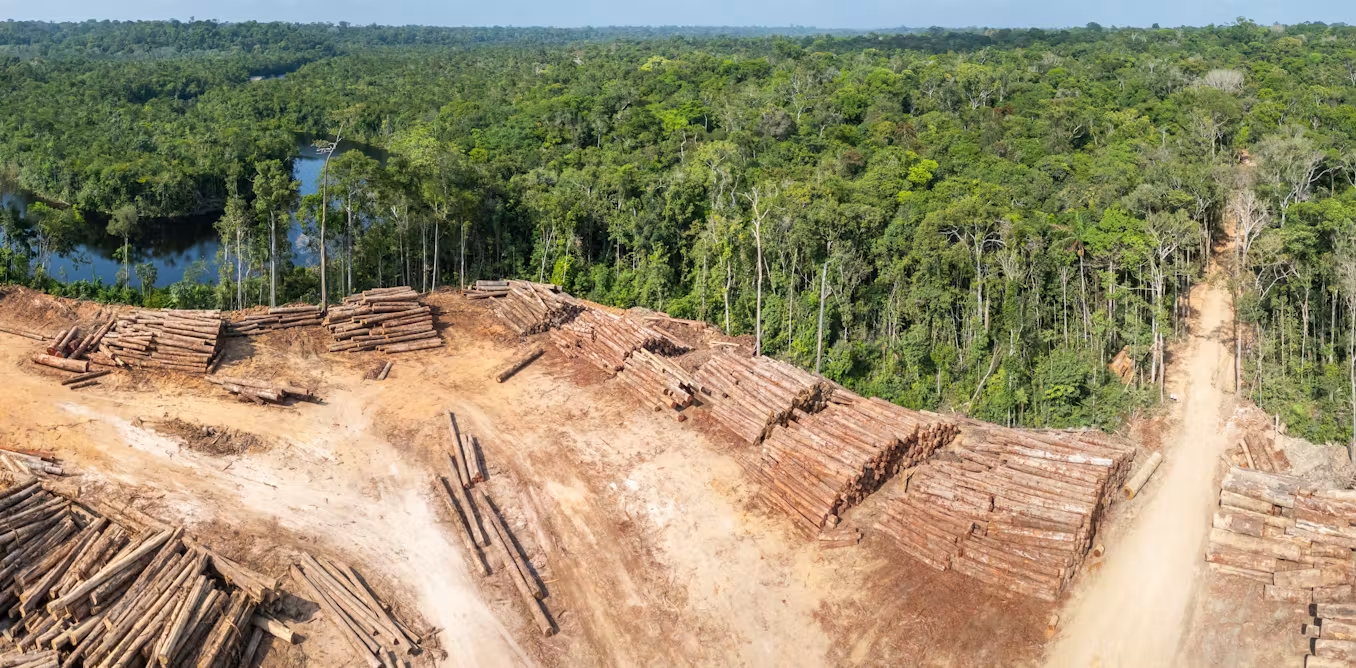
The world’s tropical rainforests are edging towards collapse. But knowing how to stop deforestation isn’t enough to drive action. The challenge is aligning all the pieces of the puzzle to initiate substantial change. Now our research suggests the key is to persuade enough people to make the system tip in the right direction.
In the mid-1980s, the British fur industry collapsed in less than a decade. Famous retail stores shut down their fur departments. Fur farming was banned in 2000. By the late 2010s, even fashion houses whose heritage was built on the fur trade had gone fur free, citing consumer sentiment.
This abrupt change didn’t come because of new technology or better regulation. It came because of a shift in social norms, triggered by British fashion photographer David Bailey’s Dumb Animals cinema ad campaign. This short film featured a catwalk model trailing a fur dripping with blood and a slogan: “It takes up to 40 dumb animals to make a fur coat. But only one to wear it.” Once desirable and luxurious, fur coats quickly became taboo.
Unfortunately, a similar shift has not yet happened in how people consider tropical forest destruction.
To slow deforestation, scientists can map and monitor forests from space to the resolution of a single tree. Certification schemes have made supply chains more transparent and given consumers and regulators something to act on. Securing Indigenous land tenure produces the lowest deforestation rates on the planet.
Yet every year another patch of Amazon the size of a small European country gets cut down or burnt.
In Southeast Asia, palm oil and pulp monocultures continue to decimate its rainforests. In the Congo Basin and West Africa, small-scale agriculture, charcoal production, cocoa, coffee and mining are steadily fraying another of the planet’s vital areas for biodiversity and carbon storage.
The world’s tropical forests are all edging closer towards a catastrophic dieback. This isn’t a knowledge issue. It’s a problem about how societies change their minds.
Tipping points
When positive change happens, it’s easy to assume that evidence accumulates that things are getting worse, the public is informed, opinion shifts, policy follows, then behaviour and consumption adjust. Each step is gradual and linear. The dial turns slowly.
Except that’s not how anything important does change. Take smoking in public places, the acceptance of same-sex marriage or the speed with which electric vehicles are becoming mainstream. Nothing happens for years or decades, then everything happens all at once.
This is the nature of tipping points: thresholds beyond which a system abruptly reorganises itself and settles into a new state that becomes hard to reverse.
À lire aussi :
UK may be on verge of triggering a ‘positive tipping point’ for tackling climate change
At the University of Exeter, we research what makes such change – good and bad – happen slowly then all at once, and how we might trigger the good ones deliberately. We’re exploring how to find tipping points that could positively protect tropical forests at our upcoming Exeter climate conference.
Many social systems, like those in nature, have tipping points. They can resist change up to a point. Then a relatively small, additional nudge – perhaps a film, a court ruling, a fall in the price of something, a critical mass of new adopters – flips a system into a new stable state that is hard to reverse.
That can be hopeful, in a way that gradual change is not, because it means that we don’t have to persuade everyone to do the right thing. We just need to persuade enough people to make the system tip in the right direction.
What the Amazon teaches us
For tropical forests, the most studied example of a deliberate tipping intervention began in 2006. Following a Greenpeace exposé called Eating Up the Amazon, the world’s largest soy traders agreed not to buy from newly cleared Amazon land. The Amazon soy moratorium worked, dramatically. Direct soy-driven deforestation in the Amazon fell from around 30% of soy expansion to under 4%. This became a textbook strategy for protecting tropical forests.
golaminnovation/Shutterstock
But while the moratorium was a success inside the Amazon, soy production has expanded elsewhere, including into the neighbouring Cerrado, Brazil’s vast tropical savanna, driving rapid deforestation there. Rural communities in the Amazon saw little of the prosperity that might have made standing forest the obvious economic choice. The underlying incentive structure – an economy that still pays more to clear land than to keep it intact – was never reshaped.
Twenty years on, that fragile arrangement is under serious strain. Major traders have signalled their intent to withdraw. Brazil is moving to ban the agreement outright.
Pressure is not coming from collapsed consumer concern. European supermarket chains including Lidl, Aldi and Tesco have reaffirmed their commitments. More than 70 organisations have signed a manifesto defending the moratorium.
The pressure is coming from somewhere harder to fix: China is now the dominant buyer of Brazilian soy and is not party to the agreement. The EU’s deforestation regulation has been delayed and weakened. A new EU trade deal with Mercosur (a South American trade bloc bringing together Argentina, Brazil, Paraguay and Uruguay) expands Brazilian exports into Europe. And Brazil’s powerful agribusiness lobby has spent two decades patiently working to dismantle the agreement from within.
So a supply-chain commitment that covers one market but not another will leak. A consumer pressure that is real in Berlin but absent in Shanghai will eventually be outflanked. A moratorium that protects a forest without making it economically rewarding for people living in it will be politically vulnerable. Each mechanism is just one part of the puzzle.
The three As
By looking at the system as a whole, we can understand how preserving the forest becomes the affordable, attractive and socially acceptable option. Affordability is about finance and the supply chain. Attractiveness is about the the co-benefits to all parties. Acceptability involves shifting the cultural and political pressure – without that, the other two erode.
We can study, plan for and even deliberately seed positive social tipping points when we design solutions with a whole systems-perspective. For tropical forests, this includes new supply-chain rules, Indigenous leadership and
the Tropical Forest Forever Facility (a new multi-billion-dollar rainforest investment fund).
A concerted, coordinated push across all three aspects will turn the protection of the standing forest into the most affordable, socially acceptable and attractive option.














































You must be logged in to post a comment Login