ALBUQUERQUE, N.M. (AP) — Even as it battled the deadliest drug epidemic in American history, the U.S. Drug Enforcement Administration permitted hundreds of thousands of fentanyl pills to hit the streets of New Mexico between 2023 and 2025, according to three current and former DEA agents and government records reviewed by The Associated Press.
DEA agents repeatedly monitored shipments of fentanyl pills — but did not seize them — as federal prosecutors sought to bring bigger criminal cases against traffickers of a synthetic opioid that the White House last year designated a “ weapon of mass destruction.”
Agents and experts, however, said the tactic amounted to a gamble with public safety that potentially imperiled communities in and around Albuquerque and may have violated U.S. Justice Department rules intended to safeguard the public.
“We poisoned our community to make cases,” DEA Special Agent David Howell told AP in a series of interviews in New Mexico. “Through our own willful blindness, we get to say, ‘We don’t really know what happened to the drugs.’ But we 100% got people killed.”
Advertisement
DEA Special Agent David Howell, who filed a whistleblower complaint, poses for a portrait outside the U.S. district courthouse in Albuquerque, N.M., on Friday, June 12, 2026. (AP Photo/Susan Montoya Bryan)
Advertisement
DEA Special Agent David Howell, who filed a whistleblower complaint, poses for a portrait outside the U.S. district courthouse in Albuquerque, N.M., on Friday, June 12, 2026. (AP Photo/Susan Montoya Bryan)
Advertisement
Advertisement
Advertisement
Advertisement
The DEA has long contended it would not be plausible to seize every shipment of every drug. But the strategy of allowing staggering amounts of counterfeit painkillers to hit the streets shocked several veteran agents who spoke with AP.
Ridding the streets of illicit fentanyl, manufactured mostly in Mexican labs, became DEA’s top priority over the past decade as overdose deaths surged. At the same time, its lethality — a few milligrams can kill the average adult — upended time-tested tactics that had been used to combat drugs like cocaine and heroin. Those methods have included allowing drug transactions to be completed so agents might follow the narcotics through the supply chain. Fentanyl, however, is so dangerous that the U.S. Justice Department developed guidelines for agents in such circumstances, encouraging them to seize the opioid whenever “practicable.”
Albuquerque, which has a neighborhood so besieged by drugs it’s known as “War Zone,” and other regions in New Mexico remain at the epicenter of the fentanyl epidemic. While overdose deaths nationwide fell 14% last year, government data show New Mexico tallied a 21% spike.
Alex Uballez, who served as U.S. attorney in New Mexico from 2022 through last year, said authorities at times allowed drug shipments to go unseized as part of a broader effort to gather intelligence and build cases against major drug traffickers. He said the approach reflected his office’s limited resources and his belief that prosecuting larger organizations can have a bigger impact than interdicting every suspected drug transaction.
Advertisement
Sign up for Morning Wire:
Our flagship newsletter breaks down the biggest headlines of the day.
Advertisement
Last year, DEA recorded the largest fentanyl bust in its history in Albuquerque.
“The bigger fish are worth catching,” Uballez said, “and that will save more lives.”
Advertisement
The DEA said in a statement that “the investigative decisions at issue were lawful, reasonable under the circumstances and consistent with Department guidance.”
“Public descriptions suggesting that DEA knowingly permitted fentanyl to reach communities are false and fundamentally mischaracterize the facts,” DEA spokesperson Amanda Wozniak wrote in an email. She said the investigations involved court-authorized wiretaps “in which agents and prosecutors conducted real-time surveillance, intelligence gathering, and operational analysis targeting larger drug trafficking organizations.”
Advertisement
Tell our investigators
AP’s global investigative team accepts tips securely and confidentially. Choose the method that works best for you.
Advertisement
Precise intelligence on drug deliveries
In some cases, the DEA had such detailed intelligence about drug deliveries that agents were able to tally precise pill counts, according to reports reviewed by AP.
Advertisement
Agents, for example, deciphered coded chatter over cellphones and closely surveilled a transaction at a mobile home park in Albuquerque in June 2023, according to a 66-page report reviewed by AP. Agents wrote in the report that traffickers delivered 74,000 pills as part of that deal, a figure federal prosecutors later confirmed in a court filing.
Days earlier, another DEA report showed, investigators watched the same distribution ring deliver a spare tire hiding another suspected fentanyl shipment that similarly went unseized.
“We did nothing, but sit back and watch,” said Howell, who filed an official whistleblower complaint in 2023 to bring attention to what he thought was a tactic that risked public safety.
Advertisement
This June 12, 2026 photo shows a mobile home park where federal agents monitored, but did not seize, a shipment of fentanyl in Albuquerque, N.M. (AP Photo/Susan Montoya Bryan)
This June 12, 2026 photo shows a mobile home park where federal agents monitored, but did not seize, a shipment of fentanyl in Albuquerque, N.M. (AP Photo/Susan Montoya Bryan)
Advertisement
Advertisement
Advertisement
This photo provided by the U.S. Drug Enforcement Administration shows pills containing fentanyl which were seized by the DEA in New Mexico, on April 28, 2025. (DEA via AP)
This photo provided by the U.S. Drug Enforcement Administration shows pills containing fentanyl which were seized by the DEA in New Mexico, on April 28, 2025. (DEA via AP)
Advertisement
Advertisement
Advertisement
Months passed before federal authorities busted the traffickers, and Howell, who participated in the surveillance, said authorities today cannot account for the unseized shipments.
“It’s outrageous to put that many lives at risk in hopes of making a big case,” said Tristan Leavitt, president of Empower Oversight, a whistleblower advocacy group that has asked the Senate Judiciary Committee and Justice Department’s Office of Inspector General to investigate Howell’s claims.
A former DEA supervisor, speaking on condition of anonymity for fear of retaliation, said he and his Albuquerque colleagues allowed “millions” of pills to go unseized during a multi-state investigation last year.
Advertisement
Howell reported in his whistleblower disclosures that agents on that case permitted the delivery of at least 1.8 million fentanyl pills.
That investigation, the former supervisor and Howell told AP, culminated in the largest fentanyl bust in DEA history, a takedown announced in May 2025 by then-Attorney General Pam Bondi that resulted in the seizure of more than 3 million pills.
“The amount we ultimately seized was hitting the streets every month while that case was going on,” the former supervisor said, adding that the DEA could have dismantled the organization six months earlier.
The U.S. Attorney’s Office in Albuquerque did not answer questions about the unseized fentanyl shipments but, in a statement to AP, said the “conduct” Howell brought to light happened during the prior administration.
Advertisement
“The current leadership of this office is focused on aggressively investigating and prosecuting fentanyl trafficking and disrupting the criminal organizations responsible for distributing these drugs,” Tessa DuBerry, a spokesperson for the office, wrote in an email.
Uballez, the former U.S. attorney, said estimated pill counts “based on intercepted phone calls are not reliable.”
“I don’t think I’d contest that drugs are ‘walked,’” he said, referring to the law enforcement tactic of allowing contraband to go unseized to further an investigation. “How much and how frequently — and with what certainty — is incredibly difficult to answer in retrospect.”
To seize or not to seize
As fentanyl overdoses became an epidemic over the last decade, the U.S. Justice Department developed an internal playbook for combatting the deadliest drug ever to cross the Mexican border. The game plan coincided with a publicity campaign that warned Americans that “One Pill Can Kill,” a DEA effort to highlight fentanyl’s unique dangers.
Advertisement
Adopted in 2017, the department’s two-page “Fentanyl Protocols” called on agents to “seize or otherwise prevent the distribution” of fentanyl “as soon as practicable.” The rules, which have not previously been made public, said that “protecting public safety is paramount,” irrespective of whether seizures compromise investigations.
The Justice Department rewrote the rules in 2024 to afford law enforcement more discretion in such cases. The updated protocols say investigators “may exercise discretion in determining whether to take action to prevent the trafficking of fentanyl,” balancing public safety risks against “the benefits to be achieved through preserving the investigation.”
The DEA rarely discusses the tactic of allowing drugs to go unseized. Its agent manual describes taking drugs off the street as “the usual course of action” but adds “there may be instances where the investigative objectives can be better achieved by not doing so.”
The agency has long used “controlled deliveries” in which constant surveillance of the drugs — and often replacing them with fake narcotics — is followed by a takedown to recover them, according to current and former agents.
Advertisement
This photo, provided by the U.S. Drug Enforcement Administration, shows pills containing fentanyl which were seized by the DEA in New Mexico, on April 28, 2025. (DEA via AP)
Advertisement
This photo, provided by the U.S. Drug Enforcement Administration, shows pills containing fentanyl which were seized by the DEA in New Mexico, on April 28, 2025. (DEA via AP)
Advertisement
Advertisement
Advertisement
In interviews, several current and former agents likened the decision to permit fentanyl to hit the streets to the infamous “Operation Fast and Furious,” a 2011 gun-walking scandal in which straw buyers smuggled some 2,000 assault weapons into Mexico with the intent of tracing the firearms to cartel leaders.
Advertisement
The Bureau of Alcohol, Tobacco, Firearms and Explosives was savaged with bipartisan criticism after two of those guns surfaced at the scene of the fatal shooting of a Border Patrol agent, and the Justice Department explicitly forbid agents from allowing firearms to be trafficked.
Blowing the whistle
Howell became so unnerved by his agency’s failure to seize fentanyl that he began flagging overdose deaths that might have been caused by the very pills DEA permitted to flow to dealers. One of those cases included a 15-month-old toddler who died after ingesting burned fentanyl residue last year in Española, a New Mexico town ravaged by grinding poverty and addiction.
Howell, who joined DEA 19 years ago after a decade in the Navy, took his allegations to the U.S. Office of Special Counsel. The agency, tasked with protecting whistleblowers, initially found a “substantial likelihood of wrongdoing” and asked the Justice Department to investigate.
In early 2024, Howell told the Justice Department’s Office of Professional Responsibility that DEA agents had observed — yet not seized — separate deliveries of 150,000 and 50,000 fentanyl pills.
Advertisement
DEA and federal prosecutors, he added, “are placing themselves in a precarious position where they will not be able to prove that the fentanyl they could have stopped did not result in the death of a person.”
DEA Special Agent David Howell, who filed a whistleblower complaint, poses for a portrait outside the U.S. district courthouse in Albuquerque, N.M., on Friday, June 12, 2026. (AP Photo/Susan Montoya Bryan)
Advertisement
DEA Special Agent David Howell, who filed a whistleblower complaint, poses for a portrait outside the U.S. district courthouse in Albuquerque, N.M., on Friday, June 12, 2026. (AP Photo/Susan Montoya Bryan)
Advertisement
Advertisement
Advertisement
Advertisement
The Justice Department’s Office of Professional Responsibility found in 2024 that the DEA and U.S. attorney’s office had made reasonable decisions in deciding to allow drugs to go unseized and that their inaction posed no “specific danger to public health.”
The Office of Special Counsel, which critics say rarely pushes back on agency findings, deemed the Justice Department’s report reasonable.
Howell, meanwhile, paid a price after coming forward. The DEA relegated him to desk duty for more than a year and docked his performance evaluations, according to Howell and DEA records. Internal records also show prosecutors barred him from testifying in federal court, citing his “pattern of refusing to heed” admonitions to allow drugs to go unseized during long-term investigations.
Pointing to DEA’s own “One Pill Can Kill” campaign, current and former agents said they could not understand the watchdog’s finding that the tactics had not put the public in danger. They noted the drug is so dangerous it has to be handled in a specialized laboratory.
The 32-year-old, a training partner of 800m Olympic champion Keely Hodgkinson, will also race at next month’s European Championships and the inaugural Ultimate Championships in September.
“There are four opportunities to win gold this year,” Hunter Bell told BBC Sport.
Advertisement
“I am two golds down and two more to go.”
Hunter Bell is blossoming later in her career.
Having taken five years out from the sport before returning during the Covid-19 pandemic, she took 1500m bronze at the Paris Olympics before pipping Hodgkinson to silver at last year’s World Championships in the 800m.
This, though, is her first outdoor title – in the event Hodgkinson is Olympic champion.
Advertisement
“Every medal is a landmark moment but my first outdoor gold is huge,” she said.
Hunter Bell and Kenya’s world champion Lilian Odira were the favourites for this title after Hodgkinson opted not to compete. The final was barely a contest with Hunter Bell setting the pace and then kicking on with 200m to go to win by more than a second.
Hodgkinson has instead taken time off before the European Championships in Birmingham, which start on 10 August.
Hunter Bell is only running in the 1500m in that event, denying the chance to see an intriguing race between the pair, but took her opportunity in her friend and training partner’s absence.
Advertisement
Though she said the win validates her decision to come to Glasgow, she defended the decision of others to withdraw.
The push for expanded use of Starlink comes as Zelenskyy looks for alternate ways to mitigate the need for U.S. Patriot air defense systems to thwart the steady barrage of Russian missile and drone attacks on Ukrainian territory. The interceptors are in shorter supply as the U.S. and Israeli war against Iran continues to rage, and Trump on Friday appeared to back away from a recent commitment to give Ukraine a license to produce them.
Zelenskyy made the request directly to Trump in an Oval Office meeting this week during his whirlwind trip to Washington, according to one person familiar with the matter. He also told lawmakers later on Capitol Hill that he wanted Starlink to help with targeting inside Russia, according to a person in the room. Both officials spoke on the condition of anonymity to discuss the sensitive private discussions. Trump did not commit to Zelenskyy’s request.
Zelenskyy has been pushing to expand Starlink use for weeks
Musk has allowed the Ukrainians to use Starlink inside their own territory, including in Ukrainian regions occupied by the Russians, but has restricted use of the satellite system inside Russia.
Advertisement
Zelenskyy has been making the case for expanded use of Starlink with U.S. officials for at least several weeks. The White House, the Ukrainian Embassy in Washington and officials at SpaceX, which owns Starlink, did not immediately respond to requests for comment on Zelenskyy’s request. Zelenskyy’s efforts to get Musk’s permission to use Starlink to help with Ukrainian attacks inside Russia was first reported by The Atlantic.
Granting permission for an expanded use of Starlink could come with risk for Musk. The Associated Press reported in December that two NATO-nation intelligence services suspect Russia is developing a new anti-satellite weapon to target Musk’s Starlink constellation with destructive orbiting clouds of shrapnel.
The intelligence findings were shown to the AP on condition that the services involved were not identified, and the news organization was not able to independently verify the findings’ conclusions.
Russia views Starlink as a grave threat, the findings indicate. The thousands of low-orbiting satellites have been pivotal for Ukraine’s survival against Russia’s full-scale invasion, which began in February 2022.
Advertisement
Ukrainian leader also pitched US lawmakers during recent visit
Zelenskyy had traveled to Washington to attend Sen. Lindsey Graham’s memorial service and used the visit to check in with Trump and allies on Capitol Hill.
Zelenskyy visited the Capitol following his meeting with Trump in the White House earlier in the day. Senators said the requests the Ukrainian president made were similar to what he had told them earlier in July during a meeting at the NATO summit in Turkey.
“They need access to Starlink long term to make their longer-range and intermediate-range systems more accurate,” said Sen. Mike Rounds, a Republican from South Dakota, who is a member of the Senate Armed Services Committee.
“They prefer to be exactly on target, as opposed to, in the general area,” Rounds said. “He made that pretty clear.”
Advertisement
Zelenskyy spoke with lawmakers late Tuesday evening ahead of a Senate vote on a punishing new Russia sanctions package, which advanced toward a final vote expected next week.
Zelenskyy also reiterated Ukraine’s need for more U.S. Patriots and the previously discussed licensing agreement so Ukraine could start producing the system in house, said Rounds, who was part of the delegation of U.S. lawmakers at the NATO conference in Ankara.
“There was a consistency from what President Zelenskyy shared with us in Turkey two weeks ago to what he shared with us again once again, in terms of what their needs are,” Rounds said. “It’s pretty straightforward.”
Trump appears to edge away from Patriots licensing commitment
The president told reporters on Friday that the licensing matter remains under discussion and said he hasn’t made a decision on it.
“We’re talking about it. But it’s a hard thing to give away that kind of technology,” Trump said.
Trump’s relationship has improved with Zelenskyy as Ukraine has gained strength on the battlefield with Russia in recent months. And Zelenskyy has sought to portray that his war with Russia is connected to the U.S. and Israel’s conflict with Iran.
Advertisement
U.S. intelligence has shown that Tehran provided Russia with drones to use against Ukraine. More recently, Russia has prepared to ship drones for Iran, including upgraded versions of the technology that Tehran originally supplied to Moscow after its invasion of Ukraine, according to U.S. and European officials.
Zelenskyy said ahead of this week’s visit to Washington that he’d share evidence with the United States that shows Russia is assisting Iran in targeting U.S. bases in the Middle East via satellite surveillance.
Zelenskyy also has been making the case to the Trump administration that his country is well positioned to help the U.S. counter Iranian drone attacks on U.S. bases in the Middle East and Gulf allies’ infrastructure.
“He has been very emphatic they are going to provide more aid to us in unmanned warfare, aerial unmanned warfare, which has been so instrumental in Iran — his people have been there, they’ve been providing technology and know-how — and they’re ready, willing and able to do it in even greater magnitude,” said Sen. Richard Blumenthal, a Democrat from Connecticut, who sits on the Armed Services Committee. “He was very emphatic on that point.”
Advertisement
___
AP writers John Leicester in Paris and Emma Burrows in London contributed reporting.
The body recovered from a river in Devon has been confirmed to be the body of a missing teenage schoolboy.
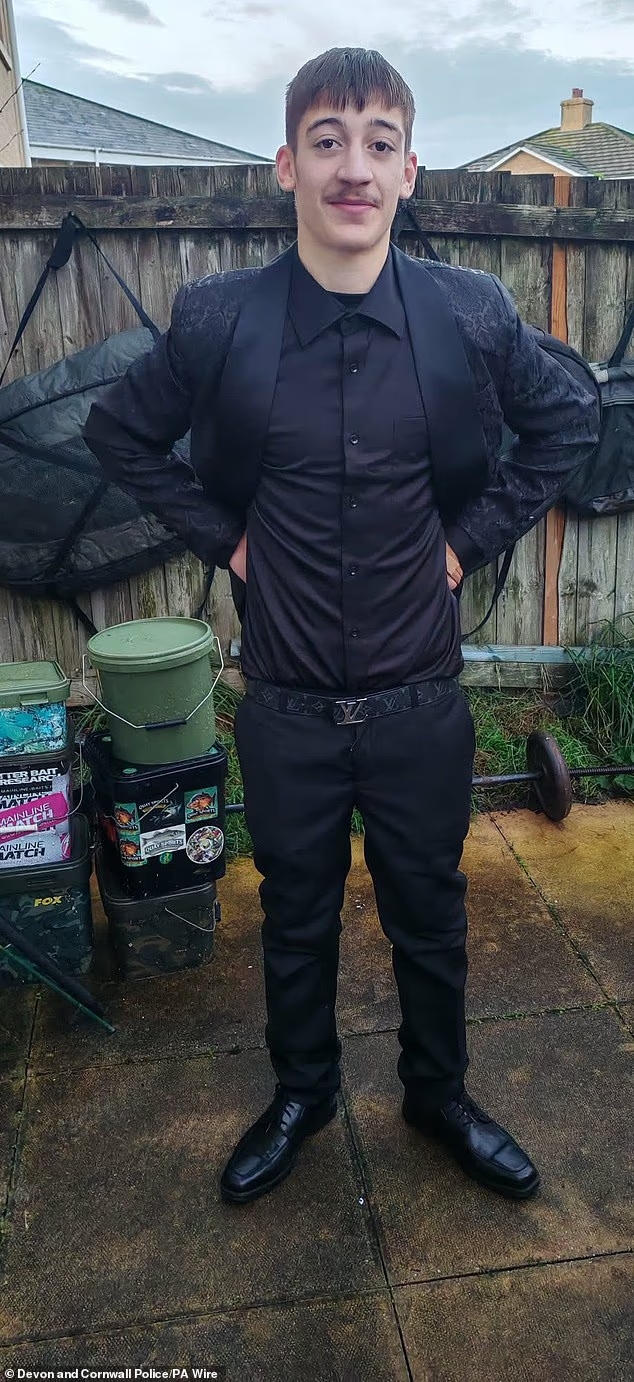
Taylor Charlton was 14 when he vanished on 8 May at around 10.30pm. He was last seen in a car park on Station Road in Barnstaple, north Devon.
His disappearance prompted a major search party, which ran until the body was pulled from the River Taw six weeks later.
The discovery came after shoes believed to belong to Taylor were discovered on consecutive days along the riverbank between Sticklepath and Bickington.
Advertisement
A series of public appeals were made, including a community search organised to coincide with what would have been the schoolboy’s 15th birthday.
In a heartfelt Facebook post at the time, loved ones wrote: ‘Today is Taylor’s 15th birthday – he isn’t spending it at home with his family.
‘He isn’t waking up to presents, he isn’t waking up to the utmost love and kindness.’
Devon and Cornwall Police have since confirmed that remains spotted and recovered from the River Taw on 24 June have been formally identified as Taylor.
Advertisement
Taylor Charlton was 14 when he vanished on 8 May at around 10.30pm. He was last seen in a car park on Station Road in Barnstaple, north Devon
Pictured is a missing poster for Devon teenager Taylor Charlton
This came after police arrested a woman in her 40s in July on suspicion of murder.
Advertisement
She is the second person to be arrested after a 20-year-old man was detained on suspicion of murder.
The pair remain on police bail while enquiries continue.
A spokesperson said this week: ‘We are extremely saddened to confirm that human remains found in the River Taw on 24 June have today been confirmed as being those of teenager Taylor Charlton from Barnstaple.
‘Taylor’s family have been updated of this development and our thoughts and condolences are with them, Taylor’s friends and the local community.
Advertisement
‘Taylor’s loved ones continue to be supported by specialist officers at this incredibly difficult and distressing time.
‘We respectfully ask that the family’s privacy is respected as they come to terms with this tragic news.’
Police said a large-scale search operation and substantial investigation was launched after Taylor was reported missing.
The force added: ‘This is not the outcome that anyone hoped for and we know how deeply this will affect the local community who have shown tremendous support throughout the search.’
Advertisement
An investigation into the circumstances surrounding Taylor’s death remains ongoing.
Taylor was 14 when he went missing but would have turned 15 in the time since he was last seen.
In a public appeal, his mother Zoe previously said she was ‘absolutely desperate’ for him to come home.
‘I love you so much and I am worried sick about you,’ she added.
Advertisement
His father Alex said: ‘Taylor is a loving, loyal and special lad and we can’t wait to have him home again.’
Police have again urged the public not to speculate or share unconfirmed information online while detectives continue their investigation.
Share or comment on this article:
Human remains found in a river confirmed to be missing teenage schoolboy
York Sport Village in Lakeside Way, Heslington said it had to close its main and small pool today (July 31) after a burst main had affected its hot water supply.
A spokesperson said: “As pool temperatures will begin to drop, it will no longer be safe for customers to use the pools.”
Recommended reading:
Advertisement
All swimming lessons have been cancelled today, along with the centre’s café.
Users have been warned that the showers in the changing rooms will also be cold, due to the lack of hot water.
The centre said it was hopeful of the hot water supply being back up and running this afternoon but confirmed this hadn’t been restored at 4.30pm.
A spokesperson said it is unknown whether the pools will be reopened this weekend.
Advertisement
They added: “We will provide a further update as soon as we have more information.
“We sincerely apologise for the inconvenience and appreciate your patience and understanding.”
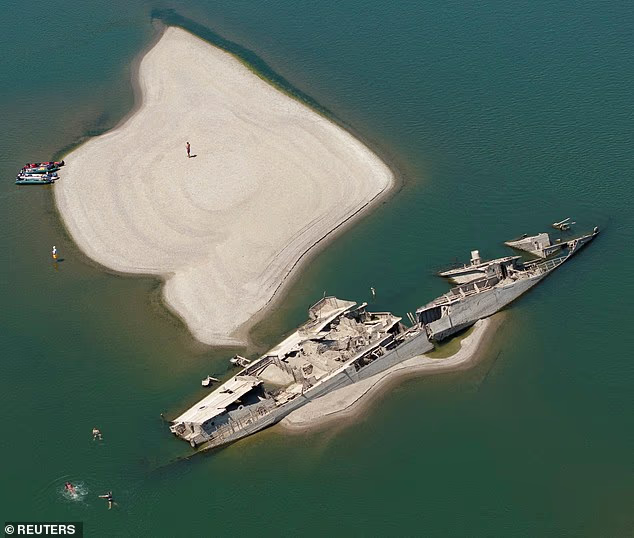
A drought sweeping Europe has uncovered a Second World War Nazi ship in the Danube River.
The German vessel was revealed after water levels in the river, located in Prahovo, Serbia, fell to record lows amid another blistering heatwave.
It is believed the German navy scuttled the boat, located in Europe’s second-largest waterway, as the crew fled the Soviet Army during the last days of the war.
An estimated 200 ships, including cargo ships and barges, sit at the bottom of the Danube, according to the European Investment Bank.
Advertisement
Boat wreckages risk blocking commercial ships moving along the river which costs Serbia approximately £4.3million per year to remove debris.
A ‘severe’ weather warning has been issued by The Republic Hydrometeorological Institute of Serbia as temperatures hit 35C (95F) and are expected to rise next week.
This comes as the Danube’s low water levels have forced Hungary’s only nuclear power plant to shut down for the first time ever next week.
The Soviet-era plant in Paks relies on the river’s water for cooling but the suction nozzles can no longer reach it.
Advertisement
A Second World War German warship has been uncovered in the Danube River due to record-low water levels
It is believed the vessel was scuttled as the crew fled the Soviet Army during the last days of the war
Hungary’s only nuclear power plant in Paks will shut down after it’s suction nozzles can not reach the Danube
Advertisement
Péter Magyar, Hungary’s Prime Minister, said the ongoing heatwave could cause the nation’s energy supply to become ‘critical’ from Monday.
The plant provides around 40 per cent of Hungary’s annual electricity generation but its operator has said the shutdown is ‘unavoidable’.
At a press conference at the plant, Mr Magyar said: ‘According to current calculations… this could happen on Tuesday or Wednesday.’
As the Danube River’s levels have fallen to the lowest in three decades, Romania has shut down one of its nuclear reactors and announced it would close a second.
Advertisement
The shutdowns are just one effect of an already record-breaking spell of hot weather, with several countries taking steps to reduce the risk of fires and ease pressure on water and energy networks.
Share or comment on this article:
Drought triggered by heatwave sweeping across Europe uncovers Nazi boat in the Danube after water levels fell
NEW YORK (AP) — A Turkish man was arrested Friday in the United Kingdom on charges alleging he conspired to funnel money and supplies to Hamas through his senior role in what prosecutors say was a sham global humanitarian organization.
Mohammad Yousef Hasna, 45, of Istanbul, was ordered held pending extradition proceedings that will occur before he can be brought to New York.
U.S. Attorney Jamie McDonald in Manhattan said Hasna worked closely with Hamas’ senior leadership to deliver supplies, food and funding to Hamas under the guise of humanitarian aid.
The United States has designated Hamas as a foreign terrorist organization.
Advertisement
It was not immediately known who would represent Hasna in the U.S.
Charges lodged against Hasna include conspiring to provide material support to Hamas, conspiring to finance terrorism and financing terrorism. Each charge carries a maximum penalty of 20 years in prison.
In a release, the U.S. government alleged that Hasna worked closely with senior Hamas leader Ghazi Hamad, a member of Hamas’ governing body, since at least 2023.
How CAN Harry moan about privacy when Meghan posts an ‘extraordinary’ amount of pictures from their secret family holiday? REBECCA ENGLISH bristles at Sussexes’ ‘hypocrisy’ – including ‘exploitative’ image appearing to show Archie visiting Diana’s grave
On the latest episode of the Daily Mail’s Palace Confidential, Rebecca English and Richard Eden discuss the ‘extraordinary’ flood of images Meghan posted to Instagram from the Sussexes’ supposedly private family holiday.
This month Harry, Meghan, Archie and Lilibet travelled across the Atlantic to spend time in Portugal and Britain. Meghan and the children were in the UK for just 24 hours, travelling to Highgrove for a landmark family reunion with King Charles.
The trip appeared to be a private affair, with the location of the couple’s rumoured holiday home in Portugal undisclosed and Buckingham Palace only announcing the family’s visit to Britain after Meghan and the children had departed.
However, last week Meghan posted a flood of photographs to Instagram from the trip, including images from near the couple’s rumoured Portugal hideaway. Most strikingly, one picture appears to show Harry and Archie walking with flowers towards Princess Diana‘s island grave at Althorp, the Spencer family’s ancestral home in Northamptonshire.
Advertisement
On Palace Confidential , Rebecca English and Richard Eden discuss the ‘extraordinary’ flood of images Meghan posted to Instagram from the Sussexes’ supposedly private family holiday
Last week Meghan posted a flood of photographs to Instagram from the trip, including images from near the couple’s rumoured Portugal hideaway
Royal editor English expressed astonishment at the decision to post the photographs, arguing it was ‘hypocritical’ given Harry’s repeated complaints about privacy and media intrusion
Advertisement
Royal editor English expressed astonishment at the decision to post the photographs, arguing it was ‘hypocritical’ given Harry’s repeated complaints about privacy and media intrusion.
‘Look, it’s up to people individually what they choose to share online. I don’t share anything with my family. That’s my choice. But what I find extraordinary about this is that Harry has long complained about the exploitation of his mother’s memory.
‘I think to allow those pictures of such a personal moment to be published like that, I personally found it quite hypocritical. I think people would say that in itself is exploitative.’
Meghan’s post included 12 intimate family photographs, captioned simply: ‘Summer Holiday’.
Diary editor Eden agreed with his co-host, arguing the images were made worse by the fact that Meghan’s Instagram account exists explicitly to promote her lifestyle brand, As Ever.
Advertisement
‘It’s an entirely commercial venture,’ he claimed. ‘You’re not sharing these photos with friends.
One picture appears to show Harry and Archie walking with flowers towards Princess Diana’s island grave at Althorp, the Spencer family’s ancestral home in Northamptonshire
‘I found them quite strange, the Althorp pictures particularly because it’s a combination of showing the backs of the children – not giving away their full identities – but then you’re revealing they’re going to lay flowers at the grave of their grandmother for the first time.
‘That’s a very intimate, personal moment, isn’t it? Being recorded and shared. Even as you’re going there: someone must have been like, ‘stop, I have got to take a picture.”
Advertisement
Catch the debate in full by subscribing to Palace Confidential on YouTube.
Share or comment on this article:
How CAN Harry moan about privacy when Meghan posts an ‘extraordinary’ amount of pictures from their secret family holiday? REBECCA ENGLISH bristles at Sussexes’ ‘hypocrisy’ – including ‘exploitative’ image appearing to show Archie visiting Diana’s grave
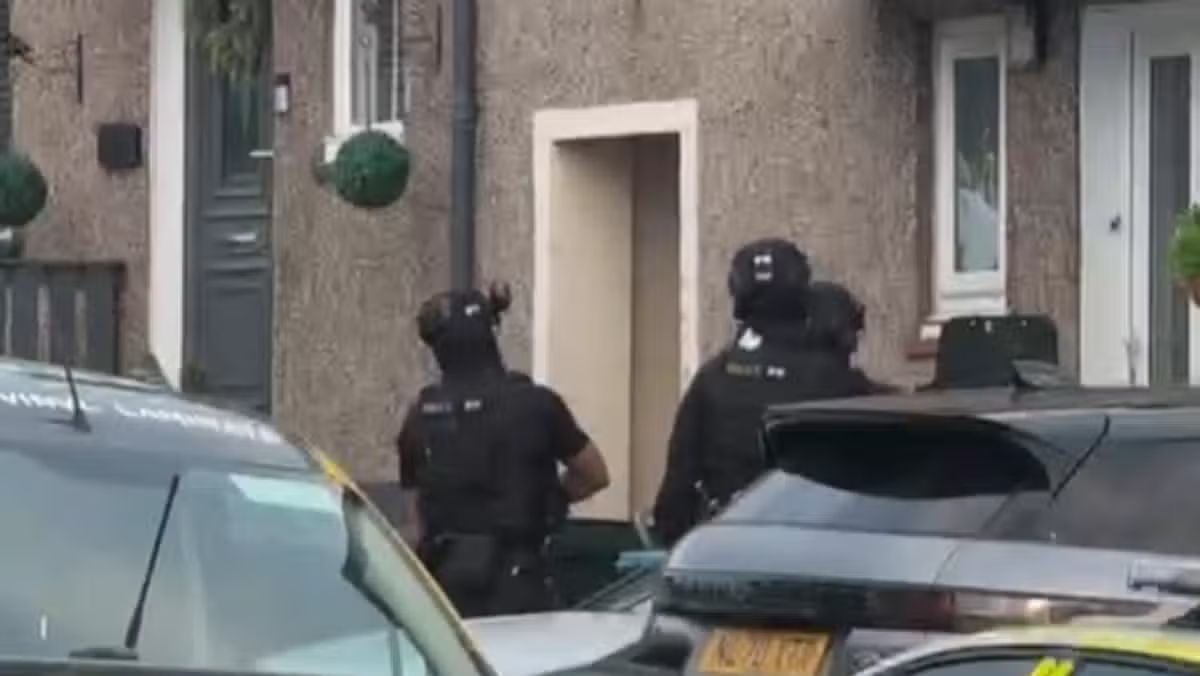
A major incident has erupted in the town this evening with armed police officers seen at the door of a property.
Armed police have swooped on a home in Ayrshire amid an ongoing incident this evening.
Advertisement
The alarm was raised around 7.30pm when officers were alerted to an incident on Dean Road in Kilmarnock. Emergency services, including Police Scotland and Scottish Fire and Rescue Service, raced to the scene.
The fire service sent two appliances and confirmed to the Record they remain in attendance alongside cops. The nature of the incident, as well as how many people are involved, remains unknown.
Footage taken at the scene shows a major emergency response in the street, which has been locked down. The area has been taped off while uniformed officers stand guard.
Dozens of marked police vans and blue-lit fire engines can be seen on the road. Firefighters in full gear appear to be digging or investigating a hole in the road.
Worried residents and onlookers can be seen gathering in numbers while the scene unfolds. The fire service confirmed their attendance to support police but had no details regarding injuries.
Police Scotland and Scottish Ambulance Service have been contacted for comment.
We’ll be bringing you the very latest updates, pictures and video on this breaking news story.
A 4.7 magnitude earthquake has struck the Naples region, centred on Pozzuoli in the Campi Flegrei volcanic zone
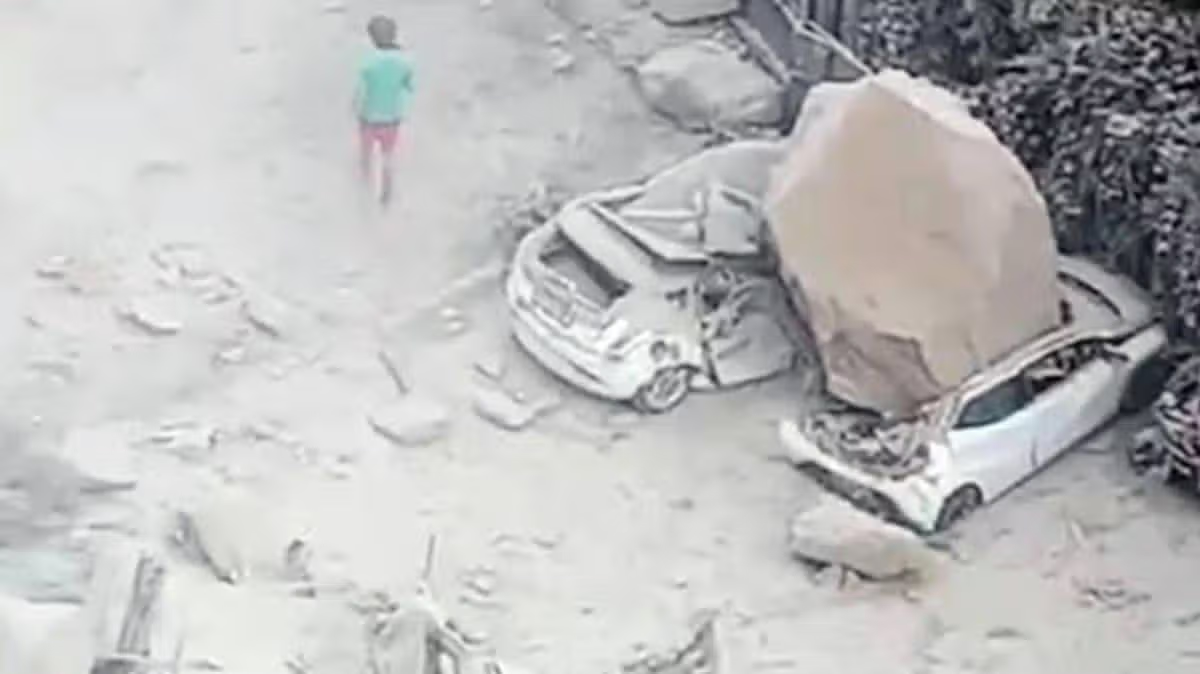
A major earthquake has rocked the Naples area, forcing terrified locals out onto the streets as buildings trembled throughout the Campi Flegrei volcanic region.
The 4.7-magnitude quake, among the strongest to hit the area in 40 years, struck at Pozzuoli, a community well-versed in seismic activity but seldom subjected to tremors of such ferocity.
Advertisement
Footage circulated by residents reveals streets strewn with rubble and chunks of stonework ripped from building fronts, while extensive electricity outages have left numerous districts without power. Authorities confirm at least four people have been injured, with the shaking experienced throughout Naples, Pozzuoli and neighbouring communities, the Express reports.
“I understand the concern and apprehension that can arise in these moments, especially among families. We immediately activated the Municipal Operations Center (COC) to coordinate all monitoring and assistance activities for the population,” said Pozzuoli mayor, Luigi Manzoni.
“We are in constant contact with the Vesuvius Observatory, the Civil Protection Department, and all the competent authorities to follow the evolution of the ongoing seismic swarm minute by minute.”
Advertisement
Further tremors of lesser strength are believed to have been detected. The National Institute of Geology and Volcanology reports that Campi Flegrei, an enormous super volcano situated close to Naples, Italy, has been undergoing an extended phase of instability marked by repeated earthquake clusters and substantial ground elevation, known as bradyseism.
From 2005 to today, a new phase of bradyseism has been underway which in April 2025 produced an uplift of about 144 centimeters, the INGV also said.
Content cannot be displayed without consent
Ensure our latest stories always appear at the top of your Google Search by making us a Preferred Source. Click here to activate or add us as your Preferred Source in your Google search settings.
“To that end, while Burnham’s proposal to allow locally funded projects worth up to £500million is welcome, London’s infrastructure needs exceed this threshold. Even projects deemed relatively ‘cheap’ for the capital, such as the West London Orbital, are projected to need funding of at least double this figure.






















































You must be logged in to post a comment Login