

Connect with us
DAPA Banner

NewsBeat

The one drink you should always order from a restaurant wine list

Published

on

The one drink you should always order from a restaurant wine list
If you see this on a wine list, order it (Picture: Getty Images)

If you can say the name of a wine without stuttering, don’t order it.  

Sure, we can all pronounce Sauvignon Blanc, Sancerre, Chablis, Côtes du Rhône and Malbec, but be warned, the ones that roll off the tongue come with the addition of a ‘pronunciation tax’.

And because it’s even easier to say ‘second wine down, please’, those come with an ‘idiot tax’ slapped on, that 80% of diners don’t know they’re paying.

If you want to drink like an insider, there’s one hack to follow, the experts say, that works every time and will ensure you’re sipping the highest quality wine for the least amount of money.

Advertisement

The trick is simply to order the drink you can’t pronounce.

Girlfriends toasting with white wine in restaurant.
If you’re picking a popular wine, you’re likely paying a little more (Picture: Getty Images)

Why it’s a good idea to go for a wine you can’t pronounce

Not many people know this, but there are certain wines on the menu that the sommelier or restaurant owner personally likes.

They squirrel them away, in nooks around the wine list. These are the bottles the staff would actually drink themselves.

These will be wines made from grapes with names that are extremely tricky to pronounce, like Agiorgitiko, Nerello Mascalese or Xinomavro.

See? They’re hard to get your mouth around.

Advertisement

And the best bit? The margins on the unpronounceable wines are significantly lower and provide incredible value for money. They aggressively mark them down in price to keep the stock moving.

You could say, they’re passion project wines, made from more unusual grapes, which sommeliers or restaurant owners put on their list because they make them tick. Many are under-the-radar wines, which they’ve found on a buying trip or a tasting that they simply had to put on the list, despite being a far harder sell.

Elegant unrecognizable restaurant bar interior
Be sure to speak to the sommelier at a swanky restaurant (Picture: Getty Images)

Maxim Kassir, Head of Wine at The Aubrey at Mandarin Oriental Hotel in London, confirms that the less familiar wines on the list are the better value choice.

Hey, foodies! Add us as a Preferred Source

At Metro Food, we’re here to bring you all the latest foodie news, delicious recipes, restaurant reviews, and cooking tips. As a loyal reader and a part of our vibrant community, we want to make sure you never miss our articles when searching for stories

Click the button below and tick Metro.co.uk to ensure you see stories from us first in Google Search.

Advertisement

Add us as a Preferred Source

From the latest Walkers flavours to the secret McDonald’s menu, Metro Food has it all

He tells Metro: ‘Naturally, the demand for famous names is higher. Most guests prefer to stay on the beaten path. And as demand increases, so does the price – simple economics.

‘Wines off the beaten path can offer great value for money. They are often the underdogs, but that’s exactly where the opportunity is. 

Advertisement

‘If guests can describe their preferences and are open to trying something different, sommeliers will always have a few cards up their sleeve.’

He continues: ‘Personally, I look for wines made from indigenous grape varieties rather than international ones. Who needs another Chardonnay from Abruzzo? I’d rather go for Pecorino.’

A waiter is pouring prosecco into glasses at the restaurant
Skip the prosecco and pick an underdog drink (Picture: Getty Images)

The wines to avoid

The wines that keep the restaurant’s lights on are the likes of Sauvignon Blanc, Prosecco, Merlot, Pinot Grigio, you get the picture.

For example, at the Ivy Brasserie, a bottle of Touriga Nacional from Portugal is £47.85 a bottle, while the Argentinian Malbec starts at £57. Both bottles retail for similar prices in stores.

That’s because the popular wines work on a standard gross profit margin of 75% GP, minimum. Often 85% at swanky London restaurants. This means that a New Zealand Sauvignon Blanc, that cost the restaurant £8 a bottle, can be found on a wine list for £55.

Advertisement

Equally, to encourage people to taste Mencia from Spain or Austrian Zweigelt, restaurants often drop their margins to 50-60%. So, you may end up paying £30 for a bottle that costs the restaurant £15, which doubles the quality in your glass for basically half the price.

Meanwhile, the second ‘cheapest’ on the list is a trap, as it’s often the most profitable wine for the restaurant. It’s no secret that these are prime fodder for people who don’t want to opt for the house wine for fear of appearing tightfisted.  

What to do if you can’t afford the wine you can’t pronounce?

Go for another wine you can’t pronounce, that’s cheaper.

There’s always one that’s cheaper.

Advertisement

And if you don’t want to wade through pages of a wine list, call over the sommelier or waiter and point to the sort of price you’re able to pay and say: ‘Do you have anything really unusual for that price? I like a Pinot Noir in style.’

With that in mind, if you want to dodge the ‘pronunciation tax’ this year, look for these grapes, which are the ones being championed by UK sommeliers and restaurant owners.

And just remember, if you have to point at the wine list because you’re afraid of mangling the name, you’ve made the right choice.

Do you take suggestions from a sommelier at restaurants?

  • I ususally just order the same thingCheck

    Advertisement
  • I’m too nervous to speak to themCheck

Unique wines to look out for on restaurant menus

Assrytiko (ass-ear-tea-koh)

If you like Chablis (but not the strain on your wallet) and other uber-dry, clean and zesty whites, this is for you. It’s grown in mainland Greece and Santorini, and has a touch of salinity thanks to the volcanic soil.

Advertisement

Grüner Veltliner (groo-na-velt-leena)

For anyone who’s developed Sauvignon Blanc-fatigue and wants to try something similar, but different. Often called Gru-Vee, this is Austria’s flagship white, and gives a naughty lick of white pepper on the finish.

Godello (go-day-yo)

Albariño’s neighbour in northern Spain, but nowhere near as well-known. It’s the sommelier’s secret weapon, zesty in its youth and leaning more towards a richer White Burgundy with a bit of age, and a fraction of the price tag.

Xinomavro (Zeen-oh-mav-roh)

Greece’s signature red grape produces wines not dissimilar in style to Barolo, minus the money drain. It translates as ‘sour and black’, and it’s grown extensively in Macedonia.

Touriga Nacional (tour-eeger-nass-eeon-al)

Portugal’s flagship red grape and the backbone grape of Port. In its non-Port form, the wines are slightly Cabernet-like, with a bergamot note, like it’s been dunked with an Earl Grey teabag. I mean that in a good way.

Advertisement

Frappato (Fra-pat-oh)

Like a bit of Beaujolais? Give Frappato from Sicily a chance. Similar softness, fruitiness and lack of mouth-drying tannins. It’s chillable too, so be sure to show it the fridge for 20 minutes before quaffing.

And Maxim also has a few thoughts on wine to keep an eye out for on the menu.

He adds: ‘People should make a beeline for Slovenian Rebula (complex, savoury, mineral-driven), Feteasca Alba from Moldova (light and fresh with ripe stone fruit flavours), and Saperavi from Georgia (structured, full-bodied wines with lots of black fruit).’

Do you have a story to share?

Advertisement

Get in touch by emailing MetroLifestyleTeam@Metro.co.uk.

Advertisement
Advertisement

Source link

Continue Reading
Click to comment

You must be logged in to post a comment Login

Leave a Reply

NewsBeat

‘Plaid Cymru may be too optimistic but at least it understands the question’

Published

on

Wales Online

Columnist Dylan Jones Evans argues that Plaid Cymru is trying to address the right questions. But that does not mean the party’s plan will work

So, to the final assessment of the political parties’ plans for the Welsh economy, and it would be fair to say that Plaid Cymru’s manifesto is the most detailed document produced in this Senedd election.

Advertisement

That does not mean that every proposal within it is convincing, but it is attempting to build a recognisable economic philosophy around a simple question that Welsh politics has avoided: not just how much economic activity takes place in Wales, but who benefits from it, and how much of the value generated here actually stays here.

Plaid argues that Wales has plenty of economic capability, but that too much of its economy remains externally owned, too much profit leaks out, and too much of its policy focuses on managing symptoms rather than building long-term strength. Its answer is a more interventionist and more explicitly development-oriented model, built around more strategic public investment, more active use of procurement, and an institutional framework designed to support business growth in ways that reinforce Welsh communities rather than bypass them.

Read Dylan’s assessments of the Tory manifesto, the Labour manifesto and the Lib Dem and Green manifestos

At the centre of this sits the proposal for a new business-led National Development Agency for Wales that can provide a clearer front door for business support, promote Wales internationally, and coordinate regional economic development in a way that Whitehall-style departmentalism and Cardiff Bay fragmentation have often failed to do. In this respect, Plaid is right to recognise that economic development in Wales has too often lacked institutional clarity and sustained focus, although any new body should not be just another rehash of the Welsh Development Agency, as some have suggested.

Advertisement

Plaid is also right to signal that the Development Bank of Wales needs reform because, despite its rhetoric, there is a growing sense that it is not yet performing to the level Wales needs. If Plaid is serious about creating more indigenous growth, stronger supply chains and better-paid jobs, then a review of the bank has to ask harder questions about whether its products are fit for purpose, whether it is taking enough strategic risk, and whether it is genuinely helping to reshape the structure of the Welsh economy rather than simply supporting activity at the margins.

There is a seriousness to the manifesto’s treatment of procurement. Welsh public bodies spend more than £8 billion each year on goods and services, and Plaid wants a much larger share of that spend retained within Wales, from around 55 per cent to at least 70 per cent. That is not a marginal adjustment but a deliberate attempt to use the public pound to strengthen Welsh firms and build capacity in local supply chains.

One can debate whether the target is achievable and whether it will create as many jobs as claimed, but the underlying instinct is sound, as public procurement in Wales has, for too long, been discussed as an administrative function rather than a strategic economic tool.

The proposal for a comprehensive national skills audit is not particularly glamorous, but employers, colleges, schools and training providers have all complained for years that there is insufficient clarity about future skills demand, too much fragmentation in provision, and too little alignment between policy and labour market needs.

Advertisement

The attempt to connect skills, apprenticeships, vocational routes and economic opportunity is sensible, especially when linked to sectors such as renewables, digital technology, medtech, agritech and the creative industries.

On digital and connectivity, there is support for superfast broadband rollout to the rest of Wales, for the semiconductor cluster in South Wales, for digital innovation, and for more coherent transport planning linked to wider economic development.

With regard to rail, they make the case that Wales has been chronically short-changed, particularly in relation to HS2 and wider infrastructure classifications, but (and excuse the pun) the train has probably left the station on this particular issue, and the UK Government is unlikely to change its mind.

The manifesto is less convincing in its assumptions about what follows from it. At times, Plaid seems to believe that if Wales had the right institutions, stronger tax powers and a fairer funding settlement, a stronger economy would naturally emerge.

Advertisement

Yes, Wales has been held back by weak tools, poor institutional design and a settlement that often leaves it underpowered, but stronger institutions are not, in themselves, a substitute for a stronger economy, nor do they automatically solve the harder questions around export intensity, business scale-up, and commercial competitiveness.

Indeed, focusing on structure rather than strategy is one of the most common mistakes that governments make in their approach to economic development and as I’ve said so many times in the past, entrepreneurship, innovation and productivity must be the beating heart of Wales’s future economic direction.

There is also, inevitably, a degree of political optimism embedded in the document and in proposals such as a Wales Wealth Fund, greater use of pension assets for local investment, and deeper fiscal reform. Each depends on institutional capacity, political leverage and execution that should never be assumed, especially given the weakness of a civil service that has served one party for over a quarter of a century.

Even so, it can be argued that Plaid Cymru has produced a manifesto that seeks to grapple with the drawbacks of the Welsh economy. Whether you agree with it or not, at least it understands that the question is not merely how to attract more activity, but how to build an economy that is more rooted and beneficial to the people who live here.

Advertisement

Of course, that does not answer the question, and there will be much more to do if they form a government, but it could present a serious economic offer that is long overdue, although that may also depend on the person they appoint as the economy minister. Certainly, that individual should be totally committed to developing the massive potential within our private sector here in Wales. If not, as we have seen too many times since the start of devolution, the good intentions in this manifesto may lead to nothing.
Source link

Continue Reading

NewsBeat

Armed groups launch coordinated attacks across Mali

Published

on

Armed groups launch coordinated attacks across Mali

The UK’s foreign office has advised against all travel to Mali following the attacks, adding that Bamako International Airport is temporarily closed. Meanwhile, the US Embassy there has told citizens to shelter in place and avoid travel, citing explosions and gunfire around the airport and near Kati.

Source link

Continue Reading

NewsBeat

Why a century-old naval disaster means Trump can’t take the Strait of Hormuz by force

Published

on

Why a century-old naval disaster means Trump can’t take the Strait of Hormuz by force

Why has nothing been done to reopen the Strait of Hormuz?

The answer is simple – as his advisers will have told Donald Trump before he attacked Iran, it is almost impossible to clear a passage through a minefield when the shoreline is held by the enemy, without being prepared to take significant casualties. And this, it seems, the US is not prepared to do.

It is one thing to bomb a less technologically sophisticated enemy from the air, but quite another to get involved in a real fight at sea level with an opponent who has been planning this form of asymmetric warfare for a very long time.

History gives a stark lesson on why America needs to tread warily – a page from the First World War.

Advertisement

It was March 1915. The “straits” concerned were the Dardanelles – the narrow passage linking the Mediterranean to the Black Sea and giving access to Istanbul. The Turks were the defenders, the British and the French the attackers.

They were in the middle of a shooting war. A vital waterway, which would normally be open for the world’s commerce, was closed because of the actions of Turkey, the bordering power. The coastline was heavily defended, and there was a high probability that mines had been laid to block the channel.

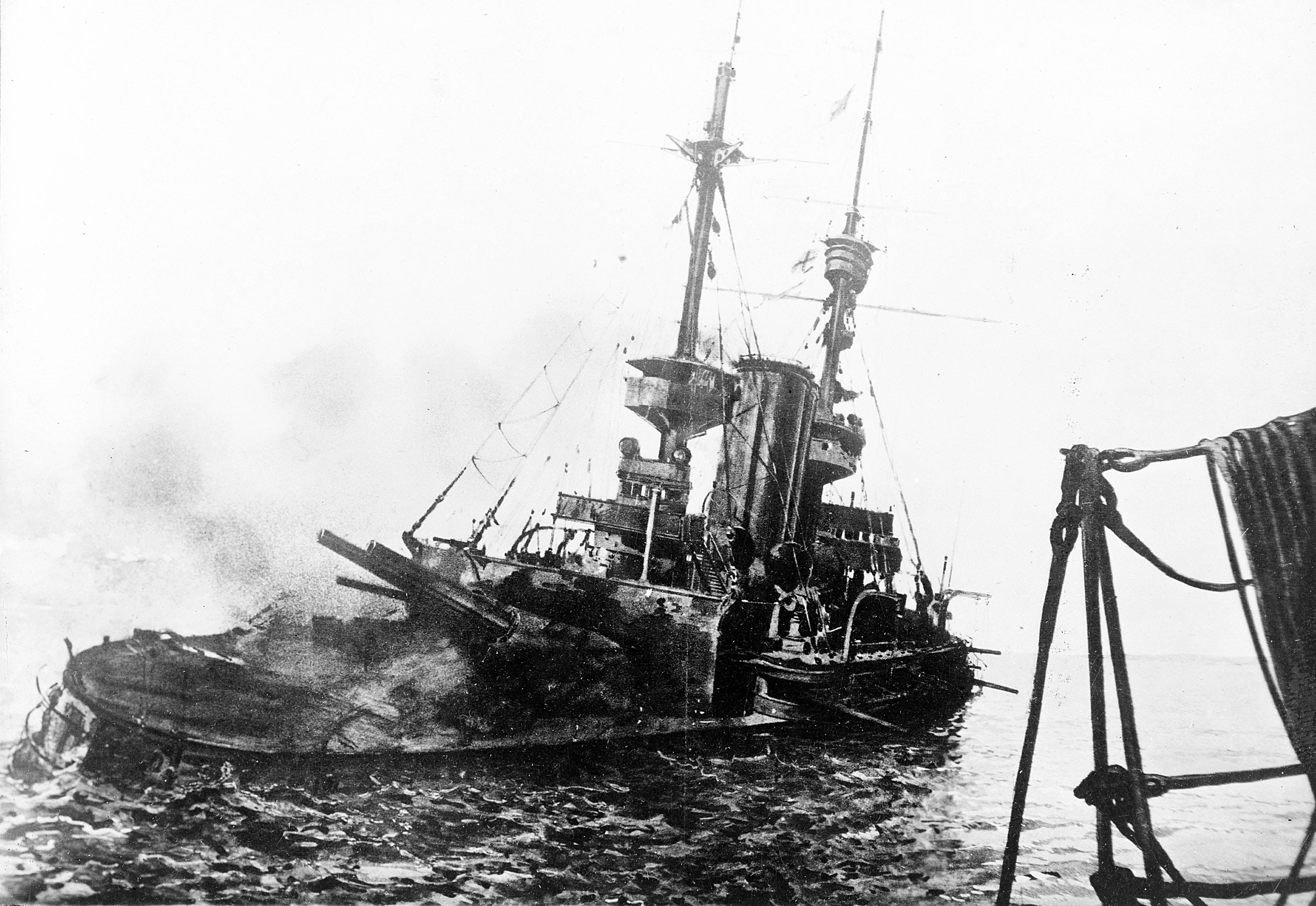
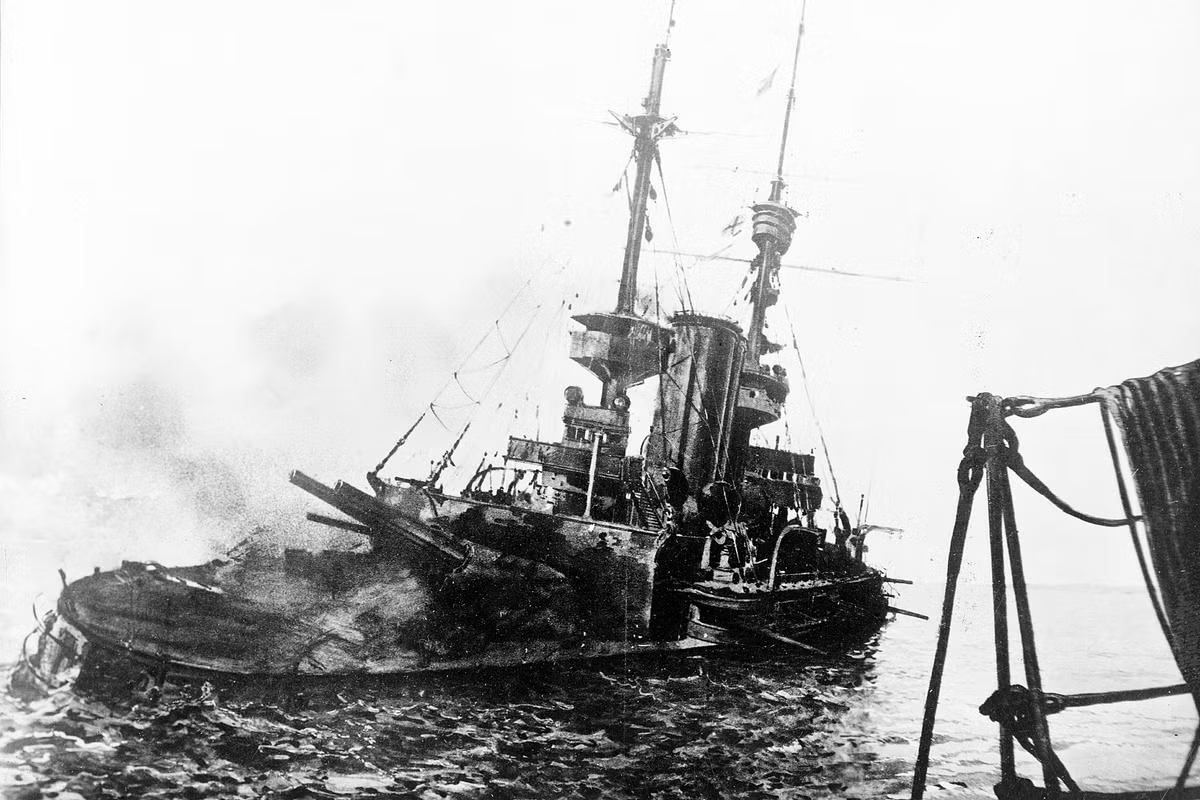
HMS Irresistible, abandoned in the Dardanelles, in northern Turkey, on 18 March 1915. She hit two mines, the second of which destroyed her main engines, and 600 men had to be rescued
HMS Irresistible, abandoned in the Dardanelles, in northern Turkey, on 18 March 1915. She hit two mines, the second of which destroyed her main engines, and 600 men had to be rescued (Library of Congress/Royal Navy)

A decision was made by the British and French that the straits were to be reopened by force – and a very considerable force was assembled for that purpose.

It comprised no fewer than 14 “capital” ships (in those days “battleships” and “battlecruisers”) supported by escorts and a large force of minesweepers.

The plan was a good one. The capital ships would stand off in clear water and bombard the shore defences. When these had been silenced, the minesweepers would go ahead and sweep another clear area.

Advertisement

The capital ships would then move forward again into swept water and recommence their bombardment – successive waves of big ships moving up, but always into water which had been swept for mines. In this way, the whole channel would be cleared, and the straits reopened.

The big push commenced on 18 March 1915. To start with, it all went well. Four capital ships – HM ships Queen Elizabeth, Agamemnon, Lord Nelson and Inflexible – formed the first attacking line.

The second line was composed of four French ships, Gaulois, Charlemagne, Bouvet and Suffren. They, in turn, were to be supported by six more British ships – HM ships Ocean, Irresistible, Albion, Vengeance, Swiftsure and Majestic – which would form a third line to pass through and relieve the French in line two.

Advertisement

The bombardment was started by the RN ships in line one at 11am. By 12.20pm, the French ships of line two had steamed through the first line to take up their advanced positions.

By 1.45pm, the fire from the shore batteries had slackened under the onslaught of the guns of the eight capital ships, and it was deemed safe enough to send in the minesweepers for the next phase. The third line of six ships was also called up to move the force forward.

However, 15 minutes later, everything started to go wrong. FS Bouvet hit a mine, and in a matter of minutes, she capsized and sank. There were only 75 survivors out of a ship’s company of 718.

The action continued. HMS Irresistible of the third wave was bombarding the forts when she, in turn, struck a mine at 3.14pm. She developed a severe list but continued with the action until she hit another mine, and her main engines were put out of action completely.

Advertisement

An attempt was made to take her in tow, but the situation was hopeless, and the order was given to abandon ship. More than 600 men were taken to safety.

Meanwhile, shortly after 4pm, HMS Inflexible struck a mine. She remained capable of steaming slowly and was ordered to withdraw. However, she had a 30ft x 26ft hole below the waterline and had to be beached to save her from sinking. She was later towed to Malta for repairs and was out of action for three months.

A Royal Navy cruiser painted in dazzle camouflage in the Dardanelles, 1915
A Royal Navy cruiser painted in dazzle camouflage in the Dardanelles, 1915 (Getty)

After these disasters, Vice-Admiral John de Robeck, the British admiral in charge of the Allied naval forces during the crucial stages of the campaign, finally decided that the waters which had been considered to be safe and swept of mines were anything but.

Accordingly, at 5.50pm, less than seven hours into the operation, he signalled a “General Recall” to withdraw the ships and return to the safe waters outside the straits.

Fifteen minutes later, at 6.05pm, HMS Ocean struck another mine, developed a major list and was deemed not to be capable of being saved. The ship’s company were taken off and she was left to her fate. Both Irresistible and Ocean later sank.

Advertisement

Fourteen major warships had attempted to force the straits. Within four hours, three of them had been sunk and one had been so badly damaged that she was out of action.

This one day of disaster was the end of trying to take the Dardanelles passage by solely naval means. The attempt was never repeated.

USS Abraham Lincoln conducts US blockade operations related to the Strait of Hormuz on 16 April 2026, in the Arabian Sea
USS Abraham Lincoln conducts US blockade operations related to the Strait of Hormuz on 16 April 2026, in the Arabian Sea (US Navy)

From that day on, the focus shifted to “boots on the ground” to conquer the Turks on land – but as is well known, this likewise failed.

A relatively weak opponent had defeated the combined forces of the two largest navies in the world by its use of asymmetric warfare and, most importantly, by the deployment of mines.

A lesson for our times, Mr President.

Advertisement

John Clark is a former Royal Naval Reserve officer who commanded various minesweepers and minehunters during his service

Source link

Continue Reading

NewsBeat

Heaton Fold Garden Centre’s first artisan market of the year returns

Published

on

Heaton Fold Garden Centre's first artisan market of the year returns

Heaton Fold Garden Centre will welcome back traders, selling an amazing of array of wares.

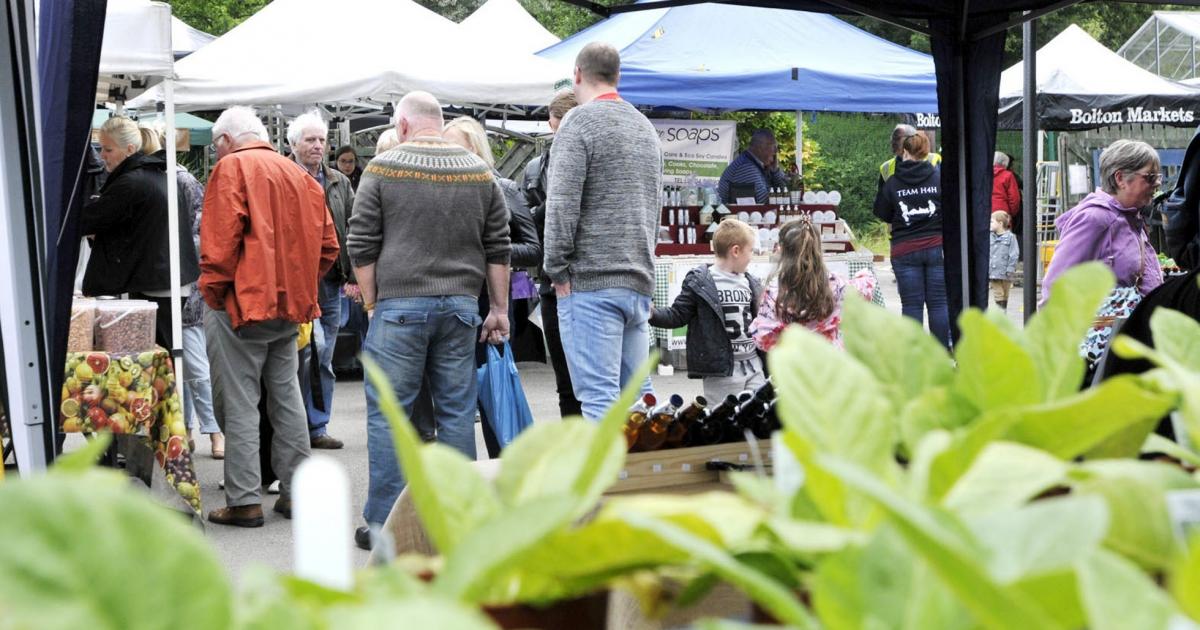
Stall owners brave the rain at Heaton Fold Garden Centre Image: VQ

Visitors can pick up handmade goods and home-cooked food while picking up bits and pieces for the garden.

And they can enjoy listening to the stories behind the goods.

Abbie Howard, from Heaton Fold Garden Centre, told The Bolton News: “We have got some of the regular stall holders from last year and we have still time to attract new and different stalls.”

Advertisement

Usually sold at the markets is jewellery, knitted items, cosmetics, pens and other handmade unique finds.

The first of the stallholders to come forward is Magari’s, which have a selection of Sourdough bread and other bakes.

A popular feature is a display from Lancashire Hawks & Owls, which was a“massive hit” last time.

Lancashire Hawks & Owls take in rescued birds of prey like falcons and owls to rehabilitate them.

Advertisement

Stall owners brave the rain at Heaton Fold Garden Centre Image: VQ

Returning to the markets once again is That Silver Touch with jewellery and MadGirl Makes with candles and wax melts.

The market runs from 10am to 3pm, with the last market taking place in December last year.

Artisan market dates are April 26, May 24, June 28, July 26, August 23, September 27, October 25, November 22 and December 13.

In a statement Heaton Fold Garden Centre said: “Come and join us as we welcome back an amazing roster of bakers, do-ers and crafters to celebrate all that Bolton has to offer; a truly talented bunch of people, and with free entry and parking, you wont want to miss it!

Advertisement

“Hot food and drink are available to buy both at the market and at our on-site Cafe. Whether you fancy a cheese and onion pie, or a bacon barm, we’ve got you covered.”

Source link

Advertisement
Continue Reading

NewsBeat

Change to West Lothian rent collection process could be on the way

Published

on

Daily Record

The report to the Housing Services Policy Development and Scrutiny Panel came in response to a composite motion by the full council earlier this year.

A change in the way council rent is collected could be on the way as housing officers tackle growing rent arrears.

Advertisement

Housing officers described a range of early intervention measures they use to help tenants stay in their homes and manage debts at a time when many are facing increasing costs.

However the council has still had to evict 45 tenants in the last year, a move which costs the council £800 a time- £36,000 in the last year- on top of the lost rent.

The report to the Housing Services Policy Development and Scrutiny Panel came in response to a composite motion by the full council earlier this year.

READ MORE: Girls at West Lothian school establish clothing bank with touch of class

Advertisement

With the current rent arrears figure sitting at more than £4m across the county, councillors called for action.

Council rents have historically been collected over 48 weeks of the year with two weeks “off” over Christmas and at the end of the financial year in March.

West Lothian currently has 14,367 tenancies with an average rent of £95.42 a week. 864 new tenancies were added in the last year.

Housing officers told the committee changes to rent collection could be made when the new five year collection strategy comes into effect beyond 2027.

Advertisement

The council motion suggested making rent collectible over 52 rather than 48 weeks; “could make payment of rent more affordable for the most vulnerable or who are facing deepening financial pressure.”

READ MORE: Bathgate & Linlithgow MP praises work of animal campaign after visit

In the meeting Councillor Tony Boyle suggested it would work better because it would align with Universal Credit payments.

A senior housing officer Alison Smith told the meeting the 48 week collection model has been in place “for all the time I have been in post and longer. I think it is something that the council could look at as part of a new strategy.”

Advertisement

She added that regular updates on rent collection would be made to the local area committees as well as the Housing Services PDSP.

Rent collection remains well above 90% across the nine council wards of West Lothian.

Officers outlined early intervention with tenants was key to the collection strategy along with engagement with tenants from the day they take up their tenancy.

READ MORE: Livingston Designer Outlet set to host major four day discount event

Advertisement

Alongside regular contact with tenants and weekly monitoring of rental income to highlight potential problems housing officers also work with tenants to direct them to agencies such as the council Advice Shops for help with finances and benefits.

Officers stressed that their goal was to keep tenants in their homes. The worst cases which end with eviction come only after tenants refuse to engage with staff or attempt to pay rents.

A housing manager Phyllis McFadden said progress to eviction could take four to five months. She added that there “was no one size fits all solution” and that each eviction case was “ complex and challenging”.

Chair of the committee Councillor George Paul thanked officers for the report and praised the work done by teams across the county to ensure rent collection.

Advertisement

Councillor Paul: “ For me eviction is the last thing I ever want to see,it is a costly process and a time consuming process for officers to get an eviction case to the courts.”

READ MORE: West Lothian charity calls on businesses to join fight against loneliness

Councillors across the political divide thanked the housing staff for their work. Councillor Pauline Orr (SNP) said: “I was one of the councillors that brought the composite motion. I just want to thank the officers for bringing the report today. It is very very detailed and very concise. There’s a lot of important information today and I understand the very difficult and challenging circumstances and that it’s not an easy job to do and at times incredibly frustrating and upsetting for officers.”

Conservative councillor Alison Adamson said; “We do appreciate the work you guys are doing. The rent collection that has taken place has always been consistently high.

Advertisement

“That’s why I get so frustrated when I hear comments about housing officers not doing enough to collect rent. This is a very concise, well presented report. Thank you very much for all the work you have done to put this work together.”

READ MORE: Families come together in Livingston to celebrate Tamil New Year

Don’t miss the latest news from the West Lothian Courier. Sign up to our free newsletter here.

Source link

Advertisement
Continue Reading

NewsBeat

Details on events happening at Belfast Book Festival 2026

Published

on

Belfast Live

The festival will run at the Crescent Arts Centre from June 4-11

Belfast Book Festival is back with a host of events bringing together the best in poetry, fiction and talks from big names such as Jan Carson and comedian Sara Pascoe.

Advertisement

This is the festival’s 16th year and it is set to run its events at the Crescent Arts Centre once again, from June 4-11. This year sees an ambitious billing of poetry, fiction, workshops and lively discussions.

The literary line-up includes Jan Carson, Andrea Carter, Sara Pascoe, Neil Jordan, Sarah Moss, Neil Hegarty, Doireann Ní Ghríofa, Katriona O’Sullivan, Nussaibah Younis, Patrick Radden Keefe, Martin Doyle, Miriam O’Callaghan, Stephen Daly, Anne Enright, Will Storr, Mícheál McCann, Rónán Hession, Wendy Erskine, Sínead Morrissey, Forrest Issac Jones and many more.

With a spotlight on Belfast, a special event with Belfast-born writer Bernard MacLaverty celebrates his work for page and screen, whilst writers Wendy Erskine and Phil Harrison join photographer Tolu Ogunware to explore contemporary Belfast through fiction and visual storytelling.

READ MORE: Diona Doherty to lead new comedy series Committed currently filming in Northern IrelandREAD MORE: The two Northern Irish spots named as ‘top trending’ summer destinations by Tripadvisor

Advertisement

In partnership with The National Year of Reading, four NI YA authors – Jenny Ireland, Stephen Daly, Kelly McCaughrain and Sue Divin celebrate new book releases and a special screening of Nostalgie, Kathryn Ferguson’s award-winning adaptation of Wendy Erskine’s short story set in NI will be supported by a Q&A.

The festival also celebrates the gothic and dystopian with Director of Interview with the Vampire and The Butcher Boy, Neil Jordan discussing his new literary sci-fi novel, The Library of Traumatic Memory, and Jan Carson shares her new dystopic novel Few and Far Between. Carson will also be in conversation with author Henrietta McKervey on her new gothic novel The Woman in the Water, inspired by Daphne du Maurier’s Rebecca.

Further programme highlights include comedian and writer, Sara Pascoe and her novel Weirdo, a tragicomic story of a young woman navigating life while battling her inner-monologue. Journalist Aimee Donnellan presents Off the Scales, an inside look at Ozempic and Katriona O’Sullivan discusses Hungry, a raw exploration of hunger, trauma, and women’s collective search for self-acceptance.

Broadcaster Miriam O’Callaghan will reflect upon her life and work via her memoir and Books Editor of The Irish Times

Advertisement

Martin Doyle, gives insight into his many interviews with prominent Irish writers across the years. Journalist and writer, Patrick Radden Keefe will also talk about his newly published book London Falling and author Lucy Caldwell will discuss the evergreen lure and popularity of Irish short fiction with panellists Jan Carson, Paul Delaney and Hedwig Schwal.

Sophie Hayles, CEO of The Crescent Arts Centre and Director of the Belfast Book Festival, said: “We’re excited to welcome everyone at The Crescent for BBF26. This year’s Festival offers a wide variety of literary events, workshops and discussions for all ages and interests. As always, BBF champions a combination of emerging writers, NI talent and international voices – feet firmly and proudly in Belfast, inviting the book world in.”

READ MORE: Channel 4 series ‘Close to Home’ led by Anthony Boyle wraps filming in BelfastREAD MORE: Vicky McClure spotted filming Line of Duty series 7 in Belfast

The winners of the Mairtín Crawford Awards, (which recognise new writers working towards their first full collection of poetry and short stories) will be announced and emerging wordsmiths can attend workshops and industry sessions offering expert advice on pitching, publishing and how to navigate social media as a new author.

Advertisement

Caoileann Curry-Thompson, Arts Development Officer for Drama and Dance, Arts Council of Northern Ireland, said: “As principal funder, the Arts Council is proud to support The Crescent Arts Centre in staging Northern Ireland’s leading annual literature festival. This Festival caters to all ages and truly shines a light on the extraordinary writing talent we have in Northern Ireland, as well as offering opportunities for those interested in writing and publishing to learn from industry experts.

“The team at The Crescent has curated another terrific programme this year and I would encourage everyone to go along and enjoy this incredible celebration of literature!”

The full Belfast Book Festival programme and event details can be found at: www.belfastbookfestival.com with all tickets available on pay-what-you-decide scale.

For all the latest news, visit the Belfast Live homepage here and sign up to our daily newsletter here.

Advertisement

Source link

Continue Reading

NewsBeat

Young woman killed in collision ‘lived life to the full’

Published

on

Belfast Live

Aoife is the daughter of Jarlath Tinnelly, an independent councillor on Newry, Mourne and Down District Council.

Mourners at the funeral of 24-year-old nursery worker Aoife Tinnelly have heard how her life was cut “heartbrakenly short” following a road traffic collision on Monday evening.

Emergency services attended the scene after a collision involving a white Audi A1 and a blue Mercedes-Benz on the Newry Road in Kilkeel shortly before 6:30 pm on 20th April. Aoife was sadly pronounced dead at the scene, and two other people were taken to the hospital for treatment.

Aoife is the daughter of Jarlath Tinnelly, an independent councillor on Newry, Mourne and Down District Council.

Advertisement

Addressing those gathered at St Colman’s Church in Massforth, the priest said that “words feel absolutely and completely insufficient and inadequate.”

A sudden loss, especially one so tragic, leaves us searching for answers that do not come easily and we may ask why. Let me sit with a silence that can feel empty, If not unbearable and yet even here in our sadness and grief, We are not without meaning, nor without hope,” he said.

“But of course, in moments like these, it is so natural to search for meaning, for reasons, for something that might make this dreadful loss feel less difficult and chaotic. But sometimes there are no easy answers that will ever satisfy. Sometimes the most honest thing we can say is that this is deeply undeserved, deeply unfair, and God knows, deeply painful.”

He added: “In Aoife’s 24 years with us, she brought something very special into this world that did not exist before her. Her personality, her warmth, her presence, her way of loving, her way of living, life to the full and her way of being known. Those things do not for a moment disappear in that accident.

Advertisement

Surely they would remain woven into the lives of everyone Aoife touched, and God knows, she touched so, so many people.

“Aoife’s life, though brief in years in the bigger scheme of things, was definitely not small by any means and a life is not measured only in years, but in love given and received, in laughter shared, in kindness shown and in the imprint left on others. By that measure, thankfully, we all know Aoife lived life to the full.”

Aoife is survived by her parents Brenda and Jarlath and siblings Daire, Odhran and Maisie.

For all the latest news, visit the Belfast Live homepage here and sign up to our daily newsletter here.

Advertisement

Source link

Continue Reading

NewsBeat

Man killed in town centre after crash between bike and car

Published

on

Wales Online

A section of the road in Maesteg was closed overnight

A man has died after a crash between a car and a bike in a Welsh town centre during the early hours of the morning.

Emergency services were called to Llynfi Road in Maesteg shortly after midnight on Saturday. The road reopened on Saturday morning after being closed for several hours overnight as police carried out investigation work.

Sadly, police have confirmed that a 21-year-old man died as a result of the collision, which involved one car and one bike. The man was from the village of Cymmer in the Rhondda Valley, but no further details have been announced at this time. Read the biggest stories in Wales first by signing up to our daily newsletter here.

Advertisement

A spokesman for South Wales Police said: “We were called at 12.05am am on Saturday, April 25, to reports of a collision involving a car and a bike on the junction of Llynfi Road and Upper Street in Maesteg.

“As a result of the collision a 21-year-old man from Cymmer has died. Investigations into the collision are ongoing.”

Get daily breaking news updates on your phone by joining our WhatsApp community here. We occasionally treat members to special offers, promotions and ads from us and our partners. See our Privacy Notice.

Source link

Advertisement
Continue Reading

NewsBeat

Man in 30s found dead behind Heron Foods shop in Stockton

Published

on

Man in 30s found dead behind Heron Foods shop in Stockton

As a subscriber, you are shown 80% less display advertising when reading our
articles.

Those ads you do see are predominantly from local businesses promoting local
services
.

These adverts enable local businesses to get in front of their target audience – the local
community
.

It is important that we continue to promote these adverts as our local businesses need
as much support as possible during these challenging times.

Advertisement

Source link

Advertisement
Continue Reading

NewsBeat

Missing 13-year-old boy Riley could be in Chester-le-Street

Published

on

Missing 13-year-old boy Riley could be in Chester-le-Street

Riley, 13, was last seen in the Regent Court area of Gateshead town centre at around 3pm on Tuesday, April 21.

However, he has been in touch with his family yesterday (Friday).

Extensive enquiries have been ongoing by Northumbria Police to locate him.

Advertisement

The 13-year-old is known to frequent the Chester-le-Street area of County Durham and the Stockton area of Teesside.

Riley is described as a white boy, 5ft 6in tall and of slim build with mousy brown short hair.

He wears glasses and is believed to be wearing a grey Berghaus jacket, black pants and black trainers.

Anyone who knows where Riley is should send Northumbria Police a direct message on social media or use the live chat and report forms on the force’s website.

Advertisement

For those unable to make contact via the above ways, call 101 and quote reference number: NP-20260421-0796.

Source link

Advertisement
Continue Reading

Trending

Copyright © 2025