

Wars often begin with a simple miscalculation. In 1914 the Kaiser assumed Britain would remain neutral if Germany invaded Belgium. He was wrong.
Prime Minister Herbert Asquith pledged Brussels the Empire’s ‘whole-hearted and unfailing support’ and led us into the Great War which killed three-quarters of a million Britons.
Over 100 years later, Vladimir Putin is on the brink of his own catastrophic miscalculation – one that could trigger Article 5 of the North Atlantic Treaty and tip Europe towards World War III.
Ever since Russia annexed Crimea in 2014, the continent has watched with dread as Putin has honed his expansionist ambitions. This gave way to panic among the bureaucrats when the Kremlin’s dreams of imperial glory led to the full-scale invasion of Ukraine in 2022.
But make no mistake, the Russian tanks will not stop at Kyiv. Indeed, a leaked Kremlin 2023 memo outlined plans for the annexation of Russian ally Belarus by 2030.
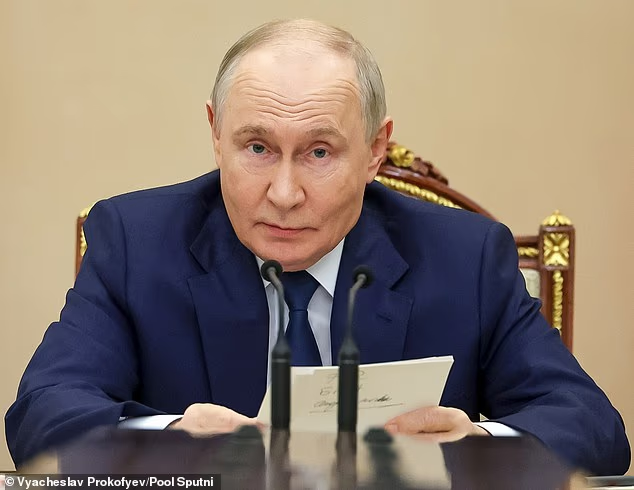
Vladimir Putin might be 73 years old but he still fancies himself as a dynamic wartime leader in the mould of Peter The Great or Ivan The Terrible.
Having watched the dictator for the past 30 years, I am in no doubt he hopes to echo the achievements of his predecessors by expanding the Russian borders further into Eastern Europe, with its strong Russian cultural heritage.
Putin, in other words, is now an old man in a hurry and I fear he is on the cusp of ordering a miscalculated escalation that could plunge Europe, as Churchill once said, into a new Dark Age.
Vladimir Putin is on the brink of his own catastrophic miscalculation – one that could tip Europe towards World War III, writes Mark Almond

Ukrainian firefighters work at the site of a Russian strike on a shopping mall in a residential area in Dnipro, Ukraine this month
Three things are happening that make me believe the Russian leader is preparing further military action that could inadvertently trigger Article 5 – the Nato clause that states that any attack on a member nation is an attack against the whole.
First, there is credible evidence Moscow is planning a significant further mobilisation of troops.
Last month, Ukraine’s President Zelensky warned Russia was planning a ‘rapid mobilisation’ of some 300,000 men by the end of the year. In the last week of August, at least 113,000 Russian citizens fled the country through the so-called Upper Lars checkpoint into Georgia, likely dodging this impending draft.
The Kremlin has meanwhile ordered Army generals to increase data collection on reservists, including their whereabouts and readiness to fight. A draft bill has also been proposed, fining Russian companies up to a million rubles (£9,000) for ‘failing to support the war effort’ or ‘impeding mobilisation’.
Second – and chillingly – last weekend, Russia’s Federal Security Service imposed restrictions on movement in two areas along the country’s border with Estonia, including a night-time curfew. They are also said to be fortifying the bank of the Narva River marking the border. This suggests preparations for a land invasion of this Nato state.
Estonia is a small country with a population of just over a million people and a mere 7,000 active military personnel. On top of that, much of it is Russian-speaking and its borderlands retain a strong Soviet nostalgia.
Yes, Estonia has been a part of Nato since 2004, but would its allies really go to war with Russia for it? Would the men of Nuremberg, Nantes or Nottingham risk their lives for the villagers of Vasknarva or Lutepaa?
Third, last week, close Russian ally Belarus launched a major four-day military exercise near its borders with Poland and Lithuania, including tank battalions. The drills took place near the strategically crucial 25-mile Suwalki Gap. Crossing Lithuanian and Polish territory, this is the shortest route between Belarus and the Russian exclave of Kaliningrad on the Baltic coast.
If Putin could seize the Gap, it would be disastrous for the Baltic States who –thereby cut off from the rest of the continent – would be sitting ducks for the Russian military machine.
On top of these Belarusian drills, earlier this month Moscow allegedly flew a drone across the Gap into Kaliningrad, in an apparent attempt to survey Nato air defences.
The direction of travel seems all too clear.
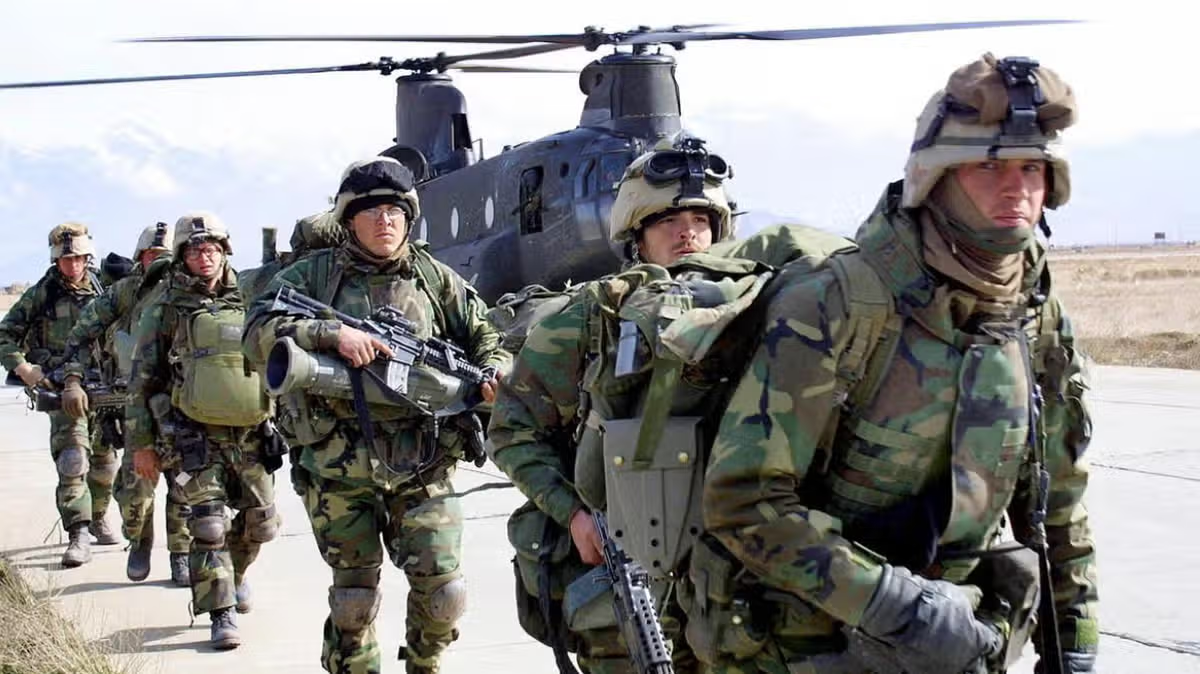
The question for Andy Burnham and other Nato leaders, then, is whether or not any of these actual or potential incursions meet the threshold for triggering Article 5. And, more to the point, whether Western Europe has the means to triumph in a clash with Moscow and its allies.
To his immense discredit, Donald Trump has long cosied up to the repulsive Putin. With the US President’s foolish war in the Middle East proving hard to stop, he is unlikely to embroil American troops in further escalations in Europe, especially for a perceived ‘minor’ incursion by Russia into the Baltics.
Knowing this, other European countries have signified their readiness to act. Last Friday, French President Macron held a successful cross-party summit to build consensus on a plan in the event of war between Europe and Russia.
Yet while France is also mobilising aggressively, Britain sits on its derriere.
Just three months ago, then-Defence Secretary John Healey resigned over failures to boost military spending to three per cent of GDP. Now promoted to Chancellor, Healey looks set to fall short of that mark again.

Members of an electoral commission wait for voters, sitting under portraits of Vladimir Putin and Denis Pushilin, the installed leader of the Russian-controlled parts of the Donetsk region
For Britain, the real challenge will not be boldly answering the call to Article 5 and coming to the aid of the Baltic states but rather if we have the capabilities to do anything to help them in the first place.
The Labour Government has talked tough on defence but failed miserably to put its words into action.
By the end of the Cold War the British Army had 153,000 regular soldiers. Today, we have fewer than half that.
Of course, a Russian attack on Nato could come in another more deniable form: cyber warfare, state-sponsored terrorism, a ‘false flag’ attack, lawfare or even spreading hostile disinformation intended to weaken European alliances.
In the short term, such hybrid escalations seem the most likely.
After all – and thank God –Putin knows he cannot currently sustain all-out war with Europe. Russia’s invasion of Ukraine has led to at least 1.4 million casualties on its own side, including almost half a million dead.
And while Putin, like Stalin before him, no doubt sees such a toll as a ‘statistic not a tragedy’, he surely calculates it will be easier to weaken Nato’s resolve first, then take what he wants.
There is already evidence he is succeeding in this.
A decisive victory for the hard-Right and grotesquely Russophile AfD party in east German local elections last week marked a major coup for Putin – and proved that western Europeans are not entirely united against the Kremlin.
Vladimir Putin is a risk taker. After four years’ stalemate in Ukraine, the ageing President is planning his next move. Only time will tell whether he could spark a conflagration that would soon engulf the continent.
- Mark Almond is director of the Crisis Research Institute in Oxford.














































You must be logged in to post a comment Login