

There is almost no chance of survival for remaining victims of Venezuela’s devastating earthquakes eight days ago that left the country on its knees – with tens of thousands still missing – a charity worker has said.
Almost 2,300 people are confirmed to have died after 7.2 and 7.5-magnitude quakes hit back-to-back last week. However as many as 40,000 are unaccounted for.
Rare stories of ‘miracles’ where trapped children and people were freed by rescue teams have offered some hope – but this is a dwindling reality as the nation has long passed the crucial 72-hour window to rescue victims.
Edward de Burgh, a senior global security officer for the nonprofit Project HOPE which has been distributing supplies and providing emergency treatment in the region, told the Daily Mail that ‘the chances of survival for those that are under the rubble has now reduced considerably’.
‘Just on our ability to survive as a human being without water in a very harsh environment, we’re getting to the point now where those miraculous cases will exist, but realistically speaking, biologically speaking, it’s not likely that people can survive much longer, if they are indeed at all alive at the moment,’ he said.
Everywhere, relatives, volunteers, and rescue workers have been racing to recover bodies.
‘The destruction in the areas where it’s hardest hit, the buildings are literally piles of rubble already, in some cases, and then trying to find the bodies in there to account for them and give them back to their loved ones is a very difficult task,’ Mr de Burgh said.
But a singular glimmer of hope last night provided some relief for the region which has become accustomed to the droning of generators and jackhammers, and often the stench of decomposing corpses.
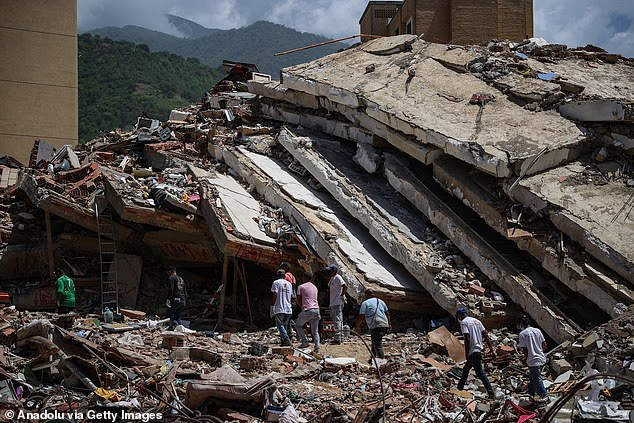
Floors of an apartment block were seen stacked on top of eachother following two devastating earthquakes in Venezuela

Project HOPE and SAMU team members conduct earthquake response operations in La Guaira, with 40,000 people still unaccounted for
Hernan Gil, 43, was astonishingly rescued from the rubble in Playa Grande, a neighborhood of Catia La Mar, in a dramatic operation involving rescuers from seven countries.
But with time running out, locals who held onto hope for the last week that their loved ones may emerge from the destruction are now beginning to enter a sobering period where they may not be so lucky.
Mr de Burgh explained: ‘In the first few days everyone has hope, solidarity kicks in and people are desperately trying to find loved ones.
‘You’ve got very professional teams working with dogs and sensors and drones and then you’ve got community teams working with hand tools to try and do their best.
‘That’s kind of slowing down now and people are starting to realize that time is not their friend anymore.
‘A lot of the international teams are now leaving, and we’re officially sort of moving into the recovery stage.
‘This pressure builds up as people are desperate dealing with the loss of people, loss of loved ones, and literally having nothing.
‘Their homes now have gone, and whatever they had in them is not retrievable in many cases.

Hernan Gil, 43, was astonishingly rescued from the rubble in Playa Grande, a neighborhood of Catia La Mar, in a dramatic operation involving rescuers from seven countries

Project HOPE and SAMU going through the rubble of one of the buildings in La Guaira with a rescue dog as they look for survivors
‘It’s the period where you have to start living with the aftermath of it, which can be exceedingly incapacitating for people.’
Rescue efforts have begun to be transformed as the area enters a recovery phase focused on supporting affected locals who survived that may no longer have access to clean water, food, medication or housing.
The more organized rescue teams have already moved into primary health and emergency medical teams have begun supporting the clinics and the hospitals, Mr de Burgh said.
Mr de Burgh said that while there are hospitals still operating in the area, they are ‘very much overstretched’ but ‘coping well’ alongside the support from ‘the international community and organisations like ourselves supporting those hospitals and clinics’.
The spread of disease is one of the principal concerns for the team as they enter the ‘secondary phase’ of the disaster zone, he added.
‘As the buildings came down, they may have impacted the sewage and mixed with the water system.
‘We don’t know this yet, but there is the risk that fresh water is going to be a challenge.’
Further basic needs of sanitation and hygiene are other priorities at this stage, as are making sure people are housed and off the streets, away from buildings that are unstable.
La Guaira, once a festive seaside resort, has transformed into a grim scene of survival and despair where entire neighborhoods have been razed.
It was the hardest hit region in Venezuela, made up of beach homes of more affluent residents and holidaymakers alongside ‘a lot of poverty and social housing’.
Now, it is the epicentre of the majority of deaths.

‘The destruction in the areas where it’s hardest hit, the buildings are literally piles of rubble already, in some cases, and then trying to find the bodies in there to account for them and give them back to their loved ones is a very difficult task,’ Mr De Burgh said

Rescue efforts have begun to be transformed as the area enters a recovery phase focused on supporting affected locals who survived that may no longer have access to clean water, food, medication or housing

With time running out, locals who held onto hope for the last week that their loved ones may emerge from the destruction are now beginning to enter a sobering period that they may not be so lucky
Mr de Burgh said: ‘You have buildings that are pancaked, pancaked and twisted in some cases, and then also buildings that have crumbled into piles of rubble, or others that have toppled over.
‘If you do the simple calculation of the fact that these buildings are so damaged in a lot of cases and there’s still a lot of people unaccounted for, the death toll over time will be confirmed higher and that’s for sure.
‘I’d rather not sort of make a guess at the death toll but if you look at the number of disappeared, the people they can’t contact, and do the simple maths, then yes, you’re probably looking at a significant rising number of deaths.’
What was once an eight-story building in the town has now become a six-meter high mound in the mountain range of rubble that makes up the area.
Manuel Alejos, a crane operator who has already pulled out seven bodies, said: ‘We’re breaking slab by slab to free the bodies… Their families need the bodies to say their goodbyes.’
‘We still have the basement to do,’ he added, hopeful that there may be survivors.
On the docks, people wait on plastic chairs. A makeshift morgue has been set up to meet the demand.
Owuar Herrera and 12 members of his family waited for hours to declare the bodies of his granddaughter, 10-year-old Dasleidy Herrera, and her grandmother, 50-year-old Mildred Moreno, both killed in the earthquakes.
‘After a week of work, we found them today. They were embracing,’ he says.
Carlos Velazquez has been looking for his 26-year-old son, Dennis, who was on the tenth floor of a building.
‘I’ve been here since day one. Even if I have to pull him out with my own fingernails, my son will rest in a proper cemetery,’ Velazquez said, his eyes filled with sadness but determination.
His son’s body was recovered shortly afterwards.
The local golf course has been turned into an emergency camp, where rows and rows of camp beds have been set up to house just some of the 15,000 people whose homes were demolished.
For many others, they have had to resort to sleeping in the streets.
‘I think what we’ll see is a sort of desperation of a long recovery period and potentially frustrations come with that, and especially as people are moving into camps, it can become overcrowded along with the need of those basic resources like water and food and hygiene and so forth,’ Mr de Burgh added.
‘In the next few weeks, we’ve got the concern of public health and then how do we get people back into housing? How do we remove all this destruction so we can build again? And that does take months.’


























































You must be logged in to post a comment Login