The five-part drama follows Leo and Clive, two neighbours in Manchester who have always managed to tolerate one another despite their many differences. However, they suddenly find themselves in an all-out war spurred on by the divided world they’re immersed in.
Given the past success of Russell’s shows, it’s no great surprise that Tip Toe’s cast features a mix of acclaimed British drama veterans who you might recognise for their past work, as well as some exciting upcoming TV stars.
Here’s a quick guide to where you have seen some of the stars of Tip Toe before…
Advertisement
Alan Cumming
Alan Cumming in The Good Wife
Reality TV fans will likely recognise Scottish actor Alan Cumming for his Emmy-winning work as the host of the American version of The Traitors.
However, long before he entered the castle, he had a long and illustrious career on both stage and screen.
Alan began his TV career with a stint on the Scottish soap opera Take The High Road before going on to become an international household name.
Advertisement
Some of his best-known movies include projects as varied as the James Bond film GoldenEye, cult comedy Romy And Michele’s High School Reunion, 90s pop explosion Spice World and Stanley Kubrick’s final offering Eyes Wide Shut. No stranger to a franchise, Alan also played Fegan Floop in the Spy Kids trilogy and blue-skinned mutant Nightcrawler in the world of X-Men, a role he’ll reprise in the upcoming Avengers: Doomsday.
On TV, Alan was nominated for three Emmy Awards for his role as political manipulator Eli Gold in The Good Wife, starred as the Mayor in Apple TV+ musical series Schmigadoon! and hosted both the Tony Awards and Baftas.
A modern icon of the West End and Broadway, Alan is a two-time Tony and one-time Olivier award winner. Although he has played a string of eclectic roles, he is best known for his seminal work as the Emcee in Cabaret.
David Morrissey
Advertisement
David Morrissey in The Walking Dead
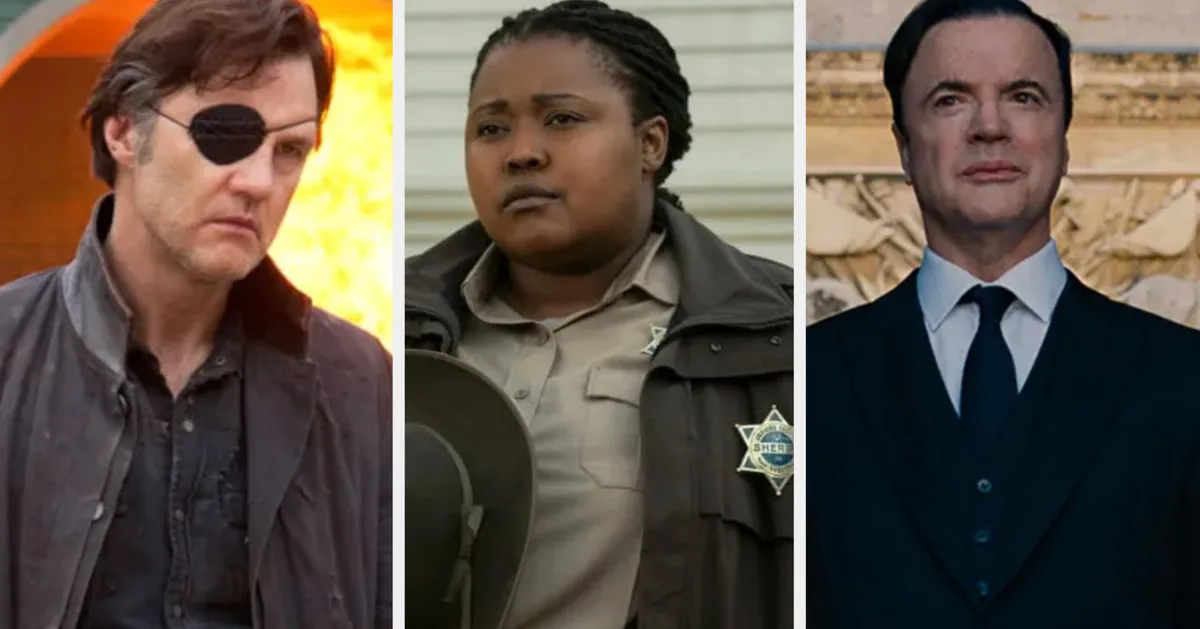
David Morrissey has been consistently appearing on our screens since the 1990s, although to many he’s best known for his work as Gordon Brown in 2003’s The Deal and for playing The Governor in The Walking Dead.
He also appeared in the crime drama Red Riding and the BBC series Sherwood, as well as playing Aimee Lou Wood’s hapless dad in the sitcom Daddy Issues.
On the big screen, he played John Lennon’s stepfather in the biopic Nowhere Boy, appeared in Steve McQueen’s Blitz and recently acted with Keira Knightley in The Woman in Cabin 10.
His next role is Beatles-related once more, as he’s expected to star in Sam Mendes’ biopics as Paul McCartney’s father.
Pooky Quesnel
Advertisement
Pooky Quesnel in The A Word
Pooky found fame playing Dr Monica Brome in the first series of Cardiac Arrest, before playing John Thompson’s love interest Emma Keaton in Cold Feet.
She will also be recognisable to soap fans, as she played Diane Short in Family Affairs, before taking over the role of Rachel Branning in EastEnders.
Her other TV credits include the 2007 BBC drama True Dare Kiss, the Doctor Who spin-off Class and the comedy W1A.
Like many of her Tip Toe co-stars, she appeared in Waterloo Road, playing geography teacher Olga in series 10 of the school-set drama.
More recently, she acted in the BBC drama The A Word and its spinoff Ralph & Katie as Maurice’s music teacher, as well as co-starring with Leslie Manville in Moonflower Murder.
Advertisement
Jackson Connor
Jackson Connor as George in Tip Toe
Playing troubled teen George in Tip Toe is definitely Jackson Connor’s biggest role to date.
However, you might have seen him in the BBC series Phoenix Rise, or the star-studded Apple TV+ drama Masters Of The Air, in which he made a blink-and-you’ll-miss-it appearance as a soldier.
Joseph Evans
Joseph Evans in Coronation Street
A star on the rise, Joseph Evans can currently be seen treading the boards in the West End revival of David Hare’s Teeth N Smiles, as well as the adorable big-screen rom com Finding Emily.
He previously played Jackson Hodge, the father of Faye Windass’ child, in Coronation Street back in 2023 and, impressively, wrote an episode of Industry.
Advertisement
Elizabeth Berrington
Elizabeth Berrington in The Syndicate
While you might not immediately recognise her name, you’ll definitely be familiar with Elizabeth Berrington’s work, as she’s one of the busiest character actors on British television, working across both comedy and drama.
Elizabeth first rose to prominence working with Mike Leigh in her on-screen debut in Naked, as well as his follow-up Secrets & Lies.
From there, she went on to appear alongside Tony Robinson in the 1997 comedy-drama My Wonderful Life, before landing roles in everything from the period drama Sanditon and the sci-fi drama The Nevers, to The Responder, The Syndicate and the feature-length episode of Black Mirror, Hated In The Nation.
As for her film career, Elizabeth appeared alongside her Tip Toe co-star David Morrissey in The Deal, playing Cherie Blair, in addition to her supporting roles in Nanny McPhee, In Bruges and the 2016 adaptation of Swallows And Amazons.
Advertisement
Her most recent roles on the small screen include Lost Boys And Fairies, Virdee, Frauds and the Nick Cave penned Sky dramedy The Death Of Bunny Munro – and while her CV is long and impressive, there’s every chance that, like us, you know her best for playing food tech teacher Ruby Fry in Waterloo Road.
Iz Hesketh
Actor and drag performer Iz Hesketh is best known to TV fans for playing the groundbreaking Hollyoaks character Kitty Draper, as well as appearing as Valerian in the Disney+ drama Renegade Nell.
On stage, Iz has played Margot in Legally Blonde at the Regent’s Park Open Air Theatre, and appeared in productions of both Head Over Heels and Fury And Elysium.
The drag daughter of Drag Race UK winner Tia Kofi, Iz also performs across the country as Seriah Sis, in addition to her acting career.
Advertisement
Luyanda Unati Lewis-Nyawo
Luyanda Unati Lewis-Nyawo in Wednesday
Luyanda Unati Lewis-Nyawo is an actor who you’ll likely recognise for their role as Deputy Ritchie Santiago in Netflix show Wednesday.
Their other credits include minor roles in 2020 Alex Garland miniseries Devs, a 2023 episode of Top Boy and the 2025 Cameron Diaz comedy Back In Action.
Luyanda is a prolific video game voice actor, too, lending their dulcet tones to Legends of Runeterra, Baldur’s Gate III and Eternal Strands.
Paul Rhys
Advertisement
Paul Rhys’ most recent on-screen role came when he appeared briefly in Emerald Fennell’s controversial adaptation of Wuthering Heights as Heathcliff’s father, having also worked with the Oscar-winning filmmaker in Saltburn, where he played butler Duncan.
The British star made his film debut in 1986’s Absolute Beginners, before sharing the screen with Robert Downey Jr in the Oscar-nominated Chaplin, Johnny Depp in From Hell and Joaquin Phoenix in Ridley Scott’s Napoleon.
On the small screen, he had a supporting role in the BBC supernatural drama Being Human, played Vlad the Impaler in Da Vinci’s Demons and appeared as real-life military officer Sir John Conroy in ITV historical drama Victoria.
Charlie Condou
Charlie Condou in Coronation Street in 2014
Charlie Condou is best known to TV fans for playing sonographer Marcus Dent in Coronation Street on-and-off between 2007 and 2014, as well as playing the lothario Ben Sherwood in Holby City.
More recently, Charlie had a guest role in The Madame Blanc Mysteries and played Gary Gabbastone in the Eurovision-themed Doctor Who episode The Interstellar Song Contest.
Advertisement
Denise Welch
Denise Welch in the Loose Women studio
Ken McKay/ITV/Shutterstock
Denise Welch is a British TV icon making her first on-screen appearance in 1981’s Barriers, followed by her breakthrough role as Jean in Auf Wiedersehen, Pet. From there, she went on to appear in Geordie staples Byker Grove and Spender, before being cast as Marsha Stubbs in Soldier, Soldier.
Her best-known acting roles include Natalie Barnes in Coronation Street, Steph Haydock in Waterloo Road and Mitzeee’s mother Trish Minniver in Hollyoaks. You may also know her for being a regular Loose Women panellist since 2005.
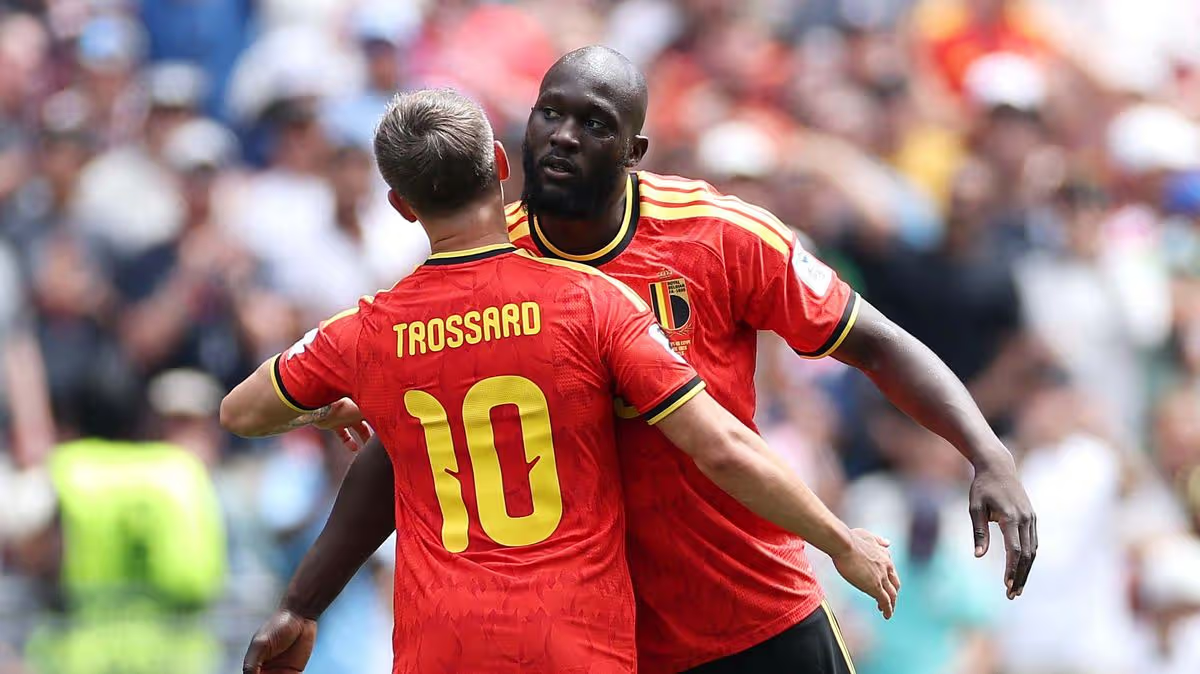
A frenetic finish followed with both sides enjoying chances. Belgium perhaps had the best of them as Lukaku headed over from close range and Mostafa Shobeir denied Brandon Mechele at full stretch, but the points were shared, leaving top spot in the group up for grabs ahead of New Zealand’s opener against Iran.
It comes as Kew completes its project to digitise of its herbarium and fungarium, using high resolution photography to turn 7.4 million specimens of pressed plant leaves, flowers, seedheads, mushrooms and spores dating back centuries into digital records that can be freely accessed and searched online.
Fifa issued a short statement to confirm an investigation had been carried out but that the official would face no action.
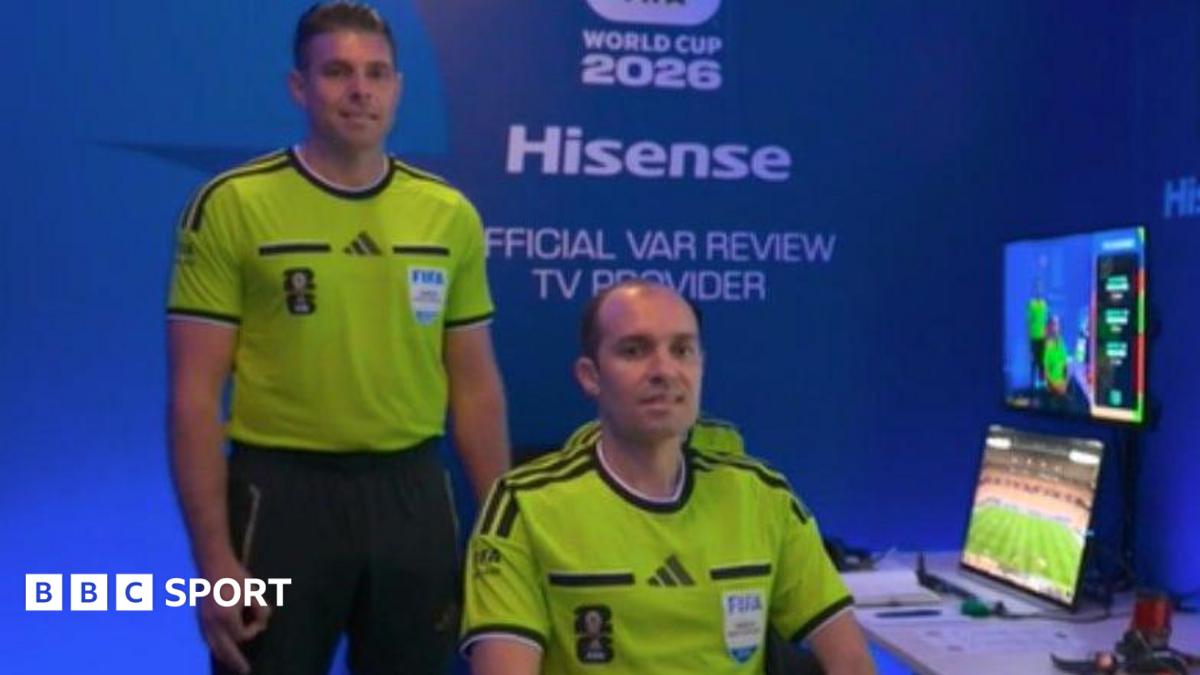
The 38-year-old Evans went on to explain that video evidence from the VAR room proved that he had made involuntary movements.
“Images taken later during the match showed that I repeated this movement many times while holding a pen between my fingers,” he said.
“Officiating at the World Cup is the biggest honour of my career and I look forward to supporting my colleagues for the rest of the tournament.”
Advertisement
Before matches during the World Cup, Fifa has been briefly focusing on the officials as part of its world feed global coverage.
First, the referee, and the rest of his team, have walked to the touchline and a graphic has been displayed with their names and roles.
Then the picture has cut to a shot of the VAR team at the referee hub in Dallas.
Rather than showing them at work and looking at their monitors, they have also briefly posed for the camera and their names have appeared on screen.
Advertisement
When the camera cut to the VAR room on Sunday, Evans was standing with his arm by his side – and then could be seen making the fingers of his right hand into a upside down ‘OK’ sign.
There was a noticeable change in approach for pre-match rituals after the Germany-Curacao game.
When the VAR hub was shown in subsequent matches, the officials were already facing the monitors. No longer did we see them looking at the camera, although their names were still displayed.
Belgium and Egypt played out an entertaining 1-1 draw to get Group G underway at the World Cup. It was an end-to-end affair for much of the evening in Seattle, with Egypt’s stubborn back line and composed midfield giving them a firm platform from which to build. No surprise, then, that the box-to-box Al Ahly midfielder Emam Ashour would open the scoring, firing beyond Thibaut Courtois from the edge of the area to put the Pharaohs in front. It might have been the winner, had Mohamed Hany not put the ball in his own net 24 minutes from time.
ALPHARETTA, Ga. (AP) — The final days of Georgia’s Republican primary campaigns have exposed internal party fault lines, produced unusual alliances and will test the party’s ability to consolidate quickly to match Democrats’ head start on the general election campaign.
The melee, including last-minute endorsements from President Donald Trump and outgoing Gov. Brian Kemp, was on full display Monday ahead of Tuesday’s runoff. Rep. Mike Collins and former football coach Derek Dooley are competing for the party’s nomination for U.S. Senate, while Lt. Gov. Burt Jones and billionaire businessman Rick Jackson are running for governor.
Trump and Kemp are aligned behind Jones but split in the Senate race. Top grassroots organizers are divided too. Even Texas Sen. Ted Cruz, a former rival to Trump, stepped into the mix on Jackson’s behalf, putting him at odds with the president and governor.
“There’s a lot of division in the MAGA world and across the Republican Party,” said Debbie Dooley, an original national tea party organizer who is backing Jones for governor but Dooley for Senate. (She’s not related to the candidate.) “We better get it together after Tuesday.”
Advertisement
Kemp insisted there is a common denominator.
“Everything I’m doing is to win in November,” he said Monday after campaigning for Jones and Derek Dooley at separate events in metro Atlanta.
Kemp has backed Derek Dooley for months in the Senate race, arguing it will take an outsider to defeat Democratic Sen. Jon Ossoff in November. Yet Kemp campaigned for the first time Monday with Jones, a day after he endorsed the lieutenant governor despite Jackson’s outsider campaign. In the governor’s race, Kemp reasoned that Jones is the right man to defeat Democratic nominee and former Atlanta Mayor Keisha Lance Bottoms.
Trump, meanwhile, has backed Jones since last August, rewarding him for his loyalty as part of Trump’s alternate Electoral College slate in the 2020 scheme to overturn Democrat Joe Biden’s presidential victory. But the president waited until the final weekend to choose Collins over Dooley, with a social media post that noted Dooley has backed Trump’s falsehoods about his loss to Biden.
Advertisement
Kemp’s and Trump’s differing courses highlight their complicated relationship — Kemp certified Biden’s electors in 2020 over Trump’s objections — and the results Tuesday will tests both men’s internal party influence as their final terms play out.
“I’m not worried about any political equations or keeping score,” Kemp said Monday after campaigning alongside Jones and Dooley at separate morning events. “It’s making sure we have the right people at the top of the ticket.”
He also rejected any notion that he was being inconsistent by pushing the Washington outsider in one race and the Georgia statehouse insider in another. The reason, he said, was that Georgia has been controlled by Republicans for more than two decades and, in Kemp’s estimation, is doing well enough that Jones would be “really building off the great legacy” of multiple state administrations. Congress, meanwhile, is a mess of “inaction” with abysmal approval ratings, he said.
Dooley, for his part, embraced Kemp’s influence and downplayed Trump’s.
Advertisement
“It’s very simple,” he said. “A vote for Mike Collins is a vote for Jon Ossoff. A vote for me is a vote for the people of Georgia.”
Jackson likewise downplayed Kemp’s last-minute nod for Jones.
“I respect Gov. Kemp very much, and I think people are ready for an outsider,” he said.
Cruz was more animated, with an implicit comparison of Jackson to Trump.
Advertisement
“He’s rich,” Cruz told Jackson supporters with a smile. And he’s a first-time candidate, the senator continued. “I don’t know anybody like that in politics,” Cruz deadpanned.
Debbie Dooley, the conservative activist, noted that erstwhile tea party leaders in the state aren’t on the same page anymore either. While she’s campaigning with Derek Dooley, the founder of Tea Party Patriots, Jenny Beth Martin, has appeared with Collins.
“It’s just not as simple as blindly following Trump anymore,” Debbie Dooley said. “I don’t want the most conservative candidate. I want the most conservative candidate who can win.”
That dual personality makes it interesting to live with day to day.
Slip inside and the first impression is of an upmarket cabin with an edgy vibe.
The graphite suede upholstery with synthetic leather trim and Nismo red stitching immediately set a sportier tone, yet the seats are generously padded and electrically adjustable for both driver and passenger, so you can sink into a relaxed driving position on longer trips.
The side profile of Nissan’s Ariya Nismo
The minimalist dash with its 12.3‑inch screen and head‑up display keeps key information clear without feeling cluttered, while the Intelligent Rear View Mirror and 360‑degree around‑view monitor make the car easy to place in town despite its size. Practicality is strong, with decent rear space and a 408‑litre boot, so it still feels like a family SUV first and a performance model second.
Advertisement
Press the starter and select Eco or Normal mode and the Ariya Nismo majors on calm refinement. The 87 kWh battery and dual‑motor e‑4ORCE all‑wheel‑drive system deliver power in a smooth, measured way, and on light throttle it feels no more demanding than any other electric crossover. The car retains the standard Ariya’s relaxed gait at a cruise, with impressive grip and a supple ride that shrugs off poorer surfaces despite the 20‑inch wheels. Noise levels are low, the heat pump keeps the cabin warm without hammering range, and the advanced driver assistance – from ProPILOT with Navi‑Link to intelligent cruise and lane keep assist – makes longer motorway slogs straightforward.
The interior of the vehicle
Range is officially quoted at 261 miles on the WLTP cycle, a figure borne out reasonably well in mixed driving conditions, which saw around 230 miles.
While the 130 kW DC rapid capability isn’t class‑leading, it’s sufficient to add a meaningful chunk of range in a coffee stop. As an efficient, relaxed EV, the Ariya Nismo is therefore more about easy progress than chasing every last mile per kWh.
Twist the drive‑mode selector round to its dedicated Nismo setting, however, and the character changes markedly. Power from the twin motors climbs to a stout 320 kW (435 PS) and 600 Nm of torque, good for 0–62 mph in 5.0 seconds, and the sharpened throttle response makes the car feel considerably more eager than the figures alone suggest.
Advertisement
In this mode the car feels genuinely agile, with the e‑4ORCE system shuffling torque between the axles to give strong traction out of bends and a more rear‑biased, playful balance than the standard car.
Nissan’s Ariya Nismo
Add in the firmer steering tune and the synthesised performance sound and the car feels to have transformed into a sharp, sporty animal when provoked.
What stands out is that Nissan hasn’t pursued headline‑grabbing numbers at the expense of liveability. It isn’t as explosive as something like a Tesla Model Y Performance, but it benefits from composure, grip and overall polish instead of outright brutality.
The suspension’s MacPherson‑strut front and multi‑link rear layout has been tuned to keep body control tidy without the brittle edge some fast EVs suffer from, and combined with strong, vented discs all round, the car feels secure and confidence‑inspiring when you press on.
Advertisement
In town you can dial things back, rely on the smooth single‑pedal effect from the regenerative braking, and you’re back in relaxed, quietly competent SUV mode.
The Nismo has no shortage of horsepower
Overlay all of this with a generous kit list – heated front seats and steering wheel, dual‑zone climate control, ambient Nismo lighting and a full suite of active safety systems – and the £56,620 on‑the‑road price looks competitive against other premium electric crossovers with similar pace. It is not the longest‑range or the quickest EV you can buy, but as a practical five‑seat family car that can switch from calm, economical cruiser to genuinely entertaining B‑road companion at the twist of a dial, the Ariya Nismo hits a sweet spot that few rivals currently match.
Nissan Ariya Nismo
PRICE: £56,620 on the road
Advertisement
POWER: 320 kW / 429 hp / 435 PS
ACCELERATION: 0-62 mph in 5 seconds
RANGE 261 miles WLTP combined
CHARGING SPEED: 22 kW AC onboard charger; 130 kW DC rapid charging
Does it seem as though more people are coming out as neurodivergent these days?
Perhaps you’ve heard complaints that social media – particularly TikTok – is driving a trend. Or maybe you’ve encountered the suggestion that neurodivergence has somehow become fashionable, a label people adopt for attention, status or belonging.
For neurodivergent people, these claims can be deeply dismissive. They reduce complex experiences and real struggles to a passing cultural craze.
My research suggests something quite different. Far from being a modern phenomenon, neurodivergence has a long history. In other words, people whose ways of thinking, sensing or behaving differed from social expectations have always existed. Members of my research project have described discovering these historical figures as like finding neurodivergent ancestors.
Advertisement
Of course, this is not about diagnosing people who lived centuries ago with autism, ADHD or other conditions. Diagnostic categories have their own history. They change over time, and can be shaped by specific cultural and geographical contexts. Moreover, I am not a doctor nor a psychologist, and I am not interested in retrospectively diagnosing historical people.
What interests me is something broader: the many people in the past who were understood – by others or by themselves – as different.
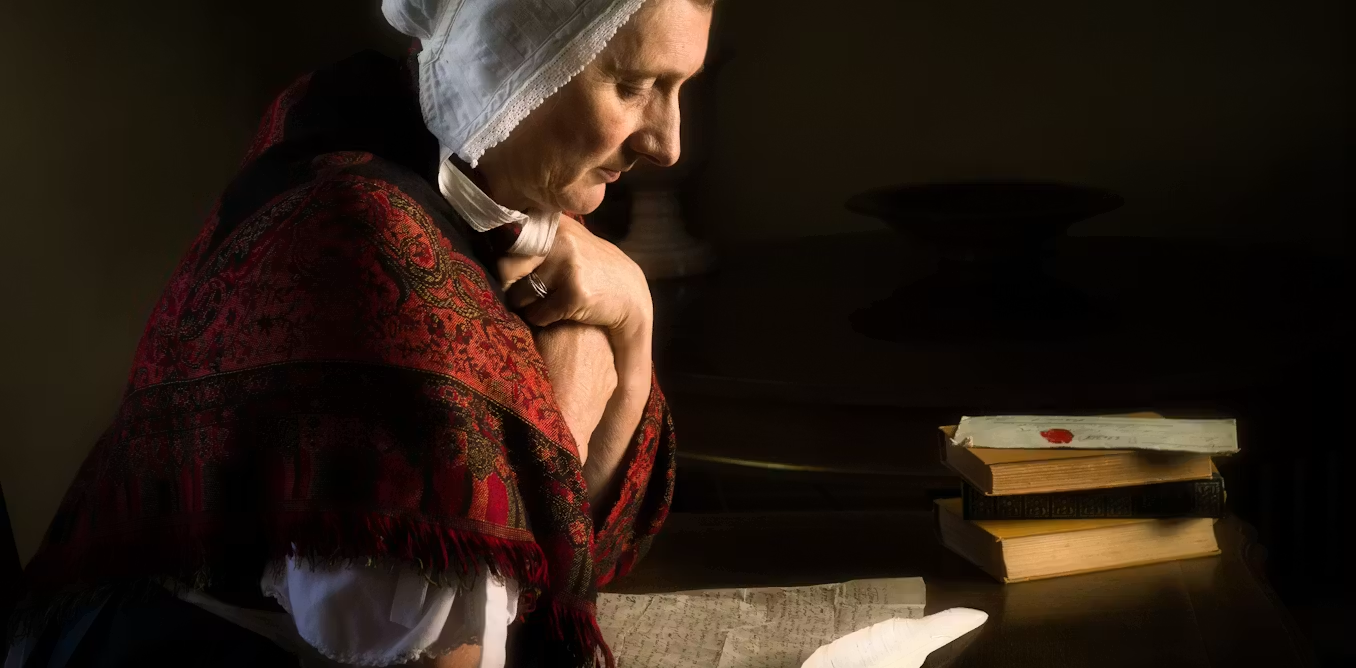
One example is Hannah Allen. She was an English widow who published an account of her experiences in 1683. She wrote about periods of profound melancholy and hearing voices, drawing on journal entries she kept during those difficult years. Stories like Allen’s remind us that people have long searched for language to describe minds and experiences that did not fit comfortably within accepted norms.
Advertisement
People have always adapted and reshaped the language available to them. Today, clinical terms regularly spill into everyday conversation. People talk about being “anxious” about an exam or “depressed” by bad weather, without necessarily claiming a diagnosis. Literature has always transformed and enriched our understanding of medical and psychological concepts.
In my work, I define neurodivergence as ways of thinking, sensing or behaving that diverge from social expectations. What’s also important is that those expectations vary across time and place. Behaviour regarded as unusual in one context may be entirely acceptable in another.
A nun from the Hospital of Santo Spirito, Rome holding rosary beads. C. Duflos le père/Wellcome Collection
Take repetitive movement, for example. Today, many neurodivergent people describe using “stims” or fidgeting to regulate attention, emotions or sensory experiences. In early modern Catholic worship, rosary beads could serve a similar function. Repetitive hand movements were not only accepted, but encouraged as part of religious practice. But context also matters.
In the 18th century, the Scottish laird Hugh Blair was criticised for struggling to sit still during family prayers. Instead, he occupied himself by knitting a sock. The habit was considered so strange that it was cited in a court case as evidence that he lacked the rational capacity to marry.
Advertisement
Examples like this show how ideas about acceptable behaviour are socially constructed. They also reveal how people whose behaviour diverged from expectations could face suspicion, exclusion or stigma. A broad definition of neurodivergence allows us to explore a wide range of historical experiences that do not fit neatly into modern diagnostic categories.
It opens up questions about phenomena such as religious melancholy, compulsive behaviours or unusual sensory experiences without forcing them into contemporary medical frameworks.
It also encourages us to think differently about the present. If neurodivergence is understood as a spectrum of human difference rather than a fixed set of diagnoses, it may help reduce stigma around experiences that are often heavily moralised, including addiction.
Reading for resonance
Neurodivergent readers often have a kind of instinct for recognising experiences that feel familiar in historical texts. This does not mean that people in the past were exactly like us. Nor does it mean we can know precisely what they thought or felt. Instead, it means acknowledging moments of connection.
Advertisement
Take Morose, the central character in Ben Jonson’s play Epicœne. Morose is intensely sensitive to noise. He seals up his house, insists that servants wear soft-soled shoes and relies on a kind of silent communication.
For many autistic readers, particularly those with sensory sensitivities, aspects of this portrayal may feel strikingly familiar, and that familiarity matters.
Too often, expertise about neurodivergence is assumed to reside exclusively with doctors and researchers. Reading for resonance recognises that experience is also a form of knowledge. Neurodivergent people can bring valuable perspectives to historical interpretation precisely because of how they experience the world.
Advertisement
This matters at a time when public conversations about neurodivergence are becoming louder and more polarised.
At the 2026 Wales Neurodiversity Show, our research team asked visitors a question: who knows more about neurodivergence – people today, or people living between 1550 and 1750? Only one person out of 15 chose the early modern period.
Our poll was just for fun, of course. But it reflects a common assumption that neurodivergence is something modern people have discovered and understood. This is something that I hope my research might change.
Certainly, we now have concepts such as neurodiversity, along with a rich vocabulary developed within neurodivergent communities themselves. Terms like “AuDHD” (autistic and ADHD) and “neurospicy” (neurodivergent) would have been absent centuries ago.
Advertisement
But new language does not necessarily mean entirely new experiences. For neurodivergent people who feel isolated or historically invisible, discovering a longer history can be profoundly validating. It reminds us that difference has always been part of human society.
Our neurodivergent ancestors may sometimes feel surprisingly familiar. At other times, they may seem so distant that we can never fully understand them. Both aspects are important.
The next time someone dismisses neurodivergence as a fad or a trend, it may be worth remembering that people have been debating, describing and living neurodivergent lives for centuries. So, if it is a trend, it is one that has lasted an extraordinarily long time.
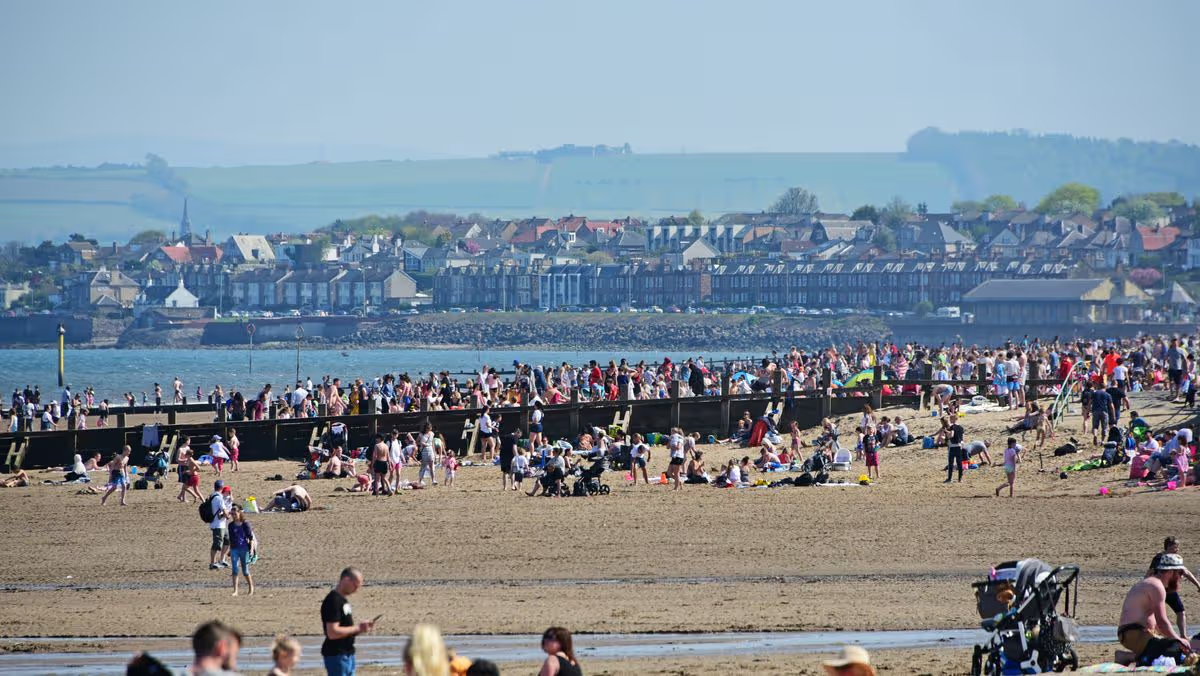
SEPA has advised against bathing and paddling at Portobello Central after routine testing found elevated bacteria levels.
Beachgoers have been warned to stay out of the water at Portobello after elevated levels of bacteria were detected during routine testing.
Advertisement
The Scottish Environment Protection Agency (SEPA) carried out sampling at Portobello Central on Thursday, June 11, with results showing a high bacteria count.
SEPA monitors Scotland’s designated bathing waters between May 15 and September 15 each year to help the public make informed decisions about entering the water.
Updating its website on Friday, June 12, the agency advised against bathing and paddling at the beach, reports EdinburghLive.
It said: “At Portobello Central, there has been a high result on a routine sample taken on 11/06/2026.
Advertisement
“We are currently advising against bathing or paddling.”
Porty Surf Lifesaving Club criticised the continued warning, saying it was “not good enough” that the beach remained effectively closed three days after the initial sample was taken.
In a post on Instagram, the volunteer-run water safety charity said: “It is just not good enough that three days after a SEPA test the beach is still closed and volunteer-led water safety charity Porty SLSC cannot deliver work with local communities at Porty beach.”
The club urged members of the public to raise the issue with their local MSPs, MPs and Edinburgh Council.
It is not the first time Portobello has been affected by poor water quality.
Advertisement
In July 2024, SEPA issued similar advice after unusually high levels of bacteria were detected in samples testing for E. coli and intestinal enterococci.
At the time, the agency said sewage had been ruled out as the cause of the pollution incident, while further analysis was unable to identify the source of the elevated bacteria levels.
The warning was lifted two days later, on July 12, after testing showed water quality had returned to normal levels.
SEPA has been approached for comment.
Advertisement
Get Daily Record Premium for just £1 per month in exclusive offer to celebrate the world cup. Click HERE.
A 10,000-strong army of England fans is heading to Dallas to see our World Cup opener against Croatia. Superfan Robert Didd has attended every single England home game since 1986, setting a record of 222 consecutive games from 1987 to 2007. He has spent around £500,000 following his country but does not regret a penny.
My first game was in October 1986, and I have been to every single home game in 40 years. In the 90s, I calculated that I had spent around £100,000 following England, but it must be about £500,000 now. I would have a bigger house and a few extra bedrooms. But I have been to 76 countries. It is like being an explorer, travelling the world you see on TV or read about in a book.
He was pictured at an early game, aged 16, with his Mitcham/Chelsea England flag. He has kept match tickets and memorabilia from a lifetime of following the national side. His ‘fear’ is of missing out if England win the World Cup.
Civil servant Garford, 64, of London, is at his 10th World Cup, spending around £12,000 on the trip. Garford is heading to Dallas and from there will take a Greyhound bus to Boston, a journey of 40 hours.
Advertisement
It is £135 with three changes, but it will be a real experience and give me time to think and see parts of America that I would never have seen otherwise. You leave at 3.15am, which may not be very comfortable, but I am going to Nashville and New York before Boston, and through Memphis, Jackson, Knoxville, and Charlottesville. That is what you will remember, the places and the people.”
England Supporters’ Association leads the Fans’ Embassy service in the US and did a four-day road trip from Florida to Dallas via Tallahassee, Florida, Mobile, Alabama, and Natchez, Mississippi. A Newcastle United fan, he told of a ‘church every half mile’ in Louisiana and rolling countryside reminiscent of his native Northumberland.
The country roads were like the A1 when it goes into single file in North Northumberland. It was old school America. The only thing missing was the Johnny Cash soundtrack. It is worth it when you get here, as the Dallas stadium is absolutely magnificent. I think the number of England supporters here, when you consider the financial challenges, is just incredible and a real credit to them.”
He stressed the need to carry water because of the extreme heat forecast for the 3pm kick-off time, with temperatures expected to reach 32-33 °C, around 90F. The match is set to be played under the roof at the stadium to make it cooler for players and fans.
Chris Thomas, 40, originally from Leeds, is leaving at 3am tomorrow (Wednesday) from Kansas City to get to the game in time for kick-off. Chris, who sells traditional British pies with a street food firm called ‘Brit Boy’, now living in Kansas City, is with his best friend, Sam Bannister, also from Leeds, and Kye Marty, another ex-pat, and his American wife, Sundy.
The stadium is about 45 minutes outside the city, so we will be driving and using taxis and public transport when we get there. Otherwise, the costs can be horrific. It is a mixture of excitement and trepidation now. I just hope England give it a good go.”
Exeter City fan George Smith, a finance worker who now lives in San Diego, California, is travelling to the England group games with Three Lions supporters based in Spain, Scandinavia and Australia. George, 42, is taking his son Charlie, 11, to the England games with him. He also plans to take his Mexican-born wife, Monica, to the famous Azteca stadium if England face her native country in the Round of 16.
Advertisement
In total, George has spent around $7,000 dollars (£5,178) on tickets for himself and his family. But the bill may rise to £12,000 depending on how far England progress.


















































You must be logged in to post a comment Login