

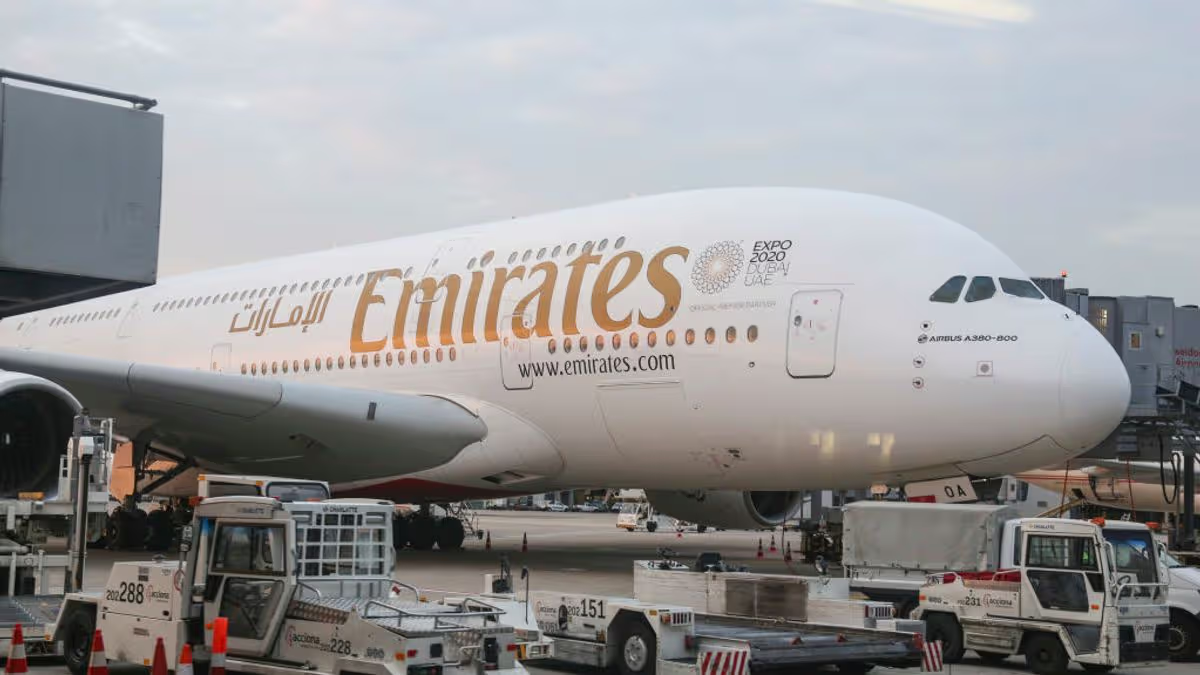
He has just returned from the UAE with crucial advice
A travel expert has issued a warning to individuals with flights booked to or from the Middle East. The alert comes as tensions continue in the area, with Israel and the US maintaining their strikes on Iran which commenced over a fortnight ago.
Iran continues to hit back with drone and missile attacks on several neighbouring and nearby nations. This resulted in Dubai, a major hub for international travel and home to the world’s busiest airport, temporarily closing its airspace for the second time in 48 hours due to strikes in the vicinity.
Simon Calder, a journalist with the Independent, has just returned from the United Arab Emirates. He provided an update on the current situation for those flying to or from the Middle East, including passengers transiting through the region en route to other destinations.
He stated: “I’ve just arrived at London Heathrow Terminal 4 after a fairly normal flight from Abu Dhabi on Etihad. What wasn’t normal was just how quiet it was when I arrived. Terminal 4, the main hub for the Middle East from London, is frankly a bit of a ghost town. Many of the flights that you would normally expect to see multiple departures on Qatar Airways to Doha and on Etihad to Abu Dhabi are not flying, and there’s also, for instance, Gulf Air based in Bahrain who are not going there.
“Having said that, there’s perhaps more flights than you might expect, given that, for example, Qatar and the UAE are on the Foreign Office no-go list. There’s a departure this evening to Abu Dhabi on Etihad and one a little later on Qatar Airways overnight to Doha. As well as that, El Al is going out to Tel Aviv. Now, you might have heard that the airspace in Israel is closed; well, it kind of is, but if you’ve got permission, and El Al certainly has, then you can go in.
“And finally, Gulf Air is flying from here later on today, but not to the normal destination of Bahrain. Instead, it’s going to Dammam, which is very close by in Saudi Arabia, from where passengers can travel to that island quite happily over the causeway. But bear in mind that the UAE, Qatar, Kuwait, and Bahrain are all on the Foreign Office no-go list. If you choose to ignore that advice, then it’s likely your travel insurance will not be valid.
READ MORE: Travel expert issues holiday ‘rise’ warning as jet fuel price surges 70 per centREAD MORE: Simon Calder issues update for anyone flying with Emirates, Etihad or Qatar Airways
Unsurprisingly, the conflict has impacted international travel in numerous ways. Not only have passenger numbers and flights passing through the Middle East declined dramatically, but neighbouring countries favoured by Brits seeking spring sunshine, including Cyprus and Turkey, have also experienced a fall in visitor numbers.
Conversely, nations to the west boasting milder weather, including Spain and Portugal, have witnessed a surge in reservations – as has the Caribbean. The situation has not only left thousands of British holidaymakers stuck in the Middle East, but many are also anxious about their upcoming travel arrangements.
The Association of British Insurers attempted to address these worries with the following statement when questioned about whether insurance will cover the cancellation of a trip to the Middle East due to concerns over the conflict.
It stated: “As the situation evolves, we can understand why people may be reconsidering their future plans to travel to the region. If you wish to cancel your trip, contact your airline, accommodation provider or tour operator in the first instance. They may be able to rebook parts of your trip or offer a refund.
“Travel insurance may not cover cancellations linked to the conflict, depending on your policy’s terms, any war exclusions, and when you bought it. Policies differ, and insurers may take different approaches, so it’s important to check with your insurer to understand what’s covered.”













































You must be logged in to post a comment Login