TUI will offer city breaks to the Basque Country destination from Manchester Airport this spring, with flights taking under two hours
Natalie King Travel Journalist
02:19, 19 Feb 2026
This article contains affiliate links, we will receive a commission on any sales we generate from it. Learn more
has introduced a new city break destination to its spring line-up, located in a region of Spain that’s increasingly catching the attention of Brits and boasts a distinctive charm.
For those weary of the Spanish Costas and seeking to avoid the typical crowded tourist locales, Northern Spain is emerging as an alternative for Brits keen to explore a different side of the country. The Basque Country alone witnessed a 40% surge in visitors last year, although this still only equates to 182,000 tourists annually – a mere fraction compared to Southern Spain.
Advertisement
Bilbao, nestled in the heart of the Basque Country, serves as an excellent introduction to this part of Spain, offering a chance to immerse oneself in the area’s unique beauty and culture.
This spring, TUI will be providing city breaks to Bilbao from four major UK airports: Bristol, London-Gatwick, London-Heathrow, and Manchester. With flights from the UK clocking in at around two hours, it’s perfect for a long weekend or mini break.
In a Lonely Planet article, one travel writer wrote: “When your plane banks toward Bilbao Airport for the final approach, the lush forest passing below looks nothing like the Spain you thought you knew.”
Advertisement
This region’s climate and landscapes are vastly different from the arid, sun-drenched south, offering milder conditions that provide relief from summer heatwaves. Between March and April, daytime temperatures hover around 17C, whilst throughout summer months they reach approximately 26C, as the south frequently swelters in mid-30s heat.
The area also receives greater rainfall than its southern counterpart, lending the surroundings a vibrant green appearance.
Situated along the Nervión River’s banks, Bilbao’s most beloved area is its historic quarter, known locally as Casco Viejo. Featuring vibrant buildings from medieval periods, an impressive cathedral, and the stunning neoclassical Plaza Nueva, packed with bars and eateries, it makes for an ideal short break location.
By contrast, the Guggenheim Museum, with its distinctive Frank Gehry-designed facade, stands apart from everything else in the city, yet attracts visitors with its extensive contemporary art collection. Even without stepping inside, it’s worthwhile passing by to admire its titanium-covered exterior gleaming in the sunlight.
Advertisement
Beyond its cultural attractions, Bilbao is renowned for its vibrant culinary scene, and whilst exploring the streets, you’ll discover numerous pintxos bars. A northern variation on tapas, pintxos consist of bite-sized bread portions topped with ingredients ranging from jamón to seafood or cheese, secured together with a cocktail stick.
Another renowned product of Northern Spain is its Rioja wines, which perfectly complement a serving of pintxos. You can indulge in a day trip to nearby vineyards, or simply pop into one of the numerous wine bars for a tasting session.
TUI’s offers feature a 7-night stay at the 4T NYX Hotel Bilbao by Leonardo Hotels on a room only basis from £583 per person. The price is based on two adults sharing a Double or Twin Comfort Room, departing from London Gatwick on 14th April 2026 with hand luggage only.
Advertisement
Alternatively, you can reserve a seven-night holiday at Hotel Sirimiri on a room-only basis from £451 per person. The price is based on two adults sharing a Double or Twin Standard Room, departing from London Heathrow on 21st April 2026 with hand luggage only.
Prices are subject to availability and may vary. For more information, visit the TUI website or download the official app.
1983 smash hit Chuckie Egg is being remade for mobile phones, and we’ve spoken to the bedroom programming teen protégé that originally made it.
It’s always sobering to realise that what counts as retro gaming is constantly changing. Although there’s no official definition, it was recently suggested that the Xbox 360 and PlayStation 3 are now definitely retro, being over 20 years old and two generations ago. Some might insist they still don’t count but there’s no arguing about the 8-bit era of the ZX Spectrum and Commodore 64, which is now well over 40 years ago.
Although there are some games from that period that are still active today (Donkey Kong launched a year before the Spectrum itself) most are not, especially anything that was developed in the UK – as a majority of Spectrum games were. 1983 was the start of the video game crash in the US but that didn’t affect Japan or Europe. At that point though the NES was still three years from release in Europe, so at that time the video games industry consisted almost solely of coin-op games and 8-bit home computers.
That year, the best-selling games on the Spectrum included text adventure The Hobbit, Jetpac from Ultimate Play the Game (later to be renamed Rare), seminal platformer Manic Miner and… Chuckie Egg by Nigel Alderton. Back in the days when a game being made by a single person was the norm, he developed the game as a teenager, in his bedroom, and saw it hog the number one spot for much of the year.
Advertisement
Nowadays you have to be of a certain age to even remember the name Chuckie Egg, especially as it only had one sequel – that was not made by Alderton and was a very different style of game, more similar to Manic Miner sequel Jet Set Willy. The original, though, unlike so many games from the period, is still very playable today.
It’s a single screen platformer where you have to collect eggs before a timer runs out. You’re pursued by chickens, with all of you attempting to pick up piles of seeds along the way – which if you get to them first will slow the timer. After the first eight levels the giant bird in the top left of the screen escapes and also pursues you, as the levels get harder and harder.
Expert, exclusive gaming analysis
Sign up to the GameCentral newsletter for a unique take on the week in gaming, alongside the latest reviews and more. Delivered to your inbox every Saturday morning.
Advertisement
It sounds simple, and it is, but what made it such a hit is the smoothness of the controls, which were much more akin to a coin-op than most computer games. Initially released on the Spectrum, BBC Micro, and Dragon 32/64, it was later ported to the Commodore 64, Acorn Electron, MSX, Amstrad CPC, and a variety of other now forgotten computer formats. It subsequently appeared on the 16-bit Amiga and Atari ST, as well as MS-DOS, but never on any console.
Like so many games of the era that means it’s largely been lost to time, increasingly forgotten by British fans and completely unknown to most American and Japanese gamers. However, Chuckie Egg has now been recreated for mobile and is available to pre-order now on iPhone and iPad, and Apple TV, for a one-time, ad-free fee of £2.99. It includes both a version of the original and a modernised edition that twists the camera angle to give it a 2.5D look.
The launch this week also gave us a chance to interview Nigel Alderton, as we discussed his memories of the 8-bit days, how he came to make the game, and what he thinks of the video games industry today.
Advertisement
GC: Even though Chuckie Egg ended up on so many different formats, I still think of it as a Spectrum game. I think probably because it was a few years before I got a computer, a Commodore 64, and the port still looked a lot like a Spectrum game.
NA: I think that was Mike Webb, the Commodore one. Mike Webb wrote about 11 different versions of it, because I wrote the original one and then other people did the conversions. But Mike ended up writing some ridiculous number, I think it might have been 11.
The Commodore had hardware sprites, and you could move a lot around the screen, taking up very little CPU, but if you wanted to scroll the whole screen on the Spectrum that was quite an exotic thing to do. So, people stayed away from those if you’re designing a game for the Spectrum; quite hard to do.
Advertisement
GC: As I understand it you were influenced by Donkey Kong and Space Panic, and I think Space Panic in particular can be regarded as the first ever platformer. So you’re talking the very early days of gaming and yet there was already an established scene with influential titles.
NA: I walked to school every day and there was a newsagent on the way, that had an arcade game. And so the first first one that I remember was Space Panic. And then at some point they had Scramble. They might have had Donkey Kong, but the very, very early arcade platform games. So if you look at Space Panic and Chucky Egg, side by side, the colours are embarrassingly similar. [laughs] I basically pinched them, but they work really well on the Spectrum, the high contrast purple and the green. But yeah, it was very early days, wasn’t it?
GC: So were you a keen gamer at that time? What were your first experiences of computing?
NA: We were lucky enough to have two or three computers at school. There was a teacher called Mr Bishop, who was very forward-looking, ’cause computers were just barely a thing at that time. And he managed to get the funds to get some Tandy TRS-80s. He commandeered a sort of broom cupboard and put these computers in there and I’d seen people wandering in out of the place with these glowing screens and wondered what the heck it was.
Advertisement
So I used to just hang around and try and get onto them to try and type BASIC. And then I peed my parents for a ZX81. But I was always more interested in the writing. I never really played computer games very much at all. Played loads of arcade games. I used to put all my pocket money into the arcades, there’s an arcade in Stockport, which unfortunately was directly on my bus route home from my Saturday job.
So I’d earn my £7 working on the Saturday, get off and change buses at Stockport with the arcade right there. And many times all my money that I earned that day went into those damn machines. [laughs] But I never really played Commodore games or Spectrum games; I never played those sorts of games very much. Just arcade games.
Nigel Alderton back in his school days
GC: I’ve been playing the game and it’s… I wouldn’t call it easy but it’s not as vindictively unfair as a lot of games from that period and it doesn’t involve rote learning. From what you’ve just said I can totally see the arcade influence, where it’s not easy but it is a lot more fluid and accessible than a lot of computer games of the times, things like Manic Miner – which I know you’re not a fan of.
NA: Yeah, I’m not a fan of puzzle games. I much more enjoy games where it’s more about the dexterity rather than figuring out a puzzle. So, I was just writing a game that I would like to play. I can’t remember if that was a conscious thing or a subconscious thing. And also, I didn’t like games that I played where if one pixel of your character touches one pixel of a deadly thing, an enemy character, then you die. So I didn’t like the feel of that. I thought it was too unforgiving. So that was a deliberate choice.
But I think I could have made it easier, is that when you come to a ladder, you’re running on platforms, when you first start playing, it takes people a while to figure out that you have to hold the ‘up’ button as you get to the ladder to be able to run up. Watching people struggling with, they go to the left of the ladder and then press ‘up’ and then to the right and press ‘up’. It’s frustrating, but once you’ve got that knack I think it was quite easy to get into.
Advertisement
GC: There’s a lot of games from that period where climbing that ladder would be a lot fiddlier than even that, but Chuckie Egg seems pretty smooth to me. Were you thinking of things like difficulty and accessibility when you were making it?
NA: Very much. I wanted to try and get progression, so that you would learn skills gradually. And so try and have a screen early on… the first screen, you don’t have to learn all the skills in one lump, and then you develop them over time. So on the first screen, you don’t really have to be able to jump off of a ladder and grab another ladder, for example. Or jump on the lift, you know? So I wanted to introduce things slowly.
And also, I wanted to be able to have as many new levels, where it was not the same as any previous level, without having to come up with new platform layouts every time. So hence, you do the first eight screens and that’s got the eight platform layouts, but then you go and do them again, and you get the bird coming out instead of the tall birds, and then you do ’em again, and you get the next eight and you do them again, and you get both, and so on.
So I was trying to have a progression, so it got got harder. There were other ideas that I never got to do because they were sort of breathing down my neck to say, ‘Come on! Get it finished, get it finished!’ [laughs] Because I would’ve gone on and just kept adding things to it, I think, if they hadn’t been getting me to do that. There were other things that could have been added to make it go on even further. But I think there’s something like, maybe 48 levels where it’s different each level and then after that it just repeats.
Advertisement
The original version has aged surprisingly well (Elite Systems)
GC: I don’t think a lot of developers in those days, were thinking along those lines, which would certainly explain why it was so popular.
NA: Yeah. I also wanted it to be four players [consecutively, not at the same time – GC]. That probably comes from the arcade, when you’re hanging around with a bunch of people or watching one player play. You get the group dynamic of taking the mickey or saying ‘Well done!’ or whatever. The more the merrier.
GC: So what would you have done to the game if you’d had more time?
NA: I think the next thing might have been two birds coming out at the same time, but with with different movements. So one would move with a different algorithm. And then I think another one was getting bits of the platform to disappear. So you get the same platform layout, but just with the odd brick taken out… ’cause that wouldn’t take up much memory to do that or having to design a complete new level.
GC: I guess maybe there was a story in the cassette inlay or something, but did you have any kind of plot explanation in mind while you were working on it? Because it’s pretty abstract but it’s not completely surreal or random like some other games from the time.
Advertisement
NA: I dunno. Because it’s all out scale, isn’t it? You know, the tall birds… I called them tall birds, but that was kind of an ostrich type thing. But then the bird that comes out of the cage is ridiculous size, isn’t it? Compared to that. There’s a sort of narrative, but it’s a bit messed up. But it is more to do with what I would… because I’m hopeless at graphics. I can do the programming, but I can’t make a pretty picture.
So it was just what was easy to draw. And the square hat came from the fact that I didn’t want pixel collision, I wanted it to be based on a softer collision detection, the collision had to be a roughly a square shape. So the hat kind of makes him visually more square.
GC: So it becomes the hit box?
NA: Yeah, so it’s a trade off between the limits of my coding ability and the limits of my graphics ability. [laughs] And then they [publisher A&F Software] called him Hen-House Harry. They came up with the name Chuckie Egg and tried to create a bit of a narrative, I think, but they were almost random characters that I was drawing.
Advertisement
Nigel tasted success early
GC: Who was the publisher? They were all northern companies back in that day, weren’t they? There were very few that were down south.
NA: Yeah, there was a lot up North and a few in Birmingham, and then there was a couple in Liverpool and then a few in London. But all the magazine publishers were down in London, but all the developers and the game creators were sort of spread all over the country.
GC: So you lived in Stockport but where was A&F based?
NA: A&F were in Denton, I think it was. But I got a Saturday job with them, through a friend of mine. And so I was just making cups of tea on a Saturday and serving in the shop and that kind of thing. And I showed them a game and they weren’t interested, but they said, ‘Oh, take it up to this guy up the road. That was in Hyde, so I went and I got given a cheque for something like £700, for this game that I’d written just before I wrote Chuckie Egg.
GC: That would’ve been a lot at the time, I imagine.
Advertisement
NA: It was a ridiculous amount! I went home with this cheque, thinking, ‘Well, this can’t be real. I won’t believe until I see it in my bank account. I showed it to my dad and that was the first time I’d actually heard him swear, like really swear. And he just couldn’t believe it. I was shocked somebody would pay me to do this thing that I just did for fun, you know? I wrote it because I enjoyed it. And then I wrote Chuck.
So anyway, I turned up to my Saturday job one day, and Chuckie Egg was only half finished, and I showed it to them and this crowd of people all started crowding around going, ‘Wow, look at this!’ So I was really chuffed that I had impressed them.
It was pixel movement and that wasn’t really a thing at that point, on the Spectrum. Nobody had really worked out how to do it. It was all character movement and there wasn’t really any pixel movement games published at that point.
GC: Can you briefly describe what the difference is?
Advertisement
NA: So, if your character, you are controlling, moves left and right, then character movement is it has to move in jumps of eight pixels on the Spectrum, left or right, or up or down. But pixel movement, you can just move one pixel at a time. Chuckie Egg moves two pixels at a time.
Nigel as he is today (Elite Systems)
GC: So were you doing all this just by yourself?
NA: I did the whole thing. I did the whole Spectrum thing, yeah.
GC: How did you learn to program? Was that at school?
NA: I managed to get a little bit of time on these Tandy TRS-80s, occasionally. ‘Cause there’s loads of kids, all sort of fighting to get on them. And there was only three of them, I think. And then there was a sort of pecking order, but I did manage to occasionally, if I stayed late enough after school or got in early enough, to get a go. And then I got to play with that on BASIC.
Advertisement
Then the main thing, where I learned the most and really started to learn how to code, was that I got a ZX81. I pestered my parents or… I think I used part my pocket money and then they chipped in a bit and I got the ZX81 and learned BASIC on that.
But then, also, I started to learn machine code on that, just the real beginnings of it. But actually got machine code to work on the ZX81. And the difference in the speed just blew my mind. When I first got a block to move left and right, on the screen, using keyboard controls… when I got the code running in machine code, I thought it’s not working because it just goes fully from the left of the screen all the way to the right of the screen, in one jump. But it wasn’t, it was just because it was so quick!
So it just blew my mind, the speed of it. And I thought, right, this is the answer. And then the Spectrum was announced and I was just drooling over magazines every week, looking at these beautiful colour pictures of the upcoming Spectrum, which was massively delayed and delayed and delayed. But yeah, I sent my cheque off and that was partly my pocket money and partly my parents. And it covered Christmas and birthday rolled into one, so I think it was over £100, which was a lot of money in those days.
So I sent my cheque off, or postal order or whatever, and then just waited and waited and waited. And I think it took three months to come, ’cause they were just so massively swamped by orders. And the day it came through I couldn’t believe it, like this magical thing. It was awesome!
Advertisement
GC: [laughs] What age were you when this was happening?
NA: I got the Spectrum when it first came out… would that have been ’82? So I was born in ’66. So what’s that? Maybe 15 or 16? I was 16 when I first started writing Chuckie Egg, I think, and then it came out when I was 17. So I was writing Chucky when I should have been studying for my mock A-levels.
GC: Well, the world benefitted from your choice. Well, I say the world, but I doubt anyone outside of Europe even knows the game. Did it ever get ported to anything that wasn’t a home computer?
Advertisement
NA: No, I don’t think so. It is being now, but back in the day. But it did go to Europe. It’s known in Portugal, apparently, and Spain. Which I’ve only just found out recently, because I got an email from a sort of retro computer enthusiast in Portugal.
GC: [laughs] Playing it again now it really should have been turned into an arcade game, but as big as the British development scene was at the time that sort of thing never happened.
NA: There was plenty of games for the Spectrum or the Commodore that could have gone the other way and gone to arcades. I think you’re right. But they all came the opposite way, didn’t they? You’d have conversions from the arcade games, but the arcade industry could have done the same thing and licensed home computer games and just pick the most popular and successful ones.
GC: So Chuckie Egg is a big success and you’ve got another massive cheque from the publisher. What happened after that? Did you work on Chuckie Egg 2?
Advertisement
NA: No, I didn’t. And I wasn’t a fan, actually. I didn’t like their design for it.
GC: I thought as much, because if you don’t like Manic Miner you’re not going to like Chuckie Egg 2.
NA: [laughs] Yeah, I don’t like that Manic Miner style of game, with the collision detection and it being puzzle-orientated. It’s just not my thing. I’ve nothing against, hat’s his name that wrote it?
GC: Matthew Smith, I think.
Advertisement
NA: That rings a bell, yeah. So then I finished school and I didn’t want to go to university, The parents were quite keen for me to do that but I didn’t really like school, so I didn’t really want to go to university. And I felt that I had a skill and somebody told me that, well, you’ve written Chuckie Egg. You could walk into any company, any games publisher, and just say, ‘Gimme a job!’ And they’d hire me. So I did. So I went and I applied to Ocean and they said, ‘Yeah, come and work for us. So I went to work for them for about 18 months, I think. A year and a half.
Nigel even made it into the papers
GC: What did you do there?
NA: I worked on Street Hawk with Mike Webb and Joffers [probably Jonathan M. Smith], what did we do? We did this game… you had like a car and it was a rollercoaster thing on the screen, and I can’t remember what the actual game was [Kong Strikes Back – GC]. I can’t remember what you were trying to do, but I think those were the only two. I don’t remember working on any others.
GC: So what happened after that 18 months? Did you go to another company or had you had enough of games by then?
NA: Well, I thought I’d go and be a freelance programmer. So I started touting around for freelance work. I think, mainly, so I had more freedom and you get more money as well. That’s how I met Steve Wilcox [who currently runs Elite Systems, publishers of this new version of Chuckie Egg – GC].
Advertisement
I can’t remember how I got in contact with him – maybe I phoned up or wrote or something, or did I reply to an advert? So he was looking for programmers to do Commando on the Spectrum and the Commodore, and one other. So I said I’ve written Chuck Egg and Street Hawk, so he hired me and a guy called Keith Burkhill to do Commando on the Spectrum. And that was on a very, very tight schedule, ’cause it had to be out for Christmas.
So I went and worked for them. And then I sort of got burnt out as a programmer and then went and worked for Steve full-time as an employee, just managing all the other programmers. Just coordinating them and making note of how far along they were, ’cause he was running so many projects at the same time and Steve was sort of overwhelmed. So I helped him to just basically schedule things. So I did that for a while, maybe a year or two, and then moved to Audiogenic down in London. And I was software development manager there and I was sort of slightly involved in that football game [Emlyn Hughes International Soccer – GC].
So I think I spent a couple of years there and then after that… I’d always viewed the games industry as a bit of a not proper job, if you know what I mean. And I thought PCs were grown-up computers and the Spectrum and the Commodore were games computers, there were sort of toys really. It’s a bit of snobbery there maybe.
So I thought, right, I’ll try and get a proper job now. And so I went to work for a company in the city. So I was back to programming again, but I was programming on a PC. So that was my entry into the PC world, which is where I spent the rest of my career, if you can call it that, my life. [laughs]
Advertisement
GC: What were you doing there? Nothing to do with games, by the sound of it?
NA: No. So, I started off doing PC support and computer installation and maintenance. So I moved to a company in south London and so they sold computers and installed ’em for people and installed ethernet networks, early ethernet networks. So, I was installing the computers, installing the networks, and we also did tech support as well. So we’d go around and fix computer problems. That was for all sorts of different companies and then I went to work for Engelhard in Surrey and spent seven years there. And they’re a precious metal manufacturer, and I was looking after all the PC equipment in that company.
GC: Steve said you were in property now?
Advertisement
NA: [laughs] I’m semi-retired but I moved house and it was a bit of a doer-upper, but then I decided that I didn’t like the location in the end. So I moved again, very quickly, and bought another doer-upper, so now I’m doing this one. So that keeps me busy.
GC: So while all this was going on the games industry was expanding and evolving in the background. Did you retain an interest in it, have you kept abreast of how things have changed?
NA: Not really, no. Because I’ve kind of grown out of going to arcades.
GC: Well, you don’t get a chance nowadays…
Advertisement
NA: [laughs] I don’t think any of my friends were particularly still into playing computer games and I was never really into playing computer games. It was a bit of a bubble really, wasn’t it? ‘Cause all these home computers came out, the VIC-20 and the Dragon and god knows what, and there was gazillions of them at one point, and then it seemed a bit of a bubble that burst maybe, I don’t know if that’s true, but it was mainly a console thing.
GC: Yeah, the whole home computer market faded away in the 16-bit era and much of the British games industry with it. It’s a shame because if Chuckie Egg had been Japanese or American you’d be on your 20th sequel by now!
NA: [laughs] I mean, the hardware moved on, didn’t it? And then you get these first person shoot ’em ups and also the idea of being able to write a game completely yourself… I mean, maybe not the graphics, but all the design, all the programming, and do it in a reasonable amount of time… one person could write a game. There’s no chance one person can do that now, or very rarely, isn’t it? Games are massive beasts now that you might need hundreds of people. Yeah, it’s very different.
Advertisement
GC: Well, that’s true for the bigger games but I don’t know how aware you are of the indie scene, where it’s not unheard of to have just a single person – or certainly a very small team – making a game on their own. Is that something you’d ever be interested in doing, as a hobby or something?
NA: So they do exist, do they? There’s the phone games I suppose, as well, isn’t there? I dunno whether Flappy Bird was just one guy?
GC: It was and he got so upset that people were addicted to the game that he stopped it, he withdrew it from sale.
NA: [laughs] I didn’t realise that!
Advertisement
GC: He was so overtaken with guilt that he was wasting people’s lives.
NA: Is that what it was?
GC: Well, that’s what he said. I think fans brought it back or something, but the original creator is not involved I don’t think.
NA: Wow. So it had a shelf life and now it’s gone.
Advertisement
GC: There’s dozens of indie games released every week but a good percentage are by very small or one-man teams.
NA: On what hardware?
GC: Some are only PC, but many of them make it to consoles if they’re successful. And some to mobile as well.
NA: Right. Yeah, it’s not a world I know anything about.
Advertisement
GC: And yet you created a classic video game all those years ago, which is still perfectly playable today. More so than most home computer games from that era.
NA: Thanks very much.
GC: It’s not a complicated game but it is very playable and there’s more variety than you’d expect.
NA: That was a conscious thing, that I wanted to get a complexity of play without a complexity of structures or things… concepts. So to try and get a lot of variety by doing combinations of the different ideas in there.
Advertisement
The 3D effect is a neat way to update the visuals (Elite Systems)
GC: I’ve always felt learning a new skill was very important, to action games at least. But it’s something that mainstream publishers have been fighting for years; they worry that it puts people off.
NA: There was a ton of kids coming up with ideas in the early days. There was so much variety as well. It was all different, the types of games and many, many genres of games.
GC: I think you’d be interested if you looked into the indie scene. Slay The Spire 2 is one of the biggest games on Steam at the moment and the first one… I think they got more people to help with the sequel but the first one was basically just two guys.
NA: I believe you get these 3D engines, and physics engines, and things now, so you’re not having to code every line. You’ve at least got some something to start with.
GC: You can get things like Unity, which are very cheap, so you can plug all that in, yeah.
Advertisement
NA: I mean, that’s the sort of thing that might get me to have a fiddle around with something and play around with something.
GC: [laughs] Give it a go, make a true Chuckie Egg 2.
NA: [laughs] Chuckie Egg 2026 or something. Chuckie Egg 2100.
GC: I suppose we should put in a quick plug for the new mobile versions. So there’s a recreation of the original and then a version with sort of isometric graphics?
Advertisement
NA: Sort of pseudo 3D, yeah. But the gameplay is very close, if not identical, to the Speccy version, the original version.
GC: Did you oversee this new version?
NA: It’s taken a while to come to fruition and I have had a play every now and again, but I’m not supervising it. It’s not me writing the code but I’ve put my twopenn’orth in occasionally.
GC: Purely by coincidence we’ve had a lot of retro stories recently, and there’s been a lot of interest.
Advertisement
NA: I had a plumber come round, a while ago.
GC: Mario, was it?
NA: [laughs] Some friends, for my birthday, had a T-shirt made with Chuckie Egg on the front of it and it was so well done that it’s framed, and so it happens to be leaning up against the wall and this guy came in and he said, ‘Oh, Chuckie Egg!’ And I said, ‘Yeah, I wrote it.’ And he couldn’t believe it. It’s amazing how many people of the right age group remember it and have a fond memory for it.
GC: You should be absolutely proud of what you made. For a Brit of the right age that was their Mario or Halo. You made something that will long outlive you.
Advertisement
NA: Yes, It’s amazing though, isn’t it? Yeah, yeah. Nice little feather in my cap.
GC: Alright, well thanks very much for your time.
NA: Cheers, cheers.
Maybe one day there’ll be a true Chuckie Egg 2 (Elite Systems)
James Blake, the current CEO of the Youth Hostel Association (YHA), will take up the role later in 2026 following the retirement of chief executive David Butterworth.
Mr Blake brings extensive experience in national leadership, outdoor access, and land management, having led the YHA through significant challenges including the Covid-19 pandemic and subsequent economic pressures.
James Blake said: “It is a privilege to join the Yorkshire Dales National Park Authority at such an important moment.
Advertisement
“The National Park is one of the country’s most treasured landscapes, and I look forward to working with staff, volunteers, farmers, land managers, communities, visitors, and partners to ensure it thrives for future generations.”
Mr Blake also led the development of Access Unlimited, a coalition of outdoor youth organisations and protected landscapes that delivered the Generation Green programme, a £7m partnership that connected young people with nature, many from the most socially disadvantaged communities.
His background includes senior roles in both central and local government, including five years as chief executive of St Albans District Council.
He is also the non-executive chair of ACRE (Action with Communities in Rural England), a national charity supporting rural communities.
Advertisement
Mr Blake said: “The National Park has an ambitious new management plan, and my key priority will be to support its delivery, including working with farmers to drive nature recovery, strengthening access for all, and championing the rural communities at the heart of the Dales.”
Derek Twine, chair of the Yorkshire Dales National Park Authority, welcomed the appointment and praised Mr Blake’s collaborative approach and leadership style.
Mr Twine said: “James brings a strong record of working collaboratively with the people who shape and care for our landscapes, alongside a compelling blend of strategic leadership, passion for the outdoors, and a proven commitment to widening access to nature.
“His experience at YHA—particularly in partnership building and in making it easier for young people and families to get out into nature—will be invaluable as we work with our many local partners to achieve the shared ambitions set out in the National Park Management Plan.”
Advertisement
The authority is currently focused on climate resilience, nature recovery, sustainable tourism, and long-term support for the farming and land-management communities that shape the National Park.
Mr Blake will officially start his new role in September 2026.
Until then, deputy CEO Gary Smith will serve as acting chief executive to ensure a smooth leadership transition.
The Yorkshire Dales National Park is one of 15 national parks in the UK and is managed by a 25-member authority made up of county and district councillors, as well as members appointed by the Secretary of State for the Environment.
The Trump administration’s decision to carry out a naval blockade of the Strait of Hormuz has raised tensions in the Persian Gulf to new and more perilous levels. The move was announced by the US president, Donald Trump, after negotiations over a ceasefire with Iran broke down on April 11, partly due to Iran wanting to retain control of the vital Strait of Hormuz, through which one-fifth of the world’s oil transits.
The blockade is designed to neutralise Iran’s efforts to close the strait to shipping it deems unfriendly to Tehran and implement a toll system for other vessels transiting the strait.
The US blockade can be seen as the latest attempt by the Trump administration to project strength. But it also throws down a challenge to Beijing. China has been the main purchaser of Iranian oil in recent years and is one of the few nations whose shipping can enter the strait unchallenged.
It appeared very likely that this status would be tested on April 14 when the Rich Starry, a Chinese owned and operated tanker under US sanction for transporting Iranian oil, transited the strait unchallenged by the US warships in the region.
Advertisement
But it has since been reported that the vessel turned back in the Gulf of Oman and headed back to the Strait of Hormuz. The US now claims that six vessels that attempted to transit the strait were turned around.
The Rich Starry’s willingness to avert a potential Sino-American clash, suggests that Beijing is still unwilling to challenge Washington’s red lines, particularly so close to a state visit by the US president next month, a trip postponed from March 31 as a result of the conflict in Iran. China has called the US blockade a “dangerous and irresponsible act”.
But what appears to be a deliberate decision not to challenge the blockade may be interpreted as another instance of Chinese weakness, which will probably embolden Washington to take more active measures against China’s tanker fleets.
However, the US seizure of any Chinese shipping could certainly provoke a more dangerous outcome, with the prospect of increased tensions or even conflict with Beijing. Should the US seize a Chinese vessel, Beijing could see this as an act of war on Washington’s part, if it chooses to interpret such an incident as an American effort to strangle the Chinese economy.
Advertisement
While an armed clash between the US and China in the Persian Gulf is unlikely, it is possible that Beijing may deploy its fleet stationed in Djibouti to the region. China’s base in Djibouti is home to its 48th escort group which has previously performed anti-piracy operations in the region as well as escort duties for Chinese-owned ships in the region. This which raises the question over whether Washington would be willing to fire on Chinese warships to enforce its blockade.
China’s challenge to the US
China’s response to an American blockade may be more indirect in nature. One form this could take is the provision of Chinese weapons systems to Iran.
China’s Beidou satellite navigation system has already played a significant role in guiding Iran’s existing stockpile of missiles against American and Israeli targets. Further Chinese military assistance, especially in the form of missiles and drones, can help Beijing retaliate indirectly through Iran.
The New York Times recently reported intelligence sources alleging that China may have shipped shoulder-launched missiles to Iran – but this was strenuously denied by Beijing.
Advertisement
On the other hand, a potential Chinese retaliation may not even take place in the Middle East. Instead, it is possible that Beijing may target American assets and interests in the Asia Pacific.
This comes at a time where several American allies in the region have become increasingly vulnerable, with some missiles system being deployed to the Middle East from South Korea. Coupled with fuel shortages as a result of the closure of the Strait of Hormuz, the region is potentially even more exposed to China’s moves should Beijing choose to act.
The US is reportedly turning vessels around in the Golf Oman, where they emerge from the Strait of Hormuz. Wikimedia Commons
While Beijing prefers a more stable Middle East and global economy, having been one of the key beneficiaries of globalisation, there are several opportunities for China’s wider goals. One of the biggest is the status of the Renminbi. It has become prominent in the oil trade in the Persian Gulf, with Iran primarily dealing with transactions in the currency. This is in line with the emergence of the petroyuan in the 21 century to challenge the dominance of the petrodollar.
Advertisement
Alongside China’s position as a supplier of aviation fuel in the Asia Pacific, the conflict has entrenched and strengthened China’s role in the global economy.
In addition, the potential shortage of petroleum can open the door for wide-scale adoption of electric vehicles (EVs), with Chinese firms such as BYD being potential beneficiaries of a future EV boom. This echoes the popularity of Japanese cars during the Opec crisis of the 1970s, due to their comparatively high fuel efficiency in contrast to American and European models.
As a result, a prolonged Middle East oil crisis may see firms such as BYD become household names, furthering the influence of “Brand China”.
Alongside these, the crisis may further China’s push to present itself as a more stable partner in contrast to Washington’s more chaotic approach. This has gained traction due to the perceived unpredictability of the Trump administration over the past 15 months.
Advertisement
China already has a comparatively favourable global image when compared to the US. A wider conflict with Iran will probably take this further. As a result, the path of the Rich Starry may chart the course of the Sino-American competition and the world that this competition will shape.
The RAF Typhoon declared an emergency while flying over the North Sea.
An RAF Typhoon has declared a mid-air emergency in the skies above the North Sea tonight. The fighter jet had been travelling south over the North Sea on Wednesday, April 15, before turning back west towards Angus and Aberdeenshire.
Advertisement
Based at RAF Lossiemouth, the jet with the call sign VENOM021 was over the North Sea when the pilot initiated an emergency procedure known as squawking 7700.
Data from the flight tracking app FlightRadar24 shows the Typhoon heading back towards its base while a number of other Typhoons continue operations in the skies off the north east coast. Parts of the flight path were not recorded by FlightRadar24.
Emergency response squawking 7700 means a general emergency has been declared.
Advertisement
It can cover a range of scenarios including a technical or medical emergency.
The procedure allows air traffic controllers and ground crews to respond to the emergency in the most effective manner.
The RAF were contacted for comment.
We’ll be bringing you the very latest updates, pictures and video on this breaking news story.
The York Business Networking Event takes place on Thursday April 30, from 5.30pm to 7.30pm, at York St John University on Lord Mayor’s Walk.
Bringing together business owners, senior leaders and professionals from across the city, it promises an informal but focused setting to make new connections and swap ideas.
Guests will arrive to a relaxed networking session at 5:30pm, with most of the mingling taking place before the formal programme begins at 6.15pm. That means plenty of time to introduce yourself, catch up with familiar faces and meet people you might not normally cross paths within the working day.
The evening will include a welcome from Steve Lowe of The Press, followed by a talk from Tom Burton, who leads the apprenticeship programme at York St John University.
Tom will explore the value apprentices can bring to organisations of all sizes, from fresh thinking and up to date skills to long term talent development. With many businesses in York facing recruitment and skills challenges, it is a timely opportunity to hear practical insight on how apprenticeships can support growth.
Local IQ networking event at York St John University. Picture are Maddie Bricklebank and Lottie Joy. Picture by David Harrison. (Image: Local IQ networking event at York St John University. Picture are Maddie Bricklebank and Lottie Joy.Picture by David Harrison.)
Steve Lowe said: “Crucially, this is not a hard sell event. It is about creating a space where York’s business community – from start ups to established firms – can learn from each other and strengthen partnerships with the city’s education providers.
QR Code to register for the event
“Whether you are looking for new clients, collaborators, suppliers or future employees, you are likely to come away with useful contacts and ideas.
Advertisement
Tickets are free but places are limited, so early booking is recommended. To secure your spot at the York Business Networking Event with The Press, York St John University and York College, simply visit Eventbrite and search for the event to register.
Under the new format, the Gunners’ potential route to this season’s Champions League final has already been mapped out.
This will be the first European knockout stage meeting between the two clubs since 2018 when Atletico beat the Gunners in the Europa League semi-final, thus denying Arsene Wenger a chance to end his reign as manager with a trophy.
As a result of finishing top in the league phase, Arsenal will have the advantage of playing the second leg of their semi-final tie at the Emirates Stadium.
Semi-final bound: Arsenal
Arsenal FC via Getty Images
Advertisement
In fact, the Gunners will have had home advantage throughout the knockout phase thanks to a new rule implemented by UEFA at the start of the campaign.
That could leave Arsenal taking on the six-time winners – with the likes of Harry Kane, Luis Diaz and Michael Olise in their ranks – in the 2026 Champions League final.
Arsenal’s potential path to Champions League final:
The BBC has given fans an update of series 14 of Father Brown as Mark Williams set return alongside fan-favourite cast members
Monde Mwitumwa TV and Celebrity Reporter
00:06, 16 Apr 2026
The BBC has confirmed that filming for series 14 of the beloved drama Father Brown is now well underway.
The enduring mystery programme first aired in 2013 and has stretched across 13 series and approximately 140 episodes to date. Set in the fictional Cotswold village of Kembleford, the 1950s period drama follows a crime-busting Catholic priest portrayed by Mark Williams.
Advertisement
BBC bosses revealed they are “delighted” that the Harry Potter and Fast Show star is returning to screens. Reflecting on his comeback to the set, Mark said: “We started filming series 14 of Father Brown in the first week of April and while it’s always a wrench to leave my garden at home when it’s just burgeoning, the Cotswold countryside makes up for it.”
He went on to say: “The trees are wearing their Swank-coats of blossom: Hawthorn, Apple, Pear and Blackthorn, and the splendid white and pink Cherries. There are lots of Magnolias too, looking like enormous wedding bouquets, and all the trees are coming into leaf.
“I love the Horse Chestnut leaves still drooping, not yet plumped up. The grass looks worthy of the Salad Bowl and the arable fields are greening. If you are not careful you could come over all poetic; but we’ve got 10 shows to make – no time for versifying. Cassock on, let the sleuthing begin.”
Mark will be joined by familiar faces Tom Chambers as Inspector Sullivan, Claudie Blakley as Mrs Isabel Sullivan and John Burton as Sergeant Goodfellow.
Other fan-favourites set to feature include Nancy Carroll as Lady Felicia, Lex Shrapnel as Father Lazarus, Roger May as Bishop Fox and Kieran Hodgson as Father Lindsey. Hannah Bristow also joins the cast in Series 14 as Rita Flint.
Father Brown’s new no-nonsense housekeeper who gets off to a bumpy start in her role. As always, there will be a wealth of exciting guest stars throughout the series, including Bill Bailey and Clive Mantle.
Advertisement
The synopsis for the new series reads: “Father Brown and the team in the thick of murder and mystery yet again in 1950s Kembleford, solving cases involving magicians and meals on wheels, avant-garde artists and deadly spiders on the loose.”
It adds: “While it might seem like business as usual, it is far from it, with Father Brown receiving a call from Father Lazarus, fresh from another prison break and hell-bent on revenge.
“The return of Father Brown’s most dangerous nemesis looms, testing the padre throughout the series before building to an exhilarating series finale.”
Advertisement
Speaking about the show’s return, Helen Munson, Commissioning Editor at the BBC said: “He’s back! We are delighted to be working with BBC Studios again to give the devoted fans 2 more series of our crime fighting cleric.
“With top notch writing, fabulous cast and the beautiful Cotswold as the backdrop it’s no wonder that Father Brown continues to be a firm favourite with the audiences all over the world.”
Meanwhile executive producer for BBC Studios Drama Productions, Neil Irvine added: “I’m delighted that Mark Williams is returning as Father Brown for a further two series and that his creative contribution has been recognised with an EP credit.”
With Hannah joining us to play intriguing new housekeeper Rita and Father Lazarus returning for a thrilling endgame, this series promises to be the most exciting yet.”
Advertisement
Father Brown is available to stream on BBC iPlayer.
French President Emmanuel Macron has announced that France will host a diplomatic summit with the UK in Paris on Friday to tackle the Strait of Hormuz crisis — and it will not include Trump
Olivia Beeson UK & World News Reporter
00:24, 16 Apr 2026
US President Trump faces the prospect of being marginalised by a frustrated Europe tomorrow over his “belligerent” stance on Iran.
French President Emmanuel Macron has announced that France will host a diplomatic summit with the UK in Paris on Friday to address the Strait of Hormuz crisis.
Following talks with Iranian President Masoud Pezeshkian, Macron confirmed the gathering would bring together ‘non-belligerent countries ready to contribute, alongside us, to a multilateral and purely defensive mission aimed at restoring freedom of navigation in the strait when security conditions allow.’
The summit comes as Trump finds himself increasingly frozen out by several European nations from post-war Middle East negotiations.
White House spokesperson Olivia Wales said: “The United States doesn’t need help from any other country – the blockade is working perfectly, implemented by the greatest Navy in the world, while Iran’s navy is at the bottom of the ocean.”
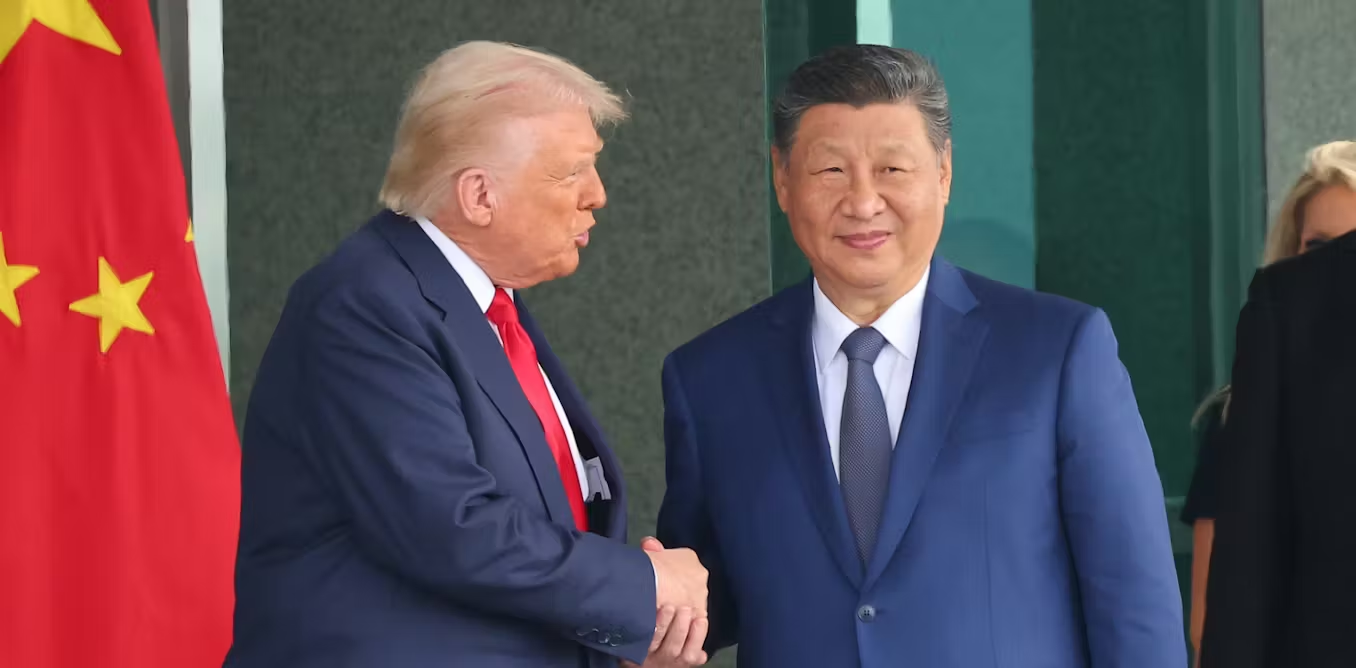
Yet Trump himself had previously declared the strait ‘permanently open’ following discussions with Xi Jinping, during which it was suggested the Chinese leader had agreed to stop arming Iran.
The Wall Street Journal reports that French diplomats believe Trump’s participation in any proposals would obstruct diplomatic progress. Nevertheless, British officials have voiced concerns that excluding the US could further antagonise Trump and create additional difficulties.
Keir Starmer has made his intention clear to maintain Britain’s distance from the growing tensions between the two countries. He told the BBC: “We’re not supporting the blockade.
Advertisement
“My decision has been very clearly that whatever the pressure, and there’s been some considerable pressure, we’re not getting dragged into the war.”
The coalition’s main aim is to ensure that shipping companies feel confident navigating the Strait of Hormuz once hostilities have ceased.
To achieve this, the plan includes rescue operations for stranded vessels, de-mining efforts to remove Iranian mines, and the creation of a programme for military personnel.
French Foreign Minister Jean-Noel Barrot indicated on Tuesday that this depends on regional stability.
Advertisement
Barrot said: “The mission we are referring to could only be deployed once calm has been restored and hostilities have ceased.”
Germany is also widely anticipated to participate in the operation.
Throughout the conflict, Trump has been vocal in criticising NATO allies for doing ‘nothing’ to support the US in safeguarding the Strait of Hormuz, warning that his country might pull out of the alliance.
Writing on his social media platform last week, Trump said: ‘None of these people, including our own, very disappointing, NATO, understood anything unless they have pressure placed upon them!!!’
Data compiled by PollCheck shows Mr Farage’s party are currently polling well in the North East, with many seats up for grabs in the May 7 elections – Gateshead and Sunderland look to be the places where Reform UK might perform the best.
PollCheck has predicted that Reform would take control of Sunderland City Council, making it the second in the region to be controlled by the party, with it winning 38 of the 75 seats up for grabs in the all-out election where every ward is up for re-election.
Projections suggest Labour could see its number of councillors cut from 49 to just 23.
Advertisement
A Reform spokesman said: “Last year, Reform UK won hundreds of council seats, including in the North East, and already we’re seeing the positive impact the party is having in those areas.
“This election is an opportunity for voters to have their say on the weak and incompetent Labour administrations both locally and nationally.
“Only by delivering big Reform wins in the North East and across the UK can we deliver the fatal blow to the two-party establishment, get Starmer out, and begin fixing Britain.”
Green
Another insurgent party hoping to do well on May 7 is the Green Party, led by left wing eco populist Zack Polanski.
Advertisement
The Greens already have a strong base in South Tyneside, where they are now projected by PollCheck to challenge Reform for second place, while party insiders feel confident that they can ‘directly challenge’ Mr Farage in the area.
Alex McKay, Green Party North East regional coordinator, said: “Across the North East we’re very excited by the reception we’ve received on the doorstep.
“When we’ve analysed this response, it looks like we’re challenging for control of both South Tyneside and Newcastle Councils.
“We also expect to make major gains across Gateshead, North Tyneside and Sunderland. National polling results, though positive for Greens, very clearly underestimate the levels of support we have identified and so we are hopeful of excellent results this May 7.”
Advertisement
Green Party leader Zack Polanski visits Darlington. (Image: ANDY FUTERS)
Labour
The Labour Party is projected to have a troublesome May, with seats up for election that they last contested at the height of the Boris Johnson Partygate scandal.
Sir Keir Starmer’s party has slid down the national opinion polls since it was elected to government in 2024, becoming the third most popular party in many UK-wide polls. And it looks set to lose control of Sunderland, Gateshead and Newcastle councils in what would be a huge blow for the party given its historic ties to the region.
Despite this, Labour says it is “fighting hard for every vote” in the North East.
“Labour councils in the North East have a proud track record of delivery and now working with a Labour government we’re making changes that will lift children out of poverty, back local businesses and strengthen communities across the region,” a spokesperson said.
Advertisement
Prime Minister Keir Starmer (Image: CHRIS BOOTH)
Potential results
Poll aggregator, PollCheck, has said these could be the most likely results on May 7, based on current opinion polls.
It was always going to be difficult for the second period to match the high-octane tempo of the first, and instead the decisive moments, both mad and magnificent, were compacted into the final few minutes.
With extra time looming, substitute Camavinga was dismissed for two yellow cards within 24 minutes of coming on. The first was for a foul on Jamal Musiala in the 78th minute and the second for taking the ball and delaying a Bayern free-kick following a foul on Kane.
The red card was to prove costly for him, and his team as the hosts made the most of their advantage.
Luis Diaz struck in the 89th minute to make it 5-4 to Bayern on aggregate, before Michael Olise put the icing on the cake in stoppage time.
Advertisement
With Guler also sent off in the aftermath, Real boss Alvaro Arbeloa admitted: “With the red card everything was over.
“It’s unbelievable to send off a player for this action. It’s not possible in a player like that, match like that. We feel really upset, really angry, really disappointed. We feel all of this is a bit unfair.”
For Bayern, a semi-final against holders Paris St-Germain will follow and boss Kompany said: “The boys were mentally strong to recover from setbacks.
“The fans helped us as well. We stayed calm and always felt that our moment would come. The boys deserved this win.
Advertisement
“We showed absolute belief and will to fight our way back into the game.”
Gerrard, a 2005 Champions League winner with Liverpool, described it as “an incredible game of football, end-to-end, fascinating tactical approaches”.
“Extra time was looking likely, but one moment of madness, indiscipline and silliness has cost Real the chance of getting to the last four,” he added.
Former Liverpool defender Stephen Warnock told Match of the Day: “Both teams were brilliant going forward, but defensively both have been poor.
Advertisement
“If you want to win the Champions League, can you play like that? It is going to be fascinating to see how that pans out when Bayern face Paris St-Germain.”



























































You must be logged in to post a comment Login