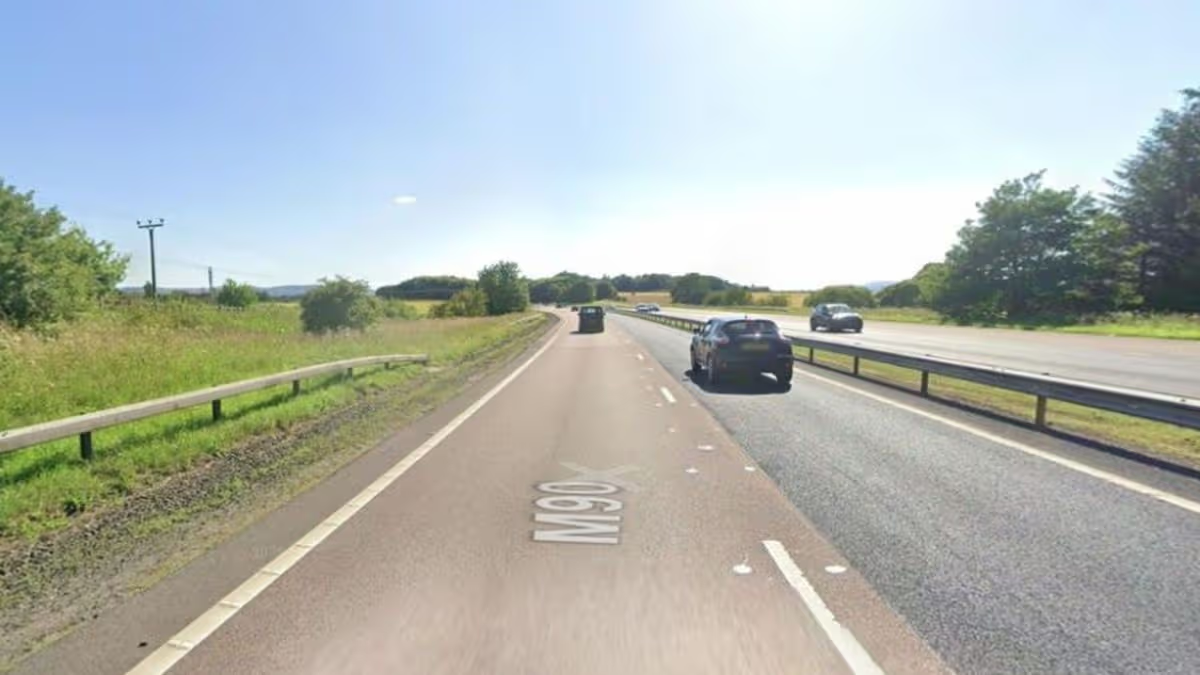
A Ford Kuga and Vauxhall Corsa crashed on the M90 late last night.
16:14, 18 Apr 2026Updated 16:15, 18 Apr 2026
Advertisement
Two men have died in a horror two-car crash where one of the vehicles was travelling the wrong way down the motorway.
Emergency services raced to the M90 near Kinross happened around 10.30pm on Friday.
A grey Ford Kuga was seen driving northbound on the southbound carriageway, near junction seven. It then collided with a white Vauxhall Corsa which was travelling southbound.
The 44-year-old male driver of the Kuga and the 20-year-old male driver of the Corsa sustained fatal injuries and were pronounced dead at the scene. Their families have been made aware.
Advertisement
The road was closed for around 16 hours between junctions six and nine to allow emergency services to carry out enquires and has since reopened. The northbound carriageway was also closed for a short time overnight.
Chief Inspector Lyne Williamson, Operational Support Division, said: “My thoughts are with the families of both the men who died following this tragic incident.
“An investigation is underway to establish the full circumstances of the crash.
“Anyone who was travelling on the M90 at the time and witnessed what happened, or has dashcam footage that could assist our enquiries, is asked to contact officers on 101 as soon as possible.”
A spokesperson for the Scottish Fire and Rescue Service said: “We received the call at 10.40pm to a two-vehicle crash on the M90. Three appliances were dispatched, with the last one leaving the scene at 2.36am.”
Advertisement
Get more Daily Record exclusives by signing up for free to Google’s preferred sources. Click HERE
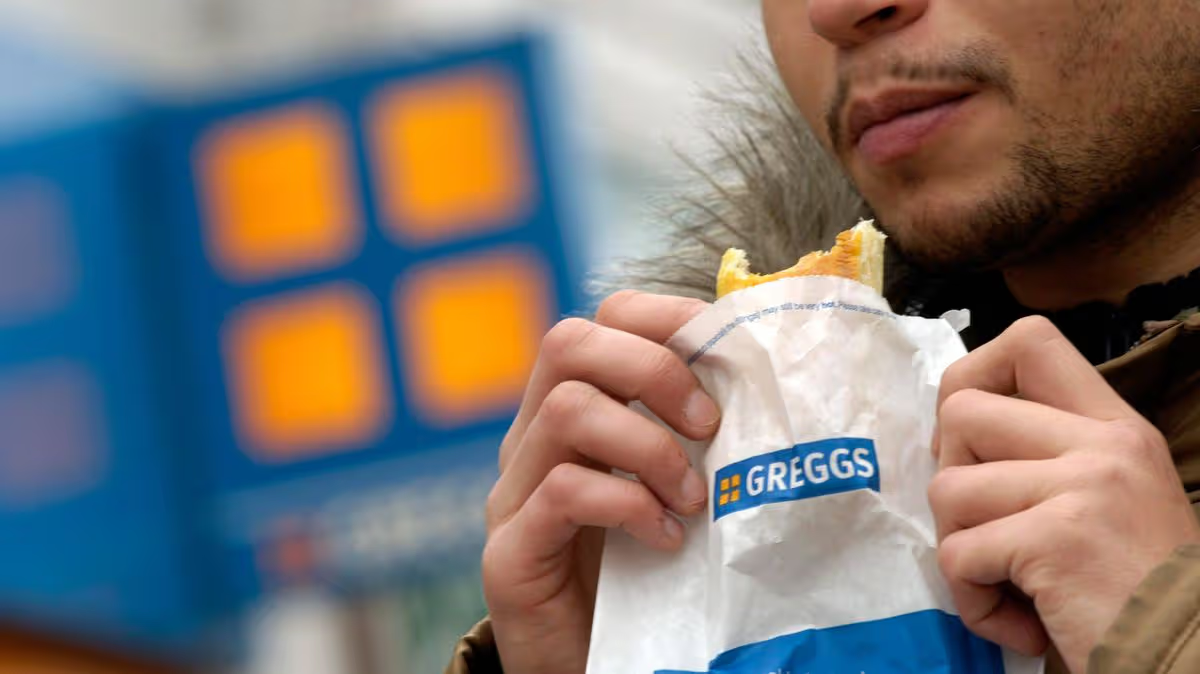
A Greggs shopper has timed their visits to the bakery chain to find the best time to guarantee fresh and hot bakes – and the ‘sweet spot’ isn’t early in the morning
Zahna Eklund Senior Social News Reporter
15:12, 20 Apr 2026
Popping into Greggs for a sausage roll can be something of a lottery – unless you’re clued up on this nifty timing tip. We all have a soft spot for Greggs, but if you’re a regular visitor to the beloved bakery chain, you’ll be well aware that getting your timing spot on is essential to guarantee your sausage roll, bake, or pizza slice arrives piping hot.
Greggs produces fresh batches of hot pastry items throughout the day, but they aren’t kept warm once they’re placed on the shelves – so if you turn up too late, you could find yourself with a lukewarm bake that’s a far cry from its best. So what is the optimum time to visit Greggs if you’re after hot food? One food enthusiast on social media has done the maths and now believes they’ve uncovered the ideal time to pop in for “fresh” food with plenty of variety.
Advertisement
In a post on the Greggs Reddit forum, one person wrote: “Started timing my Greggs visits and it actually made a noticeable difference, anyone else do this? I used to just walk into Greggs whenever I was nearby and hope for the best, but recently I started paying attention to timing.
“Going earlier in the day, especially mid-morning, the food is usually fresher, and there’s more choice available. A couple of times, I went later in the afternoon and noticed things were either sold out or not quite as fresh. It’s a small thing, but it changed the overall experience more than I expected. Now I plan it slightly instead of just popping in randomly.”
Commenters beneath the post were in agreement with the original poster. One individual even provided a specific timeframe, describing the “sweet spot” as the late morning, specifically between 10:45am and 11:30am.
They explained: “10:45 to 11:30 is the sweet spot. Fresh pizza at 11. Breakfast stops, so the bakes are all fresh.”
Advertisement
The original poster then responded: “That actually lines up with what I’ve noticed without really thinking about it. It’s like that awkward in-between where breakfast is gone, but lunch hasn’t been picked over yet.”
A Greggs staff member also contributed to the discussion with additional insight, revealing that the best time to visit actually varies depending on what you’re hoping to purchase.
They disclosed: “If you want very fresh cakes, come first thing in the morning! Yum yums are nice and soft, the glazing on them isn’t hardened, and the icing on the doughnuts is nice and moist too.
“For bakes, when you see there’s less than three or four of an item, that’s when we put in a fresh batch, so stick around for a good 20 minutes, usually takes a bit less than that if you’d like your bake fresh out of the oven. Hot sausage rolls are different; we have many batches ready at all times unless it is absolutely manic. In my eyes, the busier the shop is, the hotter your sausage rolls will be. I’ll just leave it at that if it’s any help.”
Advertisement
Greggs deliberately avoids keeping their pastry products piping hot at all times, and it’s actually a strategy that helps keep prices down for customers.
In the UK, hot takeaway food is subject to value-added tax (VAT), while food that has cooled or is served cold is exempt from this levy. If Greggs were to maintain the temperature of their sausage rolls and other baked goods after cooking, they would be obliged to pass this tax on to customers, resulting in higher prices at the till.
The bakery chain addresses this directly on their website, stating: “We sell savouries that are freshly baked in our shop ovens, then put on a shelf to cool. We don’t keep them in a heated environment, use heat-retaining packaging, or market them as hot because of this.”
They go on to add: “As bakers, we believe that baking our savouries fresh each day gives customers the best quality product. If the sausage rolls and bakes were kept hot after they had been baked, then they would be subject to VAT and the customer would have to be charged a higher price, in the same way that we charge VAT on our hot sandwiches, which are kept in a heated cabinet and are subject to VAT.”
“There are examples of balls that transfer high or low energy through all eras of play” said Andy Harland, professor of sports technology at Loughborough University.
“There is no trend that suggests the magnitude of energy transfer is increasing or decreasing over time.
“Our evidence suggests that high energy pressure wave transfer was not limited to leather balls, so, if this energy is associated with neurodegenerative disease, it is not a problem that has gone away with modern balls.”
It comes with football under mounting pressure to take more action on brain injuries, and renewed scrutiny on the relationship between heading and neurodegenerative illnesses.
Advertisement
In January, a senior coroner declared that repeatedly heading footballs is “likely” to have contributed to the brain disease which was a factor in the death of former Leeds United and Manchester United defender Gordon McQueen.
McQueen, who was diagnosed with vascular dementia, died in 2023 aged 70.
Dr Ieuan Phillips, lead researcher at Loughborough University, said: “These findings provide opportunities to work towards ball designs and testing specifications that minimise energy transfer into the brain.
Advertisement
“We’re hoping that this discovery provides some valuable information that could look more specifically at the potential causes of the disease that we’re seeing in retired players.
“At the moment, we see correlations and statistical observations about them and their careers in the game.
“As yet, it’s unexplained as to what exactly it is about the collision with a football in a header that is causing damage to the brain, and it may well be many years until we can reach that point. But I think this discovery allows us to focus specifically on something which we’ve never measured before.
“Most excitingly, it gives us the opportunity to make changes to the ball. This energy transfer that we’ve measured is separate from the big picture of the ball hitting the head and the player’s head recoiling. It is over at the very beginning of the collision and represents a very discreet pulse of energy that passes into the brain.”
Advertisement
In 2022, the FA became the first national association to remove deliberate heading in grassroots football matches at Under-12 level and below, on a trial basis.
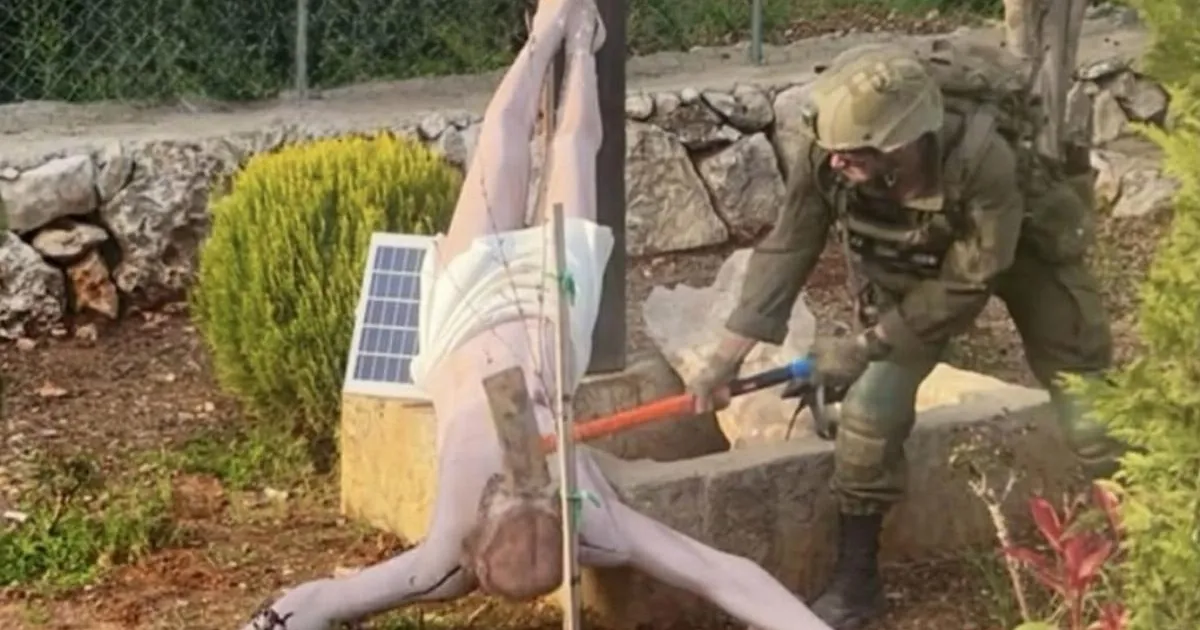
The soldier was seen smashing the weapon onto the crucifix, which had been turned upside down (Picture: X)
An Israeli soldier was photographed hitting the head of Jesus Christ in a crucifix with a sledgehammer, sparking outrage and condemnation.
The photo, taken in southern Lebanon, where Israel is continuing their campaign to establish a ‘buffer region’ outside of its own territory, prompted outcry from prominent politicians.
Prime Minister Benjamin Netanyahu confirmed the photo was real, writing on X: ‘I condemn the act in the strongest terms. We express regret for the incident, and for any hurt this has caused to believers in Lebanon and around the world.’
The Israeli Defence Forces said in a statement: ‘The IDF views the incident with great severity and emphasises that the soldier’s conduct is wholly inconsistent with the values expected of its troops.
Advertisement
‘The IDF is operating to dismantle the terrorist infrastructure established by Hezbollah in southern Lebanon, and has no intention of harming civilian infrastructure, including religious buildings or religious symbols.’
A ten-day temporary ceasefire between Israel and Lebanon was announced days ago (Picture: Getty)
Sign up for all of the latest stories
Start your day informed with Metro’s News Updates newsletter or get Breaking Newsalerts the moment it happens.
The apology has fallen on deaf ears, however, with many pointing out that in the past, the IDF has fired on other religious sites.
Advertisement
In 2024, an airstrike killed eight people who were sheltering inside the St George Melkite Catholic Church in Derdghaya, Lebanon.
The strike was rebuked by Pope Francis, who called for a ceasefire in Lebanon. The IDF said the strike was targeting militants who were operating nearby.
Last summer, Gaza’s only Catholic church – a refuge for many Christians during Israel’s war on Palestinians – was bombed. Two people were killed and several, including the parish priest, were injured.
Father Gabriel Romanelli was very close to the late Pope Francis, and the two spoke every night since the beginning of Israel’s massacre in Gaza.
Advertisement
Fadel Naem, the acting director of Al-Ahli Hospital in Gaza City, said both Christians and Muslims had been sheltering inside at the time of the attack.
They included several young children with disabilities, one of whom was injured.
Why are Israel and Lebanon fighting?
More than a million Lebanese people have been displaced (Picture: Reuters)
Hezbollah fired missiles across the border days after the US and Israel attacked Iran, resparking a lengthy regional conflict.
Israel responded with widespread bombardment of Lebanon and a ground invasion, and claims to have killed hundreds of Hezbollah fighters.
Israel has killed more than 1,530 people in Lebanon, including more than 100 women and 130 children, in the attacks. More than one million people have been displaced in Lebanon.
Advertisement
Days ago, Trump boasted that he was close to ending his tenth war after Israel and Lebanon agreed on a 10-day ceasefire.
He said he wanted a ‘lasting peace’ between the nations, adding: ‘It has been my Honor to solve 9 Wars across the World, and this will be my 10th, so let’s, GET IT DONE! President DONALD J. TRUMP’.
Speaking to reporters on the White House lawn, he said Hezbollah would be included in the ceasefire agreement.
Trump expected Aoun and Netanyahu to meet in the next week or two, before saying the White House meeting between the Mideast leaders could happen in the next four or five days.
Officers are asking for the public’s help to trace her family.
Advertisement
A spokesman for Greater Manchester Police said: “Police are appealing for the public’s help to trace family of a woman from Bolton.
“Valerie Winterbottom, aged 79, died at Shelbourne Avenue on 17/4/2026.
“There are no suspicious circumstances surrounding their death.”
Anyone who may have information about Ms Winterbottom’s family or next of kin is encouraged to contact the police coroner’s office in Bolton as soon as possible.
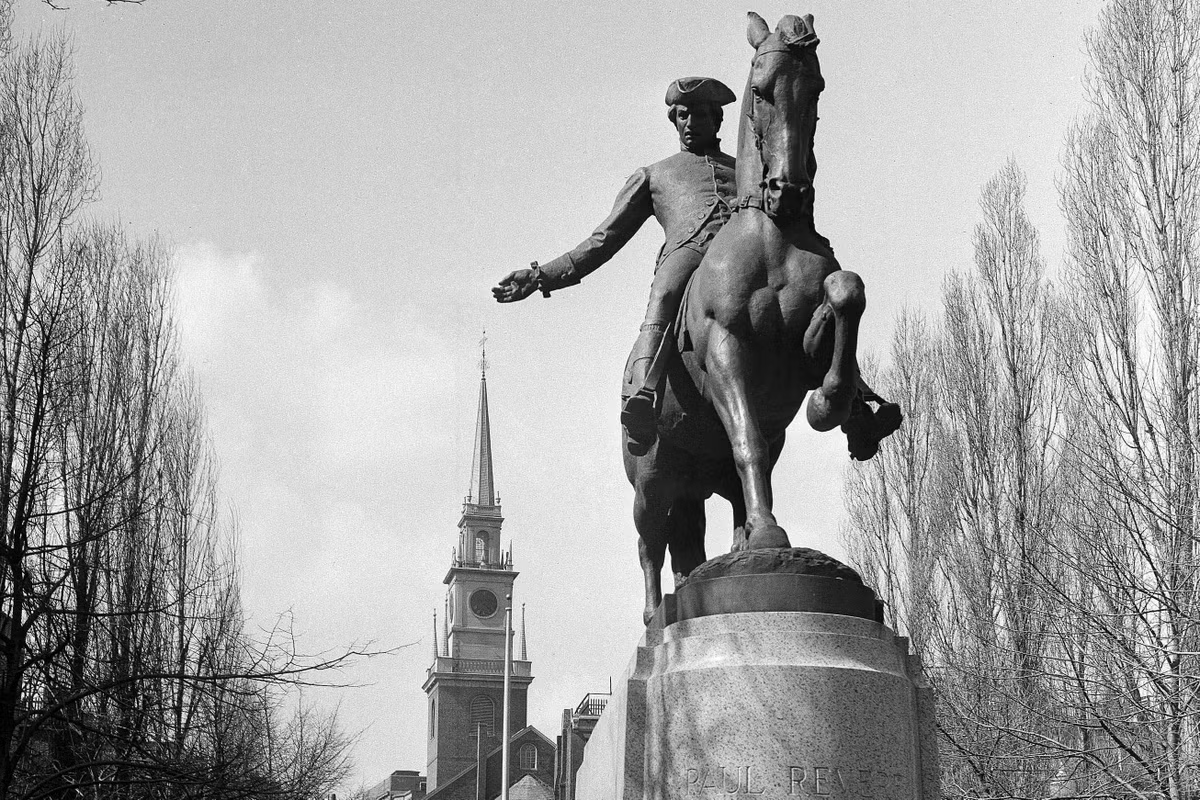
The historic midnight ride of Paul Revere is being reenacted Monday but with some modern-day tweaks: It will be run in the middle of the day, and the horse and rider will get a police escort.
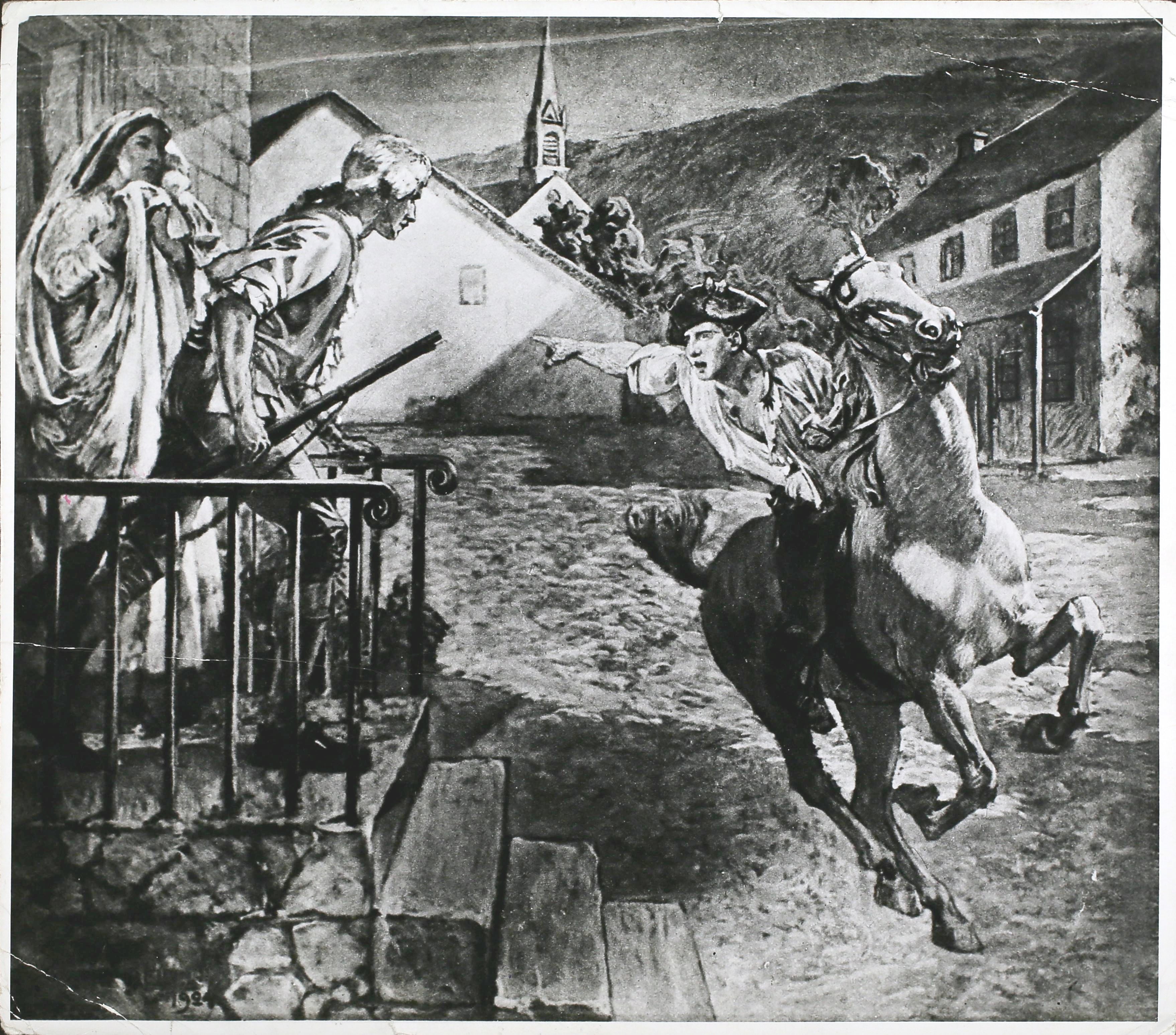
Revere’s ride took place on April 18, 1775, when the silversmith and express rider was dispatched to Lexington to warn Revolutionary leaders Samuel Adams and John Hancock that the British were coming to arrest them. He then headed to Concord to warn about raids on military stockpiles.
Revere reached Lexington around midnight, and another rider, William Dawes, got there along a different route soon after with the same message.
Their efforts resulted in militiamen, muskets in hand, confronting a much larger contingent of British regulars marching from Boston on the Lexington Battle Green. The British regulars were eventually chased back to Boston, where militias pinned them down for 11 months in what became known as the Siege of Boston.
Advertisement
“It’s important because you have to have someone to meet the British troops,” said Nina Zannieri, executive director of the Paul Revere Memorial Association, which owns and operates The Paul Revere House. “It becomes a turning point. If no patriots had turned out on the green and the British had just rolled into town, it would have been different. But they actually meet resistance.”
Paul Revere’s Ride to alert the colonial militia to the arrival of the British forces during the American Revolutionary War, April 1775. From the painting by Robert Reid in Massachusetts State House, Boston (Getty Images)
The reenactor, dressed in Colonial costume and accompanied by another horseman, will roughly trace the route taken by Revere 251 years ago. The ride will start in Boston’s North End and head to Charlestown, Somerville, Medford and Arlington before finishing in Lexington — all communities where Revere alerted militias about British movements.
Some aspects of the historic night will not be part of the event, such as Revere taking a boat to Charlestown before starting his ride.
Nor will there be Revere’s brief detention by a British patrol on his way to Concord after leaving Lexington. Revere was ultimately let go without his horse after convincing the British that hundreds of patriots were waiting for them, and he returned to Lexington to see the end of the battle.
“It’s basically important that he leaves Boston. He rides. He’s alerting people. Other people are out,” Zannieri said. “He starts a chain reaction, and he accomplishes his mission even though he gets stopped and held. He’s lucky he wasn’t killed.”
Advertisement
While Revere dodged patrols and contended with rutted and muddy roads, his 21st-century counterpart will have it easy, traversing pavement the entire way and passing through a world of stoplights, car dealerships and bustling downtowns that Revere never could have imagined. The 2026 Boston Marathon takes place at the same time, though the routes will not overlap.
Michelle DiCarlo-Domey, who organizes the ride each year for the National Lancer, the state’s historic mounted cavalry unit, said thousands come out to see history come alive and show their patriotism. The National Lancer has been holding the Revere and Dawes ride for over 110 years.
“Whenever you can interact with the riders and the horses, it can help carry history on,” DiCarlo-Domey said. “Kids can relate to what they learn in school. And where else do you see two horses running down the street?”
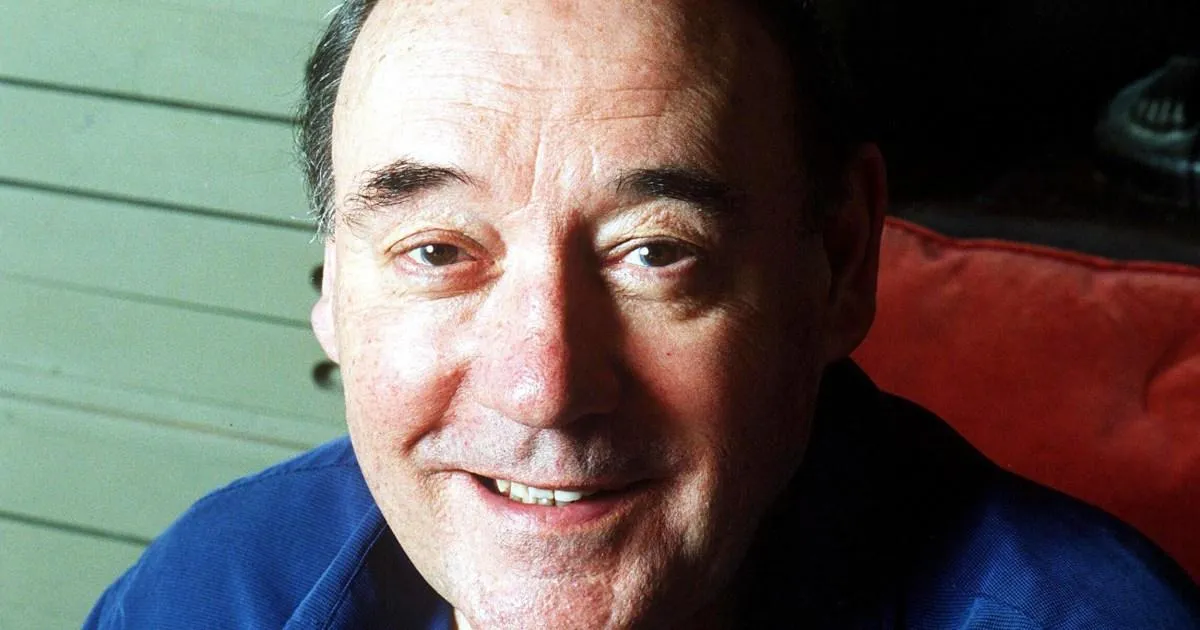
Desmond Morris, who hosted the beloved TV show Zoo Time, has died at 98 years old (Picture: Rob Judges/Shutterstock)
Television icon, author, and natural history expert Desmond Morris has died at the age of 98.
He was perhaps best known for his book The Naked Ape and the television programme Zoo Time, which he hosted from 1956 to 1967.
He scripted and hosted 500 programs for the pioneering show, as well as 100 episodes of the show Life in the Animal World for the BBC.
Zoo Time was an institution in the 50s and 60s, creating several famous, much-discussed moments, such as when Morris was toppled by a giant tortoise or urinated on by a lion.
Advertisement
At another point, a lethal cobra escaped live on-air.
The icon died in Ireland this week, where he had lived since the passing of his wife, Ramona, in 2018.
Morris’ love of animals influenced generations of Brits (Picture: ITV/Shutterstock)
Ahead of his time in many ways, Morris’ work reflected his philosophy that human beings are members of the animal kingdom as much as any other creature, and that we are inextricably enmeshed within the natural world.
He often succinctly captured this idea with the phrase: ‘Man is a risen ape and not a fallen angel.’
Born in Wiltshire in 1928, Morris joined the British Army in 1946 before studying zoology at university, eventually earning a doctorate in animal behaviour at Oxford University.
Advertisement
He soon became a respected academic, and in 1956 Morris was appointed head of the Granada Television and Film Unit at the Zoological Society of London.
Morris published hundreds of papers and dozens of books throughout his life (Picture: Mike Lawn/Shutterstock)
He used this newfound power to curate an exhibition of paintings by chimpanzees at the Institute of Contemporary Arts in 1957, provoking much ridicule but also publicity, particularly when Pablo Picasso bought one of the primates’ artworks.
Morris published his first book The Biology of Art in 1963, around the same time he began presenting Zoo Time.
But it was the publication of The Naked Ape in 1967 that made Morris a star, with the book – which looks at humans as a species and compares them to other animals – becoming a massive bestseller.
The Human Zoo, a follow-up book by Morris that examined the behaviour of people in cities, was published in 1969.
Advertisement
Throughout his life, Morris was a great lover of art, and painted thousands of canvasses himself, most in the surrealist style.
Morris told The Sunday Telegraph when he was approaching 70: ‘I would like to be remembered as someone who kept his childlike curiosity throughout his entire life. I describe myself as a senile child. That about sums me up.’
Got a story?
If you’ve got a celebrity story, video or pictures get in touch with the Metro.co.uk entertainment team by emailing us celebtips@metro.co.uk, calling 020 3615 2145 or by visiting our Submit Stuff page – we’d love to hear from you.
The scene has been recreated with toys to celebrate the launch of a new Steiff bear to mark the date of the late Queen’s birthday tomorrow, April 21.
It resembles the time the late Queen appeared in a comedy sketch with a digitally animated Paddington to mark the milestone in 2022, in which she revealed she kept marmalade sandwiches – Paddington’s favourite treat – in her handbag.
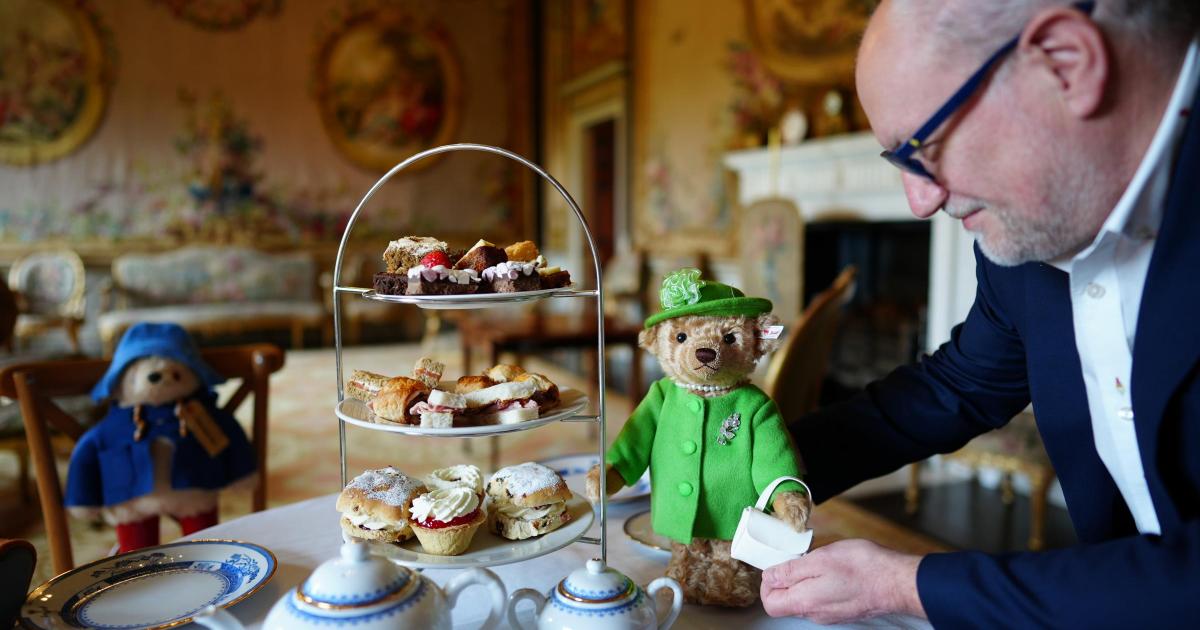
Newby Hall recreates special Queen Elizabeth II Steiff bear in the Bear House at Newby Halll. (Image: Owen Humphreys)
The stunt took place at Newby Hall, near Ripon, and saw a soft toy of Paddington positioned having tea with the special edition Queen Elizabeth II Steiff teddy bear, which wears one of the late Queen’s most recognisable outfits, a lime green coat with matching hat, pearl necklace and handbag.
Ian Munro, Steiff’s director of international sales, told the Press Association: “We’re here today at the fantastic Tapestry Room at Newby Hall, and we are celebrating the fact that 100 years ago, on the 21st of April, 1926, Her Majesty, Queen Elizabeth II, was born.
Advertisement
“And what Her Majesty (stood) for in the last 100 years was really, as she said herself, dedication and pride, and service, and I think she has a very special place in all of our hearts.
“And all of us at Steiff, together with our key partner, Galerista, wanted to celebrate this event where we’re launching a superb collectible, limited edition-style teddy bear.”
The bears will be limited to just 4,996, a nod to the late Queen living to 96 years old, and are priced at £289 each.
They will be individually numbered and presented in a souvenir bag, with coloured embroidery on the soles of their feet to commemorate what would have been the late Queen’s 100th birthday.
Advertisement
Mr Munro described the moment Paddington met the late Queen as “one of the most cherished moments” and added that it was “one of the greatest secrets”.
When the late Queen died in 2022, mourners left Paddington cuddly toys and marmalade sandwiches outside Buckingham Palace in tribute.
Founded in the German city of Giengen in 1880 by Margarete Steiff, the company which takes her name claims to have invented the first ever teddy bear, and has gone on to create an array of bears to mark occasions such as the millennium and the sinking of the Titanic.
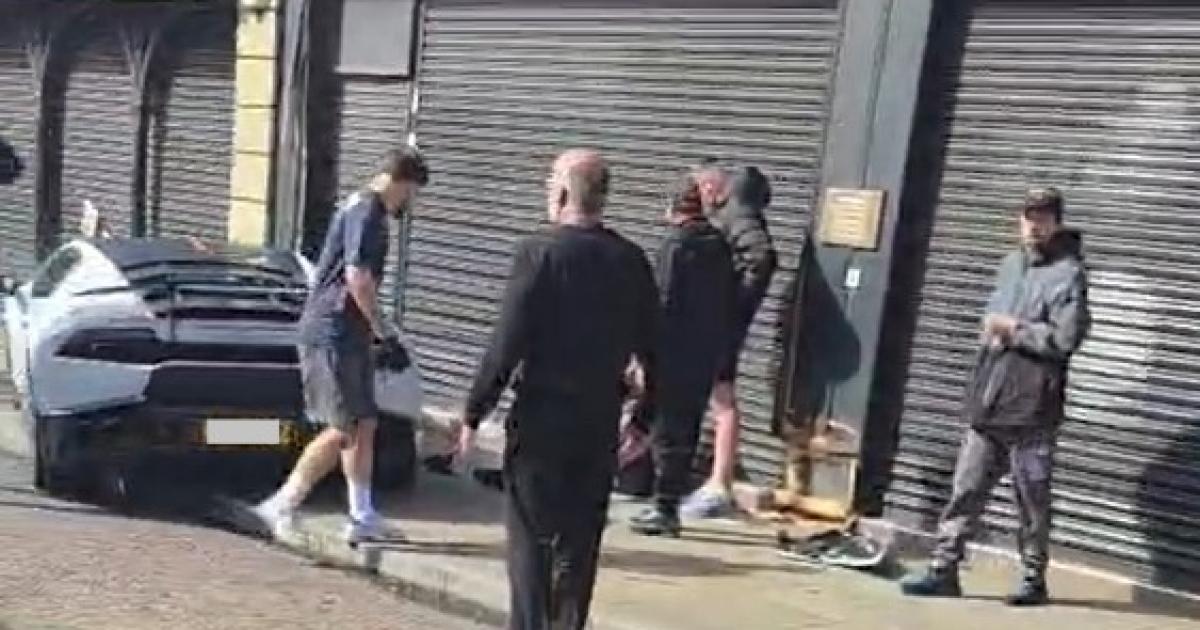
The incident happened on Darwen Street at around 11am on Sunday, just outside the Tyrrells and Embery Opticians. In footage, a man can be seen on the ground on the pavement with onlookers attempting to assist him.
The damage to the car and one section of the shop front (Image: WhatsApp)
The car, a white Lamborghini Huracan that costs more than £200,000, also caused damage to a street sign and the front of the opticians.
A police spokesperson said: “We were called at 10.59am. The pedestrian, an adult male, has been taken to hospital.”
The section of Darwen Street is one of the busiest roads in Blackburn and includes a number of takeaways and retailers.
Nasa is rushing to find a solution to prevent its first interstellar spacecraft from running out of power.
Voyager 1, which launched in 1977, suffered a drop in power levels that forced mission operators to shut down one of its instruments as a temporary fix.
The US space agency said it is now working on a “far-out plan” to extend the craft’s lifespan and restore it to full operation.
Voyager 1 is the most distant human-made object in existence, having become the first ever probe to leave the Solar System in 2012.
Advertisement
It is powered by a radioisotope thermoelectric generator, which harvest electricity from decaying plutonium. This energy system means it loses 4 watts of power every year.
An unexpected low power issue was first detected during a planned roll maneuvre on 27 February, with mission engineers warning that any additional drop in power would trigger a protection system that would shut down components on the probe.
Nasa said it shut down an instrument aboard the Voyager 1 craft, which is currently more than 25 billion kilometres (15 billion miles) from Earth, in order to prevent further issues while it works on a more permanent solution.
“While shutting down a science instrument is not anybody’s preference, it is the best option available,” said Voyager mission manager Kareem Badaruddin.
Advertisement
“Voyager 1 still has two remaining operating science instruments – one that listens to plasma waves and one that measures magnetic fields. They are still working great, sending back data from a region of space no other human-made craft has ever explored.”
The instrument, called the Low-energy Charged Particles experiment, (LECP), has been operating almost continuously for 49 years, measuring low-energy charged particles like cosmic rays from the Milky Way.
“The nuclear-powered spacecraft is running low on power, and turning off the LECP is considered the best way to keep humanity’s first interstellar explorer going,” Nasa said in an update.
“The instrument has provided critical data about the structure of the interstellar medium, detecting pressure fronts and regions of varying particle density in the space beyond our heliosphere. The twin Voyagers are the only spacecraft that are far enough from Earth to provide this information.”
If you are a history enthusiast or love historic aircraft, you probably already know about the Imperial War Museum (IWM) Duxford‘s yearly flying season. The museum’s flying season runs from May through to October every year and features a range of events.
Advertisement
The first event of the season will take place on Saturday, May 9, and will be dedicated to VE Day. Flying Days: VE Day will be celebrating “the role aviation made in the path to victory during the Second World War”.
The day will feature a flying display with plenty of historic aircraft taking part in the performance. If you already have tickets or are deciding whether to attend the event, here is the current line-up of aircraft taking part in Flying Days: VE Days.
Supermarine Spitfire Mk I
The Supermarine Spitfire Mk I is the IWM Duxford’s only airworthy aircraft and could have been called the Shrew or Scarab by its designer. The Spitfire had many roles throughout the war including as a fighter-bomber, an interceptor, and a trainer.
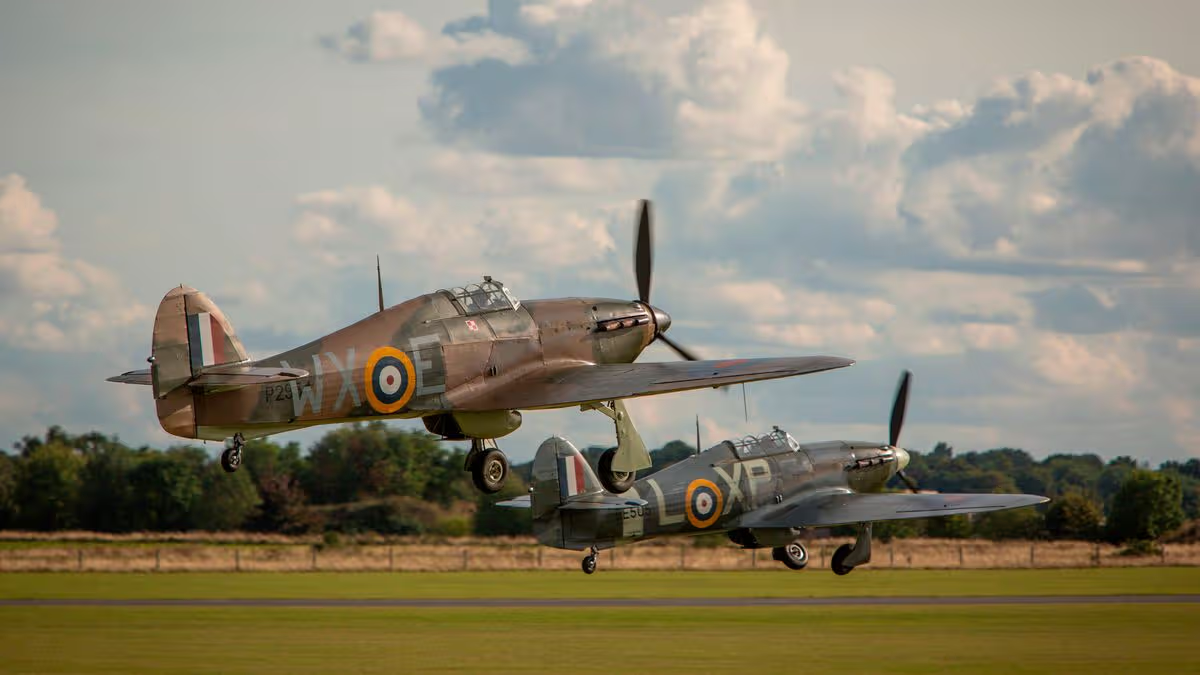
Hawker Hurricane Mk I
The Hurricane was “the RAF’s first monoplane fighter”, according to IWM Duxford. The Hurricane may have been overshadowed by the Supermarine Spitfire during the Battle or Britain in 1940 but it was essential to Britain’s victory during the Second World War.
Advertisement
The Hurricane P2902 was recovered in 1988 and has been restored using its original 245 Squadron markings.
Grumman Wildcat FM2
The Grumman Wildcat FM2 was flown by both the US Navy and the Fleet Air Arm. The aircraft was originally used by the British as a base-defence fighter but it was also used from escort carriers in the North Atlantic and from fleet carriers in later years.
Hispano HA‑112 MIL Buchón
This aircraft was developed by Spain during and after the Second World War and is a Merlin-powered version of the Bf 109. Buchóns are often used today to stand-in for wartime Luftwaffe Messerschmitt fighters. You may have seem them appear in a range of war films such as the 1969 film Battle of Britain or Dunkirk, which came out in 2017.
North American P‑51D Mustang
This aircraft was designed in 1940 by James H. Kindelberger and his team from North American Aviation. The Mustang is a long-range, single-seat fighter and fighter-bomber that was used in both the Second World War and the Korean War.
Advertisement
Lockheed 12A Electra
Described by the IWM Duxford as a “unique aircraft”, the Lockheed 12A Electra was used to secretly photograph German territory at the start of the war. They were also used to transport company executives and government official throughout the war as well as being used privately by those wealthy enough outside of wartime.
de Havilland Canada DHC‑1 Chipmunk Formation
This aircraft will be marking its 80th anniversary this year. The Chipmunk was developed after the end of World War II and was sold as a replacement for the de Havilland Tiger Moth biplane.
The Chipmunk was served as the RAF’s primary trainer from 1950 to the start of the 1990s.
LeVier Cosmic Wind
The LeVier Cosmic Wind is a Formula One air racer rather than an aircraft used for war and it was designed in 1947. The “small, high-performance” aircraft marked a shift towards more “affordable, purpose-built racing” planes.
Advertisement
It never raced in the Us but did win the premier cross-country competition in the UK in 1964.
Bücker Bü 133 Jungmann
The Jungmann was mainly used for aerobatic and air combat training by various air forces. It was a favourite for aerobatics “thanks to its agility and enduring performance” and is described as being “nimble” by the IWM Duxford.
The full flying list of the aircraft that will be performing on the day is subject to weather conditions and serviceability. There are still tickets available for the event, which can be purchased through the IWM Duxford website.
















































You must be logged in to post a comment Login