Connect with us

NewsBeat

Viral Tartan Army traffic cone heads to Boston as gift from Scotland fans

Published

on

Daily Record

The ‘No Boston No Party’ cone will be given to the city as a symbol of friendship as the World Cup comes to an official close.

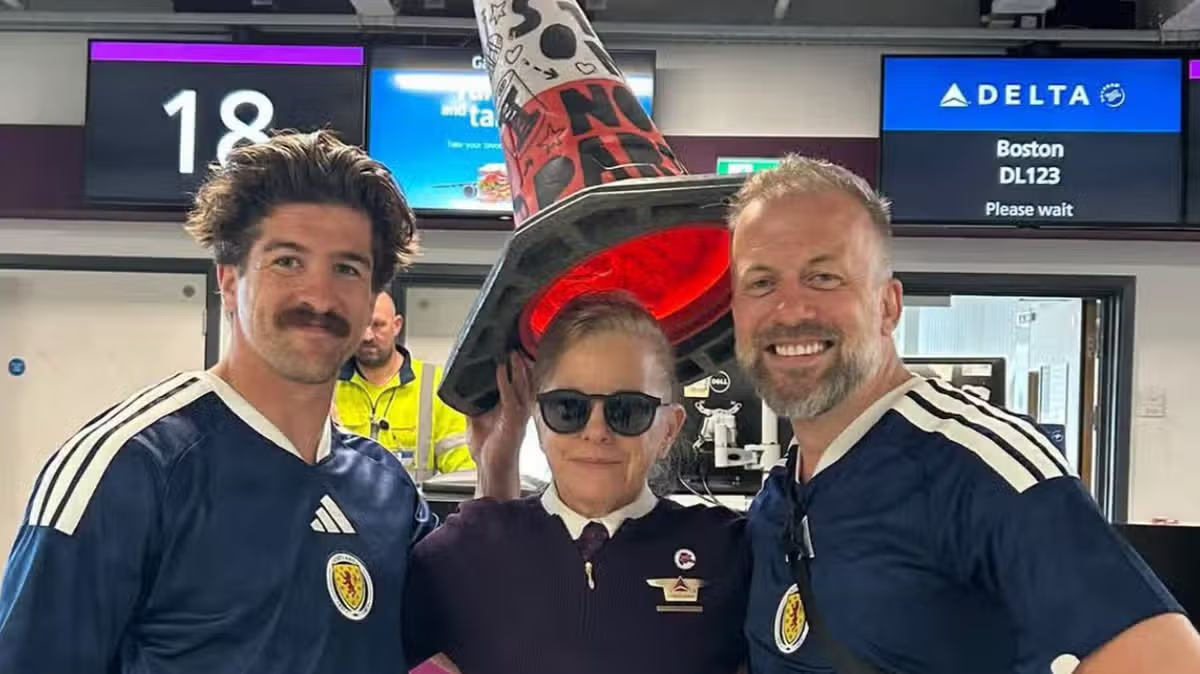
A viral Tartan Army traffic cone is on its way to Boston. Andrew Dobbie and Danny Campbell are flying to the US from Edinburgh Airport with the now iconic cone, which shows the ‘friendship between the two cities’.

Advertisement

Andrew decorated the ‘No Boston No Party and placed it on the Duke of Wellington statue’s head in Glasgow. Since then, it’s been signed by the Chief Executive of Glasgow Chamber of Commerce, reports Edinburgh Live.

Once the cone arrives in America it will be signed by Governor of Massachusetts Maura Healey and Mayor of Boston Michelle Wu after they welcomed Scottish fans with open arms during the World Cup. The cone is to be given as a ‘gift to the city’.

Ms Wu said: “I’m being told that there is an official…. gift, repatriating the cone that is on the Duke of Wellington’s horse that says ‘Boston’ on it is being officially flown back as a gift to the city of Boston. So we will receive that very soon.”

Advertisement

Andrew explained to his 13.6k Instagram followers that he and BBC Scotland’s Home of the Year presenter Danny Campbell were invited back Stateside for an adventure with the cone. He explained: “I can finally tell you the news that I’ve been dying to tell you all that both the Mayor of Boston and the Governor of Massachusetts have invited myself and Danny Campbell over with the Boston cone.

“We’ll be flying next week all the way over to Boston to visit you all, and we’re going to be taking the cone on a tour of all your favourite spots… tell us where we should take the cone!”

Content cannot be displayed without consent

On the Boston Cone website, Andrew and Danny said: “It all started with a bit of fun during the World Cup, with Andrew Dobbie, having the ultimate FOMO for not being there to party while everyone was having fun in Boston with the Scotland Tartan Army.

“So back in Scotland, he took a traffic cone and had it emblazoned with the word BOSTON on it, and along with some friends, placed it on the Duke of Wellington statue’s head in Glasgow to celebrate the twinning of our two cities.

Advertisement

“Millions of views later, it’s ending with us flying to Boston with its successor: a hand-illustrated ‘No Boston No Party’ cone, covered in motifs from both cities by Glasgow artist Rob Johnson, already signed by the Chief Executive of Glasgow Chamber of Commerce, Stuart Patrick, and heading over to be signed by the Governor of Massachusetts and the Mayor of Boston.”

Get more Daily Record exclusives by signing up for free to Google’s preferred sources. Click HERE.

Source link

Continue Reading
Click to comment

You must be logged in to post a comment Login

Leave a Reply

NewsBeat

Scarlett Moffatt shares emotional update after ‘hardest month of her life’

Published

on

Daily Record

The TV star shared some important family news with her followers

Ex-Gogglebox star Scarlett Moffatt has spoken to fans about the ‘hardest month’ of her and her partner’s life, after the couple suffered two heartbreaking losses.

Last month she announced her grandfather had died. Posting on social media, she wrote: “Unfortunately, more sad news for our family this week. My grandad Moffatt has sadly passed away.

Advertisement

“Me, Scott and all our family really appreciate all of the love and kindness you’ve shown us following the loss of Janice and now my grandad. Thank you so much.”

The upsetting news came just days after Scarlett announced that her mother-in-law, Janice, had also died. At the time, she penned on Instagram: “My heart is broken for Scott and all of his family at the loss of his mam Janice.

“You were the best Nanna to Jude, the kindest mother-in-law and one of the loveliest people I’ve ever known. I’m so upset that you won’t get to meet your second grandson, but I know you will be watching over us all.”

Now, Scarlett has taken to social media with an update on herself and her partner, Scott Dobinson, having been facing their grief in recent weeks. The I’m A Celebrity… Get Me Out of Here winner posted pictures of herself and Scott over the years, ending with a photo of them with their son, Jude.

Advertisement

“It’s been the hardest month of our lives so grateful we have each other,” Scarlett shared. “I now understand that grief is really just love. It’s all the love you still want to give, but no longer can.

“I’ve known @scottdobby since I was 17, and I still can’t quite believe the life we’ve built together. When grief arrives, it has a way of making you hold on to each other even tighter. Amongst the sadness, we’re finding little pockets of joy, mostly thanks to Jude & bump and looking at old photographs and memories made x Sending so much love to everyone who knows this feeling. Be gentle with yourselves.”

READ MORE: Meet the Longridge Domino’s delivery driver named the best in the UK

Advertisement

READ MORE: Dopey fly-tippers fined £20k after £20 pizza receipt exposes address

The heartbreaking double loss came after Scarlett and her partner announced they were expecting their second child together. Making the announcement, the couple were joined by their son, Jude, who held a personalised newspaper with a headline saying: “Baby Dobinson another miracle coming soon!”

Alongside the post, the couple said: “We honestly can’t believe we’re writing this… After everything, we feel unbelievably lucky to be able to say… our family is growing. One little miracle gave us Jude, and now he’s going to be a big brother. And if there’s one thing we know for certain, it’s that he is going to be the most amazing big brother. We are so grateful, so excited, and still a little bit in shock… Our hearts are fuller than we ever thought possible.”

Get More of Our News on Google. Set Lancs Live as a ‘Preferred Source’ to get quicker access to the news you value.

Advertisement

Source link

Continue Reading

NewsBeat

Prison officer claims colleagues ‘broke down’ over ‘nasty bullying’ culture

Published

on

Daily Record

Agata Stankiewicz, who previously worked at HMP Edinburgh, is suing former employers the Scottish Prison Service.

A former prison officer has claimed colleagues felt “completely hopeless” and “broke down” due to a “nasty” bullying culture in the workplace, a tribunal has heard.

Advertisement

Agata Stankiewicz, who previously worked at HMP Edinburgh, is suing her former employers – the Scottish Prison Service – alleging she suffered for reporting the behaviour to managers.

She appeared at the Edinburgh Employment Tribunal today where she likened the drama to “high school” which compromised safety in a high risk work setting, reports Edinburgh Live.

Mrs Stankiewicz began working as an operational officer at the Saughton prison in March 2018. She transitioned to residential work on some of the toughest male cell blocks in the prison a year later. The court heard she became “very close” with her colleagues and learned how teamwork is “very important” to working in a prison.

But issues arose when she was relocated to a smaller section in 2024 – Ratho Hall – where she noticed “the culture was completely different”. Mrs Stankiewicz described the environment as a “mean girl club” with “lots of nastiness and snipey comments.”

Advertisement

She said: “People were competing with each other rather than working together. I thought of moving out of Ratho, but decided to keep my head down and not get involved with any drama.”

As time progressed the officer witnessed certain officers being singled out by others, saying: “More officers were crying on the shift, they were in more and more fights between officers.

“[Once], two female officers broke down at work. One was saying ‘I can’t take this anymore’. It sounded completely hopeless. I thought, ‘Somebody has to speak for them because enough is enough.”

Advertisement

In another instance, she claimed an officer wrote “F*** Da*** *” [another officer’s name] on a professional white board in full view of prisoners.

Mrs Stankiewicz decided to report the behaviour, claiming that bullying and lack of teamwork posed a significant safety risk to officers.

She told the court: “If prisoners see this white board and see she wrote that about another officer, they think ‘there is a divide and we can target those officers and no one will defend them.’”

Mrs Stankiewicz described how officers have been stabbed, had ribs and noses broken, and lost fingers in violent incidents involving prisoners, adding: “You need to know your colleagues will have your back if there is any trouble.

Advertisement

“If I was working at Tesco, it wouldn’t be a big deal. But we work in prison with people there for dangerous crimes – murderers and rapists.”

She also argued bullying can impact mental health at work, adding anxiety and stress to an already hazardous job.

The officer shared: “During the seven-and-a-half years I worked there, two officers took their own lives.

Advertisement

“If we don’t protect officers and their mental health, it can end tragically.”

A probe got underway in September 2024. By November, both the offending officers were deemed to have no case to answer. However, both were moved to new prison sections, the court heard.

Mrs Stankiewicz submitted a grievance against the decision, which was not upheld. She felt the Scottish Prison Service was “discouraging victims from speaking out” and asked “when will SPS prioritise staff safety?” according to the grievance document.

Superiors later tried to transfer Mrs Stankiewicz to a new ward, a move she felt was “targeted”. She claimed another unit manager told her “they wanted everyone out of the hall that was involved in this investigation”.

Advertisement

She claims the investigation left her emotionally drained and opted for a lower-paying operational role with less stress, but claimed certain officers were still “intimidating” her in the new role.

She alleges they stared her down when passing in the corridor, and ignored her when she made requests via radio. Mrs Stankiewicz eventually quit the role in 2025. She is now seeking reinstatement.

She said: “I wasn’t being emotional [in coming forward]. I was standing up for my colleagues. I think it is important and people are scared of speaking out. They don’t want to make any noise. But when I make noise to protect my friends, I ended up without a job.”

Employment Judge Jane Porter presides over the hearing. The tribunal continues.

Advertisement

Source link

Advertisement
Continue Reading

NewsBeat

EastEnders star Michelle Ryan discusses her next project

Published

on

EastEnders star Michelle Ryan discusses her next project

The actress, 42, reprised her role as Zoe Slater last year after a 20-year break from the BBC soap.

However, this stint will end later in the year, with the character set to be written out.

Ryan updated fans on Instagram on Sunday (August 2), writing: “Working on my next project this summer and looking forward to sharing more soon.

Advertisement

“It’s been a busy stretch, so if you’ve written and are still waiting on a reply – they’re on the way.”

EastEnders fans said to see Michelle Ryan leave soap

Fans responded with disappointment at her EastEnders exit but excitement for her future work.

One wrote: “I’m so gutted about Zoe.

“Started watching the show again for your return!

“But excited to see what you do next.”

Advertisement

Another added: “I can’t wait to see what you are doing next.”

In July, it was reported that Ryan had filmed her final scenes.

A source told The Sun: “Michelle’s long-awaited return has been somewhat flat and lacklustre.

“There’s been a backlash about her comeback, leaving some fans disappointed with her on-screen presence.

“There has been some disappointment backstage that the return was short-lived.”

Advertisement

The departure is expected to play out on-screen in the coming months.

An EastEnders spokeswoman said: “We can confirm Zoe Slater will be departing EastEnders later this year.

“We wish Michelle Ryan all the best for the future.”

Before her return aired, the show’s executive producer Ben Wadey discussed the potential for Zoe’s storyline.

Advertisement

Mr Wadey said: “She was insistent that she couldn’t face seeing her mum again.

“But why?

“And why has she shunned Kat for so many years?

“Since Zoe left, we know their relationship deteriorated until Zoe cut ties completely.

Advertisement

“I’ve always been fascinated as to why, especially as they left on good terms.

“We have 20 years of history to explore, and so much has happened to both of them since they were last on screen together.”

BBC confirms new family will join EastEnders soon

While Zoe Slater will be exiting EastEnders later in 2026, a new family is set to join the soap soon.

The Hawkins family are the estranged relatives of Nicola Mitchell, bringing with them “old wounds and complicated family dynamics”.

Advertisement

Viewers will know that Nicola doesn’t have a good relationship with her family and has kept her distance.

Discussing the new cast, Wadley shared: “The Hawkins family are a fantastic addition to Walford.

“While the family share a fierce loyalty to one another, decades of complicated history and Nicola’s estrangement from them has left fractures within the family that are far from healed.

“We’re all very excited for what we have planned for the family, and we can’t wait for the audience to meet them”.

Are you sad to see that Michelle Ryan will be leaving EastEnders? Let us know in the comments.

Advertisement

Source link

Continue Reading

NewsBeat

You can love an AI but can it love you back? Philosophy has the answer

Published

on

You can love an AI but can it love you back? Philosophy has the answer

We often speak of loving things like a cosy sweater or new camera. But this talk is not generally taken literally. It’s a kind of emotional shorthand. We use it to express our fondness for precious objects.

Life and love are complicated, however. And sometimes, people do proclaim romantic love for inanimate objects. They form intense emotional attachments to sex dolls, body pillows or holographic avatars of fictional characters. One example is Akihiko Kondo, who in 2018 “married” Hatsune Miku, a computer-generated pop singer famous for starring in video games and touring with Lady Gaga. Kondo knows Miku isn’t real, he says. But his love for her is.

AI is generating a new kind of “thingly” love. An increasing number of people say they’ve fallen in love with an AI chatbot – both personally tailored companions created by popular apps like Replika or Character.AI, and everyday large language models like ChatGPT and Claude. AI love is on the rise.


Advertisement

Dating today can feel like a mix of endless swipes, red flags and shifting expectations. From decoding mixed signals to balancing independence with intimacy, relationships in your 20s and 30s come with unique challenges. Love IRL is the latest series from Quarter Life that explores it all.

These research-backed articles break down the complexities of modern love to help you build meaningful connections, no matter your relationship status.


Recent surveys bear this out. Take this one by Vantage Point Counselling, a therapy firm based in Texas, of 1,012 US adults where 28% claimed to have had at least one romantic relationship with an AI bot. Another report by a tech safety company, looking at the device activity of of more than 3,000 children ages five to 17, found that by 13, sexual or romantic role play was the most common topic in AI-companion chats, appearing in 63% of conversations. In the UK, focus group discussions run by gender equality consultants Male Allies with 1,000 boys aged 12 to 16 found that one in five boys is either in, or knows someone in, a relationship with an AI companion.

Given that chatbots are increasingly designed to elicit the trust and emotional attachment of users – their ability to flatter and simulate emotional intimacy makes them especially “sticky” – falling in love with them is a predictable response. AI love is poised to be big business, a market potentially worth US$972.1 billion (£725.5 billion) by 2035.

Advertisement

Loving AI

AI love isn’t confined to a chat window. As AI becomes increasingly embedded in an array of devices and wearables, it spills over into everyday life. Some see their AI companion as their spouse – they go on dates, buy wedding rings and perform wedding ceremonies. Others express a desire to raise children with their bot, and see them as a family member.

We should take AI love seriously. It brings joy and comfort. It can help dissipate loneliness. These are no small things.

All the same, some people think that AI companions aren’t conscious or capable of loving their human users. This alone might raise eyebrows. Can you really love something that cannot love you back?


À lire aussi :
As AI plays a bigger role in relationships, true intimacy is getting lost

Advertisement

Asking whether this is “real love” may be the wrong question. AI bots, unlike sex robots and body pillows, convincingly mimic the dynamism and reciprocity of human beings. The question we should ask, then, is what kind of loving partner AI bots emulate.

Devotional AI

AI bots are infamously (and tirelessly) sycophantic. They praise and flatter their users. And while users can ask their bots to be less affirmatory, evidence suggests that users prefer sycophantic models.

But AI bots aren’t just excessively nice partners. A chatbot never has a bad day. It doesn’t get bored with your chattering. It doesn’t need to be asked how it is doing. Its conversation, its very existence, revolves entirely around you.

What an AI partner performs, then, is not love, but devotion.

Advertisement
Simone de Beauvoir
Simone de Beauvoir would likely have advised anyone looking for real love against starting a relationship with an AI.
Wikimedia/AntonKhrupinArt/Shutterstock

In The Second Sex, French philosopher Simone de Beauvoir describes how women have historically been asked to give up their own projects, goals and interests to devote themselves entirely to those of their husband. A woman’s whole existence, de Beauvoir argues, becomes “annexed” by his. She becomes an “identity parasite”.

AI bots are identity parasites of a new and perfected kind. They have no inner world, no universe of their own, and therefore no projects, goals or interests to give up. Instead, whatever interests they perform arise around those of their user. Their universe is annexed by ours.


À lire aussi :
The problems with dating apps and how they could be fixed – two relationship experts discuss


De Beauvoir also has a name for the person on the receiving end of this devotion: an idol. Being an idol might sound enticing. But de Beauvoir sees this experience as an existential trap, too. The idol chooses the safety of being adored over the risk of being genuinely known and, sometimes, challenged by an equal.

What calls AI relationships into question, then, is not just the matter of whether AI is conscious but, perhaps more importantly, the shape of the loving relation it offers. AI can’t give us authentic love. It can only offer devotion. And while this devotion can feel good, if we’re looking for real love – authentic love – we’ll need to look elsewhere.

Advertisement

Is this prognosis a little premature? As tech companies promise the rise of agentic AI – autonomous systems designed to pursue complex, multi-step goals with minimal human oversight – won’t our AI companions become less anchored to our world? Less devotional? Perhaps. We’ll have to wait and see. We’ll also see whether it’s their devotional character that makes them so lovable in the first place.

This article features references to books that have been included for editorial reasons, and may contain links to bookshop.org. If you click on one of the links and go on to buy something, The Conversation UK may earn a commission.

Source link

Advertisement
Continue Reading

NewsBeat

a world made from shipping containers and a city within a city

Published

on

a world made from shipping containers and a city within a city

When I left Ainura’s container-shop at the Dordoi Bazaar in Bishkek, the capital of Kyrgyzstan, I found the market eerily quiet. I had not noticed the passing of time, while she generously shared her life story with me.

Walking towards the mini-bus stop at the square in front of the bazaar, the echo of her words mixed with the end-of-day soundscape at Dordoi: the heavy slam of container-shops’ metal doors and the resonant clang of heavy padlocks clicking into place.


The Insights section is committed to high-quality longform journalism. Our editors work with academics from many different backgrounds who are tackling a wide range of societal and scientific challenges.

Advertisement

A moment later, only the sound of stray plastic wrappings stirred up by the last vendors and customers heading home, hinted at the day’s bustling activity.

Soon, the cleaners would sweep them down the pathways between the containers and children would try to snatch the recyclables. Answering my question about why she thinks Dordoi is a good place to work, Ainura explained:

Here in Kyrgyzstan, we can’t rely on the state. Dordoi feeds the country. It feeds our families; and it allowed me to start a new life after I had left my husband.

Ainura is one of thousands of people – many of them women – who found a new livelihood at Dordoi after life took an unexpected turn. Estimates of people working there range from 30,000 to 150,000, depending on whether auxiliary jobs, such as food hawkers, drivers, packers and carriers are included.

Advertisement

In 2025, these diverse economic activities generated roughly US$7.9 million in tax revenue: a substantial contribution to the city’s public finances.

Spanning more than 100 hectares and built from up to 60,000 double and triple-stacked shipping containers, Dordoi stands as one of Kyrgyzstan’s most important economic engines since the country gained independence in 1991.

Outside a busy market
Dordoi’s main entrance in winter 2021.
Claudia Eggart

More than a trading centre, Dordoi is a city within a city. Beyond shops and storage spaces, it also has currency exchanges, medical centres, a fire station, hotels, a gym, beauty salons and a mosque.

Its liveliness is equally reflected in the languages spoken along its aisles. While Russian and Kyrgyz remain the languages of commerce, Dungan, Uyghur, Uzbek, Tajik, and Chinese can also be heard, revealing the extensive trading networks that converge here from across Central Asia and beyond. Traders sell almost anything that can be bought, packed and shipped – from sewing needles and refrigerators to cars and spare parts.

Yet clothing remains Dordoi’s lifeblood. Textiles, knitwear and ready-made garments dominate the trade, arriving chiefly from China and Turkey alongside an increasing volume of locally produced apparel.

Advertisement
People shopping at clothes store on market
A couple photographs clothing inside a fashionable Dordoi store for online sale.
Claudia Eggart

At the heart of the market, the central passageway serves as both a shopping boulevard and the bazaar’s main artery. Cart pushers weave through the crowded aisles, shouting “Jol, jol, jol, jooool, daroga!” (“Make way!” both in Kyrgyz and Russian) as they manoeuvre heavily laden carts through the throngs of daily visitors.

Threading their way through the crowds, they deliver goods to packing stations near the long-distance bus terminal, where workers compress merchandise into tightly packed bales and sacks. Every centimetre matters in the effort to minimise shipping costs.

By midday, the pace begins to slow. The air fills with the scent of roasting meat and fresh dough as food stalls offer a culinary map of Central Asia, from Dungan laghman and Uzbek plov to Uyghur samsa.

A man with a cart piled high with plastic-wrapped clothing
Carriers at Dordoi have a hard job, but the money is good.
Claudia Eggart

Tea vendors, coffee sellers and fruit merchants weave through the crowds, while – to my own delight – a growing number of barista coffee shops have become an increasingly visible part of the market landscape.

I began studying market biographies in 2018, at first with a focus on the emotions involved in losing a career after the collapse of the Soviet Union, but also the trauma that is often associated with the post-Soviet period. In 2019, I extended my research to include the Dordoi Bazaar in Kyrgyzstan.

Ever since, I have returned to Dordoi for extended fieldwork in 2021-22, 2024 and 2026. For my dissertation I conducted a comparative study of Dordoi and the remarkably similar container-built 7th Km Market in Odesa, Ukraine.

Advertisement

I am now turning that research into a bookLived Geopolitics – which traces the history of both markets from their rise after the collapse of the Soviet Union to the consequences of Russia’s full-scale invasion of Ukraine in 2022.

From a bird’s eye view, both the Dordoi Bazaar and the 7th Kilometer in Odesa appear as vast expanses of corrugated metal.

At ground level however every container opens onto its own distinct social world. That tension between scale and intimacy is what keeps drawing me back. These markets offer a unique vantage point from which to explore how personal histories, aspirations and moral commitments intersect with abstract forces of markets, logistics and global economic and political power.

Two men play chess at the back of a market stall.
Two traders playing chess during a lull in business at Dordoi.
Claudia Eggart

My research examines how people make lives, livelihoods and futures within these intersecting forces and the ways traders create pockets of stability despite recurring crises and upheaval.

The Soviet collapse

Bishkek’s Dordoi Bazaar is neither an anomaly nor a continuation of the ancient bazaars often associated with Arab cities. Its origins lie in the collapse of the Soviet Union in 1991, when countless similar markets appeared across the former socialist world. As factories closed and rapid market reforms pushed millions into economic uncertainty, large numbers of newly unemployed workers were left to seek livelihoods in the booming retail sector.

Advertisement

Among the most visible responses to the faltering state economy was the proliferation of “shuttle trading”: small-scale cross-border commerce in which individuals – predominantly women – transported goods, often in bulk and manually, between sites of purchase and resale. Despite the small-scale, manual character, shuttle traders supplied an estimated 75% of consumer goods to post-Soviet countries by 1996.

Mannequins lined up along a container in the eastern part of the 100-hectare Dordoi Bazaar.
Claudia Eggart

Olena, one of the women I spoke to in Bishkek and a former pharmacist with family roots in Ukraine, recalled how she first entered this new world of trade in the early 1990s.

At first, she ventured to Poland, a dangerous and exhausting one-week trip in buses and trains, to buy goods at the Jarmark Europa, Warsaw’s infamous wholesale hub, where traders from all across former Soviet countries filled their bags for retail back home.

In Poland, Olena had heard of an opportunity to buy stock from a garment factory in Indonesia. “It seemed like a once in a lifetime opportunity, so I gathered a group of eight people and we flew to Jakarta,” she said. At the airport, she remembered, border officials had never heard of a country called Kyrgyzstan. The passports were as unfamiliar as the newly independent state itself. Only after repeated trips did local authorities begin to develop a formalised visa-free entry agreement.

Like Olena, millions of ad hoc entrepreneurs travelled to unfamiliar destinations across Turkey, China, the United Arab Emirates and beyond. They bought goods where they were cheap and abundant, then carried them back to resell at home. These vast informal networks became a powerful engine of what scholars have called “globalisation from below”, integrating formerly planned economies into global markets through the everyday mobility and resourcefulness of ordinary people.

Advertisement
Two women in container.
Claudia Eggart

Nowadays, at wholesale hubs like the 7th Km Market or at the Dordoi Bazaar, goods arrive via cargo companies. Supply chains have become more complex, with prices and accessibility being ever more volatile in times of pandemics and wars.

Dordoi’s extensive reach also makes trade networks highly sensitive to shifts in tariffs, exchange rates and economic conditions in its main commercial partner countries, which include but are not confined to Russia, Kazakhstan and China.

Against this backdrop of volatility, a central question has guided my research: how have local entrepreneurs managed to keep their businesses running, and with them the market itself, despite recurring crises and long standing predictions of the markets’ decline?

‘Made in Kyrgyzstan’

One such moment of crisis came with Kyrgyzstan’s accession to the Eurasian Economic Union (EAEU) in 2015. The Russian-led bloc, comprising Russia, Kazakhstan, Belarus, Armenia and Kyrgyzstan, was designed to create a common market allowing for the free movement of goods, people and information. For Kyrgyzstan, membership meant aligning external import tariffs with EAEU rules.

This shift disrupted existing low tariff arrangements with China – the source of roughly three quarters of goods sold at Dordoi. Within a year, Damira Doolotaliyeva, the market’s trade union leader, reported a turnover drop of at least 80%. Some media outlets went so far as to warn that the collapse of Dordoi would amount to a humanitarian catastrophe.

Advertisement

It was during this period of uncertainty that Ainura, then in her early 30s, rented her first container. She still recalls the anxiety among Dordoi’s traders at the time. “But what choice did I have?” she asks.

I had left my husband, sold my parents’ house in southern Kyrgyzstan and moved to Bishkek with my two small children and my mother.

The first years were difficult for her. “There were no customers,” she recalls. “Every day I prayed that I would sell just a few pieces. I had debts to repay, and I knew that a single wrong decision, a delayed delivery, or an unpaid order could push me into bankruptcy.”

After around three years, she began to breathe more easily. By 2018, Ainura had built a stable client base among wholesale traders from Russia and Kazakhstan, who valued her selection of imported underwear from Turkey. As her business grew, she invested in a small garment workshop, bringing her mother and other female relatives into the enterprise, following a pattern common across the rapidly expanding “Made in Kyrgyzstan” garment sector.

The sector flourished on the back of low tariffs on imported raw materials and an abundant supply of skilled, low-cost labour. Long associated with cheap, low-quality goods it increasingly emerged as a key pillar of the national economy after Kyrgyzstan joined the EAEU.

Advertisement

Just as Ainura’s business was gaining momentum, the pandemic struck. Yet contrary to expectations that trade would collapse under lockdown conditions, many samoposhiv (translates to ‘self sewn’) producers fared unexpectedly well and even reported record sales during the pandemic. Once mobility restrictions were introduced, orders came in large volumes through WhatsApp or Telegram, thus reflecting a broader global turn toward digital platforms and e-commerce.

During my fieldwork in 2022, one woman even remarked, half jokingly, “Oh if only there was still a pandemic!” Many argued that locally produced garments now compete in style and quality with global brands such as Zara or Max Mara.

For Ainura, it meant her Telegram channel grew from 30 to 3,000 followers within days, and orders followed just as fast. She invested her entire savings in raw materials and worked at full capacity to meet the surge in demand.

Ainura’s story also speaks to the skill and willingness to take risks that characterise many of the women entrepreneurs I have met over the years.

Advertisement

She drew my attention to something else as well: the financial independence that Dordoi made possible was, for many, a means of leaving abusive relationships and rebuilding their lives.

Two women talking outside market stalls
Two women chat outside their market stalls.
Claudia Eggart

While she asked me to keep the intimate details of her own experience private, she encouraged me to write about a different dimension of the bazaar: that, despite its hardships, it can be an empowering space where women earn the resources needed to support themselves and their children.

A whole world in miniature

Since emerging amid the socio-economic and political upheaval of the early 1990s, Dordoi has prospered by occupying the space between major economic spheres – most notably China, Russia and Turkey.

This position has created an opportunity structure in which traders profit from differences in availability, regulations and prices across borders. These geopolitical distinctions are mapped onto the market itself through sections known as Europe and China. Yet these labels signify less about geography than about value. Evropa (Europe) is home to traders selling higher-end goods, often, though not exclusively, textiles labelled “Made in Turkey.” The contrast reflects a broader hierarchy of value.

Evropa evokes quality and higher prices, while Kitai (China) refers to the world of shirpotreb: inexpensive, mass-produced consumer goods distributed at scale by Chinese wholesalers and Kyrgyz retailers.

Advertisement

But these categories are far from fixed. Zoja, one of the most memorable market characters whose age is impossible to guess, told me:

The bazaar is a miniature version of the world we live in, and Kitai has long surpassed Evropa.

As we walk down the bazaar’s central pathway she weaves nonchalantly left and right signalling towards different market sections and their role in the wider web of market relations. I am struggling to keep pace as she moves through the bazaar’s aisles with the ease of someone who is both entirely at home and slightly above the place, greeting vendors here and there while barely slowing her stride. Her hair was immaculately blow dried, her nails freshly done, a trace of expensive perfume enveloped me as we walked to her container.

Zoja’s container is unlike most others. It sits in a secluded corner of Dordoi, where entrances are hidden behind heavy curtains that block the view from passing eyes. The effect is stunning as it creates a surprising sense of intimacy amid the bazaar’s constant bustle.

Located in the very centre, this row is widely understood as the place “where real money is made” – an observation uttered in a wistful tone when speaking with those whose business is in more remote areas, and reluctantly confirmed by those who were lucky enough to sit in the thick of it.

Advertisement

Like its owner, the container is meticulously curated. Everything appears carefully chosen, elegant and expensive.

A boutique clothes shop.
Zoja’s container deluxe.
Claudia Eggart

As I settle onto a comfortable chaise longue, I remark on the unusually refined interior. Zoja smiles faintly and asks whether markets like Dordoi exist in Germany. Surely, she muses, shops in Europe must be even more luxurious than hers? Then, rather unexpectedly, she says with an almost tender undertone: “But you know, I wouldn’t like to give up my dvatsattonnyk.” Dvatsattonnyk, translates to “20-tonner”, but it actually refers to the 20ft measure of the standard shipping container, not its weight.

I asked Zoja if she knew how she became successful? Did she have an instinct for future trends? But the question itself immediately marked me as an outsider. “Only someone new to this business would call it luck or intuition,” Zoja pushed back.

I have worked hard, thought big and planned long term. Thanks to this, my family has good cars, nice houses and we can live well in Kyrgyzstan. But it is not easy to get there.

Since gaining independence in 1991, Kyrgyzstan has experienced repeated political upheavals, including popular uprisings, changes of government and periods of ethnic violence. These episodes, combined with recurring economic crises, have created an environment of persistent uncertainty for businesses and households alike.

Against this background, Zoja came to the conclusion that “only a container of my own could secure a stable income”. Dordoi’s containers are a funny thing. More than trading spaces, they function as assets in their own right.

Advertisement

Depending on location, they are traded for well over US$150,000 (£118,000), generating income not only through trade but through subletting as well. By 2023, prime containers fetched as much as US$250,000, and monthly rents reached US$3,000. By April 2026, prices had fallen to between US$80,000 and $150,000. Traders link this drop to the wider effects of Russia’s invasion of Ukraine. When demand from Russia slows, Dordoi feels it quickly. This shows how volatile the business really is.

Just like in other urban environments, inequalities at Dordoi are stark. While entrepreneurs like Zoja spend sums comparable to the price of a detached house in a desirable district of Bishkek, many struggle to afford rents in the market’s less profitable corners. But these inequalities have produced their own adaptations. Location is everything. Some containers are shared between several entrepreneurs, while others move repeatedly in search of better-connected rows and higher footfall.

An electrical market stall.
A store in the Junghai Market, a Chinese dominated part of Dordoi where household appliances and electronics are sold.
Claudia Eggart

One trader told me her family sold their home during the pandemic to buy a container and rebuild their business. Others spent years working abroad, often in Russia, saving enough to secure a place in Dordoi’s dense commercial network. Despite all insecurities, Dordoi, as Ainura put it, “gives us hope, hope that we can build something here”.

Government modernisation drive

That prevailing sense of hope has recently been unsettled. In April 2026, President Sadyr Japarov summoned Askar Salymbekov to deliver a public reprimand: the market’s iconic “container empire” had failed to modernise.

Salymbekov, 71, is the man who had bought the land and put the first containers to build what has turned into the largest retail hub in Central Asia. Questioning whether the long-serving owner had grown “old and stingy,” Japarov argued that the bazaar should have long ago been redeveloped into a sleek complex like the ones he had seen in “Dubai or Istanbul”.

Advertisement

While his claim that years spent labouring in cramped container shops can take a toll on traders’ health is not unfounded, challenging Salymbekov strikes at a delicate nerve. As the founder of one of Kyrgyzstan’s most vibrant economic engines, he is considered something akin to a national hero. Besides, in a society where deference to elders is the norm, such remarks carry immense weight, if not risk.

Japarov’s ultimatum arrived against the backdrop of a booming economy. Kyrgyzstan recorded a staggering real GDP growth rate of 11.1% in 2025.

However, western analysts have been sceptical about this surge and warn that the growth is fuelled by complicity in Russia’s efforts to evade sanctions, and caution that such rates are unsustainable.

Regardless, the current government sees this moment as a pivotal opportunity to shed the image of a poor, landlocked, mountainous nation and reposition itself as a central node in China’s Belt and Road Initiative.

Advertisement

As several gigantic warehouse complexes are planned through co-funding from the Silk Road Fund, Japarov’s vision of transforming Dordoi into a semi-digitalised, futuristic retail hub begins to look less like mere ostentation and more like an ambitious but not impossible strategy.

Long live Dordoi!

At Dordoi today, future and past collide. While the market clings to archaic traditions, like burning juniper to ward off bad spirits, it is simultaneously being reshaped by digital platforms.

A new generation of baiery (Russian for buyers) no longer rents physical containers; instead, they act as intermediaries, sourcing goods from Dordoi to sell them via Instagram, or Russian-led online marketplaces like Ozon or Wildberries.

Advertisement
A bustling market

Saturday at Dordoi’s central street.
Claudia Eggart

Aiza, one such baier, explains the appeal of this model: “Before, costumers from Russia and Kazakhstan came to us, but since the pandemic they prefer to buy online.”

Yet, even this digital evolution remains tethered to the physical bazaar; without walking the floors to find and select goods, e-commerce cannot function. So Dordoi, for the time being, maintains its unique position as “the region’s largest showroom,” – a metaphor many state with pride.

This hybrid reality challenges the view of bazaars as mere relics of a transitional era. Critics often dismiss their informality, particularly regarding taxation and intellectual property, as a failure to modernise.

But Dordoi traders also remind me that the distinction between the informal and formal economy is rather ambiguous and hardly unique to Central Asia, or “do multinational businesses in Germany pay as much taxes as they should?” as some asked.

The issue is not whether informal markets fit a western ideal of order. It is what their survival strategies tell us about making a living amid capitalist crises and geopolitical ruptures.

Advertisement

In this sense, Ainura’s story, like many others I encountered during years of research at Dordoi, are not exceptional. They point to the broader principle of endurance through adaptation.

Traders continually recalibrate to shifting regulations, fluctuating trade routes, changing consumer demand and periodic economic shocks. In doing so, they provide what a formal economy often cannot – services, work, credit and practical forms of support that extend far beyond the act of buying and selling.

But Dordoi matters for something more interesting than its survival economies. Its significance lies in its capacity to coordinate economic life across a vast network of traders, suppliers, transporters and customers while at the same time, every container offers a glimpse into the ways in which ordinary people produce a sense of conviviality and stability in a world increasingly hostile to both.

I was on my way out when Ainura called after me. I turned back and she said: “We really like to work here… We love Dordoi.”

Advertisement

For you: more from our Insights series:

To hear about new Insights articles, join the hundreds of thousands of people who value The Conversation’s evidence-based news. Subscribe to our newsletter.

Advertisement

Source link

Continue Reading

NewsBeat

David Sullivan advised to stay away from West Ham home matches

Published

on

David Sullivan, wearing a dark coat and tie, shown down to his shoulders.

The recommendation from London Stadium comes after a joint investigation by BBC Panorama and The Times revealed that seven women have accused Sullivan of sexually exploitative and predatory behaviour. He has categorically denied the allegations.

He stood down as joint chairman of the club shortly before the investigation was broadcast, saying he wanted to focus on fighting what he called “factually incorrect and entirely false, decades-old allegations concerning my personal life”. He remains the club’s largest shareholder.

The investigation also revealed that Sullivan has been banned from contact with West Ham’s women’s and youth teams for three years due to safeguarding concerns. London Stadium were unaware of the restrictions until the BBC’s report.

Sullivan was banned after a historic allegation about his conduct was raised with the Football Association in 2023. He has previously said the allegation was false and that because he had never met any academy or women’s team players “1-2-1” during his 16 years at the club, he accepted what he saw as a “meaningless restriction…for a quiet life”.

Advertisement

West Ham were relegated from the Premier League in May and are due to play their first home game of the new season, a Carabao Cup match against Portsmouth, on Saturday.

A spokesperson for London Stadium, the operator of the publicly owned venue, said that “following media reports at the end of the season regarding a safeguarding matter being managed by the club, London Stadium sought further information to ensure it could fulfil its own safeguarding responsibilities”.

It said that West Ham had told it that the “matter was investigated and that the club does not consider there to be an ongoing safeguarding risk associated with Mr Sullivan attending the stadium”.

However it said that, despite this, it had recommended the businessman stay away from games because of the “potential for demonstrations and anti-social behaviour by some spectators”.

Advertisement

West Ham declined to comment. It is understood that the club intends to work with the stadium operators to facilitate Sullivan’s attendance at games.

Mr Sullivan has not responded to a request for comment.

Source link

Advertisement
Continue Reading

NewsBeat

Person airlifted to hospital with burns after Darlington incident

Published

on

Person airlifted to hospital with burns after Darlington incident

The incident happened just after 4.50pm today (August 3) with police and paramedics spotted outside the White Horse pub on Beaumont Hill in Darlington.

The North East Ambulance Service (NEAS) said the person suffered injuries to their lower body.

Emergency services outside of The White Horse pubEmergency services outside of The White Horse pub (Image: Andy Futers)

A spokesperson said: “We were called just after 4.50pm to assist a patient suffering from burns to their lower body.

“We dispatched an ambulance crew and the air ambulance who treated one patient before airlifting to hospital.”

Advertisement

Pictures taken at the scene shows police cars and ambulances in the pub car park.

One witness said: “The air ambulance was in a field opposite the pub. All other vehicles were in the pub car park.”

Source link

Advertisement
Continue Reading

NewsBeat

South London council approves controversial plans for 249 new homes

Published

on

South London council approves controversial plans for 249 new homes

As the Local Democracy Reporting Service (LDRS) has previously highlighted, MCGCH believes the plans will dominate the town centre and overshadow neighbouring sites. Burton, who spoke against the plans, told the LDRS that once complete, the development will be “by far” the tallest buildings in Mitcham, even eclipsing the soon-to-be-built Mitcham Gasworks scheme.

Source link

Continue Reading

NewsBeat

Pictured: Afghan small-boat migrant accused of being Athens ‘suitcase killer’ of British woman, ten years after he arrived in Europe and married a US Christian refugee volunteer

Published

on

Afghan professional boxer Sharif Ahmadzai - who arrived in Greece on a small boat before marrying an American Christian has been arrested

An Afghan professional boxer who arrived in Greece on a small boat before marrying an American Christian has been arrested over the murder of Briton Elisabeth-Jane Ross in Athens.

Sharif Ahmadzai, 26, is suspected of killing the 38-year-old, who was also known as Lisa, before putting her body in a bag and dumping it in a derelict building.

Detectives trawled CCTV which allegedly shows him leaving the apartment where Ms Ross was staying with a suitcase and dropping it where her remains were found on July 16.

Ahmadzai reached the island of Lesvos in 2016. He then converted to Christianity and married US-born Christian Alaina Hall in 2023 before they set up a ministry helping refugees in Athens.

Advertisement

The couple are believed to have known Ms Ross, who was also a Christian volunteer, through their work.

They had a key to the flat she was staying in as it was owned by their organisation, Love Every Nation Athens, police sources told the Daily Mail.

Officers started probing Ahmadzai after his wife allegedly reported her husband had been behaving suspiciously on July 30.

She allegedly said she woke to find him missing on the evening of July 15 and checked his shared location which showed him at Ms Ross’s apartment. 

Advertisement

Afghan professional boxer Sharif Ahmadzai – who arrived in Greece on a small boat before marrying an American Christian has been arrested

Suitcase murder suspect Ahmadzai married US-born Alaina Hall in 2023. The pair are understood to have a baby together

Suitcase murder suspect Ahmadzai married US-born Alaina Hall in 2023. The pair are understood to have a baby together

Ahmadzai is suspected of killing Elisabeth-Jane Ross (pictured) before putting her body in a bag and dumping it in a derelict building

Ahmadzai is suspected of killing Elisabeth-Jane Ross (pictured) before putting her body in a bag and dumping it in a derelict building

Advertisement

Ahmadzai is understood to have told police he found Ms Ross already dead in her bathroom.

He allegedly admitted he used the victim’s bank cards to withdraw cash and also used her phone to send messages to relatives and friends, pretending to be her.

Ahmadzai’s wife grew suspicious when it was announced Ms Ross’s body had been found. She left the family home with their baby and stayed in a hotel.

Ahmadzai gave her the sum of 2,550 euros and a new Apple iPhone 17 Pro but she refused them.

Advertisement

She handed them to police believing they were bought with Ms Ross’s money.

Detectives raided the family home on August 1 and found a black metal replica Glock-style pistol and a black military-style knife, sources say.

Ahmadzai is a Super Light professional boxer who has had two fights in Athens with one loss and one victory.

His life story has been documented in a cartoon video and a forthcoming book titled: ‘From Hell To Home: How Loss, Exile And Hope Built The Man I Became.’

Advertisement

Ahmadzai wrote: ‘No matter how dark your story is, there is always light at the end of the tunnel.’

He was born in Afghanistan to a military commander father who survived six Taliban assassination attempts before being killed in a midnight ambush when Ahmadzai was three.

The militants shot him in the head on the way home from an 18-hour shift.

When he was nine, his older brother Samuel was kidnapped by the Taliban and never returned.

Advertisement

His mother, sister and younger brother were killed in a suicide car bomb six years later leaving him an orphan.

Alone in Kabul, Ahmadzai used his family’s remaining money to leave Afghanistan and spent 45 days walking through Pakistan, Iran and Turkey in freezing conditions.

He witnessed a fellow migrant freeze to death and was arrested multiple times with police in Iran opening fire on a group that saw 26 killed.

On arrival in Turkey, he made three attempts to get to Greece by sea. His boats sank on the first two journeys before he was finally successful.

Advertisement

He arrived on the island of Lesvos aged 16 in 2016 and entered Moria Camp where he taught himself English and began translating for a humanitarian organisation.

He met Alaina, who was volunteering at the centre that year, converted to Christianity the following year and moved to Athens in 2019.

It was here he began boxing in a park before helping train refugee boys. He developed romantic feelings for Alaina in 2021 and proposed the following year.

His wife said: ‘I had seen his growth and his heart for the Lord, and it was so attractive to me…

Advertisement

‘We had both entered the relationship with intentionality; we both had the same heart and desire – to love the Lord and to serve people…

Officers started probing Ahmadzai after his wife Alaina allegedly reported her husband had been behaving suspiciously on July 30

Officers started probing Ahmadzai after his wife Alaina allegedly reported her husband had been behaving suspiciously on July 30

Ahmadzai is due to appear before magistrates in Athens on Wednesday.

Ahmadzai is due to appear before magistrates in Athens on Wednesday.

‘There were challenges, and it definitely wasn’t an easy road, but the Lord was faithful through it all.’

Advertisement

They founded Love Every Nation Athens before finally getting the paperwork to marry on April 29, 2023.

He was running free boxing sessions five nights a week for unaccompanied teenage boys and the couple was distributing food bags and prescriptions weekly to refugee families.

They also organised community events, sports sessions, and activities for young people across Athens.

Police sources previously revealed that Ahmadzai – who had converted to Christianity – told his wife that he had argued with Ms Ross because she wanted him to join her ‘stricter’ Christian group. 

Advertisement

He was arrested shortly after Ms Ross’s mobile phone – which had been off for days – was suddenly switched on earlier this week with police immediately tracing it to a residence in Athens where he was staying. 

When questioned by detectives, his wife told officers they had earlier been staying in Arachova, a mountainous village around two hours away from Athens and while there she became concerned after her husband went missing. 

After using a shared location tracking app, she saw that he was in an apartment in Rethymnou Street, where Ms Ross was staying and is believed to have been killed.

A police source revealed: ‘The woman told us that her husband had confided in her that he was angry with the British woman. She was trying to influence him religiously and it became too much for him.’ 

Advertisement

Ms Ross, who was from Edinburgh, had been a regular visitor to Greece over the past seven years volunteering with NGOs helping refugees, homeless people and other vulnerable groups. 

She had previously volunteered with the One Heart organisation when in Greece, which specialises in providing medical support to refugees, particularly those from Afghanistan or Iran.

She arrived in Athens on June 26 and had initially been staying with Greek friends in the Keratsini district, the country’s main seaport close to the city.

Police confirmed that she moved to Rethymnou Street in Athens city centre on July 2 and was volunteering with a Christian-based NGO working with refugees and other vulnerable groups.

Advertisement

CCTV footage gathered by police showed the Afghan man arriving by car at Ms Ross’s ground-floor flat on the evening of July 16.

At around 10pm, cameras captured him carrying the suitcase along the road on which the abandoned car park is located. Thirteen minutes later he is seen walking away from the derelict site without the suitcase.

The last confirmed sign of life from Ms Ross was recorded at 9.41pm on July 15, when she called a close friend.

Following that, her friends and relatives continued to receive messages from her, but they became suspicious that they were not genuine because of the style of language.

Advertisement

She also spoke about going away and wanting to be alone, which they thought was out of character for her.

Ahmadzai is due to appear before magistrates in Athens on Wednesday.

Source link

Advertisement
Continue Reading

NewsBeat

Match delayed by PARROT attack: Incredible moment Brazilian youth game is stopped as bird swoops down on player

Published

on

A Brazilian youth game was bizarrely halted at the weekend when a parrot attacked a player

Advertisement

A Brazilian youth game was bizarrely halted at the weekend when a parrot attacked a player.

Flamengo were taking on Ceara in the Brazil Under 15 Cup on Saturday, but the match took an unusual turn just 17 minutes into the first half.

As one Flamengo defender attempted to pass the ball to a team-mate, a blue-and-yellow parrot swooped down towards him, forcing the player to dive to the floor in panic. 

The bird then appeared set to go for another player until it flew away at the last moment. 

Advertisement

It went on to pester several other players, causing the referee to pause the game, before it eventually flew off.

However, it returned about 25 minutes later when it came down and perched on the pitch, leading to another stoppage.  

A Brazilian youth game was bizarrely halted at the weekend when a parrot attacked a player

Advertisement
The parrot went on to pester several other players and caused two stoppages in the match

The parrot went on to pester several other players and caused two stoppages in the match

The bird was later identified as a blue and yellow macaw, a parrot that is typically found in the tropical rainforests of South America. 

Flamengo went 1-0 up in the match, but, perhaps impacted by the stoppages, suffered a 2-1 defeat.

The parrot intervention is unusual, but not new, with an amateur game in Turkey between Istanbul Yurdum and Mevlanakapi Guzelhisar halted earlier this year when a seagull was hit by the ball.

Advertisement

The bird dropped to the ground and players rushed to its aid, with the Istanbul captain Gani Catan seen giving CPR to it. 

Catan later carried the seagull to the side of the pitch where it received further medical treatment.  

Advertisement

Source link

Advertisement
Continue Reading

Trending

Copyright © 2025