

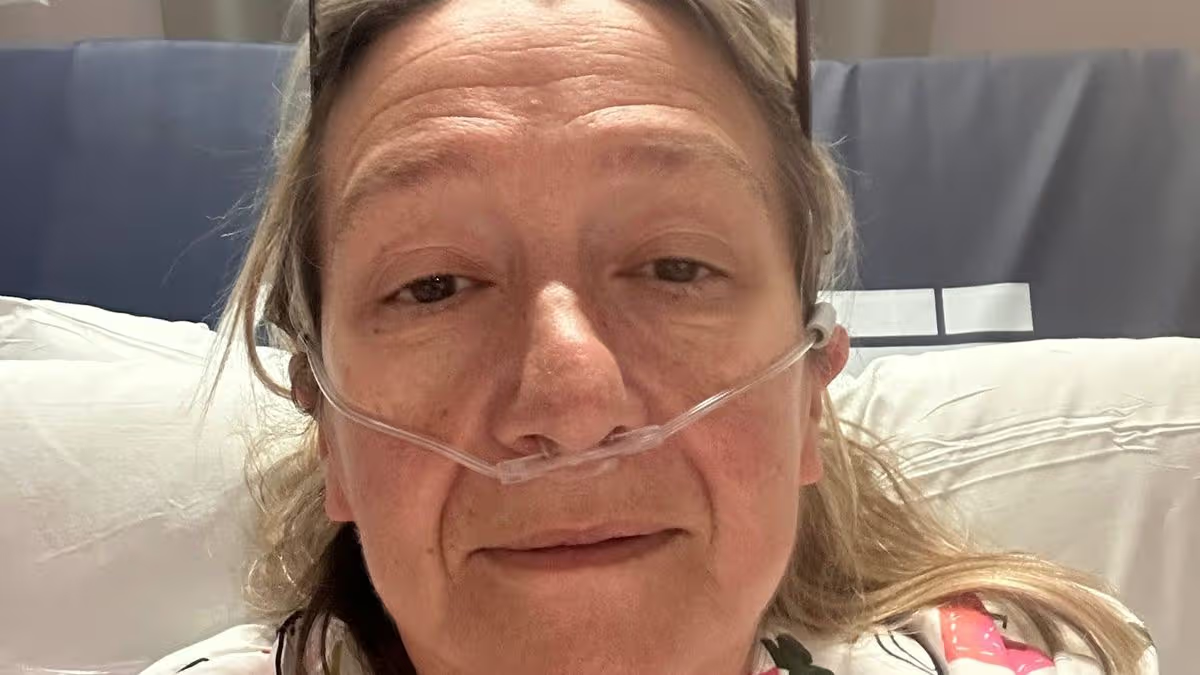
Ruth Lloyd-Williams, from Llandudno, was first diagnosed ‘by chance’
A mother who had IBS for decades before receiving a terminal bowel cancer diagnosis has said she is determined to outlive her prognosis and is manifesting a “miracle” as she believes “cancer hates positivity”. Ruth Lloyd-Williams, 61, a businesswoman who lives in Llandudno, was first diagnosed with bowel cancer “by chance” in February 2025 after spontaneously booking a GP appointment for a check-up.
One month later, she was told she needed a stoma and had “five years” to live and, one year later, after various treatments including chemotherapy and radiotherapy, she was given the news she only had “months to live”. Despite this prognosis, Ruth refuses to be a statistic and is determined to see her grandson born in September – and she is currently receiving a new treatment which she hopes will prolong her life.
If “the worst happens”, she has decided she would like to be cremated in her wedding dress to avoid the “pain and heartbreak” of her family having to dispose of it, and she would like to have her ashes scattered in her back garden, so she “never misses out on a family BBQ or a garden party”.
Speaking about her advice to others with terminal cancer, she told PA Real Life: “Don’t just sit there and be the statistic. It doesn’t matter how old you are because, unfortunately, cancer doesn’t care how old you are, or what your life plans are or whether you’re going on holiday next year.
“But if you can do anything, be as positive as you can. Cancer hates positivity. I am full of hope and do believe that miracles do happen.”
Ruth has had symptoms of irritable bowel syndrome (IBS) – a common condition which affects the digestive system and can cause stomach pain or cramps, bloating, diarrhoea and constipation – ever since she can remember. She recalls having “tummy ache” from the age of five and being taken to hospital during primary school, but she said doctors “never knew what to do about it”.
As she reached adulthood, she said she just “learned to live with it” – but her symptoms of excruciating abdominal pain, frequent or infrequent bowel movements and anxiety were “debilitating” at times.
“You get to the point where it’s just part of your life,” Ruth said. “I was just left to get on with it, so every time it flared, I either treated it myself or I just saw myself through the process.”
Ruth said her symptoms were never fully investigated – she just had “this IBS label” – and her flare-ups continued over the following years. In January 2025, however, while at her GP surgery booking an appointment for her husband Paul, now 67, she enquired about booking a check-up for herself.
She had been experiencing some discomfort and noticed a recent change in her bowel movements, so she thought: “I’ll go and ask, I’ve not been for years.” After an initial appointment, Ruth was referred for a colonoscopy on February 5, 2025, which she said was “fairly painless and all over in a flash”.
Within an hour, she said she was given the “bombshell” news that she had bowel cancer and a 6cm tumour had been found. “It was almost like an out-of-body experience – you’re out there watching somebody else get this news that’s going to change their life,” she said.
The following month, in March, her consultant told her the cancer was “treatable and not curable” and she would need a stoma – an opening on the surface of the abdomen which has been surgically created to divert the flow of faeces or urine.
She added: “I could hear this wailing noise and it wasn’t until I stopped to think that I realised that wailing noise was me.”
On the day of the stoma procedure on March 19, 2025, Ruth said she arrived at hospital in silver sequin trousers to “make a statement”. However, just two days later, she was given further “out of the blue” news.
“The consultant came along to see me and said, ‘I’ve got some news for you. Unfortunately, we’re going to have to upgrade your diagnosis’,” she said.
“I said, jovially, ‘Oh, an upgrade to me is extra leg room and a glass of champagne, so what is it?’ He said, ‘No, unfortunately, the scan showed that you’ve got mets (when cancer spreads) in your liver, you’ve got five years and there’s nothing we can do’.”
Ruth subsequently underwent chemotherapy from April to September, followed by 25 sessions of radiotherapy, and she had her liver resectioned and ablated – a treatment which uses extreme temperatures to destroy cancer cells – on February 6, 2026. However, she then suffered an infection and another follow-up scan in March this year revealed the tumours had increased in size again and her liver was “riddled”.
“I went to see the consultant after it had all calmed down and I was told I’d only got months to live,” she said. “But my answer to that was, ‘Well, I can’t go anywhere because I’ve got a grandson due in September’.”
Ruth, who built a community support resource for women called Network She, was offered a new treatment called Breakwater. She currently receives this intravenously once a fortnight and takes tablets every day. While she said she suffers side effects of fatigue, nausea, mouth abscesses and peripheral neuropathy, a type of nerve damage, she is responding well to the treatment and hopes it will prolong her life.
“It’s very easy to have a diagnosis and think, ‘Oh, I’m dying, I may as well just sit on the couch and wait for it to happen’… I’m not doing that,” she said. “I’m now on something that wasn’t available to me when I was first diagnosed, so one year down the line, two years down the line, there might be something else.”
Ruth, who also runs a medical education business for healthcare professionals called HCP Ed-UK, is now writing a diary-style book about living with bowel cancer, featuring characters named after her tumour, stoma and PICC line, which is used to give chemotherapy or other treatments. She named her tumour Billy because, at first, she hoped he would have “no mates”, her stoma Prada after the luxury brand and its bags and her PICC line Lilli after the food piccalilli.
She has worked with an illustrator called Michelle Webster to create an animation of her tumour, basing the character on one of “the ugliest fish in the world”, a blue hairy frogfish, and her stoma.
“This all comes from dealing with imposter syndrome,” she explained. “I’ve found over the years that when you’re dealing with something that is big and uncomfortable, or just unpleasant, if you name it and you give it a personality, it’s easier to deal with.”
Ruth hopes to release the book later this year, titling it, Ruth vs Billy – One Woman’s War Against Billy The Hairy Blue Face Frog Fish, and she has set up a Facebook group in the same name, where she posts regular updates. She is encouraging everyone to advocate for themselves when it comes to their health, do their own research and remain as positive as possible.
“Cancer hates positivity, so I hate cancer, so therefore I am being as positive as I possibly can – and that alone makes you feel better,” Ruth said. “Your diagnosis doesn’t have to be the end of your life. It might be eventually, but it also might be the reason for living.
“I’ve very much learned you have to live in the moment and I often think of the phrase: ‘Don’t count the days, make the days count’.”
To find out more, visit Ruth’s Facebook page.



















































You must be logged in to post a comment Login