

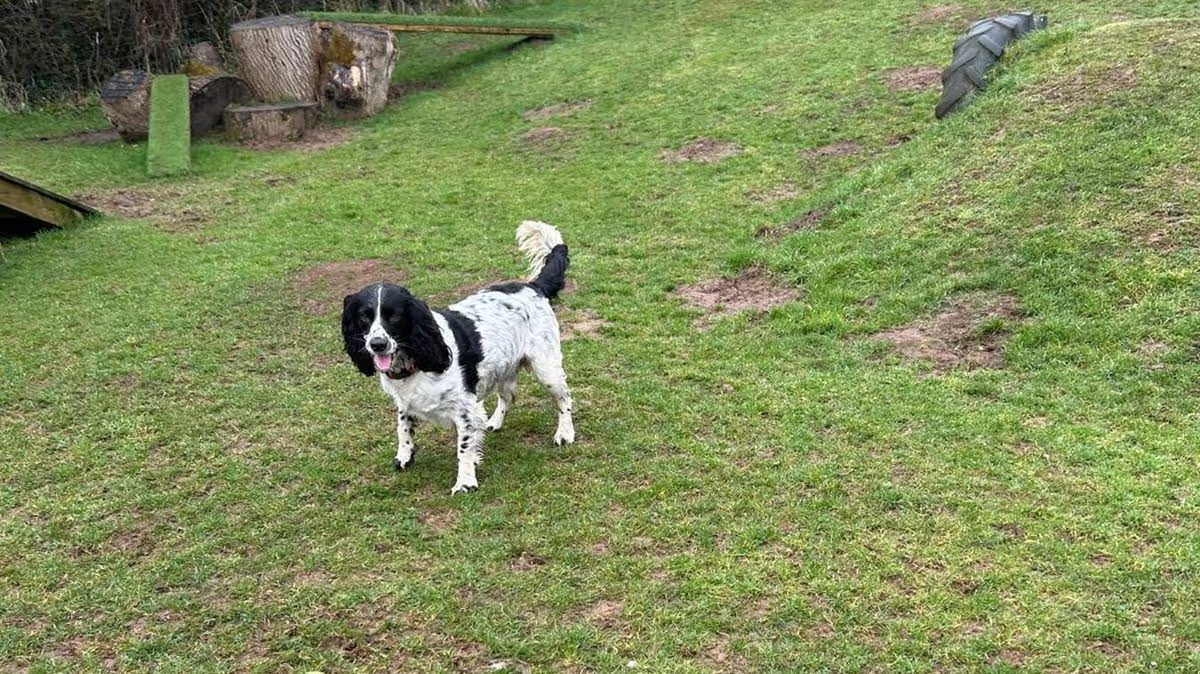
Jo Bowen-Jones, from Anglesey, believes her dog Baxter died after a suspected adder bite – the only venomous snake native to the UK – at common land beside RAF Valley near Rhosneigr
A dog owner believes her beloved pet died after being bitten by a snake near a Welsh beach.
Jo Bowen-Jones, from Anglesey, suspects her dog Baxter was bitten by an adder – the only venomous snake native to the UK – on common land beside RAF Valley near Rhosneigr.
Ms Bowen-Jones, a grandmother living in Rhosneigr, told North Wales Live how on the morning of Tuesday, 31 March, the pair had crossed a wooden bridge over Afon Crigyll when their walk came to an abrupt halt after Baxter, a Springer-Cocker spaniel, lifted his paw and started limping.
“I was on a track heading back to the car, not too far from the bridge, when I saw Baxter suddenly stop and lift his front paw,” she said. “He didn’t yelp and after some coaxing he came to me. But he was struggling to walk. I had to half carry him over the bridge.”
READ MORE: Ricky Gervais restores faith in humanity after terrified dog thrown off city wallREAD MORE: Dog trainer names 4-word phrase that ‘will make pet’s behaviour worse’
Unable to get her dog home unaided, she asked a passing campervan owner to keep watch over him while she retrieved her car. “I was only gone five minutes,” she said. “But in the time I’d been away he’d vomited and pooed himself. There wasn’t any swelling but I felt his paw and there was a tiny mark.”
Having rung ahead to Bodrwnsiwn Vets in Mona, Ms Bowen-Jones and the campervan owner lifted Baxter into her estate car. She arrived at the veterinary practice within 30 minutes of the suspected bite, reports Wales Online.
“They carried him in on a rug – there was no way he could walk,” she said. “His breathing was ragged, his tummy was taut and his eyes were not good.” Baxter was administered anti-histamines and paracetamol and placed on a hydration drip. Vets also suspected an adder bite, though anti-venom medication was not administered.
“It can cause anaphylactic shock and other side effects,” Ms Bowen-Jones said. “As Baxter’s breathing was so laboured, it was decided anti-venom was too risky.”
She made arrangements to collect Baxter at 6pm, planning to transport him to Colwyn Bay, Conwy, for overnight care, as no such provision has been available for pets on Anglesey since June 2024.
“I got a phone call from the vets at 5pm to say Baxter had taken a turn for the worse,” she said. “His heart had stopped and, by the time I got there, he had died.
“I knew he was going downhill and I was losing him but it was still a shock. He was a fit and healthy five-year-old dog. As he had deteriorated so quickly it made me wonder if he’d had an underlying condition.
“I can’t fault the vets. They did their best and they were very clearly very upset. We’re 80%-plus sure it was an adder bite that killed him.
“He didn’t swell, as often happens, but every dog reacts differently. Soon after I read an adder had been seen in the same area around the same time.”
Keen to alert other pet owners to the danger, she posted a cautionary message on Facebook. “Dog owners often associate adders with coastal dunes but this happened on grassland,” she said. “They can be found in any open, sunny habitat.
“This year they seem to have come out early. Usually they will do their best to avoid people and dogs. But early in the year, as they emerge from hibernation, they can be a little drowsy and might not be so quick to get away, so extra care is needed.”
Despite a considerable surge in the UK’s dog population, adder bites remain uncommon and fatalities are exceptionally rare. While nearly all dogs that are bitten display symptoms, 95.4% reportedly pull through with prompt veterinary treatment. Fatalities typically result when the bite goes untreated, and tend to be more common among smaller breeds.


















































You must be logged in to post a comment Login