Connect with us
DAPA Banner

NewsBeat

Water trip risk assessment not sufficient before boy’s death, inquiry told

Published

on

Daily Record

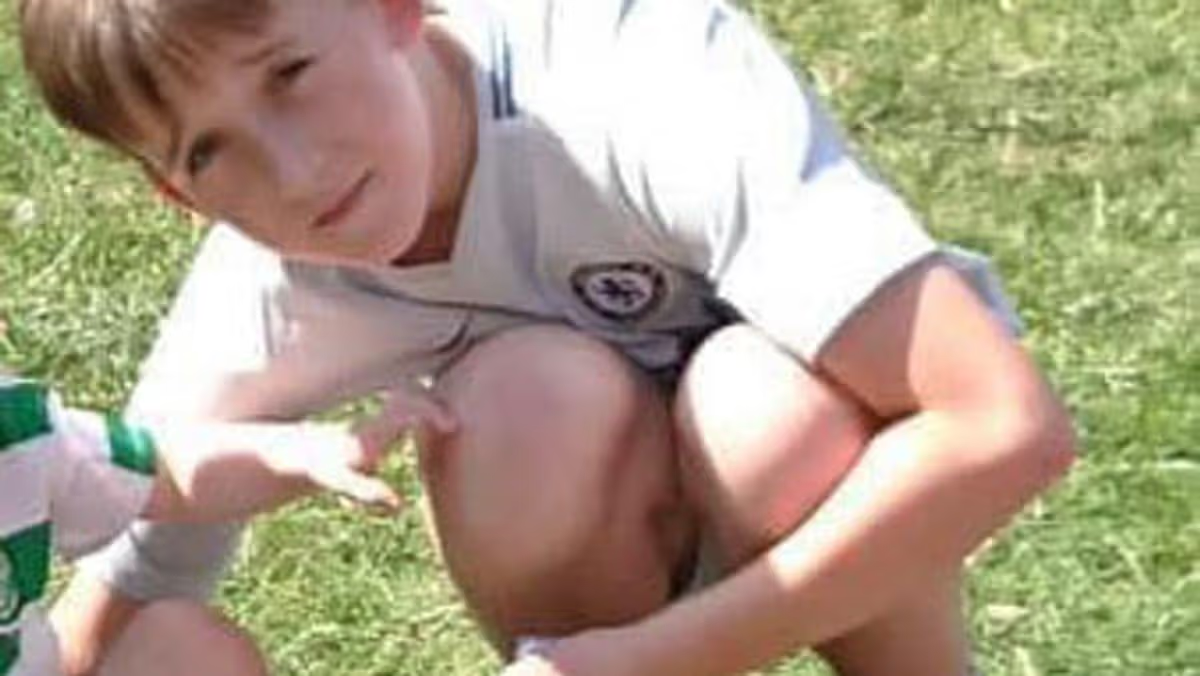
Kayden Walker, 12, drowned after getting into difficulty in the River Tay while on a day trip with a community group in July 2019.

A risk assessment for a river boarding trip which led to a 12-year-old boy’s death was not “suitable and sufficient”, an inquiry has heard. Kayden Walker, who could not swim, died after becoming trapped on the upstream side of a weir while on a day trip with the Church House community group in July 2019.

A Fatal Accident Inquiry (FAI) heard from Katrina Pearson, an environmental health officer with Perth and Kinross Council, who was involved in the investigation following his death. Asked by procurator fiscal depute Catherine Fraser whether she would consider the weir to be a “high risk location”, she replied “absolutely” and said the main hazard would be body entrapment.

However, she said a number of reasonable precautions could have been taken to prevent the incident. She told the inquiry on Tuesday: “In the first instance I would expect that the risk assessment for the activity would have been suitable and sufficient, which it was not in this case.

Advertisement

“And if it was they would have known about the hazard of the weir and the potential for body entrapment and also the risk to non swimmers and to swimmers. And I would expect that sufficient controls would be put in place to mitigate this – avoidance of the weir or not taking non-swimmers to such a high risk location, or additional supervision or robust safety briefing.”

Kayden, from Glasgow, was separated from his board during a river boarding session on the River Tay, near the village of Stanley, Perthshire, on July 28 2019. After being pulled from the water, he was airlifted to Ninewells Hospital in Dundee and was then transferred to the Royal Hospital for Children in Glasgow where he died on July 29.

The FAI, taking place at Falkirk Sheriff Court, follows the prosecution of Outdoor Pursuits Scotland Ltd in October 2024 for a contravention of health and safety legislation which led to Kayden’s death. The company was fined £10,000. Aimee Doran, representing Outdoor Pursuits, put it to Mrs Pearson that she was commenting on reasonable precautions from a health and safety point of view and without having any particular expertise in water-based activities.

Mrs Pearson replied: “Yes, from the health and safety point of view, not technical aspects.”

Advertisement

The joint FAI is also considering the death of Ruaridh Stevenson, 39, from Cupar, Fife, who drowned after trying to help a client who experienced difficulties in the waters flowing through Dollar Glen, Stirlingshire on April 13, 2024. Mr Stevenson was a director of a company which offered “canyoning” experiences on Scottish rivers.

The inquiry heard from Peter Carroll, a volunteer assistant ranger with the National Trust for Scotland (NTS) which cares for the area where the incident happened. He helped give CPR to Mr Stevenson after a member of the public came to tell them what was happening as he worked with NTS countryside ranger Laura Livingstone.

Mr Carroll went to the scene which was in an area called the Devil’s Cauldron which Ms Livingstone had described to the FAI as a “water feature hollowed out which forms a bowl that goes down about seven or eight feet.”

Advertisement

He told the inquiry: “When I looked down into the cauldron I could see Mr Stevenson on a ledge lying on his back and a chap was doing CPR.”

Mr Carroll then went to guide emergency services to the scene, which could not be reached by vehicles, before getting into the water himself to help with CPR. He said: “I was in the water until Mr Stevenson was pronounced dead and the recovery process started.”

Ms Livingstone, who has been an NTS ranger for 10 years, said the water level looked “high” on the day of the incident and she thought it was “borderline” as to whether canyoners should be in it. She told the inquiry that the area around the Devil’s Cauldron is fenced off after an incident around a decade ago where someone jumped in and died after hitting their head.

Ms Fraser asked: “Despite the fence do canyoners move the fence to access it?” to which Ms Livingstone replied, “yes.”

Advertisement

The inquiry also heard that there is a section nearby not managed by NTS that is not fenced off. Karen Railton, representing NTS asked: “Do you think if a sign was put up saying it was dangerous that would stop canyoners?”

Ms Livingstone said, “no.”

The FAI continues before Sheriff Keith O’Mahony.

Get more Daily Record exclusives by signing up for free to Google’s preferred sources. Click HERE.

Advertisement

Source link

Continue Reading
Click to comment

You must be logged in to post a comment Login

Leave a Reply

NewsBeat

Thornaby dangerous driver loses his licence and Ford Mondeo

Published

on

County Durham driver crashed his VW Up into victim's car

Carl Callen was spotted by officers as he raced bumper to bumper in his Ford Mondeo with another vehicle in Ingleby Barwick.

Teesside Crown Court heard how the 32-year-old mechanic initially pulled over for the police before executing a three-point turn and driving off at speed at about 10pm at night.

Lucy Todd, prosecuting, said: “Both vehicles accelerated hard and reached a speed of 70mph in a 40mph zone – the Mondeo was bumper to bumper with the one in front before officers activated their lights and sirens.”

Advertisement

The court heard how both cars pulled over before Callen performed a three-point turn and tried to make off from the scene.

Miss Todd said Callen reached speeds in excess of 90mph and went through a red light at the crossroads of Myton Way and The Rings causing another vehicle to take evasive action.

She said the defendant eventually pulled over again and told the officers that he had panicked before telling them there was cocaine for personal use in his car.

Callen, of Sapley Close, Thornaby, pleaded guilty to dangerous driving following his arrest on February 2 last year.

Advertisement

Michele Turner, mitigating, said her client had no previous convictions and his pre-sentence report shows that he has no criminogenic needs to address.

She said he had now found a new job and his father was taking him to and from work in Hartlepool.

Recorder Kama Melly KC sentenced Callen to a 12-month community order and told him he must carry out 50 hours of unpaid work.

“You seemed to be racing another vehicle and were driving at 70mph in a 40mph area and other drivers had to take evasive action,” she said.

Advertisement

Callen was also banned from driving for a year and had his car seized by the police.

Source link

Advertisement
Continue Reading

NewsBeat

Sunderland rapist Taranvir Galsinh has prison sentenced extended

Published

on

Sunderland rapist Taranvir Galsinh has prison sentenced extended

Taranvir Galsinh from Sunderland – who showed “no remorse for his actions” – was sentenced to 12 years and three months in prison last December. 

The 45-year-old took a teenager to a hotel where he raped her, sexually assaulted her, and paid her for having sex with him.

Galsinh also sexually assaulted her in a car several times and on one occasion tried to strangle her.

Advertisement

He also raped a second girl, and forced her to engage in sexual activity in his vehicle, for which he also paid her.

He previously pleaded guilty to pleading guilty to three counts of rape, intentional strangulation, three counts of paying for sexual services of a girl, sexual assault of a child, causing a child to engage in sexual activity, two counts of engaging in sexual activity with a child and assault by penetration of a child.

However, detectives and prosecutors were unhappy with the outcome and submitted an appeal against the sentence.

At the Court of Appeal in London last week, his sentence was extended to 18 years with one additional year on extended licence.

Advertisement

The Sexual Harm Prevention Order (SHPO) and lifetime restraining orders against both girls imposed at the original sentencing hearing remain in place.

Detective Constable Hanna Liddle, of Durham Police, said: “The consequences of Galsinh’s actions will outlast any sentence but having seen the impact of what he has done we believed the sentence should be longer.

“He subjected the girls to an horrendous ordeal and continues to show no remorse for what he has done.

“The girls have been incredibly brave throughout this whole process, and we hope this extension to the sentence will help them as they try to find a way forward with their lives.”

Advertisement

To report a rape or sexual assault, call Durham Police on 101, or dial 999 in an emergency.

If you’re more comfortable reporting online, you can visit the force’s online reporting page.

If you’re not ready to speak to police, there are other agencies who can help:

The Meadows Sexual Assault Referral Centre provides free, confidential healthcare and compassionate support to people who have experienced rape or sexual assault. Call 0330 223 0099 or visit The Meadows – SARC

Advertisement

The Rape and Sexual Abuse Support Line is available 24/7and provides support for anyone who has been affected by rape or sexual assault. Call 0808 500 2222 or visit 24/7 Rape and Sexual Abuse Support Line

The Rape and Sexual Abuse Counselling Centre (RSACC) offers free, specialist support to anyone who has experienced any form of sexual violence at any time in their lives. Call 01325 354119, email info@rsacc-thecentre.org.uk or visit 24/7 Rape and Sexual Abuse Support Line

Source link

Advertisement
Continue Reading

NewsBeat

Viola player Lawlor looking forward to performing Bruch

Published

on

Viola player Lawlor looking forward to performing Bruch

Catherine Lawlor, viola soloist in the next concert by the Portsmouth Philharmonic, has taken time out of her schedule to give us an exclusive interview detailing her career, Max Bruch’s concerto she will play in and has a word too for departing orchestra leader Colin Wilkins.

Source link

Continue Reading

NewsBeat

World Cup 2026: Fifa appears to rule out moving Iran’s matches to Mexico

Published

on

US President Donald Trump and Fifa president Gianni Infantino stand next to each other

Fifa appears to have ruled out moving Iran’s matches at this summer’s World Cup to Mexico from the United States.

The president of Iran’s football federation had said negotiations were under way to move fixtures in order to ensure their players’ safety.

It comes amid US and Israeli strikes on Iran, which has responded with attacks on Israel and US-allied states in the Gulf.

However, on Tuesday Fifa said in a statement it was looking forward to nations “competing as per the match schedule”.

Advertisement

The US is co-hosting the World Cup, which takes place between 11 June and 19 July, with Canada and Mexico.

Iran are scheduled to face New Zealand on 16 June and Belgium on 21 June, both in Los Angeles, and Egypt in Seattle on 27 June.

Last week US President Donald Trump said that while Iran are “welcome to the World Cup”, he does not think “it is appropriate” they attend “for their own life and safety”.

“When Trump has explicitly stated that he cannot ensure the security of the Iranian national team, we will certainly not travel to America,” said Iranian football federation president Mehdi Taj in a post, external on a social media account belonging to the Iranian embassy in Mexico.

Advertisement

“We are negotiating with Fifa to hold Iran’s World Cup matches in Mexico.”

A Fifa spokesperson said: “Fifa is in regular contact with all participating member associations, including Iran, to discuss planning for the World Cup.

“Fifa is looking forward to all participating teams competing as per the match schedule announced on 6 December 2025.”

Source link

Advertisement
Continue Reading

NewsBeat

Leakproof, insulated and long-lasting flasks tried and tested

Published

on

Leakproof, insulated and long-lasting flasks tried and tested

Whether you’re a seasoned hiker, daily commuter, or just someone who loathes lukewarm coffee, a reliable thermos makes all the difference. The best thermal flasks combine vacuum insulation with leak-proof lids, durable exteriors and smart features such as one-handed push buttons or built-in cups.

Testing uncovered a large variation in heat retention, build quality and usability. Some high-performing models kept drinks hot for over 12 hours in wet and windy conditions, while others barely saw us through back-to-back Zooms while working from home.

We tested a wide range, from slim urban styles to rugged designs built for adventure, and assessed each one for thermal performance, ease of use, leak resistance and durability through a series of drop tests, temperature checks and backpack trials. You can read my full reviews below, followed by the answers to some frequently asked questions.

Advertisement

The best flasks: At a glance


How to choose the best flask

Leak-proofing is essential. Look for flasks marketed as fully leakproof, not just spill-resistant, with a secure screw lid and silicone gasket. Ease of cleaning is another deal-breaker. Wide-neck flasks are far easier to rinse, dry and keep hygienic, especially for those who fill their flask with soup, smoothies or milkier brews. An easily hand-washed or dishwasher-safe model is best for daily use.

Weight and grip are important considerations, too. Lightweight flasks are ideal for commutes or day bags, but they mustn’t feel flimsy. Look for powder-coated finishes or textured sleeves for added grip, especially in cold or wet conditions. Finally, it’s worth checking out the brand’s sustainability credentials. Will they offer replacement lids or, better yet, a lifetime guarantee? These are indicators of quality, longevity and less waste in the long run.


How I test flasks

To bring you the best thermos flasks of 2026, I rigorously tested models from best-selling brands like Stanley, Thermos and Hydro. Only the very best made this guide. Each flask was put through a week-long trial in real-life conditions, from cross-country train journeys to all-day hikes in the Lake District, where they were stuffed in rucksacks, left in hot cars and dropped (intentionally) on kitchen floors.

  • Insulation performance: I filled each flask with boiling water, recorded the starting temperature and then measured again six hours later. I compared my results with the manufacturers’ claims.
  • Capacity: I measured how much liquid each flask actually held. Some couldn’t be filled to the brim due to the lid design or risk of spillage.
  • Material and durability: I assessed the flasks’ toughness by performing a one-metre drop test onto hard wooden flooring.
  • Lid design and leak-proofing: I examined how easy each lid was to open, drink from and safely reseal. I then shook and inverted full flasks to check for leaks and spills.
  • Portability: Weight (both full and empty), grip comfort, handle design and fit in cup holders or backpacks were all considered.

All top-scoring flasks are stored for longer-term testing and comparison. This guide is regularly updated, with new flasks tested upon release. Visit our Who We Are page to learn more about the testing process.


Source link

Advertisement
Continue Reading

NewsBeat

Konica Minolta installs two AccurioPress C12010 digital production presses for The Mailing People in Portsmouth

Published

on

Konica Minolta installs two AccurioPress C12010 digital production presses for The Mailing People in Portsmouth

Konica Minolta Business Solutions (UK) Ltd has successfully completed the installation of two AccurioPress C12010 digital production presses for The Mailing People. The new investment by the full-service direct mail experts extends its production line to four presses from Konica Minolta, at its print room in Portsmouth.

Source link

Continue Reading

NewsBeat

‘There was a boom – it was like an earthquake’: What it’s like being in Israel right now | World News

Published

on

Damage to a building in Israel

A woman scrambles down the steep embankment cradling a baby in her arms.

A man extends a hand to someone else whose step quickens. The sirens start blaring, a warning that incoming missiles are just minutes away.

We’ve all just pulled over at the side of a busy motorway on the outskirts of Tel Aviv.

The usual rules to head down to a bunker are out of the window – all we can do is find a ditch.

Advertisement
Image:
A woman with a baby takes cover by the side of the road

That’s the pattern of life in Israel right now, with alerts still ringing out through the day and night, right across the country.

After the all-clear, we realise missiles have hit neighbourhoods a couple of kilometres away from us.

We head to a built-up area where firefighters are dousing down the flames of cars that have caught fire. The local population has escaped injury.

It’s quite a chaotic scene when we arrive as soldiers seal off the area, warning people to get back.

Advertisement

A 21-year-old woman called Keshet tells us part of an Iranian cluster bomb landed right by her home.

Part of a bomb cluster landed near Keshet's home
Image:
Part of a bomb cluster landed near Keshet’s home

“There was a boom,” she says. “We ran outside and saw the fire. It was like an earthquake – it was very frightening.”

There’s not much complacency. The war is into its third week and people have confidence in Israel’s defence systems to intercept missiles.

Some are getting through and there’s the other very real danger of falling debris from the skies after an interception.

Damage to a building in Israel
Image:
Damage to a building in Israel

Israel’s defence missiles collide with the incoming missiles from Iran or Hezbollah – and the debris can land absolutely anywhere.

Read more:
Mourners in Lebanon defy Israel’s evacuation orders
How UK might try to keep the Strait of Hormuz open

Advertisement

Kobi Hassonah is angry. He lives next door to a storage container which was destroyed in a blaze when debris fell from an intercepted missile.

When we speak to him, the acrid smell of smoke is still in the air.

“Do they [the Iranians] even know what they’re aiming at?” he says. “They just fire. It landed right next to my house. Of all the places.”

But that notion – that nobody wants to be the unlucky one – is largely still driving people to shelters. Safe spaces underneath their homes or beneath the ground. Not everyone has a safe room in their home.

Advertisement

In an underground car park, we meet 46-year-old Alex Proskurov from the city of Rishon LeZion, just south of Tel Aviv.

“We don’t really care about sitting in a bomb shelter for months,” he says defiantly. “As long as we finish the job once and for all.”

Alex Proskurov in an underground car park. Pic: Sky News
Image:
Alex Proskurov in an underground car park. Pic: Sky News

His advice: “Don’t be a hero and it’s going to be fine.”

Advertisement

Iran isn’t causing large-scale casualties in Israel – unlike Israel’s bombs launched on Iran and Lebanon.

But it is successfully engaging in psychological warfare.

Source link

Advertisement
Continue Reading

NewsBeat

10 ways that future urban living will be greener

Published

on

10 ways that future urban living will be greener
6. People-powered lighting

Laurence Kemball-Cook founded Pavegen with a simple but ambitious aim: to create affordable off-grid electricity in cities.

“I was looking at new forms of street lighting powered by solar and wind,” he says. “But in dense urban environments neither of those technologies work well. Wind needs to be in the sea or high up, and solar struggles when you’re surrounded by tall buildings.”

Cities, though, have something else in abundance: moving people. As an industrial designer with a fascination with sustainability, he spent five years building prototypes in his bedroom of a system that would harness the kinetic energy of footfall and turn into power.

Advertisement

As with all good inventors, people told him he was crazy; but his breakthrough moment came when he realised a flywheel technology would work. “One step can spin the flywheel for up to 10 seconds, which is good for batteries because it gives continuous power.”

Multiply that by thousands of footsteps, and the output becomes something significant. After a trial at the London 2012 Olympics, where a temporary walkway was fitted with its tiles to power lighting, Pavegen now has installations in 250 sites in 5 countries.

Read the full article here.

Image: Pavegen

Advertisement


Source link

Advertisement
Continue Reading

NewsBeat

Jamie Laing says move for wife Sophie Habboo’s first Mother’s Day ‘backfired’ as she’s left in tears

Published

on

Manchester Evening News

Jamie Laing has joked that his gift to celebrate his wife Sophie Habboo’s first Mother’s Day backfired as he videod her breaking down in tears.

The couple are best known for starring together in E4 reality show Made In Chelsea, and they tied the knot in 2023 in a civil ceremony in London before a larger, more extravagant celebration in Seville, Spain.

It was then in June last year that they announced they were expecting their first child together, and in early in December, the they announced their baby’s arrival, as Jamie showed the first photos of him and Sophie with their newborn son, revealing his unique name. He wrote at the time: “Ziggy, you have our whole heart”.

Jamie and Sophie have since given glimpses into their lives as new parents, while keeping their son out of the spotlight as much as possible. But following Mother’s Day in the UK on Sunday (March 15), podcast host Jamie took to social media with a video of his wife in tears.

Advertisement

In the short clip, Sophie, 31, is seen sobbing as Jamie, 37, asks: “Wait, why are you upset?” As she holds her head in her hands, she emotionally responds: “He’s never going to be that small.”

A message across the video read: “POV: When your Mother’s Day present backfires,” while Jamie also captioned the post: “Reminder… Don’t make your wife a photo album of your newborn baby for Mother’s Day.”

Advertisement

It comes after Sophie marked her first Mother’s Day by posting a snap of herself pushing her pram around London, dressed in a black leather jacket and white trousers. She also gave a glimpse at the two-month-old, posting a photo of his feet as they sat at a restaurant table.

Alongside the post, she penned: “15 weeks of being a mama and wow… what a ride it’s been. I didn’t realise it was possible to feel so many emotions all at once. I totally get now what people mean when they say they wish they could freeze time. One minute I’m dreaming about the day I can sleep through a full night again, and the next I’m tearing up at the thought of you not needing me in the night or falling asleep in my arms anymore.

“The emotional rollercoaster is wild, it has changed me in ways I never expected, and I’m so grateful for that. The hardest, most rewarding and most magical little bundle of joy all in one. Being your mama is, and will always be, my greatest achievement and joy and the thing I am most proud of. You really are the missing piece to my puzzle.”

She added: “To all the mamas who have been by my side through these early weeks, I love you. And to all the mamas around the world, you truly are all heroes.”

Advertisement

Source link

Continue Reading

NewsBeat

The best washer-dryers for a two-in-one solution to laundry

Published

on

The best washer-dryers for a two-in-one solution to laundry

A washer-dryer seems the perfect space-saving alternative to buying separate washing machines and tumble dryers, and is usually more affordable. Still, you don’t want to get stuck with a subpar combo, which could run up high electricity costs and leave clothes damp after the drying cycle. If this is the case, you may want to buy a cheap-to-run heated clothes airer.

Washer-dryers can cost anywhere from £350 to more than £2,000 but for most people, you’ll still be making a saving compared to buying separate machines. The two main types of washer-dryers are freestanding and integrated, which are fairly self-explanatory, but you can read more about what to look for in a washer-dryer in the FAQs section below.

Freestanding washer-dryers tend to be more popular, which is why I’ve focused on them for this guide. I’ve also asked experts for advice and their own recommendations of specific washer-dryers.

Advertisement

The best washer-dryers: At a glance


How to choose a washer-dryer

Choosing the best size and capacity for your home are key when buying a washer-dryer. “It’s important to check the dimensions to ensure it will fit in your space,” says Gwil Snook, buyer at AO. “Think about the drum size you’ll need. Washer-dryers with up to 7kg capacity are suitable for six trousers and t-shirts or one single duvet. 8-9kg is ideal for eight trousers and T-shirts or a double duvet and 10-11kg suits 10 trousers and T-shirts or one king-size duvet.”

“Remember that the machine’s drying capacity is often 50-70 per cent of the washing load, so factor this into your decision making,” Carly Pearson, buyer at Argos adds. Secondly, consider energy rating. “More efficient models use less water and electricity, so could save money in the long run,” says Pearson. “Some models also offer eco-friendly wash and dry cycles that further reduce energy and water consumption.”

The final thing to consider, says Pearson, is noise level. “If your washer-dryer will live in a part of your home that can’t be shut away to keep quiet, make sure you go for the quieter option.”


How we chose the best washer-dryers

To help you decide which washer-dryer to purchase, I sought the input of experienced buyers Carly Pearson of Argos and Gwil Snook of AO, asking how they choose the washer-dryers to sell at their retailers. They advised me on the best washer-dryers based on factors like energy efficiency, drum size, washing and drying capacity, ease of the control panel, spin speeds and how well they expel water.

Advertisement

As many of the machines below have been recommended by experts rather than tested by us at home, we haven’t scored them. For those that were tested at home, the testing was done by home and appliance writer Emily Peck, who used each machine on a variety of loads including bedding, towels and sports clothes to see how they fare against each other.

Visit our Who We Are page to learn more about the testing process.


Source link

Advertisement
Continue Reading

Trending

Copyright © 2025