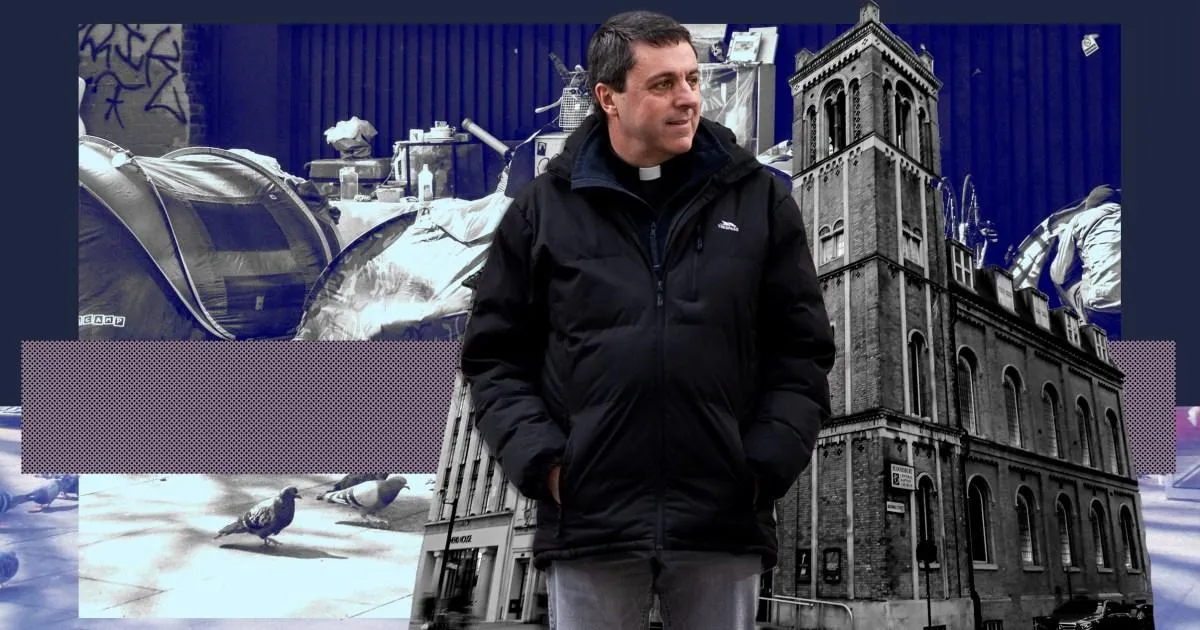
Bloomsbury Central Baptist Church is struggling to support all those who need help (Picture: Getty/ Metro/Olivia Murrell)
A central London church where Martin Luther King Jr preached has said they are overwhelmed by the number of homeless people needing help.
Bloomsbury Central Baptist Church said rough sleeping in the capital is ‘out of control’ and ‘beyond anything the church can solve’.
Other churches and charities joined their call for more action and investment from City Hall to address the crisis.
Bloomsbury Central has teamed up with street artist Endless to erect a 7ft statue to highlight the scale of the problem.
Advertisement
Revd Dr Woodman (left) and Endless (right) have teamed to call for more action on homelessness (Picture: Olivia Murrell)
A record 210,000 Londoners are homeless and living in temporary accommodation, including an estimated 102,000 homeless children.
There are also record numbers of rough sleepers in the capital, at more than 13,000 as of July last year, according to Trust for London.
That represents a 400% increase compared to 2008/2009, despite City Hall’s budget for rough sleeping having gone up fivefold under Sadiq Khan.
Dr Simon Woodman, the minister at Minster of Bloomsbury, said there has been a ‘huge rise in people sleeping on the streets’ since Covid.
He told Metro: ‘I frequently find someone sleeping on the doorstep of the church.
Advertisement
‘We have people sleeping out the back of the church. It is constant in this area and is definitely getting worse.
‘This situation is getting out of control. It is too big.’
The 7ft statue has the 210,000 figure emblazoned on it (Picture: Olivia Murrell)
Latest London news
To get the latest news from the capital, visit Metro’s London news hub.
Advertisement
The church has a long history of helping homeless people and let around 15 people sleep in their basement every night as part of Camden’s night shelter scheme, run by C4WS charity.
Revd Woodman said churches like Bloomsbury Central, where Martin Luther King Jr held his first sermon on British soil in 1961, are being overly relied upon by politicians to tackle rough sleeping.
He said: ‘Churches are the safety net. We are not the solution.
‘We need more action at a political level and wider systemic change in the way homelessness is addressed in London.’
Advertisement
In an effort to put pressure on those in power to act, he agreed to let street artist Endless to put up a new artwork on the church.
The artist’s installation features a life-size mural of a person experiencing homelessness and the large number ‘210,000’ representing the number of homeless in the capital.
Endless, whose work has been included in the permanent collection of the Uffizi Gallery in Florence, told Metro: ‘As a Londoner doing street art for 10 years, I have seen the increase in the homeless population.
A ‘tent city’ lines parts of Tottenham Court Road near Bloomsbury Central (Picture: Getty Images)
‘We need more people to notice the problem and the communicate about it.
‘Because the Church is in such a central position in London, we hope it will attract more eyes on the issues.’
Advertisement
Other charities and churches joined in calls for more to be done to tackle homelessness and rough sleeping in London.
The Connection at St Martin-in-the-Fields, which runs out of the iconic St Martin-in-the-Fields church in Trafalgar Square, said more investment was needed into key resources to support rough sleepers.
The charity’s CEO Pam Orchard told Metro: ‘We are sadly seeing increasing stories of hardship every single day at St Martin-in-the-Fields, here in the heart of the capital.
‘Until we see a substantial increase in investment in affordable and suitable social housing as well as mental health and addiction services, services like ours will continue to be used by the most vulnerable in our society.’
Advertisement
The number of rough sleepers have reached record highs in London(Picture: Getty Images)
In December 2025, Mayor Khan launched a new London Ending Homelessness Accelerator Programme, backed with £3.5m worth of investment.
The Robes Project, which supports people experiencing homelessness in Lambeth and Southwark, said the sector was also facing a 10% drop in donations.
‘We believe it takes a village to support someone out of homelessness, and that everyone has a part they can play,’ CEO Lisa Moodie added.
The Conservatives joined in the criticisms of how Sadiq Khan has handled homelessness and housebuilding in London.
Sir James Cleverly, the Shadow Secretary of State for Housing, Communities and Local Government, said Labour’s record in the capital had been one of ‘failure’.
Advertisement
He added: ‘Things are especially bad in Labour-run London, where housebuilding has totally collapsed and Sadiq Khan is plumbing depths of failure not seen the Second World War.
‘This just means more competition for fewer homes.’
Sadiq Khan has pledged to eradicate homelessness by 2030 (Picture: Thomas Krych/Anadolu via Getty Images)
A spokesperson for the Mayor of London touted Mr Khan’s success at helping 20,000 people off London’s streets in his bid to eradicate rough sleeping by 2030.
The statement said: ‘The Mayor is clear that no one should have to sleep rough on our streets and every Londoner deserves a safe and secure home.
‘Sadiq is continuing to lead from the front in London and has supported nearly 20,000 people off the capital’s streets since he became Mayor in 2016.
Advertisement
‘This winter, the Mayor has funded new prevention programmes to help those in greatest need, building on the £10m investment he made last year – more than any Mayor – establishing a network of ending homelessness hubs covering the whole of the capital.
‘The Mayor remains committed to ending rough sleeping in London by 2030 but clearly there is still more to do and Sadiq will continue working closely with partners, the Government, councils, and experts to build a safer, fairer London for everyone.’
I’m a Celebrity South Africa viewers left “raging” as the latest episode ended on a major cliffhanger during the first eating trial.
The ITV spin-off series has returned to viewers screens, and this year they mean business. The trials and challenges are set to be even tougher than the main installment as 12 new famous faces return to tackle them.
During Tuesday’s (April 7) episode, the campmates were still in their divided two camps, with the Savannah Scrub hoping they’d soon join the main camp.
Advertisement
Get MEN Premium now for just £1 HERE – or get involved in our WhatsApp group by clicking HERE. And don’t miss out on our brilliant selection of newsletters HERE.
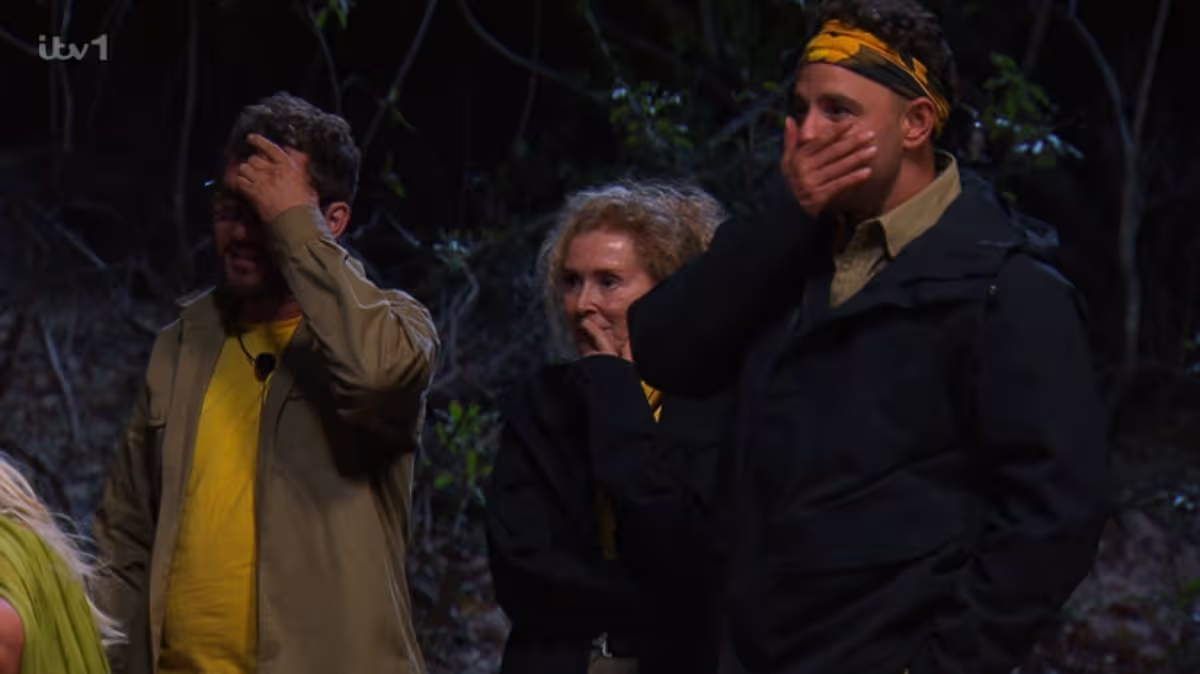
However, the stars were met with different news as Ant and Dec informed them that two new campmates would be joining the competition, and set up an eating trial for the newcomers.
As everyone gathering round to watch, Coronation Street’s Craig Charles and Essex icon Gemma Collins showed up in the Savannah. Craig and Gemma were on the same series in 2014, with Gemma quitting after 72 hours and Craig sadly also departing due to his brother’s death.
The main camp were asked which celebrity they wanted to back, and David Haye made the decision to choose Craig. That meant that Gemma was the newcomer of Savannah Scrub.
Advertisement
During the gruesome trial, they were faced with dishes such as fish eye pie and brain freeze as they try to win points for their opposing teams.
They had to decide how many servings of each dish they wished to consume, with the player who committed to the highest number of servings forced to follow through in order to win a point.
Things became intense as both Gemma and Craig chose to drink 30 shots of the unappetising liquid in front of them. Ant and Dec announced that it was now a race to see which one of them would finish first, and therefore win the challenge for their chosen camp.
Advertisement
However, just as they started the credits rolled and viewers at home admitted they were “raging” as they have to wait until tomorrow to see the result.
On X (formerly known as Twitter), @taytomultifan wrote: “I’m raging they ended it there” as @supertv247 added: “Axe this pre-recorded format immediately WHAT DO YOU MEAN ending the episode on a cliffhanger in the MIDDLE OF A TRIAL?!”
@upsteadkidd agreed and said: “what a cruel way to end that” as @sophielout453 quipped: “No no no, it didn’t just end like that. Who do I’m celeb think they are. Love island?”
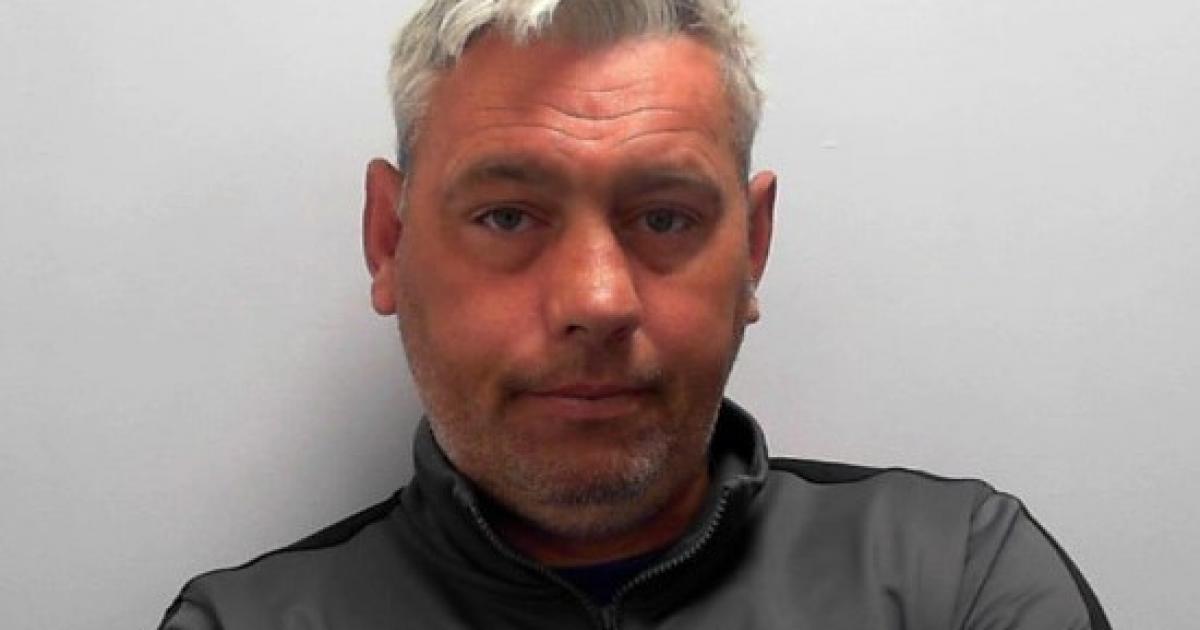
Darren Gill, 45, from Middlesbrough, is also wanted in connection with alleged shop theft charges, North Yorkshire Police said.
The force said Gill, who has links to Harrogate and Knaresborough, did not attend court in connection with the charges.
Gill is described as white, 5ft 5ins tall, of medium build, with grey hair.
Advertisement
North Yorkshire Police said “numerous police inquiries are ongoing” to locate Gill.
“If you know where he is call North Yorkshire Police on 101 and quote reference 12250170299, or speak to Crimestoppers anonymously on 0800 555 111,” a force spokesperson said.
The president wrote on Truth Social that U.S. forces would pause plans for a massive, final military assault against Iran for two weeks while negotiations continued between the two countries, mediated by Pakistan.
He also claimed that a complete re-opening of the Strait of Hormuz would be part of the arrangement around a temporary pause in his plans.
“Based on conversations with Prime Minister Shehbaz Sharif and Field Marshal Asim Munir, of Pakistan, and wherein they requested that I hold off the destructive force being sent tonight to Iran, and subject to the Islamic Republic of Iran agreeing to the COMPLETE, IMMEDIATE, and SAFE OPENING of the Strait of Hormuz, I agree to suspend the bombing and attack of Iran for a period of two weeks,” said the president.
Advertisement
“This will be a double sided CEASEFIRE! The reason for doing so is that we have already met and exceeded all Military objectives, and are very far along with a definitive Agreement concerning Longterm PEACE with Iran, and PEACE in the Middle East,” he added.
Donald Trump vowed on Monday that he would destroy Iran’s ‘civilization’ if the country did not agree to his demands (AFP/Getty)
UNITED NATIONS (AP) — Russia and China on Tuesday vetoed a U.N. Security Council resolution aimed at reopening the Strait of Hormuz that had been repeatedly watered down in hopes those two countries would abstain.
The vote — 11-2, with two abstentions from Pakistan and Colombia — took place just hours after U.S. President Donald Trump issued an unprecedented threat that a “whole civilization will die tonight” if Iran does not open the strategic waterway and make a deal before his 8 p.m. Eastern deadline. One-fifth of the world’s oil typically passes through the strait, and Iran’s stranglehold during the war has sent energy prices soaring.
Russia and China strongly defended their opposition, both citing Trump’s most perilous threat yet to end Iran’s civilization as confirmation that the proposal would have given the U.S. and Israel “carte blanche for continued aggression,” as Russian envoy Vassily Nebenzia put it.
Nebenzia and China’s U.N. ambassador, Fu Cong, said the resolution failed to capture the root causes and full picture of the conflict by not showing that America and its closest ally started the now spiraling war.
Advertisement
Fu said in his statement that resolution was “highly susceptible to misinterpretation or even abuse,” and if it were adopted ”would send a wrong message and have serious, very serious consequences.”
Russia and China immediately followed up by circulating a rival resolution, seen by The Associated Press, which urged all parties to halt military activities and condemned attacks on civilians and civilian infrastructure. Nebenzia told reporters it was already in a form that could be put to a vote.
,The foreign minister of Bahrain, which authored the draft, assailed the U.N.’s most powerful body for not taking action and allowing the international community to be “held hostage to economic blackmail” from Iran.
Abdullatif bin Rashid Al Zayani said failing to adopt the resolution sends “the signal that the threat to international waterways can pass without any decisive action by the international organization responsible for the maintenance of international peace and security.”
Advertisement
Al-Zayani told reporters that Gulf countries will intensify diplomatic efforts to deter Iran’s attacks and safeguard freedom of navigation.
But Iran’s ambassador to the U.N. thanked its allies on the 15-member council for refusing to adopt the resolution.
“The text unjustifiably and misleadingly portrays Iran’s lawful measures in the Strait of Hormuz, which have been taken in the exercise of its inherent right of self-defense in accordance with the UN Charter, as threats to international peace and security,” Amir-Saeid Iravani said in his statement.
How the resolution evolved
It’s doubtful the resolution, even if it had been adopted, would have impacted the war, now in its sixth week, because it was been significantly weakened to try to get Moscow and Beijing to abstain rather than veto it.
Advertisement
The initial Gulf proposal would have authorized countries to use “all necessary means” — U.N. wording that would include military action — to ensure transit through the Strait of Hormuz and deter attempts to close it.
The United States, which had supported the draft from its original form, assailed the countries that objected to the resolution.
“No one should tolerate that they are holding the global economy at gunpoint,” Mike Waltz, the U.S. ambassador to the U.N., said of Iran, “but today, Russia and China did tolerate it.” He said in his statement: “They sided with a regime that seeks to intimidate the Gulf into submission, even as it brutalizes its own people during a national internet blackout, for daring to imagine dignity or freedom.”
After Russia, China and France, all veto-wielding members of the Security Council, expressed opposition to approving the use of force, the resolution was revised to eliminate all references to offensive action. It would have authorized only “all defensive means necessary.” A vote had been expected on Saturday.
Advertisement
But instead the resolution was further weakened to eliminate any reference to Security Council authorization — which is an order for action — and limit its provisions to the Strait of Hormuz. Previous drafts had included adjacent waters.
The resolution vetoed Tuesday would have “strongly” encouraged countries to coordinate their efforts to ensure the safety of navigation across the Strait of Hormuz, including escorting merchant and commercial vessels.
The resolution also demanded that Iran stop impeding freedom of navigation through the strait and attacking civilian infrastructure.
Why it was Bahrain pushing the UN resolution
In response to the U.S. and Israeli attacks beginning on Feb. 28, Iran has targeted hotels, airports, residential buildings and other civilian infrastructure in more than 10 countries, including the Islamic Republic’s Gulf neighbors, some of the world’s major exporters of oil and natural gas.
Advertisement
Iran’s blockade in the strait is seen by Gulf nations as an existential threat. Bahrain, a Gulf nation that hosts the U.S. Fifth Fleet and is the Security Council’s Arab representative and its president this month, has been pressing for U.N. action.
In response to Iran’s strikes against its Gulf neighbors, the Security Council adopted a Bahrain-sponsored resolution on March 11 condemning the “egregious attacks” and calling for Tehran to immediately halt its strikes.
That resolution, adopted by a vote of 13-0 with Russia and China abstaining, also condemned Iran’s actions in the Strait of Hormuz as a threat to international peace and security and called for an immediate end to all actions blocking shipping.
—-
Advertisement
This version corrects the second reference to China’s U.N. ambassador to Fu.
The Wolverines (37-3) claimed all 57 votes in Tuesday’s poll in the third year the AP has released its final rankings after the completion of the NCAA Tournament. Michigan beat UConn 69-63 in Indianapolis on Monday night to complete the winningest season in program history, along with winning its first NCAA title since 1989 and the Big Ten’s first since 2000.
Michigan spent a week at No. 1 in mid-February and didn’t rank lower than fourth after November in its second season under Dusty May.
Yaxel Lendeborg, an AP first-team All-American, had said before the Final Four that this could go down as the best team in program history, including the famed “Fab Five” freshman teams that reached the NCAA title game in 1992 and 1993. Standing amid the confetti on the court after Monday night’s win, Lendeborg figured this year’s group had done enough to earn that distinction.
Advertisement
“I think we are, man,” said Lendeborg, who battled through ankle and knee injuries suffered in the win against Arizona in the national semifinals. “I’m waiting for the Fab Five to give us the approval. But if they do, then I’ll let it be said that we’re the best team ever.”
The top tier
UConn (34-6) jumped five spots to No. 2 after its March Madness run, including an incredible comeback from 19 down to stun Duke in the Elite Eight and keep alive its chances for a third national title in four seasons. Arizona was third, followed by Duke, which held the No. 1 ranking before March Madness and was the tournament’s top overall seed before a loss to UConn in the Elite Eight.
Illinois was next, climbing eight spots to No. 5 after the program’s first trip to the Final Four since 2005. That marked the second time that a team went from being ranked outside the top 10 to cracking the top five after a Final Four run, the other being Alabama jumping 16 spots to No. 3 to end the 2024 season.
Purdue, Houston, Iowa State, Florida and St. John’s rounded out the top 10.
Advertisement
Climbing to final position
Tennessee finished at No. 12 after reaching the Elite Eight for the third straight year. The Volunteers’ postseason push vaulted them 11 spots, making them the biggest climber from the March 16 poll before the NCAA Tournament.
In all, nine teams ranked from the previous poll moved up in the season’s final rankings.
Last slide
Virginia had the poll’s biggest tumble, falling eight spots to No. 17 after falling in the second round to the Volunteers as a 3-seed.
No. 18 Gonzaga and No. 25 Wisconsin both fell six spots after failing to make the second weekend. The Cavaliers, Zags and Badgers were among 11 ranked teams from March 16 to tumble while still remaining inside the final poll.
Advertisement
In and out
Iowa and Texas both jumped into the poll after being unranked heading into March Madness. The Hawkeyes finished the season ranked No. 15 after reaching the Elite Eight in a run that included a second-round upset of top-seeded Florida.
Iowa’s jump marked the third time a team that was unranked going into the NCAAs hopped into the top 15 in the post-tournament AP poll. The other two came in 2024, with N.C. State sitting at No. 10 after its improbable Final Four run and Clemson at No. 14 after reaching the Elite Eight.
The 22nd-ranked Longhorns entered the poll after going from the First Four to the Sweet 16.
Iowa and Texas replaced North Carolina (No. 21) and St. Mary’s (No. 22) from the previous poll.
Advertisement
Conference watch
The Big Ten dominated this year’s tournament, first by getting a league-record six teams into the Sweet 16 then tying the tournament’s overall record with four teams in the Elite Eight before ultimately sending Michigan and Illinois to Indianapolis. The league finished with a national-best seven teams in the final AP Top 25 of the season.
The Southeastern Conference was next with six ranked teams, followed by the Big 12 with five, the Atlantic Coast Conference with four and the Big East with two. The West Coast Conference with Gonzaga was the only league from outside the power conferences to have a Top 25 team.
I’m A Celebrity… South Africa star Adam Thomas has returned to the ITV show leaving soap fans feeling nostalgic
Angie Quinn Screen Time Reporter
22:52, 07 Apr 2026
I’m A Celebrity star Adam Thomas has returned to the ITV show, sparking a frenzy among soap fans. The 37-year-old originally appeared on the 16th series of the popular reality programme in 2016, but he is also famed for playing Adam Barton in Emmerdale for nearly a decade, from 2009 to 2018.
During his time on the ITV show, fans saw his character tackle a series of storylines, including a feud with Cain Dingle (Jeff Hordley), turning to arson, an on-off marriage with Victoria Sugden (Isabel Hodgins), and a bromance with Aaron Dingle (Danny Miller).
Making a hasty exit in a shipping container to start a new life in France, viewers were left heartbroken when Adam decided to leave Emmerdale.
At the time, addressing the exit, the actor said it wasn’t an easy decision for him. In a statement, Adam explained: “I’ve had an amazing eight years working on Emmerdale, and I’ve loved every minute of it.
Advertisement
“It was a really tough decision to take to leave but I felt that now is the time to move on and challenge myself with some new roles.”
He added: “I’d like to thank everyone at Emmerdale for both giving me the opportunity to work as part of such a great team and for giving my character, Adam Barton, some great storylines too.”
However, seeing Adam back on television has left Emmerdale fans demanding he returns to the soap.
Taking to X, one fan penned: “When I said I wanted Adam Thomas back I meant on @emmerdale #ImACeleb #Emmerdale”, as another replied: “Shout it louder!”
Advertisement
A third explained: “Seeing Adam Thomas on ITV and it not being in Emmerdale is deeply upsetting to me #imaceleb.”
One person confessed: “Emmerdale star Adam Thomas’ (crying faces)”, while another added: “With all that’s going on in his family, Adam should have returned years ago. I’d recast if the OG actor isn’t interested. #Emmerdale.”
Away from Emmerdale, the actor launched his career following an appearance on the BBC’s Doctors in 2002, and is also particularly recognised for his portrayal of Donte Charles in Waterloo Road.
Advertisement
In 2023, Adam also competed in the 21st series of Strictly Come Dancing, paired with professional dancer Luba Mushtuk. He was eliminated in Week 7, finishing in 9th place after a dance-off against Angela Rippon.
I’m A Celebrity… South Africa currently airs at 9pm on ITV and ITVX
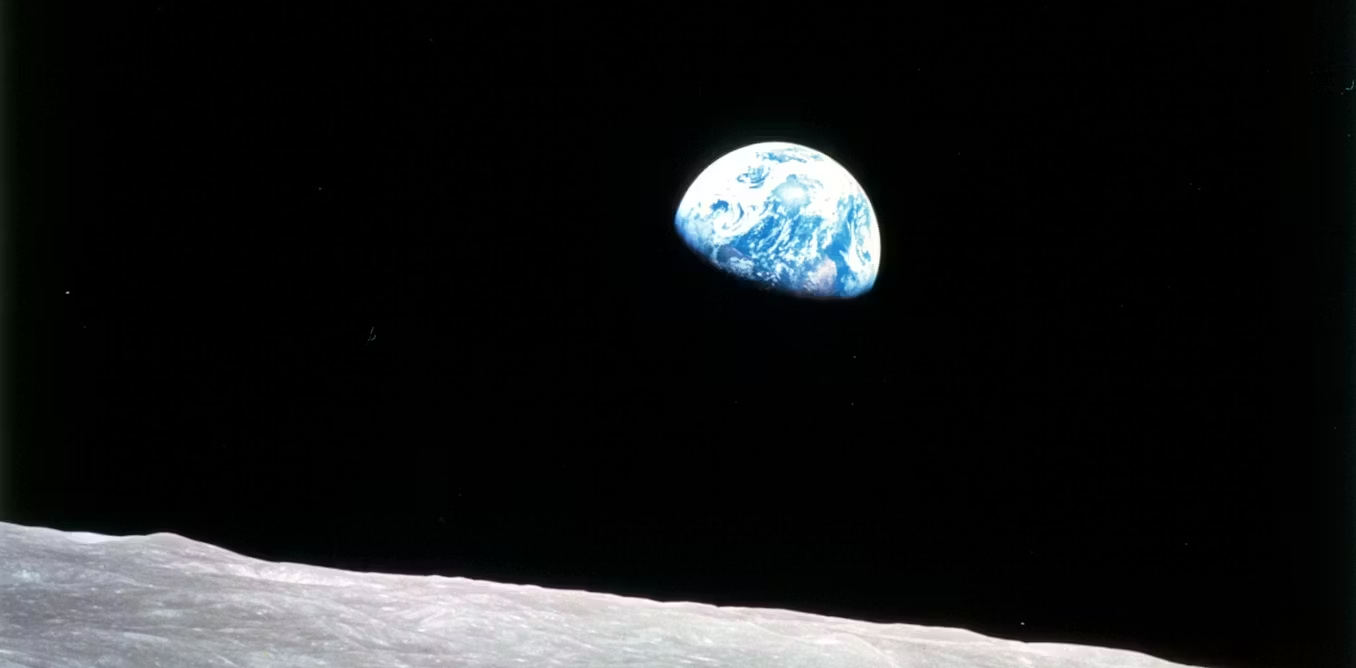
A new Earthset image has been captured by the crew of Artemis II, 58 years since the iconic Earthrise photograph taken by the crew of Apollo 8. Over these past six decades, the climate has changed dramatically.
“Oh my God, look at that picture over there! There’s the Earth comin’ up. Wow, is that pretty.” That was Nasa astronaut Bill Anders’ reaction to seeing the Earth appearing to rise above the lunar horizon as their Apollo 8 spacecraft came around the Moon on Christmas Eve 1968.
Theirs were the first human eyes to see our planet at such a distance and from another celestial body. As fellow astronaut Jim Lovell said a few hours later: “The Earth from here is a grand oasis in the big vastness of space.”
That original Earthrise image is widely credited with helping to set the mainstream environmental movement in motion. Although I wasn’t born when the Apollo 8 photo was taken, a framed print of it hangs above my desk as a reminder of the beauty and fragility of our planet.
Advertisement
‘Earthset’ is the new photo from the far side of the Moon, captured on April 6 2026 by the crew of Artemis 2 as Earth dips behind the lunar horizon. Nasa
For me as a climate scientist, these photos, taken 58 years apart, inspire me to reflect on how the Earth’s climate has changed in the interim.
The concentration of carbon dioxide (and other greenhouse gases) in our atmosphere has rapidly increased as a result of over half a century of continued and spreading industrial development, driven primarily by burning fossil fuels.
This is clearly illustrated by the Keeling curve – a graph that plots the continuous record of atmospheric CO₂ from Mauna Loa Observatory in Hawaii (started by Charles Keeling in 1958).
This curve shows a steep and steady increase from approximately 320 parts per million (ppm) in 1968 to about 430ppm in 2026. This increase of over one-third in the total carbon dioxide in our atmosphere shows little sign of slowing down.
Observed timeseries of atmospheric carbon dioxide concentration and global mean surface temperature with added logos for the Apollo 8 and Artemis 2 missions. For latest updates on these and other key climate change indicators, visit the Met Office climate dashboard: https://climate.metoffice.cloud/dashboard.html
That additional blanket of greenhouse gases has increased the surface temperature of our planet. Data from the World Meteorological Organization shows how the global mean temperature record (the average temperature of the Earth’s surface) has risen by approximately 1.2°C since the Apollo 8 Earthrise photo was taken. This represents most of the warming that has happened since the early industrial period in the mid-19th century.
While an average global temperature increase of 1.2°C may not sound large, it means that regional hot extremes and new records are now much more likely. For example, my team’s recent research has shown that a 40°C day in the UK (first recorded on July 19 2022) is now over 20 times more likely than it was in the 1960s.
Advertisement
The global average temperature has surged in the past three years – most probably driven by a combination of internal climate variability and human-made emissions (including strong reductions in industrial aerosol particle emissions that largely act to cool the planet). In 2023, temperatures jumped from the previous record of 1.29°C (set in 2016) to 1.45°C above the early-industrial 1850-1900 baseline.
This record was then immediately broken in 2024 – the first year to temporarily exceed 1.5°C. Going beyond that boundary in a single year doesn’t mean we have breached the 1.5°C target set by the 2015 Paris climate agreement, which is generally accepted to refer to a 20-year average. However, it does highlight how rapidly we are now approaching that level of warming.
Temperatures in both years were partly boosted by warmer conditions in the tropical Pacific due to El Niño, a climate phenomenon that affects weather patterns globally. Last year, after El Niño had subsided, was slightly cooler at 1.43°C. However, current forecasts give a high probability for another El Niño developing during the second half of 2026. If this materialises, we could easily exceed 1.5°C again.
Advertisement
A key question is whether global warming is accelerating. This is difficult to detect directly from the surface temperature record. However, a recent study found a significant acceleration after accounting for the “noise” of year-to-year variability.
The view from above
Climate science isn’t just about measuring changes in temperature.
One of the legacies of the 1960s space race was the subsequent launch of many satellite observation platforms that have transformed our ability to monitor, understand and predict changes to the global climate.
We now have continuous monitoring of many key components of Earth’s climate system, including sea surface temperature, sea level, and the extent of polar sea ice, glaciers and land surface changes. Unfortunately, many of these reveal worrying trends, such as more frequent heatwaves on land and sea, loss of Arctic sea-ice, melting glaciers and sea-level rise.
Advertisement
Observed timeseries of Earth energy imbalance (EEI) from Nasa Ceres dataset. Ned Williams
One of the most concerning recent trends comes from a set of satellite instruments called the Nasa Ceres, which have measured changes in the Earth’s energy imbalance (EEI) since 2000. EEI is the difference between the amount of solar energy absorbed by the planet and the thermal energy radiated back into space.
The Ceres data shows a strong upward trend, indicating a growing rate of accumulation of energy, consistent with an acceleration in global heating.
Looking ahead, I hope that by the time astronauts take the first Earthrise photo from Mars (perhaps in the late 2030s), we are heading towards net-zero carbon emissions and more stable global temperatures.
Achieving net zero is this century’s Moonshot. The prize is minimising the severity of the worst climate consequences of global heating – leaving our children and future generations a sustainable “grand oasis” here on Earth.
Plenty of people have worked under a manager who appears confident, articulate and highly visible – yet they struggle to lead their team effectively. Team members can become disengaged, decision-making slows and performance declines. But despite this, the same people always seem to progress through the hierarchy.
Unfortunately, this is not unusual. In many organisations, leadership potential is assessed using signals that are easy to observe. These could be confidence, charisma or communication style – rather than the traits that actually produce effective teams.
This creates a persistent problem. Organisations promote people who look like leaders rather than those who demonstrate the capabilities required to lead.
Promotion decisions are often made under conditions of uncertainty. Bosses will not always have the right information to be able to predict a candidate’s leadership ability. This is why they fall back on visible cues.
Advertisement
These cues are generally based on how someone performs in meetings, how well they present their ideas, or how comfortable they appear when speaking to senior management or stakeholders. Those who show self-confidence and authority while communicating tend to be perceived as ready for leadership.
But these signals can be misleading. In my ongoing doctoral research on inclusive leadership, I have found that effective leadership is less about visibility and more about how leaders support and develop their teams.
Studies have found that people who show dominance and confidence can be perceived by management as more capable and ready for leadership, despite objective measures of performance which do not always support this judgement.
Other research has even shown that traits such as narcissism can increase the likelihood of someone becoming a leader – even though these qualities do not predict leadership effectiveness.
Advertisement
When evaluating leaders, managers have been found to confuse confidence with competence. Large studies on personality and leadership show that people with traits like extroversion are more likely to become leaders. But again, these traits are not always strong predictors that someone will be effective in the job.
The qualities that matter more
While confidence and visibility are essential attributes in leadership, they are not core drivers of success. Research shows other capabilities can matter more. These include sound judgement, the ability to help others develop, emotional intelligence and the capacity to build an environment where employees feel valued. This might mean staff feeling free to share ideas or raise concerns, for example.
Teams perform more effectively when employees feel valued in their workplace. And an openness to sharing ideas and admitting mistakes without fear are also essential factors in building strong teams.
Studies of emotional intelligence suggest that leaders who demonstrate empathy and interpersonal awareness are often better able to build trust and keep their team performing at a high level. The true measure of leadership has been shown to be reflected in team performance and outcomes, rather than a leader’s personal charisma or visibility.
Yet these capabilities can be hard to measure during the promotion process. They develop gradually through experience and are often demonstrated through everyday interactions, rather than visible moments like presentations or meetings. As a result, organisations may overlook people who have strong leadership potential – simply because their contributions are less visible.
Promoting the wrong leaders can have significant consequences. When employers reward visibility over capability, they risk creating a culture where self-promotion is prioritised over collaboration. Teams will be more reluctant to challenge decisions or give fresh perspectives, especially if leaders appear confident but are not open to feedback.
Over time this can weaken decision-making, reduce employees’ engagement and ultimately increase staff turnover. Large meta-analysis also shows strong links between a manager’s behaviour, their employees’ engagement and business outcomes (measured in things like productivity and customer satisfaction).
Advertisement
Promotion systems that favour confidence and visibility can also affect diversity within leadership teams. People who communicate differently or who are less inclined to talk up their achievements could be overlooked even if they demonstrate strong leadership skills. This can result in leadership teams that lack diversity in thinking and experience, as similar traits and communication styles are repeatedly rewarded.
If organisations want to improve, they must look past the most visible signals of leadership potential. Instead, they could focus on evidence of how people support and develop their teams before they reach leadership level, by looking at things like how they mentor colleagues, create a cohesive teamwork culture or respond to challenges with other workers.
Organisations can gather broader feedback on potential leaders from peers or team-based assessments. This allows them to create a more accurate picture of how someone leads in practice.
And leadership development programmes can help organisations learn how to identify people who demonstrate strong skills but who do not necessarily fit those traditional leadership stereotypes.
Advertisement
Modern workplaces are becoming more complex, with remote working and the rapid adoption of AI changing how employees are organised and managed. Leaders must be able to adapt through these challenges, while managing diverse teams. In these environments, the ability to listen, collaborate and support staff can be far more important than simply projecting confidence.
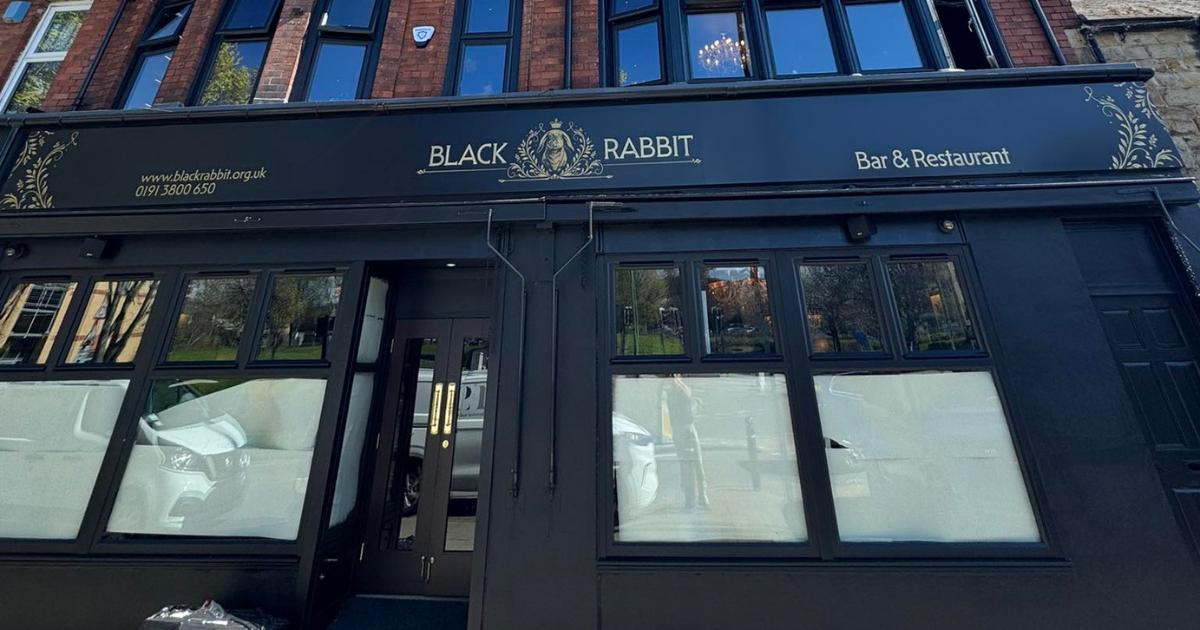
The Black Rabbit is opening in the former Hollathans on Ashfield Terrace in Chester-le-Street after its long-time owners stepped away from the venue after 20 years.
The venue has been taken over by Terry Haley, 32, and Richard Nellis, 57.
Terry runs bars in Durham including The Drunken Duck and the Ye Old Elm Tree, while Richard is best known for running Hibou Blanc and The Grey Owl. He also runs the Abbey Group, a construction company specialising in the hospitality sector.
Black Rabbit is set to open this week in the former Hollathans in Chester-le-Street. (Image: BLACK RABBIT/ FACEBOOK)
The new owners have invested £750,000 into a refurbishment of the premises.
Advertisement
The pair met in a sauna and eventually decided to work together.
The Black Rabbit is set to open on Ashfield Terrace this Friday, April 10, for drinks only over the weekend before closing again from Monday until Friday, April 17, when it will relaunch with a full bar and kitchen.
The owners said the decision to open earlier than planned came after strong interest online from people wanting to visit the venue.
Richard and Terry said: “It has always been a well-established place within the town that recently had dwindled away, but it was still a staple in the area and so when we saw the opportunity we just had to take it.
Advertisement
“The Black Rabbit will be a luxury, nice offering bringing something up market to the area, similar to what Richard has already built with his higher end places.
“Due to demand and response that we didn’t expect to this level we will be opening for drinks only on Friday (April 10) and a full opening with the kitchen the following week.”
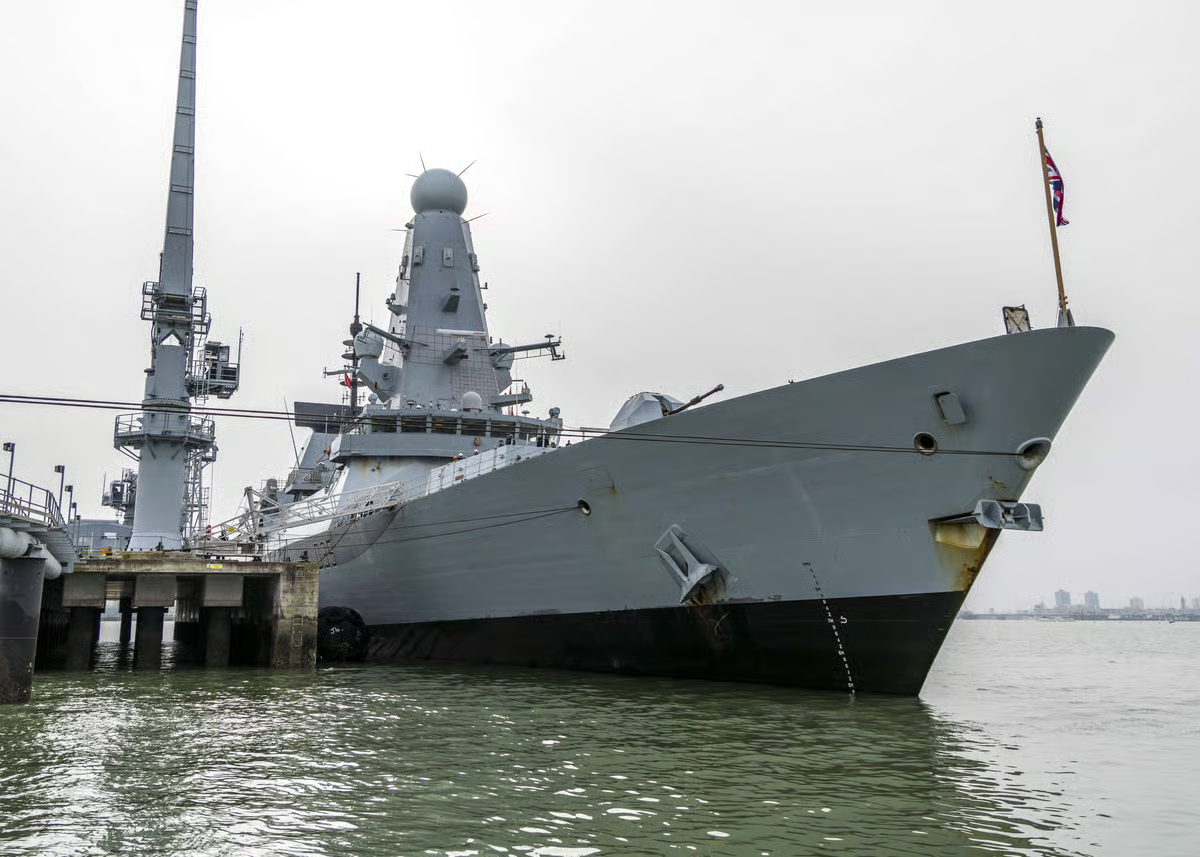
Obese-Jecty, a former Army officer, said: “Four weeks late to the Eastern Mediterranean and lasted two weeks before suffering maintenance issues, with the MoD claiming it’s a scheduled stop, just as the potential of retaliatory Iranian strikes within hours is the lead headline around the world.”














































You must be logged in to post a comment Login