Connect with us
DAPA Banner
DAPA Coin
DAPA
COIN PAYMENT ASSET
PRIVACY · BLOCKDAG · HOMOMORPHIC ENCRYPTION · RUST
ElGamal Encrypted MINE DAPA
🚫 GENESIS SOLD OUT
DAPAPAY COMING

NewsBeat

What REALLY happens to your body when you stop drinking six coffees a day: I expected jitters and hideous withdrawal symptoms, says CLAUDIA CONNELL…

Published

on

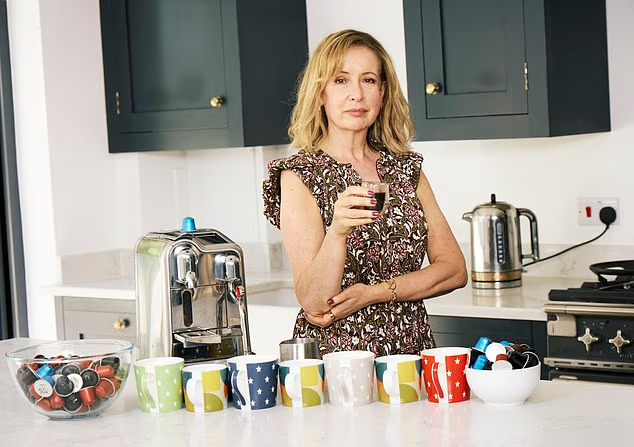
Since splashing out £600 on a sleek barista-style machine that uses pods, Claudia Connell started drinking several cups of coffee a day. But will quitting make her healthier?

Every morning I follow the same routine. I take a liquid probiotic on an empty stomach that requires me to wait ten minutes before eating or drinking anything.

Desperate to have my first strong, flat white coffee of the day, I set a timer on my phone. When the time seems to drag, I check the timer is definitely running. Come on! Why is it taking so long?

By the time we’re at eight minutes, I start preparing the coffee with my fancy machine so my steaming mug is ready and waiting on the stroke of ten minutes. Bliss.

Safe to say, I love coffee. None of your mild and weak rubbish watered down with half a pint of milk, either – it has to be espresso, the highest intensity I can find, either with a dash of hot milk, or sometimes drunk as a double – black, straight down like a tequila shot.

Advertisement

My first coffee is swiftly followed by another and I carry on drinking cups throughout the day, notching up five on average – though six or seven isn’t unheard of.

Coffee is now so popular in the UK that 98million cups of it are consumed daily. This means there are now more regular drinkers of coffee than tea, something that would have been unthinkable a generation ago.

Since splashing out £600 on a sleek barista-style machine that uses pods (the expense felt justified since a flat white takeaway is now just shy of £5 in many coffee shops), I rarely drink tea. But the question is: do I drink too much coffee? And even though I seem to experience no ill effects, will quitting make me healthier? Is it – God forbid – ageing?

The messages are mixed.

Advertisement

Since splashing out £600 on a sleek barista-style machine that uses pods, Claudia Connell started drinking several cups of coffee a day. But will quitting make her healthier?

It’s well established that caffeine can increase anxiety, disrupt sleep and induce temporary spikes in your heart rate and blood pressure. Some studies suggest it can raise cholesterol, too.

Yet, just last week, a report based on a large-scale analysis of UK health trends found drinking four to five coffees a day can significantly improve liver health – reducing the risk of liver cancer, for example, by 47 per cent – while it also contains antioxidants and has anti-inflammatory qualities.

Advertisement

Having recently turned 60, I’m firmly in what’s referred to as ‘sniper’s alley’ when it comes to health. It’s an age when people can suddenly be taken out by things such as high blood pressure, heart disease and raised cholesterol.

So, to see once and for all whether being a coffee addict is either good for me or keeping me from optimum health, I decide to quit for six weeks.

Coffee never gives me palpitations, but the thought of giving it up does. I honestly think I’d find it easier to give up food than coffee. It’s one of my few vices.

To ensure fair and accurate results, I take a series of health tests while still drinking my usual amount, with a plan to repeat them when I’m coffee-free.

Advertisement

Health firm Medichecks offers a series of home assessments and recommends I take its £119 Advance Diet and Lifestyle Blood Test, which will measure 27 biomarkers, including liver and kidney function, cholesterol level and key vitamins and minerals.

A nurse draws the blood and the results are sent off to a lab to be analysed and studied by a doctor.

In the meantime, I visit my GP to have my blood pressure checked – it’s a healthy 117/78 (anything under 120/80 is considered good). I then purchase an at-home monitor, to make further, regular checks. Sure enough, I get the same reading as the GP, so I know it’s reliable equipment.

While the blood tests will measure my cortisol levels at the time of taking, I also want to investigate them throughout the day to see if caffeine causes any big spikes. Cortisol is a stress hormone, and when levels become consistently too high it can lead to other problems – such as weight gain, mood swings and brain fog.

Advertisement

Regenerus Labs offers a £133 cortisol analysis saliva test based on four samples gathered throughout the course of one day.

Since the most commonly experienced side-effects of caffeine are a racing heart and poor sleep, I need to track those, too. For that I use an Oura Ring (from £399). Fitted with sensors, it analyses 30 biometrics (including sleep patterns, stress and heart rate), uploading the data to a linked smartphone app.

Blood pressure is typically a little higher first thing in the morning and when I take mine, before any coffee, it’s 119/80 – still in the healthy range but slightly elevated. A few minutes after, I’m one flat white down (with an extra shot for good measure) and I take some more readings. My blood pressure is now 121/81 and my resting heart rate goes from 65 to 68bpm. However, just five minutes later things have settled to their pre-coffee levels.

Caffeine can induce temporary spikes in your heart rate and blood pressure, disrupt sleep and increase anxiety

Caffeine can induce temporary spikes in your heart rate and blood pressure, disrupt sleep and increase anxiety 

Advertisement

So coffee does spike blood pressure and heart rate, but I don’t feel it and I don’t really care. I once wore a heart monitor to see how stressed I got reverse parking a car – it was much worse. During my coffee phase, I drink a minimum of five cups a day, including into the afternoon.

I know some people swear they can’t have caffeine after a certain time, but it never seems to interfere with my sleep. I’ve even been known to take a book and a coffee to bed with me.

I’m on HRT, which has undoubtedly saved me from menopausal insomnia. Consequently, I’ve always slept like a log.

My Oura Ring requires at least two weeks of wearing before it can start accurately reporting my stress levels and ‘readiness’ – this is a daily score calculated after analysing nine key metrics including sleep, heart rate, body temperature and activity.

Advertisement

I’m not a ‘stressy’ person – I tend to take everything in my stride – and feel confident my stress readings won’t be dramatic.

But it does get to work immediately on analysing my sleep. Have I been kidding myself all this time about the way coffee affects it?

I check the data the morning after drinking five coffees – the last one at 6pm before going to bed at 11pm – and it shows that I have a sleep score of 78 (out of 100) and a ‘readiness’ score of 83, rated as very good.

Over the following month of coffee-drinking, I average seven hours, 40 minutes of sleep per night, achieving good levels of both REM and deep sleep – the most restorative stages.

Advertisement

I know most would think this very odd, but the only part of my data that surprises me is that it seems to take me around 40 minutes to drop off – it always feels much faster than that to me.

Claudia wears an Oura ring ¿ a device that analyses sleep, heart rate, body temperature and activity ¿ which helped her to track the effects of going caffeine-free

Claudia wears an Oura ring – a device that analyses sleep, heart rate, body temperature and activity – which helped her to track the effects of going caffeine-free

On my last full week of caffeine, a bit nervous about what lies ahead, I ramp things up a bit and drink six cups a day – a bit like an alcoholic before they go to rehab.

Astonishingly my sleep score marginally improves, while my resting heart rate when asleep goes down to 62bpm.

Advertisement

My blood results from Medichecks fall well within normal ranges and my cortisol analysis from Regenerus shows my levels are on the lower side first thing in the morning. They then fall back to a normal range throughout the day. Coffee definitely doesn’t seem to be spiking them.

What’s more, my first stress report from my Oura Ring confirms I experience lower than average stress. I’m beginning to feel really quite super-human, especially as throughout the six weeks of sustained coffee-drinking my blood pressure remains good and steady. I’m very much dreading having to quit. But perhaps doing so will tip me into super-healthy status, delivering the sleep quality, stress levels and blood pressure of a baby?

I decide to go cold turkey and brace myself for hideous withdrawal symptoms: headaches, fatigue, not to mention my irritability at missing my favourite drink. I’ve known people to be physically sick from caffeine withdrawal, with terrible aches and pains after giving it up.

And what will I drink instead? I don’t want to risk decaf coffee, just in case the beans get mixed up. (I have to confess that during my waitressing days, when a customer ordered decaf I didn’t exactly take care to make sure I picked up the right jug). I do like matcha tea but it contains caffeine, so I settle on peppermint instead. It’s light and refreshing but nowhere near as satisfying as coffee.

Advertisement

Nearly every morning I reach for coffee on auto-pilot and stop myself in the nick of time. In the end, I dismantle the machine and hide it at the back of a cupboard.

When I travel to London on the train, I usually make a cafetiere’s worth of coffee and fill a travel mug. Twice I do this without thinking, but thankfully realise before taking a sip.

But the physical side still seems bizarrely fine. I wait for the headache to kick in… and it doesn’t. No shakes, no irritability and my head is perfectly clear.

To be honest, I’m baffled – why am I so unaffected? A nutritionist friend suggests my extraordinary tolerance of caffeine may be genetic and suggests a DNA test.

Advertisement

After taking a saliva swab, I send my sample off to DNApal, which will produce a report (prices starting from £239.99) analysing my unique genetic data. This includes my ‘stimulant genotype’ – or how my body reacts to and metabolises stimulants such as caffeine.

Caffeine is not considered addictive in the same way as nicotine or alcohol, but it can still lead to physical dependence. For many, coffee becomes ingrained into a daily routine

Caffeine is not considered addictive in the same way as nicotine or alcohol, but it can still lead to physical dependence. For many, coffee becomes ingrained into a daily routine

My response gets odder still. Rather than improving my sleep, quitting coffee seems to be doing the complete opposite. My first night of caffeine-free sleep is terrible according to my Oura Ring, earning me a score of just 54. The next day is the same.

I put it down to my anxiety about giving up coffee. The only improvement is that it now takes me an average of 30 minutes to fall asleep instead of 40. As for my daily stress levels, they stay the same, as does my blood pressure when I check it.

Advertisement

Dietitian Nichola Ludlam-Raine (nicsnutrition.com) says: ‘Genetics play an important role in how we metabolise caffeine, including variations in the CYP1A2 gene, which influences how quickly caffeine is broken down by the liver.

‘Fast metabolisers often tolerate coffee well and may be less likely to experience sleep disruption or jitters. Age, body size, medications, smoking status and habitual caffeine intake can also influence how someone responds.’

Sure enough, my results from DNApal come back and show that I have an AA variant on the CYP1A2 gene. This gene is responsible for detoxifying multiple substances including caffeine, meaning it moves faster through my system than it does for those without the variant.

As a result, I have a high tolerance and am able to drink it without getting the jitters or feeling anxious. It’s also unlikely to increase my risk of hypertension.

Advertisement

My results also show that when it comes to the ADORA2A gene – which is related to caffeine-linked insomnia – I have something called a TC variant. That means there’s an increased chance coffee could lead to sleep disturbances, but in my case the variant doesn’t appear to be expressed.

When I discuss this with Vicky Godfrey, DNApal co-founder and a registered nutritional therapist, she tells me the fact I metabolise coffee so quickly is the pertinent factor here. And suddenly it all makes sense. It’s why I can order a double espresso at the end of a restaurant meal at 11pm and sleep perfectly well, while my friends sip their chamomile tea and look on in horror.

As I’m getting towards the end of my coffee-free time, I repeat my blood and saliva cortisol tests.

My blood tests show that, off coffee, my cholesterol has risen the tiniest amount, my iron levels dropped fractionally, and my vitamin B12 rose. The cortisol monitoring shows my levels have fallen, but only by the smallest amount.

Advertisement

Had the results shown caffeine made me more stressed and wrecked my sleep, I would have been prepared to quit. But thanks to my genetics, I can knock it back like there’s no tomorrow, so that’s what I will do.

After the six coffee-free weeks are up, I devour my first mug of the day – and then four to follow. For the first time ever, I stop and consider: do I feel wired? Hyper? Shaky? No, I really don’t. I know this is very lucky.

Given coffee doesn’t affect me, does that mean I’m free to drink even more or is there a danger of becoming dependent?

Ludlam-Raine says: ‘Even if someone metabolises caffeine quickly, as you appear to, the general recommendation of up to 400mg per day (roughly three to four barista-style coffees) still applies. It doesn’t mean higher intakes are beneficial or risk-free.

Advertisement

‘Caffeine isn’t considered addictive in the same way as nicotine or alcohol, but it can lead to physical dependence.

‘There’s a psychological component, with many people associating coffee with routines, comfort, productivity or social occasions. For many coffee drinkers, cravings are likely to be a combination of dependence and habit rather than addiction.’

Remarkably, my first night back on the caffeine is the best sleep I’ve had in ages – eight hours and 32 minutes – and earns me a sleep score of 94.

Maybe the relief of returning to my favourite beverage has relaxed me? Either way, I’ll be caning the coffee from now on.


Advertisement

Source link

Continue Reading
Click to comment

You must be logged in to post a comment Login

Leave a Reply

NewsBeat

Mid-air brawl’ forces UK-bound easyJet flight to return to Tenerife

Published

on

Mid-air brawl’ forces UK-bound easyJet flight to return to Tenerife

The captain decided to return to Spain about 30 minutes after departure “due to the danger” the fight “posed to the safety of the flight”, the air traffic controller said.

Police met flight EZY3352 when it touched down at Tenerife South airport on Tuesday evening, per the crew’s request.

The 186-passenger aircraft then continued to Liverpool.

Advertisement

The air traffic controller said in its statement, originally written in Spanish: “Our full support goes out to the crews and passengers who are increasingly having to endure these situations.”

EasyJet said the plane “returned to the airport and was met by police due to a group of passengers behaving disruptively.

“The flight then continued to Liverpool.”

The airline added: “Our cabin and ground crew are trained to assess all situations and to act quickly and appropriately to ensure that the safety of the flight and other customers is not compromised at any time.

Advertisement

“We take these incidents very seriously and do not tolerate disruptive behaviour towards our staff.

“The safety and wellbeing of customers and crew is always our highest priority.”

Air traffic control also said: “The crew of the flight from Tenerife South to Liverpool, after about 30 minutes of flight, informed us that they needed to return to the airport and requested police presence upon arrival.

“A group of about 10 passengers had started a fight on board, and the captain decided to return due to the danger it posed to the safety of the flight.

Advertisement

“We expedited their return as much as possible while coordinating with the airport for police presence.

“They landed and cleared runway 07 without incident.”

Source link

Advertisement
Continue Reading

NewsBeat

Spennymoor man banned again after driving while disqualified

Published

on

Spennymoor man banned again after driving while disqualified

John Hallimond, of Weardale Street, Spennymoor, appeared at Peterlee Magistrates’ Court on July 17.

He pleaded guilty to driving a Kia Sportage while disqualified and without insurance on Market Place, Wolsingham, on July 16.

The court heard Hallimond had shown “a flagrant disregard for court orders”, which led magistrates to impose a six-week prison sentence, suspended for 12 months.

Advertisement

He must also complete up to 15 days of rehabilitation activities as instructed by his supervising officer.

In addition, Hallimond was banned from driving for 16 months and ordered to pay £85 in costs to the Crown Prosecution Service.

Hallimond’s early guilty plea was taken into account when imposing the sentence. 

Advertisement

Source link

Continue Reading

NewsBeat

Ukraine’s secret weapon: The bright pink ‘Flamingo’ missiles with engines bought from landfill sites that are striking fear into Russia’s generals

Published

on

A Ukrainian long-range 'Flamingo' cruise missile, with its distinctive bright pink tip, sits on its launcher

A cut-price cruise missile containing engines bought from landfill sites is threatening to level the playing field in Ukraine‘s war against Putin‘s forces.

FP-5 Flamingo missiles are allowing Zelensky‘s men to hit targets deep into Russian territory for the first time, as foreign correspondent Chris Pleasance explains in the latest episode of the Daily Mail’s War On Tape.

The projectile’s distinctive name stems from the fact that prototypes were painted bright pink to make them easier to retrieve, while FP is the initials of the manufacturer Fire Point. 

The missile’s power and range are so extensive that many analysts initially refused to believe that they were real. 

Advertisement

 At 45 foot long and with a wingspan of 20 feet, the Flamingo is one of the largest and heaviest cruise missiles ever created.

The projectile weighs six metric tonnes, with a one-tonne warhead, and can fly at speeds of up to 600mph. It is likely its heaviness that gives the missile its signature ‘S’-shaped flight path.

But such power and speed also comes on a budget. Each Flamingo costs around $500,000.

The missile is powered by an Ivcheno AI-25TL engine, originally designed by the Soviets for their training aircraft. Many were scrapped at the end of their service life, so Ukraine bought them from landfill at a cut price. 

Advertisement

A Ukrainian long-range ‘Flamingo’ cruise missile, with its distinctive bright pink tip, sits on its launcher 

Prototypes were painted bright pink to make them easier to retrieve, earning them them their distinctive nickname. Pictured: Two members of a Czech endowment fund for Ukraine look at a Flamingo cruise missile at the Fire Point secret factory at an undisclosed location

Prototypes were painted bright pink to make them easier to retrieve, earning them them their distinctive nickname. Pictured: Two members of a Czech endowment fund for Ukraine look at a Flamingo cruise missile at the Fire Point secret factory at an undisclosed location

Workers inspect a Flamingo cruise missile at Fire Point's secret factory in Ukraine on Monday, August 18, 2025

Workers inspect a Flamingo cruise missile at Fire Point’s secret factory in Ukraine on Monday, August 18, 2025

Advertisement

In comparison, America’s Tomahawk cruise missile is less than half that size, packs less than half the explosive payload, and costs almost four times as much.

The Flamingos are made of carbon fibre strands woven together by machines and so can be assembled quickly. 

Kyiv claims to be currently manufacturing three Flamingos a day, with the aim of increasing that to seven.

Pleasance said: ‘You can begin to see why this missile caused such a stir when it was first unveiled, and why some people refused to believe it was real. 

Advertisement

‘Because the Flamingo fills a large and sophisticated gap in Ukraine’s arsenal: long-range precision strike weapons.’

He added: ‘On a near daily basis, Russia pummels Ukraine with all manner of long-range precision weapons: cruise missiles, ballistic missiles, hypersonic missiles, even experimental missiles like the Oresnik. These are fast-moving, difficult to shoot down.

‘So there’s a whole domain of warfare in which Russia can cause immense damage to Ukraine, but in which Ukraine cannot damage Russia. At least that is until now. 

‘The Flamingo fills this gap in three ways. First, it has a very long range. Second, it has a very large warhead. And third, it is Ukrainian-made.’

Advertisement

The Flamingo has a range of 1,900 miles – significantly beyond America’s ATACMS, Britain’s Storm Shadow or France’s Scalp missiles. 

A graphic detailing the Flamingo missile's technical specifications and the sites of some of the strikes it has been used in

A graphic detailing the Flamingo missile’s technical specifications and the sites of some of the strikes it has been used in

Pleasance said: ‘To say the Flamingo has a long range is perhaps understating things. It isn’t just comparable to the long-range Western weapons that Ukraine has been given in the past, it is significantly better.’ 

He added: ‘It is in an entirely different league, and puts virtually the entire western portion of Russia within striking distance. 

Advertisement

‘That means Ukraine can now hit strategically important factories, oil refineries, and military bases, large numbers of which are based in this region, and of course, both of Russia’s most important cities. Moscow and St. Petersburg.’ 

The Flamingo does not contain GPS or GNSS, or a terrain-scanning system like the Tomahawk, but has achieved remarkable military success during its short lifespan.

Ukraine’s first Flamingo strikes took place in late August 2025 and targeted an outpost in Crimea, around 65 miles behind the front line.

Three missiles were launched, two arrived on target, and one scored a hit, satellite images later revealed.

Advertisement

While the target held little value in and of itself, it proved the Flamingo’s capabilities beyond doubt. 

The next strike came a little over three weeks later, in September 2025, when a Flamingo missile hit a factory in Belgorod, Russia, around 40 miles from the front line, which makes components for Russian fighter jets.

The launch of a Ukrainian long-range FP-5 Flamingo missile, which represents a major advance in the country's strike capabilities

The launch of a Ukrainian long-range FP-5 Flamingo missile, which represents a major advance in the country’s strike capabilities

Four missiles were launched. All four arrived on target, and photos from the scene showed fires inside the factory, suggesting significant damage was caused.

Advertisement

Russia then claimed two further attacks took place in October. It seems one failed when the missiles were shot down, while it is unclear where the other missile landed.

In November, the missiles were used again, this time against the Oryol power plant, more than 100 miles behind the front. 

Four were launched, all four arrived on target, but all of them were shot down during the final phase of the attack, raining fiery debris on the city. 

Further strikes in December and January saw Flamingos fired almost 400 miles behind the front line, one of which struck the firing range that Russia uses for its Oresnik missiles. 

Advertisement

The pattern appears to be that each strike pushes slightly further into Russian territory, testing the Flamingo’s range. 

Two more strikes took place in February, and both scored hits, destroying two significant facilities in the process. 

First, the Kotlaban ammunition storage, a little over 300 miles from the front was blown up, and then the Votkinsk missile factory was also badly damaged. 

The second strike was particularly significant because it occurred more than 800 miles from the front line, much further than Ukraine has been able to strike ever before, even with Western weapons. 

Advertisement

A further strike in March targeted the Chebyevsk ammunition factory, more than 600 miles away. And while two missiles arrived on target, neither of them hit it. 

An explosion from a Ukrainian strike on Orlovskaya Thermal Power Station in Russia's Oryol region in January, a site known to have been hit by Flamingo missiles

An explosion from a Ukrainian strike on Orlovskaya Thermal Power Station in Russia’s Oryol region in January, a site known to have been hit by Flamingo missiles

The last reported strike occurred in May, targeting the Cheboksari factory that makes navigation components for Russian military vehicles. 

Six missiles were launched, and one landed a hit on the factory, but the extent of damage remains unknown.

Advertisement

Pleasance said: ‘Overall, the hype is very real. Flamingos exist and are broadly capable of everything Ukraine said they would be capable of doing. 

‘They have been used in at least eight strikes over the last nine months, of which five caused significant damage. For the first time since the war began, Ukraine now has a long-range precision strike weapon in its arsenal over which it has full control. 

‘Russia can no longer launch missiles into Ukraine with impunity. Kyiv can and will hit back. The tide of this war is slowly but surely beginning to tilt back in Ukraine’s favour.’ 

Source link

Advertisement
Continue Reading

NewsBeat

Retired female teacher died in freak wooden pole accident – and school district was negligent, family says

Published

on

Paula Budin, a retired elementary school teacher, died in 2024 after she was allegedly struck by a pole while walking

Advertisement

A retired female teacher was enjoying a walk at a local school when she was ‘violently struck’ and killed by a 45-foot pole, her family alleges in a new lawsuit against the district. 

Paula Budin, who was 73 at the time, died on December 5, 2024, after she was struck by a pole while walking at Roxborough High School’s track in Philadelphia, according to a civil complaint obtained by the Daily Mail. 

Her sister, Joyce Siegel, filed a lawsuit in the Philadelphia Court of Common Pleas last Friday, alleging that Budin’s death was a result of negligence by the School District of Philadelphia and the company hired to inspect the school’s facilities.  

Just after 11am on December 5, 2024, a witness saw Budin lying on the grass unresponsive and called 911. Paramedics rushed to the scene and found the former teacher ‘lying on the ground and bleeding from the back of her head,’ according to the complaint. 

Advertisement

Emergency responders attempted life-saving measures and transported her to Temple University Hospital, but she was pronounced dead about an hour later, complaint continues.  

An autopsy later concluded that Budin’s cause of death was ‘multiple blunt force injuries,’ and it was ruled an accident, according to the lawsuit. 

Siegel’s lawyers allege that the school district removed all of the poles after Budin’s death. 

They wrote in the lawsuit that they inspected the four poles and found that the one that snapped was manufactured in 1997. 

Advertisement

Paula Budin, a retired elementary school teacher, died in 2024 after she was allegedly struck by a pole while walking 

Budin was found at the Roxborough High School track. Her sister has alleged that the pole that struck her was not properly inspected

Budin was found at the Roxborough High School track. Her sister has alleged that the pole that struck her was not properly inspected 

A wrongful death lawsuit alleges that stormwater runoff decayed the pole that allegedly killed Budin

A wrongful death lawsuit alleges that stormwater runoff decayed the pole that allegedly killed Budin 

Advertisement

‘There were no inspection tags anywhere on the subject pole indicated that the pole had never been inspected and therefore not properly maintained by the School District of Philadelphia,’ the lawsuit alleges. 

Siegel’s lawyers argued that the base of the pole was located close to a storm drain and runoff water caused it to deteriorate. They alleged that the pole was ‘almost completely rotted’ where it snapped. 

‘The School District of Philadelphia knew or should have known of the dangerous condition of the subject pole as there were visible signs of its decay as far back as 2014,’ the lawsuit alleges. 

‘Despite this actual and/or constructive knowledge and their appreciation of that risk of catastrophic harm, the district did not take corrective action nor did it warn students or members of the community of the risk of catastrophic harm,’ it continued.

Advertisement

The lawsuit also places blame on Parsons Corporation, which inspected Roxborough High and the track in 2015 and issued a 79-page review two years later. However, Parsons allegedly repeatedly failed to inspect the subject poles.

The lawyers in the lawsuit included images showing how close the pole allegedly was to a drain

The lawyers in the lawsuit included images showing how close the pole allegedly was to a drain 

The lawsuit claims that the School District of Philadelphia 'knew or should have known of the dangerous condition of the subject pole'

The lawsuit claims that the School District of Philadelphia ‘knew or should have known of the dangerous condition of the subject pole’ 

The district and Parsons are both accused of one count of negligence and one count of wrongful death. 

Advertisement

Four ‘John Does’ have also been named in the lawsuit. The attorneys noted that they could not pin down exactly who installed the pole or the drain inlet. 

Budin’s family is seeking compensatory damages and a jury trial. The defendants have yet to respond to the complaint.

The lawsuit describes Budin as someone who ‘enjoyed an active lifestyle.’ Before retirement, she taught elementary schoolers at the Community Partnership School. 

The Daily Mail has reached out to Siegel, the School District of Philadelphia, Parsons and the lawyers involved in the suit for comment. 

Advertisement

Advertisement

Source link

Continue Reading

NewsBeat

Jason Sudeikis addresses ‘very difficult’ phone calls to former Ted Lasso actors ahead of new season

Published

on

Jason Sudeikis addresses ‘very difficult’ phone calls to former Ted Lasso actors ahead of new season

The upcoming season of Ted Lasso is introducing brand new characters — but the series’ star and co-creator Jason Sudeikis had to say goodbye to the previous cast first.

Apple TV’s hit series was supposed to end with its 2023 finale as Sudeikis’s titular character returned to the U.S. after three seasons as coach of a British men’s soccer team.

Instead, Sudeikis and his fellow co-creators began to brainstorm about continuing the show. Eventually, they landed on a fourth season centering on an all-female team, the cast and creators told The Hollywood Reporter in an article published Wednesday.

However, the new creative direction meant that the fictional AFC Richmond team at the center of the first seasons would not return. Sudeikis, 50, was tasked with explaining that to the actors who played those teammates in “very difficult” individual phone calls, he told THR.

Advertisement

“Because I didn’t want them to hear it on the internet,” the Saturday Night Live alum told the outlet. “And because I love those guys and we all went through something together.”

Jason Sudeikis will return as Ted Lasso for season four of the Apple TV show
Jason Sudeikis will return as Ted Lasso for season four of the Apple TV show (Getty)

Although the old team will not be coming back to the show, lead actors including Sudeikis, Hannah Waddingham, Jeremy Swift, Juno Temple and Brett Goldstein will all be returning for the long-awaited fourth installment.

Currently, there is no update to whether supporting actors Toheeb Jimoh (Sam), Cristo Fernández (Dani), Kola Bokinni (Isaac) and Billy Harris (Colin) will return, although Jimoh joked that he expected his character to have a funeral in the new episodes. Plus, potential guest appearances still remain on the table.

The Independent has reached out to Apple TV for further comment.

Jason Sudeikis and Hannah Waddingham star as a soccer coach and team owner in ‘Ted Lasso’
Jason Sudeikis and Hannah Waddingham star as a soccer coach and team owner in ‘Ted Lasso’ (Apple TV+)

Phil Dunster, who played Jamie Tartt, will also be absent from season four due to scheduling conflicts with his role in Steve Carell’s comedy Rooster, it was announced earlier this year. The actor told podcaster Zach Sang that leaving the show felt like “the end of school when you graduate.”

Apple TV+ logo

Watch Apple TV+ free for 7 day

Advertisement

New subscribers only. £9.99/mo. after free trial. Plan auto-renews until cancelled.

Try for free

ADVERTISEMENT. If you sign up to this service we will earn commission. This revenue helps to fund journalism across The Independent.

Apple TV+ logo

Watch Apple TV+ free for 7 day

New subscribers only. £9.99/mo. after free trial. Plan auto-renews until cancelled.

Advertisement

Try for free

ADVERTISEMENT. If you sign up to this service we will earn commission. This revenue helps to fund journalism across The Independent.

In another shake-up, the series recast the child actor who plays Henry, Sudeikis’s character’s son. Grant Feely will take over the role in the new episodes.

An official logline for season four, out August 5, reads: “Ted returns to Richmond, taking on his biggest challenge yet: coaching a second division women’s football team. Throughout the course of the season, Ted and the team learn to leap before they look, taking chances they never thought they would.”

Source link

Advertisement
Continue Reading

NewsBeat

Is Joel dead in EastEnders? Fans ‘rumble’ his attacker – and its not Avani

Published

on

Daily Mirror

EastEnders finished their Wednesday show with a dark cliffhanger, as Joel Marshall was left lying in the road after being attacked by someone on the square, leading some to wonder if he was dead

EastEnders‘ Joel Marshall has been left lying in the middle of the road, and some fans aren’t certain he’ll ever wake up.

During Wednesday’s show, the teen was lured to a party in the park, only for the rest of the teens to tie him up and pour warm beer over his head. They left him tied to a fence, but when they returned, he’d been set free. Cameras then cut to where Joel ended up – unconscious on the floor.

The way Joel was lying had some fans questioning if he was alive or not. “Do you think Joel is dead or do you think he will pull through?” one fan asked online.

Advertisement

In response, some argued that he could be, but that they weren’t sure, saying: “That’s what I’m assuming but cuz it was so dark I could barely see what was on his head”.

Another said that they didn’t want his story, in which he went down to manosphere pipeline, beat up his stepmother Vicki and posted revenge porn of Avani online, to end in his death. One fan said: “If Joel is dead it would be an awful end to a well written story.”

Regardless of whether Joel is dead or alive, someone attacked him. All signs appear to be pointing towards Avani having done it, as she almost attacked Joel last week and has been furious that he was back in Walford. But eagle-eyed fans have suggested it is her friend Amy instead.

Advertisement

“I feel like Amy is up to no good in the Joel assault,” a viewer wrote. “That will create a nice dynamic with Jack while Denise is struggling.”

Another agreed that her behaviour as the ringleader of the revenge plan against Joel had been “bizarre”. A third agreed that “Amy in particular seemed to get so much joy out of” pouring beer on Joel that they “wouldn’t be surprised at all” if she had hit him as well.

Others suggested the attacker could be Barney, who used to have a crush on Avani, especially since his mother has killed someone before. “I reckon they’re double bluffing us and it’s gonna turn out to be Barney,” a fan said. “He’s got his mother’s killer instincts after all.”

Advertisement

A second added: “He is very protective over Avani and they are close friends; so it wouldn’t be too much of a reach that gentle soul Barney makes a rash decision like this – thinking that if Ross & Joel see how hated he is then they will decide to leave and Avani will feel free again.”

While many fans are sure Avani wasn’t involved, they do still think she will come under suspicion: “I’m calling it now Avani and Denzel kissed when they went off for there heart to heart and they are going to want to keep it a secret so everyone will kinda think they did the attack.”

Like this story? For more of the latest showbiz news and gossip, follow Mirror Celebs on TikTok , Snapchat , Instagram , Twitter , Facebook , YouTube and Threads .

Advertisement

Source link

Continue Reading

NewsBeat

Eve Myles gushes over ‘breathtaking’ co-star in ‘masterpiece’ series

Published

on

Wales Online

The Crow Girl co-stars Eve Myles and Katherine Kelly have been full of praise for each other

Coronation Street’s Katherine Kelly has won praise from co-star Eve Myles for her “extraordinary” turn in The Crow Girl.

Advertisement

The duo appear together in the thriller, which is adapted from Erik Axl Sund’s bestselling Scandinavian novel, with their characters — DCI Jeanette Kilburn (Eve) and psychotherapist Dr Sophia Craven (Katherine) — tracking down a murderer.

The opening series of the gripping drama is showing on Channel 5, while the second series is available on Paramount+, and audiences have been captivated by the “great acting” and “suspenseful” narrative, reports the Daily Star.

The actors have both been full of praise for each other, with Katherine telling Digital Spy that Eve was “astonishing” in the drama. Meanwhile, Eve expressed how “proud” she felt of her colleague, who became a household name playing Becky McDonald in the ITV soap between 2006 and 2012.

“I cannot give you a single scene where Katherine Kelly is not extraordinary,” she said.

Advertisement

“I don’t use that word lightly, but she is extraordinary. Breathtaking. Bold, ambitious, tender, beautiful.”

She went on to describe Katherine as “absolutely a sensation” in The Crow Girl, which also features actor Dougray Scott.

The thriller debuted in 2025, with audiences hailing Jeanette and Sophia’s narrative as “a masterpiece”.

Advertisement

The show’s synopsis states: “When the bodies of unidentified young men start to show up around Bristol, beaten and full of the anaesthetic Lidocaine, police face mounting pressure and little evidence as they hunt the killer.”

“As more bodies surface – including a child missing for over 10 years – the killer edges closer to home, starting a race against time to untangle a web of secrets,” the synopsis continued.

“Dark and gripping, Crow Girl is a murder mystery series that masterfully blends grim themes with sharp, intelligent writing,” one impressed viewer wrote on IMDb. com.

Advertisement

Another fan posted: “It’s been a long time since a show kept me glued to the TV episode after episode. I watched this in one day and I am thoroughly left hanging with bated breath for season two.”

Another reviewer described it as “a challenging watch but very clever”.

The Crow Girl is airing on Channel 5.

Source link

Advertisement
Continue Reading

NewsBeat

Cameron Menziesu urgently treated by medics and out of World Matchplay after scary incident

Published

on

Daily Mirror

Action at the World Matchplay had to be suspended during Cameron Menzies’ clash with Ross Smith as the former was taken off stage to receive medical attention – later withdrawing

Play at the World Matchplay in Blackpool had to be halted after Cameron Menzies was forced to leave the stage to receive medical attention – leading to his withdrawal from the tournament.

He was leading Ross Smith 2-1 but the fourth leg of their contest was put on hold. Before Menzies slumped over he was swaying on the stage, which caught the attention of those around him. He looked as if he was feeling faint before his discomfort became obvious.

Sky Sports presenter Emma Paton said: “We are having a break in our first match because Cameron Menzies is unwell. All we know at the moment is that he is being seen to by St John’s Ambulance. He is with some medics at the moment. Hopefully he is ok and feeling better very shortly.”

Advertisement

Mark Webster added on the incident: “Smith was obviously concerned. He’ll be offering his support. While the medics are seeing to Cameron, he’s got to stay on the practice board. But ultimately it’s just about hoping that Cameron is okay at the minute.”

Smith has ultimately progressed to the quarter-finals as a result of Menzies’ unfortunate illness. After Menzies’ withdrawal the night’s second match – Gian van Veen vs Wessel Nijman – has been bought forward.

There will be more to follow on this breaking news story and Mirror Sport will bring you the very latest updates, pictures and video as soon as possible. Please check back regularly for updates on this developing story. Follow us on Google News, Flipboard, Apple News, X, Facebook or visit The Mirror homepage.

Advertisement

Source link

Continue Reading

NewsBeat

Elon Musk Slated Over AI-Generated Odyssey Film Claim

Published

on

Elon Musk Slated Over AI-Generated Odyssey Film Claim
Elon Musk in January 2026

Tech billionaire Elon Musk’s declaration that his AI company Grok will create its own feature-length adaptation of The Odyssey by the end of the year has been met with widespread derision.

Musk has been among the most vocal critics of Christopher Nolan’s new adaptation of The Odyssey in the lead-up to its release, most notably due to the casting of Lupita Nyong’o as Helen Of Troy and Elliot Page as Sinon.

His hot takes on the film have included branding Nolan an “anti-White racist”, accusing him of “desecrating Homer” and suggesting that the director’s decision to include a diverse cast in his latest film was about winning “awards” after Oscars organisers introduced new measures with regards to movies it nominates (despite the fact that Nolan’s last film Oppenheimer already won Best Picture and Best Director, and Variety’s research indicating that no film nominated for Best Picture in the Oscars’ history would no longer be eligible under the new guidelines).

Forbes has also reported that Musk has boosted posts on the social media site he owns, X, which criticise Nolan, while some of his own messages have included misinformation.

Advertisement
Christopher Nolan

On Wednesday, Musk doubled down on his criticism of The Odyssey, after scenes generated by Grok inspired by the original text were shared on X.

Before this year ends, Grok Imagine will make a full-length movie of The Odyssey that is historically accurate and true to the art of Homer,” he told his followers.

Musk’s comments were pretty quickly picked apart online, with many suggesting that the popularity of The Odyssey since its release last week suggests that audiences wouldn’t exactly be up for watching the whole thing, in inferior AI form…

Others also questioned how “historically accurate” a story featuring gods and monsters could ever really be…

For his part, Nolan has chosen not to address the right-wing critics of his film, but he has previously spoken enthusiastically about Nyong’o’s casting, insisting that she had always been his first pick for the role of Helen Of Troy.

The strength and the poise were so important to the character of Helen,” he previously told Elle. “And Lupita makes it look effortless.

“I’m sure there’s a tremendous amount of discipline and training that goes into projecting that kind of poise and feeling the emotion bubbling beneath the character, the layers of the character right there underneath. She’s just an incredible person to work with, and I was absolutely desperate for her to do the part.”

Advertisement

He has previously voiced his disdain at the idea of AI-generated art, telling The Telegraph: “I’ve never seen a more rapid wholesale dismissal of a supposedly foundational jump in technology in my lifetime. So much energy has been expended on bringing in AI, but if you look at [the younger] generation’s reaction, they’re utterly rejecting it.”

He added: “Their judgment of AI slop has been immediate and harsh. They see it for what it is very quickly – and it’s much easier for them to identify it, because it grew out of an online world they know really well.

“And while that doesn’t mean that every aspect of the technology is useless or meaningless, in film-making it’s hitting at exactly the wrong time. After years of driving towards heavily virtual environments, we’re seeing a renewed interest in more tactile, more real forms of storytelling.”

Advertisement

Source link

Continue Reading

NewsBeat

‘Petrified’ frontline cops call for Old Firm shame game report to be implemented

Published

on

Daily Record

There have been calls for clubs to be docked points or forfeit games if fans invade pitches in future.

The body that represents thousands of Scots cops has expressed ‘deep concerns’ that officers were left “petrified” following fan violence at a Scottish Cup tie earlier this year. The Old Firm, police chiefs and fans have been hammered in an SFA report into the scenes that marred the end of the tie in March between Rangers and Celtic at Ibrox.

Advertisement

The review slammed “life-threatening violence” during a pitch invasion, with officers left “petrified” of policing another game at Ibrox. David Kennedy, General Secretary of the Scottish Police Federation – which represents officers up to the rank of Chief Inspector – said: “It is deeply concerning that experienced police officers have described feeling genuinely scared while carrying out their duties.

“No officer should ever feel that their personal safety is at such risk simply for policing a football match. The review itself highlights the concern that some officers were described as being ‘petrified’ at the prospect of policing another match at Ibrox, and that should concern everyone involved in Scottish football.

“What is important now is that Police Scotland, the Scottish FA and both football clubs work together to learn the lessons from these events and implement the necessary changes. The overwhelming majority of supporters simply want to enjoy the game safely, and everyone involved has a responsibility to ensure that Police officers, stewards, players and fans are never again placed in the position they found themselves in on 8 March.

Advertisement

“The Scottish Police Federation is still in the process of finalising its own health and safety report into the events of that day.” Shameful scenes followed the March match, which Celtic won on penalties.

Members of the Hoops fan group the Green Brigade had forced entry to the ground without tickets. A pitch invasion by the Celtic support prompted a counter-invasion by a section of Rangers fans.

Rival supporters went on to the field, leading to police, stewards and players being assaulted and flares being thrown. The damning report by UEFA security expert Mark Blackbourne for the SFA said: “On the pitch: the confrontation between both sets of supporters, with masked home fans armed with poles and reinforced gloves, came within a very small margin of becoming a violent mass confrontation.

“The four minutes and 28 seconds it a small took to establish of control was a period in which violent serious, potentially life-threatening violence was possible.”

Advertisement

The report went on: “The jeopardy of extra time and penalties, the scale of the away allocation and the historical resonance of the occasion combined to produce a risk profile. Neither Rangers FC nor Police Scotland had key leads on the ground with experience of managing an away allocation of 8000 Celtic supporters at Ibrox.”

Police Scotland have to date made 37 arrests in connection with the disorder. Blackbourne said it was a post-match Glasgow City Council Safety Advisory Group meeting which recorded that time-served cops were “petrified” of policing another match at Ibrox.

He added: “That word must be read in context, not in isolation, but so qualified, it remains deeply disturbing for Scottish football. This reference demands the most serious attention from all parties with responsibility for the governance of safety and security at major football fixtures in Scotland.”

Advertisement

Blackbourne’s report also outlines how a 10-year-old and nine-year-old were injured by coins thrown by fans and a Rangers player was racially abused. Former player and SFA Chief Executive Gordon Smith says fans should be warned that their clubs could be docked points or have to forfeit games if they invade pitches in large numbers.

He added: “I think the fans should be told that invasion of the pitch would change the result of the match. In a league game they lose points, if is a cup game they are put out the cup even though they might win.

“I do think that would change the behaviour. They then know by doing that they are actually going against their team, their own club.

“They are actually doing a negative thing therefore that might be a way of controlling them and stopping them doing things like that if they know their club are going to suffer as a result. Any pitch invasion at all for me deserves that punishment.”

Advertisement

Smith also said it was a mistake by the SFA to allow so many away fans at the March cup game. He doesn’t want fans banned from Old Firm games but would prefer a reduced number being allowed into the away end for cup games as they are in league games.

Smith added: “It was a mistake to allow that. There had been a reduction in number of fans at Old Firm league games in terms of the away fans.

“I think that has been the right decision to reduce it. So there is less chance of a problem there.”

Advertisement

Smith continued: “We need to get to the same figures as the league are doing and the SFA have to change that for any cup matches in the future. It takes away totally from the game if there is no rival fans there.

“I am not in favour of away fans not being there. I am in favour of reduced numbers so that it is easier to control for the police.”

Chief Superintendent Rhona Fraser, vice president of The Association of Scottish Police Superintendents said: “We welcome the Blackbourne Report and the recommendations that place the collective responsibility for safety squarely on the shoulders of the fans and football clubs, supported by the authorities.

“Whilst sanctions against clubs should be a last resort, they must be swiftly implemented and sufficiently powerful to punish those offenders who bring shame on the national game. First and foremost, this is an issue for football, not the police or prosecutors.”

Police Scotland Assistant Chief Constable Alan Waddell said: “We will continue to engage with the clubs and football authorities on the recommendations contained in the report.”

Advertisement

Get more Daily Record exclusives by signing up for free to Google’s preferred sources. Click HERE

Source link

Continue Reading

Trending

Copyright © 2025