Connect with us

NewsBeat

why politics is the fastest growing subject

Published

on

why politics is the fastest growing subject

This year’s A-level results show a significant increase in the number of students choosing to study politics. In fact, politics saw the largest year-on-year increase of all A-level subjects in the UK, with entries up 11.9% this year compared with 2025.

This is an additional 2,639 students – up from 22,185 to 24,824. Politics still accounts for only 3% of all A-levels studied across the UK in 2026. This increase comes on the back of increases in demand for over a decade. Politics is one of the fastest-growing A-levels – up 81% in the UK since 2010.

Who studies politics?

There is an interesting phenomenon going on in terms of who is choosing to study politics. In 2022, the subject marked an important watershed when, for the first time, more women than men studied politics across the UK. A significant change for a historically male-majority subject.

The trend of a small female majority has continued year on year. In 2026, though, the gender split is almost 50-50.

Advertisement

This change in gender demographics over time is quite distinct from the trajectory of many other social science subjects. Psychology has remained strongly female-majority, while economics and business studies are male-majority subjects.

For young women, there may be several distinct factors at play. First, increased interest may be linked to recent changes to the A-level syllabus. A study found that young women placed greater importance than young men on topics such as human rights, elections and voting, climate change and inequality. These are all topics that feature in the revised 2017 politics syllabus, which covers a wider range of political ideas and global issues than previously.

In addition – while somewhat harder to assess – it seems that social media is playing a role in enabling greater engagement and awareness of political issues and debates among young women. This may be because online debates about issues that resonate with young women, including women’s rights, may be encouraging interest in politics.

Advertisement

This would chime with research showing that traditional classroom discussions are less effective in developing “political self-efficacy” (how much a person believes in their ability to understand and make change through politics) among girls than boys aged 11-16. This suggests that factors outside the classroom, such as social media, may be fuelling increased interest.

Why are teens choosing politics?

According to the British Academy, students taking A-level politics in England tend to come from wealthier families compared with the norm for A-level students. Historically, A-level politics has been a popular, and widely offered, subject at private schools.

Yet recent data shows that the number of state-funded schools in England offering A-level politics has risen. More state-funded sixth forms and secondary schools offering the subject suggest that greater accessibility may be a factor in the rise in uptake.

There are most likely multiple reasons for the rise in demand for the politics A-level over the last 15 years. Factors such as ongoing global conflicts, climate change and the increased volatility of national politics, such as the UK’s six prime ministers in the last decade, have increased interest in and the desire to understand how we are governed and what triggers global political change. The proposed lowering of the voting age to 16 may also have prompted increased interest in the subject among teenagers.

Advertisement

Research suggests that young people care deeply about social and political issues and that they are increasingly keen to understand the systems that affect their lives.

The growing popularity of politics A-level may reflect a generation that recognises that political literacy is no longer simply an advantage, but an essential part of active citizenship. But there is still more work to do to ensure that this growing demand is met. A recent report by the Electoral Commission found that 72% of young people believe schools and colleges should do more to teach politics, democracy and voting.

The challenge for politicians is to turn young people’s growing interest in politics into meaningful political participation. In the last general election only 40% of 18–24-year-olds voted, and just 20% of those were from lower socioeconomic groups. Parties that engage young people on issues they care about and involve them between elections are likely to be rewarded. Ultimately, politicians must move from speaking to young people to working with them.

Young people are not disengaged from politics but increasingly interested in understanding it. The challenge is to build on this interest, to create opportunities for young people from all backgrounds to pursue political studies education at school and university. It also means finding more diverse ways to support all young people to engage with and participate in politics.


Advertisement

Source link

Continue Reading
Click to comment

You must be logged in to post a comment Login

Leave a Reply

NewsBeat

Parents of social media victims see Meta trial as pivotal for online safety

Published

on

Parents of social media victims see Meta trial as pivotal for online safety

As opening statements kicked off Tuesday in a trial for Meta Platforms, advocates and parents of social media victims gathered outside the federal courthouse in Oakland, California, with a banner that stretched several feet across.

Written on it in black ink were the names of children and young adults who have died from social media related harms, including deaths by suicide after bouts of cyberbullying or sextortion. Giovanni, an 11-year-old, Bubba, a 13-year-old, and Englyn, a 14-year-old, were among the nearly 600 names. Parents said the names were “just the tip of the iceberg.”

“Behind us, justice is going to be served,″ said Lennon Torres, an advocate with the organization Heat Initiative. “The courtroom doors are open, and it is time that the public see what the executives at Meta have known all along: that their products are designed to addict and to harm children.″

Many of the gathered parents have attended previous trials, congressional hearings and other events related to online child safety. But they say this trial, in which the attorneys general from four states are seeking billions of dollars in damages for social media harms to children, marks a significant moment.

Advertisement

They see it as the culmination of years of work and public pressure on social media firms to do more to protect kids online. Social media companies are increasingly facing lawsuits over harms to young users, and Meta already has lost two pivotal cases over harms to children and teens this year, both of which it is appealing.

The trial represents a “groundswell of public perception changing against these companies,” said Amy Neville, whose 14-year-old son Alexander Neville died from fentanyl poisoning after being deceived by a drug dealer operating on Snapchat. Neville, like many other parents who have lost their children in similar ways, has dedicated her life to educating and spreading awareness of the dangers of social media.

“If we can keep holding them accountable over and over, something has to give, and I don’t want us to stop doing this until they’ve made their products safe by design,” she said.

Lawsuit focuses on broad claims

This lawsuit is not focused on any individual person, case or specific harm tied to social media, but rather broader claims that Meta made decisions in designing Instagram and Facebook that put young users at risk. The states also claim Meta knew the platforms to be dangerous and lied about how dangerous they were.

Advertisement

Meta has rejected the allegations and said the trial will show the work it has done to make its platforms safer.

The trial’s outcome could have significant consequences for Meta’s bottom line and how its platforms are designed and operated. But many parents are eager for evidence from the trial, namely internal Meta documents, to be brought to light.

John DeMay, whose son Jordan died by suicide at age 17 after being subject to a sextortion scheme on Instagram, is one of those parents who will be closely watching the trial and the evidence that emerges.

“As this information starts to unfold and unfold and unfold, the American people, the American mothers and the American fathers who are not seeing this stuff every day can see it and go, ‘Oh my God, this is really what’s happening,’ ” he said.

Advertisement

Some of the parents present outside of the courtroom were residents of the four states that are the plaintiffs in this trial — California, Colorado, Kentucky and New Jersey — and they thanked their attorneys general for the work on the case.

Lori Schott of Colorado said Attorney General Phil Weiser has viewed the content that populated her daughter Annalee’s social media feeds and read her journals after her death by suicide. Annalee, who was 18 when she died, wrote in her journals about feeling ugly and comparing herself to other girls’ social media profiles.

Parents call for accountability

In a message to Meta, its CEO Mark Zuckerberg and the head of Instagram Adam Mosseri, Schott said outside of court that they have built one of the most powerful companies in the world, “but power does not excuse harm.”

“Profits does not erase the responsibility of Big Tech and no company — no matter how wealthy, no matter how influential, no matter how untouchable it feels it is — should get to stand above the truth, the law and our children,” Schott continued.

Advertisement

Many parent advocates seemed to carry optimism with them on Tuesday. Erin Popolo, whose daughter Emily Murillo died by suicide after being subject to intense cyberbullying, was hopeful the trial’s outcome could lead to meaningful change on social media.

“I think that we’re going to make history here,” she said.

___

Associated Press journalist Terry Chea contributed to this report.

Advertisement

Source link

Advertisement
Continue Reading

NewsBeat

Hilary Duff remembers ‘hardworking and effervescent’ Hayden Panettiere

Published

on

Hilary Duff remembers ‘hardworking and effervescent’ Hayden Panettiere

Duff drew on her shared experience with Panettiere, who similarly started acting in her youth, and said: “I remember staying up late, chatting and gossiping, and connecting because we were part of such a small sliver of people who actually understood the strange lot in life we were navigating…

Source link

Continue Reading

NewsBeat

‘Every victim matters’ – PSNI’s new campaign highlighting male domestic abuse victims

Published

on

Belfast Live

From April 2025 to March 2026, 32% of all victims of domestic abuse crimes in NI were male

A new campaign has been launched by the PSNI to raise awareness of domestic abuse against men.

Advertisement

The campaign, titled ‘Every Victim Matters’, in partnership with the Men’s Advisory Project, aims to challenge misconceptions, highlight the different forms abuse can take, and encourage men experiencing abuse to seek support.

From April 2025 to March 2026, the PSNI recorded 5,817 domestic abuse crimes perpetrated against male victims across Northern Ireland. 32% of all victims of domestic abuse crimes recorded in that time frame were male. These crimes had a sanction outcome rate of around 19%.

Speaking at the launch, Detective Superintendent Kerry Brennan said: “Officers have stood in living rooms where the silence says more than any statement ever could.

“Men sitting there, shoulders hunched, eyes fixed on the floor—not because they’ve done something wrong, but because they’ve been made to feel they don’t deserve to be heard.

Advertisement

Domestic abuse doesn’t wear one face, and it certainly doesn’t check your gender before it destroys your confidence, your safety, and your sense of self.

“As officers, our job is to protect without prejudice. Abuse is abuse. It’s not a lesser crime because the victim is male, and it’s not something to be minimised or joked about.

“Every victim deserves dignity, support, and to know that the law stands firmly on their side. When we fail to recognise that, we don’t just fail individuals—we reinforce the very stigma that keeps people trapped.

“So I say this clearly: if you are a man experiencing domestic abuse, you are not weak, and you are not alone. Speaking up is not a failure of strength—it’s the first act of reclaiming it. Your voice matters just as much as anyone else’s. We will listen, and we will act.”

Advertisement

The campaign highlights issues including coercive control, emotional abuse, and controlling behaviours, which are often less visible but equally harmful.

Every year, the Men’s Advisory Project supports more than 1,000 men and boys affected by domestic abuse across Northern Ireland.

Rhonda Lusty, CEO, said: “We very much welcome this campaign from the Police Service of Northern Ireland and its clear message that male domestic abuse is real, it is serious, and men who come forward will be listened to.

Advertisement

“We know how difficult that first disclosure can be. Many of the men who come through our doors have lived with abuse, coercive control, fear and isolation for a very long time before they tell anyone what is happening to them.

“Domestic abuse can happen to any man, at any age and from any background. It can happen within an intimate relationship or within a family.

“It is not always physical and it is not somehow less serious because the person experiencing it is male. The consequences can be life-changing and, tragically, they can be life-ending.

“Our message to any man experiencing abuse is very simple: what is happening to you matters. You can speak to the police and you can speak to us. The Men’s Advisory Project are specialists, and we are here for you and your needs.”

Advertisement

Justice Minister Naomi Long has funded the campaign and is showing her support publicly, saying: “The reality is that anyone can become a victim of domestic abuse and that’s why this campaign is so important.

“I am delighted to be able to support this campaign which will help to increase awareness that men are affected by intimate partner abuse, and that they should never feel ashamed or unable to seek help.

“Support is available; speaking up is the first step in the road to recovery.”

The public is encouraged to look out for signs that someone they know may be experiencing abuse and to reach out. For more information, visit: www.psni.police.uk/every-victim-matters

Advertisement

For all the latest news, visit the Belfast Live homepage here and sign up to our daily newsletter here.

Source link

Continue Reading

NewsBeat

Meta trial begins as company accused of preying on vulnerability of young brains

Published

on

Daily Mirror

A jury will decide whether or not Meta designed its apps to “hook the users, hold them for as long as they can, harvest their data and hide the truth from the public”

Meta, the parent company of Instagram and Facebook, has been accused of contributing to the youth mental health crisis by knowingly and deliberately designing features that addict children to its platforms.

Advertisement

California, Colorado, Kentucky and New Jersey are seeking billions of dollars in damages as well as fundamental changes to how Meta runs its platforms. The states claim Meta gathers data from children aged 13 without the consent of their parents, a major breach of US federal law if proven accurate.

The lawsuit also argues that Meta routinely collects data on children under 13 without their parents’ consent, in violation of federal law. The company strongly denies the allegations.

The trial started in a California federal court on Tuesday, August 18. A jury will decide whether or not the tech giant designed its apps to “hook the users, hold them for as long as they can, harvest their data and hide the truth from the public,” as Megan O’Neill, a deputy attorney general for the California Department of Justice, put it in her opening statement.

Here’s everything you need to know about the opening day of the trial…

Advertisement

What allegations does Meta face?

The lawsuit alleges Meta illegally collected and used data of children aged under 13 who were using its social media platforms. It also claimed the company made decisions in designing its platforms that drove excessive use “and put young users at risk, and lied to users, their families, and the public about the safety of its platforms.”

The US Attorney Generals allege Meta violated federal and state laws, including the Children’s Online Privacy Protection Act (COPPA) as well as the New Jersey Consumer Protection Act. COPPA, introduced in 1998, many years before Meta’s founding, requires websites, apps as well as other online services to gain verified parental consent before collecting data from children aged under 13.

The lawsuit, originally filed in 2023, also claims “harmful” features on Instagram and Facebook drove excessive use by children and teenagers that caused them to be distracted at school and disrupted their ability to sleep at night, “all the while misleading users, their families, and the public about the existence and severity of these risks.”

Advertisement

The opening statements

O’Neill told the court: “You’re going to hear that Meta knew a lot about kids’ brains.” This includes how they are constantly seeking rewards, how they are sensitive to social feedback and “how they are still developing their ability to control impulses the way adults do.”

Meta, she said, researched these vulnerabilities and talked about how it could change Instagram to respond to them. She said: “‘The young ones are the best ones’ is a title of a Meta study we are going to show you.”

Meta, O’Neill said, also knew that kids under 13 were using its products even though they were banned from it, and “failed to take the simplest most obvious steps to keep them off.”

Advertisement

Meta executive Arturo Béjar gives evidence

Former Meta executive Arturo Béjar, who worked as an engineering director at Facebook from 2009 to 2015, was the first witness to be called.

Béjar said that, contrary to Meta’s statements, the company’s research on safety issues was not being used to improve products. For example, regarding eating disorder content, Meta’s engineers “had very good ideas on how to make it better” so that users, especially young ones, would not be exposed to it.

“But once it was reviewed, it got whittled down to a little pebble that didn’t make a difference,” he said.

Meta attorney highlights company work on safety

Meta lawyer Paul Schmidt said he will focus on the work Meta does to make its platforms safer and share information with the public.

He said: “Much of this lawsuit is about the government attorneys and their witnesses saying in trying to improve, we’d do it a little differently. In talking about how to improve, we disagree with how you talk about it. It’s meaningful, and the evidence will be meaningful, these efforts Meta has taken to improve.”

The proceedings

The proceedings are expected to last six weeks. The trial is expected to hear testimony from Meta CEO Mark Zuckerberg and other executives as well as former employees.

U.S. District Judge Yvonne Gonzalez Rogers in Oakland is overseeing the trial.

Advertisement

If Meta loses the trial, the court would have wide discretion over the size of any financial penalty. Meta has said if it loses, the case could result in damages amounting to $1.4 trillion, but legal experts believe that would be unlikely.

Source link

Continue Reading

NewsBeat

Travel chaos after fire blocks lines at London Bridge station

Published

on

Travel chaos after fire blocks lines at London Bridge station

A fire near railway lines in London has resulted in cancelled services as around 100 firefighters tackle the blaze.

Network Rail said the blaze in Deptford, southeast London, had closed all lines between London Bridge and New Cross on Tuesday evening.

Significant smoke is affecting the area and it is unsafe for trains to pass, the agency added.

A statement on the National Rail website said: “A fire on a property between London Bridge / Canada Water and New Cross / New Cross Gate means all lines are blocked.

Advertisement

“As a result, trains between these stations may be cancelled, severely delayed by up to 100 minutes or revised.”

The fire is at a waste facility on Landmann Way in Deptford, near to train lines which run to London Bridge Station. The cause of the blaze is not yet known.

Smoke and flames from a blaze on Landmann Way, in Deptford as seen from Millwall
Smoke and flames from a blaze on Landmann Way, in Deptford as seen from Millwall (PA)

In a statement, London Fire Brigade said: “Fifteen fire engines and around 100 firefighters are responding to a fire on Landman Way, Deptford.

“The fire involves around 50 tonnes of household waste stored at a waste facility. This will be a protracted incident, with firefighting operations expected to be taking place through the night.”

Speaking from the scene, station commander Duncan Rees said: “Crews are working hard in difficult conditions to bring the fire under control. One of the Brigade’s 32m ladders and a 64m ladder are both being used as a water towers to tackle the flames from above

Advertisement

“A large amount of smoke is being produced by the incident. Local residents should keep doors and windows closed where possible.”

The brigade took the first of over 160 calls reporting the incident at 7.59pm, and crews from East Greenwich, Old Kent Road, Deptford and surrounding fire stations have been sent to the scene.

People have been asked to avoid the area and keep their doors and windows closed where possible because of the large amount of smoke.

Source link

Advertisement
Continue Reading

NewsBeat

UK salmonella outbreak kills one and leaves more than 200 ill

Published

on

UK salmonella outbreak kills one and leaves more than 200 ill

The UK Health Security Agency (UKHSA) confirmed 207 cases between August 11 last year and August 1 this year, with 199 in England, six in Scotland, one in Wales, and one in Northern Ireland.

The outbreak “may be linked to eggs imported from outside of the UK.”

However, the Food Standards Agency (FSA) said there is “no evidence that UK-produced eggs are affected”.


It said that investigations had identified links to imported eggs “mainly used by food service and catering establishments such as restaurants or cafes, as a potential source”.

Advertisement

More than a third of people affected (38%) in the outbreak were admitted to hospital, with two people developing potentially life-threatening blood stream infections.

The highest numbers have been recorded in London (47) and Yorkshire and Humber (38).

The cases span a wide age range, from babies to people as old as 90.

What causes salmonella?

Hannah Charles, lead epidemiologist for gastrointestinal infections at UKHSA, said: “Salmonellosis is often caused by eating or handling contaminated food and can be spread rarely from person-to-person.

Advertisement

“Salmonella generally causes a mild illness, although vulnerable groups with weakened immune systems may experience more severe illness.

“Symptoms of a salmonella infection include diarrhoea, stomach cramps and sometimes vomiting and fever.

“Anyone who is concerned about symptoms should contact their GP or out of hours service in the first instance.

“There are simple steps to prevent the spread of salmonella: wash your hands thoroughly after using the bathroom and before preparing and handling food, cook food thoroughly, and if you have any symptoms, avoid handling food for others where possible.”

Advertisement

Hannah adds: “We’re working with Food Standards Agency and other public health agencies to investigate a salmonella outbreak that may be linked to eggs imported from outside of the UK.”

“Number of confirmed cases is likely to be just the tip of the iceberg”

Jacquelyn McCormick, head of incidents at the Food Standards Agency, said: “We are working closely with the UK Health Security Agency and other partners to investigate an outbreak of Salmonella Enteritidis.

“The exact cause has not yet been identified, however investigations so far have identified links to eggs imported from outside the UK, mainly used by food service and catering establishments such as restaurants or cafes, as a potential source.

“There is no evidence that UK-produced eggs are affected.

Advertisement

Salmonella has affected more than 200 people in the UK in the last year (Image: Getty)

“While investigations continue, our advice around eating eggs remains the same.

“Eggs which are thoroughly cooked and handled hygienically should not present a food safety risk.

“Infants, young children, pregnant people and older adults should only eat runny or raw eggs if they have a British Lion mark or are produced under the Laid in Britain egg assurance scheme.

“This advice does not apply to those who are severely immunocompromised and require medically supervised diets.

Advertisement

“We continue to advise people who are handling eggs, eggshells or egg packaging to always wash their hands thoroughly with warm water and soap and dry them properly afterwards.”

Dr Damien Tully, associate professor at the Medical Research Council/Uganda Virus Research Institute and London School of Hygiene and Tropical Medicine Uganda Research Unit, said: “This is a sizeable outbreak, but the number of confirmed cases is likely to be just the tip of the iceberg.


Recommended reading:


“Many salmonella infections cause relatively short-lived gastrointestinal illness and people may recover without ever being tested, meaning the true number of infections associated with an outbreak can be considerably higher than the number identified through laboratory surveillance.”

Advertisement

Dr Tully added: “For most healthy people, salmonella causes an unpleasant but self-limiting illness, although it can occasionally cause serious disease, particularly in young children, older adults and people with weakened immune systems.

“Good food hygiene remains important: wash your hands before preparing or eating food, avoid cross-contamination in the kitchen, and make sure foods such as eggs, poultry and meat are cooked thoroughly.”

What are your tips for soothing a stomach ache? Let us know in the comments below.

Advertisement

Source link

Continue Reading

NewsBeat

Ministers should prioritise cheap power not net zero, Tories to say in speech

Published

on

Ministers should prioritise cheap power not net zero, Tories to say in speech

“This report shows what a common sense approach looks like. Unlike Labour, who are wedded to the old failing plans; or Reform, who still don’t believe climate change is happening, the Conservatives will protect our environment, protect our energy security and make energy cheaper. Our plan means using our own oil and gas in the North Sea, removing unnecessary costs from energy bills, and backing cheap, reliable, abundant energy for homes and businesses.”

Source link

Continue Reading

NewsBeat

Black academics need to feel they belong in higher education

Published

on

Black academics need to feel they belong in higher education

The death of Professor Jason Arday has left many of us with a profound sense of sadness. For Black academics in particular, his loss feels deeply personal. Jason represented possibility – a reminder of what could be achieved despite the barriers that continue to shape Black people’s experiences in education.

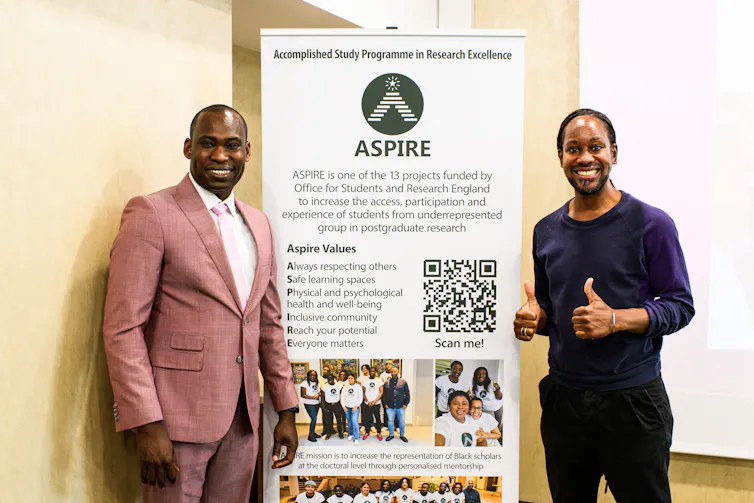
I had the privilege of knowing Jason and welcoming him to speak to scholars on the Accomplished Study Programme in Research Excellence (Aspire), which was set up to address the underrepresentation of Black students progressing into doctoral education.

Jason had been facing accusations of plagiarism and resigned from his position at the University of Cambridge. He was found dead on August 14 2026.

His passing has made me reflect on an uncomfortable question: do Black academics really belong in UK higher education? Of course, we should belong. The more difficult question is whether our institutions consistently make us feel that we do.

Advertisement

This question has shaped much of my work through the Aspire programme. Across three cohorts, Aspire has supported 59 Black and mixed-Black scholars. Fifteen progressed into fully-funded PhDs at universities across the UK.

Those numbers matter. But our research suggests that the most important impact of such programs cannot be captured through numbers alone.

Jason Arday (left) and Ifedapo Francis Awolowo at an Aspire event in 2024.
Aspire/Key Reflections, Author provided (no reuse)

Despite years of commitments to equality, diversity and inclusion (EDI), Black academics remain significantly underrepresented at the highest levels of higher education. Only around 1% of professors in the UK are Black.

Behind that statistic are people navigating systems in which they may rarely encounter someone who looks like them in positions of seniority.

Advertisement

Scholars were transformed not simply by learning how to write research proposals, navigate PhD applications or identify funding. What mattered enormously was the building of relationships.

They encountered mentors who believed in them. They met Black academics who made becoming a researcher seem possible. They entered spaces where conversations about race did not have to be avoided. They became part of a community in which their ambitions were taken seriously.

For some, the journey towards a PhD began with something much simpler than research training: someone telling them that they belonged there.

Sometimes, exclusion is being the only Black person in the room. Sometimes it is not knowing the unwritten rules. Sometimes it is constantly having to prove that you deserve to occupy the space you have already earned.

Advertisement

And sometimes it is quietly wondering: is this place really for someone like me?

Supporting Black scholars is not an act of charity. Universities are intellectually richer when knowledge is produced by people with different histories, experiences and perspectives. Different questions are asked and assumptions are challenged. Students encounter new possibilities for who can become a professor, researcher or intellectual leader.

This is why the current moment should not lead universities to become less committed to EDI. It should make us more intentional about it.

Black woman looking at book in library
Black scholars should be not only represented but valued and supported.
Kjetil Kolbjornsrud/Shutterstock

EDI cannot simply be something written into strategies, displayed on websites or celebrated during particular months. It must be something people experience. And one of the simplest tests of meaningful inclusion is whether people genuinely feel they belong.

My work draws on ubuntu, the African philosophy often captured as “I am because we are”, alongside omoluabi, a Yoruba philosophy concerned with character, integrity and our responsibilities towards others. Both challenge the idea that academic success is purely an individual achievement. None of us flourishes alone.

Advertisement


À lire aussi :
How African principles of community are helping Black students in the UK into PhD study


Most academics can remember somebody who opened a door, encouraged them after a rejection, advocated for them, or simply believed in them before they fully believed in themselves.

That is why racial equity must move beyond access towards belonging and duty of care.

One message consistently ran through Jason’s work and his interactions with others: kindness and love matters. Behind our titles, publications, grants and achievements are human beings who need community, encouragement and care.

Advertisement

There is a difference between being invited into a university and feeling wanted there; between being represented and being valued; between surviving academia and flourishing within it.

Universities therefore need to ask difficult questions. Who mentors Black scholars? Who advocates for them? Who notices when they are struggling? Where can they speak honestly about their experiences? Who reminds them that they do not have to navigate academia alone?

This is not the time to retreat

These questions are becoming more urgent at precisely the moment when EDI initiatives are facing increased scrutiny and universities face enormous financial pressures. There is a danger that universities will respond to this situation by retreating from EDI initiatives.

If mentoring changes trajectories, fund it. If communities create belonging, sustain them. If targeted interventions enable talented Black scholars to enter doctoral education, invest in them.

Advertisement

Otherwise, EDI risks becoming performative – something institutions are comfortable talking about but less willing to resource.

Picture taken at the ASPIRE showcase event in 2024.
ASPIRE/Key Reflections, Author provided (no reuse)

The question should never really have been: do Black academics belong in higher education? We do. The question for universities is: what are we doing to make sure they know that they do?

Jason’s work feels especially important now. Kindness may sound too soft for conversations about structural racism. I believe the opposite. There is something profoundly powerful about creating institutions in which people genuinely care whether others flourish.

At a time when some Black academics are looking towards the future with uncertainty and wondering where they truly belong, retreating from racial equity cannot be our response.

We must instead build universities where Black scholars do not merely enter and survive, but are supported, valued and able to flourish.

Advertisement

Source link

Continue Reading

NewsBeat

Tourists swamp Dolomites beauty spot with ‘crazy’ queues forming for local delicacy – as Italian mountains groan under pressure from visitor invasion

Published

on

Shocking videos show an influx of tourists waiting hours at an altitude of 2,300 meters amidst the breathtaking scenery in 'mad' winding queues for famed fresh, cream-filled doughnuts

Advertisement

A beauty spot in the Dolomites has been swamped by tourists searching for a local delicacy as the mountain range comes under increasing pressure from crowds of visitors.

The Alpine region is known as one of the most scenic spots in Italy with its cable cars, mountain views and hiking trails luring millions of holidaymakers a year.

This summer is no different. Videos show tourists waiting hours at an altitude of 2,300m in ‘crazy’ winding queues for a cabin’s famed cream-filled doughnuts.

Visitors wake up in the early hours of the morning to get their hands on the sweet treat before they sell out at the Rifugio Friedrich August hut on the Langkofel mountain near the border with South Tyrol. 

Advertisement

Some have even reported camping out just to guarantee themselves a doughnut. 

Furious locals have become fed up with holidaymakers more concerned with social media photos than appreciating the region’s natural beauty, while unimpressed TikTok users called the viral spot a ‘tourist trap’.

One wrote under a video of queues: ‘Pretty much all if the huts/refugios in the Alps have great traditional high quality locally/home-made food. 99% of them without having to wait in lines at all.’

‘This is madness,’ said an Italian influencer who promotes tourism in the region. 

Advertisement

Shocking videos show an influx of tourists waiting hours at an altitude of 2,300 meters amidst the breathtaking scenery in ‘mad’ winding queues for famed fresh, cream-filled doughnuts

Last week on the day of the solar eclipse, severe traffic gridlocked roads on the Passo di Giau mountain

Last week on the day of the solar eclipse, severe traffic gridlocked roads on the Passo di Giau mountain

One hiker said: ‘I’ve been coming to the mountains for years and I’ve truly never seen such chaos; there are queues everywhere.’ 

Advertisement

Another wrote: ‘They’re not interested in the Dolomites. They come in flip-flops just to take pictures.’ 

An exasperated social media user also commented: ‘Yeah that’s why I’m choosing countries and cities and places no one in social media knows about.’ 

Meanwhile, last week on the day of the solar eclipse, severe traffic gridlocked roads on the Passo di Giau mountain pass.

Footage showed hundreds of cars completely at a standstill all the way down into the valley. 

Advertisement

Barriers have also been installed near the picturesque Santa Maddalena church to prevent unauthorised drivers from reaching it by car. 

The serene beauty spot has been overrun by hundreds of tourists looking to visit the most popular landmarks.

The swarm of tourists have caused carnage in the quaint village and has seen the region implement new restrictions that limit cars to just 150 per day

The swarm of tourists have caused carnage in the quaint village and has seen the region implement new restrictions that limit cars to just 150 per day

Furious locals have become fed up with holidaymakers more concerned with social media photos than appreciating the regions natural beauty

Furious locals have become fed up with holidaymakers more concerned with social media photos than appreciating the regions natural beauty

Advertisement
The serene beauty spot has been overrun by hundreds of tourists looking to visit the most popular landmarks

The serene beauty spot has been overrun by hundreds of tourists looking to visit the most popular landmarks

A woman who claimed she has been visiting the Dolomites for 35 years said: ‘This year it seemed to me as if I were on another planet. There have never been so many people here.’ 

Earlier this year a video showed a line hundreds of meters long at a bus stop for a shuttle as crowds waited to visit the world-famous Three Peaks. 

It is one of the most visited attractions in the Alps and during peak season up to 14,000 visitors flock to the region everyday. 

Advertisement

The councillor for the area, Nicola Bombassei, who oversees the environment and land use planning, reportedly said last month the queues were ‘unacceptable’, adding that the region is already seeing a record number of visitors. 

Efforts will be made to find ways to reduce crowds, she said. 

A ski-lift has been suggested in recent years as a means to better manage overcrowding in these zones, however many argue this contravenes a quota system restricting vehicle access to the area.

The director of operations for Dolomiti Bus, Gabriele Mariani, was reported to have said that their shuttle service has been reinforced in the wake of the masses of crowds.

Advertisement

‘We are constantly monitoring visitor flow and adapting our service according to needs,’ he added.

Advertisement

Source link

Advertisement
Continue Reading

NewsBeat

ZZ Top drummer Frank Beard dies aged 77

Published

on

Scorched earth at the scene of helicopter crash

Members of the group have included founder and lead vocalist Billy Gibbons and the late Dusty Hill. When Hill died in 2021, the group carried on performing with Elwood Francis as its bassist.

“Today, Elwood and I lost a great friend and collaborator, and the world lost one of the most naturally innovative drummers and a great and true son of Texas,” Gibbons said.

“His signature backbeat was key to keeping ZZ on top. The band of which he was part for six decades is going to keep on keeping on as he had wished,” he said.

ZZ Top, which was inducted into the Rock and Roll Hall of Fame in 2004, has continued touring throughout North America, Europe and South America.

Advertisement

Shows the group called off after Beard’s death had been scheduled in Salt Lake City, Utah, on Monday and in Colorado Springs, Colorado, on Wednesday.

The group said it plans to resume its current The Big One! Tour over the weekend, with two dates at Austin City Limits, which the band said was one of Beard’s favourite venues in “a city that had been something of a second home for him”.

Source link

Advertisement
Continue Reading

Trending

Copyright © 2025