Swapping cigarettes for vapes does not put users ‘at risk of serious harm’ – is the surprising conclusion of a major review into e-cigarette safety.
Experts behind the report promoted the use of the devices as a stop-smoking treatment, saying doctors should be ‘reassured’ of their safety.
The review also found that e-cigarettes are at least two thirds more effective at stopping people smoking than nicotine gum and patches.
The advice comes a week after the publication of a stark review that linked vaping to a host of health conditions in young people, including respiratory problems including wheezing and coughing, depression and panic disorders.
The authors, from the Royal College of Paediatrics and Child Health (RCPCH), also found a higher incidence of allergies, sleep and eye symptoms in young vapers.
‘There is much we do not yet know about [vaping’s] long term impact on children and young people…but a clear and concerning picture is emerging,’ said the College’s Vice President for policy, Dr Mike McKean.
Meanwhile, paediatrician and author of last week’s study, Professor Will Carroll, said vaping ‘should not be seen as a harmless part of growing up,’ adding that it is ‘clearly linked with respiratory symptoms and nicotine dependence’.
However, the authors of the new review, published in the prestigious Cochrane Library, argue that the risks of vapes ‘pale in comparison’ to smoking.
Evidence now suggests that vaping is not nearly as safe as once thought
‘With every update, the evidence has become stronger that vapes play a crucial role in supporting people trying to quit smoking,’ Dr Jamie Hartmann-Boyce, senior author of the review from the University of Massachusetts Amherst, said.
‘Based on the consistency of the findings here, it’s clear they are not only substantially less harmful than smoking, but a proven and viable option for people wishing to quit traditional cigarettes.’
The number of Britons aged under 16 who vape overtook the number of smokers of the same age for the first time this year, official figures show.
Prof Carroll told the Daily Mail that the new report neglects the risk of the devices to young people.
‘One person’s exit from the perils of tobacco smoking might be a child’s entry into a lifetime of nicotine addiction and subsequent poorer health,’ he said.
A full UK-wide ban on selling vapes and nicotine products to under-18s is already law and will come into force on 29 October.
This will make it illegal to sell any nicotine or vape product to anyone under 18 including nicotine vapes, nicotine free vapes, e-liquids and nicotine pouches.
Adults who buy or attempt to buy vapes or nicotine products for under-18s will also be committing an offence.
Vaping in cars carrying anyone under 18 will also be banned in England under government plans to reduce the harms caused by smoking and vaping.
The Department of Health and Social Care said the measures it is proposing are needed, given the growing evidence about the dangers of heated tobacco and vaping.
Around 5.4 million adults now use e-cigarettes daily or occasionally, compared with 4.9 million who smoke. This means one in 10 adults now vape.
Research shows that one in two smokers will die from smoking-related disease, such as lung cancer, chronic obstructive pulmonary disease (COPD), heart disease and stroke.
Despite this, many smokers, who may have been hooked on nicotine for decades, find it difficult to stop.
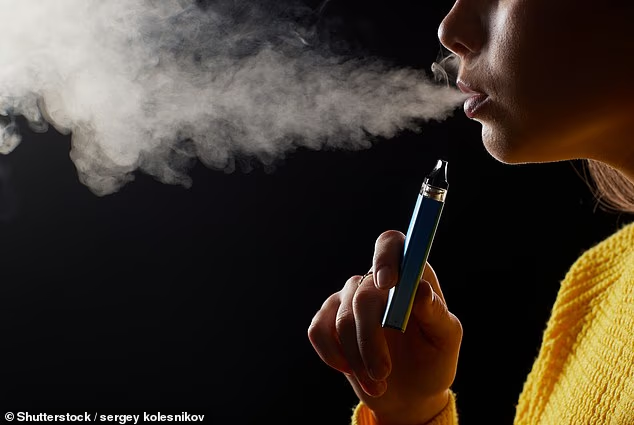
Vapes are handheld devices that work by heating a liquid that usually contains nicotine and flavourings. Nicotine is then inhaled as a vapour, rather than smoke.
For this reason, it has been suggested that regulated vapes are safer than traditional cigarettes because they do not expose users to the same levels of toxic chemicals.
However, another study involving more than 4.5million ex-smokers and published in the journal Nature Medicine last month found that swapping cigarettes for vapes may not reduce the risk of lung cancer.
Results showed that those who took up vaping to help them quit traditional smoking had a significantly higher risk of the disease, compared to those who kicked the habit entirely.
For the latest review, researchers analysed 80 studies involving 29,861 adult smokers that assessed the effectiveness of vapes for smoking cessation.
The University of Massachusetts scientists compared the results of different interventions over the course of six months, as well as side effects.
Vapes were compared with traditional nicotine replacement therapies such as patches or gum, drugs used to help people stop smoking, and therapy.
The authors also compared the outcomes of nicotine-free vapes and those with the addictive substance.
The researchers found more people stop smoking for at least six months with vapes than with any other conventional method.
Around 10 per cent of smokers using vapes quit successfully, compared to five per cent of those receiving no support or behavioural support alone.
Nicotine e-cigarettes led to higher quit rates than nicotine gums and patches – about four more quitters per 100 people; a difference of around 67 per cent.
While there appeared to be no difference in the number of serious side effects reported, the researchers conceded this may be because their study only included regulated e-cigarettes.
‘Not all e-cigarettes are the same,’ Dr Hartmann-Boyce explained. ‘The harms we hear about are often from unregulated vaping devices that may contain psychoactive substances like THC.
‘And the vaping devices assessed in this review are probably very different from what a teenager may be using.’
The review only followed participants for two years – and could have missed longer-term complications, the authors added.
The researchers concluded that while vaping is not risk free, it is considerably less harmful than smoking – which is the leading preventable cause of disease and death in the UK.
Data released in July from Action on Smoking and Health found that over half of British adults who smoke believe vaping is as harmful or more harmful than smoking.
‘The misconceptions matter,’ Dr Hartmann-Boyce said. ‘People who switch entirely from smoking to vaping an e-cigarette are likely to substantially improve their health.
‘The advice remains largely the same – we know these are useful tools to help people quit smoking and we feel more confident in those results now.’
The harms of vaping are said to lie with exposure to heated chemicals – this is thought to be toxic to lung tissue.
In the UK, smokers looking to quit have a growing range of options available.
Alongside nicotine replacement therapies such as patches and gum, some GP practices and stop smoking services can offer prescription medicines including varenicline, cytisine and bupropion.
Nicotine vapes have also been offered on the NHS since 2023 to patients attempting to kick cigarettes.
However, there is growing concern that vaping is not as nearly as safe as once thought.
The researchers, meanwhile, stressed that while the best approach will vary from person to person, combining vaping with behavioural support often gives smokers the best chance of success.



























































You must be logged in to post a comment Login