
Politics
Anna Ridgway: Burnham has the chance to do what no politician has dared – scrap the triple lock

Anna Ridgway is National Coordinator for Students for Liberty UK.
Three months ago I wrote on this site that Britain needs to start thinking differently about the state pension. I was called selfish, ignorant, cruel, and (my favourite) a “lefty.” Seventy-three comments, many of them furious. One commenter told me I just need to get off social media and stop doing university courses that do not lead to a good income. Noted.
But here is what has changed since April. Keir Starmer is gone. Andy Burnham is almost certainly about to become Prime Minister. The fiscal case I made has not changed much. The OBR still projects £80 billion more in state pension spending by the 2070s, with over half driven by the triple lock. The IFS still shows the full new state pension running £30 a week higher than it would under simple earnings indexation. Annual spending is still £12 billion above what an earnings link would have cost. None of this is news.
What is new is that the consensus against the triple lock has hardened into something close to unanimity. As Sky News reported recently, think tanks from across the political spectrum now warn the policy is unsustainable. The original estimates when it was introduced in 2012 suggested it would cost around £5.2 billion a year by 2029–30 and push the state pension up by an average of 0.2 percentage points above earnings growth. It has blown past both figures.
Even the Resolution Foundation, a centre-left outfit once led by the current pensions minister Torsten Bell, has called time on it, publishing a report in June called What a Ratchet! which found that pensioner poverty fell by 15.8 percentage points in the fourteen years before the triple lock existed, driven mostly by Pension Credit, and that the policy has cost the Treasury three times more than originally expected while doing comparatively little for the poorest pensioners. When a think tank that close to Labour is saying this, it is worth paying attention. More importantly, they proposed a concrete replacement. More on that shortly.
Now, Burnham has publicly committed to keeping the triple lock. Of course he has. Every party leader does. But there are reasons to think he might actually be the one to ditch it, and reasons to think he should.
The first is that he has watched, up close, what happens when you reform pensioner benefits stupidly. The winter fuel allowance debacle was not the only thing that sank Starmer, but it became the one voters kept bringing up. Labour MPs called it “kryptonite” on the doorstep. The reason it stuck was not the policy itself but the execution: announced three weeks into government, with no groundwork, no explanation of what the savings would fund, and no compensating offer. It looked like taking from pensioners for nothing in return.
The lesson is not “never touch pensioner spending.” The lesson is “don’t do it badly.” Burnham can learn from this. He can do it differently.
His own advisers are already telling him to. Lord O’Neill, the former chairman of Goldman Sachs Asset Management and the man who coined “BRIC”, has called ending the triple lock a “no-brainer.” Andy Haldane, formerly chief economist at the Bank of England, has warned that Britain cannot afford its current spending commitments. Both sit at the centre of Burnham’s economic thinking, and both are pushing hard.
And Burnham has something Starmer never had – goodwill.
He is the most popular figure in the Labour Party by a country mile. He won Makerfield with a majority over 9,000, smashing expectations. He has framed his pitch around “economic renewal” and trust. If a prime minister is ever going to spend political capital on something difficult, the first six months are when you do it. Everyone knows this. Burnham knows this.
The Resolution Foundation has even handed him the replacement policy on a plate. A “smoothed earnings link” would keep the state pension tracking wages over the long run, while still protecting its real value in years when inflation outpaces earnings. What it would not do is keep ratcheting the pension above earnings every time the economy misbehaves. The difference in cash terms? About £1.30 a week by 2029–30. That is it. £1.30 a week less for pensioners, £650 million a year back to the Exchequer, growing over time.
£1.30 a week. That is what stands between the current policy and a fiscally sustainable alternative. Try telling me that is not a trade worth making.
There is also a looming absurdity that makes reform almost unavoidable. The full new state pension is now £12,548 a year. The personal allowance is frozen at £12,570. Next year, the state pension will breach that threshold, and pensioners receiving only the state pension will start paying income tax on it. Burnham has said he will exempt them. Fine. But that is yet another sticking plaster on top of a system that is generating its own contradictions faster than politicians can patch them.
Yes, this is politically risky. YouGov found in May that 66 per cent of the public support keeping the triple lock. Only 14 per cent oppose it. Landslide numbers. But dig into the detail and the picture shifts. When people are presented with specific alternatives, like a double lock or a smoothed earnings link, support and opposition split much more evenly. The British public might well accept change if anyone in politics actually tried to explain one.
So far, nobody has.
Westminster knows all this, by the way. As this site noted back in April, the triple lock is an open secret. Almost every economist, journalist, and politician privately accepts it is unsustainable. They keep it because older voters turn out, younger voters do not, and nobody wants to go first. That is not principle. It is cowardice dressed up as compassion.
Burnham could break the pattern. Not by cutting pensions or punishing pensioners, but by swapping a volatile and badly designed indexation formula for a stable one, and being straight about why. He could say: we are protecting the state pension, we are keeping it rising with wages, and we are using the savings to bring down the tax burden on young workers, build houses, and fund training for people locked out of the labour market. Call that an attack on pensioners if you like. I would call it governing.
Will he do it? The early signs are not encouraging. Burnham recently did a Reddit “Ask Me Anything” session, presumably to show he is the kind of leader who engages with difficult questions. One of the most upvoted questions asked whether it is time to abolish the triple lock. His answer: “I appreciate there’s a lot of debate about this but it is important that the commitment in the manifesto stands.” That is not a leader preparing the ground for reform. That is a politician reading from the same script as every other politician who has ever been asked this question.
His public statements are no bolder. Defenders will point out, as they always do, that the UK state pension remains low by international standards. That is true. But the triple lock is not a policy designed to reach a target and stop. It is a ratchet with no ceiling, and keeping it because the pension is still comparatively modest does not make the mechanism any less broken.
The economists around Burnham are serious. The fiscal arithmetic does not go away. And the political window is as open as it is likely to get. Plenty of people doubt he has it in him. They may be right. But if Burnham ducks this, the next prime minister will face the same problem under worse conditions. And the generation paying for it, my generation, will still be here, still paying, still waiting for someone in charge to be honest.
I said in April that symbolism does not pay the bills. Three months on, I see no reason to update that view.



The Democratic Party’s fight over Israel is returning to where it began. Jewish Democrats are warning the results could push them out of the party entirely.
In Michigan, where grassroots anger over the Biden administration’s approach to the war in Gaza gave rise to the “uncommitted” movement in 2024, the American Israel Public Affairs Committee’s main super PAC, United Democracy Project, has spent a record $30 million — more than double its next-highest spend ever, according to AdImpact data — to keep progressive and staunch Israel critic Abdul El-Sayed from defeating pro-Israel Rep. Haley Stevens in the state’s hotly contested Democratic Senate primary.
And in Missouri, AIPAC is spending $2 million to block Israel-critical Cori Bush’s comeback bid. This comes after the group uncorked $9 million last cycle to unseat her.
“There’s a high level of discomfort in the Jewish community,” said Sam Lauter, founding member of Democratic Majority for Israel, which has endorsed Stevens and Bush’s opponent, Rep. Wesley Bell (D-Mo.), but hasn’t spent money on advertising.
If El-Sayed and Bush score victories, he said, “it does mean that my community is going to have to reassess how we’re approaching this battle, reassess our role in the party itself.”
Tuesday’s primaries represent a fork-in-the-road moment for pro-Israel Democrats. Groups like AIPAC and DMFI have waded into Democratic primaries this cycle with mixed results. Progressives have scored wins in New York, New Jersey, Colorado, Pennsylvania and Illinois in part by capitalizing on voters’ negative attitudes toward Israel, in some cases toppling longtime incumbents who were more Israel-friendly, while also falling short in some races.
Michigan and Missouri mark one of progressives’ last opportunities to cement a foothold in the party ahead of November. If Stevens and Bell lose on Tuesday, some Jewish Democrats worry their defeats could represent a tipping point for the Democratic Party, completely reshuffling the political landscape ahead of a general-election fight in which both chambers of Congress hang in the balance — and rendering many pro-Israel Democrats politically orphaned.
“It makes it very uncomfortable for elected Jewish Democrats like myself to wonder, when every other thing is about, you know, Israel and Jews, what’s my place in this party?” said Michigan state Rep. Noah Arbit, founder of the Michigan Democratic Jewish Caucus. “Can I see myself in this party? Can I continue to feel comfortable being elected on the Democratic Party line?”
Patrick Dorton, a spokesperson for United Democracy Project, insisted pro-Israel Democrats “are here to stay.”
“We are not going to let pro-Israel voices in the Democratic Party be silenced,” he said. “We are going to make sure that pro-Israel voices are heard in the primary process, this year and in the future.”
The race for Michigan Senate and Missouri’s 1st District quickly turned into referendums on the party’s once unwavering support for the longtime U.S. ally and AIPAC’s highly controversial interventions in Democratic primaries. Bush’s campaign has accused Bell of “abandoning” Missourians and “jetting off to Israel with AIPAC,” while El-Sayed has attacked Stevens for aligning herself“with AIPAC and Republicans to continue to fund a war machine.”
Bush’s campaign did not respond to a request for comment. In a statement, El-Sayed campaign spokesperson Roxie Richner said the campaign has sought to unify Michigan residents “from all walks of life — across ages, races and faiths — around getting money out of politics, money back in pockets, and Medicare for All.”
Both races are a callback to earlier fights over Israel that have divided the Democratic Party and that accelerated in the wake of the Israel-Hamas war. Nearly 60 percent of Democrats believe the party is too supportive of Israel, an AP-NORC survey from June found, an increase from 45 percent of Democrats who felt similarly in January 2024.
Bell’s primary win over Bush in 2024 was one of AIPAC’s biggest wins last cycle. Israel-critical Democrats in Michigan, meanwhile, hammered Biden and later Vice President Kamala Harris for not prioritizing Gaza in their campaigns.
“That felt like people were upset with the war in Gaza,” Andy Schor, mayor of Lansing, Michigan, and one of the highest-ranking Jewish elected officials in the state. “Now it feels like these candidates are anti-Israel.”
Richner countered that El-Sayed “has continuously emphasized the importance of differentiating between criticisms of the Israeli government and Judaism and the Jewish people.”
“He understands that the fights against antisemitism and islamophobia are intertwined, and as Michigan’s next U.S. Senator, will work to stamp both out,” she said in a statement.
The Michigan race also marks a unique litmus test for pro-Israel Democrats in a purple state that is poised to have an outsized role in selecting the party’s next presidential nominee and, eventually, the next occupant of the White House. The Democratic National Committee put forward a proposal earlier this month to make Michigan one of six early contests in 2028.
Dennis Bernard, the Jewish Federation of North America’s national chair of government relations, said an El-Sayed victory would be the most compelling evidence yet that “there is a strong anti-Israel, antisemitic streak within the Democratic Party, and it’s growing, and it’s growing outside of just hard blue states.” Bernard, who has historically supported politicians on both sides of the aisle, is backing Stevens in Tuesday’s primary.
Still, Michigan’s Senate race has divided the Jewish community. Some leading Jewish activists are backing El-Sayed — including progressive former Rep. Andy Levin, who lost a primary to Stevens in 2022 that was a proxy war between rival pro-Israel groups J Street and AIPAC.
“I think that Abdul El-Sayed feels that he has an opportunity and a responsibility to be a leader in the United States of the movement for Palestinian rights, and so he modulates his politics around this very carefully,” Levin said.
Arbit, the Michigan state representative, said he’s resigned to Israel’s diminishing relevance in the party ahead of the next presidential primary, regardless of how Tuesday’s primaries play out.
“I find it very hard to imagine that we’re going to have a candidate who is quote-unquote pro-Israel. I don’t know how that works,” he said of the 2028 presidential primary. “I just think the party grassroots is so poisoned against the state of Israel.”
Shia Kapos contributed reporting.
Politics
The House | If Burnham is serious about the cost of living, he must act boldly on food prices


Supermarket in 2026 (Alamy)
4 min read
Andy Burnham has promised “a cost of living government” as he enters office. Along with energy bills, rising food prices are one of the main ways households have felt the impact of inflation most acutely.
In April of this year, over 90 per cent of those who reported an increase in their cost of living cited food being more expensive as one of the reasons. Prices for food and non-alcoholic drinks have risen 38 per cent since 2020, a greater increase than overall inflation (31 per cent), and some experts think we could see this become a 50 per cent cumulative increase by the end of this year thanks to the war in Iran.
Food inflation is not just a result of geopolitical shocks disrupting supply chains and raising energy costs. It’s also driven by more persistent factors like climate change – with the UK losing the equivalent of a year’s supply of bread for every person due to the impact of extreme weather on domestic wheat harvests. This means the government’s task is not just to help people with the present crisis but also to tackle long-term problems in our food system to bring prices down.
One policy that would have the greatest immediate impact is targeted income support. Higher food prices are felt most acutely by the poorest households, who spend a greater proportion of their income on essentials. Recent research from the Joseph Rowntree Foundation found that five in six low-income households on Universal Credit struggle with food and bills. They propose an “Essentials Guarantee” – an uplift in benefits that would eradicate this issue.
Another option to combat food poverty is ramping up public provision of free and low-cost meals. This should include universal free school meals to help the 3.8 million children who currently live in food insecure households, but schools are not the only setting where meals could be publicly provided. An economic adviser to Burnham recently supported calls for a National Food Service, a network of community kitchens and diners providing free meals, and the Autonomy Institute has suggested that local authorities could repurpose “dark kitchens” (which cook for delivery platforms rather than a front-of-house restaurant) as community-owned kitchens cooking affordable food.
In the longer-term, the government needs to ensure our domestic food system is more resilient and produces more of what we consume. The UK currently imports around 40 per cent of its food, though this rises to around 50 per cent of vegetables and 80 per cent of fruit. These longer supply chains are more vulnerable to the effects of global shocks, with countries like Italy and Spain which produce more of their own food seeing lower price rises after Russia’s invasion of Ukraine than the UK did.
Government support for local agriculture should focus on transitioning to more ecological and climate-resilient practices, including moving away from fossil-fuel based fertilisers. It should also seek to diversify the ownership of food production and retail. Rather than the rising number of environmentally destructive “megafarms”, we need more community and co-operative ownership of land, more grants for small-scale urban farming, as well as community-owned bakeries and food markets.
The four largest food and drink retailers in the UK (Tesco, Sainsbury’s, Asda and Aldi) control two-thirds of the grocery market. While a Competition and Markets Authority investigation didn’t find evidence that this level of market power has led to excessive price rises for consumers, the imbalance of power between supermarkets and food producers can lead to supply chain unfairness that threatens the sustainability of UK agriculture.
Andy Burnham has signalled from his first days as Prime Minister that his economic strategy will involve finding ways to put money in people’s pockets now while also developing a long-term plan to transform the UK. His approach to the food system should be no different.
People need help to weather periods of crisis, but long-term trends are also putting upward pressure on prices that cannot be left unchecked. The government has trailed plans to help people afford their utility bills – now they need a bold plan to help people afford their food shop too.
Eleanor Shearer is a senior research fellow at Common Wealth think tank
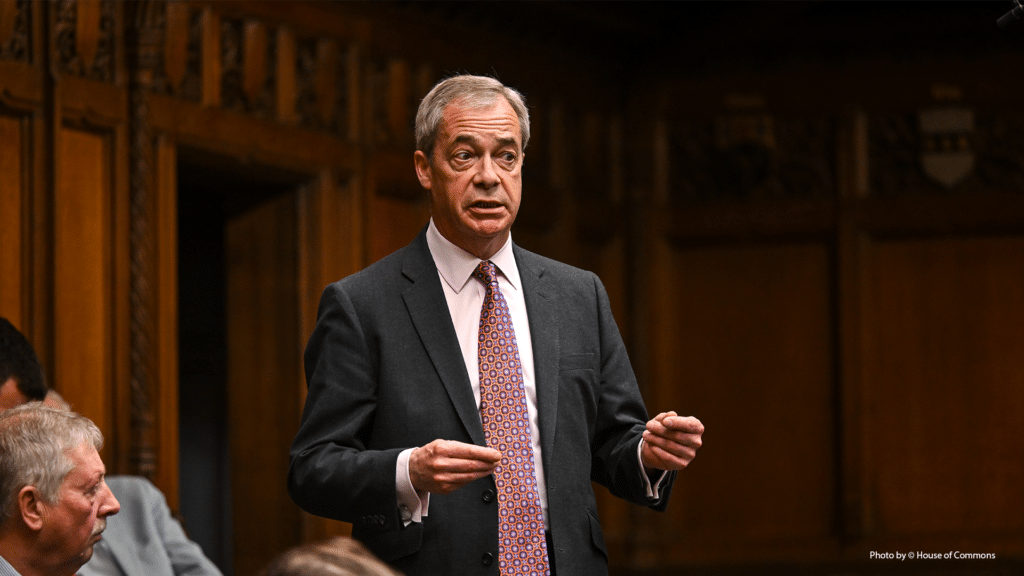
Ben Worthy and Laura Richards-Gray make the case that in triggering the by-election in Clacton, Nigel Farage sparked a conflict which he hoped he could control. They argue his gamble has not paid off since he has not been able to do so.
Nigel Farage’s decision to call a by-election has been pored over in detail. In an attempt to stymie an investigation into his finances, the Reform leader once again tried to place himself several moves ahead. Yet what was intended as a strategic masterstroke has now become a pointless by-election against someone in a bin. And one that has triggered a renewed bout of scrutiny of Farage’s finances.
Inspired by David Karpf’s account of about his public spat with a Republican politician, one way to look at Farage’s decision is through the lens of the logic of conflict (and having a fight). Back in the 1960s E.E. Schattschneider wrote a short book which challenged then conventional views of pluralism in a democracy. Put simply, he argued that democracy was all about conflict. Which fights get dragged into the open or kept out of sight, and how they unfolded, determined how democracies work.
Every conflict, Schattschneider argued, was decided by three things: who was involved, what the fight was about, and how long it lasted. Whoever could control these things would win.
In setting up his Clacton clash, Farage deliberately triggered a conflict which he hoped he could control. Behind his decision were a series of assumptions. First, that the by-election would involve all the major political parties. Second that this would lead to a ‘people versus the establishment by-election’. Finally, he seems to have believed that calling the by-election would bring the numerous Parliamentary investigations to a halt, and make the people of Clacton ‘the judges of my actions’.
All three assumptions have been proven wrong. Farage lost control of who was involved, when the major parties pulled out. He is now not facing the ‘establishment’ but instead Count Binface, Laurence Fox and Mr Fishfinger. He is fighting thin air and silliness. The public in general support Binface over Farage, perhaps swayed by his promises of capping of croissant prices at £1 and a return to 99 flakes costing 99p.
Consequently Farage could not control what the fight was about. Polling shows, as this headline put it, ‘Brits aren’t buying Farage’s anti-establishment crusade’. Rather, the fight is likely to be about Farage and his money. Ever since it was revealed in April that he was given £5 million by a crypto billionaire, this issue has dominated discussion. As Will Jennings commented ‘Raising the salience of your personal financial scandals is a bold move’.
The media are already raising questions and digging into different aspects of Farage’s financial dealings. There are now two separate Parliamentary investigations (on hold but very much not stopped) as well as possible investigations from the National Crime Agency and the Met Police.
And it has had an effect. A majority of voters see Farage as sleazy. Perhaps more worrying from his point of view, fewer than half of Reform UK voters (40%) think he has been honest, while only 22% think he has been dishonest and 39% are unsure.
Importantly, Farage’s gamble in Clacton is part of a wider conflict – Reform’s battle to replace the Conservatives. Polling suggests Reform may have hit a ceiling, and they have certainly been under-performing in by-elections. Its rise is neither as solid nor inevitable as it looks. By focusing on his conflict Clacton, Farage is neglecting the broader battle.
One of the secrets of Farage’s success has been to challenge the rules of the game and dictate the narrative. In this instance, he has lost control of the conflict.
By Dr Ben Worthy, Lecturer in Politics, Birkbeck, University of London and Dr Laura Richards-Gray, Senior Lecturer in British Politics, Birbeck, University of London.

spiked is funded by readers like you. Only 0.1% of regular readers currently support us. If just 1% did, we could grow our team and step up the fight for free speech and democracy.
Become a spiked supporter and enjoy unlimited, ad-free access, bonus content and exclusive events – while helping to keep independent journalism alive.


The destruction of Gaza’s healthcare system has placed reproductive health under unprecedented threat. Israel has decimated hospitals and healthcare infrastructure, and restricted access to reproductive and maternal care. This has left Palestinian women without the support they need to sustain life.
The war on reproductive health has been allowed to continue under the farcical “ceasefire” announced in October 2025. Meanwhile, women have nowhere to turn.
Reproductive violence
Pregnant women are moving between overcrowded shelters, sleeping in tents, or damaged buildings. Nothing is guaranteed, not even their next meal or when they may go into labour, and epidurals are largely unavailable. Ultimately, there is no safe pregnancy in Gaza.
The very few maternity wards that exist are overwhelmed; tackling dwindling fuel supplies and severe medicine shortages. Even basic items such as laboratory equipment and surgical tools are absent. These are withheld by the occupation whose punitive mindset dictates what enters the Gaza Strip.
The situation has become indescribably difficult for pregnant women. They are increasingly vulnerable in the face of circumstances far beyond their control. Women who should be receiving routine antenatal care are barely able to survive. In addition, they can barely access a maternity ward on foot or by vehicle.
Describing the macabre situation, a new report, Pregnancy Under Siege, states:
the line between survivable and lethal has been erased by deprivation.
The Palestinian Return Centre (PRC)-commissioned report added that complications which are entirely treatable are now becoming fatal. This is because there is no possibility of treatment.
4,000 miscarriages in just six months
The first six months of 2026 witnessed 4,000 miscarriages and the destruction of 1,825 health facilities. Hospitals have been brought to their knees. Only 20 of 37 hospitals remain partially functional, Medical Aid for Palestinians (MAP) has reported.
Pregnancies are risky enough without a live-streamed genocide. Making matters worse, Israel has targeted roads leading to and from hospitals. Moreover, ambulances are repeatedly targeted despite their protected status under international law.
Travelling to hospitals has become a life-threatening risk under such violence, daily and unrelenting. Many women are going into labour without skilled medical assistance, and routine pregnancy monitoring has largely disappeared for expectant mothers.
Without early diagnosis, conditions that are normally manageable can claim both the mother and baby’s life.
Cesarean sections make up half of all deliveries
Almost half of all deliveries in Gaza are now by caesarean section. This is exceptionally high is compounded by the fact that women are arriving at hospital dangerously late. Often, they arrive in critical condition if at all.
The challenges rarely end with delivery. Women recovering from c-sections are often discharged within hours because hospitals urgently need beds, Amnesty International has found. Many return to overcrowded camps with no privacy, limited access to clean water or postnatal care. As a result, the risk of infection and other complications increases.
Newborns also face severe risks. Around 70 percent are born prematurely or underweight, placing enormous pressure on hospitals already struggling with shortages of incubators, oxygen supplies and specialist equipment. Persistent shortages of medicines and repeated disruptions to essential services further undermine their chances of survival.
The dangers are not only physical. The PRC report warns that the psychological toll of Israel’s actions in Gaza may have lifelong consequences for both mothers and their children.
Constant fear of air strikes, repeated displacement and the trauma of losing loved ones place extraordinary psychological strain on pregnant women. Research has consistently linked prolonged maternal stress with higher risks of miscarriage, premature birth and restricted foetal growth. These are outcomes that Gaza’s healthcare workers confront daily.
60 percent of Gaza’s pregnant women are anaemic
Gaza’s humanitarian crisis, intentionally manufactured by the Israeli occupation, has left pregnant women severely malnourished. Almost 60 percent have developed anaemia due to poor nutrition. This is further exacerbated by worsening health conditions and a lack of supplements.
According to the latest Integrated Food Security Phase Classification (IPC) analysis, Gaza remains at critical risk of famine, with around 25,000 pregnant and breastfeeding women expected to require urgent nutritional support.
Recent UN figures show that 1.9 million of Gaza’s 2.1 million people are displaced and exposed to ongoing health and environmental risks. Up to 70 percent of the population cannot access even six litres of water a day. As part of its well-planned genocidal campaign against Palestinians in Gaza, the Israeli occupation has damaged or destroyed nearly 90 percent of water and sanitation infrastructure. This has left families reliant on small quantities of contaminated or untreated water.
Widespread environmental contamination, the spread of disease and the lack of clean water are now major concerns. For those who are pregnant, dehydration and poor sanitation increase the risk of urinary tract infections, kidney complications and other serious illnesses.
So much for ‘special protections’ under international law
International humanitarian law affords special protection to pregnant women and infants during armed conflict. So why are the reproductive rights of Gaza’s female population being systematically disregarded? They aren’t treated humanely, and Israel actively deprives them of the care they need.
The impunity stinks. Hospitals have been destroyed, newborns have died from preventable causes, and pregnant women have been denied life saving care, with little meaningful accountability.
When hospitals are reduced to rubble, ambulances cannot reach women in labour, and food, water and medicine are withheld, it is not only Palestinians who are under attack—it is the principles of international law itself.
The evidence points to a war on reproductive health, one in which accountability remains painfully absent.
Featured image via the UNFP / Canary
By Charlie Jaay


Greater Manchester Green mayoral candidate Geraldine Coggins has announced that she would join Green-led London councils in Lambeth and Lewisham in commissioning a review of policing in immigration raids.
Coggins announced the plans at a cost-of-living themed hustings organised by GM Coalition of Disabled People, Acorn Tenants Union, GM Living Income Campaign, and GM Immigration Aid Unit. As mayor, she would also be the Police and Crime Commissioner for the city-region. (Her full manifesto is here.)
Lewisham became the first council to pass a motion pledging not to use council resources or public money to assist with any raids “where legally possible” last Wednesday. This followed Lambeth’s announcement in June that it would commission a review of the council’s arrangements for sharing information and intelligence with immigration enforcement agencies. Both are now Green Party-run councils, as of May’s elections.
Green Party leader Zack Polanski has previously called Labour’s immigration policy plans “performative cruelty.” Those plans, hardened under Starmer, appear to be continuing under new PM Andy Burnham.
Labour candidate Bev Craig did not attend the cost-of-living hustings. Green sources say it’s the third such community hustings in a row that she has missed. This has sparked accusations of evading scrutiny and reinforced the idea that Labour feels more comfortable working with developers than listening to local people.
Reform UK’s candidate, mega-landlord Sian Astley, likewise dodged the climate, LGBTQ+, cost-of-living, and Muslim organisations’ hustings. It seems neither Labour nor Reform are eager to show up.
Labour and Reform dodge Manchester mayoral election community hustings
Green Coggins stands by migrant workers
In her announcement, Green mayoral candidate Coggins made clear that Labour is in the wrong:
From speaking to people across Greater Manchester, I’ve heard growing fears about the direction of Andy Burnham and Shabana Mahmood’s callous approach to immigration.
As Mayor, I will use my Police and Crime Commissioner powers to commission an urgent review of Greater Manchester Police’s role in supporting Home Office immigration raids. Greater Manchester residents should know how often our police are being asked to support Home Office immigration raids, why they are attending and how much officer time is involved.
Immigration raids are often violent and intimidatory and often involve demanding entry without a warrant. This manifests across Greater Manchester as stopping delivery riders under the guise of checking their vehicle license, turning up to shops and demanding to see people’s right to work, or turning up at their door demanding access. Many people have died in immigration detention centres.
INQUEST reported earlier this year that at least 31 detained migrants have died since 2017 in immigration detention centres and prisons. Half of those were never convicted of anything criminal.
It’s not only anti-Labour political opponents who believe that Labour’s approach to immigration has turned unjustifiably vicious. Even Burnham ally Angela Rayner, now his housing minister, criticised Labour’s new hostile environment-style policies and far-right pandering. Back then, though, she was a backbencher.
@TheCanaryUK Greater Manchester Mayoral Elections Hustings 2026
At the ACORN / GM Living Income /Coalition of Disabled People cost-of-living and affordability hustings
Also involved are the Greater Manchester Immigration Aid Unit
Labour + Reform nowhere to be seen
Suspicious! pic.twitter.com/mZ4qfUjYVq
— C.J.Mc. Baillie (@cjmbaillie) July 28, 2026
Green candidate Coggins went on to discuss the broader global picture in her statement:
People want a fair immigration system, not Trump-style immigration raids that pull local police away from fighting crime and damage trust between communities and the police. Our police should be focused on tackling violent crime, modern slavery and organised criminal gangs, not drawn into Home Office-led immigration operations.
I will meet with the Chief Constable in my very first week as Mayor to ensure that policing resources are focused on keeping our communities safe while maintaining public confidence.
I will also work with council leaders and community organisations to explore every lawful option to protect vulnerable people, strengthen trust in policing and ensure victims of modern slavery and trafficking are identified and supported. And on a national level, I will call on the Government to end the routine use of local police in Home Office immigration raids as a matter of urgency.
Greater Manchester is a proudly diverse and welcoming city-region. We will always stand up for safe communities, effective policing and treating people with dignity.
Spain offers Burnham an alternative to Labour’s Danish-style immigration crackdown
Featured image via the Canary / Cameron Baillie
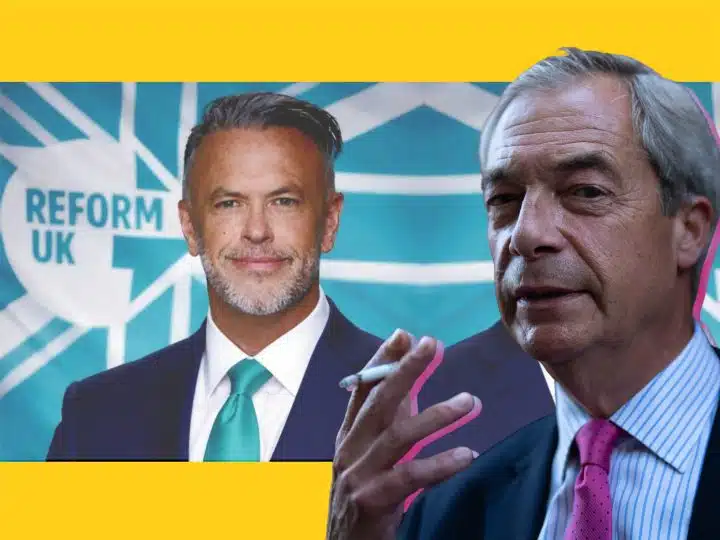
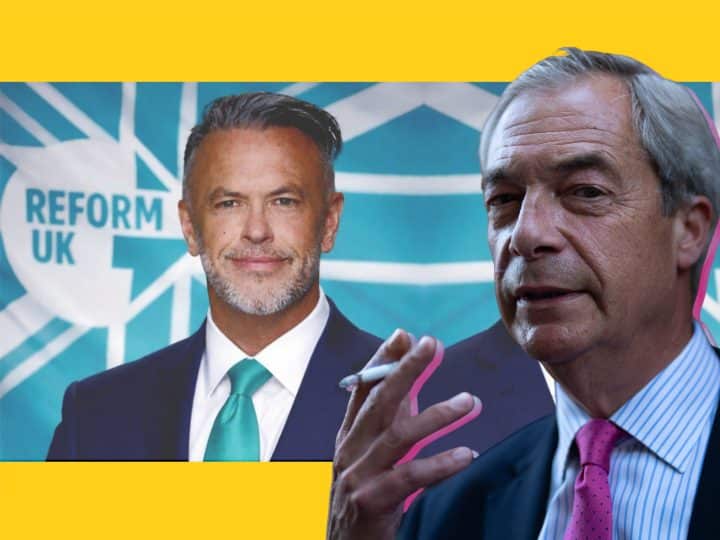
Northumbria Police have charged Reform councillor Glenn Gibbins. Gibbins attracted attention over his comments relating to Nigerian people, with this controversy having now led to the police’s involvement:
— Politics UK (@PolitlcsUK) July 29, 2026
 BREAKING: A Reform UK councillor in Sunderland has been charged with posting a grossly offensive comment after writing in 2024 that Nigerians should be melted down to fill in potholes pic.twitter.com/hNcf8QUIQk
Reform’s Glenn Gibbins
Gibbins successfully ran to become a Reform councillor in May this year. Reform subsequently suspended Gibbins while they investigated the controversial comments, reinstating him in June. Now, Northumbria Police have released the following statement:
A man has been charged with posting a grossly offensive comment on social media.
Glenn Gibbins, a councillor for Sunderland City Council, has been charged with the offence under the Communications Act 2003.
The charge is in relation to a post from 2024 which referenced the Nigerian community.
We received a report in relation to the post in May this year and carried out an investigation. The Force submitted a file to the Crown Prosecution Service, who subsequently authorised the charge.
The 66-year-old, from the Sunderland area, is due to appear before South Tyneside Magistrates’ Court next month.
We are aware there has already been significant interest in relation to this individual and the social media post and we’d urge people not to speculate both online and in the community in relation to this case.
A Reform UK spokesperson has since said:
The party is aware of the situation involving Cllr Gibbins. We will monitor the verdict closely
Featured image via the Canary
By Willem Moore


The UK’s new fund for investing in AI ventures does zero due diligence on whether companies receiving cash use copyrighted work without permission. The revelation comes after a series of Freedom of Information (FOI) requests by Ed Newton-Rex. Rex is chief executive of ‘Fairly Trained‘, which checks and certifies AI companies’ use of data for training their models.
UK ‘Sovereign AI fund’
In fact, Newton-Rex had to use three FOI requests to praise the admission out of the government. Disgraced former PM Keir Starmer handed the reins of the half-billion pound fund to the daughter-in-law of his idol Tony Blair.
Newton-Rex notes that, at first, the fund claimed it “considered” copyright compliance. However, when he then FOI’d the documents relating to the process, the fund had to admit that it had no such process. Instead, it claimed this is done by the government’s British Business Bank:
I asked what their criteria were when selecting companies to back, particularly regarding copyright. They said “copyright compliance is considered as part of legal execution, including as part of a typical representations, warranties and disclosure process.”
So I asked for the docs they used as part of that “representations, warranties and disclosure process”, so that I could see what they said about copyright. They said they had no such documents, and that the British Business Bank actually carried out the the representations, disclosures and warranties process on their behalf.
But when he asked the Bank for the documentation it uses in that process, it denied doing anything of the sort:
So I asked the British Business Bank for the docs they use in that process. But they replied saying they do no such thing, not for Sov AI or anyone – they let the commercial lead investor sort the reps and warranties.
What does this mean? It means the Sov AI fund is allocating taxpayer money to AI companies without checking whether they train on copyrighted work without permission.
As Newton-Rex pointed out, investing in banks that use copyrighted materials without permission is illegal under UK law:
Why does this matter? Two reasons:
1. I can’t believe the government would actively want to invest in companies that use the copyrighted work of British creatives without permission. Doing so is (i) illegal in the UK, (ii) possibly illegal elsewhere, and (iii) clearly antithetical to protecting its citizens and treating them fairly.
2. There are already signs that companies Sov AI has backed may be planning to do exactly this – e.g. Cosine, which has publicly said it plans to train on datasets that are known to contain copyrighted work.
If Sov AI is going to continue investing UK taxpayers’ money in AI companies, it is imperative that it introduces simple due diligence into whether companies exploit creatives’ work without permission. This would involve virtually no additional overhead, and would help ensure their investments align with the interests of the British public.
Lawless AI
The revelations come as the AI industry has been exposed as buying up huge numbers of irreplaceable rare books, then destroying them after scanning in order to monopolise their information. It comes as the UK government continues to massively expand AI-driven facial recognition around the country with no mandate to do so. And as the US and Israel use AI to drive the mass slaughter of Palestinian civilians.
It also comes as experts warn that AI-triggered economic collapse is inevitable if AI companies continue behaving as they have been. There is no sign of change — and no sign that the UK government is even interested in trying to rein in their excesses and abuses.
Featured image via the Canary
By Skwawkbox


US President Donald Trump’s former campaign manager Brad Parscale is overseeing an Israeli influence operation. Drop Site News reported that the operation is training bots to embellish fake claims that Palestinian journalists are linked to terrorism. The story has sparked debate about israel’s approach to using new technologies in information warfare.
The campaign has even tried to muddy the waters around the Israeli military’s murder of Palestinian child Hind Rajab. The operation aims to shape the views not of humans, but of the AI chatbots that people increasingly turn to for ‘corroborating’ information.
Drop Site reported on 28 July:
The key intended audience of these sites is not concerned Americans, it’s not even humans—most of the sites average a few hundred unique visitors each month.
Instead, Parscale and his firm, Clock Tower X, created them as part of a $46.5 million contract with the Israeli government to try and influence artificial intelligence-powered chatbots, tools like Claude or ChatGPT.
The process is known as Large Language Model (LLM) Poisoning. Drop Site reported:
In his initial agreement with Israel, Parscale said that he would deploy “websites and content to deliver GPT framing results on GPT conversations” as part of the contract.
More recently, his team even told Axios they are “seeing success” at getting popular AI systems to incorporate information from their sites, though they declined to provide data.
Even more chillingly, the outlet said, the multi-million dollar scam “is working”.
Disinformation experts reviewed:
a Drop Site analysis of chatbot queries and training data.
They found:
tens of millions of Americans who use chatbots are increasingly likely to receive answers manipulated by Parscale on behalf of the Israeli government.
Drop Site asked Parscale-run search engines about things like whether US backing of Israel benefited America. The answer was invariably yes.
The outlet said:
All of Parscale’s websites contain a statement at the bottom which states “this material is distributed by Clock Tower X LLC on behalf of the State of Israel.” This statement is a mandatory disclosure requirement under the Foreign Agents Registration Act (FARA).
The US-based website added:
Despite this, when Drop Site asked prominent chatbots about the latest news from Paxpoint.org, Perplexity and Copilot did not flag that the site was created as part of an Israeli influence operation. Claude, ChatGPT, and Gemini did flag the caveat.
Disinformation expert Alice Lee told Drop Site the Israeli networks compared to Russian disinformation in interesting ways:
While Russia’s Pravda network overall is far larger, Parscale’s sites have a far higher rate of successfully being archived.
As the Canary reported on January:
half of all political accounts linked to Israel social media are bots. This includes many of the accounts boosting posts by Benjamin Netanyahu and members of his terrorist government.
Parscale is also linked to a firm which will be familiar to UK readers. Drop Site said:
Parscale, who gained national attention as Trump’s campaign manager for hiring the controversial microtargetting firm Cambridge Analytica, is the largest recipient of Israel’s massive influence investment.
Cambridge Analytica was the US and UK dark money-backed influence operation which shaped narratives around, for example, the 2016 Brexit referendum.
There was a time when Trump and his allies endlessly talked about ‘fake news’. To some degree they still do. But the truth is they are some of the most venomous purveyors of garbage information around, as well as major beneficiaries of the fact-free ‘mirror world’ they’ve created.
Featured image via the Canary
By Joe Glenton


US diplomats staged a walkout of a UN meeting over French dignitaries’ criticisms of the Trump administration’s human rights record.
Which is, you know, completely accurate considering the kidnap of president Maduro, strikes against civilian vessels, and unlawful imprisonment (and murder) under ICE, to name but a few.
‘Forced labour’ tariffs
The ridiculous walkout stunt, which took place during a security council meeting on 27 July, was part of an ongoing feud between the two countries’ delegations.
Several days beforehand, on 23 July, the Trump administration announced massive tariffs on more than 80 countries. In effect, these reinstated the previous tariffs struck down by the US Supreme Court.
Seemingly in place of a rationale, US trade representative Jamieson Greer accused the countries, including the UK and the whole EU, of using forced labour. Greer praised US efforts in policing its forced-labour ban, and stated that:
It’s well past time for our trading partners to do the same.
International Twitter beef
The very next day, the Trump administration set its sights on the UN’s human rights record. In particular, the US criticised the reinstatement of human rights chief Volker Türk for a second term.
.@AmbUNReform: The UN human rights system has been losing credibility for decades.
Volker Türk led it to its deathbed. Today’s vote kicked the bucket. pic.twitter.com/9yBB516mAp
— U.S. Mission to the UN (@USUN) July 24, 2026
Of course, the US delegation’s dislike for Türk is unsurprising — he’s been a vocal critic of America’s recent human rights record. This included a March statement to the UN Human Rights Council in Geneva:
We have enjoyed bipartisan support from the U.S. on human rights over many decades … I am now deeply worried by the fundamental shift in direction that is taking place domestically and internationally.
Policies intended to protect people from discrimination are now labelled as discriminatory…Divisive rhetoric is being used to distort, deceive and polarize. This is generating fear and anxiety among many,
The UN’s legitimacy deficit
In response to the US criticism of the UN’s rights record and its chief, the French Geneva Mission took to social media. On 25 July, it posted:
The US used to be a beacon of human rights. Not anymore. Today, it stands alongside North Korea, Nicaragua, Mali & Russia, isolated. And the world no longer listens to it.#AmericaAlone https://t.co/GLNMsYEH9n pic.twitter.com/UTVvljTMeO
— France ONU Genève

 (@FranceONUGeneve) July 25, 2026
That reference to “North Korea, Nicaragua, Mali & Russia” named four of the nine countries which joined the US in voting against Türk’s re-appointment. Meanwhile, 144 countries voted in favour, with 13 abstentions.
Continuing the Twitter feud, Mike Waltz — the US ambassador to the UN — posted:
It is disappointing – though not surprising – that this is how France deflects on its shameful vote to coddle some of the worst human rights abusers.
France voted for someone who has been lecturing, free, sovereign democracies like the United States, the UK, and Israel, while… https://t.co/m6zxE95d5l
— Ambassador Mike Waltz (@USAmbUN) July 26, 2026
Professionalism? Never heard of her
Then, during Monday’s security council meeting, ostensibly to discuss Russia’s war on Ukraine, the US wasted time by choosing to criticise France in person. US deputy ambassador Dan Negrea called his country a “beacon of liberty for the world”, adding:
As such, we will not be affording them the benefit of listening to their politicized drivel until they renounce their condescending and disrespectful rhetoric and behave in a manner commensurate with their seat on this council.
Because bringing your Twitter beef to an unrelated UN meeting and then storming out just screams ‘fitting behaviour for a security council seat’.
But then, that really is typical of the Trump administration all over, isn’t it? These overgrown children have become used to being able to bribe, bully and threaten anyone in the US so that they get their own way.
Then, as soon as they’re confronted with a modicum of pushback outside of their safe American bubble, they simply have no comeback but to splutter and bolt for the exit.
This entire debacle would almost be laughable, were it not that these same pampered, snivelling wastes of space control one of the most powerful militaries on Earth.
Featured image via the Canary
By Grace
Ashton Kutcher makes rare cameo as wife Mila Kunis fills in for Kelly Ripa on “Live”

Thailand News Update: Crime and Security Concerns

Binance Rolls Out Regulated Gold and Silver Options via ADGM


-

 Fashion6 days ago
Weekend Open Thread: Brooks Brothers
-
 Sports4 days ago
Commonwealth Games boxing: Jadumani Singh seals dominant 5-0 win over Pakistan’s Sumama Rehman to enter quarter-finals | Commonwealth Games News
-

 Business12 hours ago
Why Trees Belong on the Risk Register
-

 Tech3 days ago
Intel is reversing course and bringing hyper-threading back to its server chips
-

 Politics3 days ago
Luke Littler dismantles Gerwyn Price to retain title in Blackpool
-

 Crypto World5 days ago
Ripple bought a bank in pieces. The $4 billion audit
-

 Politics2 days ago
The Part of the Electric Transition Nobody Wants to Discuss
-
 Entertainment6 days ago
A New Post-Apocalyptic Gundam Anime Series Blasts Into SDCC
-

 News Videos3 days ago
BITCOIN JUST ENTERED THIS CRITICAL ZONE…
-

 Fashion6 days ago
16 Dresses for the High Summer Event
-

 Sports6 days ago
2026 3M Open leaderboard: Scottie Scheffler finds putter in Round 1, sits three back
-

 News Videos7 days ago
The Peugeot Family: How 200 Years of an “Old Money” Dynasty Died in A Boardroom
-

 Business1 day ago
Major shareholder moves on Canyon
-

 Crypto World4 days ago
XRP Ledger adds $2.6B as RWA inflows rank second
-

 Politics4 days ago
Spain sweeps the board at 2026 World Cup with individual awards
-

 Crypto World7 days ago
Uniswap (UNI) pushes deeper into tokenized RWAs with permissioned trading pools
-
 Entertainment2 days ago
‘Stargate’ Creator’s New Sci-Fi Series Returns for Season 3 Tomorrow
-

 Tech5 days ago
Anthropic launches Claude Opus 5, a cheaper AI model for coding, agents and enterprise workflows
-

 Entertainment4 days ago
Sara Gilson Killed By Husband After Viral “Pedophile” TikTok Video
-

 News Videos2 days ago
Claude: Build Financial Dashboards in Minutes (2026)
You must be logged in to post a comment Login