

Politics
BBC Expert Says Donald Trump Will Be Furious About Iran Bombing

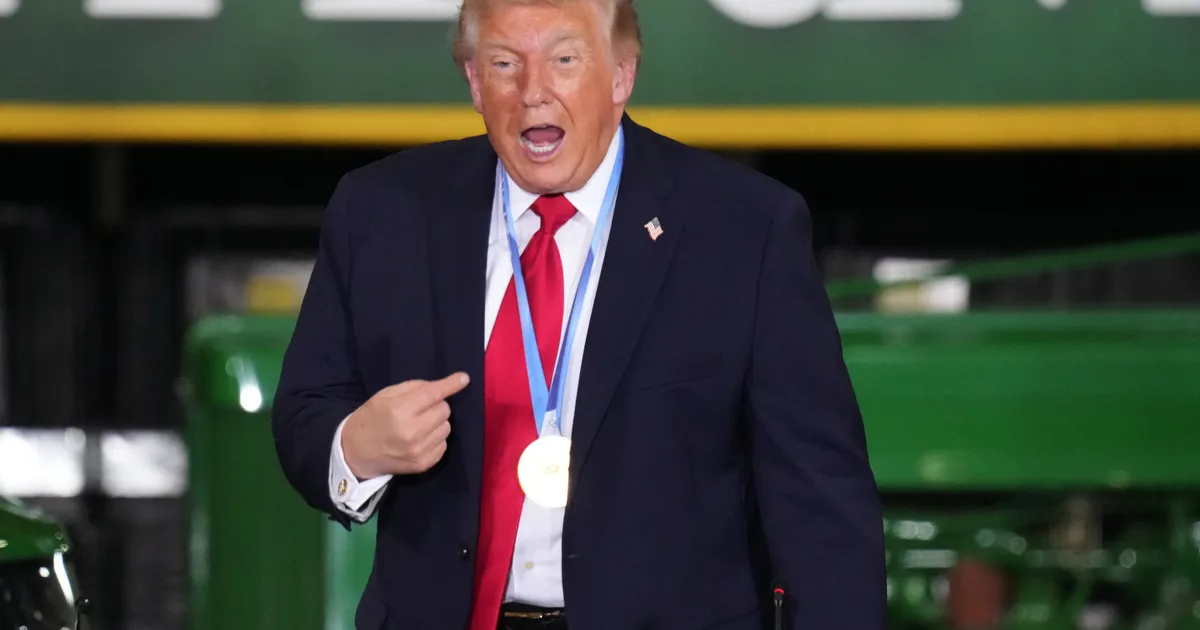
Sarah Smith, the corporation’s North America editor, has “once again been defied” by Israeli prime minister Benjamin Netanyahu.
Israel’s military said it carried out strikes on targets in central and western Iran early on Monday morning.
That came after Tehran launched missiles on northern Israel on Sunday.
On Radio 4′s Today programme, Smith pointed out that Israel had already angered the White House by bombing Lebanon in recent days, despite Trump’s claims that a peace deal to end the Iran war is close.
“And then, after Iran fires some missiles at Israel, he was very clear with the Israeli prime minister not to retaliate because he was worried that that could derail the peace negotiations that are going on,” she said.
“He made it clear that the Iranian missiles hadn’t done any damage, and therefore there was no need for any retaliation. And yet, very soon after that we saw that Israel did take action.
“We haven’t heard from Donald Trump since then, but he will be furious. He was very, very clear with Benjamin Netanyahu not to do this, and once again he has been defied.
“It was almost exactly a year ago that Donald Trump was answering reporters’ questions in front of TV cameras and dropped the f-bomb, surprisingly, because he was so angry with Netanyahu for firing missiles at Iran in breach of a ceasefire agreement.
“And now he says that we’re very close to a US-Iran agreement, and will be furious that he thinks that is being imperilled by Israel’s actions.”
Subscribe to Commons People, the podcast that makes politics easy. Every week, Kevin Schofield and Kate Nicholson unpack the week’s biggest stories to keep you informed. Join us for straightforward analysis of what’s going on at Westminster.

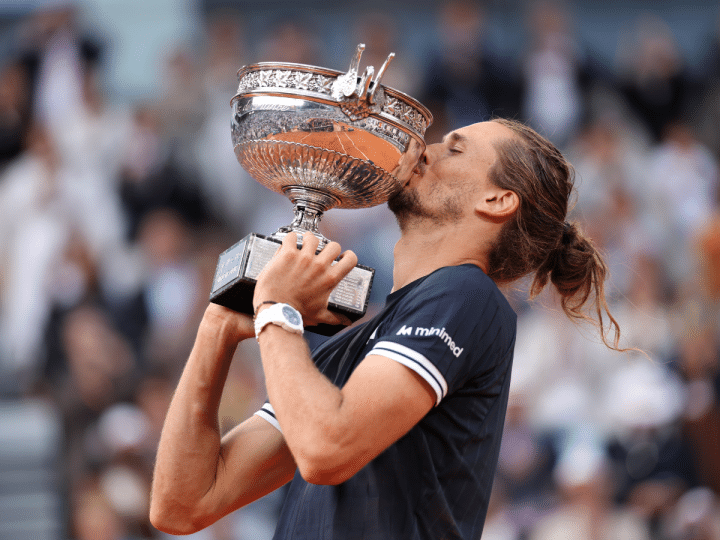
Alexander Zverev is no longer the nearly‑man of men’s tennis. After years of close calls, heartbreaks and three previous failed attempts on the sport’s biggest stages, the German has finally claimed his first Grand Slam title.
And he did it the hard way, outlasting Italy’s Flavio Cobolli in a dramatic five‑set French Open final.
On a sun‑soaked Philippe‑Chatrier, Zverev delivered the performance he has spent more than a decade chasing. The scoreline — 6‑1, 4‑6, 6‑4, 6‑7, 6‑1 — tells the story of a match that swung wildly, demanded nerve, and ultimately crowned a player who refused to let another opportunity slip away.
Alexander Zverev has a lightning start
Zverev opened like a man determined to end the narrative that had followed him for years. He tore through the first set 6‑1, dominating from the baseline and punishing Cobolli’s second serve. The Italian, playing in his first Grand Slam final, looked tight, tentative and overwhelmed by the moment.
The match flipped quickly. Cobolli settled, found his rhythm, and began to match Zverev’s weight of shot. A break midway through the second set gave him the foothold he needed, and he rode the surge of energy from the crowd to level the match at one set apiece. Suddenly, Zverev was no longer cruising. He was in a fight for the title.
Trading blows in a tight third set
The third set became a test of margins, it had long rallies, heavy hitting, and both players refusing to blink. Zverev edged ahead with a crucial break, leaning on his serve to keep Cobolli at bay. The German’s composure returned, and with it, the sense that he was beginning to reassert control. He took the set 6‑4, moving one away from the title.
Cobolli’s surge and a tense tie-break
The fourth set was chaos with momentum swings, missed chances, and a rising Italian who refused to go quietly. Cobolli, who had benefitted from extra rest after receiving a semifinal walkover earlier in the week, looked fresher as the set wore on. He broke Zverev twice, surged to a 5‑3 lead, and seemed poised to force a decider.
Zverev, battling visible discomfort in his lower body, clawed back to 5‑5. The tension was suffocating. Every point felt decisive. The set spilled into a tie-break, where Cobolli was fearless, aggressive, and riding the moment, he struck the decisive blows. He took it 7‑5, sending the final into a fifth set and igniting the Parisian crowd.
For Zverev, it was familiar territory, another Grand Slam final, another lead slipping away.
Career-defining set
Zverev came out for the fifth set with a clarity and conviction that had eluded him in previous finals. He broke Cobolli immediately, then again, racing to a 4‑0 lead. The Italian’s legs, so lively in the fourth, began to betray him. The German’s experience, power and poise took over.
At 5‑1, Zverev earned championship points. On the second, Cobolli pushed a return long, and Zverev collapsed onto his back, hands over his face, overwhelmed by the moment he had chased for so long.
This was not just a match. It was the culmination of a journey defined by near misses and painful memories.
Zverev had lost Grand Slam finals in 2020, 2024 and 2025, each in its own agonising fashion. He had suffered a devastating ankle injury on this very court in 2022, leaving in a wheelchair and unsure if he would ever return to the same level.
He had been labelled the best player never to win a major. Now, that label is gone.
His triumph also marks a historic moment for German tennis, the first men’s Grand Slam singles title for the country since Boris Becker won the Australian Open in 1996.
Though defeated, Cobolli leaves Paris transformed. The 10th seed had never been this deep in a Slam before, but his run aided by a semifinal walkover yet defined by fearless shot‑making, has announced him as a rising force in the sport.
He pushed Zverev deeper than many expected, matched him physically for long stretches, and showed a competitive edge that suggests this will not be his last appearance on a major stage.
His fourth‑set surge, in particular, electrified the crowd and turned the final into a genuine spectacle.
A tournament of opportunity
This French Open was wide open from the start. Carlos Alcaraz withdrew with injury. Jannik Sinner suffered an early exit. Novak Djokovic was eliminated before the second week. The draw cleared, and Zverev, who has long been burdened by expectation suddenly had a path to greatness.
He beat Benjamin Bonzi, Tomáš Macháč, Quentin Halys, Jesper De Jong and Jakub Menšík en route to the final, navigating the chaos of an upset‑filled tournament with a steadiness that had often deserted him in the past.
What does this mean for Alexander Zverev?
This title changes everything. It validates years of work, silences doubts, and resets the trajectory of his career. He now becomes part of a rare group of players who won their first major in their fourth final, joining names like Andre Agassi, Goran Ivanišević and Dominic Thiem.
With Wimbledon looming, Zverev enters the next phase of the season not as a contender searching for a breakthrough, but as a Grand Slam champion with the confidence to chase more.
A classic French Open final
This was a match that had everything: dominance, collapse, revival, tension, and ultimately, redemption.
Alexander Zverev’s maiden Grand Slam title wasn’t handed to him. He had to fight for it, suffer for it, and steady himself when the ghosts of past failures threatened to return. Cobolli pushed him to the edge, but the German found the resolve that had eluded him in previous finals.
In the end, he lifted the Coupe des Mousquetaires high above his head. A trophy 13 years in the making, earned on the court that had given him both his darkest and now his brightest moments.
Featured image via Clive Brunskill/ Getty Images
By Faz Ali
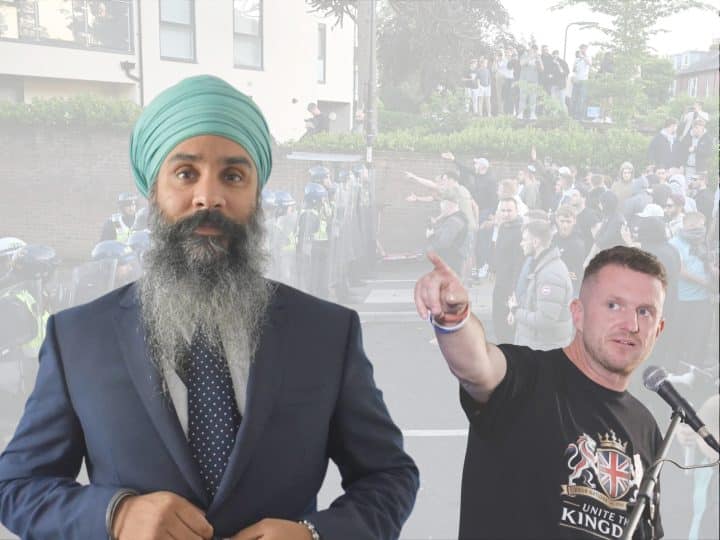
Tommy Robinson is a far-right agitator who’s led street movements like the English Defence League (EDL) and Unite the Kingdom (UtK). While Robinson’s propaganda has shifted over the years, the common throughlines have been Islamophobia and the fear of migrants.
As these prejudices aren’t unique to white Brits, there are some people from minority groups who have thrown in with Robinson and his ilk.
Now, one of the Sikh men who supported Robinson in the past is being warned to watch his back.
Short story:
Bobby Singh, who twerks for Tommy Robinson, is now being threatened by Tommy Robinson.
"If I personally see Bobby Singh, I'll personally punch his fucking head off." pic.twitter.com/CKsdzy0Npv
— Mukhtar (@I_amMukhtar) June 7, 2026
Robinson’s ex-mate Bobby Singh — who is he?
Bobby Singh is the co-founder of Love Your Postcode, a real estate and property management company. Recently, Singh attended the far-right Unite the Kingdom rally (as Mukhtar highlighted in the video above), where he voiced his support for Robinson. He’s also reshared anti-Muslim posts from Robinson like the following:
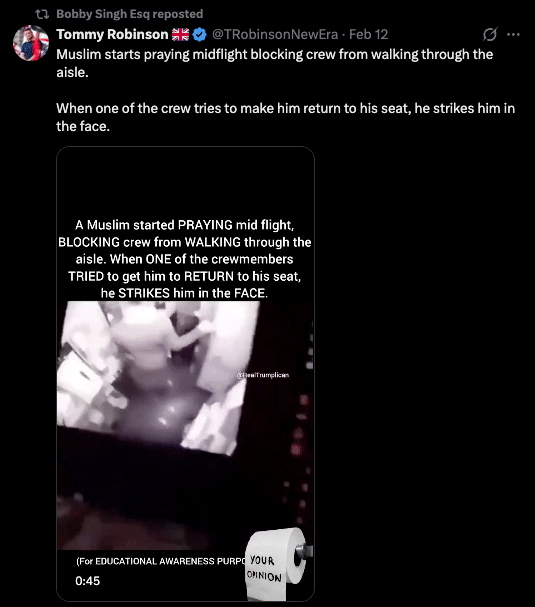
Because the above comes from Robinson — a known bullshitter and far-right propagandist — most people would ask themselves:
- Is this AI?
- Was it staged?
- Did it happen recently or years ago?
The other thing to remember is that sometimes Muslim people commit crimes. This is true of every group. But smear merchants like Robinson give the impression that Muslims are uniquely bad by only highlighting crimes committed by them.
Either Singh is willing to turn his brain off when he sees Islamophobic content or he lacks critical thinking skills.
The controversy surrounding Singh
Singh has now attracted controversy because of a TikTok panel in which he asked viewers to vote one “if you’re in support of the Singh” or two “if you’re in support of Henry”. From context, it’s clear that the men in question are the murderer Vickrum Digwa and his victim Henry Nowak (most baptised Sikh men have the surname ‘Singh’, but Digwa does not).
The video attracted greater controversy because at one point another man asks to change the vote, stating:
Can you put a 1 in the comments if I should piss on Henry’s grave, and a 2 if I should shit on his grave.
Singh has since claimed the backlash is a ‘character assassination’, and that while he was on the TikTok panel, he doesn’t agree with everything that was said.
Bobby Singh has RESPONDED to the live TikTok video circulating online.
In it, he shared a panel with someone who asked: “should I shit or piss on Henry Nowak’s grave?” The video also shows him agreeing that “Henry is wearing a turtleneck, so he means trouble,” and endorses… pic.twitter.com/V5Vo7xP5Ky
— Sydney Jones (@SydneyJones_) June 7, 2026
Regardless of whether Bobby Singh made the worst comments or not, it was clearly in poor taste to ask viewers to vote on which man they backed.
Digwa murdered Nowak with an illegal weapon, and then he fooled the police into thinking Nowak was the aggressor. Digwa’s actions, then, contributed towards a situation in which Nowak was handcuffed while bleeding out (with the other factor being police incompetence).
Dis-unite the Kingdom
Ironically, Love Your Postcode says the following about itself:
Our commitment to community cohesion and philanthropy is interwoven with a passion for business, inspiring others to lead with confidence and a sense of social responsibility.
We say, ironically, because co-founder Singh attended Robinson’s Unite the Kingdom rally, this now-yearly event isn’t committed to “community cohesion” at all. We say that because it promotes “remigration”.
Speakers at the first event included the Dutch Generation Remigration. The Canary wrote this about the group:
Well, they’re the leading proponents of ‘remigration’, which is the plan to mass deport migrants and their descendants from European countries.
We’re not quite sure how that will work in Britain given the continuous influxes of populations we’ve experienced since the Roman Empire, except we are sure, obviously – they’re talking about deporting Black and brown people.
Generation Remigration did not attend the 2026 UtK event. No doubt because key member, Eva Vlaardingerbroek, was banned from entering the UK earlier this year.
Robinson has kept the ethnic cleansing torch burning, anyway, and regularly posts about “remigration” himself. Take this from 12 May:
Invaders and their offspring, tormenting and brutally attacking our people in Europe and filming it “for fun” and to assert dominance.
Remigration and de-islamisation can’t come quick enough.
You’ll note Robinson calls for “remigration” and “de-Islamification”. He’s doing this to make it clear it won’t just be Muslims who go.
You’ll also notice he’s not saying something like ‘deport the non-indigenous Brits‘. This is because the in-group currently includes all white Europeans.
This won’t last, of course, and we only have to look back to 2016 to see when the far right was actively hostile towards continentals — most notably Polish people.
Clearly, to anyone smart enough to read between the lines, Bobby Singh isn’t in the in-group, so why was Robinson promoting him before this latest controversy? And why was Singh promoting Robinson?
Singh and Robinson: Bedfellows
To Robinson, there’s an obvious benefit to tolerating a guy like Bobby Singh. Specifically, he can point at him and say: “See, how can I be racist when I’m best mates with this guy?” The answer is obvious, and it’s that in this case, the two are friends because of racism, specifically racism against migrants, which seems to be Singh’s beef if his retweets are anything to go by.
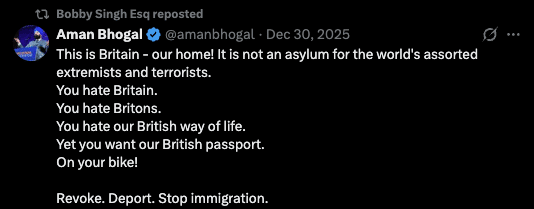
In modern Britain, establishment politicians like Nigel Farage warn ‘All migrants are bad‘ and their supporters hear ‘All Muslims are bad‘.
Inevitably, this becomes ‘All Black and Brown people are bad‘, because believe it or not, the white rioters shown below aren’t the best at identifying cultural signifiers; they just see a person’s skin colour and lose their minds.
Dozens of bricks being thrown pic.twitter.com/VwPXkfZlmR
— Taj Ali (@Taj_Ali1) June 2, 2026
Unless you’re a white British man, a guy like Robinson will always always turn on you at some point. But for some, their desire to punch downwards overrides their instincts for self-preservation.
To be fair, what Singh said was obviously grim, but Singh isn’t the only Sikh man facing backlash from the far-right.
Sikhs at a London remembrance march describe their fears and report a rise in abuse following Henry Nowak’s murder.
— Sky News (@SkyNews) June 7, 2026
 https://t.co/Zl3K65O6Kq pic.twitter.com/WB5y5UwmnD
Nigel Farage has retweeted JD Vance's tweet, calling British Sikhs "mass invasion of migrants."
Like I said the other day. Look how quickly they turned on the Sikh community. pic.twitter.com/1eGb1WYbnb
— Mukhtar (@I_amMukhtar) June 6, 2026
In-fighting
Known white supremacists like James Goddard are repeating the following:
Deport the Sikhs
It should be noted Robinson is still defending Sikhs despite a significant proportion of his far-right followers turning on them.
About 535,000 Sikhs live in the UK (around 0.8% of the population).
The Sikhs aint taking over our towns or cities, or even the UK for that matter you fucking moron.
They integrate and add value, they love, respect and do fight for our country. Sikhs are not… https://t.co/bv5Qa4IUwp
— Tommy Robinson
 (@TRobinsonNewEra) June 4, 2026
You're a disingenuous shithouse.
Fuck you and your framing. Nobody said we should "give up our homeland to Sikhs", own it dickhead.
— Tommy Robinson
(@TRobinsonNewEra) June 4, 2026
Lest we forget, Robinson literally calls for “remigration”. Clearly he doesn’t actually respect Sikhs; he’s just using them as cover for his Islamophobia.
What this shows, anyway, is that it’s impossible to maintain tactical positions on the reactionary far right. There will always be those who are willing to go further, and they will always find themselves arguing from a stronger position because the logical end point of this ideology is a patriarchy of indigenous whites.
An odd one
One final thing to note about Bobby Singh is that he’s not completely deluded about the white supremacist movement he’s attached himself to. In a video which appears to have been filmed at Unite the Kingdom, Singh said:
And by the way, just for the record, just for the record, lads. If they do go back and you ask me to go back, I wouldn’t have a fucking issue…There is no greater honour than going back to a country where it’s your real people of your colour. So what I’m saying is, mate, I’m patriotic, but if you ever want to say to me, ‘Bobby, your time’, I’m more than happy.
It’s not good that Singh — or anyone — feels this way. Every British citizen who isn’t 100 years old grew up in a multicultural country. The problems we’ve faced since then don’t arise from that fact; they arise from rich people stealing all of Britain’s wealth while blaming minority groups as cover.
Speaking as a white Briton, believe me, skin colour is no indicator of individuals being “your real people”. The people I have the least in common with in this country are the white identitarians who line up behind Tommy Robinson. If such people ever take power, I’ll be doing everything I can to move to a country that doesn’t treat skin colour as the defining characteristic.
Although Bobby Singh may not have an issue, you have to assume foreign countries would object to us banishing millions of European-born citizens into their territories. This might surprise people who think the British Empire never ended, but we actually don’t have the right to dump people wherever we like. This is especially true when it comes to nuclear powers like India and Pakistan.
The few
It’s important to re-emphasise that guys like Bobby Singh are a minority of a minority. Most Sikhs don’t support a movement which will inevitably come for them. At the same time, most would never willingly volunteer to be deported to a country they weren’t born in.
Singh being ex-communicated from the British far right was predictable. The same thing will happen to every other person who isn’t a member of the core inner group because this movement is only heading in one direction.
Featured image via Mario Tama/ Finnbarr Webster/ Getty Images
By Willem Moore
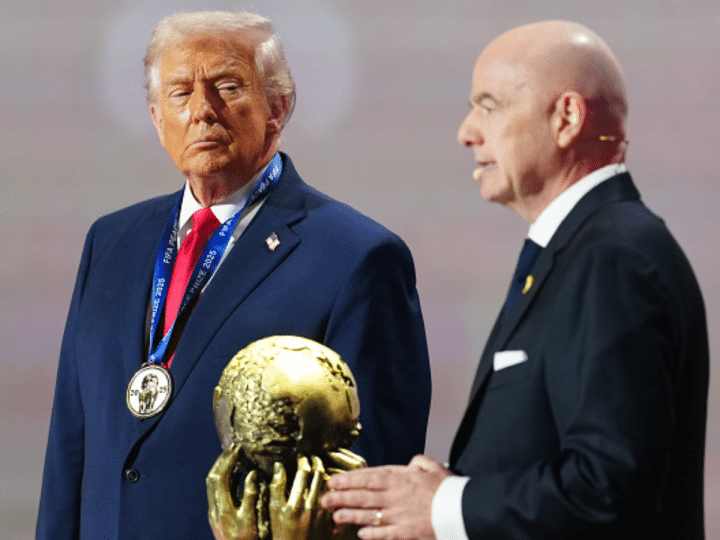
The World Cup is supposed to be the moment the world comes together. Instead, with less than a week to go, the United States is facing mounting accusations that it is shutting the world out.
The International Sports Press Association (AIPS) has formally written to FIFA, warning that “many” Iranian and African journalists have been denied visas needed to cover the 2026 tournament on U.S. soil.
The letter sent June 5 and published on the AIPS website, was addressed to Bryan Swanson, FIFA’s director of media relations, and Jochen Steinhoff, FIFA’s head of media operations & services. And its message was blunt.
AIPS president Gianni Merlo wrote:
We find ourselves facing a long-standing and unacceptable problem for us journalists: the denial of entry visas to regularly accredited colleagues.
He went further, saying the issue is widespread and worsening:
There are many cases: Iranian colleagues, African colleagues, some of whom have been given single entries, so if their team goes to play in Canada or Mexico and they follow it, they can no longer return to the States. The cases are countless and, I repeat, unacceptable.
For a tournament marketed as the most inclusive in history, the optics are disastrous.
World Cup chaos
Merlo’s letter cuts at the heart of the contradiction: the U.S. is hosting a global event while enforcing some of the strictest immigration policies in modern American history.
Politicians always say that sport unites and builds bridges between young people in countries in conflict, but in this case, we are going in the opposite direction.
He warned that blocking journalists undermines the very image FIFA claims to champion:
We believe it is important to allow colleagues to attend the event and work, because their presence will be crucial to the image of sport and what it represents, especially in a country like the United States of America, where freedom of the press is a must.
The practical consequences are already being felt. Some journalists have lost money on flights they can no longer use. Others face the prospect of being locked out of the U.S. mid‑tournament if they follow their teams to Canada or Mexico.
Merlo explained:
We’re already significantly behind schedule, and many colleagues have already lost the opportunity to use plane tickets booked on time, and they’ll also face significant additional expenses.
FIFA responds by passing responsibility back to governments
FIFA confirmed it had received the AIPS letter. A spokesperson said only that:
the ability to enter host countries are ultimately consular and immigration matters.
In other words: FIFA are trying to dodge any blame for this.
But that stance is becoming increasingly difficult to defend. Multi‑entry visas are essential for journalists covering teams that move between the three host nations. Ivory Coast, for example, will play in Philadelphia, then Toronto, then back to Philadelphia. Senegal finish their group in Toronto and may need to return to the U.S. for the knockouts. Tunisia start in Mexico before heading to Kansas City.
If journalists can’t follow them, fair coverage simply collapses.
The timing of the dispute is awkward. AIPS and FIFA have long maintained a close working relationship. In April, dozens of AIPS representatives visited FIFA’s headquarters in Switzerland. AIPS even awarded FIFA the Best Press Facilities Award for 2025, praising its media operations during the Club World Cup in the U.S.
At that event, Swanson told delegates:
We appreciate and respect the important work of the media. We understand journalists have a job to do in covering FIFA’s activities and we do what we can to support you… All we ever ask is to be reported on with fairness and balance.
Those words now ring hollow for the reporters who cannot even enter the host nation.
The Trump factor
The visa crisis cannot be separated from the political climate. Since returning to the White House last year, President Donald Trump has reinstated and expanded travel restrictions affecting several World Cup nations.
The U.S. has active travel bans on nationals from Iran, Haiti, Senegal, and the Ivory Coast. That is four countries that have qualified for the tournament. Additional visa bond measures apply to Algeria, Cape Verde and Tunisia.
Athletes, support staff and immediate family members are exempt. Fans and journalists are not.
This is the core of the crisis: the World Cup is being hosted by a country that is simultaneously restricting entry to the very people who make the event global.
The situation also places FIFA president Gianni Infantino under renewed scrutiny. In December, he controversially awarded Trump a FIFA Peace Prize. And only this week, after meeting Trump, Infantino posted on Instagram:
America is ready to welcome the world for the FIFA World Cup 2026, I thanked (Trump) and his Administration for their continued support of this truly global event.
But Infantino’s past statements now haunt him. In 2017, during the U.S. bid to host the tournament, he said:
Any team, including the supporters and officials of that team, who qualify for a World Cup need to have access to the country, otherwise there is no World Cup.
Trump himself wrote to Infantino in 2018 promising that:
all eligible athletes, officials and fans, would be able to enter the United States without discrimination.
Those assurances now look a lot like lies.
A U.S. State Department spokesperson said
The United States is well prepared to welcome legitimate travelers from around the globe for the largest and greatest FIFA World Cup in history.
But the statement also made clear that security takes precedence:
The Administration will not waver in upholding U.S. law and the highest standards of national security and public safety… We adjudicate each visa application on a case-by-case basis after rigorous review and thorough vetting.
That leaves journalists, especially those from countries under travel restrictions in limbo. Clearly, the US’ definition of “legitimate” differs from the rest of the world.
A total disaster before it begins
The World Cup is meant to be a celebration. Instead, the conversation is dominated by who can’t get in.
The AIPS letter is more than a complaint, it is a warning. If journalists cannot enter the United States, the world cannot see the World Cup. Coverage will be uneven, distorted, or absent entirely for nations already underrepresented in global media.
The symbolism is stark, a tournament branded as “uniting the world” is being undermined by the host nation’s own policies.
FIFA can insist immigration is not its responsibility. The U.S. can insist security comes first. So unless the two sides find a solution, the 2026 World Cup risks becoming the most politically fraught, least accessible tournament in modern history.
A global event cannot function if the world cannot attend.
Featured Image via Jia Haocheng – Pool/Getty Images
By Faz Ali

We hope you love the products we recommend! All of them were independently selected by our editors. Just so you know, HuffPost UK may collect a share of sales or other compensation from the links on this page if you decide to shop from them. Oh, and FYI — prices are accurate and items in stock as of time of publication.
As a shopping writer, I test endless products each month. But, naturally, I don’t love everything.
Some of them, I’m holding my breath to get through, and the others stick around for, well, forever.
Whether you’re looking for a pay day treat or simply nosey about what I’ve been up to this month (I see you), here are 17 things I tried this month that will stay by my side for the forseeable.
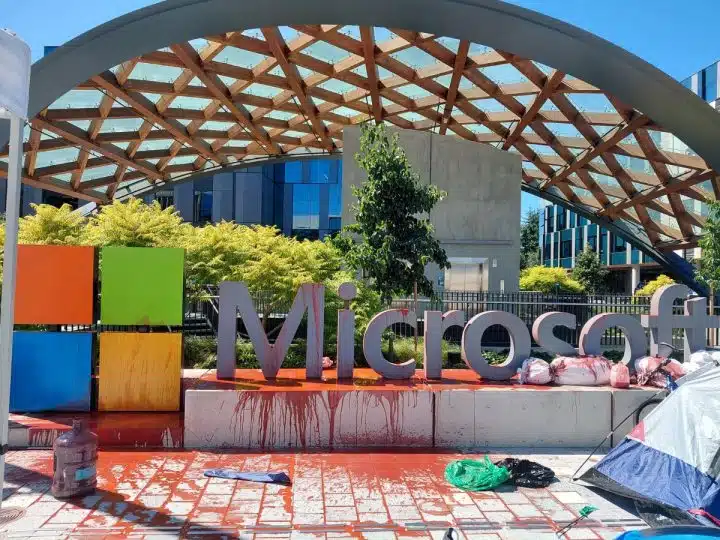

A campaign group has called out Microsoft’s sham investigation into the Israeli Ministry of Defence’s use of Microsoft technology.
Microsoft released a bizarre “final update” on the investigation on Thursday, June 4th, after the group, No Azure for Apartheid, disrupted all days of Microsoft’s Build conference this week.
It included protests from the water, sky, and ground to call out the company’s continued complicity in Israel’s genocide.
Microsoft whitewashing
According to the group, the statement is the company’s latest failed attempt to “whitewash its genocide-profiteering” and avoid accountability for its:
active role in powering Israel’s occupation, apartheid, and genocide.
In reality, the statement provides “no meaningful update” since Microsoft’s September announcement of cutting a few services to Unit 8200, an Israeli military spy agency, which it made only after a sustained pressure campaign.
In a statement, the group said:
Microsoft pretends to have a bold stance against mass surveillance by cutting a single service to a single unit while it continues to facilitate mass surveillance and genocide of Palestinians through many other ways.
In August 2025 right before launching this so-called “investigation,” Microsoft colluded with the Israeli military to quickly transfer the intercepted Palestinian phone call data out of the Netherlands to the Microsoft Israel data center. In doing so, Microsoft expedited the concealment of crimes against humanity from any European regulator or international investigation.
Thursday’s statement does not even mention the phone call data hosted in Microsoft’s data centres in Ireland and Israel. It only mentions the Netherlands. This makes it clear that Microsoft chose to focus on this site after local protests at the data centre in the Netherlands.
Microsoft has made it clear it does not care about Palestinians’ privacy. It cares only about its reputation and how it impacts its profits.
‘Digital backbone’
Microsoft allows the Israeli military and government to host other surveillance projects on Azure, including the Rolling Stone database, a Palestinian population and movement registry and the Al-Munasseq or “The Coordinator” application, which is used to collect surveillance data on Palestinians. Israel forces Palestinians to download the app to manage apartheid permits to control and restrict their movement.
Microsoft also refuses to address how other Israeli surveillance units, including Unit 81 and Unit 9900, which are other Israeli military spy agencies, use its technology.
Additionally, the Lotem Unit has received direct training from Microsoft workers.
From providing services to Israeli combative and central military units, to being embedded in the national water and electricity companies which steal Palestinian resources, and the Israeli police and prison systems that arrest and torture Palestinians, Microsoft provides the digital backbone of Israel’s entire illegal occupation of Palestine.
Sustained pressure
As the Canary has previously reported, Microsoft workers have been speaking out and protesting against Microsoft’s complicity for years. And they’re not the only ones:
Civil society organizations have reached out to Microsoft. Legal experts have put the company on notice for facilitating illegal crimes against humanity. Shareholders have called Microsoft out on failing proper due diligence. Still, Microsoft decided to stall for months, as the filename Summary-of-2025-External-Investigation-Follow-Up.pdf indicates that the “investigation” actually concluded in 2025.
The group points out that even the follow-up steps detailed in the investigation report are a load of rubbish. There are no additional details on deals with private companies. Companies such as Cellebrite and Cobwebs regularly conduct mass surveillance of Palestinians. Both host their software on Azure and have been used to hack into thousands of Palestinians’ phones.
Microsoft also claims that its follow-up steps include:
additional guidance to employees regarding Microsoft policies related to acceptable use of its products and services
and:
additional mechanisms for employees to raise concerns.
But as the campaign group points out, Israeli Microsoft workers were not ignorant when they developed surveillance systems to spy on Palestinians, or proudly showed off their employees committing genocide in Gaza on its Facebook page. Company leadership were also not ignorant of what their second-largest military customer was doing with their products.
Of course, there is no moral way to work with a genocidal military or government:
Beyond the failed whitewashing, accountability evasion, and feigned ignorance in Thursday’s statement, Microsoft egregiously lists a series of “follow-up steps.” Let us be clear, there is no moral, legal, or compliant way to work with a genocidal military and government. As long as Microsoft works with the Israeli military and government in any capacity, it is complicit in crimes against humanity.
Microsoft is not only complicit in genocide – it is actively enabling and directly participating in war crimes for a genocidal terrorist state. And its latest statement does nothing except show the world how little accountability it is willing to take.
Featured image via No Azure for Apartheid
By HG
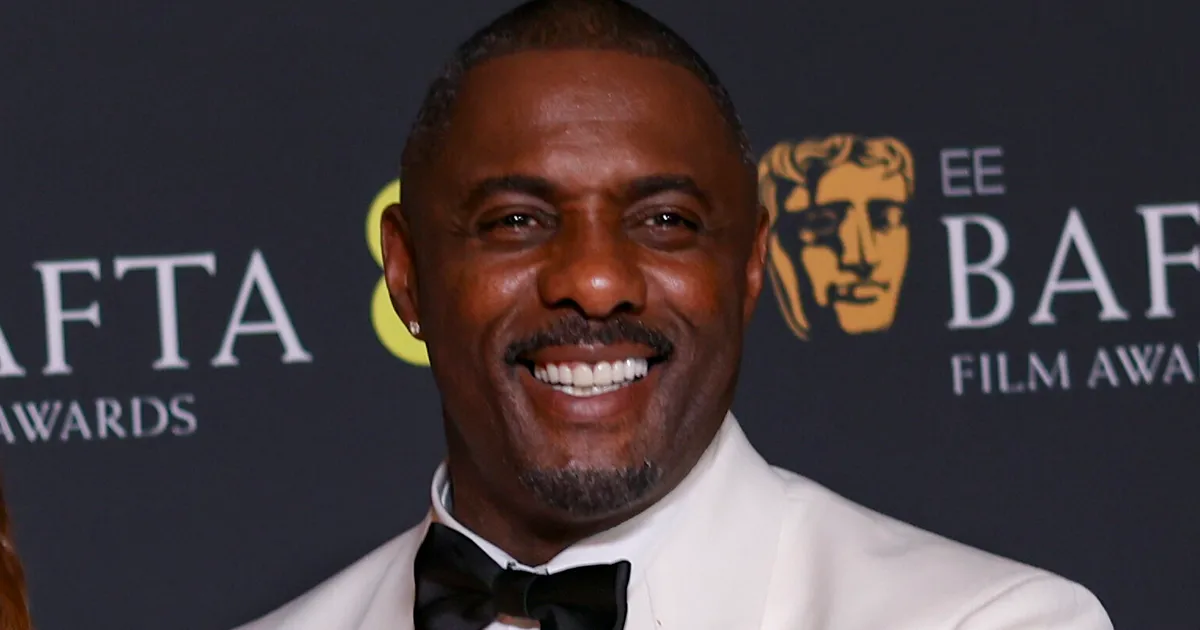
It was first reported that he was in contention to become the first Black actor to portray Bond in 2014, when leaked emails from Sony executives indicated that he was a favourite for the role.
“I’ve always felt that it’s not a realistic thing,” he told the magazine for its Heroes Issue. “James Bond was written how he was written for a reason. But I was complimented by it.
“And also, I think, in realistic terms, some markets just don’t go for that. Bond is big all over the world. And [audiences] won’t [all] go for a Black male, an African male, playing Bond. That’s not what they like in their culture. Period.”
Sir Idris added that he doesn’t think changes to the character are needed, claiming: “Bond is so unrealistic, so a hint of reality is good, but let’s not try and make it woke. I think you’ve got to be pure to what it is: escapism. Don’t try and answer the world’s taste. Just be Bond.”
The Heroes Issue of British GQ is available via digital download and on newsstands on Tuesday 9 June.
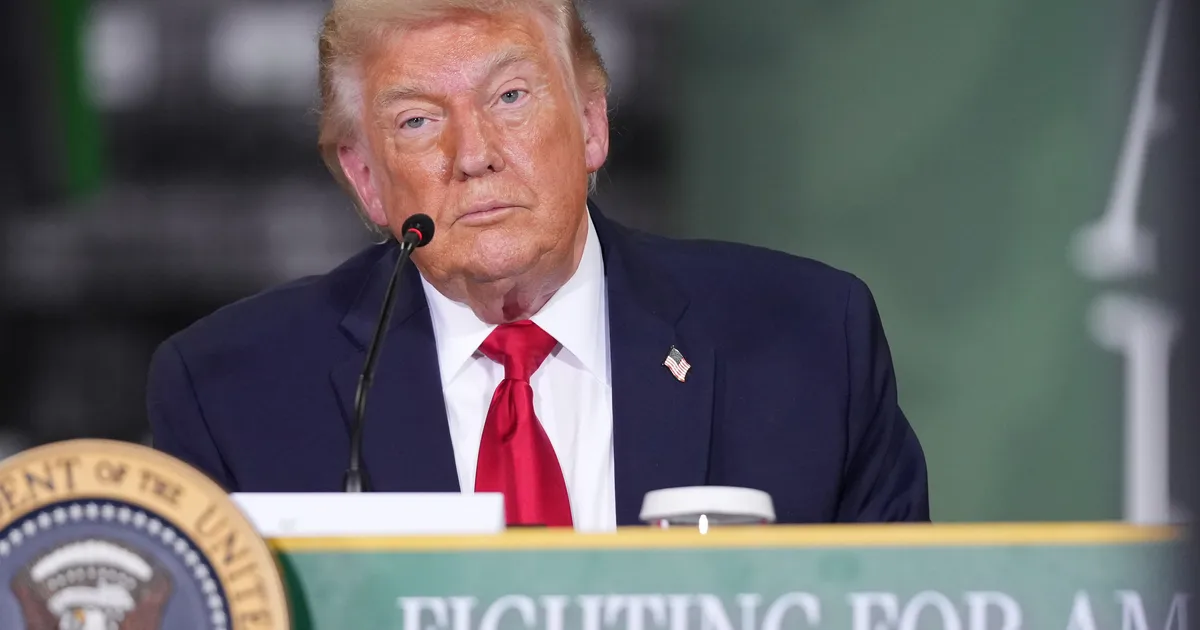
A leading Middle East expert has branded Donald Trump’s decision to go to war in Iran “an absolute strategic failure”.
Jeremy Bowen, the BBC’s international affairs editor, said the US president’s vow to bring down the Tehran regime has not come true.
His comments came after Israel defied Trump by launching retaliatory strikes against Iran in a further blow to his hopes of securing a peace deal.
It is the first time the two sides have attacked each other since a ceasefire was agreed in April.
The US joined forces with Israel in bombing Iran on February 28, with the apparent aim of bringing down the country’s ruling regime and destroying its nuclear capability.
But despite repeated claims by Trump that an end to the conflict is imminent, no agreement on a permanent ceasefire has been reached.
On Radio 4′s Today programme this morning, Bowen said “Trump is coming up against the limits of US power in the Middle East”.
He said: “What’s happening in the last 24 hours or so is another sign of the absolute strategic failure of the war that was launched on February 28.
“If you think back to then, both Trump and Netanyahu said publicly that the regime in Iran would be weakened to the point of collapse and it hasn’t been.”
Israel’s military said it carried out strikes on targets in central and western Iran early on Monday morning.
That came after Tehran launched missiles on northern Israel on Sunday.
Subscribe to Commons People, the podcast that makes politics easy. Every week, Kevin Schofield and Kate Nicholson unpack the week’s biggest stories to keep you informed. Join us for straightforward analysis of what’s going on at Westminster.
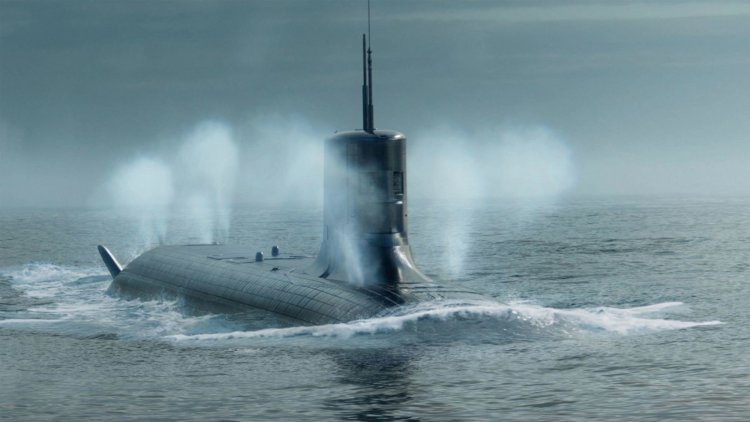
Artist’s impression of the SSN-Aukus class submarine (Pictorial Press Ltd/Alamy)

4 min read
The publication of the Defence Committee’s report on Aukus – the trilateral partnership between Australia, the UK and the US – confirmed what many in the defence community have long known: the strategic rationale remains unassailable.
Aukus will bolster security in the Indo-Pacific and Euro-Atlantic, strengthen our most trusted alliances, and secure a vital technological advantage. Indeed, the Defence Committee found the partnership is more necessary than ever.
There is, too, a positive domestic story. Delivering a brand-new class of nuclear-powered submarines – the SSN-Aukus class – to provide a common fleet for both the Royal Navy and the Royal Australian Navy represents a crucial revitalisation of our industrial base. Aukus is not merely a foreign policy pact; it is a significant blueprint for British industrial expansion and economic growth.
Some 21,000 people will be working on the SSN-Aukus in UK shipyards and across the supply chain at its peak. To meet the broader demands of the Defence Nuclear Enterprise, Britain’s nuclear workforce is forecast to increase by 40,000 by 2030. We are already seeing world-leading skills academies, heavily oversubscribed, stepping up to this challenge, creating highly skilled, high-wage jobs that will sustain families for decades.
The establishment of Defence Technical Excellence Colleges and the Defence Universities Alliance will better align education with our long-term industrial needs. A Defence Skills Passport will allow this highly trained workforce to move across the sector.
But delivering Aukus will require far more people than current plans can provide. This means new, innovative approaches to skills development are needed. We must build on what we already do well and use the unique recruitment opportunity to spread skilled jobs across the country.
Some £4bn in contracts has already been signed for the design and prototyping of the SSN-Aukus, alongside a £3bn investment into advanced manufacturing capabilities. In 2025, a £9bn contract was signed with Rolls-Royce to cover reactor design, manufacturing and service. However, delivering SSN‑Aukus requires steady government funding over many years and across multiple parliaments. This must be a cross-government priority, with an annual review comparing planned and actual investment.
As MP for Barrow and Furness, I see the transformative power of the Aukus partnership every day. We are targeting £1bn in investment for the rapid overhaul of local infrastructure. This means building thousands of high-quality new homes, improving educational outcomes, regenerating the town centre and upgrading healthcare and transport. This is not just about building submarines; it is about permanently rebuilding a community.
As MP for Barrow and Furness, I see the transformative power of the Aukus partnership every day
But we must also accelerate the integration of our supply chain. By proactively integrating small and medium-sized enterprises directly into advanced capability projects, we can turn agile tech firms into industrial heavyweights, but only if the government moves faster to remove the bureaucratic hurdles blocking their entry.
Aukus is a phenomenal success story of cutting-edge innovation and local economic regeneration. However, to sustain and accelerate a multi-decade programme of this magnitude, we must ensure it enjoys unshakeable public support.
In recent years, there have been repeated calls for a more open and honest conversation with the public on defence and security issues. This is where parliamentarians can – and must – do more. As part of a wider conversation about the role of defence in society, Aukus provides a strong opportunity to show the real, practical benefits that a successful defence industry can bring to local economies across the UK. MPs have an important role to play in delivering this message locally but, to do so, the Ministry of Defence should take a more open and proactive approach to working with MPs and engaging with the media to support this shared aim.
The Defence Committee inquiry has highlighted how important the Aukus partnership is, while also making clear the scale and complexity of what is needed to deliver it. For Britain, Aukus brings significant challenges as well as major opportunities. As parliamentarians, we must play our part to build public understanding and secure the sustained political commitment and investment needed for this long-term national endeavour.
Michelle Scrogham is Labour MP for Barrow and Furness and member of the Defence Select Committee
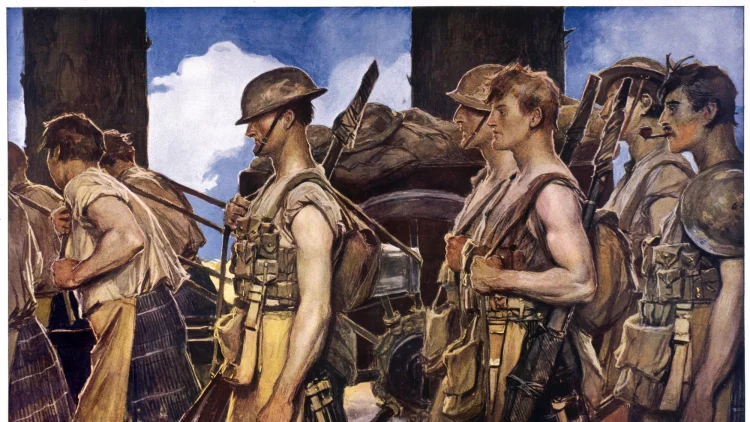

Ecossais Revenant de Combat by the French painter Francois Flameng
“Old soldiers never die; they simply fade away,” warned General Douglas MacArthur in 1951. More than half a century later, it’s not the soldiers who are fading but the nation’s focus on them that seems to ebb and flow. Professor Hugh Milroy, CEO of Veterans Aid, asks whether Britain is now caught in that same difficult rhythm?
Veterans are pulled into the spotlight in great surges of public emotion, only to be swept back out again as the tide of attention recedes. Their needs don’t come and go, but the system built to support them often seems to. Despite high profile claims of success from various governments, our workload at Veterans Aid would indicate that this assertion is the worrying reality for some veterans.
I’ve always felt that the nation’s link to veterans was anchored in four words – service, sacrifice, honour, and respect. Moreover, that it was universally accepted that a grateful nation would care for them in old age or adversity.But today, that promise sometimes feels disturbingly fragile. Support doesn’t stand firm; it surges, collapses, and drifts. One moment veterans are hailed as heroes; the next, they’re left navigating a maze of inconsistent policies, short‑lived initiatives, and a system that in some cases, seems to forget them as quickly as it remembers. The reality on the ground tells a different story. Veterans don’t need waves. They need foundations.
From my perspective, as one delivering frontline services to a large group of veterans in crisis, the shift in perceived obligation is no longer abstract – and that adjustment has consequences. In both delivery and quality the system of care for some veterans is a piecemeal, patchy, postcode lottery that frequently delivers without reference to urgency or actual need. Long term plans to improve the situation are underway but I fear that this will be too little, too late.
Recently I was given a sharp reminder of what it is to be forgotten and invisible as a veteran. I spent time talking to ‘John’, a very unwell ex-soldier who was sleeping rough. Fortunately there are fewer like him now, but one is too many.
I’ve had over 30 years’ experience in the world of veterans’ wellbeing but came away from that meeting with ‘John’, feeling despondent. It seemed that all the talk by the great and the good over the past 15 years had generated little more than hot air for veterans in real trouble.
I recall someone in government once describing Britain as “the best country in the world to be a veteran”, but it’s a fantasy to suggest that what was once a serious commitment, is still being honoured. Like promises written in vanishing ink, the pledges made to people like ‘John’ are rapidly disappearing.
This homeless former soldier had been in prison. He was in poor health and had been hospitalised, but he couldn’t name one of the government’s much vaunted veterans’ welfare initiatives (e.g. VALOUR et al) and it was only by chance that he found Veterans Aid. As we chatted over a coffee, during a wide-ranging conversation, I brought up the Armed Forces Covenant. As he scoffed at the suggestion it had any relevance to him, I could see that he had not a single visible tooth. Is this really the standard of veteran care we are settling for?
In recent months we, at Veterans Aid, have seen a series of moments that, taken individually, might be dismissed as symbolic; debates over legacy legislation which completely ignores the costs to individual veterans and their families, and decisions such as the refusal to grant the Royal Regiment of Scotland the Freedom of the City of Glasgow.* But taken together, they point to something more significant; a growing vagueness in how we, as a nation, view those who have served.
For the veterans we work with, this uncertainty is not abstract. It fosters a quiet yet deepening sense of being forgotten – or, more troublingly, of being reassessed, reconsidered, even devalued. And it raises the uncomfortable question of what it means to be a veteran in a post-heroes era; a time of fading hope?
As sector charities become more process-driven and qualification for support more complex, the likelihood of excluding those in greatest need increases. Just a week ago we encountered two veterans who could barely read. In a digital age, with a growing reliance on IT literacy, street dwellers without an address, no access to smart phones, TVs or newspapers, know nothing about advertising or marketing campaigns. They are effectively unreachable.
This is wrong: Care must meet veterans where and how they are, not where systems demand they be.
We are used to talking about moral injury in the context of conflict; something that happens when individuals experience a betrayal of deeply held values. But there is another form of moral injury that receives far less attention. What happens when that sense of betrayal occurs at home? When veterans encounter a system that is slow, fragmented, and too often reactive; when they feel they must fight to be understood; when recognition becomes conditional? I believe that that, too, leaves a mark which may have a binary impact on attitudes towards recruiting. To put it bluntly, no cut is deeper than perceiving that you have been forgotten by the nation you once served.
Despite good intentions, much of what now exists to support veterans in the UK is a hodgepodge of services. Some are genuinely fit for purpose, but others are woefully inadequate. Charities like ours step in at the point of crisis; dealing with homelessness, acute mental health needs, and financial collapse.
We stabilise, we rebuild, we move people forward, but too often, despite our effectiveness, we are intervening late, navigating systems that were never designed with coherence in mind. This is not a criticism of any single department or policy; it is an observation about a system for veterans that has evolved for political reasons without a clear, shared foundation other than in policy documents.
The gulf between policy, intent and genuine delivery is huge. Throwing money at organisations in the hope that it will result in a coherent effective model is nothing short of laughable. Especially when some have no knowledge, or only scant understanding, of the uniqueness of military life. This a recipe for chaos, not a solution.
Ultimately, veteran care is not just about provision of services; it is about national intent. And if that intent becomes uncertain or unclear, and veterans increasingly see their support becoming politicised, diluted, or inconsistently applied, then the system it is built upon begins to weaken. Because when intent blurs, service, sacrifice, honour and respect slip from principle to pretence.
What I see from the coalface of crisis intervention is not a sudden failure, but a gradual unravelling – i.e. more complex cases developing; longer periods of instability; greater reliance on emergency intervention and, most concerningly, a growing sense among veterans themselves that they are no longer fully seen. Overlay that with money going to organisations who must agree to operational controls by funders, and the client starts to become a case rather than a human being. In the end, slow motion collapse is just as damaging as a catastrophe.
This should concern policymakers, not only because of what it means for those individuals, but because of what it signals about the future. You cannot sustain a system of support if the societal commitment that underpins it is not there. The United Kingdom has long taken pride in how it treats its armed forces community, but this is a moment that demands more than pride. It demands clarity, consistency, and listening leadership. And to those living with the current system such as ‘John’, the truth is obvious; scale means nothing if people can’t be ‘seen’.
Sustainability means moving beyond symbolic gestures and short-term funding cycles based on the needs of government rather than the needs of the substantial number of veterans who are falling through the cracks. It means building a coherent, properly coordinated system that intervenes early, before crises develop. It means removing ambiguity around recognition and ensuring that those who have served are neither politicised nor marginalised. And it means working in genuine partnership with all players in the charitable sector, not just those who ‘play the game’ to get funding.
When resources flow to those who toe the party line rather than those who actually meet veterans where they are, the community loses the very organisations that understand its realities. The result is a support landscape that looks vaguely impressive on paper yet fails the people it claims to serve. Scale, brand and symbolism are no substitute for substance.
What troubles me most is the way funding so often quietly shifts toward large, branded organisations – often those most skilled at navigating political expectations – while smaller, frontline charities are left in the wilderness. Analysis1 of UK charity accounts shows that charities with annual incomes above £10m constitute only around one per cent of organisations yet account for 67.5 per cent of total charity income, highlighting the concentration of resources within a small number of very large charities. This is the inevitable outcome of a system that rewards presentation over proximity to the problem. But the effect is unmistakable; veterans will inevitably be harmed.
We know our charity saves lives and, just as critically, eases the burden on the taxpayer by around £2m per year. In other words, it works. But not one single question has been asked, from anyone in government, as to how this is done – and that is worrying.
I say none of this in anger, but out of a genuine wish to see a system worthy of the people it exists to support. Progress has been made, and more will be made, but some veterans will continue to be failed if the only model that counts is the one defined by government.
Those who deliver real impact, often quietly, often without fanfare, must be brought into the conversation without having their independence diluted or their effectiveness constrained. If the current drift continues, it will do more than fail individuals; it will signal that national gratitude is conditional, that service can be praised in public yet overlooked in practice. That would diminish not only the Covenant, but the values we claim to hold as a nation.
What is needed now is clarity, genuine consistency, and a willingness to work with those who truly understand the landscape. Anything less is passive acceptance of a situation that will inevitably get worse.
References
- Research and Analysis. Research Report: Mapping and Understanding the UK Civil Society Sector. Published 28.05.2026
* The Flameng painting depicts Scottish soldiers, specifically members of Highland regiments wearing kilts and returning from the front lines during WW1

Radio 1 presenter Mollie King has opened up about the sudden accident that led to her taking a two-week break from the airwaves.
On Monday morning, the former Saturdays performer shared that she would be returning to Radio 1 after an accident at her home led to her taking some time off from work.
“Many of you have kindly messaged me over the past two weeks asking why I haven’t been on air – thank you so much for checking in!” she wrote on Instagram.
“After coming home late from work, I suddenly collapsed unconscious on the bathroom floor at 4am, hitting my head and face as I fell. It was a huge shock and I ended up being rushed to A&E.
“I keep thinking how grateful I am that I wasn’t on my own and had Stuart [Broad, her fiancé] to bring me round after I fell.”
Mollie went on to thank the medical staff who helped her after her accident, before sharing that the incident has been a “real wake-up call that I need to make some time to get my strength back, not just for my own health, but so I can be the best version of myself for my family too”.
She continued: “Yesterday was my first day doing anything social. After what has felt like a very long two weeks, it was amazing to get out and spend time with my girls. We even had the surprise of spotting Daddy on a big screen, which made us all smile.
“Thank you so much to everyone who has checked in on me, and for all the lovely birthday messages too. Your kindness has meant so much. I can’t wait to be back on the radio with Matt [Edmondson, her Radio 1 co-star] today.”
After initially rising to fame as a member of the chart-topping British girl group The Saturdays, Mollie joined Radio 1 as a permanent presenter in 2018.
She and her partner Stuart Broad welcomed their first child, a daughter named Annabella, in November 2022.
In January 2025, Mollie gave birth to the couple’s second daughter, Liliana.
Mollie confirmed last summer that she’d had to take time off Radio 1 to undergo surgery to treat an undisclosed medical issue, noting at the time that “everything went well and I’m doing much better now”.

Glasgow bus ploughs into wall with passengers on board

Fresh plans for long-delayed Cornwall development put forward

Arthur Hayes sells WLD after Maelstrom AI IPO pitch



-

 Fashion3 days ago
Weekend Open Thread: Evereve – Corporette.com
-

 Business7 days ago
Jade Biosciences, Inc. (JBIO) Discusses Positive Interim Results From JADE101 Phase I Healthy Volunteer Study and Development Plans Transcript
-
 Crypto World3 days ago
Jensen Huang Approves Samsung, SK Hynix, and Micron for NVIDIA (NVDA) HBM4 Memory Supply
-

 Sports6 days ago
French Open 2026 results: Alexander Zverev beats Rafael Jodar and will play Jakub Mensik in semi-finals
-

 Tech6 days ago
CryZENx Releases Fresh Playable Content Deep Inside Jabu-Jabu for His Ocarina of Time Remake
-
 Business5 days ago
Trump Taps Housing Chief Bill Pulte as Acting Intelligence Director After Gabbard Exit
-
 Business1 day ago
The Pain Points Taking a Fragile Tech Rally Down a Notch
-
 NewsBeat5 days ago
Republicans balk at Trump’s attempt to appoint a MAGA enforcer to lead National Intelligence
-
Crypto World3 days ago
LBank Surpasses 25 Million Users Worldwide as AFA Partnership Continues to Drive Global Growth
-

 Tech3 days ago
RCS Messages Between iPhone and Android Get End-to-End Encryption With iOS 26.5
-

 Tech3 days ago
Microsoft launches MXC, an OS-level sandbox for AI agents, with OpenAI and Nvidia already on board
-
 Crypto World6 days ago
Seagate (STX) Stock Surges to Record High on AI Boom and Legal Settlement
-

 Tech3 days ago
Meta steals a tactic from Tesla and builds data centers in tents
-

 Business3 days ago
(VIDEO) Justin Bieber Delivers Surprise Happy Birthday Serenade to Diners at Los Angeles Mexican Restaurant
-

 Crypto World21 hours ago
Trump’s AI Ownership Plan Could Benefit Anthropic at OpenAI’s Expense
-
 Crypto World5 days ago
EU AI Data Center Project Faces Delays as Funding Gaps Grow
-

 Entertainment5 days ago
Did The Mandalorian And Grogu Already Ruin The Next Star Wars Movie?
-

 Business5 days ago
Aehr Test Systems Stock Soars 17% Amid Surging AI Demand and Conference Spotlight
-
 Crypto World3 days ago
Merlin (MRLN) Stock Soars 32% on Major USSOCOM Autonomy Milestone
-
 Business6 days ago
Claude AI Down Today Reason: Why Anthropic’s AI is not working today? What’s the latest quota update
You must be logged in to post a comment Login